

Collaboration is not a one-size-fits-all approach. Organizations and teams collaborate differently depending on their goals, teams, workflows, and work environments.
From employees working across departments to global teams collaborating remotely, each type of collaboration serves a unique purpose and addresses specific business needs.
Understanding the different types of collaboration is essential for building effective teams, improving communication, and achieving better outcomes.
Whether collaboration takes place within an organization, with clients, across cultures, or through digital platforms, choosing the right collaborative approach can significantly influence productivity, innovation, and decision-making.
1. Internal collaboration
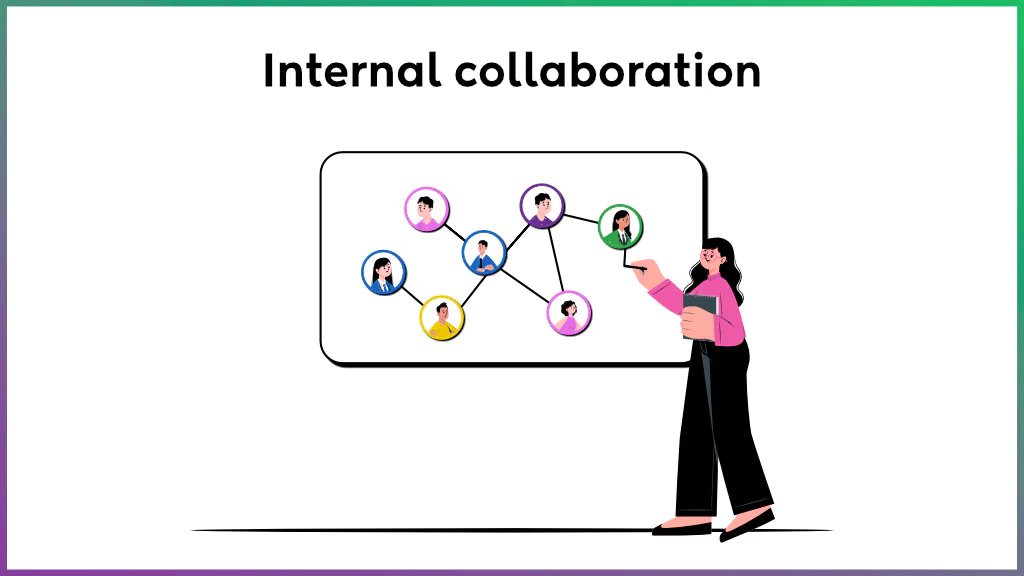
Internal collaboration is the process through which individuals, teams, departments, and other units within an organization work together to achieve common goals. It involves communication, coordination, and knowledge sharing among members inside an organization.
Effective internal collaboration improves team productivity, decision-making, strengthens teamwork and problem-solving, reduces duplication of effort, and improves alignment between departments by enabling employees to share information and coordinate work more efficiently.
A study conducted by East Tennessee State University found that 93.8% of respondents agreed or strongly agreed that internal communications systems were vital.
In internal collaboration, information is shared both formally and informally.
- Formal practices generally include structured meetings, defined workflows, and digital collaboration tools. These mechanisms ensure clarity, accountability, and a consistent flow of information.
- Informal collaboration, by contrast, happens through spontaneous exchanges, quick problem-solving conversations, unstructured feedback, or ad hoc knowledge sharing. These informal relationships and interactions often make up for the gaps left by formal systems.
Internal collaboration occurs between people in the same departments.
For example, two developers working on the same project, a marketing and sales team collaborating on a new campaign, or a dev and QA team collaborating on code.
To sum up, internal collaboration is the mechanism that allows organizations to stay adaptive, innovative, and resilient in an environment where challenges demand cross-functional solutions. Without it, even the smartest people and the best tools work in silos.
2. External collaboration
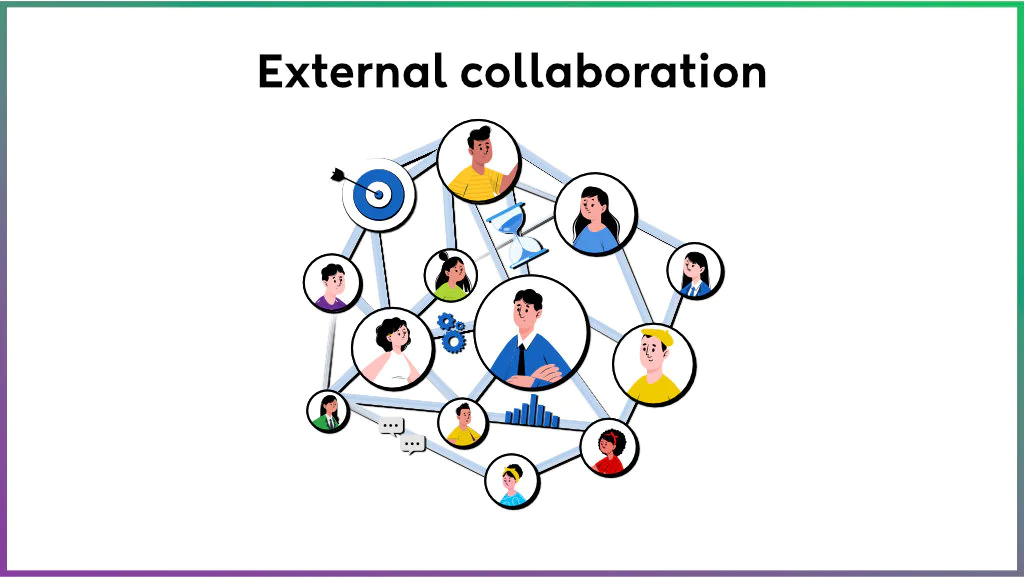
External collaboration is the process of organizations engaging with entities outside their boundaries. These include suppliers, customers, competitors, research institutions, and other external stakeholders.
Its main objective is to innovate, explore new opportunities, solve complex problems, and co-create value by sharing talents, knowledge, and resources.
When executed well, it gives organizations access to ideas and capabilities beyond their own. It creates a mindset shift that defines the resilient businesses today.
A 2022 study published in Nature’s Humanities and Social Sciences Communications journal on the impact of external collaboration suggests that vertical collaboration (with suppliers/customers) and horizontal collaboration (with competitors) positively affect a firm’s research and development intensity, which in turn leads to improved growth.
External collaboration requires clear agreements, trust, and systems that make information sharing safe and efficient.
Legal frameworks like NDAs and data-sharing protocols set boundaries, and collaboration platforms help teams work together in real time.
3. Strategic collaboration
Strategic Collaboration is a long-term partnership between two or more organizations that come together to achieve mutually beneficial outcomes. Commonly, companies, startups, research institutions, and competitors participate in strategic collaboration.
The participants in such collaborations are often companies, startups, research institutions, or even competitors who recognize that combining their unique strengths can create entirely.
It creates new opportunities for entering new marketing, developing innovative solutions, and producing services that generate value in ways that would be impossible independently.
Strategic collaboration focuses on building new capabilities, accessing new customer segments, and creating new business models, instead of immediate cost savings or efficiency gains.
The success is measured by long-term strategic outcomes, such as market position, competitive advantage, or the creation of new options for future growth.
Because these results take time to develop, the collaboration typically spans multiple years, requiring patience, sustained trust & investment, and ongoing adaptation.
4. Business collaboration
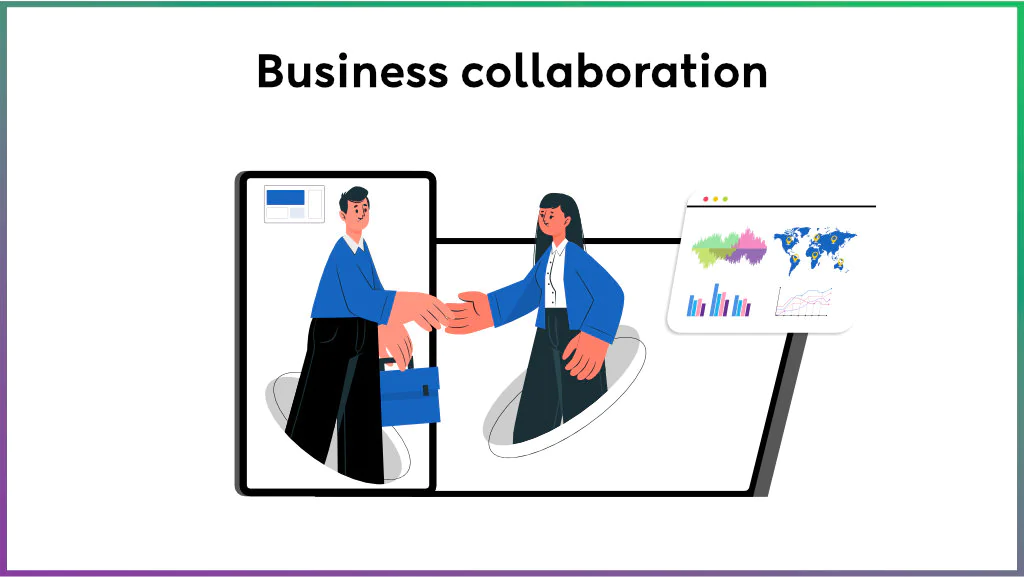
Business collaboration is the partnership between two or more independent organizations that work together to improve efficiency, optimize operations, or achieve shared commercial objectives.
Participants include companies, nonprofits, startups, or public institutions. It focuses on leveraging each partner’s strengths and resources rather than developing entirely new capabilities.
Unlike strategic collaborations, it emphasizes coordination and mutual benefit within established frameworks, rather than long-term transformative change.
The success of business collaboration is evaluated through operational metrics such as cost savings, revenue growth, process efficiency, and timely delivery.
5. Knowledge collaboration
Knowledge collaboration is the process of employees, teams, or organizations sharing information, skills, ideas, and experiences for decision-making, problem-solving, and learning.
It helps solve complex problems, innovate, and build new frameworks of understanding.
Knowledge collaboration takes place through discussions, documentation, training sessions, shared databases, and team meetings. It ensures that valuable information is accessible and not limited to individual employees or isolated teams.
Effective knowledge collaboration improves innovation, efficiency, and decision-making because employees can learn from one another and apply shared expertise to their work.
For example: A software development team maintains a shared knowledge base where developers document coding practices, troubleshooting methods, and technical solutions. Team members use this information to solve problems quickly and maintain consistency across projects.
6. Client collaboration
Client collaboration is the process of businesses and their clients actively working together to improve outcomes, co-create value, and deepen the impact of a service or solution.
Organizations collaborate with clients to understand expectations, gather feedback, share updates, and improve output throughout the work.
It involves actively engaging clients throughout a project or process rather than limiting communication to final deliverables.
Collaborating with clients includes meetings, progress reviews, shared project tools, brainstorming sessions, and ongoing communication channels that help maintain transparency and alignment between both parties.
7. Cross-functional collaboration
In cross-functional collaboration, people with different skills, knowledge, and perspectives from different departments come together to work on a complex problem.
It commonly involves departments such as marketing, sales, product development, operations, customer support, and human resources.
When done effectively, it improves decision-making, innovation, identifies new opportunities, and improves organizational efficiency.
However, when not done clearly, differences in priorities, goals, terminology, or work styles can create challenges.
8. Cross-team collaboration
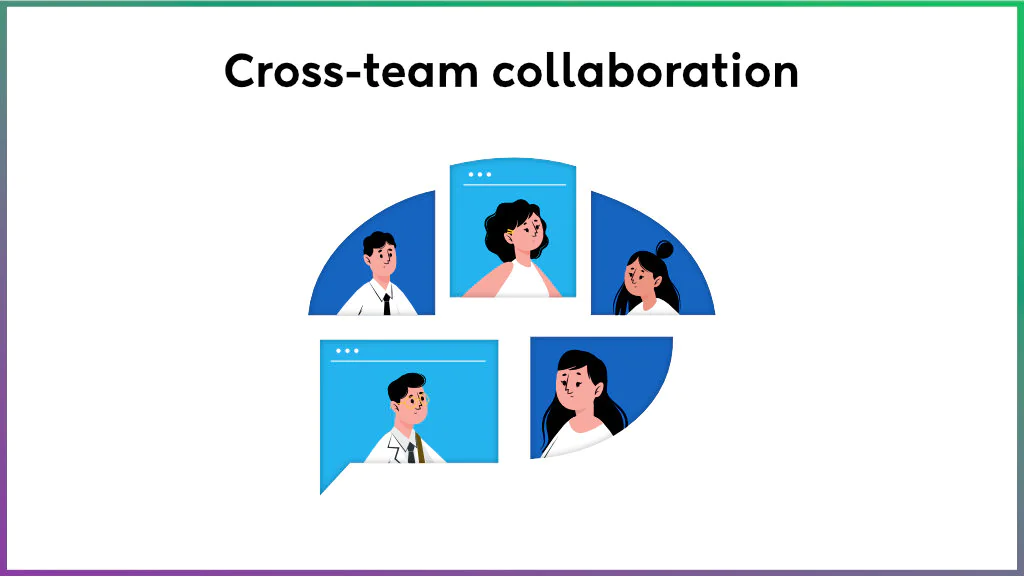
Cross-team collaboration is the process of two or more teams working together to achieve a common goal or solve a problem that requires shared effort and expertise.
It enables these teams to coordinate their activities, share information, and align work to achieve outcomes that cannot be accomplished effectively by a single team alone.
Unlike cross-department collaboration, cross-team collaboration can occur between teams within the same department or across different departments.
Effective cross-team collaboration improves productivity, decision-making, and project outcomes by bringing together diverse skills and perspectives. It helps teams share resources, avoid duplicated effort, and resolve issues more efficiently.
For example: A software development team collaborates with a quality assurance (QA) team to release a new application feature. By working together throughout the process, both teams help ensure a high-quality product release.
9. Project collaboration
Project collaboration is the process of individuals or teams working together on a temporary initiative while sharing responsibilities, information, and resources to achieve specific objectives.
It involves communicating regularly, sharing updates, exchanging ideas, and working with team members, teams, and departments on tasks according to project requirements.
It helps teams identify issues early, make informed decisions, and ensure that projects are completed efficiently and on schedule.
However, poor collaboration can lead to communication gaps, delays, duplicated effort, and missed project objectives.
10. Document Collaboration
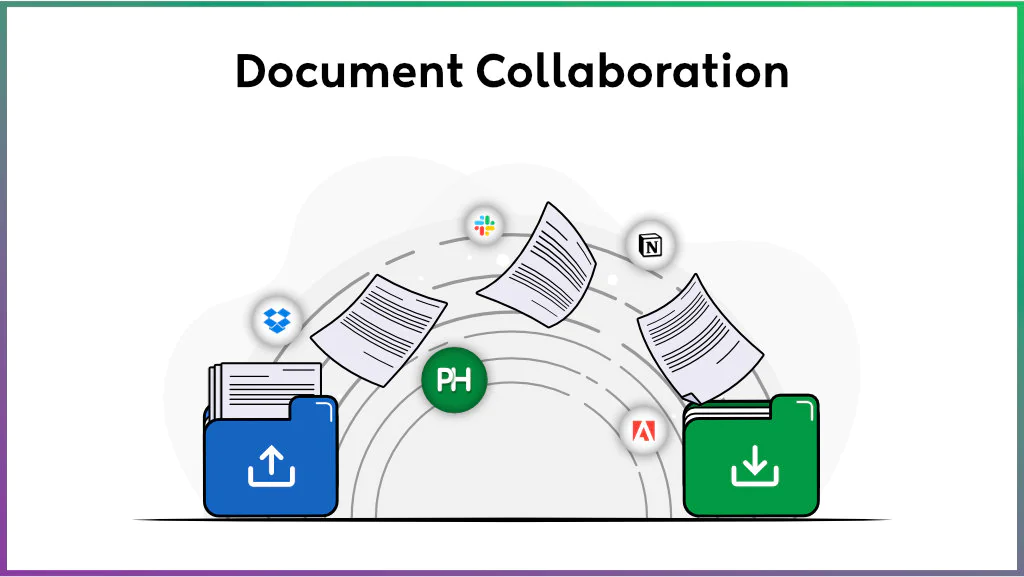
Document collaboration is the process in which multiple individuals work together to create, edit, review, and approve a shared document.
It improves accuracy, efficiency, and consistency by allowing multiple contributors to work on the document without creating conflicting versions.
Instead of working on separate copies, teams use shared documents that allow everyone to access the latest document version, contribute, and track changes.
Document collaboration is supported by cloud-based tools such as Google Docs, Microsoft Word Online, and collaborative content management systems like ProofHub.
They offer features such as simultaneous editing, commenting, version control, and document sharing.
11. Content collaboration
Content collaboration is the coordinated effort of multiple contributors (writers, editors, designers, marketers, and subject-matter experts) working together to create, edit, and distribute content to achieve objectives.
It enables teams to collaborate on the full content lifecycle, from ideation and planning to creation, review, and publication.
Teams work collaboratively on brainstorming ideas, conducting research, reviewing and editing, sharing feedback, and approving final versions to improve content quality.
It helps ensure accuracy, consistency, and alignment with brand guidelines, business objectives, and audience needs.
Organizations typically use content management systems, shared documents, and collaboration tools like ProofHub to coordinate these activities.
12. Marketing collaboration
Marketing collaboration is the joint effort of the teams, partners, and cross-disciplinary stakeholders to execute marketing campaigns that align with business goals.
It brings together individual expertise from different disciplines such as content, design, SEO, analysts, sales, and product to achieve marketing objectives.
Effective collaborative marketing helps improve marketing strategy, maintain consistency across channels, campaign quality, and overall performance.
For example: A company is launching a new product. Before launching the marketing campaign, the marketing team collaborates with the product team to understand the features, the sales team to identify the pain points, and the design team to create promotional materials. Together, they develop a marketing campaign that effectively reaches the right audience.
13. Design collaboration
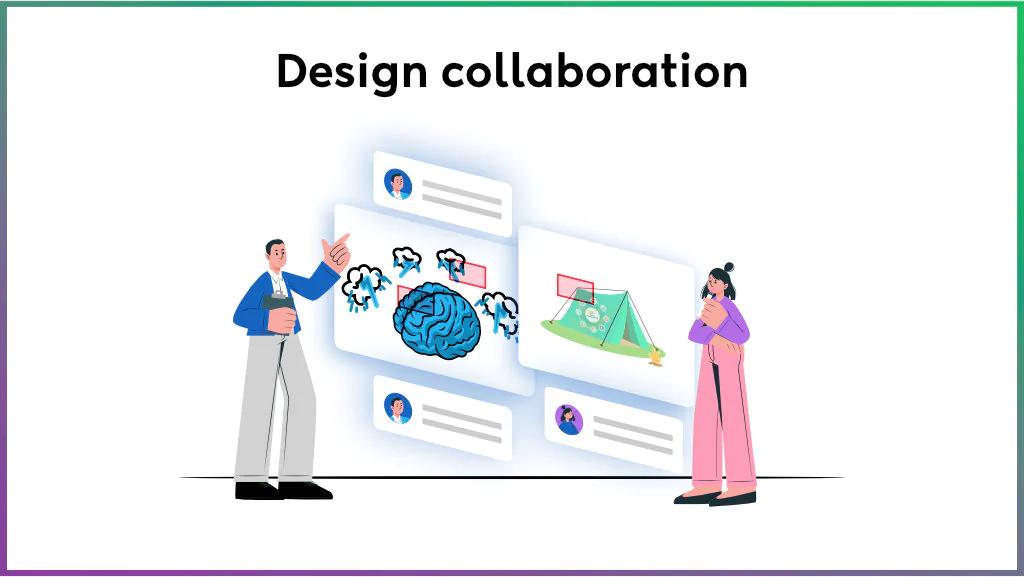
Design collaboration is a process of co-creating solutions with other stakeholders to develop, refine, and deliver a design that meets the project objectives.
It improves efficiency by reducing misunderstandings between designers and stakeholders, streamlining feedback processes, and minimizing rework.
Collaborating involves exchanging ideas, feedback, and expertise throughout the design process with team members such as product managers, marketers, clients, and users to ensure visual quality.
Teams collaborate through brainstorming sessions, design reviews, prototyping, feedback cycles, and iterative improvements.
Contributors share concepts, comment on designs, track revisions, and maintain alignment through collaboration tools.
14. Remote collaboration
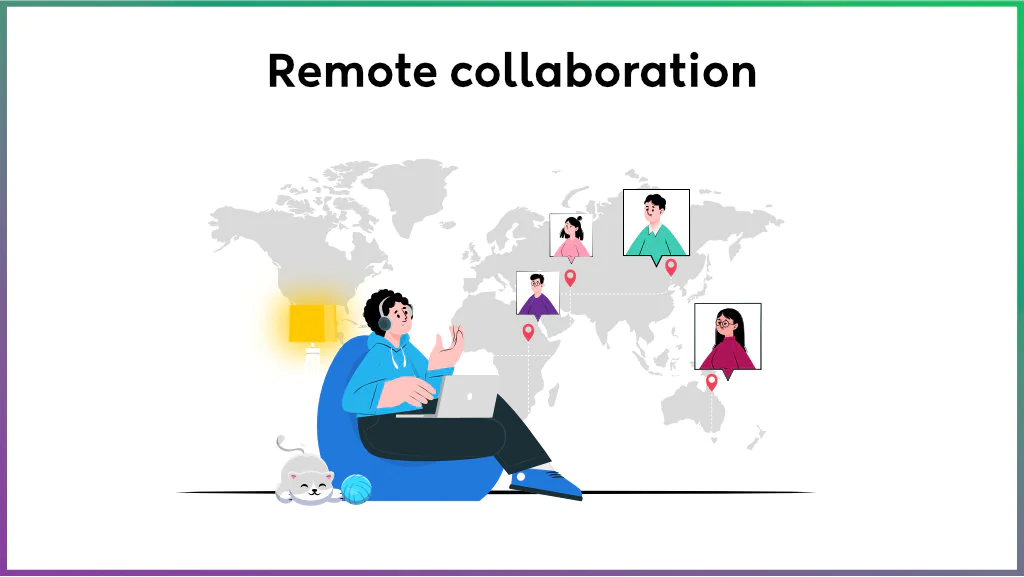
In remote collaboration, individuals or teams contribute to a project or task from distinct locations.
It enables employees to coordinate work, communicate, share information, and complete tasks without being physically present in the same workplace.
Teams use tools such as video conferencing platforms, team messaging applications, project management software, cloud storage systems, and shared documents to stay connected and collaborate effectively.
Effective remote collaboration requires participants to take ownership of both their tasks and their visibility.
For example, a remote team member responsible for a campaign asset might receive a task with a deadline, reference documents, and a feedback thread in a team collaboration platform. After submitting the draft, they tag relevant reviewers, see changes requested, and deliver revisions without needing a live call. This allows teams to make decisions in real-time, maintain transparency about campaign progress, and solve problems quickly without needing to be in the same office.
15. Virtual collaboration
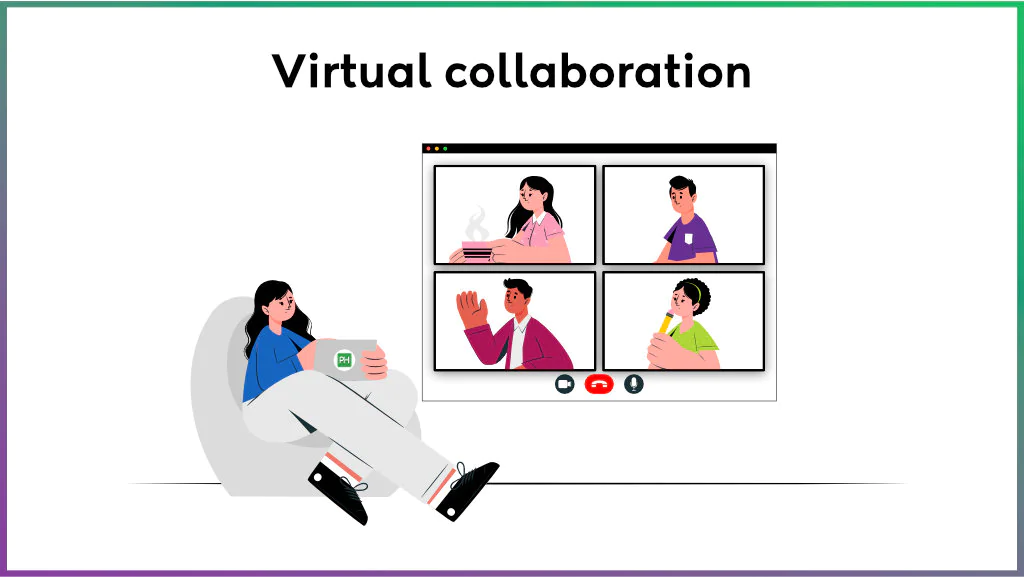
Virtual collaboration enables teams to work together through digital tools, regardless of whether team members are physically co-located or distributed. Tasks, information, and communication are done through digital platforms.
It enables people across locations and time zones to align, communicate, and work on shared goals using online tools such as collaboration platforms, video conferencing, shared workspaces, instant messaging, and cloud platforms.
Digital tools are key to virtual collaboration. They allow teams to track task progress and deadlines, share files, provide feedback, and centralize all communication.
The system becomes the team’s shared brain, reducing friction and improving responsiveness.
16. Hybrid collaboration
Hybrid collaboration is the process of coordinating work between in-office and remote teams to achieve shared goals.
It enables teams to collaborate effectively regardless of their physical location. Team members work flexibly either from the office or remotely, interacting both face-to-face and with digital collaboration tools.
Successful hybrid collaboration requires clear communication, transparency, and inclusive collaboration that provides equal access to information to team members.
Hybrid collaboration can improve operational efficiency by enabling teams to work asynchronously and across locations.
However, organizations may face challenges such as communication gaps, unequal participation, and difficulties in maintaining team coordination if collaboration is not designed carefully.
17. Real-time collaboration
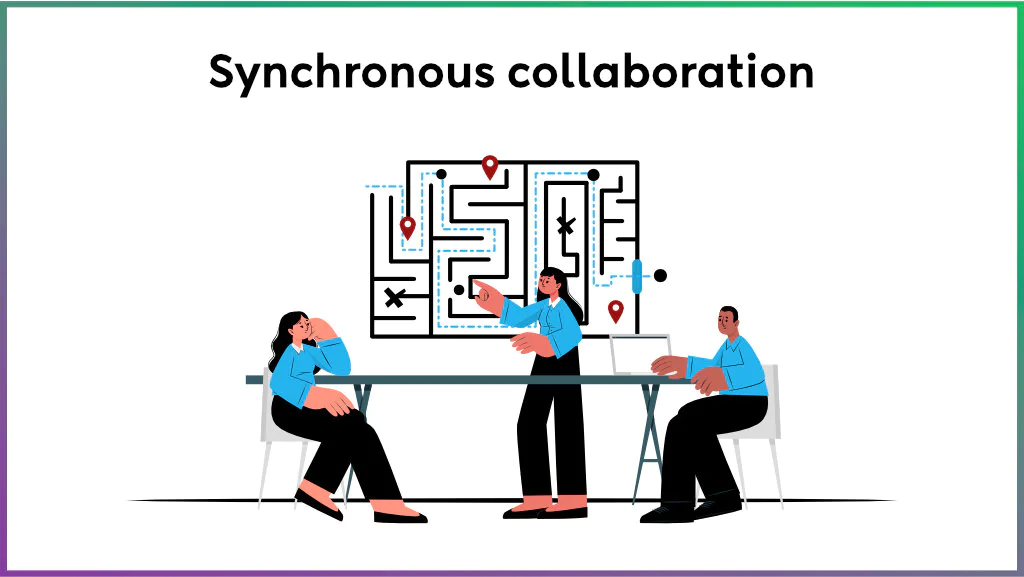
Real-time collaboration is the synchronized participation and collaboration between team members on different projects, tasks, files, or documents where they communicate and share feedback, ideas, and information instantly, regardless of geographical boundaries.
Real-time (synchronous) collaboration is most effective for teams that need immediate feedback and response.
It is suitable for brainstorming sessions, crisis response, fast decision cycles, or nuanced discussions where teams need to collaborate in real-time.
However, poorly structured synchronous collaboration often suffers from redundancy, decision fatigue, or dominance by a few voices. When communication exceeds a group’s capacity to process it effectively, performance suffers.
18. Asynchronous Collaboration
Asynchronous collaboration is the process of individuals or teams working together towards a common goal without participating or working at the same time.
It allows teams to communicate, update, and work across time zones and schedules. Instead of relying on real-time interactions, employees use digital tools such as shared documents, project management platforms, messaging applications, and email to communicate and collaborate.
Asynchronous collaboration is particularly useful for distributed teams working across different time zones or flexible work schedules.
Team members can review updates, provide feedback, complete tasks, and make decisions independently while maintaining visibility into project progress.
19. Cloud collaboration
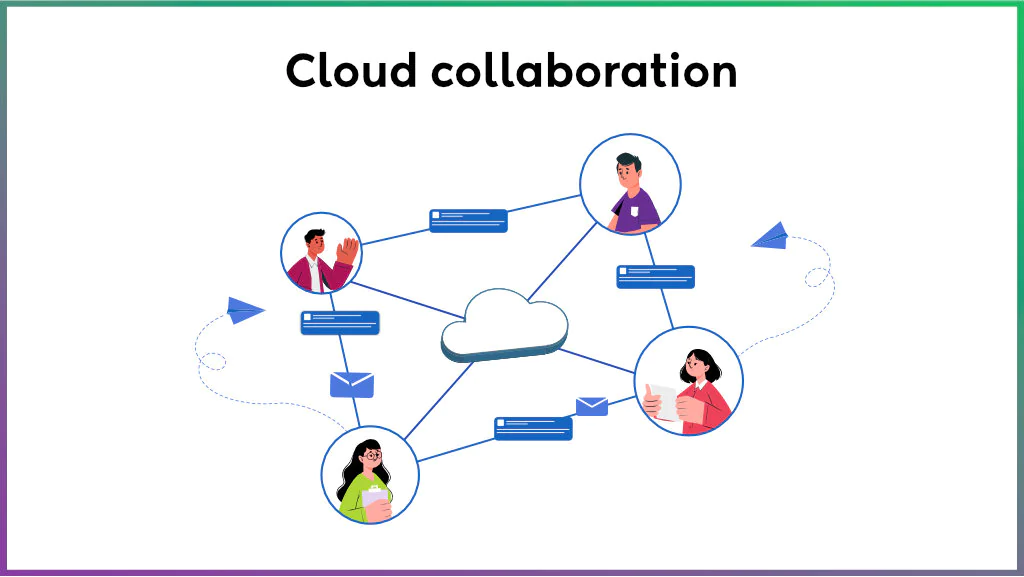
Cloud collaboration is the process of individuals or teams working together using cloud-based platforms to communicate, access, share, and manage files, information, and workflows.
It enables teams to access the workspace by using cloud-based collaboration tools such as ProofHub, Google Workspace, etc. They allow teams to access, create, edit, and share information instantly regardless of their location.
Cloud collaboration improves accessibility, productivity, and team coordination. It eliminates the need to store files on local devices and enables team members to access updated versions of information.
20. Interprofessional collaboration
In interprofessional collaboration, professionals from different disciplines within a specific domain work together to achieve a common outcome.
It brings together individuals with specialized knowledge and skills to address complex tasks or challenges.
It is common in environments such as healthcare, education, public policy, or social services, where expertise from different professions is necessary to accomplish objectives.
It promotes communication, coordinated decision-making, and shared responsibility among professionals.
For example: In a hospital, doctors, nurses, pharmacists, and physical therapists collaborate to develop and implement a patient’s treatment plan. Each professional contributes specialized expertise to ensure that the patient receives comprehensive and coordinated care.
21. Interdisciplinary collaboration
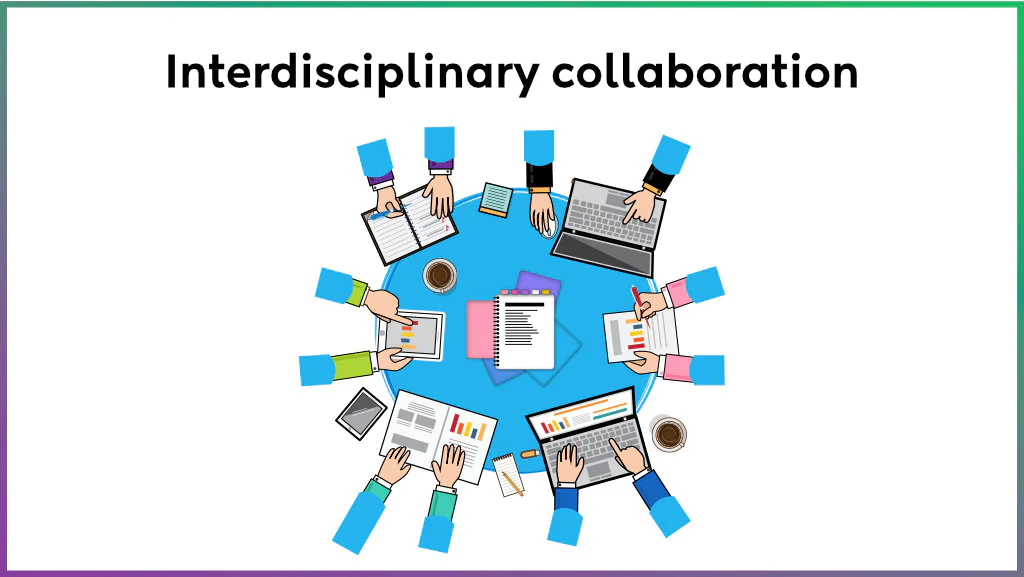
Interdisciplinary collaboration is the process of individuals or teams from academic disciplines working together to solve complex problems, drive innovation, or produce new insights.
It integrates knowledge, methods, and perspectives from different disciplines to address challenges that require expertise from multiple fields.
It is commonly used in research, product development, healthcare, education, sustainability projects, and innovation initiatives where diverse expertise is required.
Unlike interprofessional collaboration, interdisciplinary work brings together different domains altogether. It requires contributors to go beyond their disciplinary zones, often learning each other’s frameworks and logic. This makes epistemological flexibility and shared learning central to success.
For instance, a data scientist working with an urban planner, a behavioral psychologist collaborating with a UX designer, or a climate scientist engaging with an economist all reflect the kind of boundary-spanning work that defines interdisciplinary teams.
Which factors determine the right type of collaboration for a team?
Selecting the appropriate type of collaboration depends on how the team is structured, what the task demands, and the broader organizational environment. The goal is to align collaboration style with execution realities, so teams stay coordinated without unnecessary overhead.
Key factors include:
- Nature of the task: Is the work routine or exploratory? Time-bound or ongoing? Complex, ambiguous projects benefit from interdisciplinary or cross-functional collaboration, while repetitive workflows may require simpler coordination models.
- Diversity of expertise: The more varied the skill sets involved, the more structured the collaboration must be. Interdepartmental or interprofessional collaboration helps ensure each domain’s contribution is integrated meaningfully.
- Team distribution: Co-located teams can rely on synchronous or informal collaboration. Distributed teams—especially across time zones—require asynchronous, virtual, or hybrid models to stay aligned.
- Organizational culture and structure: Flat, flexible companies may thrive on informal, agile collaboration. Hierarchical or process-heavy environments often need formal governance, cross-department steering groups, or well-defined workflows.
- Technology infrastructure: The tools available determine what’s possible. Cloud platforms, communication apps, and project management systems (like ProofHub) enable distributed and real-time collaboration across boundaries.
- Level of interdependence: If teams are heavily reliant on one another to complete tasks, tighter integration is required. Loosely coupled teams may only need periodic alignment.
The ideal collaboration model strikes a balance between autonomy and coordination, tailored to how people work, what they’re trying to achieve, and what systems are in place to support them.
Can an organization use multiple types of collaboration at once?
Yes, most modern organizations operate in layered, dynamic environments where no single collaboration model is sufficient. Different teams, projects, and departments often require different types of collaboration to meet their unique goals.
For example, while a product development team might rely on cross-functional collaboration to build new features, the marketing and sales departments may engage in cross-department collaboration to align go-to-market efforts. Meanwhile, a customer support team may use asynchronous collaboration tools to handle ticket escalations across shifts and time zones.
What are the five principles of effective collaboration?
The five principles of effective collaboration are shared purpose, defined roles and expectations, open communication, mutual respect, and psychological safety and accountability.
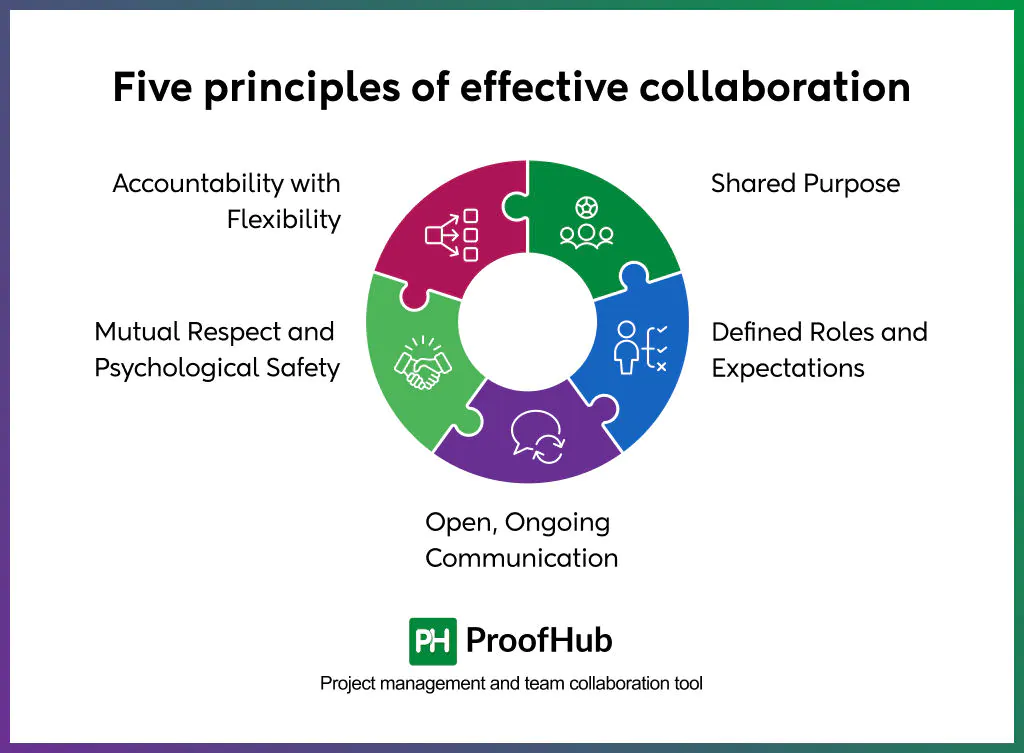
1. Shared purpose: Everyone involved should understand and align with the core objective. Without a unifying goal, coordination becomes fragmented.
2. Defined roles and expectations: Clarity about who’s responsible for what reduces overlap, confusion, and conflict, especially in cross-functional or matrixed teams.
3. Open, ongoing communication: Teams must create space for honest dialogue, feedback, and updates. This includes both formal check-ins and informal sharing.
4. Mutual respect and psychological safety: Each team member’s perspective should be valued. When people feel safe to speak up or challenge ideas, better outcomes follow.
5. Accountability with flexibility: Individuals follow through on commitments but adapt as circumstances change, balancing reliability with responsiveness.
Together, these principles foster alignment, trust, and adaptability-the three core ingredients of real collaboration.
What are the important skills required for effective collaboration?
Effective collaboration depends not just on tools or processes, but on the interpersonal, cognitive, and collaboration skills that make joint work productive. Key skills include:
- Active listening: to fully understand others’ perspectives before responding.
- Clear communication: to articulate ideas, ask questions, and surface blockers without confusion.
- Empathy: to navigate different work styles, needs, and emotional cues.
- Adaptability: to stay flexible when plans shift or priorities change.
- Constructive feedback: to challenge ideas without creating friction.
- Decision-making and prioritization: to move discussions toward outcomes.
Together, these skills create a climate of mutual trust, responsiveness, and clarity—which is essential for collaboration to work consistently, especially under pressure.