
Knowledge collaboration refers to the deliberate coordination of people, teams, and organizations to create, contextualize, refine, share, and apply knowledge by combining their diverse perspectives and expertise. Thereby building a shared understanding and solutions that cannot be achieved alone.
When teams collaborate on knowledge, they translate individual strengths and perspectives into shared organizational intelligence that supports faster problem-solving, more confident decision-making, and improved cross-functional alignment.
Knowledge collaboration occurs differently depending on how knowledge is created, shared, and used. It is explicit when teams collaborate on documented knowledge, tacit when knowledge comes from experience and judgment, interpretive when information requires collective meaning-making and alignment, and applied when shared understanding is translated into coordinated action.
In practice, knowledge collaboration is an intentional and repeatable process. It progresses through stages in which knowledge is discovered, captured, shared, discussed, applied, and regularly updated to remain relevant and reliable.
Knowledge collaboration often breaks down due to human hesitation, weak documentation habits, siloed teams, and disconnected tools. These barriers prevent knowledge from flowing across the teams, directly impacting execution quality, decision accuracy, and long-term performance.
However, by establishing a single source of truth, clear ownership, standardized formats, version control, and purposeful application, organizations sustain performance, reduce individual dependency, and enhance the collective capability to ensure knowledge remains effective at scale.
What is knowledge collaboration?
Knowledge collaboration is the structured, continuous process in which individuals and teams create, share, refine, and apply knowledge by contributing their perspectives, experience, & expertise, and by building on one another’s insights to solve work-related problems.
Knowledge collaboration focuses on applying shared knowledge to produce actionable outcomes, not merely exchanging information. Teams learn together, contribute to shared knowledge bases, interpret insights collectively, and integrate diverse expertise into coordinated action. This ensures knowledge moves from individual awareness to organizational use, supporting informed decisions when needed.
It operates through structured discussions, formal exchanges, brainstorming sessions, documented contributions, and continuous feedback loops. The streamlined mechanism captures insights and prevents knowledge silos, ensuring information is applied rather than remaining isolated or unused.
What are the benefits of knowledge collaboration?
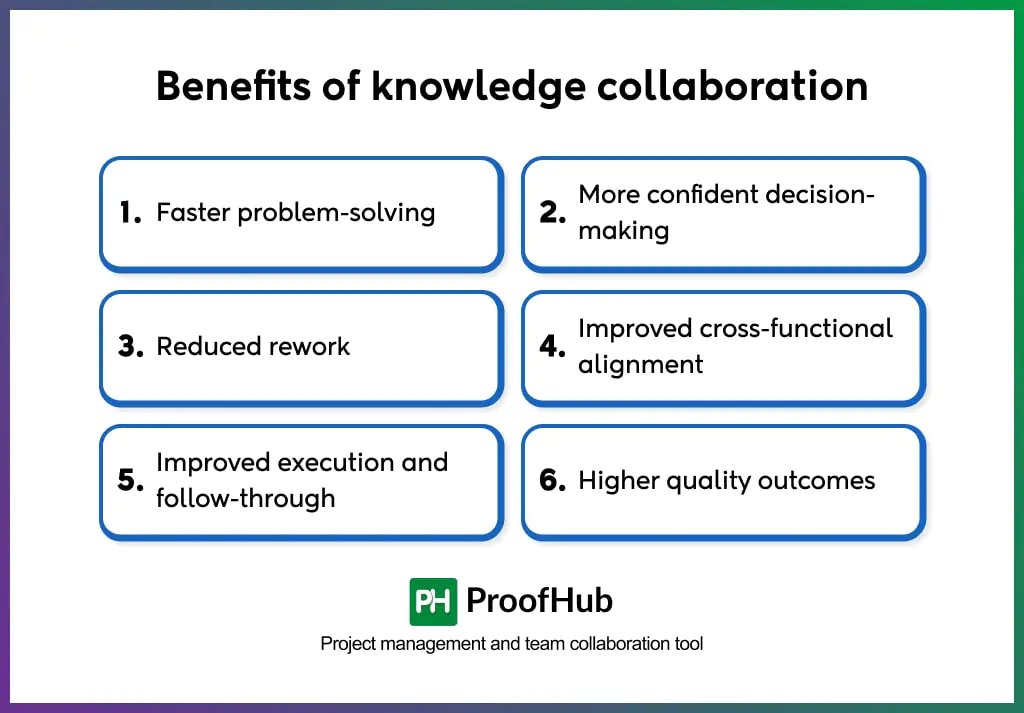
Knowledge collaboration delivers measurable benefits, including faster problem resolution, smarter decision-making, reduced rework, improved team alignment, effective execution, and higher-quality outcomes.
Here are some of the key benefits of knowledge collaboration:
- Faster problem-solving: Teams resolve problems faster when they collaborate using validated past solutions, decision context, and documented patterns. Shared access to this knowledge helps teams diagnose issues faster, reduce back-and-forth, and take immediate corrective actions.
- More confident decision-making: Teams make decisions with greater clarity when they are built on collective expertise, validated knowledge, and shared context rather than individual biases, guesswork, or isolated viewpoints. This leads teams to make more decisive, informed choices that are easier to justify and made with greater confidence.
- Reduced rework: Fewer revisions are required when teams share knowledge and context from the start. With past decisions, errors, and solutions documented, teams avoid redoing work when information is outdated or incomplete.
- Improved cross-functional alignment: Teams work more effectively when they share a clear understanding of goals, constraints, and dependencies. Also, when knowledge is shared openly across roles and departments, and information is withheld, it reduces misinterpretation, misunderstandings, and siloed execution.
- Improved execution and follow-through: Teams execute work more effectively when knowledge is shared, responsibilities are visible, and decisions are documented. When everyone knows what needs to be done, why, and by whom, work progresses without repeated clarifications, realignments, and reapprovals.
- Higher-quality outcomes: Teams deliver more accurate and reliable results when they align on established expectations, share knowledge across systems, and co-design execution and validation methods. The practice exposes gaps, integrates diverse viewpoints, and generates new information to refine solutions earlier and deliver work that meets expectations with greater precision.
What are the types of knowledge collaboration?
Knowledge collaboration is classified into four types based on how knowledge is created, understood, and applied in work contexts: explicit, tacit, interpretive, and applied.
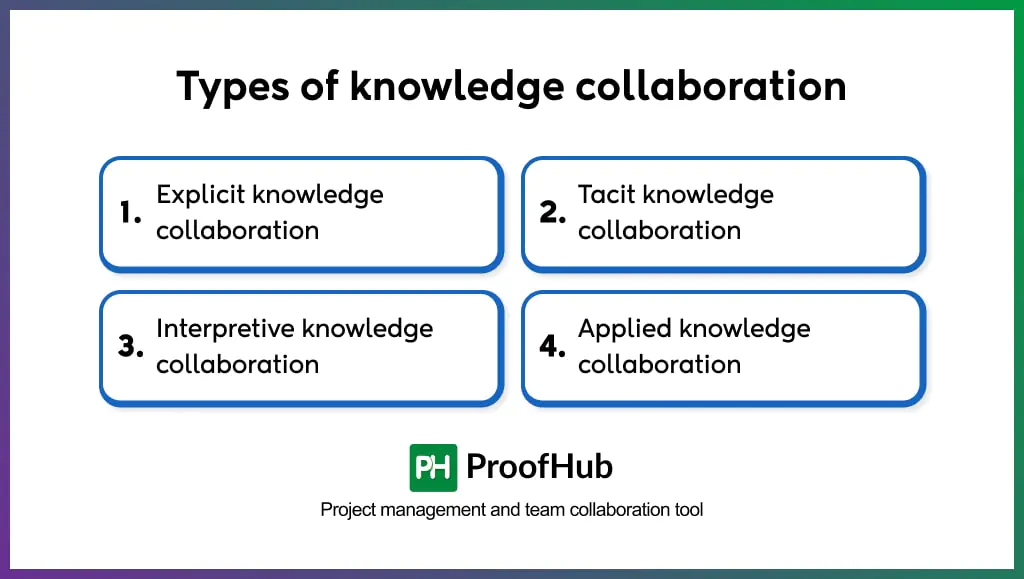
1. Explicit knowledge collaboration: Explicit knowledge collaboration focuses on the knowledge that is already known. The knowledge that can be easily articulated, documented, structured, shared, and transferred.
Teams collaborate on knowledge that is captured in SOPs, policies, wikis, manuals, reports, facts, principles, and shared databases to ensure consistent understanding, accessibility, and reuse. This type of collaboration supports accumulation, standardization, and continuity of knowledge, reducing dependency on individual memory and enabling reliable execution at scale.
2. Tacit knowledge collaboration: Tacit knowledge collaboration focuses on building on each other’s experience-based understanding and is often difficult to document.
Teams collaborate by leveraging knowledge from personal experience, judgment, domain expertise, and contextual insights, exchanged through mentoring, discussions, reviews, and feedback loops. This type of collaboration supports structured extraction and gradual conversion of individual expertise into shared organizational knowledge.
Companies like Facebook and Shopify host internal hackathons where employees from diverse backgrounds contribute their tacit skills, lived experience, and contextual judgment to translate them into explicit knowledge.
3. Interpretive knowledge collaboration: Interpretive knowledge collaboration focuses on collectively interpreting information and insights to build shared understanding.
Teams collaborate by interpreting data, discussing assumptions, refining meaning, and aligning perspectives through dialogue and shared analysis before any action is taken. This type of collaboration ensures teams act from a shared understanding of the knowledge, improving alignment and accuracy in the final results.
4. Applied knowledge collaboration: Applied knowledge collaboration focuses on translating shared knowledge into coordinated actions to solve work-related issues and make informed decisions.
Teams collaborate by applying knowledge gained from documented guidance, learned patterns, and experience-based judgment directly to workflows, processes, and execution practices. This type of collaboration ensures knowledge influences both operations and outcomes, enabling faster execution and sustained performance.
What are the key stages of the knowledge collaboration process?
Knowledge collaboration is a continuous, iterative process that ensures knowledge is discovered, contextualized, understood, applied, reused, and sustained to support consistent performance.
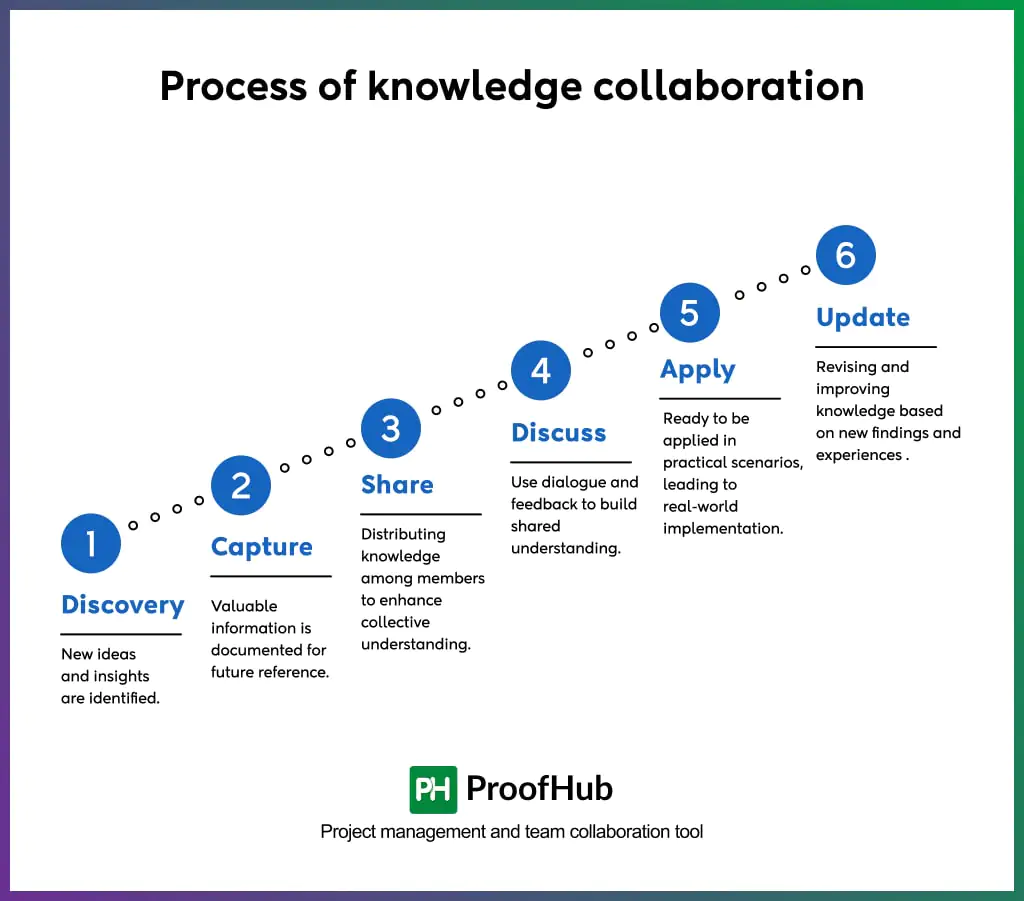
Here are certain key stages of the knowledge collaboration process:
- Discovery: Discovery often involves identifying not just the knowledge, but also the relevant knowledge holders and stakeholders. Teams identify patterns, assess risks and opportunities, and learn lessons through brainstorming, discussion, observation, experimentation, and hands-on experience.
- Capture: Document knowledge generated through collaborative practices to ensure reliability. This includes capturing insights, decisions, context, solutions, and learning into structured forms such as guidelines, wikis, SOPs, discussions, and shared notes and documents.
- Share: Sharing ensures the right knowledge is distributed among teams and across roles at the right time. Teams make information accessible through intentional handoffs, shared systems, or collaborative spaces while maintaining relevance, clarity, and appropriate access without creating overload, confusion, or misuse.
- Discuss: Discussion focuses on building shared understanding and validating knowledge before action is taken. Teams review information, question assumptions, align perspectives, refine interpretations, and reconcile different viewpoints to ensure clarity and confidence in how the knowledge is understood and applied.
- Apply: Application is the use of shared knowledge to carry out coordinated action. Teams use validated insights and confirmed understanding to guide workflows, solve problems, execute tasks, improve processes, and make decisions that strengthen overall effectiveness and execution.
- Update: Updating ensures knowledge remains accurate, relevant, and valuable through ongoing collaboration. Teams revisit existing knowledge, address gaps, and incorporate new insights periodically to refine context, improve reliability, and ensure decisions are based on the most current and credible information.
What are the challenges of knowledge collaboration?
Knowledge collaboration fails due to employee hesitation, information silos, outdated knowledge, poor documentation, communication gaps, and fragmented systems that prevent knowledge from being shared, understood, and used effectively.
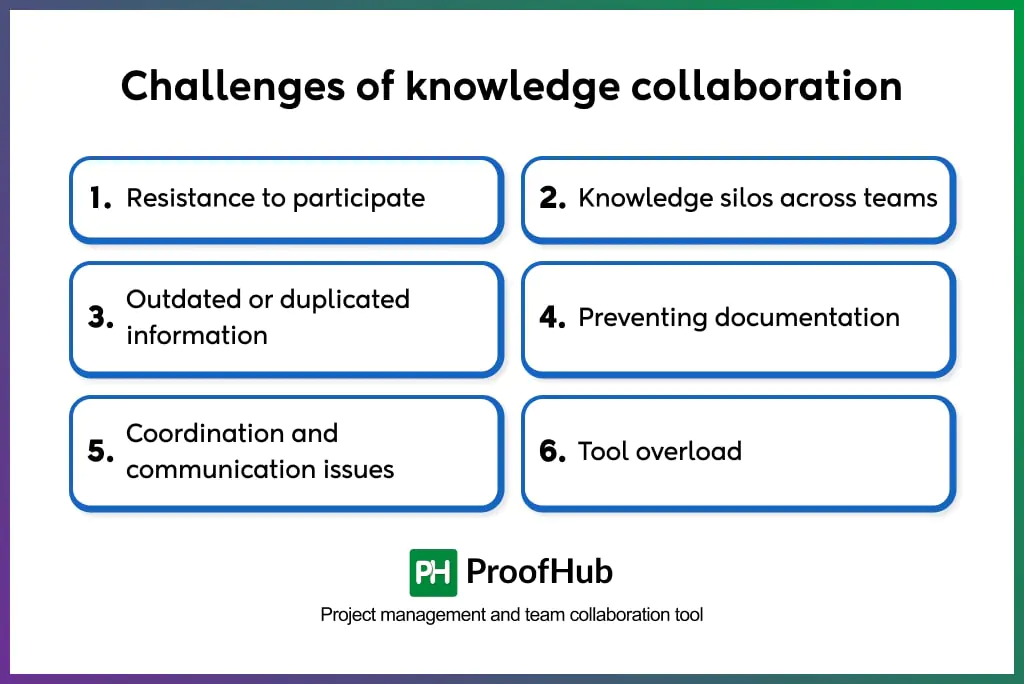
- Resistance to participate: Employees hesitate to share knowledge due to a lack of trust, fear of losing relevance, low psychological safety, or the belief that their input may be ignored or criticized. When these concerns surface, people keep their insights to themselves, and crucial knowledge remains locked with individuals.
- Knowledge silos across teams: When teams work in isolation, knowledge remains confined to individual roles, functions, or projects. Teams waste time on duplicate work and proceed with different understandings and assumptions, leading to misaligned execution and inconsistent decisions across the organization.
- Outdated or duplicated information: Without clear ownership and version control for knowledge assets, knowledge becomes obsolete, outdated, scattered across tools, or retained only in memory. Teams can’t rely on shared resources, and the risk of errors, rework, and incorrect decisions increases significantly.
- Preventing documentation: Failing to capture decisions, context, and lessons from collaborative meetings, informal conversations, and day-to-day exchanges can lead to valuable insights being lost or forgotten. This undocumented knowledge keeps teams reactive and forces decisions based on incomplete or outdated understanding.
- Coordination and communication issues: Poor coordination and unclear communication across teams increase dependency gaps, delayed handoffs, and misinterpretations. Knowledge gets handed over too late, lacks context, or is intentionally withheld, resulting in misalignments, execution delays, and avoidable tensions among teams.
- Tool overload: Using too many disconnected tools or poorly integrated systems fragments knowledge across platforms. Teams spend excessive time searching across multiple locations and second-guessing where accurate information lives, which discourages adoption of shared-knowledge practices.
Best practices to follow for effective knowledge collaboration
Effective knowledge collaboration happens when all the critical elements, including human, structural, and technological factors, are perfectly aligned to support how knowledge is created, shared, and used.
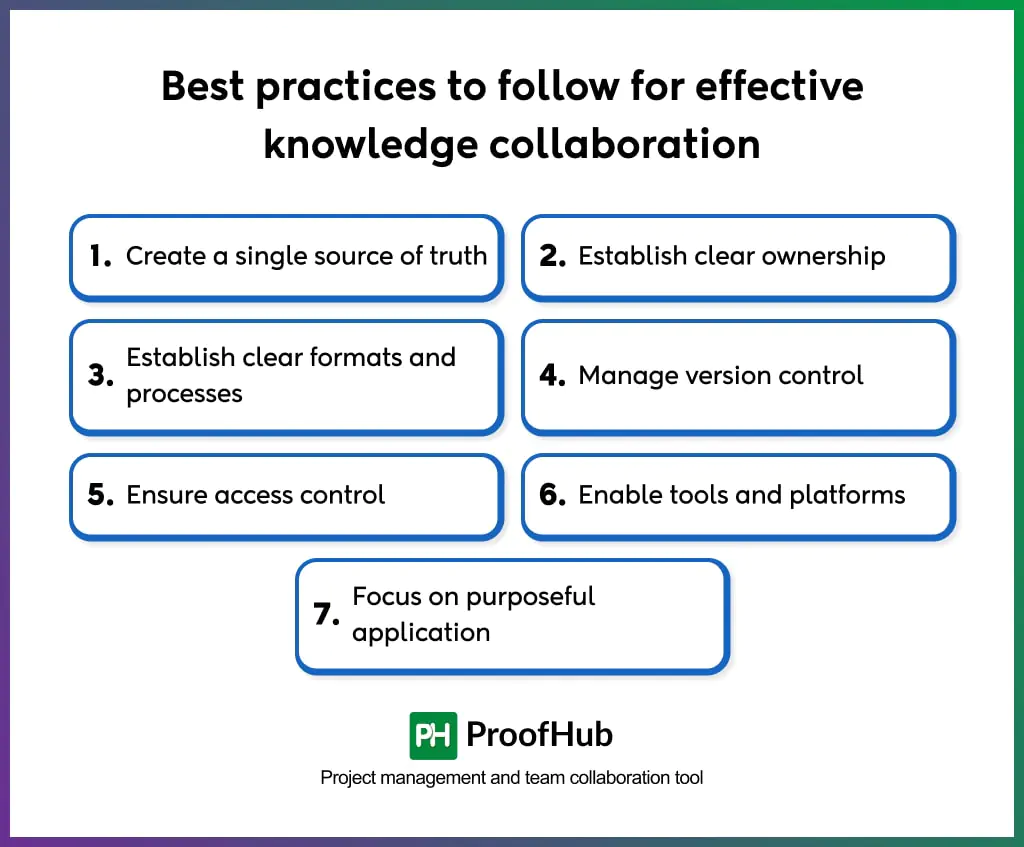
- Create a single source of truth: Limiting the number of places where knowledge lives helps teams operate from a shared understanding of the validated knowledge. This ensures no one is working from their own assumptions, outdated knowledge, or parallel versions, eliminating confusion, misinterpretation, and duplication of work that slows execution.
- Establish clear ownership: To prevent knowledge decay, assign one or more clearly defined owners responsible for ensuring the accuracy, relevance, and timely updates of every knowledge asset. This practice enforces accountability across the knowledge lifecycle while keeping information aligned with current realities.
- Establish clear formats and processes: Using consistent formats and templates makes knowledge easier to categorize, find, understand, and reuse. Standardization reduces the cognitive effort required to manage assets and versions across locations.
- Manage version control: Keeping a clear record of what changed, why, and by whom helps teams stay up to date and aligned. Version control preserves context, prevents accidental overwrites, and ensures everyone works with the most current information.
- Ensure access control: Granting access-based permissions ensures sensitive information is accessible only to those who need it, without compromising its confidentiality. The practice secures responsive knowledge sharing across teams and roles.
- Enable tools and platforms: Use intuitive knowledge management systems, collaboration platforms, or shared drives to centralize and organize knowledge and make it easily accessible. This is especially useful for remote or hybrid teams.
- Focus on purposeful application: Effective knowledge collaboration occurs when knowledge is actively applied in a structured, purposeful manner rather than accumulated as high volumes of information without context or use.
What are the best tools for Knowledge collaboration?
Digital tools such as shared documents, wikis, video conferencing, and collaborative platforms enable people to contribute, refine, and apply knowledge continuously, regardless of location or time zone differences.
Here are different types of knowledge collaboration tools:
- Communication platforms: These tools enable teams to exchange ideas, clarify interpretations, and align understanding through chats, calls, discussions, and real-time walkthroughs. Examples: Slack, Microsoft Teams, Zoom.
- Document and content tools: These tools allow teams to create, edit, organize, review, and refine knowledge without losing context and version history. Examples: Google Docs, Microsoft Word.
- Knowledge management systems: These tools serve as centralized repositories for storing, organizing, and reusing validated knowledge. Examples: Document360, Team wikis.
- Project management tools: These tools connect knowledge with execution by linking tools for discussions, chat, files, proofing, annotation, and updates directly to tasks and workflows. Examples: ProofHub, Trello, ClickUp.
- Collaboration tools: These tools support shared thinking, sense-making, and real-time knowledge creation through whiteboards, screen sharing, and annotations. Examples: Miro, FigJam.
Examples of knowledge collaboration
Knowledge collaboration examples demonstrate how individuals and teams co-create, refine, share, and apply knowledge in real-life scenarios to drive productivity gains and measurable results.
Here are two examples of knowledge collaboration:
1. Knowledge collaboration within a development team
A development team experiences recurring issues in every release. QA documents bugs and default patterns from past sprints, while developers share implementation challenges and technical constraints. The Tech lead reviews the shared knowledge to identify common failure points. During sprint reviews, the team interprets these insights and updates the coding standard to prevent recurrence. The documented learnings are then applied to upcoming sprints, preventing repeated issues and improving release stability.
2. Knowledge collaboration in a cross-functional team project
Cross-functional teams collaborate on a new product feature. The development team aligns internally on feature capabilities, technical constraints, and delivery timelines, and documents these inputs clearly. Based on the sales team’s customer insights, deal-stage feedback, and objections, the Marketing team gathers possible insights through customer research and market context. Entire knowledge is aligned and applied collectively to refine scope, messaging, and enablement assets, ensuring aligned decisions and effective execution.
What is the difference between knowledge collaboration and knowledge sharing?
Knowledge collaboration is a broader concept, while knowledge sharing is a part of it. Where knowledge collaboration focuses on collectively creating, improving, contextualizing, sharing, and applying knowledge to enable better decisions and measurable outcomes, knowledge sharing focuses on distributing knowledge so others can access or reuse it.
| Aspect | Knowledge Sharing | Knowledge Collaboration |
| Definition | The exchange of information, insights, and experiences among individuals or teams | A structured, ongoing process of creating, refining, sharing, and applying knowledge collectively |
| Goal | Make knowledge accessible | Enable better decisions, problem-solving, and results |
| Interaction Type | Mostly one-way or limited back-and-forth | Ongoing, multi-directional interaction |
| Activities | Sharing documents, providing answers, and mentoring | Collective discussions, brainstorming, feedback loops, problem-solving |
| Outcome | Knowledge becomes accessible and available for others to use | Knowledge becomes shared, refined, and usable across the organization |
What prevents employees from sharing knowledge openly?
Employees avoid sharing critical knowledge when they are unclear about how the knowledge will be used, for what purpose, and how it will impact the outcomes. They also withhold information when they fear losing relevance, authority, or control because of their expertise becoming widely accessible.
Low trust in organizational culture further discourages sharing, because teams don’t feel acknowledged or rewarded for their efforts and contributions. Also, fear of being criticized, misinterpreted, or called out for mistakes causes employees to keep insights to themselves.
Organizations can reduce these barriers by clarifying knowledge use, fostering psychological safety, and recognizing shared contributions. Establishing intentional learning-focused norms that emphasize improvement over judgment makes employees more willing to share insights, surface uncertainties, and contribute openly without fear of negative consequences.
How can organizations encourage a culture of knowledge collaboration?
Organizations can foster a culture of knowledge collaboration by deliberately shaping leadership behaviors, organizational practices, and supporting systems so that knowledge collaboration becomes the default way teams work.
- Model the behaviour: Knowledge collaboration strengthens when leaders actively share insights, ask questions, and contribute to shared knowledge workspaces. Visible leadership involvement sets the tone and establishes a behavioral norm for the entire organization.
- Break down silos: Organizations can remove structural, cultural, and functional barriers that isolate teams by encouraging shared goals, cross-functional collaboration, document learning, and open information exchange. Unified objectives and shared systems ensure knowledge remains accessible and reusable rather than confined to individual roles and teams.
- Promote psychological safety: Create an environment where individuals and teams feel safe to share ideas, admit mistakes, ask questions, provide feedback, and question each other’s assumptions without fear of criticism or judgment. Psychological safety enables early knowledge sharing, honest dialogue, and continuous learning.
- Establish clear processes and guidelines: Develop and document protocols for capturing, organizing, updating, reviewing, and sharing knowledge. Well-defined guidelines reduce confusion, prevent inconsistency, and align teams around a common understanding.
- Integrate collaboration into workflows: Knowledge collaboration becomes a sustainable practice when it is deeply integrated into daily routines and execution workflows. Teams capture insights and learnings during discussions and task execution, rather than treating collaboration as a separate activity.
- Provide the right tools and training: Offer intuitive tools and practical training to make knowledge easy to document, access, update, refine, and collaborate on. Ensure tools are simple and easy to adapt, supporting collaboration without inconsistencies or overload.
What is the role of documentation in sustaining knowledge collaboration?
Documentation plays a critical role in preserving, scaling, and sustaining knowledge by converting it into durable and reusable organizational assets. It helps organizations capture experience-based insights, prior decision contexts, and operational learnings, ensuring consistent operations and regulatory compliance.
It ensures consistency and continuity during role changes or employee turnover, retaining critical knowledge within the organization. Documented knowledge also enables teams to collaborate across time zones, schedules, and locations without relying on real-time coordination.