

External collaboration is the process of organizations working with outside partners, such as clients, suppliers, contractors, distributors, research institutions, or even competitors, to achieve shared goals through resource alignment, knowledge exchange, and joint execution.
External partnerships provide access to specialized expertise, advanced technologies, and broader networks, reducing costs, accelerating innovation, diversifying supply chains, and strengthening long-term resilience.
Effective external collaboration requires clear objectives, selected partners with aligned goals, established governance frameworks, standardized communication, and trust for success.
In this article, we discuss what external collaboration is, its benefits, strategies for effective implementation, common challenges, and how to overcome them, along with real-world examples and tools that enable external collaboration.
What is external collaboration?
External collaboration is the process of organizations working with individuals or groups outside their corporate boundaries to achieve shared goals through knowledge exchange, resource alignment, and joint execution.
It involves formal partnerships with vendors, contractors, clients, and industry peers. External collaborations bridge organizational boundaries to create extended networks of value.
Why is external collaboration important?
External collaboration helps organizations maintain competitiveness, innovation, and efficiency with external resources. It gives managers access to expertise, technology, and capacity without building them internally, reducing fixed costs, improving scalability, and enabling faster delivery of products and services.
It drives innovation by introducing external knowledge and diverse perspectives. According to the study “Collaboration with External Organizations and Technological Innovations”, conducted by Dragana Radicic and Jonathan Pinto, collaboration with customers, suppliers, competitors, and Higher Education Institutions (HEIs) significantly improved product and process innovation.
It also reduces risks by diversifying supply chains and avoiding operational bottlenecks. Managers depend on external stakeholders to address specialized research, regulatory requirements, and market expansion, making collaboration essential for long-term stability.
What are the benefits of external collaboration to organizations?
External collaboration boosting innovation, expanding market reach, reducing costs, and strengthening competitive advantage through external expertise, technology, and networks.
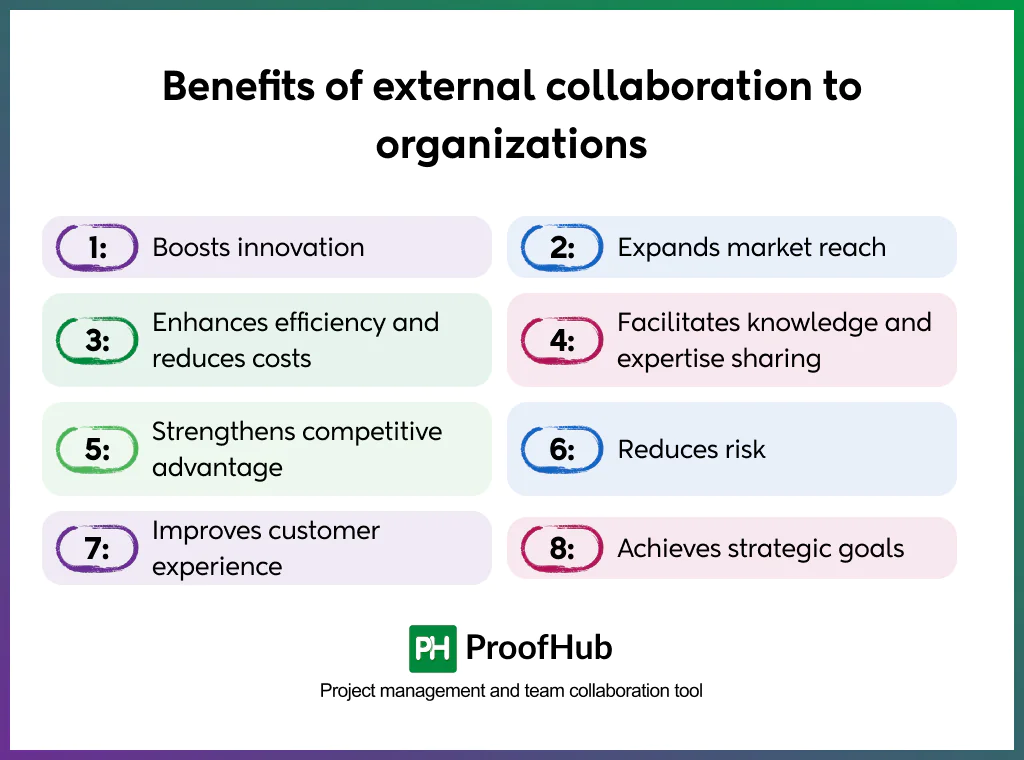
Here is how external collaboration drives organizational success:
- Boosts innovation: Provides access to new ideas, research, and technologies. Diverse perspectives generate better solutions and accelerate adaptation to market changes.
- According to a study “Enhancing Innovation Performance through Business Process Innovation: The Strategic Role of External Collaboration” conducted by Gun Jea Yu, Joonkyum Lee, and Bumsoo Kim, collaboration with external firms provides valuable external knowledge, which, when combined with internal process innovations, results in better innovation outcomes.
- Expands market reach: Helps build partnerships with distributors, vendors, or clients, enabling entry into new markets, increasing brand visibility, and enhancing customer trust.
- Enhances efficiency and reduces costs: Improves efficiency and reduces costs through shared use of resources, lower fixed expenses, streamlined operations, and faster delivery cycles.
- Facilitates knowledge and expertise sharing: Provides knowledge and specialized skills that are not available internally, enabling continuous learning and capability development within the organization.
- Strengthens competitive advantage: Joint efforts with suppliers, clients, or contractors provide a competitive advantage by improving an organization’s ability to respond to a market shift with more agility and resilience.
- Reduces risk: Help diversifying supply chains and responsibilities, which minimizes dependency on single sources and prevents operational disruptions.
- Improves customer experience: Enhances customer experience by providing better product quality, customization, and service delivery.
- Achieves strategic goals: Helps organizations achieve long-term objectives such as innovation leadership, sustainability, and international expansion.
Strategies for implementing effective external collaboration
To implement external collaboration effectively, define clear objectives, choose the right partners, establish governance, standardize communication, align performance metrics, integrate processes, and build trust.
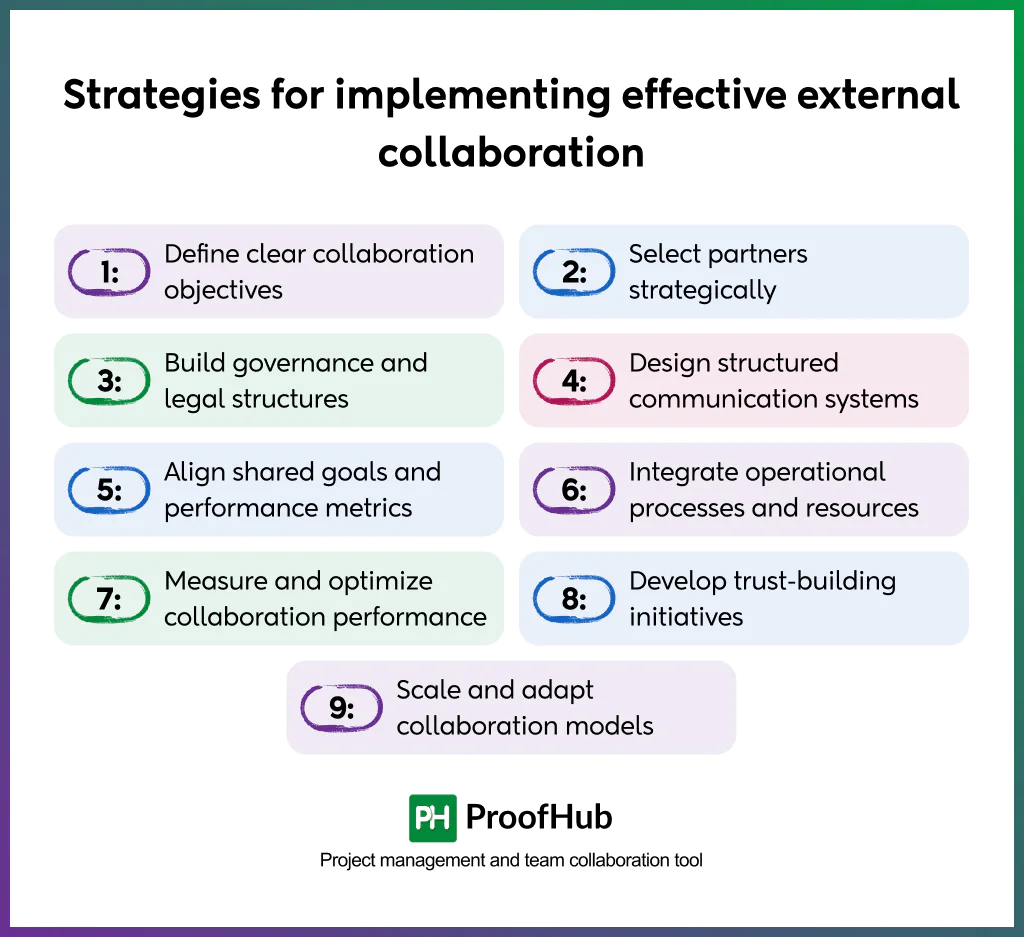
The following are the key strategies for implementing external collaboration effectively:
1. Define clear collaboration objectives
Defining collaboration objectives clearly keeps partnerships focused and prevents wasted resources. When goals are locked, both sides understand why the partnership exists and what outcomes to expect, making it easier to evaluate success.
To define objectives, set clear goals such as innovation outcomes, cost reduction, or market expansion. Use tools like OKRs, project charters, or balanced scorecards to map responsibilities and track ownership. Review regularly to ensure priorities stay aligned as conditions change.
2. Select partners strategically
Choose partners who align with strategic needs. A well-matched partner contributes expertise, reliability, and stability which amplifies the collaboration outcomes.
To select partners, conduct due diligence using financial health checks, case studies, and reference validation before committing. Involve cross-functional managers in partner evaluation to avoid blind spots.
3. Build governance and legal structures
Establish governance and legal structures to avoid conflicts and uncertainties. Clear frameworks prevent disputes, streamline decision-making, and allow organizations to focus on results instead of resolving disagreements.
To build governance structure, create agreements that cover roles, responsibilities, intellectual property rights, and compliance obligations.
Governance models with escalation procedures and predefined authority reduce bottlenecks, while early legal involvement prevents costly revisions later.
4. Design structured communication systems
Structured communication systems reduce delays and ensure accountability across all stakeholders.
Transparent communication keeps projects on track and prevents information from being lost across fragmented channels.
Use centralized platforms where documents, discussions, and approvals remain accessible to all partners. Set regular meeting and escalation paths to ensure urgent issues are addressed quickly.
5. Align shared goals and performance metrics
Aligning shared goals with clear performance metrics keeps collaborations transparent, consistent, and performance-driven. When all parties evaluate success the same way, external collaboration becomes easier to manage and improve.
To align collaboration, convert broad objectives into measurable KPIs such as delivery speed, cost savings, or product launches. Standardize reporting formats and review cycles for comparison. Involve both internal and external stakeholders when setting metrics to build ownership and accountability.
6. Integrate operational processes and resources
Integrate operational processes and resources to streamline execution and prevent duplication of effort. It accelerates delivery, reduces friction, and maximizes the use of available assets.
To integrate operations of both teams, adopt shared tools for project collaboration and management, workflow automation, and document collaboration to let partners work efficiently without risking data exposure.
7. Measure and optimize collaboration performance
Measuring KPIs helps optimize the performance of collaborative efforts and provide opportunities for improvement. It ensures minor issues don’t grow into systemic failures.
Use dashboards and performance reviews to track leading indicators such as cycle times and error rates. It helps gather insights, helping teams adapt quickly and maintain momentum.
8. Develop trust-building initiatives
Build trust in teams through transparency and fairness for strengthening long-term relationships and reducing conflicts.
Share both successes and setbacks openly, recognizing contributions, and balancing risks and rewards fairly. Partnerships thrive when stakeholders feel respected, valued, and secure in their roles. It builds credibility over time, making it easier to navigate uncertainty together.
What are the common challenges of external collaboration?
The common challenges of external collaboration includes: communication barriers, information silos, data security risks, conflicting goals, fragmented tools, and limited shared infrastructure.
Let’s understand in detail:
- Communication barriers: Different styles, time zones, and reporting formats across organizations create misalignment and rework, slowing approvals and decisions. To address these, create a joint communication plan (schedules, channels, single points of contact), use of a common workspace for updates, and consistent documentation.
- Information silos: Updates held by partners or organizations cause version conflicts, duplicate work, and missed dependencies. To fix, set up a centralized platform with a shared repository where all collaborators can access, review, and update information.
- Data security risks: Sharing files via email, shadow IT, or unsecured links risk data security breaches or compliance issues. To mitigate risks, store and manage information in a single controlled environment with defined permissions, encrypted access, and proper audit trails.
- Conflicting goals and priorities: Focusing on target of own targets (margin, speed, scope), creates scope creep, budget overruns, and missed milestones. To align goals of both the teams, set shared OKRs and metrics, discuss collaboration trade-offs early and communicate expectations from collaboration clearly.
- Fragmented tools: Using incompatible project management suites, or file formats, causes errors and delays. To minimize it, standardize the core platforms, integrate systems via APIs (Application Programming Interfaces), and use a shared data dictionary.
- Limited shared infrastructure: No shared environments, vendor portals, or secure sandboxes, slows onboarding and handoffs. To avoid this, provide shared cloud workspaces, sandbox environments, and secure exchange platforms with clear governance for access and uptime.
What are the examples of external collaboration?
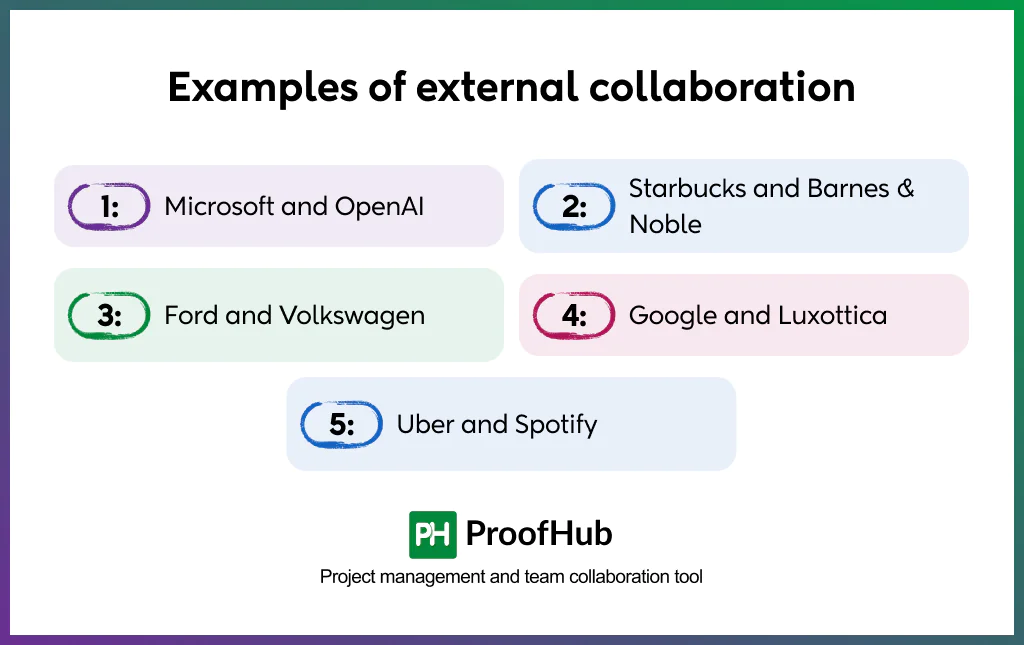
Some examples of external collaboration include:
- Microsoft and OpenAI: Microsoft invested in OpenAI and integrated GPT-4 across Azure, Bing, and Microsoft 365 Copilot. This allowed Microsoft to embed advanced AI in its services, while OpenAI gained the resources it needed to grow.
- Starbucks and Barnes & Noble: Starbucks opened cafes inside Barnes & Noble bookstores. This makes the bookstore a more enjoyable place to spend time, which helps both companies sell more.
- Google and Luxottica: Google worked with Luxottica (parent of Ray-Ban and Oakley) to design Google Glass frames that combine style with functionality, giving Google design expertise and Luxottica access to wearable tech innovation.
What tools enable external collaboration?
The best suitable tools for external collaboration are: document collaboration, project management, video conferencing, messaging, file sharing, and digital whiteboarding platforms.
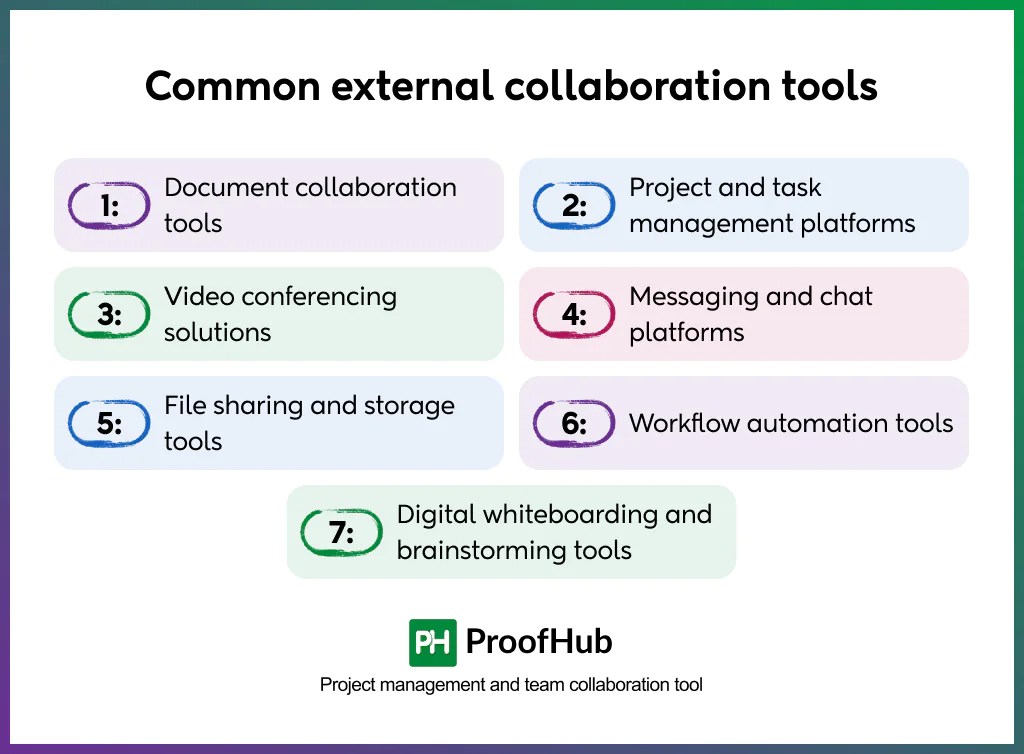
Here are some common external collaboration tools:
1. Document collaboration tools: Allows multiple partners to create, edit, and review documents, spreadsheets, or presentations in real-time. They prevent version conflicts, reduce email threads, and give external stakeholders visibility into the latest updates.
2. Project management platforms: Provides a centralized space where organizations can assign responsibilities, set deadlines, and track progress in real-time. It helps teams understand dependencies, reduce duplicated efforts, and keep projects on track, ensuring everyone is aligned with goals.
3. Video conferencing solutions: Help create a space for brainstorming, problem-solving, and relationship building. They allow teams to communicate instantly and run workshops, status updates, or negotiations with external teams.
4. Messaging and chat platforms: Enables quick, informal communication without relying on lengthy emails. Allows partners to set up dedicated channels or groups for project discussions. It improves response times, reducing bottlenecks, and making collaboration more agile.
5. File sharing and storage tools: Gives collaborators access to large files, media assets, and reports. They ensure data is stored centrally with clear access controls and permissions, reducing risks of duplication, loss, or unauthorized sharing.
6. Digital whiteboarding and brainstorming tools: Allows distributed teams to ideate, map workflows, and visualize processes together in real-time. They replicate the benefits of in-person brainstorming sessions and encourage creative problem-solving among external collaborators.
Some widely-used external collaboration tools include:
- ProofHub: Combines project management, task tracking, and team collaboration in a single space for internal and external partners.
- Microsoft Teams: Integrates chat, video meetings, and file sharing to streamline real-time communication across organizations.
- Zoom: Provides reliable video conferencing for external workshops, training sessions, and negotiations.
- Google Workspace: Offers real-time document, sheet, and presentation collaboration with secure file sharing.
- Dropbox: Provides centralized file storage and sharing with controlled access for external stakeholders.
What is the difference between external and internal collaboration?
The main difference between external and internal collaboration lies in who participates and how the collaboration is managed.
- Internal collaboration happens within an organization. Teams, departments, or individuals work together to achieve common business goals. It relies on shared systems, company culture, and internal governance. For instance, marketing and product teams aligning on a new launch is internal collaboration.
- External collaboration involves working with stakeholders outside the organization, such as suppliers, customers, contractors, competitors, or research institutions. It requires formal agreements, data-sharing policies, and structured governance to handle differences in goals, systems, and trust levels. For example, a company partnering with a university for R&D or with another brand for a joint venture.
What external collaborations should a business consider?
A business should consider external collaborations that align with its goals for innovation, efficiency, market growth, and long-term competitiveness.
Some common options include:
- Involving customers in product or service design aligns offerings with real needs.
- Partnering with universities or labs provides access to advanced research and specialized talent.
- Businesses pool resources to expand into new markets or product lines.
- Working with public bodies supports compliance, access to incentives, and CSR (Corporate Social Responsibility) initiatives.
- Competitors cooperate on shared challenges such as R&D or industry standards while still competing commercially.
What are the risks of poor external collaboration?
Poor external collaboration weakens performance instead of improving it. When partners withhold information or fail to document decisions, teams waste effort on duplicate work and miss valuable insights. It slows down innovation and makes projects difficult to scale.
Misaligned goals can cause disputes, delay delivery and stretch budgets. Furthermore, sharing sensitive data through unsecured channels creates compliance violations and reputational damage.
How to ensure data privacy in external collaboration?
Ensuring data privacy in external collaboration requires a combination of technical safeguards and clear governance policies.
Share sensitive files through secure portals or encrypted channels, with access limited on a least-privilege basis. Multi-factor authentication (MFA) and single sign-on (SSO) prevent unauthorized access, while regular audits verify that permissions remain accurate.
Legal agreements such as NDAs, Data Processing Agreements (DPAs), and GDPR-aligned clauses must define ownership, retention, and acceptable use of data. Organizations also need vendor risk assessments to confirm that all partners comply with recognized security standards such as ISO 27001 or SOC 2.