

As organizations work on increasingly complex projects, collaboration across different departments becomes important for bringing together the knowledge and expertise needed to achieve common objectives.
Cross-functional collaboration brings different departments together to work toward common objectives.
Successful cross-functional collaboration requires clear goal alignment, strong leadership, effective communication, defined responsibilities, and a culture of constructive feedback. Without these elements, differences in priorities, working methods, and communication can create challenges that affect how effectively teams work together.
This article explores the benefits of cross-functional collaboration, practical strategies, common challenges, & real-world examples that support effective cross-functional teams.
What is Cross-functional collaboration?
Cross-functional collaboration is a process in which professionals from different teams, departments, and educational backgrounds work together toward a common goal. Each contributor brings their own functional expertise and specialization that is necessary for the project to be successful.
This collaboration leads to better communication and understanding between departments, thereby enhancing decision-making and empowering teams to work together.
What are the benefits of cross-functional collaboration?
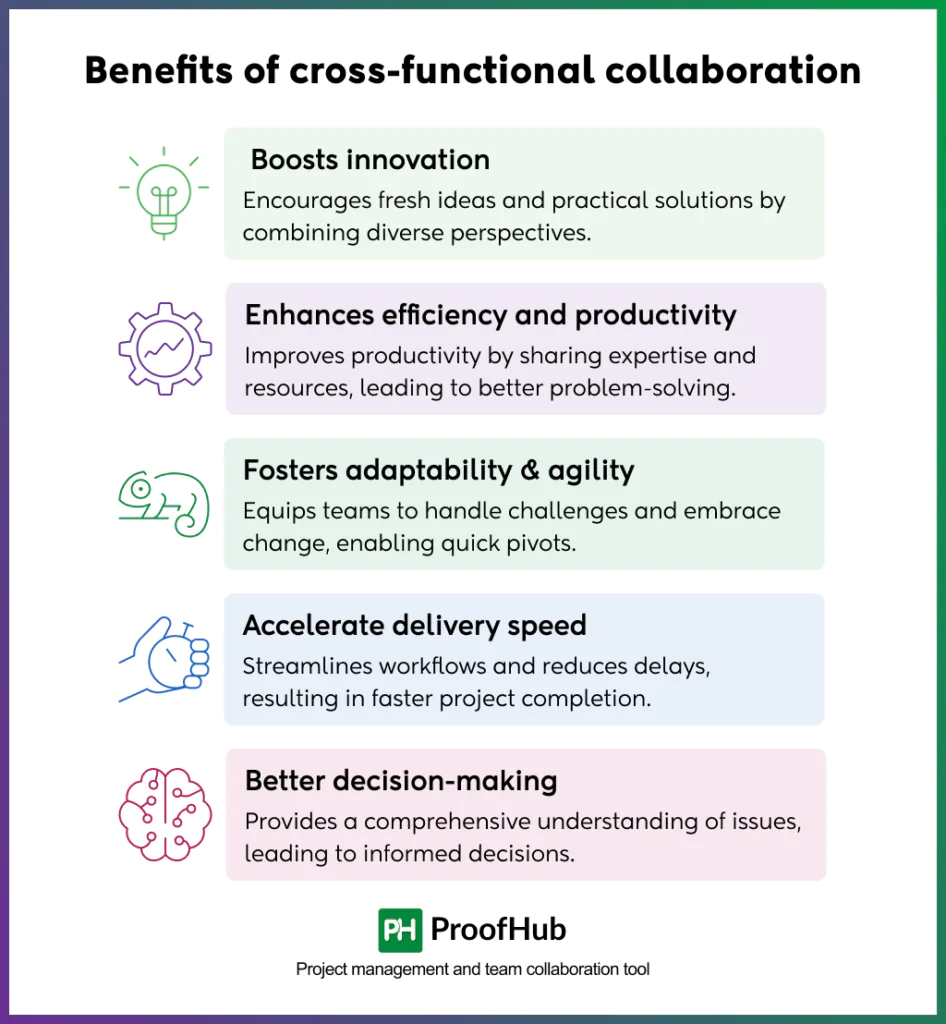
Cross-functional collaboration offers several benefits for organizations, including boosting innovation, enhancing efficiency and productivity, fostering adaptability and agility, accelerating delivery speed, and supporting better decision-making.
1. Boosts innovation
Cross-functional collaboration allows individuals from different areas to exchange knowledge, share perspectives, and learn from one another. This allows teams to approach problems from different angles, generate fresh ideas, and develop solutions that are both innovative and practical.
2. Enhances efficiency and productivity
Cross-functional collaboration allows members from different departments to share their expertise and combine resources. By bringing different areas of knowledge into the same project, teams can identify and resolve problems earlier. As a result, teams can use their time and resources more efficiently, improving overall productivity.
According to the study “Optimizing Cross-Functional Team Collaboration in IT Project Management”, conducted by Vanitha Sivasankaran and team in 2024, cross-functional collaboration enhances efficiency and productivity by leveraging the diverse strengths of team members from different functional areas, which leads to improved problem-solving capabilities and more efficient resource utilization.
3. Fosters adaptability & agility
Cross-functional teams are better equipped to handle complex challenges and adapt to changing circumstances. By combining varied perspectives, organizations can respond to shifts more efficiently and cultivate a culture that embraces change, enabling teams to pivot quickly and seize new opportunities.
4. Accelerate delivery speed
Collaboration between different departments reduces conflicting priorities, eliminates duplicate efforts, and closes knowledge gaps. As a result, teams can streamline workflows, minimize delays and deliver projects faster.
5. Better decision-making
When teams from different functions contribute to a decision, they bring information and perspectives from different areas of the business. This gives teams a more complete understanding of the issue, reduces gaps and inconsistencies, and helps them make more informed and aligned decisions.
Strategies to improve cross-functional collaboration
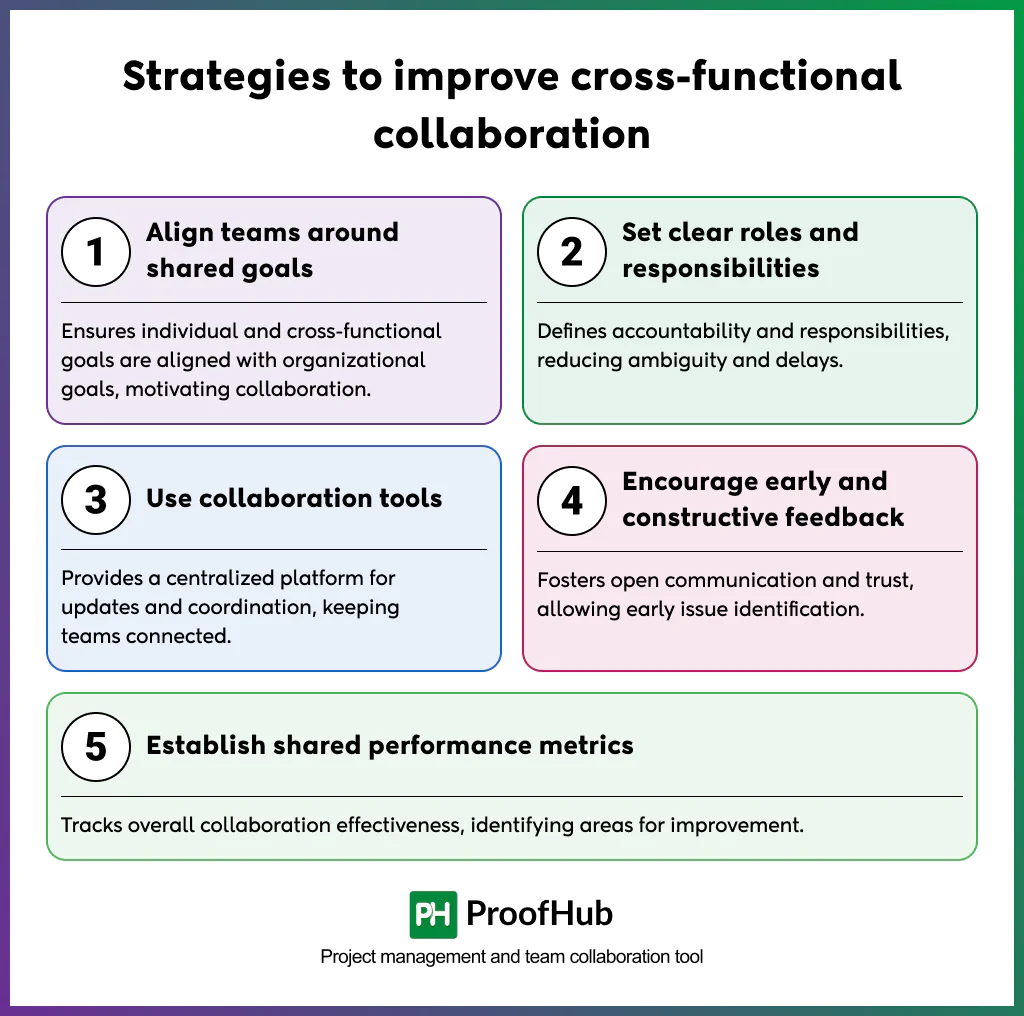
Improving cross-functional collaboration requires aligning teams around shared goals, setting clear roles and responsibilities, using shared collaboration platforms, encouraging early and constructive feedback, and establishing shared performance metrics.
1. Align teams around shared goals
Ensure individual and cross-functional objectives are aligned with the organisation’s broader goals. When team members understand their roles and how their work supports overall business goals, they’re motivated to collaborate effectively and less likely to operate in silos.
2. Set clear roles and responsibilities
Define who is accountable for decisions, deliverables, and approvals from the start. Clear roles help team members understand their responsibilities, take ownership of their work, and avoid unnecessary dependencies. This reduces overlapping and work delays caused by ambiguity over roles.
3. Use collaboration tools
Use a collaboration tool to keep project updates, timelines, and progress visible to all teams. Having information in a centralized place helps team members stay connected, access the latest updates, and coordinate their work more effectively.
4. Encourage early and constructive feedback
Encourage team members to share feedback early and respectfully, especially across departments where perspectives differ. When feedback is openly shared and valued, teams can identify issues early, reduce misunderstandings, and build trust among team members.
5. Establish shared performance metrics
Track metrics that reflect the overall effectiveness of collaboration and the project’s success as a whole, not only siloed KPIs. Shared performance metrics help teams understand how their combined efforts are contributing to project outcomes and identify areas that need improvement.
What are the challenges of cross-functional collaboration?
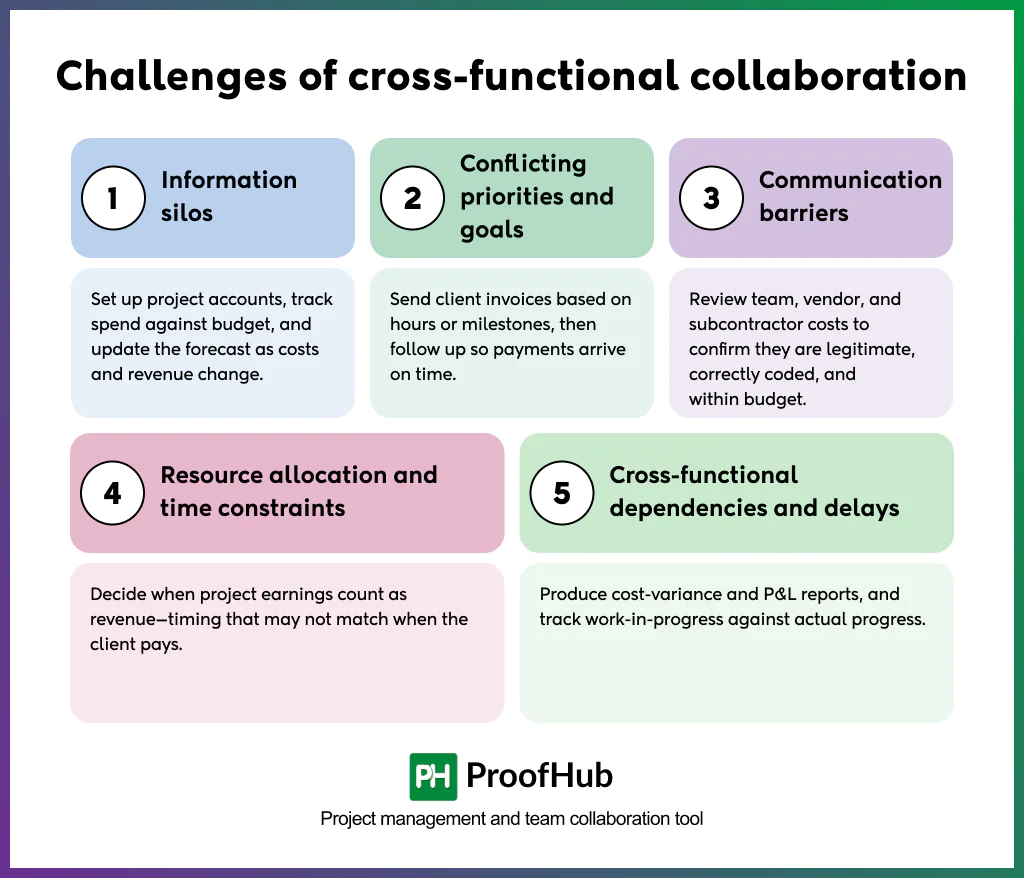
Cross-functional collaboration creates friction when teams operate with different priorities, languages, and working methods. Understanding these underlying challenges enables organizations to build strategies that maintain alignment, clarify authority, and sustain productive momentum.
1. Information silos
Information silos prevent data sharing, leading to duplicate efforts and poor decision-making. When there is no centralized system, essential information becomes inaccessible to team members, leading to misinformed decisions, missed opportunities, and reduced efficiency.
Use a centralized tool where relevant project information can be stored, accessed, and shared across teams. This gives team members visibility into the latest information and reduces information gaps between departments.
2. Conflicting priorities and goals
Different departments have their own priorities and goals, making it difficult to maintain coordination, move the project forward and achieve common goals.
Establish shared understanding of priorities and ensure that departmental goals support the organization’s overall objectives. Conduct alignment meetings regularly to review teams’ priorities, address conflicts, and maintain a common direction.
3. Communication barriers
Different teams use distinct terminologies, tools, workflows and have their own communication styles. When team members interpret information differently or use communication methods that other teams are not familiar with, it slows down coordination and affects project progress.
Establishing common communication practices and encouraging clear, inclusive language to create a more unified and productive environment. Agreeing on appropriate communication channels and keeping relevant updates accessible to all teams can help reduce misunderstandings and improve coordination.
4. Resource allocation and time constraints
Limited resources and time can create competition between teams, especially when multiple departments need the same people, budget, or other resources. Without visibility into each team’s capacity and commitments, resources can become over-allocated, creating bottlenecks, burnout, and conflicting demands.
Use a shared resource management system that provides visibility into team capacity, commitments, and resource availability. This helps organizations identify overallocation early and allocate resources based on project needs.
5. Cross-functional dependencies and delays
When teams depend on each other to complete their work, a delay in one area can affect the progress of other teams. Without a collaboration plan, departments may work at different speeds, causing dependencies to be missed and timelines to slip.
Implement a shared collaborative timeline with clear milestones and dependencies that are visible to all. Hold regular, brief check-ins where teams report progress and identify potential schedule risks early.
Examples of cross-functional collaboration
Some examples of cross-functional collaboration include-
Example 1. New product development
When a new product is developed, different departments get involved. R&D designs the product, the marketing department conducts market research, the sales department provides customer insights, and finance assesses budget feasibility. When these departments collaborate, it ensures that the product is cost-effective, ready for market, and meets expectations.
For example, the engineering team might design a prototype while marketing tests customer reactions before full-scale production.
Example 2. Marketing campaigns
Cross-functional collaboration ensures that the marketing campaigns are effective. Designers create visuals, IT supports digital platforms, sales provide insights on customer preferences, and marketing lays down the strategy. This kind of collaboration ensures that the perspectives of everyone are included. For instance, a product launch email campaign requires marketing content, design graphics, and IT’s technical setup at the same time.
Example 3. Customer experience enhancement
Improving the customer journey is essential for businesses. It involves customer service reporting pain points, UX designers redesigning interfaces, product teams adjusting features, and marketing updating communications. It ensures a seamless experience across touchpoints. For example, feedback about a confusing app feature could trigger UX and product teams to redesign it, while marketing communicates the update to users.
What tools are best suited for cross-functional collaboration?
The best tools for cross-functional teams are project management tools, communication and messaging tools, document and file collaboration tools, video conferencing tools and knowledge management tools.
They help teams coordinate tasks, communicate effectively, share information, and keep project progress visible across departments. Different tools support different collaboration needs, from managing projects and tasks to communicating and sharing documents.
1. Project management tools: Help cross-functional teams organize tasks, assign responsibilities, track progress, and manage deadlines in one place. ProofHub is a project management and collaboration tool that supports cross-functional teams.
2. Communication and messaging tools: Help teams share updates, discuss work, and coordinate activities across departments.
3. Document and file collaboration tools: Allow teams to create, edit, store, and share information in a shared workspace.
4. Video conferencing tools: Help cross-functional teams hold meetings, discuss projects, and collaborate in real time, particularly when team members work from different locations.
5. Knowledge management tools: Help teams organize and share project information, processes, decisions, and other resources across departments.
What is the difference between cross-functional and cross-departmental collaboration?
Cross-functional collaboration brings together people with different functions, expertise, or responsibilities to work toward a shared objective. Whereas cross-departmental collaboration involves people from two or more separate departments working together on a shared task, project, or objective.
Cross-functional collaboration focuses on bringing together different functions or areas of expertise, while cross-departmental collaboration focuses on bringing together separate departments.
The two can overlap when different functions are organized into separate departments.
For example, a project involving product management, engineering, marketing, and finance can be both cross-functional and cross-departmental.
What skills support effective cross-functional collaboration?
Effective cross-functional teams rely on interpersonal, analytical, and organizational skills. The key skills include
- Communication: Strong communication helps team members clearly understand goals, tasks, updates, and expectations across different functions.
- Active listening: Allows team members to understand different perspectives, requirements, and concerns before responding or making decisions.
- Problem-solving: Helps teams combine knowledge from different functions to identify issues and develop effective solutions.
- Critical thinking: Critical thinking helps team members evaluate information and different perspectives when addressing complex challenges.
- Adaptability: Adaptability enables team members to respond effectively to changing priorities and unexpected obstacles.
What collaboration approach works best for cross-functional teams?
A facilitative collaboration approach works well for cross-functional teams because it creates an environment where team members can ask questions, challenge ideas, and share different perspectives without fear of judgment. It encourages teams to work toward consensus around a common goal while using open discussion and a structured decision-making process to resolve conflicts and strengthen team relationships.
Can cross-functional collaboration develop innovative solutions?
Yes, cross functional collaboration can develop innovative solutions by bringing together people with different expertise and perspectives, allowing teams to challenge assumptions and approach problems from multiple angles.
When functions such as marketing, engineering, design, and operations share ideas and work together, they can identify new opportunities, develop creative solutions, and improve ideas based on different areas of knowledge.
For example, a development team can combine technical expertise with customer and market insights to develop solutions that are both practical and aligned with customer needs.
What role does organizational culture play in cross-functional success?
A culture that values trust, openness, and shared accountability encourages teams to communicate freely, share knowledge, and work together toward common goals. When employees feel safe to voice ideas, provide feedback, and challenge assumptions, collaboration becomes more effective, and innovative solutions emerge.
Conversely, a culture that fosters silos, competition, or rigid hierarchies can hinder cooperation, create misunderstandings, and reduce the impact of cross-functional initiatives. In short, a supportive and inclusive culture lays the foundation for collaboration, alignment, and long-term success across diverse teams.
What is the difference between cross-functional collaboration and coordination?
Cross-functional collaboration involves people from different teams actively sharing knowledge, perspectives, and expertise to work toward a shared goal. Coordination focuses on organizing tasks, responsibilities, timelines, and dependencies so that different teams can work together effectively.
While collaboration involves joint problem-solving and contribution, coordination focuses on organizing and aligning the work. Both are important for cross-functional teams, as effective coordination helps organize the work while collaboration brings together the expertise needed to achieve the desired outcome.