“PMOs ensure good governance. They improve success rates and, in turn, boost business results and profitability.” — Antti Kämi, PMP, Wärtsilä, Helsinki, Finland
A project manager can effectively manage a project on their own. But when multiple projects are running in parallel, competing for resources, affecting one another, and influencing broader organizational objectives, then managing individual projects doesn’t remain feasible.
Someone needs to manage the system around those projects. That requires a coordinated approach to managing projects as part of a larger organizational system, along with a structured function that ensures these practices are consistently implemented across projects.
This is where project governance and the PMO become important. Governance establishes the framework for authority, decision-making, oversight, and control, while the PMO provides the processes, tools, and support needed to put that framework into practice.
In this guide, we explain what PMO and project governance are, how they work together, the relationship and differences between them, PMO types and maturity levels, core PMO functions and governance components, and common challenges.
What is a Project Management Office (PMO)?
A project management office (PMO) is an organizational body that standardizes processes, establishes and maintains project management standards, enables strategic execution, and provides oversight to align project execution with organizational goals.
Its role extends beyond supporting project execution to establishing enterprise-wide governance and accountability, standardizing risk and reporting practices, overseeing project management tools and methodologies, developing project management competencies, and defining performance measures.
What is project governance?
Governance in project management is the framework of structure, policies, processes, roles, communication protocols, and decision-making rules that provides strategic direction to deliver agreed-upon output.
Governance sets the standards for how projects are directed, monitored, and controlled without directly managing day-to-day project execution.
It defines who holds authority, how key decisions are made, which standards apply, how issues are escalated, which resources require approval, and how projects are prioritized to keep risks under control and maintain quality standards.
What are the benefits of PMO Governance?
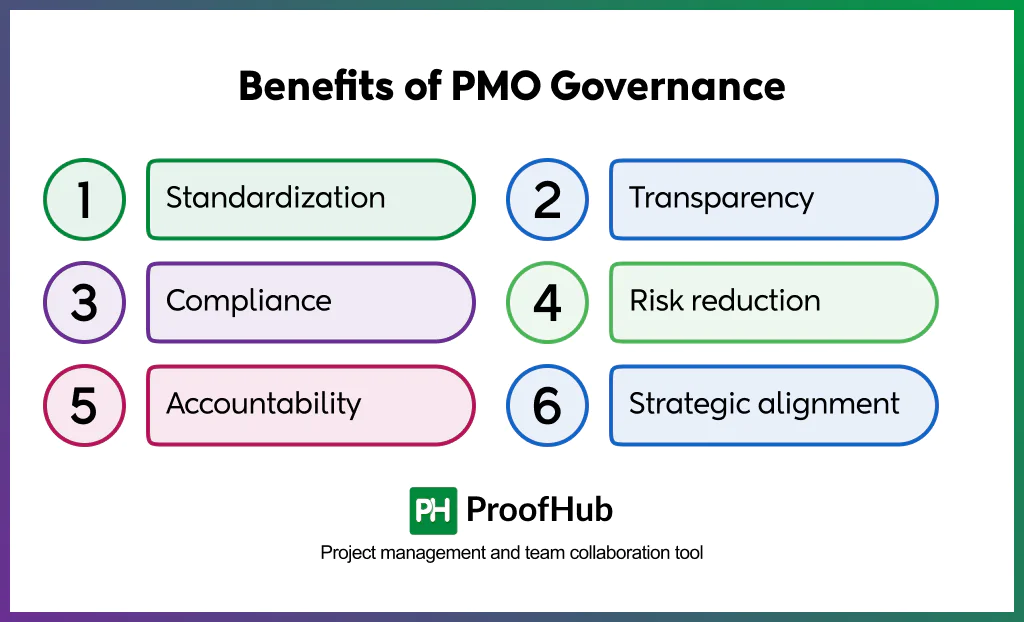
PMO governance improves consistency, transparency, compliance, risk control, strategic alignment, and accountability across projects by establishing a structured set of policies, rules, and decision-making frameworks.
- Standardization: Governance drives standardization by establishing common policies, methodologies, processes, templates, and best practices. Teams work within consistent standards across all projects without compromising quality or consistency, resulting in predictable project delivery and repeatable outcomes.
- Transparency: Governance frameworks establish reporting structures that enable stakeholders to gain consistent and transparent visibility into project status, performance, risks, resources, and dependencies. Project managers and executives can use these insights to identify issues early and make project decisions more confidently.
- Compliance: Governance establishes compliance controls and approval mechanisms at key project checkpoints, ensuring every project follows defined policies, regulatory requirements, and contractual commitments. This helps organizations protect operational integrity throughout execution.
- Risk reduction: Structured governance includes escalation paths, reviews, controls, and risk registers to identify and address potential blockers early in the project lifecycle before they impact project timelines, budgets, or scope. Teams can use these insights proactively to adapt strategies and allocate resources before risks escalate.
- Accountability: By defining who owns the decision-making, who is responsible for each project stage, and how decisions are approved and escalated, governance establishes clear ownership for project decisions, tasks, and outcomes. This clarity ensures that teams understand their responsibilities to address trade-offs, risks, and escalations on time.
- Strategic alignment: Effective governance establishes regular communication channels, feedback loops, governance reviews, performance metrics, and decision-making checkpoints. These governance mechanisms ensure projects remain aligned with stakeholder expectations and organizational goals.
What is the relationship between PMO and project governance?
PMO and project governance are two interdependent functions; one establishes the framework for how projects are directed and controlled, while the other helps put that framework into practice.
Project governance establishes the directions, rules, authority, and decision rights that the PMO helps ensure are understood and followed across project teams.
The PMO provides resources, methodologies, tools, techniques, and support to convert these standards into consistent project practices that teams follow in their day-to-day operations.
Both work in tandem to connect strategic direction with consistent execution.
What is the difference between PMO and project governance?
Project governance is a decision-making framework that defines how projects should be directed and controlled, while a PMO is the organizational function that ensures those governance standards are applied across projects.
Project governance establishes a structured system defining the rules, policies, processes, and responsibilities that need to be followed to ensure strategic alignment of the project.
The PMO standardizes and operationalizes governance standards through processes, reporting practices, tools, and support mechanisms to support project delivery.
The PMO operates within the boundaries established by the governance system, enabling teams to execute projects consistently while maintaining compliance with established governance standards.
Note: A governance framework can exist independently regardless of a formal PMO.
What are the types of Project Management Offices (PMOs)?
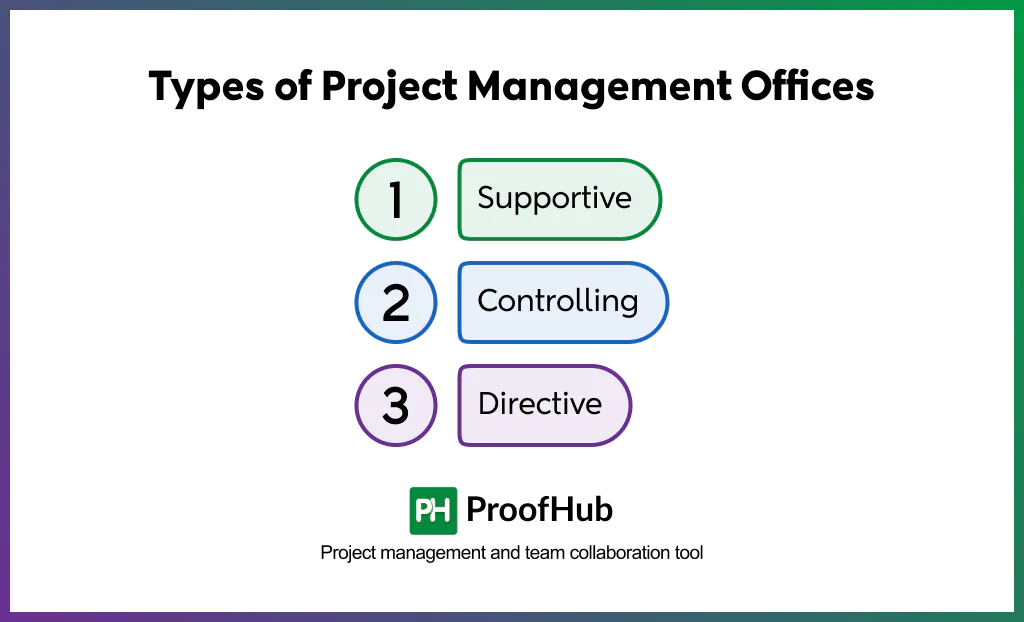
The three common PMO types based on their level of authority and control over the project are: supportive, controlling, and directive.
1. Supportive
The supportive PMO is a consultative function that provides advisory support and oversight with minimal control.
It provides guidance, tools, training, templates, and best practices to project teams without directly interfering with their decision-making or day-to-day project execution.
It is useful in environments where project managers and teams have enough experience and established capabilities to manage projects independently, but require expert guidance and best practices to improve project outcomes.
2. Controlling
The controlling PMO is a governance-focused function that supports project delivery while exercising some level of control.
It ensures approved project management methodologies, tools, templates, and processes are consistently followed, while ensuring compliance with organizational standards and governance requirements.
It is suited to organizations where PMOs are required to maintain greater oversight and standardization, while teams retain responsibility for project execution to ensure successful project delivery.
3. Directive
The directive PMO is an authoritative function that directly manages and executes projects with a high level of authority.
It controls project management practices, resources, processes, and delivery decisions to ensure higher consistency and closer alignment with organizational priorities.
It is best suited to organizations where PMOs take full ownership of project delivery and work in close collaboration with project managers and functional teams to achieve strategic objectives.
Note: The selection of a PMO type depends on the unique needs and characteristics required by an organization. A PMO may combine characteristics of multiple types to create a tailored structure that provides the greatest value.
What are the core functions of a PMO?
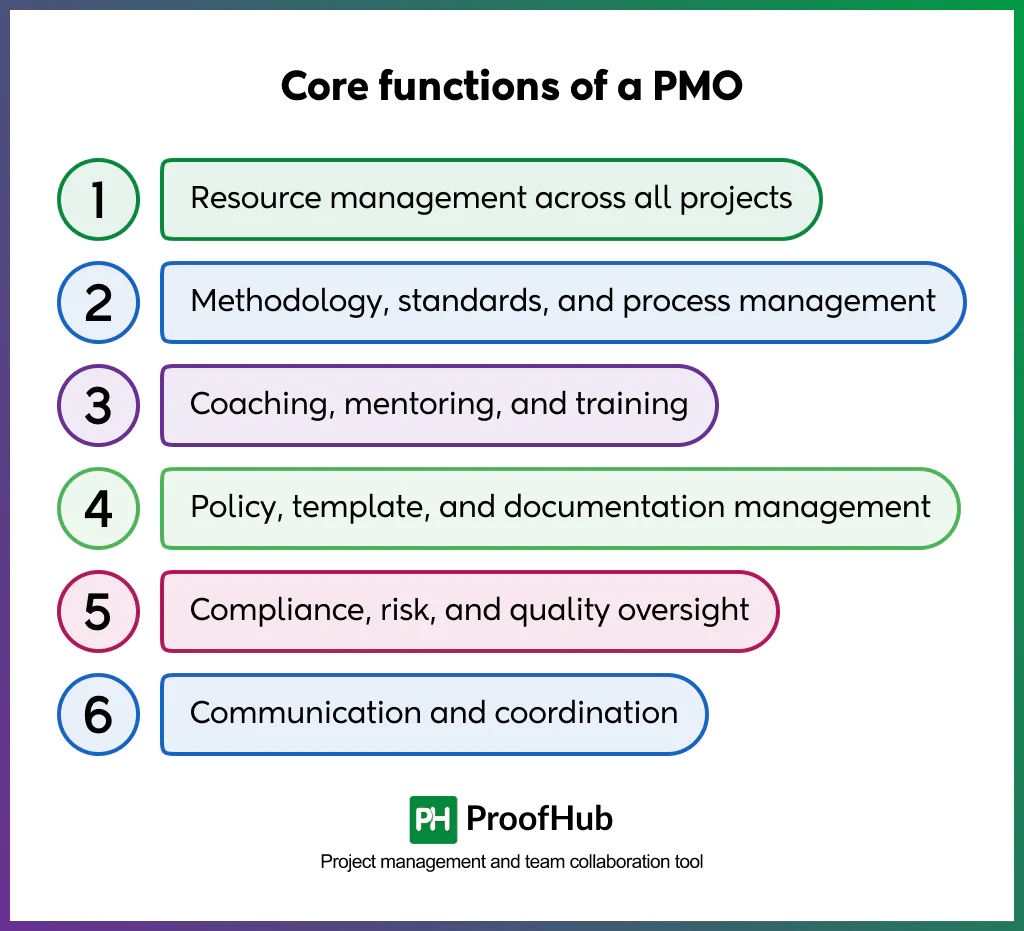
PMO has six core functions, including: resource management across all projects, methodology and process management, providing coaching and training, creating policy and templates, compliance monitoring and audits, and coordinating communication across projects.
1. Resource management across all projects: A PMO is responsible for managing financial, physical, and manual resources across all the projects. This includes ensuring optimal allocation while balancing competing demands and priorities across projects. This helps prevent resource conflicts, underutilization, and overallocation.
2. Methodology, standards, and process management: A PMO identifies and develops project management methodologies, best practices, and standards. Instead of applying general practices to every project, it tailors them based on the organization’s needs, project complexity, and objectives to support consistent delivery.
3. Coaching, mentoring, and training: A PMO supports project managers and teams through coaching, mentoring, and training on project management practices, tools, methodologies, and governance requirements. Support is provided at different stages of the project lifecycle to help teams strengthen their capabilities as the project progresses.
4. Policy, template, and documentation management: A PMO develops and manages project policies, procedures, templates, and standard documentation. This creates a single source of truth for teams to follow and implement, reducing the need to create everything from scratch every time.
5. Compliance, risk, and quality oversight: A PMO is responsible for ensuring and monitoring project compliance with approved project management standards, policies, and procedures throughout the project lifecycle. The objective is to ensure established practices are actually followed, risks are identified early, and quality or compliance issues do not undermine project outcomes.
6. Communication and coordination: A PMO coordinates cross-project communication, ensuring teams, project managers, steering committees, executives, and other stakeholders are aware of project status, risks, dependencies, and decisions that affect their work. It also facilitates information sharing and coordination to maintain visibility and transparency across the project portfolio and identify potential conflicts early.
What are PMO Maturity Models?
PMO maturity models are structured frameworks organizations use to evaluate and enhance their current PMO maturity levels. They help identify capability gaps and areas for improvement, develop a roadmap for growth, and improve overall project management capabilities. By benchmarking against industry standards and defined maturity criteria, organizations can set realistic goals and achieve sustained improvements.
PMO maturity models not only help improve a PMO’s capabilities, practices, systems, and processes but also assess how well they align with organizational goals and performance. As PMOs mature, they are better positioned to align their services with stakeholder needs, support project performance, and demonstrate greater organizational value.
5 maturity levels of a PMO are:
What are the three pillars of project governance?
The three foundational pillars of project governance are: Structure, people, and information.
1. Structure
The structure establishes clarity and control in the project governance framework. It defines the decision-making bodies, escalation paths, reporting relationships, and approval mechanisms.
The purpose is to ensure stakeholders understand their authority, responsibilities, and how decisions are made and escalated without conflicting authority or duplicated efforts.
2. People
The people establish accountability across governance activities. It ensures the right roles and responsibilities are assigned to key stakeholders, including the steering committee, executive sponsor, project manager, and governance lead.
It defines who is accountable for decisions, oversight, and project outcomes. Even the best governance structure is ineffective without accountable people.
3. Information
The information enables informed governance decisions by providing relevant project information.
It supports oversight, performance monitoring, risk management, issue escalation, and decision-making through project documentation, status reports, communication channels, governance reviews, and performance dashboards.
Core components of an effective project governance framework
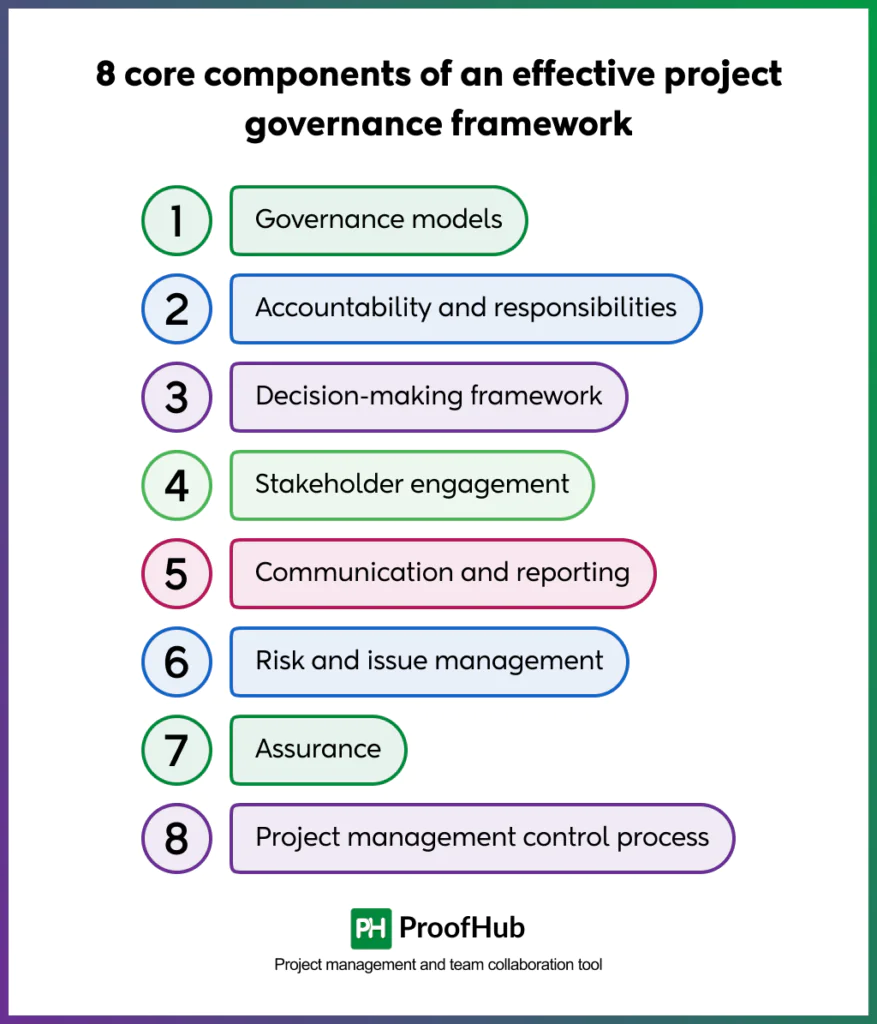
The 8 core components of project governance include governance models, roles and responsibilities, decision-making framework, stakeholder engagements, communication and reporting, risk and issue management, assurance, and project management control processes.
1. Governance models
The governance model defines the appropriate level of oversight and rigour required for a project. It outlines who holds decision-making authority, the hierarchy of steering committees, executive sponsors, and boards, as well as reporting lines.
This ensures the governance structure is proportionate to the project’s complexity and strategic importance.
2. Accountability and responsibilities
Defining accountability and responsibilities keeps the governance process clear and effective.
This ensures accountability is explicitly defined rather than assumed, while making it clear who needs to make, approve, consult on, and communicate each decision.
Clear accountability strengthens the effectiveness of every other governance component.
3. Decision-making framework
A structured decision-making framework is a crucial part of the governance process that defines how decisions will be made, which decisions require approval, and who holds the formal authority to make or approve them.
Decision thresholds are established to ensure the right people make decisions at the right level in the right capacity, keeping them aligned with project objectives.
4. Stakeholder engagement
Identifying and engaging key stakeholders is crucial to identifying their expectations and interests.
This includes everyone from the steering committee, PMO, project team, and business owners to stakeholders impacted by the project’s deliverables.
Engaging the right stakeholders at the right time ensures expectations remain aligned from the beginning and decisions do not stall due to any misunderstanding.
5. Communication and reporting
Establish clear communication channels and reporting mechanisms based on stakeholders’ expectations, information needs, and interests.
Define the communication mode, frequency, audience, and level of detail to ensure stakeholders receive precise, accurate, and relevant information without information overload or unnecessary delays.
6. Risk and issue management
Proactively identifying risks and potential mitigation actions is essential to protect project objectives and prevent issues from escalating.
Governance establishes processes that help project managers address threats as they appear instead of reacting after problems have already materialized and affect project outcomes.
7. Assurance
Project assurance is a structured oversight process that verifies risks and issues are identified and addressed appropriately.
It involves establishing relevant metrics and mechanisms that provide visibility into project performance and enable stakeholders to monitor scope, quality, cost, and schedule.
Regular assurance reviews validate the quality and accuracy and build confidence in project delivery.
8. Project management control process
Monitoring and controlling processes involve tracking performance against the approved baseline across scope, schedule, cost, quality, and resources.
Any significant deviations and emerging threats are identified and reported to implement corrective actions and bring performance back in line.
This is a continuous process that provides ongoing visibility into project health and enables timely intervention.
Common challenges in PMO and project governance
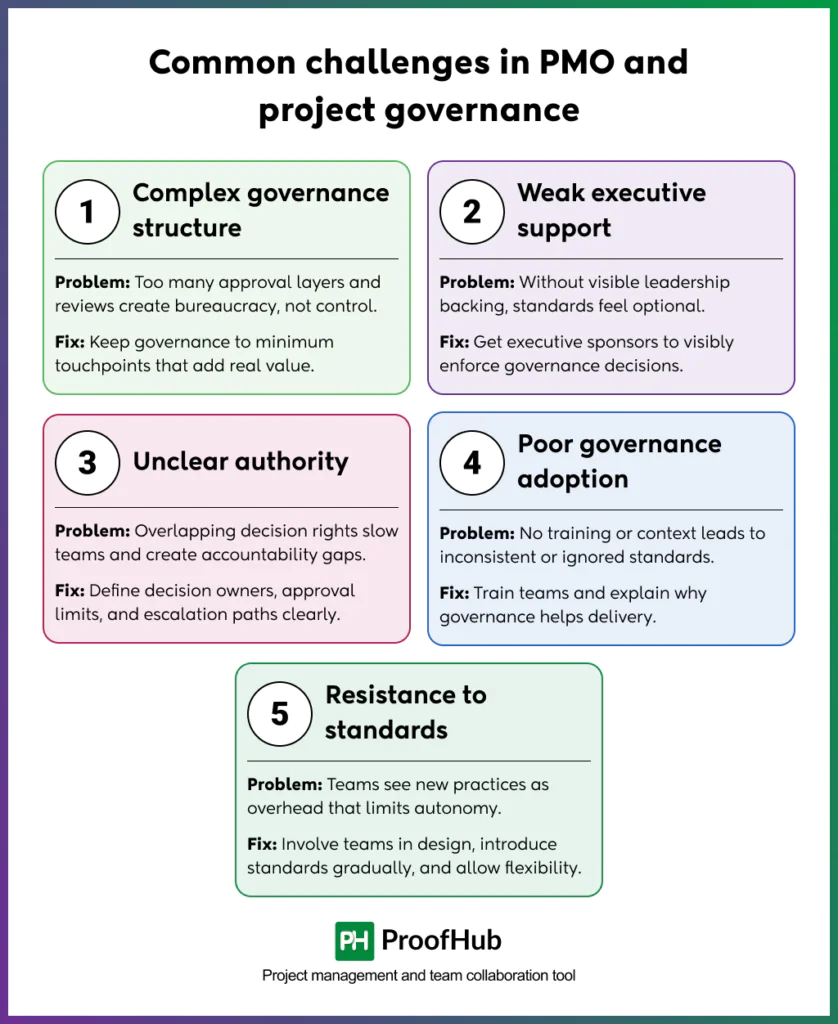
The most common PMO and project governance challenges include complex governance structure, weak executive support, uncontrolled scope changes, unclear authority, poor governance adoption, and resistance to standardized practices.
- Complex governance structure: Overly rigid and complex governance models that introduce multiple approval layers, review committees, and reporting requirements can create unnecessary bureaucracy instead of meaningful control. To simplify governance, keep it limited to the minimum necessary touchpoints that provide meaningful oversight and add value.
- Poor executive support: PMOs operate through authority delegated by leadership. Without visible and consistent executive sponsorship, teams may view standards as optional guidance rather than organizational requirements. To fix, secure the executive sponsor’s commitment to visibly enforce governance decisions.
- Unclear authority: Overlapping decision rights create gaps in accountability and cause hesitation in teams, as they are unsure of who has the authority to make decisions or approve changes, frustrating teams and slowing down processes. To set clear authorities, prepare a clear decision-rights document that defines accountable owners, approval thresholds, and escalation paths for key project decisions.
- Poor governance adoption: Expecting teams to follow governance standards without providing formal training, clear guidance, or sufficient awareness leads to inconsistent adoption or breakdown of governance during project execution. To improve adoption, provide training and clearly explain why governance requirements are needed and how they can help deliver projects more effectively.
- Resistance to standards: Teams may push back even when they are informed of the requirements. It happens when people are accustomed to their working style and perceive new standards as unnecessary overhead or formal controls that limit their autonomy. To avoid resistance, introduce standards gradually and explain their value to the teams before making them mandatory.
Example of PMO and Governance in project management
One of the real-world examples of PMO and governance in project management is OU Health, Oklahoma’s flagship academic health system.
OU Health’s Enterprise Technology Solutions team faced a growing number of strategic and departmental projects competing for attention. Their existing PMO structure was found to be focused on managing individual projects, not on enterprise-wide governance.
To address this, project sponsors established an end-to-end, enterprise-wide governance process. The PMO implemented shared tools for portfolio and resource visibility and introduced standardized project artifacts to bring consistency to reporting across projects. Governance made the prioritization decisions; the PMO built the infrastructure that made those decisions possible.
The result was enterprise-wide visibility into projects and resources, a formal and aligned review process, and greater consistency in project performance.
Who is responsible for project governance?
Project governance is typically owned by the project sponsor and supported by the steering committee. The PMO establishes and standardizes governance processes and reporting practices across the organization, while project managers apply these standards during the day-to-day execution.
How does a PMO improve project success?
A PMO improves project success by establishing consistent project management practices and standardizing governance across the organization, which helps teams execute and complete projects more predictably and successfully.
It also improves the conditions in which projects are delivered by strengthening strategic alignment, standardizing performance measurement, improving cross-project coordination, and increasing visibility into project health to identify risks and issues earlier. Together, these practices help teams keep projects aligned with organizational objectives.
Does every organization need a PMO?
No. Not every organization needs a PMO. The need depends on the number and complexity of projects, risk exposure, level of coordination required, and organizational maturity, rather than company size or revenue.
In a smaller organization with a limited number of projects, a project manager can apply light-weight governance without a dedicated PMO. On the contrary, the same small organization managing multiple interdependent, high-risk projects may benefit from a PMO to establish consistent governance.