

Every project requires a clear definition of what quality means before work begins. Quality standards in projects provide documented requirements, specifications, and criteria that guide the planning, execution, and evaluation of deliverables.
They help teams work toward the same quality expectations, measure performance consistently, and ensure deliverables comply with stakeholder, organizational, and industry requirements.
This guide explains what project quality standards are, why they are important, how to define, maintain, monitor, and measure them, the common mistakes to avoid, practical examples across industries, and how they differ from acceptance criteria and project requirements.
What are quality standards in projects?
Quality standards in projects are the documented requirements and guidelines that ensure the project delivers consistent excellence from initiation to completion.
The standards serve as essential benchmarks for measuring the project’s progress and determining its overall success.
Project quality standards establish clear expectations with stakeholders, ensure deliverables are fit for the desired outcome, and facilitate proactive risk management. These norms also contribute to safe product delivery and ensure adherence to industry regulations and the client’s unique needs.
Why is defining quality standards important?
Defining quality standards is important because:
- They establish clear metrics for how project deliverables should be planned, executed, and evaluated.
- They eliminate ambiguity by defining the quality level every deliverable must meet, ensuring the project team follows a consistent approach from start to finish.
- Clearly defined quality standards make it easier to measure performance, verify compliance with organizational or industry requirements, and identify deviations before they become major issues.
- Helps project managers make informed decisions, maintain consistent quality across deliverables, and keep the project aligned with stakeholder expectations.
- Quality standards reduce rework, improve operational efficiency, and increase stakeholder confidence by ensuring that final deliverables consistently meet the required quality level.
Steps to set quality standards
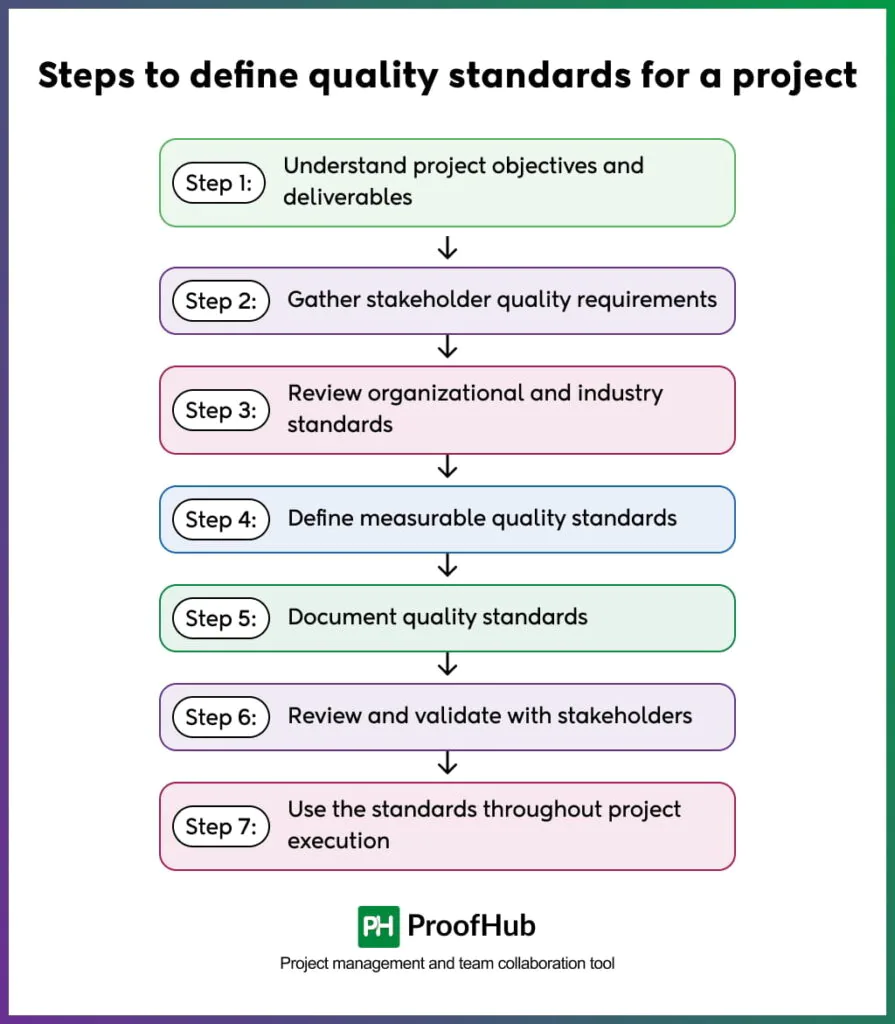
The seven steps to define quality standards are: understanding project objectives and deliverables, gathering stakeholder quality requirements, reviewing organizational and industry standards, defining measurable quality standards, documenting quality standards, reviewing and validating with stakeholders, and using the standards throughout project execution.
Follow these steps to define effective quality standards for your project.
Step 1: Understand project objectives and deliverables
To define a quality standard, identify exactly what the project must produce and how each task should be carried out to meet that outcome.
Turn each objective into a measurable goal, for example: staying within 10% of the approved budget. This measurable goal is the starting point against which all subsequent quality standards will be evaluated.
Document these goals as your baseline, and map every task to a named deliverable so you can check it against that standard later. This gives every later decision a clear reference point, so nothing gets built or judged against guesswork.
Step 2: Gather stakeholder quality requirements
Identify the specific stakeholder groups such as end users, project sponsors, regulators, or internal teams. Collect their quality expectations directly through interviews, surveys, or requirement-gathering sessions.
Log each requirement in a shared document as you collect it, noting which stakeholder raised it and why it matters to them.
Once compiled, circulate the document back to stakeholders to ensure alignment before moving forward. It prevents miscommunication that would otherwise surface as costly rework after delivery.
Step 3: Review organizational and industry standards
Review and identify the applicable industry standards and check the project against them for compliance. Check internal policies (style guides, SOPs) to ensure the project remains in alignment with the organization’s objectives.
It ensures the project remains compliant with the industry standards and passes the licensing and certification process. Following internal standards provides a competitive advantage and a unique selling proposition.
Step 4: Define measurable quality standards
Convert each stakeholder requirement and each benchmark into a specific metric with a numeric target, e.g., defect rate, response time.
Decide how each will be measured and how often. Assign ownership per metric. Once each requirement has a metric and a target, it counts as a defined quality standard.
Defining these metrics turns vague requirements into numbers anyone can check objectively. This removes ambiguity and debate; a target is either met or it isn’t
Step 5: Document quality standards
Compile the objectives, requirements, and metrics into a quality management plan, checklists, and templates. Keep it updated as requirements change.
Store it where the whole team can access it. A quality standard only functions if the team can reference it, so this step turns the metrics into a usable document.
This makes the standard usable by the whole team, not just something living in one person’s head. This protects continuity if someone leaves the project and keeps everyone working from the same source of truth.
Step 6: Review and validate with stakeholders
Review the quality standards with your stakeholder groups and walk through the documented standards point by point. Confirm each target is realistic given actual budget and timeline.
Get written sign-off to make the standard official. A quality standard isn’t finalized until the people who set the requirements confirm it’s workable.
Documenting and sharing quality standards with stakeholders makes it easy to implement and reduces the chances of disputes at a later stage of the project.
Step 7: Use the standards throughout project execution
Build the checklists from defined quality standards into the regular workflow: sprint-end audits, weekly sampling, ongoing tracking. Assign a quality analyst to run each check on schedule.
Log results every time so deviations get caught early, keeping output aligned with the standards you defined. A quality standard only has value once it’s actively applied to work, not just approved.
Ongoing checks catch problems early, when they’re cheap to fix, rather than at final delivery, when fixing them is expensive or impossible.
How to maintain quality standards throughout the project lifecycle?
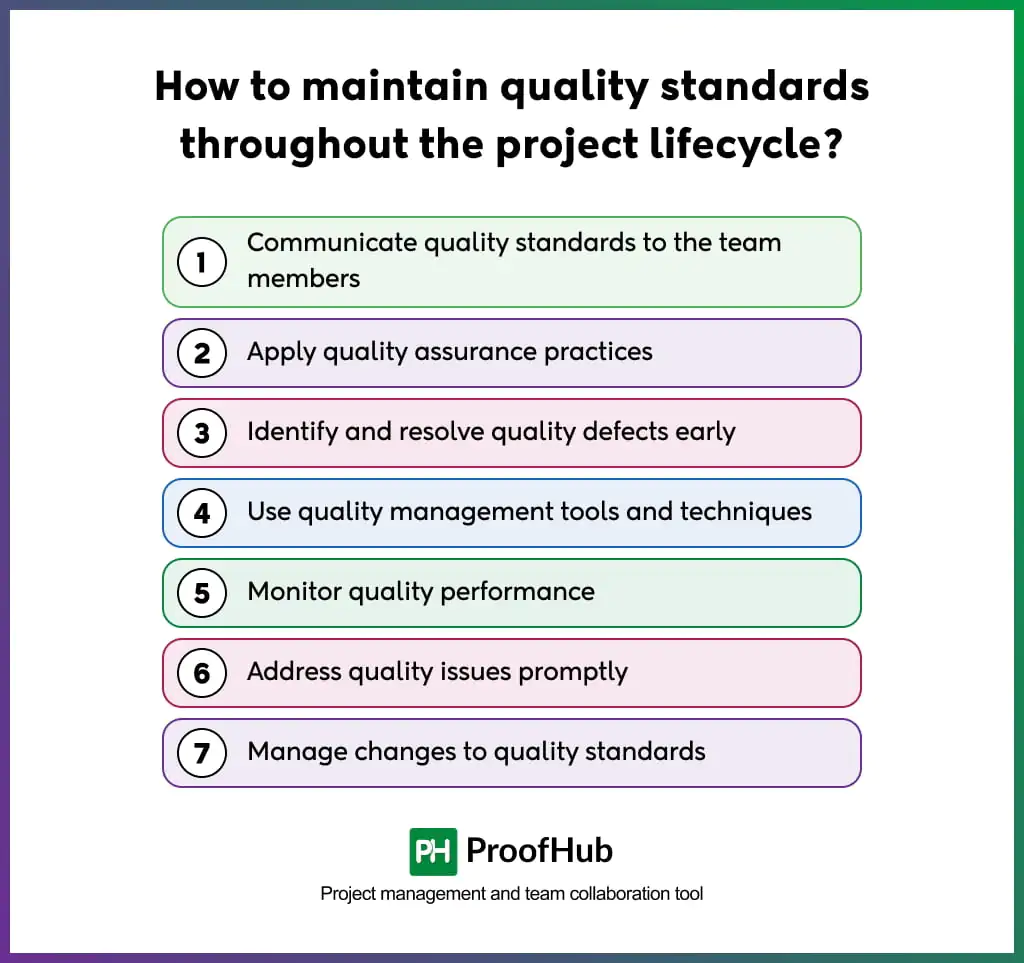
To maintain quality standards throughout the project lifecycle, follow the seven steps: communicate quality standards to the team, apply quality assurance practices, identify and resolve quality defects early, use quality management tools and techniques, monitor quality performance, address quality issues promptly, and manage changes to quality standards as the project evolves.
Maintaining these standards effectively requires following targeted steps:
1. Communicate quality standards to the team members
Use clear, concise language and visuals, such as charts, to ensure all team members easily understand the requirements.
Maintain transparency about the project constraints to effectively manage stakeholder expectations and avoid misunderstandings.
Establishing clear communications allows the team members to identify and resolve issues effectively while keeping everyone aligned on the project’s quality goals.
2. Apply quality assurance practices
Conduct regular process audits and ensure the team strictly adheres to established organizational standards and practices.
Implement a continuous inspection process to verify that the project activities align with the quality management plan and proceed without unnecessary risks.
This process-oriented approach optimizes workflows, minimizes variability, and ensures that deliverables are consistent across all phases of the project lifecycle.
3. Identify and resolve quality defects early
Identifying defects early prevents minor errors from escalating into larger, more costly quality problems that could jeopardize the project during its later phases.
Conduct regular quality audits, reviews, and inspections to detect any changes from requirements, specifications, or stakeholder expectations at the earliest possible stage.
This early capture of faults allows the team to correct errors immediately and ensures that all final work items meet the planned specifications.
4. Use quality management tools and techniques
Utilize tools like root cause analysis, process mapping, and statistical analysis to uncover specific areas needing improvement and enhance overall control.
Use tools like Statistical Process Control (SPC) to analyze data patterns, identify variations, and predict quality trends, enabling the team to make informed, data-driven decisions.
Leverage technology to automate quality processes, which improves operational efficiency, reduces the likelihood of human error, and enhances total visibility into quality performance.
5. Monitor quality performance
Track KPIs such as defect rates and customer satisfaction scores to gain real-time insights into the project’s ongoing quality levels.
Try using tools such as checklists, surveys, and audits to verify that each deliverable meets the established benchmark for success.
Ongoing monitoring ensures the project remains on track and provides the factual data needed to determine the overall success of the final results.
6. Address quality issues promptly
Find the root cause of any arising quality problems and immediately develop a formal corrective action plan to mitigate their impact on the project.
Implement these corrective measures quickly to prevent minor issues from affecting the final project outcome or causing significant, costly delays to the timeline.
Maintain a continuous tracking system for all corrective actions to verify they resolve the problem without introducing new delays, costs, or defects.
7. Manage changes to quality standards
Carefully assess the potential impact of the proposed changes on the project scope and the current quality management plan before any implementation.
Ensure all changes are formally reviewed and approved by the project sponsor and other relevant stakeholders to keep everyone aligned on the updated quality requirements.
Update all related documentation and communicate these changes clearly to the entire team to ensure consistency and a shared understanding of the new benchmarks.
What are the common mistakes to avoid while defining quality standards for projects?
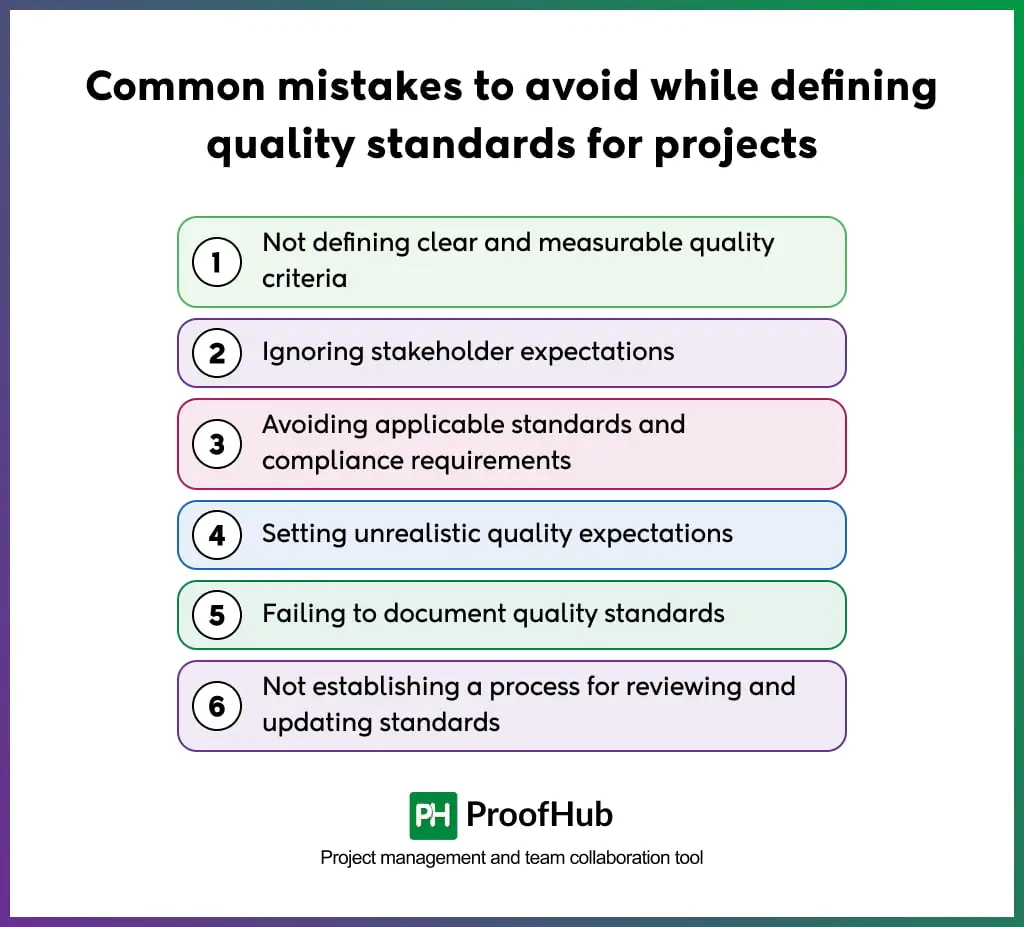
The common mistake that project managers make while defining the quality standards of a project is that they don’t define the measurable quality data clearly. Sometimes they ignore stakeholder expectations and compliance requirements, setting unrealistic quality expectations. They fail to document quality standards and cannot establish a process to review and update them.
While defining quality standards, avoid these common mistakes to ensure your project remains on track and meets its objectives:
- Not defining clear and measurable quality criteria: Vague quality expectations such as “high quality” or “user-friendly” leave too much room for interpretation. Without measurable criteria, team members may have different understandings of what constitutes an acceptable deliverable, making it difficult to assess performance objectively.
- Ignoring stakeholder expectations: Quality is ultimately judged by the people who use, approve, or fund the project. Defining standards without consulting stakeholders often results in deliverables that meet internal expectations but fail to satisfy customer or business requirements.
- Avoiding applicable standards and compliance requirements: Many projects must comply with industry regulations, contractual obligations, or organizational policies. Overlooking these requirements while defining quality standards can lead to failed audits, legal risks, product recalls, or customer dissatisfaction.
- Setting unrealistic quality expectations: Quality standards should challenge the team without exceeding available resources, budget, or project timelines. Setting overly ambitious benchmarks often creates unnecessary pressure, delays, and burnout while providing little additional value.
- Failing to document quality standards: Quality standards that exist only in discussions or individual understanding quickly become inconsistent as the project progresses. Different team members may follow different approaches, leading to confusion, inconsistent deliverables, and accountability issues.
- Not establishing a process to review and update standards: Project requirements, customer expectations, and business priorities often change during execution. If quality standards remain static, they may no longer reflect what the project needs to achieve.
Examples of quality standards in projects
Quality standards vary across projects depending on the industry, deliverables, and stakeholders’ expectations. While the specific requirements differ, every project defines clear standards to ensure work is completed consistently, complies with applicable regulations, and delivers the expected outcomes.
1. Software and IT project
A software development project for a customer-facing application defines quality standards, including coding standards, software testing requirements, cybersecurity guidelines, performance benchmarks, accessibility requirements, and user acceptance criteria.
These standards ensure the application is secure, reliable, easy to use, and performs consistently before it is released to end users.
2. Manufacturing project
A manufacturing project for launching a new product establishes quality standards for raw material specifications, production processes, equipment calibration, inspection procedures, product testing, and quality assurance practices.
These standards ensure products are manufactured consistently, meet design specifications, minimize defects, and comply with customer and regulatory requirements.
3. Construction project
A commercial building project defines quality standards covering building codes, material specifications, workmanship requirements, structural inspections, safety regulations, and quality control procedures.
These standards help ensure the structure is built safely, complies with legal requirements, meets engineering specifications, and delivers long-term durability.
4. Engineering project
An engineering project for designing industrial equipment establishes quality standards for design specifications, technical reviews, design validation, testing protocols, engineering documentation, and change management procedures.
These standards ensure the final design is technically accurate, safe to implement, compliant with regulations, and capable of meeting its intended performance requirements.
When should quality standards be defined during a project?
Quality standards should be defined during the quality planning phase, the foundational first step of the project lifecycle. They must be established before execution to create a baseline for success and provide the necessary benchmarks for measuring progress.
Who is responsible for defining quality standards in a project?
The project manager is primarily responsible for establishing quality goals and standards. However, this process must involve all the relevant stakeholders and the project team to ensure their needs and technical expertise are incorporated.
What happens if quality standards are not clearly defined?
Without clear quality standards, organizations lack the criteria to gauge whether a project is succeeding or failing. This leads to inconsistent practices, a failure to meet stakeholder expectations, and unresolved defects that escalate into major quality failures later in the project lifecycle.
Can quality standards change during a project?
Yes, quality standards can change and should be regularly reviewed and updated to maintain their relevance as requirements and priorities shift. Any changes must be carefully evaluated through a formal change management process and approved by the project sponsor and relevant stakeholders.
What is the difference between quality standards and acceptance criteria?
Quality standards define how well the project must be built (technical excellence), while acceptance criteria define what the project must do to be approved by the client (functional requirements).
What is the difference between quality standards and project requirements?
Quality standards define how well the deliverables must be executed to ensure safety, reliability, and excellence, while project requirements define what the project must deliver to solve a business problem.
Conclusion
Quality standards in projects provide a clear framework for defining, measuring, and maintaining the expected level of quality throughout project execution. By establishing measurable standards, documenting them, validating them with stakeholders, and monitoring compliance, project teams deliver consistent results while meeting organizational, regulatory, and customer requirements. Regardless of the industry or project type, well-defined quality standards improve decision-making, support effective quality management, and ensure every deliverable meets the requirements established at the start of the project.