
Project prioritization is the process of evaluating and ranking projects based on factors such as importance, urgency, feasibility, and available resources. The process helps teams focus on completing high-value, high-impact projects first that drive meaningful business ROI.
In this guide, let’s explore what project prioritization is, why it matters, steps to do it, the most effective frameworks to use, and common pitfalls to avoid along the way.
- 1.Project prioritization is a structured process for evaluating and ranking projects based on factors such as strategic alignment, business value, urgency, risk, and resource availability, so teams always know where to focus first.
- 2.The key benefits of project ranking include enhanced focus on high-impact work, optimized resource allocation, improved strategic alignment, better decision-making, higher ROI, maximized project success rates, and strengthened stakeholder alignment.
- 3.Key steps in project prioritization include defining strategic objectives, setting criteria, collecting project requests, scoring projects, validating against constraints, and re-prioritizing regularly.
- 4.Criteria such as business value, ROI, urgency, risk level, customer impact, regulatory compliance, and technological feasibility provide teams with a consistent basis for ranking projects.
- 5.Top prioritization frameworks involve RICE, MoSCoW, scoring model, value vs. effort matrix, Kano model, and story mapping.
What is project prioritization?
Project prioritization is the process of identifying and sequencing the important projects an organization should tackle first. It considers factors like strategic alignment with business goals, expected financial benefits, potential risks, urgency, resource availability, and more.
It enables project managers to make an informed decision on where and how to utilize limited resources, such as time, skills, and budget, to drive maximum business impact.
Why is project prioritization important?
Project prioritization is important because it enables managers to focus on high-impact work, optimize resource allocation, improve strategic alignment, make better decisions, maximize ROI, align stakeholders, and improve success rate.
Here are the benefits of project prioritization:
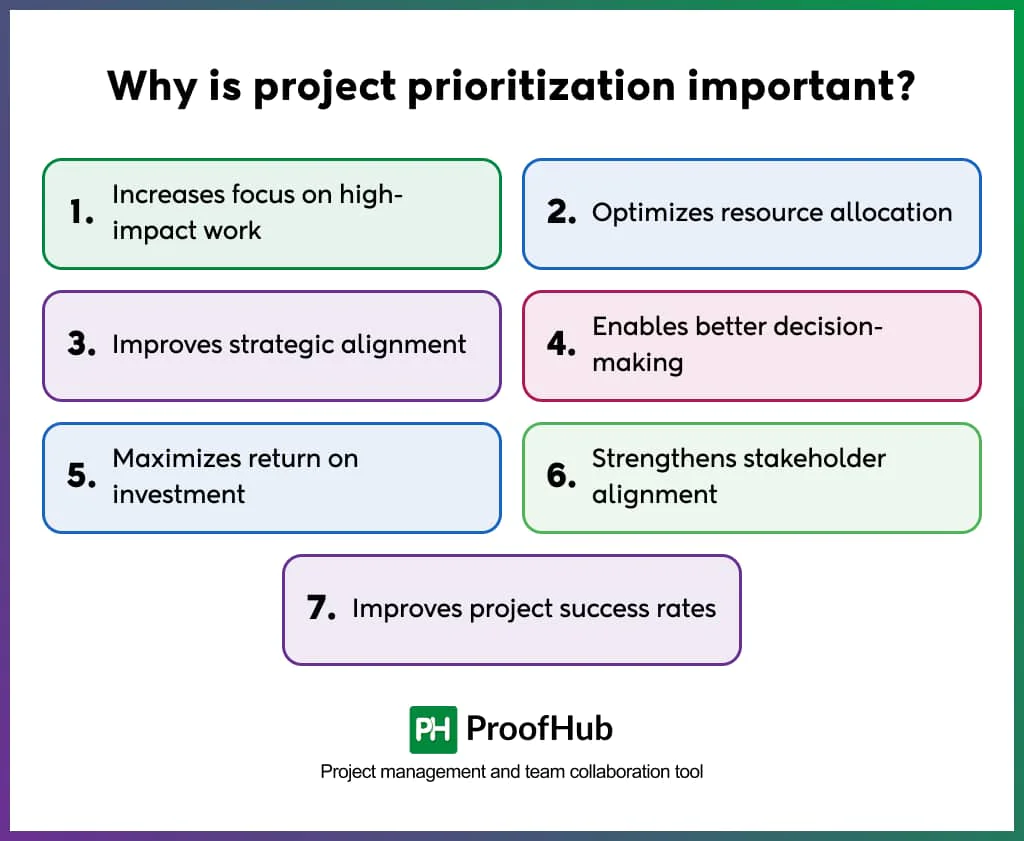
- Increases focus on high-impact work: Directs teams towards initiatives that create the most business value. Preventing wasting resources on low-priority tasks and contributing meaningfully to organizational growth.
- Optimizes resource allocation: Project prioritization helps assign the right people, budget, and tools to the right projects at the right time. Enabling organizations to utilize existing resources and prevent capacity wastage.
- Improves strategic alignment: Ensures current and pipeline initiatives align with the business’s long-term strategic goals. This allows managers to focus their efforts on projects that support the bigger picture.
- Enables better decision-making: Provides clear criteria and a structured evaluation process to assess initiatives. Enables informed decision-making on which projects to pursue, delay, or drop.
- Maximizes return on investment: Directs resources toward high-value projects that promise the strongest returns. It helps organizations boost profitability and improve overall financial outcomes.
- Strengthens stakeholder alignment: Keeps the stakeholders on the same page by providing a clear view of which projects are being prioritized and why. It reduces internal conflicts, manages expectations, and aligns teams around shared goals.
- Improves project success rates: Ensures the right projects receive the attention, resources, and clarity they need. Leading to better results, fewer delays, and stronger overall delivery performance.
How to prioritize projects effectively?
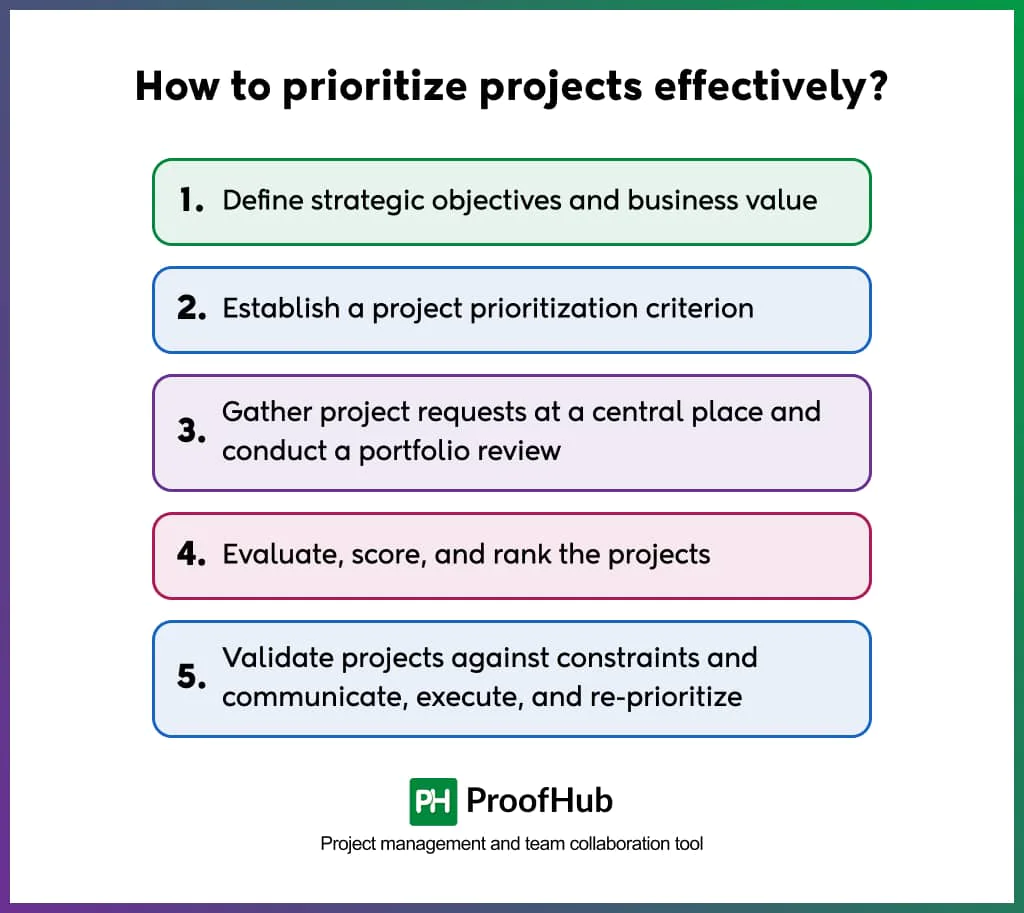
The five steps to prioritizing projects effectively are:
1. Define strategic objectives and business value
2. Establish a project prioritization criterion
3. Gather project requests at a central place and conduct a portfolio review
4. Evaluate, score, and rank the projects
5. Validate against constraints and communicate, execute, and re-prioritize
Here’s a step-by-step breakdown of how to do it right:
1. Define strategic objectives and business value
Evaluate the organization’s long-term strategic objectives. Whether it is focusing on revenue growth, customer retention, regulatory compliance, or enhancing operational efficiency?
A project that does not align with the business’s strategic goals is a project ready to fail. When goals are clarified upfront, it is easier to identify and rank projects that can meaningfully contribute to those objectives.
Assess the project for business value. Clearly define what valuable means to your business. For an organization, high-value projects can be projects that increase revenue, reduce operational costs, or improve customer service.
2. Establish a project prioritization criterion
A project prioritization criterion is a set of factors that help managers compare and score projects that are valuable for the organization.
Common prioritization criteria include:
- Business value and ROI: Determines whether a project is worth investing in based on the financial or strategic returns it promises. Calculate expected revenue impact, cost savings, and payback period. Prioritize projects delivering returns within 12–18 months over longer-term investments.
- Urgency and deadlines: Indicates how time-sensitive a project is based on regulatory requirements, market windows, or contractual obligations. Map out time-sensitive dependencies and create a deadline-based timeline. Ensure urgency never overrides strategic importance when making the final call.
- Risk level: Measures the likelihood of project failure and the potential impact on the business if it is delayed or canceled. Conduct a risk assessment and score projects based on the probability and severity of failure. Prepare mitigation plans for high-risk initiatives before assigning them a priority ranking.
- Resource availability: Determines whether the organization has the people, budget, and tools needed to execute a project right now. Evaluate current team capacity and tool readiness before finalizing priorities. Avoid prioritizing initiatives that the organization cannot realistically execute.
- Strategic alignment: Evaluates how directly a project contributes to the organization’s defined long-term goals and OKRs. Map each initiative against strategic priorities and assign scores based on the strength of that connection. Remove or defer projects that do not align with any defined business objective.
- Technological feasibility: Assesses whether the organization has the right technology, infrastructure, and technical expertise to deliver a project successfully. Identify capability gaps for each initiative and estimate the effort needed to close them. Deprioritize projects with major readiness gaps until requirements are met.
- Customer impact: Measures the extent to which a project improves customer satisfaction, loyalty, retention, or the overall experience. Assign higher scores to initiatives with direct and measurable customer outcomes. Consider customer feedback and usage patterns to validate impact estimates.
3. Gather project requests at a central place and conduct a portfolio review
Consolidate all project requests into a single, structured system such as a centralized dashboard, intake form, or project management platform.
Ensure each request includes standardized details such as objectives, scope, timelines, resource requirements, and expected business value. Centralization improves visibility, reduces duplication, and enables consistent evaluation.
Conduct a portfolio review by assessing all active and proposed projects collectively rather than in isolation.
Evaluate each initiative against defined criteria, including strategic alignment, impact, urgency, and resource availability. Compare projects objectively to determine priority, sequencing, or deferral.
A structured intake process, combined with portfolio-level evaluation, supports informed decision-making, aligns with organizational goals, and optimizes resource allocation.
4. Evaluate, score, and rank the projects
Evaluate and assign scores to each project based on the predefined criteria. Use a prioritization matrix or scoring model to attach weights and calculate a final weighted score for every initiative.
Rank all projects by total score once the evaluation is complete. Projects with the highest scores receive priority in resource allocation and execution.
Those with lower scores are either deferred to a later cycle, deprioritized within the current portfolio, or dropped entirely based on organizational capacity and strategic fit.
A structured scoring and ranking process eliminates subjectivity from prioritization decisions. It ensures that every project is evaluated on equal terms and provides teams with a clear, logical basis for moving forward.
5. Validate projects against constraints and communicate, execute, and re-prioritize
Validate the prioritized list against real-world constraints, including team capacity, budget, timelines, and technical dependencies. Confirm feasibility before moving forward, and adjust priorities when limitations affect delivery or resource allocation.
Identifying issues early helps prevent bottlenecks and ensures smooth project execution. Once validated, clearly communicate the priority list to all project stakeholders. Teams execute better when they understand the reasoning behind the decisions.
Communicating changes transparently builds trust and keeps everyone aligned from the start.
Building a re-prioritization plan keeps the portfolio healthy and responsive without creating unnecessary instability. Revisit the list periodically as priorities change over time. Business conditions change, new projects come in, and teams upskill themselves.
Project prioritization methods and frameworks
Project prioritization frameworks and methods are RICE, MoSCoW, scoring, value vs. effort matrix, Kano, and story mapping. Here are the detailed descriptions of these methods:
1. RICE method
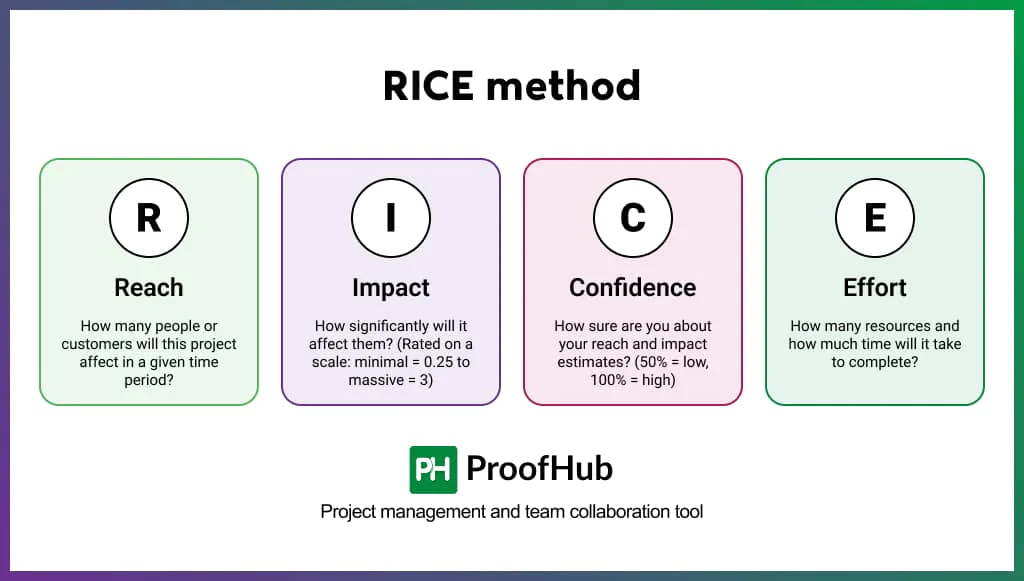
RICE stands for Reach, Impact, Confidence, and Effort. It’s a prioritization framework that gives each project a numerical score using the formula: (Reach × Impact × Confidence) ÷ Effort.
- Reach: How many people or customers will this project affect in a given time period?
- Impact: How significantly will it affect them? (Rated on a scale: minimal = 0.25 to massive = 3)
- Confidence: How sure are you about your reach and impact estimates? (50% = low, 100% = high)
- Effort: How many resources and how much time will it take to complete?
A higher RICE score means a higher priority. The framework is particularly useful for product and engineering teams who need to make data-driven decisions about a large backlog.
2. MoSCoW method
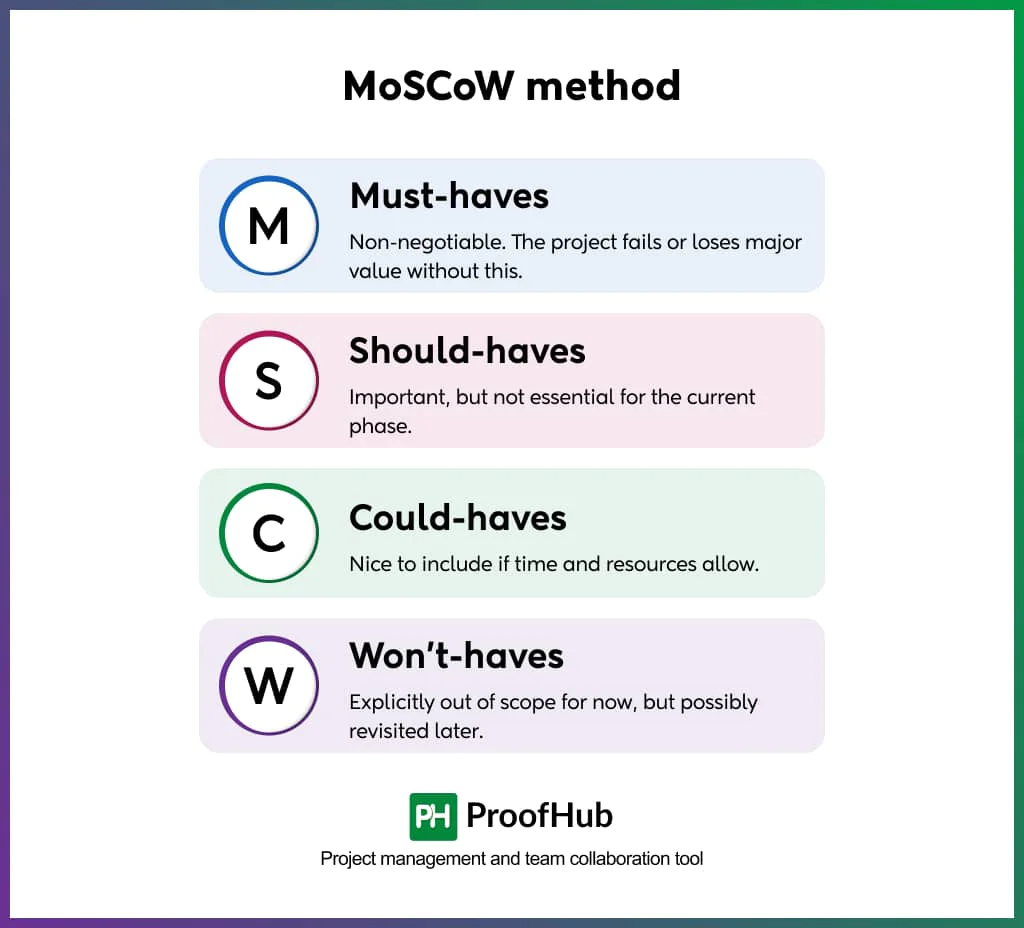
The MoSCoW method is a prioritization technique that categorizes projects or features into four groups based on their level of importance and urgency. Every initiative is placed into one of the following buckets:
- Must have: Non-negotiable. The project fails or loses major value without this.
- Should have: Important, but not essential for the current phase.
- Could have: Nice to include if time and resources allow.
- Won’t have: Explicitly out of scope for now, but possibly revisited later.
MoSCoW works well in agile environments, such as sprint planning, setting scope boundaries, and aligning stakeholders on what’s truly essential vs. what can wait.
3. Scoring model
A scoring model lets you evaluate projects against a weighted set of criteria, including:
- Strategic alignment – Measures how closely the project supports the organization’s defined long-term goals and OKRs.
- ROI – Evaluates the financial or strategic return the project is expected to generate.
- Resource demand – Assesses the level of people, budget, and tools required to successfully execute the project.
- Project risk – Determines the likelihood of failure and the potential impact on the business if the project is delayed or cancelled.
- Customer impact – tracks the extent to which the project improves customer experience, satisfaction, loyalty, or retention.
- Regulatory compliance – identifies whether the project is tied to a legal obligation, industry regulation, or government mandate that must be met.
Each project is scored against these factors, and the final weighted score makes it easy to compare all initiatives fairly and objectively. The scoring model is highly customizable and works well for PMOs managing large, diverse portfolios where apple-to-apple comparisons are difficult.
The scoring model looks like this:
4. Value vs Effort matrix
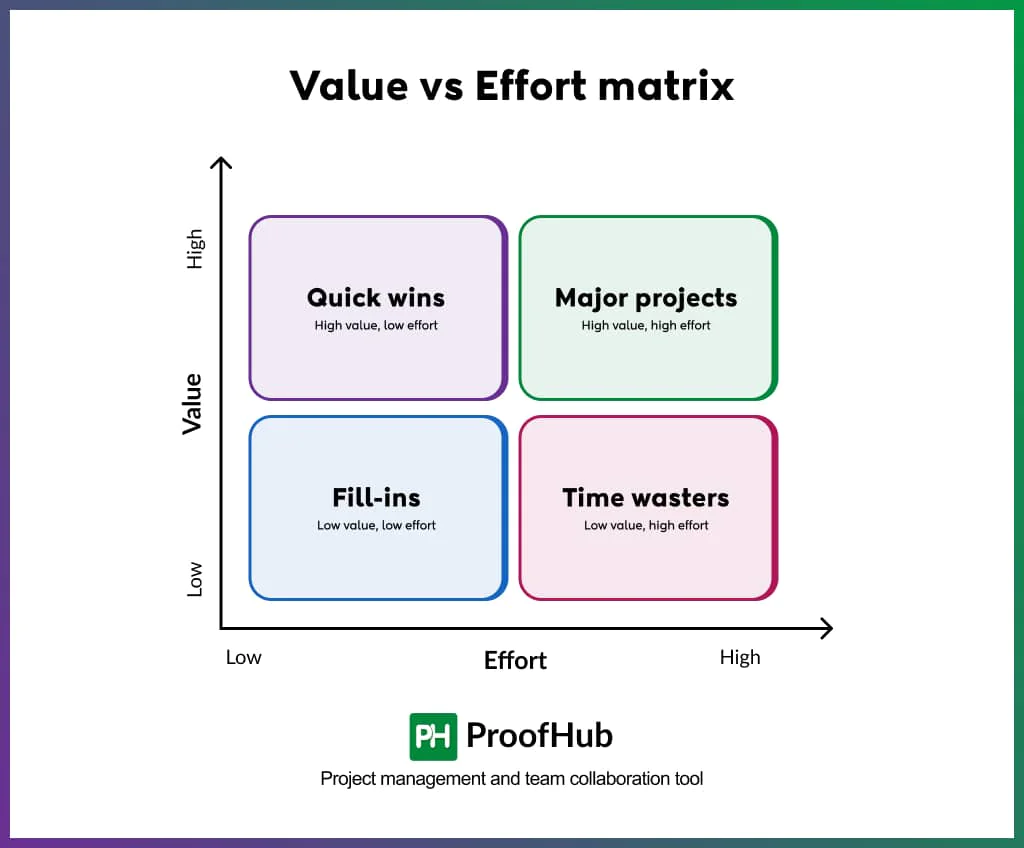
The Value vs. Effort matrix is a visual prioritization tool that helps teams evaluate and rank projects based on two dimensions: the value they deliver and the effort required to complete them. Projects are plotted on a two-by-two grid and fall into one of four quadrants:
- High value, low effort (quick wins): These projects deliver strong results without heavy resource investment. They are often called low-hanging fruit. So, prioritize and execute them immediately.
- High value, high effort (major projects): Provide significant benefits but require substantial investment. Plan carefully and allocate resources thoughtfully.
- Low-value, low-effort (fill-ins): Offer limited impact but are easy to complete. Do these when capacity allows, but don’t let them crowd out higher-priority work.
- Low value, high effort (time wasters): Require high resources without a meaningful return. Eliminate or postpone unless justified by specific needs.
This matrix is great for rapid prioritization sessions and especially effective for quickly visualizing trade-offs.
5. Kano model
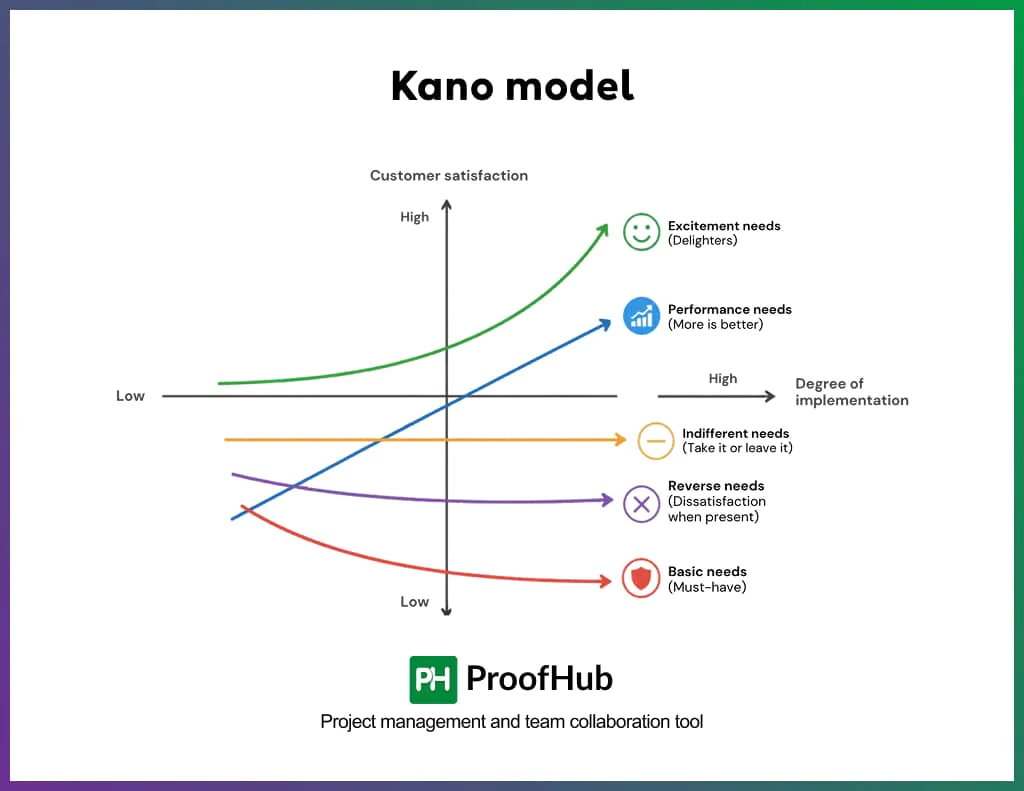
The Kano model is a customer-centric framework that classifies projects or features according to their impact on customer satisfaction. It groups them into five main categories:
- Basic needs (must-have): These are the fundamental features that customers expect by default. For example, calling and messaging functionality in a smartphone.
- Performance needs (more is better): Features that have a direct relationship with customer satisfaction. The more you deliver, the happier customers are. For example, a faster load time in a software platform.
- Excitement needs (delighters): Unexpected features that delight customers and build loyalty. For example: AI-powered features in a project tool.
- Indifferent needs (take it or leave it): Features that have little to no impact on customer satisfaction, regardless of whether they exist or not. For example, offering multiple color themes in a project dashboard.
- Reverse needs (dissatisfaction when present): Features that actually cause dissatisfaction when included. For example, pre-installed notifications or pop-ups.
The Kano model helps prioritize projects that actually move the needle on customer experience, making it valuable for product development and service design teams.
6. Story mapping
Story mapping is a visual prioritization technique that organizes project tasks and features along two axes: the user journey (horizontal) and priority level (vertical). It’s most commonly used in Agile environments to prioritize backlog items and plan releases.
By mapping out what users need to do and in what order, teams can identify the most critical parts of the user experience. Projects and features that support those parts get prioritized first, while delaying or dropping the rest.
What are the common pitfalls to avoid in project prioritization?
Common pitfalls to avoid in project prioritization include a lack of shared vision, unclear criteria, poor resource assessment, ignored dependencies, overlooked risks, and undervalued intangible benefits.
Read on to understand each one in detail:
1. Lack of shared vision for strategic objectives
Without a clear understanding of the company’s strategic goals, stakeholders prioritize projects based on personal preferences and visibility. As a result, important projects receive less attention, thereby impacting the overall business performance.
2. Unclear project prioritization criteria
Absence of well-defined evaluation criteria leads to inconsistent decision-making. When scoring factors such as impact, urgency, or effort are not clearly established, prioritization becomes subjective and difficult to justify across stakeholders.
3. Inadequate assessment of resource capacity
Prioritizing projects without evaluating your internal resources’ capacity creates bottlenecks and unnecessary delays. As a result, it leads to last-minute firefighting, low-quality work, and client dissatisfaction.
4. Ignoring project dependencies
Failing to map out dependencies between projects always leads to surprise delays mid-execution. Prioritizing a low-priority project might block a high-priority one, resulting in severe cascading issues.
5. Ignoring potential risks
Every project is associated with risk, including scope creep, resource unavailability, or underlying technical issues. Failing to evaluate these risks during prioritization results in committing resources to high-risk initiatives without a strategic mitigation plan.
6. Ignoring intangible benefits
Not every valuable project shows up clearly in a financial model. Some projects promise benefits that are hard to quantify, such as enhancing brand reputation, boosting employee morale, and increasing customer trust.
Real-world example of project prioritization
Let’s say a mid-sized software company has five projects in the pipeline for the next quarter: a mobile app redesign, a security patch rollout, a new CRM integration, an internal reporting dashboard, and a customer onboarding improvement initiative.
Using a simple scoring model with three criteria: strategic alignment, ROI potential, and urgency, the team scores each project on a scale of 1 to 5 and assigns weights: strategic alignment (40%), ROI (35%), and urgency (25%).
Also, for a 1–5 scale, here’s what each score means:
After scoring, here’s how the projects rank:
Based on the scores, the mobile app redesign ranks first (highest strategic value and ROI), followed by the CRM integration and security patch. The internal reporting dashboard is pushed to the bottom and delayed to the next quarter. Now, the team has a clear, logical reasoning for resource allocation, eliminating any loud voices and guesswork.
Who is responsible for project prioritization?
Project prioritization is typically led by the Project Management Office (PMO) or senior project managers, but it’s not a solo job. Input comes from department heads, project leads, finance teams, and key stakeholders who understand both the strategic direction and ground-level constraints.
What happens when projects are not prioritized?
Without prioritization, organizations often fall into a reactive mode. Project start chasing whatever feels most urgent at any given moment. Leads to resource overload, where teams are stretched across multiple projects and are making slow progress on all of them. Important strategic work gets pushed aside in favor of the loudest requests.
Deadlines slip, budgets overrun, and teams burn out. Stakeholders lose confidence when they can’t see a clear plan, and morale suffers when effort doesn’t turn into results.
How often should projects be reprioritized?
Most teams prefer to review priorities quarterly because they have enough time to see meaningful progress and are frequent enough to adapt to changes. However, in fast-moving industries or agile teams, monthly or sprint-by-sprint reviews are used to implement feedback in a timely manner.
What is the difference between quantitative and qualitative prioritization approaches?
The difference between quantitative and qualitative prioritization approaches is:
What is the difference between project prioritization and task prioritization?
The difference between project prioritization and task prioritization is:
Final thoughts
Project prioritization has become essential for organizations managing multiple projects. The approach allows managers to focus on the high-value, high-priority projects to generate meaningful outcomes and drive sustainable business growth. When done well, it aligns resources with business goals, reduces capacity wastage, and gives the team the clarity they need to do their best work. Utilize the above-cited prioritization frameworks to map urgency, define criteria upfront, and revisit priorities regularly.