Project execution is where plans stop being documented and start becoming reality. It’s the phase that determines whether a well-built strategy actually delivers, or quietly falls apart under real-world pressure.
From assigning tasks and managing resources to tracking progress and handling the unexpected, execution is where project managers earn their keep.
This informative blog breaks down what project execution really involves, why it matters, the methodologies that guide it, the challenges that derail it, and the practices that keep it on track.
Read on to get a complete, practical understanding of how to execute projects successfully.
- 1.Project execution is the phase where approved plans turn into actual work, and it’s the real test of whether a strategy holds up once resources, timelines, and people are in motion.
- 2.Without continuous progress tracking against the baseline plan, small schedule or budget slips go unnoticed until they’ve already compounded into bigger problems.
- 3.Communication breakdowns, not flawed planning, are the leading reason execution falls apart, because delays and misalignment often come from information not reaching the right people in time.
- 4.Scope creep, the uncontrolled expansion of work beyond what was originally planned, affects over half of all projects and remains one of the most damaging execution risks if not locked down early.
- 5.The right execution methodology depends on how predictable the work is, Waterfall suits fixed-scope projects, Agile suits projects with evolving requirements, and Hybrid blends both for complex initiatives.
- 6.Building quality checks into every milestone, rather than waiting until final delivery, catches defects when they’re still cheap and easy to fix.
- 7.Strong execution ultimately comes down to clear task ownership and real-time visibility, accountability is what keeps planned work and actual progress from drifting apart.
What is project execution?
Project execution is the phase where approved plans are put into action. It bridges planning and delivery by turning documented strategies into real work.
Teams carry out assigned tasks, resources are deployed, and the project manager ensures everything aligns with the defined scope, timeline, and budget.
Execution works alongside monitoring to catch deviations early, making it the phase where plans either hold up or get stress-tested against reality.
Why is project execution important?
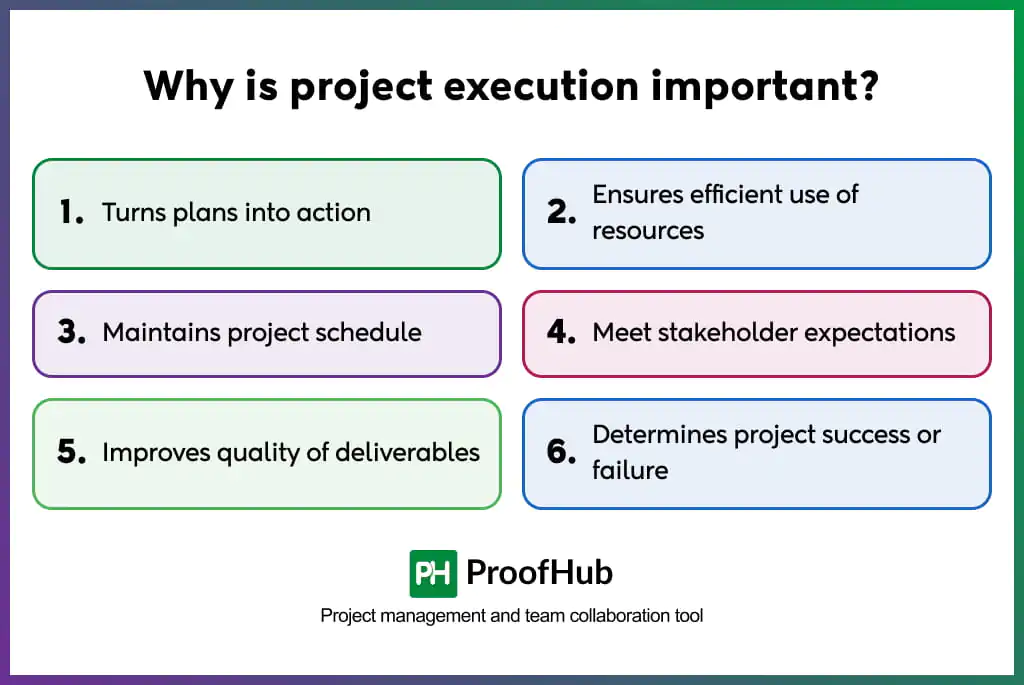
The project execution phase is important because it turns plans into action, ensures efficient use of resources, maintains the project schedule, meets stakeholder expectations, improves the quality of deliverables, and determines project success or failure.
Here are the reasons why it is important to:
- Turns plans into action: Converts approved project documents into assigned tasks and real work. Execution converts documented strategies, timelines, and resource allocations into tangible output. Without it, even the most detailed project plan remains theoretical.
- Ensures efficient use of resources: Allows project managers to actively allocate resources where they are needed most, reducing waste and preventing bottlenecks before they escalate.
- Maintains project schedule: Keeps task progress aligned with the approved baseline timeline. Allowing managers to spot delays early and make adjustments before they compound into larger schedule overruns.
- Meet stakeholder expectations: Helps deliver outcomes that match what stakeholders reviewed and approved during planning. Regular updates and milestone completions build trust and keep expectations grounded in actual progress.
- Improves quality of deliverables: Ensures outputs meet defined standards before moving to the next phase rather than after problems surface at delivery.
- Determines project success or failure: It directly affects final outcomes. Strong execution holds scope, cost, and quality together; poor execution unravels even the strongest project plans.
What is a project execution plan?
A project execution plan (PEP) is a formal document that defines how a project will be executed, monitored, and controlled, detailing scope, schedule, resources, roles, and risk management approaches.
It helps teams stay aligned on deliverables, timelines, and accountability, reducing ambiguity and rework once work begins.
It is created during the planning phase, right after the project charter and scope are approved, before execution starts.
What should be included in a project execution plan?
The project execution plan includes project organization, scope, schedule, resource allocation, budget, risk management, and communication.
Each element addresses a specific operational need, and together they ensure no critical detail is overlooked once work begins.
Let’s learn more about these seven core components:
- Project organization: Defines the project’s reporting structure, listing key roles like project manager, sponsors, and team leads along with their responsibilities and decision-making authority. It clarifies who approves changes, who resolves conflicts, and how escalations move up the chain, so accountability never becomes a guessing game mid-project.
- Project scope: Outlines deliverables, boundaries, and exclusions, ensuring everyone agrees on what the project will and won’t cover before work begins. A well-defined scope statement, often paired with a work breakdown structure, prevents scope creep by giving the team a clear reference point to validate new requests against.
- Project schedule: Breaks down tasks, milestones, and deadlines into a timeline, often using Gantt charts to show dependencies and the critical path. It also flags which tasks can run in parallel and which must wait on others, helping the team sequence work realistically instead of optimistically.
- Resource allocation: Specifies which people, tools, and materials are assigned to each task, preventing overallocation and ensuring availability matches demand. This section typically maps skill sets to task requirements, so the right person is working on the right deliverable at the right time.
- Project budget: Details estimated costs across labor, materials, and contingencies, serving as the baseline for tracking spending throughout execution. It also defines thresholds for cost variance, alerting the team early if actual spend starts drifting from projections.
- Risk management plan: Identifies potential risks, their likelihood and impact, and outlines mitigation or contingency strategies to minimize disruption. It assigns risk owners and review checkpoints, turning risk management from a one-time exercise into an ongoing practice.
- Communication plan: Establishes how, when, and with whom project updates are shared, including reporting frequency, channels, and escalation paths for issues. It ensures stakeholders get the right level of detail, avoiding both information overload and critical gaps in visibility.
What are the key components of the project execution phase?
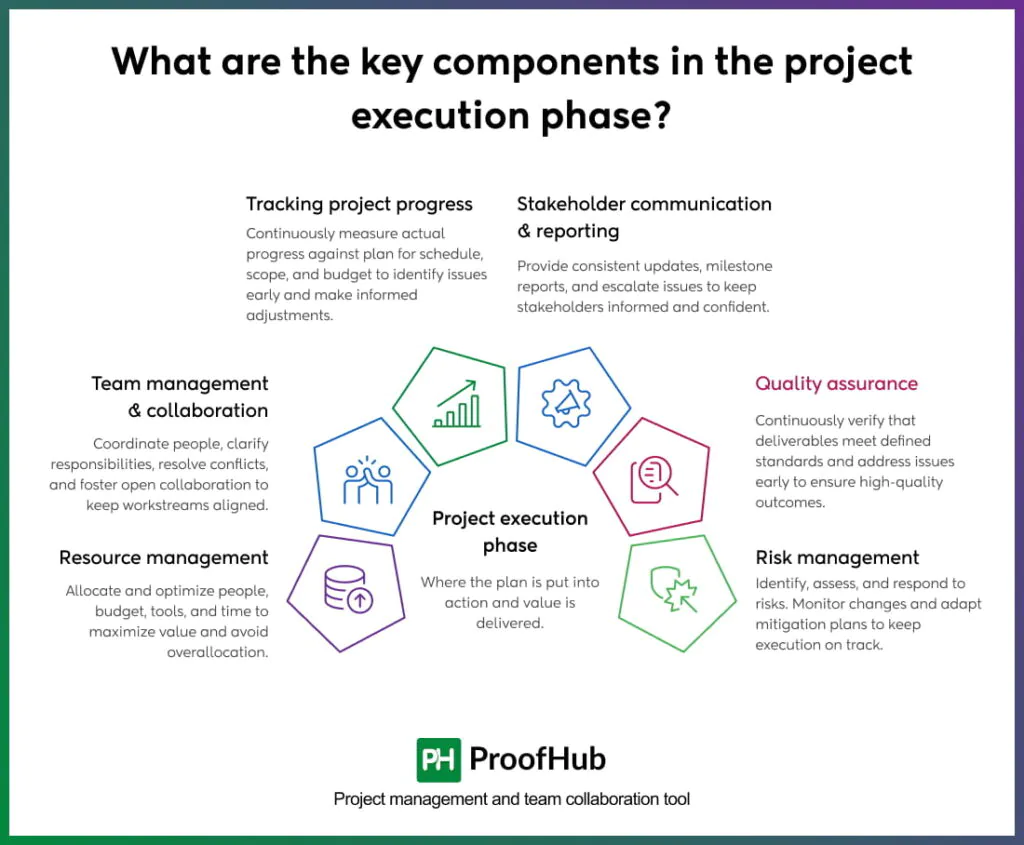
The six key components in the project execution phase are resource management, team management and collaboration, tracking project progress, stakeholder communication and reporting, quality assurance, and risk management
The project execution phase is the core of the project lifecycle where the actual work takes place. Its primary goal is to carry out the project plan, coordinate resources, and produce the required deliverables.
Key components to focus on during this phase include:
1. Resource management
Resource management is the process of allocating and optimizing people, budget, tools, and time throughout execution.
It ensures every resource is deployed where it delivers the most value, prevents overallocation, and keeps project costs from exceeding the approved baseline.
Effective resource management directly determines whether teams can sustain output without burnout or budget overrun.
2. Team management and collaboration
Team management and collaboration are the practice of coordinating people, clarifying responsibilities, and maintaining alignment across all workstreams.
During execution, project managers assign tasks based on skills, resolve conflicts, and create the conditions for teams to work efficiently.
Strong collaboration keeps communication open and ensures no work falls through the gaps between team members or departments.
3. Tracking project progress
Tracking project progress is the continuous process of measuring actual work completed against the planned schedule, scope, and budget.
It gives project managers a real-time view of where the project stands, flags delays before they escalate, and provides the data needed to make informed adjustments.
Without consistent tracking, execution runs blind.
4. Stakeholder communication and reporting
Stakeholder communication and reporting is the structured process of keeping decision-makers and involved parties informed throughout execution.
It includes status updates, milestone reports, and escalation of issues that require approval or intervention.
Consistent reporting builds stakeholder confidence and ensures no surprises surface at the delivery stage.
5. Quality assurance
Quality assurance is the ongoing process of verifying that deliverables meet the standards defined during planning.
It runs parallel to execution rather than waiting until the end, catching defects and gaps early when they are easier and less costly to fix.
QA protects the credibility of the final output.
6. Risk management
Risk management is the active process of identifying, assessing, and responding to threats that could disrupt execution.
It involves monitoring known risks, updating mitigation plans as conditions change, and acting quickly when new risks emerge.
Proactive risk management keeps execution on track even when circumstances shift unexpectedly.
What are the key activities in a project execution?
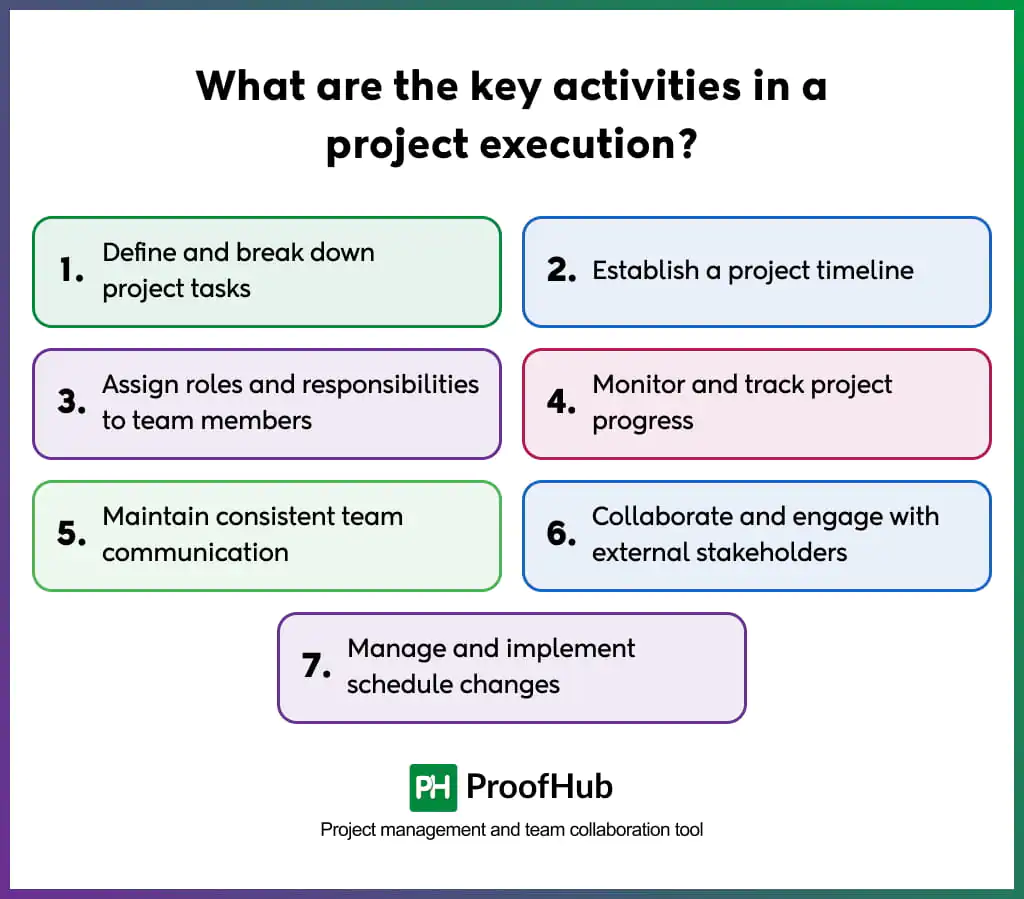
The key activities in project execution are defining and breaking down tasks, establishing a timeline, assigning roles, monitoring progress, maintaining communication, engaging stakeholders, and managing schedule changes.
It is the core phase where plans are put into action to build and deliver the project’s output.
Here is a closer look at each:
1. Define and break down project tasks
Divide the overall project scope into specific, actionable work items that teams can execute.
Breaking tasks down eliminates ambiguity, makes workloads manageable, and ensures every deliverable has a clear owner and deadline.
It sets the foundation for everything that follows in execution.
2. Establish a project timeline
Set a structured schedule that sequences tasks, assigns deadlines, and maps dependencies across the project.
A well-built timeline gives the team a shared reference point for prioritization and keeps execution moving in the right order.
It also creates the baseline against which progress is measured throughout the phase.
3. Assign roles and responsibilities to team members
Assign the right people to the right tasks based on skills, availability, and project requirements. It eliminates duplication and closes accountability gaps.
It helps team members know exactly what they are responsible for delivering and by when, keeping execution focused and organized.
4. Monitor and track project progress
Continuously measure task completion, resource usage, and timeline adherence against the approved plan. It gives you the visibility to catch deviations early.
Regular monitoring enables corrective action before small delays compound into larger schedule or budget overruns.
5. Maintain consistent team communication
Maintain regular check-ins, updates, and feedback to keep all team members informed and aligned.
Strong internal communication reduces misalignment, surfaces issues before they escalate, and ensures the entire team moves in the same direction throughout execution.
6. Collaborate and engage with external stakeholders
Actively involve clients, sponsors, vendors, and other external parties to keep expectations managed. Collaborating with stakeholders ensures their input is captured at the right time.
Engaging consistently prevents late-stage surprises that can disrupt delivery.
7. Manage and implement schedule changes
When scope shifts, risks materialize, or delays occur, evaluate changes to the project timeline and incorporate them in a controlled way.
Structured change management protects execution from unplanned disruption and keeps the team focused on the final delivery date.
What are the key deliverables of the project execution phase?
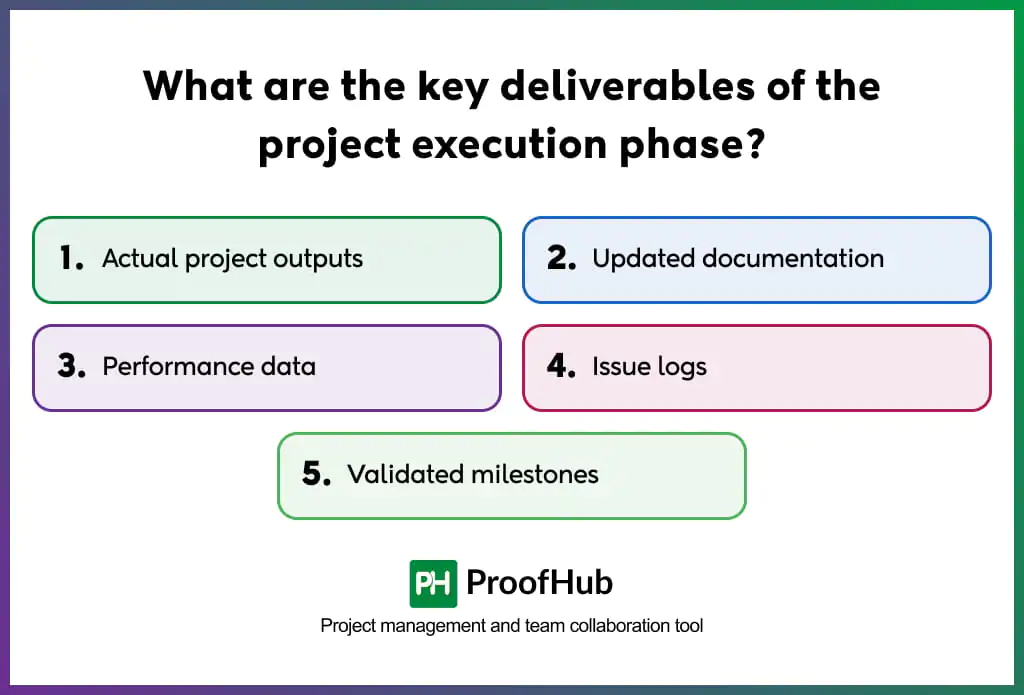
The key deliverables of the project execution phase are actual project outputs (products/services), updated documentation (change logs, revised timelines), performance data, issue logs, and validated milestones.
The execution phase deliverables are the tangible and documented outputs that confirm work is progressing as planned and meeting the standards set during project planning.
They serve as proof points that execution is on track and give stakeholders, teams, and project managers a concrete basis for decisions.
Here is what each deliverable covers:
1. Actual project outputs
Actual project outputs are the physical or functional results produced during execution, including products built, services launched, or solutions deployed.
They represent the core purpose of the project and are the primary measure of whether execution has delivered what was promised.
2. Updated documentation
Revised project records that reflect changes made during execution, including change logs, updated timelines, and amended scope documents.
Keeping documentation current ensures the entire team works from accurate information throughout the phase.
3. Performance data
Measurable records of how execution tracks against the approved plan, covering schedule adherence, budget consumption, and resource utilization.
Project managers use this data to identify gaps and take corrective action before issues compound.
4. Issue logs
Structured records of problems, blockers, and risks that surface during execution along with the actions taken to resolve them.
Maintaining issue logs creates accountability and ensures nothing gets overlooked or forgotten mid-project.
5. Validated milestones
Formally confirmed checkpoints that signal a significant phase of work has been completed to the required standard.
Validated milestones give stakeholders confidence that execution is progressing and that the project remains on course for delivery.
What methodologies are used for project execution?
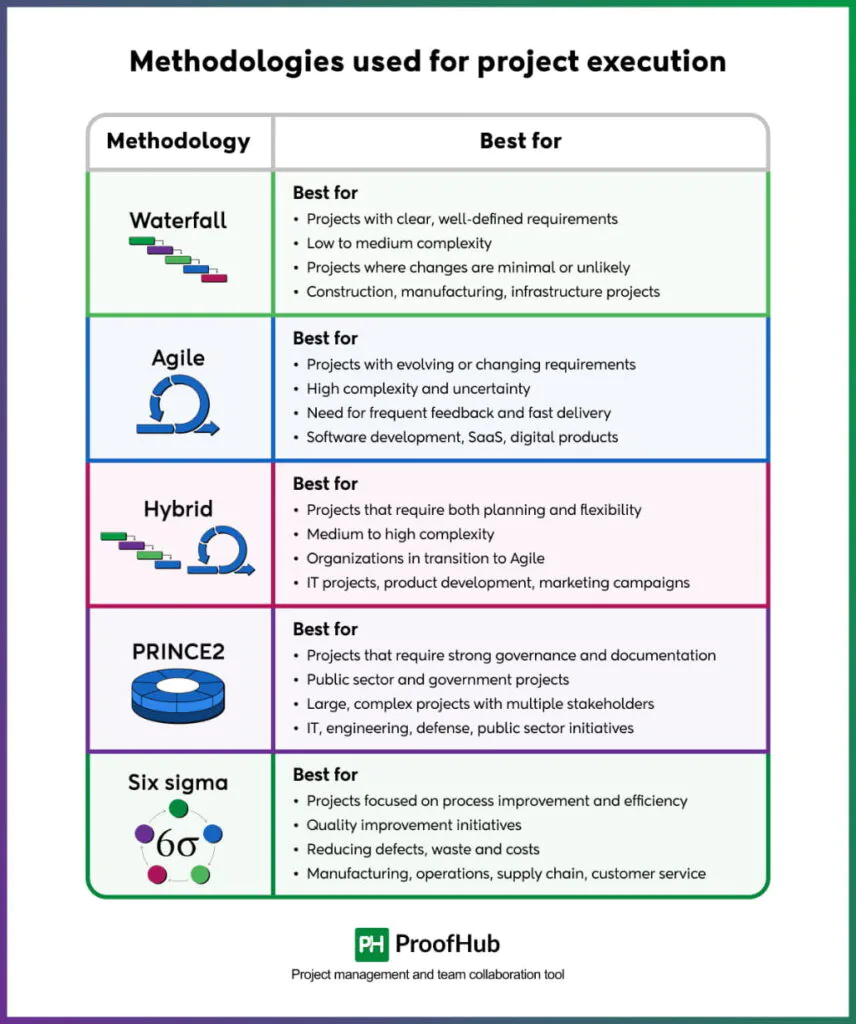
The methodologies used for project execution are waterfall, agile, hybrid, PRINCE2, six sigma.
These project execution methodologies are structured frameworks used to guide a project from initiation to completion, ensuring tasks are organized, risks are minimized, and goals are achieved efficiently.
Here is a breakdown of each:
1. Waterfall
Waterfall is a linear or sequential methodology where each phase must be completed before the next begins.
Waterfall brings clarity to execution by giving teams a fixed roadmap, defined handoffs, and predictable milestones.
It works best for projects with fixed scope, clear requirements, and little expectation of change, such as construction, manufacturing, or compliance-driven initiatives.
2. Agile
Agile breaks execution into short cycles called sprints, allowing teams to adapt based on feedback and changing requirements.
Agile keeps execution flexible and responsive, enabling teams to course-correct quickly without derailing the entire project.
It is best suited for software development, product design, and any project where requirements are likely to evolve throughout execution.
3. Hybrid
A combination of Waterfall and Agile that applies structured planning to fixed elements while keeping iterative flexibility for areas of uncertainty.
Hybrid methodology allows project execution teams to maintain control over stable workstreams while staying adaptive where change is inevitable.
It works best for complex projects with both fixed and evolving components, such as large-scale digital transformation initiatives.
4. PRINCE2
PRINCE2 is a process-driven methodology built around defined roles, controlled stages, and continuous business justification.
PRINCE2 strengthens execution by ensuring every stage is formally reviewed, approved, and accountable before work proceeds.
It is best suited for government projects, enterprise-level programs, and organizations that require strong governance, clear accountability, and detailed documentation throughout execution.
5. Six Sigma
A data-driven methodology focused on eliminating defects and reducing process variation through structured analysis.
Six Sigma improves execution quality by grounding decisions in measurable data rather than assumptions, keeping output consistent and reliable.
It is best suited for manufacturing, operations, and quality improvement projects where measurable performance gains and process consistency are the primary objectives.
What are the common challenges in the project execution phase?
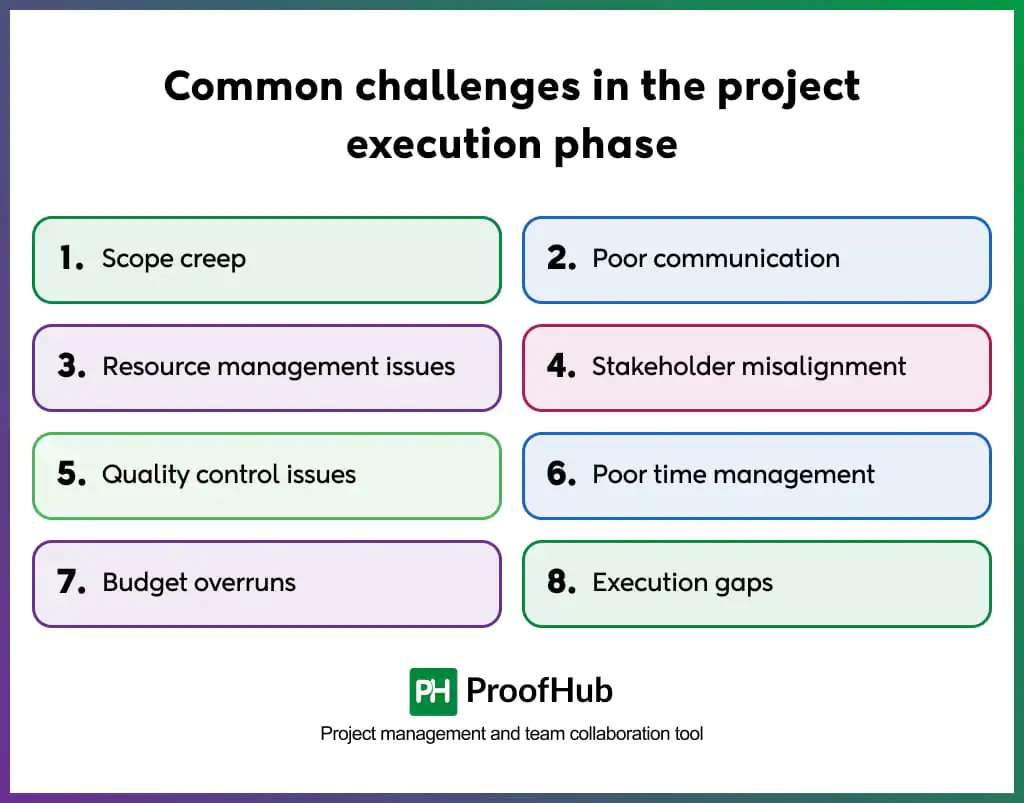
The common challenges in the project execution phase are scope creep, poor communication, resource management issues, stakeholder misalignment, quality control issues, poor time management, budget overruns, and execution gaps.
Even with thorough planning, real-world execution often brings unexpected challenges that project managers and teams must quickly navigate.
Here are the challenges that mainly occur in the project execution phase:
1. Scope creep
Scope creep occurs when more work gets added than originally planned, work that cannot be absorbed without the project missing key objectives or passing up opportunities. It results in wasted money, lower satisfaction, and delayed benefits.
According to PMI’s 2018 Pulse of the Profession report, 52% of projects experienced scope creep, up from 43% five years earlier, and even high-performing organizations are not immune since about one-third of their projects face scope creep, compared to 69% for underperformers.
Solution: Lock scope through a formal change control process and require sign-off for any deviation from the original plan.
2. Poor communication
Poor communication stems from scattered channels, inconsistent reporting, or assumptions that everyone has the same information. The result is duplicated work, missed deadlines, and misaligned priorities across teams.
Communication breakdowns are consistently cited as a leading cause of project failure because they erode trust and slow down decision-making exactly when speed matters most.
Solution: Set up structured check-ins and a single source of truth for project updates so everyone works from the same information.
3. Resource management issues
Resource management issues occur when people, budget, or tools are misallocated, overcommitted, or unavailable when execution needs them most.
It is caused when initially planned resources are not adjusted to the shifting project priorities.
Resource conflicts are common and difficult to predict without active oversight throughout execution.
Solution: Track resource allocation in real time and rebalance workloads before bottlenecks affect the schedule.
4. Stakeholder misalignment
Stakeholder misalignment happens when different stakeholders hold conflicting expectations about scope, priorities, or what success looks like.
Misalignment can come from unclear charters, infrequent stakeholder engagement, or assumptions made during planning that were never validated.
On larger projects, with multiple departments or external partners involved, the risk multiplies since each stakeholder group may prioritize different outcomes.
Solution: Establish a shared project charter early and revisit it during reviews to keep all stakeholders aligned on priorities.
5. Quality control issues
Quality control issues arise when deliverables fail to meet the standards defined during planning, often because checks happen too late in the process.
Quality issues are common in projects with tight deadlines or insufficient testing phases, where verification gets compressed or skipped entirely to keep pace with the schedule.
Solution: Build quality checks into each milestone instead of waiting until final delivery to catch defects.
6. Poor time management
Poor time management causes due to unrealistic timeline estimates, unclear task dependencies, or shifting priorities mid-project.
It often stems from a combination of overoptimistic planning and a lack of buffer for the unexpected.
The scale of the problem is reflected in PMI 2021 Pulse of the Profession Report: only 59% of projects were completed on time in 2021, meaning a significant share of projects still miss their deadlines despite improvements in recent years.
Without active tracking, these delays often go unnoticed until they have already affected the final delivery date.
Solution: Use a detailed timeline with buffer periods and review task progress against it on a consistent cadence.
7. Budget overruns
Budget overruns are triggered by scope changes, inaccurate cost estimates, or inefficient resource use.
Budget overruns are common in projects without clear financial checkpoints, where spending is reviewed only at major milestones rather than continuously.
By the time the issue surfaces, course-correcting often requires difficult tradeoffs in scope or quality.
Solution: Monitor spending against the budget weekly and flag variances early enough to course-correct.
8. Execution gaps
Execution gaps occur due to weak progress tracking, unclear task ownership, or insufficient visibility into day-to-day work.
Small gaps are easy to miss early on, but they widen as execution progresses, eventually causing missed deliverables or rework.
Execution gaps are common in larger teams where accountability is distributed and no single person has full visibility into how planned work compares to actual progress.
Solution: Assign clear task ownership and use progress tracking tools to catch gaps between planning and execution before they widen.
Best practices for successful project execution
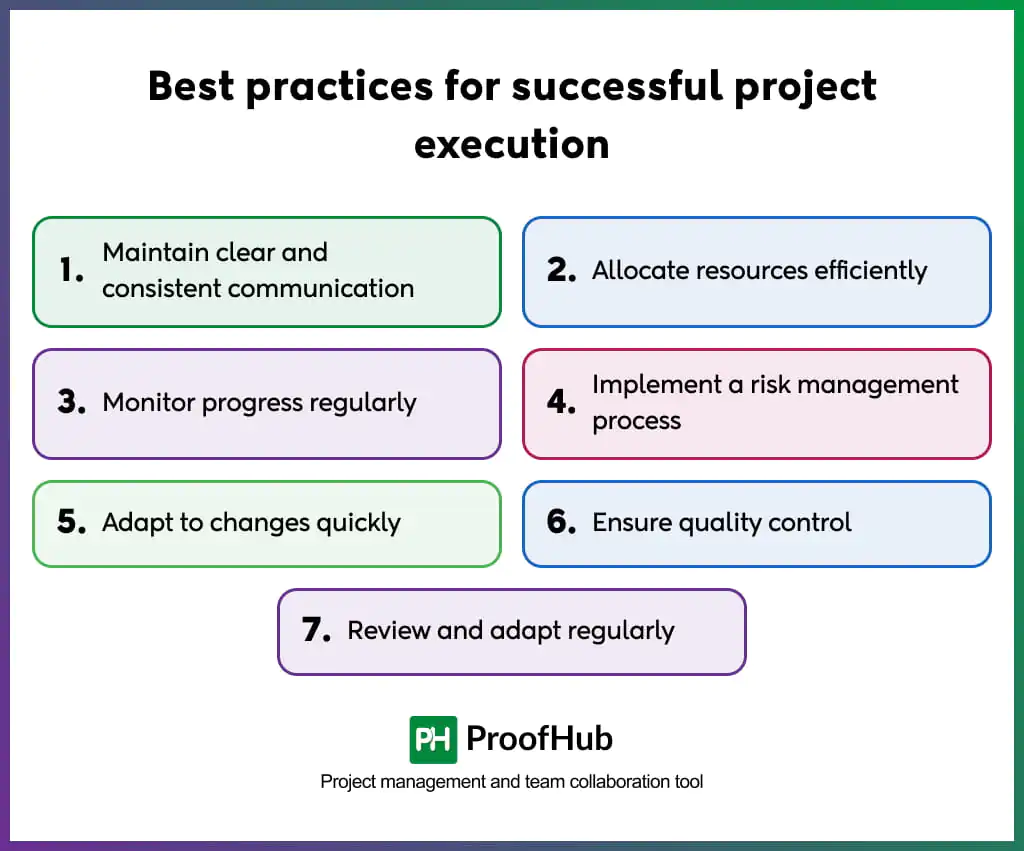
The best practices for successful project execution are: maintain clear and consistent communication, allocate resources efficiently, monitor progress regularly, implement a risk management process, adapt to changes quickly, ensure quality control, and review and adapt regularly.
Here’s what each one looks like in action:
- Maintain clear and consistent communication: Keep all team members and stakeholders informed through regular updates, structured check-ins, and a single source of truth. It ensures everyone moves in the same direction and surfaces issues before they escalate.
- Allocate resources efficiently: Deploy people, budget, and tools where they create the most value, and adjusting allocations as priorities shift. Efficient resourcing keeps execution running smoothly without overcommitting any single part of the team.
- Monitor progress regularly: Track task completion, schedule adherence, and budget consumption against the baseline plan. It gives early visibility into deviations and allows project managers to course-correct before small delays become major setbacks.
- Implement a risk management process: Identify potential risks early and build mitigation plans before they cause project execution to be blindsided. A defined risk process keeps the team prepared rather than reactive.
- Adapt to changes quickly: Respond swiftly to shifting requirements, new constraints, or unexpected obstacles without losing sight of the project’s core objectives. Quick adaptation prevents minor changes from derailing the broader plan.
- Ensure quality control: Build checks into each milestone rather than waiting until final delivery. Catching defects early is easier, less costly to fix, and protects the credibility of the final deliverable.
Review and adapt regularly: Revisit the project plan at set intervals and adjust based on real performance data. Regular reviews ensure the project stays aligned with its original goals even as conditions change.
Simple project execution plan template
A project execution plan template helps you apply everything covered above, organize tasks, track progress, and flag risks before they become problems.
Turn your project plans into action with
clarity and control.
Download the Project Execution Plan Template to streamline tasks, track progress,
and stay ahead of risks, every step of the way.
How to use this template
- Start with the Project Overview sheet and fill in the basics before execution kicks off.
- Move to Task Breakdown and list every task with a clear owner and dependency mapped to its Task ID.
- As work begins, switch to Progress Tracker weekly and update % complete and status using the dropdowns, the colors update automatically.
- Log any new risks or blockers in the Risk & Issue Log as they come up, rather than waiting for a review meeting.
- Check the Dashboard anytime for a live snapshot, no manual updating needed there since it’s all formulas.
How this will help you
- Keeps execution visible in one place instead of scattered across chats and docs.
- Gives an always-current dashboard view for stakeholder updates without extra reporting work.
- Dropdowns and color coding make status checks fast at a glance.
- The risk log ensures issues get tracked and resolved instead of surfacing too late.
What are the biggest risks during project execution?
The biggest risks during project execution include scope creep, resource shortages, missed deadlines, budget overruns, poor stakeholder communication, and unmanaged dependencies.
These risks can derail timelines, inflate costs, and compromise deliverable quality if not identified and addressed early through active monitoring and risk response planning.
How do you measure the success of project execution?
Compare actual progress against the baseline plan across schedule adherence, budget compliance, scope alignment, and deliverable quality.
Other key indicators include stakeholder satisfaction, milestone completion rates, and how effectively risks and issues were managed throughout the execution phase.
What is the difference between project execution and project monitoring and controlling?
Project execution is the phase where the project plan is put into action, teams carry out assigned tasks, and resources are deployed to produce the project’s deliverables.
Project monitoring and controlling runs in parallel with execution, tracking actual performance against the baseline plan and making adjustments to keep the project on scope, schedule, and budget.
While execution is about doing the work, monitoring and controlling is about measuring and correcting that work as it happens.
Here is the table to learn more about both:
How does project planning differ from project execution?
Project planning defines scope, timeline, budget, and resources before any work begins. While, execution puts those plans into action through actual tasks and deliverables.
Planning answers “what needs to happen,” while execution answers “is it happening.” Planning is largely theoretical and document-driven, whereas execution is hands-on, dynamic, and focused on turning approved decisions into real, tangible progress.
When is the project execution plan document created in the project life cycle?
The project execution plan document is created at the end of the planning phase, right before execution begins.
It is built once the project scope, schedule, budget, and resource allocations have been finalized, and it translates those approved plans into a structured roadmap that guides the team through actual implementation.
This sequencing ensures the document reflects fully validated decisions rather than preliminary assumptions, so execution starts on a stable, agreed-upon foundation.