Projects do not fail because of poor planning; they fail due to poor tracking. When delays go unnoticed, budget overruns silently, and scope gradually expands, teams can lose sight of the original plan.
Project monitoring and control solve this by continuously tracking project performance and taking corrective action as soon as data deviates from the plan.
This blog covers what project monitoring and control mean, why they matter, their types, process steps, key KPIs, common challenges, best practices, techniques, and tools, and how they differ from related concepts like evaluation.
- 1.Project monitoring and control is a continuous process that tracks project performance and takes corrective action to keep it aligned with its plan.
- 2.It works through a six-step cycle: collecting data, comparing it to baselines, analyzing variances, reviewing risk and quality, correcting courses, and reporting to stakeholders.
- 3.Tracking specific KPIs, such as cost performance index and schedule variance, tells managers exactly how far the project has drifted from its budget and timeline.
- 4.If project monitoring and control are done well, it catches risks early, keeps teams accountable, and prevents scope creep, budget overruns, and delays.
What is project monitoring & control?
Project monitoring and control is a process group used to track performance, identify problems, and ensure that a project meets its goals and objectives. It runs throughout the project lifecycle, parallel to execution, rather than as a single isolated phase.
This focus area is divided into two distinct but connected areas: monitoring and control.
Monitoring observes and collects real-time project data such as time spent on tasks, money spent, and whether work meets quality standards or not. Project managers compare this data against the original plan.
Control is the action taken on the monitoring findings. When real-time data deviates from the plan, managers take corrective steps such as reassigning team members, adjusting the timeline, or revising the budget.
Why is project monitoring and controlling important?
Project monitoring and control is important because it helps detect issues & risks, build team accountability, strengthen stakeholder communication, control scope changes, optimize resource management, ensure quality standards, enable data-driven decisions, and keep the budget and schedule on track.
Additionally, it provides managers with real-time visibility to act before small issues become major failures.
Let’s understand the importance of project monitoring and control in detail:
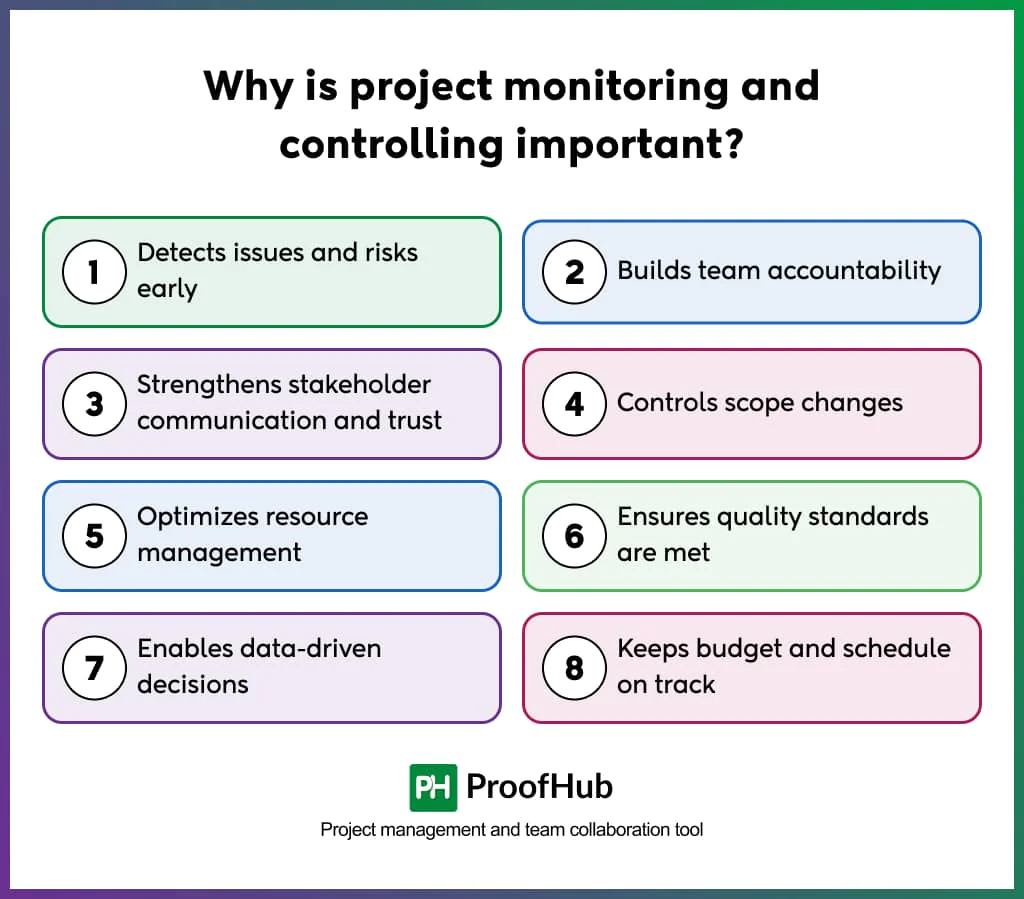
- Detects issues and risks early: Project monitoring and control continuously compare real-time data against the baseline (a fixed, approved version of your project plan) to catch changes as soon as they appear. These deviations could be a delayed task, a budget spike, or a quality gap. Managers apply targeted mitigation strategies to protect the project’s timeline and successful completion.
- Builds team accountability: When progress is tracked against the baselines, it makes the ownership of each deliverable clear. The milestone tracking ensures that no single task is missed during execution. It also ensures that every team member stays aligned with their responsibilities throughout the project.
- Strengthens stakeholder communication and trust: Project monitoring provides stakeholders with accurate, up-to-date information on project progress, risks, and changes. This helps them make timely decisions and respond quickly when issues arise. Regular updates keep stakeholders aligned throughout the project.
- Controls scope changes: Every change is reviewed for cost and schedule impact before approval. This prevents scope creep and keeps the project within its original boundaries. Formal change control ensures no modification enters the project without proper review.
- Optimizes resource management: Continuous monitoring compares actual resource usage against the project plan, making it easier to identify where people, budgets, or materials are overused or underutilized. Managers can then reallocate resources based on current project needs to maintain productivity and avoid bottlenecks.
- Ensures quality standards are met: Regular quality reviews confirm that deliverables meet established standards throughout the lifecycle. Consistent monitoring reduces costly rework at the end of the project. Every deliverable is validated against requirements before moving to the next stage.
- Enables data-driven decisions: Real-time KPIs and performance metrics provide an objective view of project performance. Managers use this information to identify trends, evaluate alternatives, and take corrective action before small issues become major problems. This leads to faster, more informed decision-making throughout the project.
- Keeps budget and schedule on track: Measuring the actual progress against the baselines flags the overruns and schedule slippage at the early stages of a project. The immediate corrective action prevents small variances from growing into major losses. Projects with strong controls consistently finish on time and within budget.
9 types of project monitoring
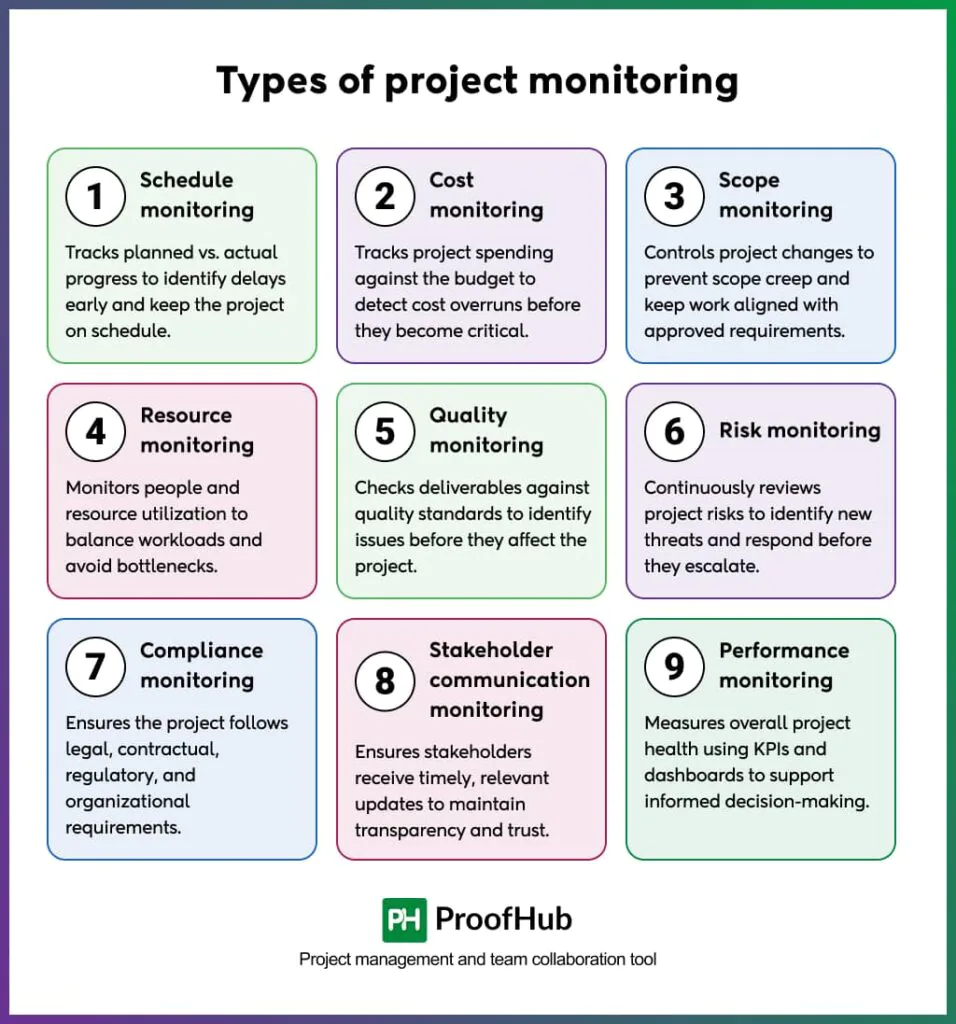
The key types of project monitoring are schedule monitoring, cost monitoring, scope monitoring, resource monitoring, quality monitoring, risk monitoring, compliance monitoring, stakeholder communication monitoring, and performance monitoring.
Together, they work as part of the broader monitoring and controlling process, giving project managers a full picture of how the project is progressing across time, budget, quality, and people.
Below are the key types of project monitoring used throughout the project lifecycle in detail:
1. Schedule monitoring
Schedule monitoring checks whether the work getting done today matches what the plan said should get done today.
It relies on baseline comparisons, actual start and finish dates against planned ones, and tools like the critical path method to flag which delays actually threaten the deadline versus which ones have slack to absorb.
The payoff is early warning: a two-day slip caught in week one is a course correction, while the same slip caught in week eleven is a crisis.
2. Cost monitoring
Cost monitoring tracks burn rate against budget using metrics like Earned Value Management, comparing what should have been spent for the work completed against what was actually spent.
It’s less about knowing the total is over budget after the fact, and more about spotting the trend line early enough to renegotiate scope, reallocate funds, or flag it to sponsors before the gap becomes unrecoverable.
3. Scope monitoring
Scope monitoring guards the project’s edges. Every change request gets logged, assessed for impact on time and cost, and either formally approved or rejected.
Nothing slides in through a casual “can you also just add” conversation. Its impact shows up less in day-to-day metrics and more in preventing the slow scope creep that quietly turns a three-month project into a six-month one without anyone deciding that on purpose.
4. Resource monitoring
Resource monitoring tracks utilization: who’s overloaded, who’s underused, which equipment is a bottleneck.
It’s usually visible through resource allocation charts or workload views. Done well, it prevents burnout on one side of the team and idle time on the other, and it catches capacity problems before they become the reason a deadline gets missed.
5. Quality monitoring
Quality monitoring checks deliverables against acceptance criteria at each stage, not just at final handoff. This might mean peer reviews, testing checkpoints, or client sign-offs at milestones.
The value compounds over time. Catching a flawed deliverable in week two costs a fraction of what it costs to catch it in week ten, after three other pieces of work have already been built on top of it.
6. Risk monitoring
Risk monitoring keeps the risk register alive throughout the project instead of treating it as a document written once at kickoff.
It involves rechecking probability and impact scores as conditions change, and watching for risks that weren’t on the original list. The real impact is optionality.
A risk you saw coming gives you time to choose a response. A risk that surprises you only gives you a reaction.
7. Compliance monitoring
Compliance monitoring ensures the project stays inside legal, contractual, and internal policy lines, covering data handling rules, industry regulations, and contract terms, among others.
It matters most in regulated industries or client work with strict contractual obligations, where a compliance miss isn’t just a project problem but a legal or financial one.
8. Stakeholder communication monitoring
Stakeholder communication monitoring tracks whether the right people are getting the right updates at the right cadence, not just whether status reports go out, but whether stakeholders actually feel informed and aren’t blindsided by news.
The impact is mostly about trust. Projects with strong communication tend to get more goodwill when something does go wrong, because stakeholders have been in the loop all along.
9. Performance monitoring
Performance monitoring is the umbrella view, pulling schedule, cost, quality, and resource data into KPIs and dashboards that show overall project health at a glance.
Its value is in decision speed. Instead of a manager manually piecing together whether the project is healthy, the dashboard tells them where to look first.
What are the key steps in the project monitoring and control process?
The steps in the project monitoring and control process are to collect performance data, analyze performance against baselines, analyze variances & trends, perform risk & quality reviews, implement corrective or preventive actions, and report and communicate to stakeholders.
Here are the explanations of these steps:
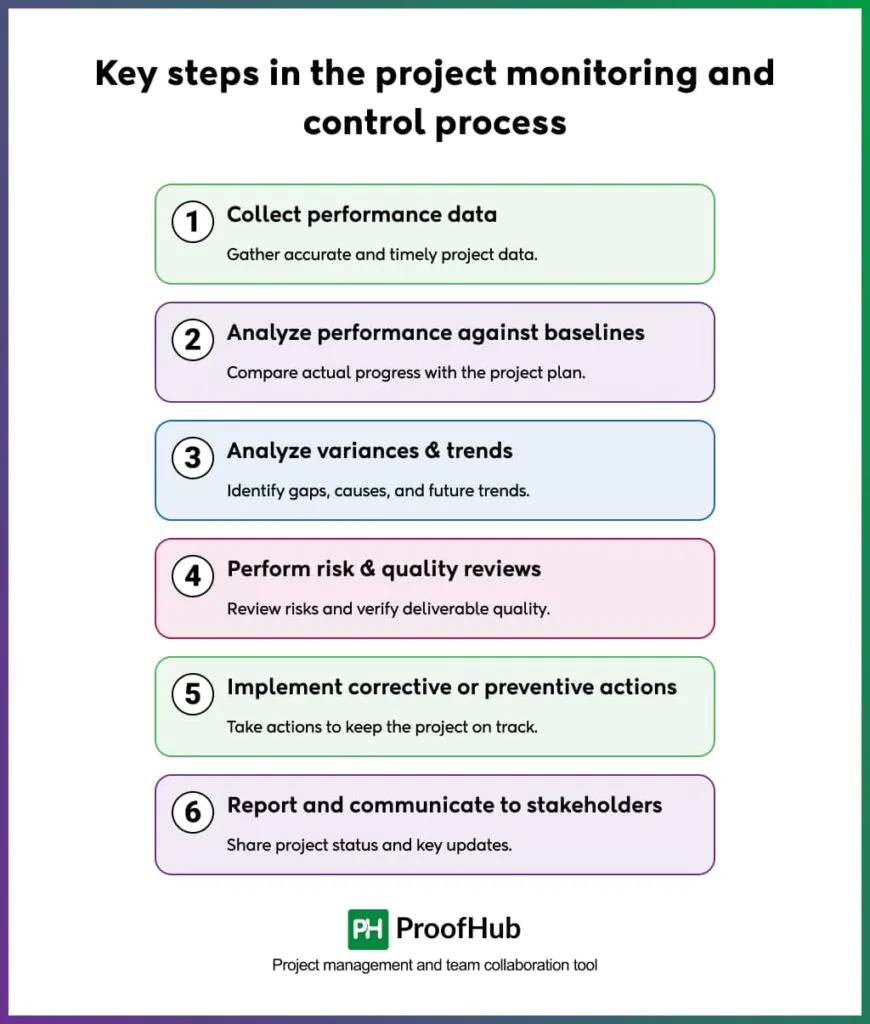
1. Collect performance data
Work performance data refers to the raw, unprocessed observations collected directly from project execution. It is the first step in gathering the raw work performance data from ongoing project activities.
Accurate, timely data is the foundation on which every subsequent step in the monitoring and control process depends.
2. Analyze performance against baselines
Compare the raw performance data against the approved scope, schedule, and cost baselines set at the start of the project.
This turns numbers like “60% of tasks complete” into meaningful context, such as whether that 60% is ahead of, on, or behind where the plan expected it to be at this point.
Common tools include Earned Value Management, schedule variance calculations, and cost performance indices.
The output isn’t just a status label; it’s a quantified gap between planned and actual performance that tells a manager exactly how far off track something is, if at all.
3. Analyze variances & trends
Analysis goes beyond the simple comparison where managers examine the magnitude and cause of any differences, known as variance analysis.
For example, if a project is over budget, this step identifies whether it was a one-time error or a systemic issue.
Trend analysis is also used here to look at performance over time, allowing managers to forecast future outcomes such as the Estimated Time to Completion (ETC) based on current productivity.
Understanding these patterns helps the project team move from a reactive state to a proactive one, where they can anticipate problems before they become critical.
4. Perform risk & quality reviews
Managers conduct quality audits and risk reviews to confirm deliverables meet requirements and existing risk responses still work.
During this step, the team conducts quality audits to verify that deliverables meet stakeholder requirements and project specifications.
Simultaneously, risk reviews are performed, which check whether existing risk responses are working and spot new risks emerging during execution. This keeps the project protected against internal and external threats throughout its lifecycle.
5. Implement corrective or preventive actions
If any analysis reveals that the project is drifting away from its goals, project managers issue a change request for corrective or preventive actions.
The corrective actions are taken to align the current project performance with the plan, while preventive actions are the proactive steps taken to reduce the probability of negative impacts in the future.
These actions include reallocating resources, adjusting schedules, or refining processes. Every action must go through a formal change control to ensure that its impact on all project constraints is understood before it is put into effect.
6. Report and communicate to stakeholders
These reports translate raw data and analysis into clear, actionable information about project health, achievements, challenges, and the status of any implemented changes.
These reports also provide transparency regarding project health, achievements, challenges, and the status of any implemented changes.
Effective communication builds trust with sponsors and clients, which ensures that they have the information necessary to make high-level decisions.
By maintaining a regular report, the project managers ensure that there is no misalignment in project objectives and the chosen path forward.
7 Effective techniques for project monitoring and control
The project monitoring and control techniques include earned value management, change control management, variance analysis, risk assessment, critical path analysis, trend analysis, and root cause analysis.
The key project monitoring and control techniques include:
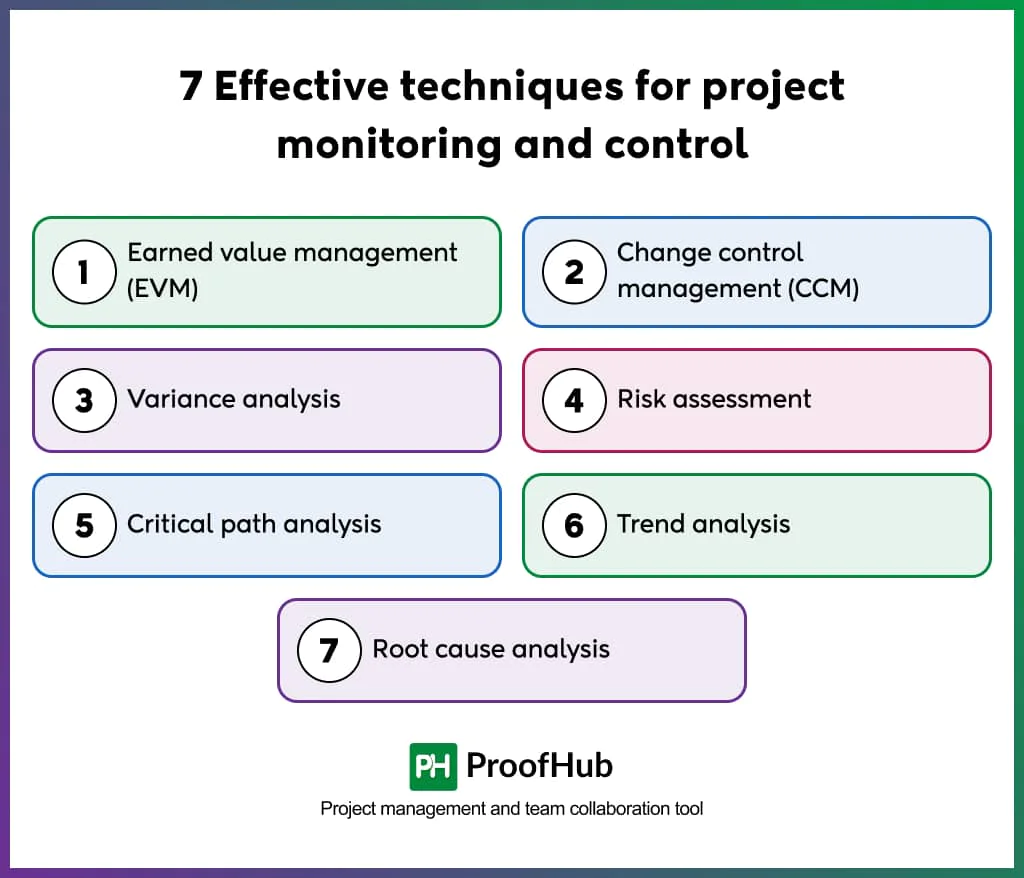
1. Earned value management (EVM)
EVM combines scope, schedule, and cost metrics to provide a clear view of project health.
It allows you to measure the value of work actually completed against the original plan to forecast final costs and completion dates.
This helps you identify cost and schedule issues early and make more accurate forecasts for project completion.
2. Change control management (CCM)
CCM is a formal process used to review and approve every proposed modification to the project’s scope, budget and timeline.
It ensures that any change is documented and its impact is fully understood before implementation to prevent “scope creep.”
As a result, projects remain aligned with their approved objectives while reducing the risk of uncontrolled scope, budget, and schedule changes.
3. Variance analysis
Variance analysis compares actual project performance against the approved scope, schedule, and cost baselines to identify deviations.
It helps examine where differences occur, measure their impact, and investigate the underlying causes to determine whether they are temporary issues or recurring trends.
This analysis helps you decide if corrective action is needed to keep the project aligned with its objectives.
4. Risk assessment
Risk assessment involves the regular identification and tracking of potential threats that could negatively impact the project’s goals.
Proactive risk monitoring allows the team to implement mitigation strategies early, stopping potential problems before they escalate into crises.
It helps resolve performance issues early before they significantly affect project outcomes.
5. Critical path analysis
Critical path analysis identifies the longest sequence of dependent tasks that must be finished on time for the project to meet its deadline.
It highlights the most essential activities, helping managers prioritize tasks that have no room for delay.
It helps focus on critical activities and prevent delays that would directly impact the project’s completion date.
6. Trend analysis
Trend analysis examines performance data over a period of time to identify patterns and predict future outcomes.
It allows you to forecast whether the project will continue to meet its targets based on current team productivity.
You can anticipate future issues and take preventive action before performance declines further.
7. Root cause analysis
RCA is used to find the underlying reason for the issue rather than just fixing the surface symptoms.
Identifying the root cause is essential for preventing the same mistake from recurring later in the project lifecycle.
Addressing the root cause helps prevent recurring issues and improves the efficiency of future project execution.
What are the most important KPIs in project monitoring and control?
The important KPIs in project monitoring and control are schedule variance, cost variance, cost performance index, schedule performance index, resource utilization rate, milestone completion rate, budget utilization report, defect density and quality metrics, risk exposure metrics, and stakeholder satisfaction score.
Let’s understand the most important KPIs in project monitoring and control:
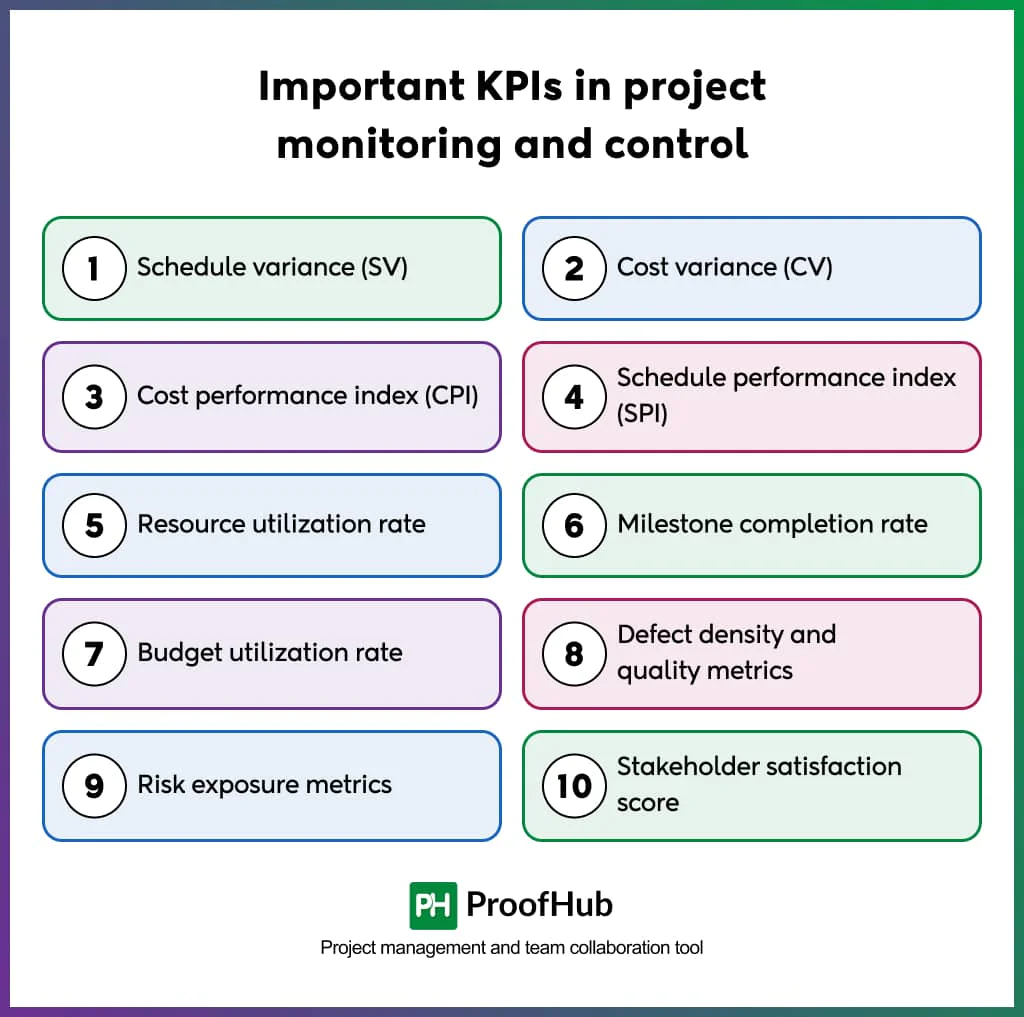
- Schedule variance (SV): These metrics identify if your project is ahead of or behind its timeline by comparing the value of work completed to the work planned. It serves as a warning sign for managers to detect a project’s timeline before risks cause major project delays. Tracking this allows project managers to determine exactly when the project deviated from its original schedule baseline.
- Cost variance (CV): Cost variance shows the difference between your actual spending and the budgeted amount of work finished at any given time of a project. These metrics catch financial overruns early in the project and ensure that it stays viable with its approved funding. If the answer to the metrics gives you a positive number, then the project is under budget; if it gives you a negative number, it shows that the project is spending more than planned.
- Cost performance index (CPI): CPI measures financial efficiency by showing how much value the project is generating for every dollar spent. A score above 1.0 shows excellent efficiency, while anything below 1.0 means the project is overspending for work done. Project managers rely on this index to forecast the total final cost and make necessary adjustments to the budget.
- Schedule performance index (SPI): The KPI measures the progress efficiency by comparing the actual speed of work against the original planned timeline. It helps you predict whether the project will realistically hit its completion date based on current team performance. Maintaining a high SPI ensures that the team is completing essential tasks effectively and staying on the critical path.
- Resource utilization rate: Resource utilization rate tracks how effectively your team members, tools, and materials are being assigned to specific project tasks. It helps you spot “bottlenecks” where staff are overextended or areas where resources are sitting idle and being wasted. Monitoring this ensures a balanced workload, which improves team productivity and reduces employee burnout.
- Milestone completion rate: Milestone completion rate tracks the percentage of major project targets or “milestones” that were finished on their original scheduled dates. It provides a high-level of project health, showing stakeholders if the key phases are being delivered as promised. Consistently hitting these targets builds confidence and proves the project is moving steadily toward successful completion.
- Budget utilization rate: Budget utilization rate, also known as burn rate, measures how quickly you are consuming the project budget compared to the plan. It highlights if you are spending funds too fast, allowing you to take corrective actions before the project runs out of money. Monitoring this prevents financial crises and keeps your spending habits transparent for sponsors and leadership.
- Defect density and quality metrics: These metrics measure the number of errors or flaws found in deliverables compared to established quality standards. This ensures that the final product meets all the stakeholder requirements and is “fit for purpose” without extra work. High defect rates alert you that the team needs to improve its processes to avoid costly and time-consuming rework.
- Risk exposure metrics: Risk exposure metrics track the status of identified threats and help you assess if new risks have appeared as the project moves forward. By monitoring these risks, project managers can carefully implement mitigation strategies early to stop problems before they occur. High risk scores alert the team to prioritize resources toward the most dangerous obstacles to project success.
- Stakeholder satisfaction score: The stakeholder satisfaction score measures the confidence and trust clients, sponsors, and team members have in the project’s progress. The high scores are typically the result of clear communication, transparency, and timely delivery of quality work. Regular tracking helps you identify unhappy stakeholders early so you can address their concerns and maintain their support.
What are the common challenges in project monitoring & control?
The common challenges in project monitoring & control are scope creep, inaccurate, delayed, or inconsistent reporting, poor communication and stakeholder alignment, resource allocation conflicts, inadequate budget and cost control, reactive risk management, resistance from team members, overreliance on status meetings, and lack of system integration.
The following are the common challenges in project monitoring & control:
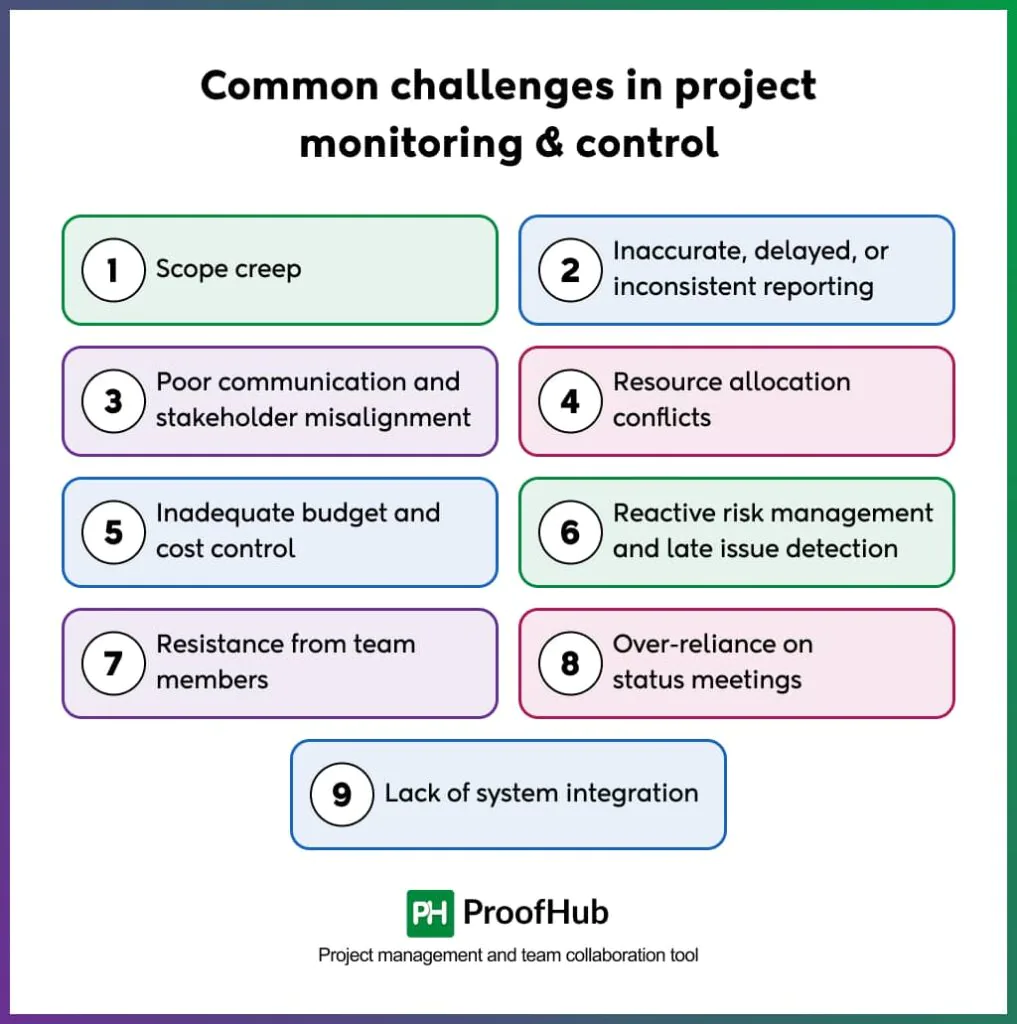
- Scope creep: Scope creep occurs when a project expands beyond its original boundaries due to unauthorized changes or shifting requirements. It leads to significant timeline delays and budget overruns if not managed with a strict control process.
- Inaccurate, delayed, or inconsistent reporting: Infrequent or unclear updates create misunderstandings that cost time and money, leaving teams misaligned on project goals and less confident in the team’s direction. This inconsistency forces managers to waste time extracting information from conflicting updates rather than focusing on actual performance analysis.
- Poor communication and stakeholder misalignment: Unclear information leads to misunderstandings that cost both time and money. Stakeholders become misaligned on project goals and lose the trust of the team without transparent updates. This inconsistent communication creates misalignment on project goals and erodes stakeholder trust.
- Resource allocation conflicts: Limited resources and poor scheduling leave some team members overworked while others sit idle, creating inefficiencies that slow overall project progress. Monitoring balances these constraints to ensure tools and personnel are assigned to the most critical tasks effectively.
- Inadequate budget and cost control: Actual spending that isn’t compared regularly against the approved budget lets small variances go undetected until they grow into serious financial problems.. Without constant and consistent monitoring, a small early variance can easily turn into a deep financial problem.
- Reactive risk management and late issue detection: Identifying risks after they have become active problems causes teams to lose the lead time required for effective mitigation. This proactive monitoring is necessary to catch the subtle deviations early before they grow into a major crisis.
- Resistance from team members: Some team members view monitoring as micromanagement, which leads to unreported issues and optimistic updates. This resistance results in poor adoption of monitoring tools and incomplete data from integrated software, and meetings not identifying the technical root cause of project slippage.
- Over-reliance on status meetings: Relying solely on meetings is often misleading because they reflect general sentiment rather than actual performance data. Without supporting data, meetings may fail to identify the technical root cause of project slippage.
- Lack of system integration: Tracking data across multiple disconnected tools increases the chance that critical updates get lost or logged in the wrong place, making it hard to maintain one accurate view of project health. This fragmentation makes it difficult for project managers to maintain a single and accurate view of the project’s overall health.
What are the best practices for effective project monitoring & control?
The best practices for effective project monitoring and control are defining clear baselines and monitoring metrics early, establishing a consistent monitoring and reporting cadence, using a centralized project management tool, standardizing reporting templates, involving stakeholders throughout the project, documenting every approved change, and using monitoring data to drive decisions and improvements.
These practices work together to keep a project aligned with its goals from initiation through closure. The fixed baselines give teams something to measure against, consistent reporting and centralized tools keep that data accurate and visible, and stakeholder involvement plus documented changes keep everyone accountable to what was actually agreed and delivered.
The best practices for effective project monitoring & control are:
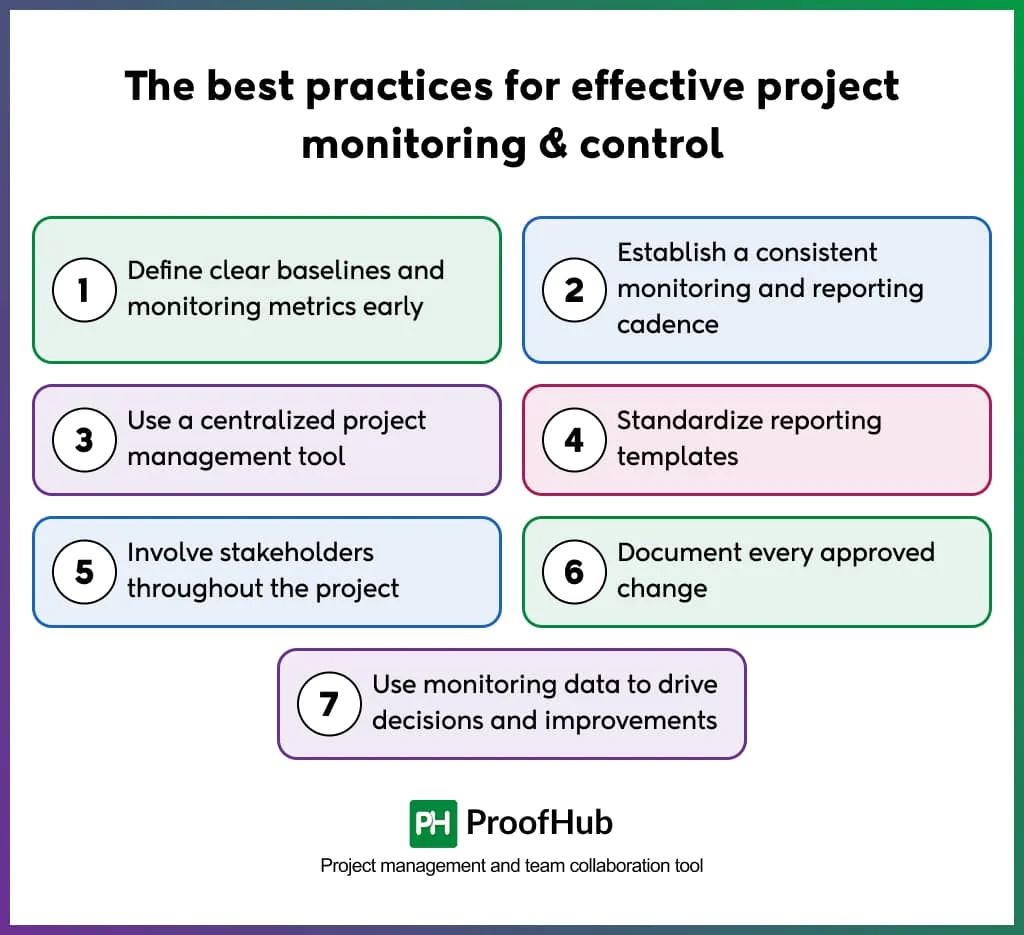
- Define clear baselines and monitoring metrics early: Locking scope, schedule, and cost targets during planning gives the team a fixed reference point to measure every deviation against throughout execution.
- Establish a consistent monitoring and reporting cadence: Setting a fixed reporting frequency, weekly or biweekly, and enforcing it regardless of project status keeps data current and speeds up decision-making.
- Use a centralized project management tool: Consolidating tasks, budget, timelines, and risks into one platform instead of spreadsheets gives every stakeholder one accurate, real-time view of project health.
- Standardize reporting templates: Using the same report structure and metrics across every reporting cycle makes performance data easy to compare period over period and cuts preparation time.
- Involve stakeholders throughout the project: Sharing progress updates and flagging risks at every milestone, not just major checkpoints, keeps expectations aligned and reduces resistance to changes.
- Document every approved change: Logging every approved modification to scope, cost, or schedule in a formal change register creates a clear audit trail and prevents undocumented changes from causing scope creep.
- Use monitoring data to drive decisions and improvements: Reviewing KPIs and performance data before making corrective decisions, rather than relying on instinct, replaces guesswork with evidence-based, justified actions.
What are the best tools for project monitoring and control?
The best tools for project monitoring and control are Gantt charts, dashboards, performance reports, a project time tracking tool, a document management system, and project management software.
The following are the best tools for project monitoring and control:
- Gantt charts: Gantt charts provide a visual timeline that maps out task durations, milestones, and dependencies to ensure work aligns with the original plan. They are essential for identifying the critical path, which helps project managers focus on the specific tasks most likely to impact the final project deadline.
- Dashboards: Dashboards are the real-time control room; they consolidate data into easy-to-read graphs and charts for a high-level view of project health. They allow managers to monitor Key Performance Indicators (KPIs), such as budget versus actual spending and risk levels, across multiple departments simultaneously.
- Performance reports: These reports synthesize work data into detailed summaries that track project variance, workload, and overall status for specific periods. They provide the objective information necessary for stakeholders to make informed, data-driven decisions regarding the project’s future trajectory.
- Project time tracking tool: This tool collects actual work hours to ensure team members are keeping to the project plan and to accurately measure labor costs. By comparing logged hours against planned estimates, managers can identify productivity patterns and prevent schedule slippage.
- Document management system: A centralized system ensures that all performance records, change requests, and approvals are documented and accessible in one location. This maintains a “single source of truth,” reducing the risk of stakeholders working from conflicting or outdated information.
- Project management software: These comprehensive platforms integrate various features like automated tracking, resource management, and risk modules into a single interface. By centralizing all project data, the software streamlines communication and enables managers to quickly implement corrective actions when deviations occur
Tools like ProofHub simplify this process even further. As an all-in-one project management and team collaboration tool, it centralizes task tracking and reporting in one place. The platform helps teams stay organized, improves accountability, and provides a clear structure for planning, managing, and successfully delivering projects.
What is the difference between monitoring and controlling?
Monitoring refers to the process of observing, tracking, and collecting project data. It focuses on understanding what is happening during the project lifecycle by measuring performance and progress.
Controlling, on the other hand, is the process of using that data to take corrective actions. It ensures that any deviations from the plan are identified and addressed to keep the project aligned with its goals.
In simple terms, monitoring provides visibility, while controlling drives action.
Here is the table to understand better:
| Aspects | Monitoring | Controlling |
|---|---|---|
| Function | Tracking and observing progress | Taking corrective action |
| Role | Passive — data collection | Active — decision-making |
| Focus | What is happening | What to do about it |
| Output | Performance data and reports | Change requests and adjustments |
| Timing | Continuous, throughout execution | Triggered by detected deviations |
Who is responsible for monitoring and controlling the project?
The project manager holds primary responsibility for monitoring and controlling the project. The project manager plans, organizes, and directs the project to completion, building the budget, assigning work, and determining the timeline before execution begins.
Throughout the project, they ensure that approved changes are implemented correctly and that new risks are identified and addressed promptly.
They also keep stakeholders informed through regular status reports, helping everyone stay aligned on project objectives and progress.
What is the difference between project monitoring and evaluation?
Project monitoring is continuous and tracks ongoing progress, whereas project evaluation is periodic and assesses overall outcomes and impact.
Here is the detailed table to understand the concept:
| Aspect | Monitoring | Evaluation |
|---|---|---|
| Timing | Continuous, throughout the project | Periodic — at milestones or project end |
| Focus | Inputs, activities, outputs | Outcomes, impact, value |
| Function | Supports decision-making | Supports accountability and learning |
| Audience | Project team and direct stakeholders | Wider audience — sponsors, leadership |
| Purpose | Keeps the project on track | Assesses whether objectives were achieved |
Conclusion
Project monitoring and control is what separates projects that finish on time and within budget from those that quietly drift off course. It gives managers the data to detect deviations early, the process to act on them immediately, and the reporting structure to keep every stakeholder aligned throughout execution. Without it, even the most detailed project plan fails at the first untracked deviation.