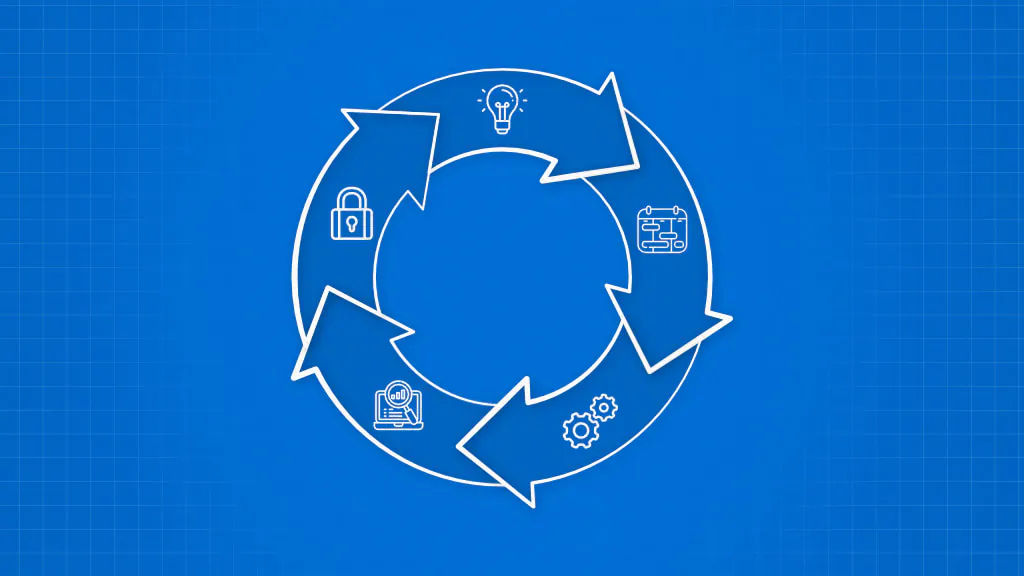
Every project, large or small, goes through certain stages from beginning to end. These stages collectively form the project lifecycle.
A project management lifecycle is the structured framework of initiating, planning, executing, monitoring & controlling, and closing the project.
It describes the characteristics of each stage and the activities to be performed at each stage. For example, execution requires the highest level of staffing, whereas initiation requires the lowest level of staffing.
By understanding the project management lifecycle, a manager can better manage the project and make informed decisions.
In this post, we are going to discuss the project lifecycle in depth to help you build an understanding.
- 1.A project lifecycle is the five-phase structure through which every project goes from its initiation to completion.
- 2.The five phases of a project lifecycle include initiation, planning, execution, monitoring & control, and closure.
- 3.Project lifecycle provides structure, ensures accountability, improves planning, aligns stakeholders, and maximizes resource efficiency.
- 4.Common challenges in managing a project lifecycle include poorly defined scope, poor planning, stakeholder misalignment, communication breakdowns, and weak project closure practices.
What is a project lifecycle?
A project lifecycle is the five-phase structure through which every project goes from its initiation to completion. The five standard phases include initiation, planning, execution, monitoring & controlling, and closure.
The project lifecycle streamlines the activities that need to be executed in each phase.
For example, the initiation phase includes collecting requirements and conducting feasibility studies, whereas the execution phase includes activities such as performing project work, assigning tasks, sharing information, and requesting updates.
A project manager needs knowledge of the project lifecycle to understand the key steps and activities to lead the project successfully.
Why is a project lifecycle important?
The project lifecycle provides structure, ensures accountability, improves planning, aligns stakeholders, maximizes resource efficiency, and ensures quality.
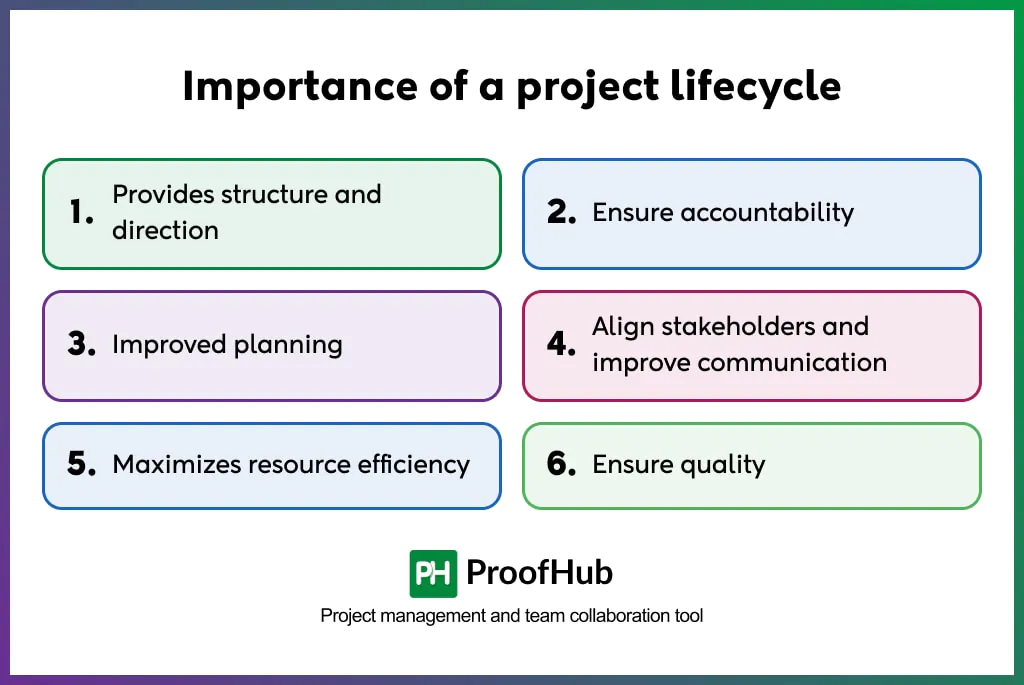
- Provides structure and direction: The project lifecycle breaks down complex work into manageable phases. Each phase has a defined start and end, specific goals, and clear deliverables. It provides a structured framework that guides a project, ensures clarity, consistency, and control at every stage.
- Ensure accountability: Specifies accountability and responsibilities of the individuals involved in executing, reviewing and approving the tasks. It gives everyone (the project manager, the project sponsors, and the project team) clarity on what to do and ensures accountability.
- Improved planning: Helps produce consistent, accurate project plans by providing a structured framework. For example: the planning phase prompts the project manager to address scope, schedule, budget, resources, risks, and communication. This surfaces dependencies, constraints, and issues early on when they are easy to address.
- Aligns stakeholders and improves communication: Provides a common language for stakeholders (manager, sponsor, team members) with different roles, priorities, and levels of technical knowledge involved in a project.
- Maximizes resource efficiency: Helps project managers allocate resources where they are needed most, at the right time. For example: Execution is the most resource-intensive phase. Planning and Closure require fewer resources. Understanding the lifecycle helps managers ramp resources up and down intelligently.
- Ensure quality: Embed quality checkpoints into every phase. In the planning phase, quality standards and acceptance criteria are defined. Work is executed according to the set standards, and final deliverables are reviewed and accepted at closure when the output meets the agreed standard.
What are the phases of a project management lifecycle?
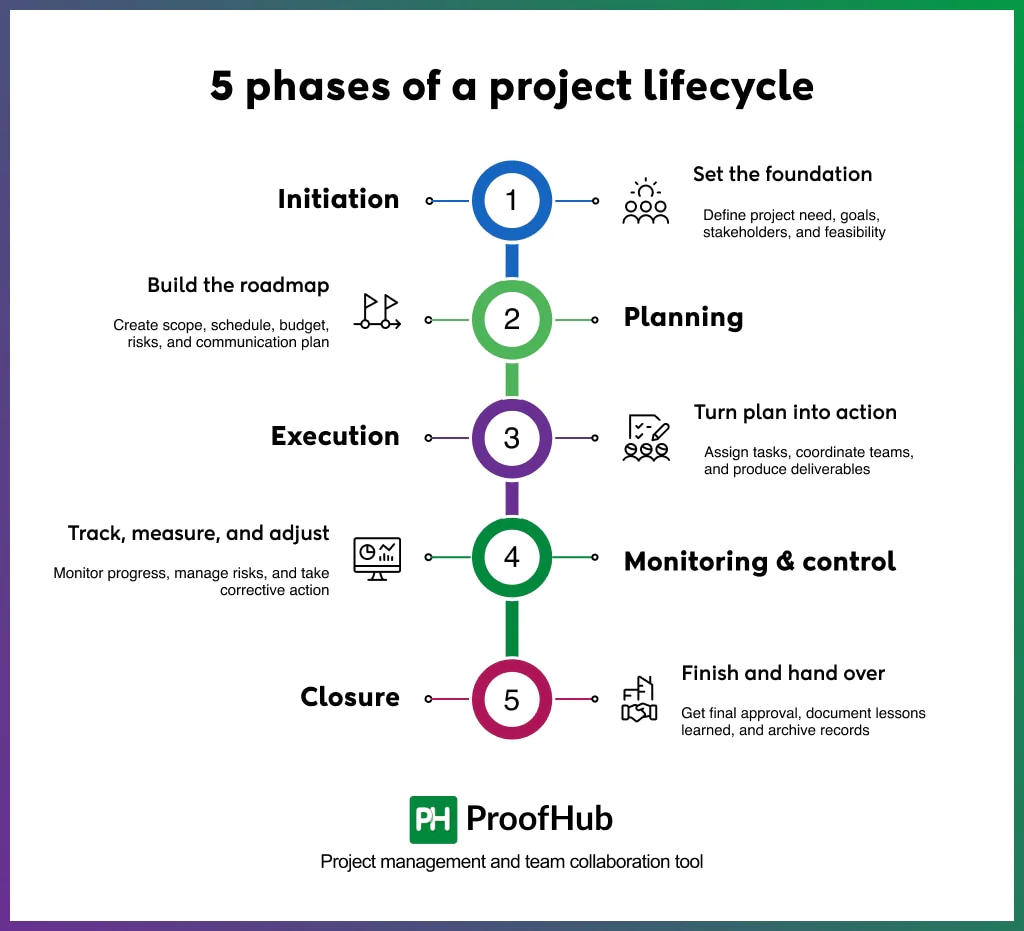
The five phases of a project lifecycle include initiation, planning, execution, monitoring & control, and closure. They provide a structured framework for managing projects from approval to completion.
1. Initiation phase
Project initiation formally authorizes a project and defines its purpose. It is the first phase of the project lifecycle and its starting point.
It establishes the project’s foundation by defining goals, securing authorization, and aligning stakeholders. Without it, projects lack direction, clear purpose, and formal organizational commitment from the start.
Key activities of the project initiation phase
- Identifying a business need, problem, or opportunity that the project will address.
- Conducting a feasibility study to determine the project’s profitability.
- Defining the project’s objectives, purpose, goals, and high-level requirements.
- Creating a project charter to formally approve the project and assigning a project manager.
- Identifying all the stakeholders of the project to learn about their expectations, influences, and interests in the project.
Key deliverables of the project initiation phase
- Project proposal: Explains why the project is needed, what it aims to achieve, and how it will be executed.
- Business case: Justifies the benefits, costs, and potential risks associated with the project based on the findings of feasibility studies.
- Stakeholder register: Lists all stakeholders and their roles, expectations, & influence.
- Project charter: Outlines the project purpose, objectives, scope, stakeholders, constraints, & high-level requirements, formally authorizes the project, and assigns the project manager.
2. Planning phase
The planning phase defines how a project will be executed, monitored, controlled and delivered.
The planning phase involves creating a comprehensive project management plan.
A detailed roadmap, including scope, schedule, cost, resources, quality, and communication, is created for the project team.
Key activities of the project planning phase
- Interviews with stakeholders to gather detailed information to define the project scope.
- Writing the project scope to document what is included and what is not in the project.
- Creating a work breakdown structure (WBS) to break the work into smaller parts.
- Creating a detailed project management plan, which includes sub-plans, such as cost, scope, time, risk, and communication management.
- Sharing the plan with key stakeholders and obtaining final approval before executing it.
Key deliverables of the project planning phase
- Scope statement: Defines detailed project scope, deliverables, exclusions, and acceptance criteria.
- Work Breakdown Structure (WBS): A hierarchical decomposition of project work that breaks the project work into smaller and manageable tasks.
- Project management plan: A comprehensive document that outlines how the project will be executed, monitored, and closed. It consolidates all subsidiary plans, such as scope, schedule, cost, quality, risk, communication, and resources, into one governing document.
3. Execution phase
In the execution phase, the team performs planned tasks to create deliverables and achieve project objectives.
The project manager ensures that everything outlined in the project management plan is executed as planned.
Key activities of the project execution phase
- Assigning tasks to the team members and providing clear instructions.
- Teams collaborate and communicate.
- The project manager facilitates a clear and timely exchange of information and coordinates with resources to resolve issues.
Key deliverables of the project execution
- Project deliverables: The actual work products produced, such as software, designs, reports, prototypes, etc.
- Status reports: Regular updates on progress, milestones hit, risks, and blockers.
- Meeting minutes: Official record of decisions made and actions assigned in project meetings.
- Change requests: Formal submissions requesting a modification to scope, schedule, or budget.
4. Monitoring and control phase
The monitoring and controlling phase tracks project performance and risks and manages changes to keep the project aligned with the project management plan.
It helps identify problems early on and manage change effectively to ensure scope, schedule, and budget stay within agreed boundaries.
Key activities of the project monitoring and control phase:
- Progress is measured against the original plan. Schedule, budget, and scope are monitored, and key performance indicators (KPIs) are tracked.
- Ensuring stakeholders remain informed about progress, changes, and any potential impacts on project outcomes.
- Risks are monitored for new developments.
- Change requests are evaluated and approved or rejected.
- Corrective actions are taken when the project drifts off course.
Key deliverables of the project monitoring and control phase:
- Performance reports: Compare actual performance against baselines for scope, schedule, and cost.
- Quality control reports: Document the results of quality inspections and any defects identified.
- Change log: Records all approved, rejected, and pending change requests and their impact.
- Updated risk register: Revised to reflect new risks, closed risks, and updated assessments.
5. Closure phase
The closure phase is the final stage of the project lifecycle, in which teams complete project activities, hand over deliverables, document lessons learned, obtain project sign-off, and officially close the project.
Key activities of the project closure phase
- Securing approvals and formal acceptance of deliverables by stakeholders or clients.
- Documenting lessons learned from the project for future reference.
- Contracts with vendors are closed.
- Team members are released and their contributions recognized.
- All project documents are archived.
Key deliverables of the project closure phase
- Final deliverables: Complete and approved outputs handed over to the client or stakeholders.
- Final sign-off document: Formal acceptance of deliverables by stakeholders or clients.
- Final project report: Summarizes project objectives, performance, achievements, and any deviations.
- Lessons learned document: Highlights successes, challenges, and improvement opportunities for future projects.
- Project archive: Includes all project documentation for future reference.
What are the types of project management lifecycle?
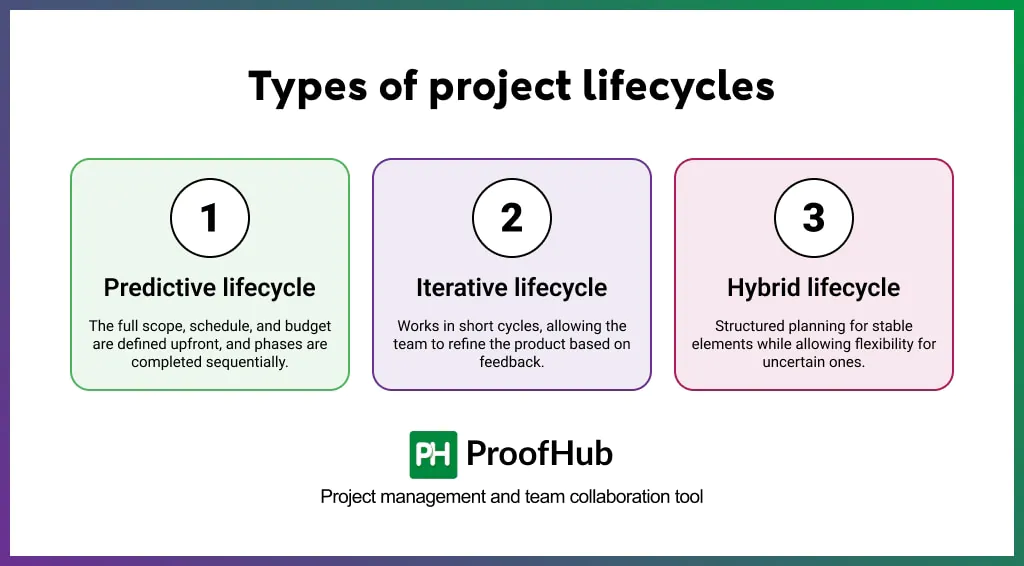
A project lifecycle is primarily of three types: predictive, iterative, and hybrid. They define how a project progresses from initiation to completion.
1. Predictive lifecycle
In a predictive lifecycle, the full scope, schedule, and budget are defined upfront, and phases are completed sequentially. This model works well for projects where requirements are clear and unlikely to change.
Best for: Construction, manufacturing, and regulatory compliance projects.
2. Iterative lifecycle
An iterative lifecycle works in short cycles, allowing the team to refine the product based on feedback. The overall scope is understood early, but details evolve.
Best for: Software development projects with evolving requirements.
3. Hybrid lifecycle
A hybrid lifecycle combines predictive and agile approaches — using structured planning for stable elements while allowing flexibility for uncertain ones.
Best for: Large-scale projects with both fixed and dynamic components.
What are the challenges in managing a project lifecycle?
Common challenges in managing a project lifecycle are poorly defined scope, poor planning, stakeholder miscommunication, scope creep, resource conflicts, weak project monitoring and closure.
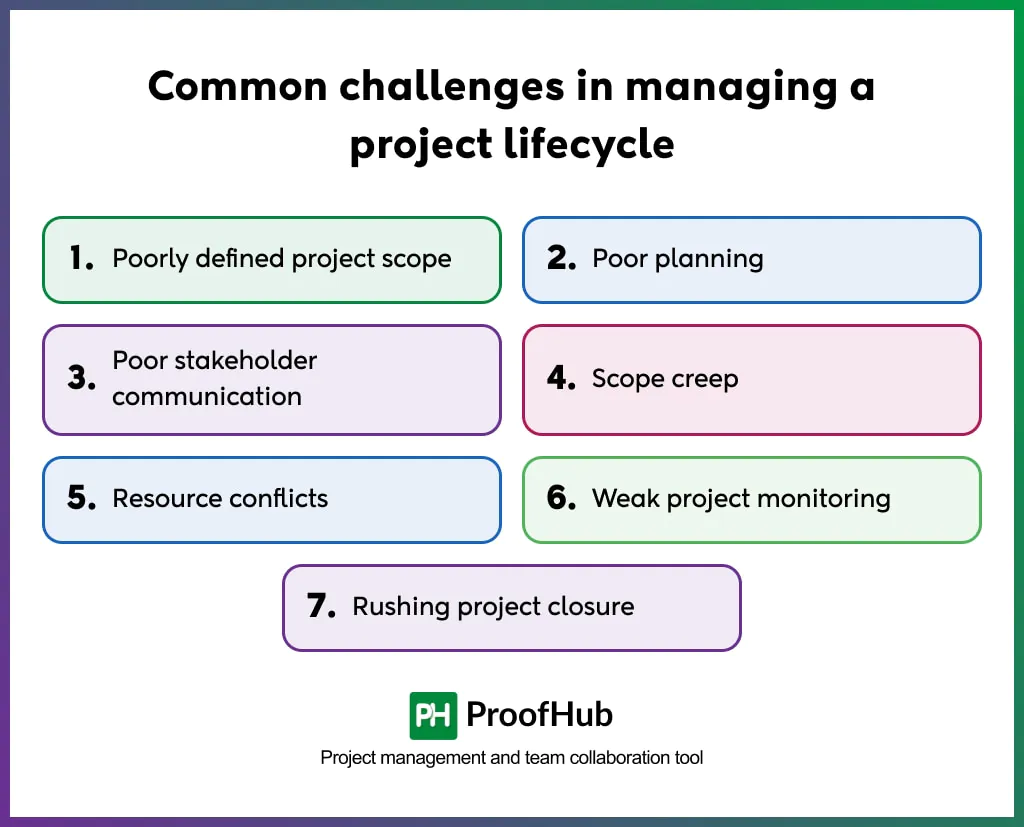
- Poorly defined project scope: Unclear requirements, work instructions, boundaries, and undefined deliverables lead to missed client expectations at delivery, rework, and budget overruns.
- Poor planning: Undefined task durations, cost, and task dependencies, inadequate risk planning lead to a plan that collapses under real-world conditions and falls behind within the first few weeks.
- Poor stakeholder communication: Infrequent, unclear, and inconsistent communication leads stakeholders to lose trust and submit last-minute change requests. To fix, understand stakeholders’ priorities, levels of involvement, and expectations.
- Scope creep: The gradual, informal expansion of a project’s scope without adjusting time, budget, or resources leads to increased costs, resource waste, and reduced profit margins.
- Resource conflicts: Occurs when multiple projects or tasks compete for the same resources (tools, people, instruments). It leads to scheduling delays, workload imbalance, performance issues, and reduced productivity.
- Weak project monitoring: Tracking project progress verbally, unclear KPIs, status reports, and check-ins lead to poor monitoring and control. It delays issue detection and increases the risk of scope creep, budget overruns, and project delays.
- Rushing project closure: Leads to incomplete documentation, unresolved issues, missing lessons learned, and unfinished formal project closure. It causes organizations to lose important knowledge, fail to recognize team contributions, and lead to disputes with vendors.
Best practices for managing the project lifecycle effectively
To manage the project lifecycle effectively, define the project scope clearly, set realistic project standards, implement a change control process, develop a stakeholder communication plan, and manage resources proactively.
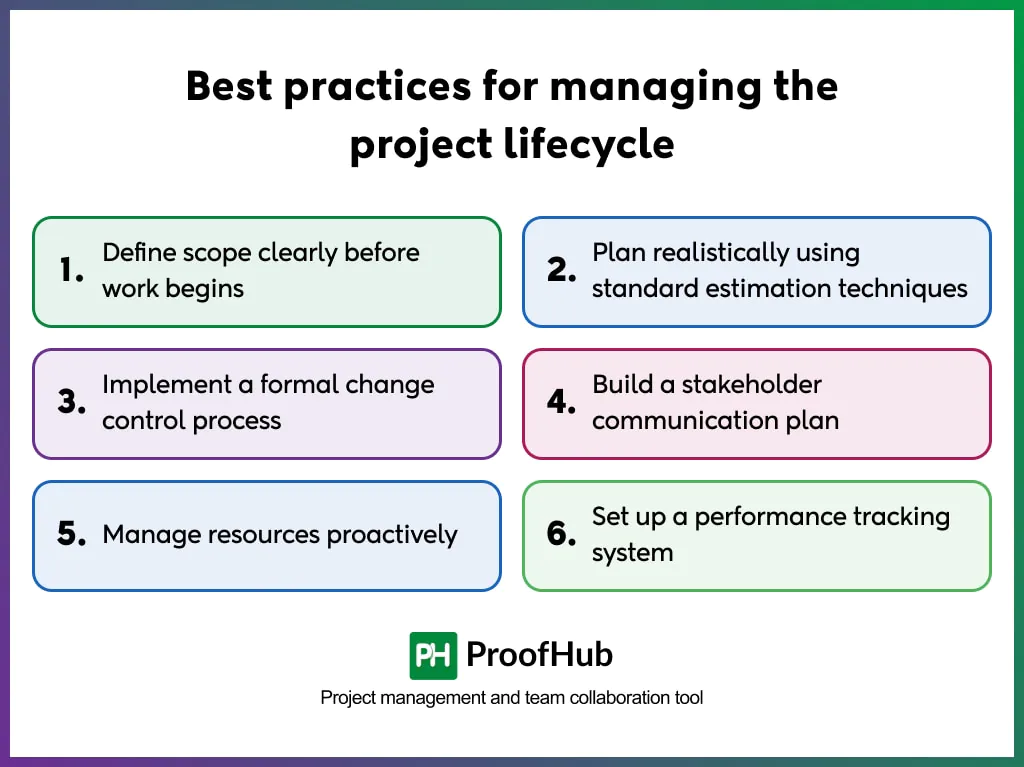
1. Define scope clearly before work begins
Clearly define what is included in the project, what is explicitly not included, and the acceptance criteria. Document these in the project charter and the scope statement.
Get formal sign-off from all key stakeholders on these documents. This creates a shared baseline that the entire team can refer back to when disagreements arise later.
2. Plan realistically using standard estimation techniques
Use the Work Breakdown Structure (WBS) to break the project into the smallest possible tasks before estimating. Use standard estimation methods, such as three-point estimating.
Add a 10–20% schedule buffer to absorb unknowns, delays, and unexpected complexity.
3. Implement a formal change control process
Make sure every requested change to scope, schedule, or budget is submitted through a formal Change Request Form.
Assess the impact of each request on time, cost, resources, and scope before approving or rejecting it. Update the project plan whenever a change is approved.
4. Build a stakeholder communication plan
Define in advance who needs what information, in what format, and how often. Document this in a formal Communication Plan covering weekly status reports, steering committee updates, and team standups.
Send updates consistently and ensure no stakeholder is ever surprised by project developments.
5. Manage resources proactively
Map each team member to specific tasks and timeframes in a Resource Management Plan during the Planning phase. Track actual versus planned utilization weekly to catch over-allocation early.
Aim for 80% utilization per team member to preserve flexibility for unexpected tasks. When a capacity gap is apparent weeks in advance, escalate to leadership immediately.
6. Set up a performance tracking system
Define the key performance indicators, such as schedule variance, cost variance, and milestone completion rate. Apply RAG status indicators to schedule, budget, scope, and risks in every status report so stakeholders have an instant read on project health.
Use Earned Value Management to objectively measure whether the project is ahead or behind on both time and cost. Track consistently and act on what the data tells you.
Who is responsible for managing the project lifecycle?
The Project Manager is responsible for managing the project lifecycle, guiding the project from start to finish. They ensure it is completed on time, within budget, and to the agreed quality standards.
What is the difference between a predictive and iterative project lifecycle?
A predictive lifecycle follows a sequential path, one after another, whereas an iterative cycle follows a cyclic path, repeating phases.
A predictive lifecycle defines the full scope, schedule, and budget upfront. Phases are completed sequentially, one after another, with little room for change once work begins. It works best when requirements are clear and stable from the start.
An iterative lifecycle requires working in cycles, refining the product based on feedback after each cycle. This provides flexibility, adaptability, and continuous improvement. Requirements can evolve as the project progresses.
Is the project management lifecycle always 5 phases?
No, a project does not always have five phases. The number of phases depends on the organization, industry, project type, and methodology.
However, the five-phase model is the standard framework used by most organizations, as defined by the Project Management Institute (PMI).
Can project management phases overlap?
Yes, project management phases can overlap depending on the project methodology and strategy.
Overlapping helps reduce project duration, improve responsiveness, and enhance resource utilization.
On the other hand, it can increase the risk of rework and increase the complexity of a project.
For example: Planning and Execution can overlap on fast-moving projects. While the core plan is finalized, early low-risk tasks may begin in parallel to save time. This is known as fast-tracking.
Do all projects follow the same lifecycle?
No, not all projects follow the same lifecycle because the lifecycle structure depends on project type, size, industry, and methodology.
Most projects follow core phases such as initiation, planning, execution, monitoring, and closing, but implementation varies.
For example, construction projects follow fixed stages, whereas software projects typically use Agile iterations.
What happens if a phase is skipped?
Skipping a phase increases project risk, reduces control, and creates execution gaps. It increases the risk of project delays, cost overruns, rework, and project failure.
For example: Skipping the initiation phase results in unclear objectives and stakeholder alignment.
Skipping the planning phase results in inaccurate schedules, budgets, and resource allocation.
Does Agile follow the same project lifecycle?
Yes, Agile follows the same lifecycle concept. However, Agile breaks the project into short, repeated cycles (sprints) and executes phases iteratively rather than moving through five phases sequentially.
For example: Each sprint contains a mini-lifecycle: planning, execution, review, and retrospective. Agile does not reject the lifecycle concept; it reshapes it from a straight line into a series of loops.