Every project runs into uncertainty, like a delayed vendor, a shifting requirement, or a budget miscalculation. Left unmanaged, these risks compound into missed deadlines and blown budgets.
Project risk management gives you a structured way to spot threats early, score them, and respond before they derail the work.
In this article, you can learn about what project risk management is, why it matters, its seven-step process, the types of risks projects face, response strategies, common challenges, risk registers and matrices, and a free template to get started.
- 1.Risk management is proactive. It plans for uncertain events before they happen, unlike issue management, which reacts to problems already underway.
- 2.The process has seven steps. Plan Risk Management, Identify Risks, Perform Qualitative Analysis, Perform Quantitative Analysis, Plan Risk Responses, Implement Risk Responses, and Monitor Risks.
- 3.Risks fall into five categories. Technical, financial, operational, external, and organizational, each needing a different response.
- 4.Threats and opportunities need different strategies. Threats get avoided, mitigated, transferred, or accepted. Opportunities get exploited, enhanced, shared, or accepted. Anything beyond the team’s authority gets escalated.
- 5.Risk score equals probability times impact. Teams typically rate both on a 1-5 or 1-10 scale to prioritize risks.
- 6.The risk register and risk matrix work together. The register logs detailed tracking data. The matrix gives a quick visual for prioritization. Both need regular updates.
- 7.Common failures compound each other. Poor identification, unrealistic assumptions, weak monitoring, and missing mitigation plans rarely happen alone. One gap tends to create the next.
What is project risk management?
Project risk management is the process of identifying, analyzing, and responding to uncertain events that could affect a project’s objectives, cost, schedule, or quality.
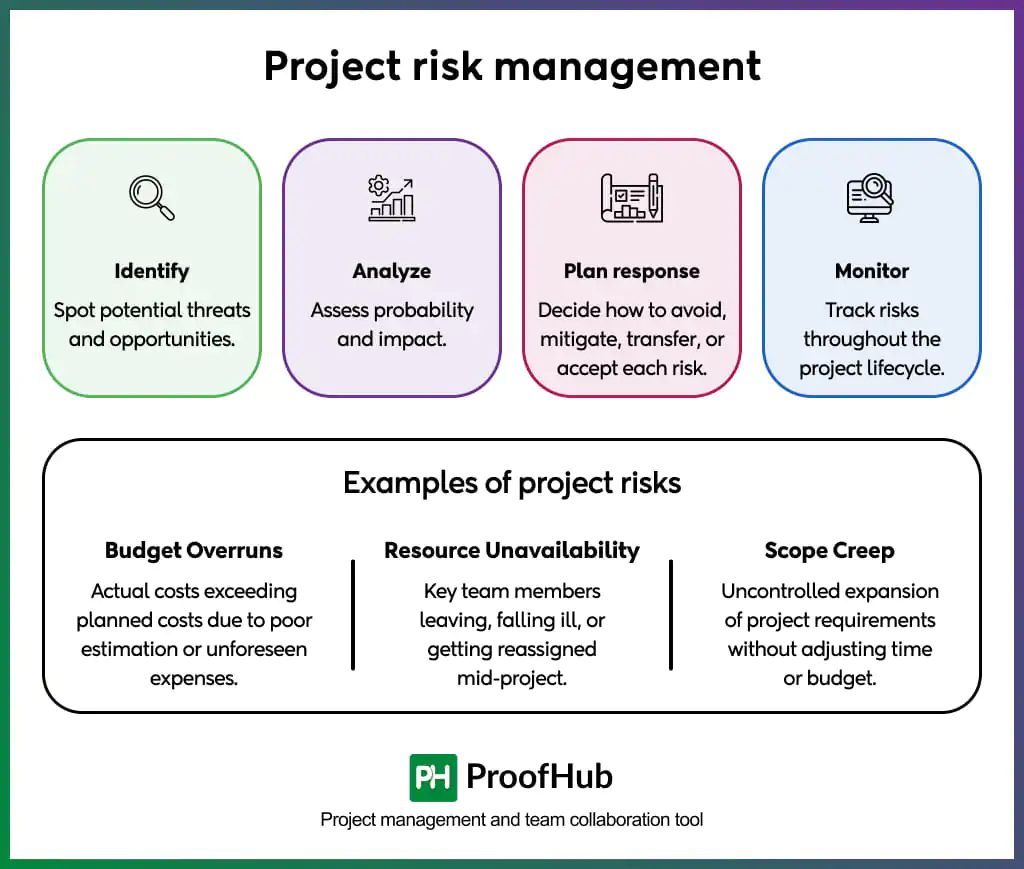
It involves four core activities: risk identification (spotting potential threats and opportunities), risk analysis (assessing probability and impact), risk response planning (deciding how to avoid, mitigate, transfer, or accept each risk), and risk monitoring (tracking risks throughout the project lifecycle).
Common examples of project risks include:
- Scope creep: uncontrolled expansion of project requirements without corresponding adjustments to time or budget.
- Resource unavailability: key team members leaving, falling ill, or getting reassigned mid-project.
- Budget overruns: actual costs exceeding planned costs due to poor estimation or unforeseen expenses.
Why is project risk management important?
Project risk management is important because it reduces uncertainty, improves decision-making, protects the project from delays, improves stakeholder confidence, optimizes project resources, helps avoid budget overruns and quality issues.
Here is why managing project risk is important:
- Reduces uncertainty: Risk management identifies unknowns early and converts them into manageable variables, so teams act on data instead of guesswork.
- Improves decision-making: Risk analysis equips project managers to choose between trade-offs, such as accepting a delay versus increasing the budget, instead of making reactive calls without context.
- Protects the project from delays: Proactive risk planning catches schedule threats before they materialize, allowing teams to adjust timelines or reallocate resources before deadlines slip.
- Improves stakeholder confidence: Transparent risk tracking shows stakeholders that the team anticipates problems and has response plans ready, which builds trust in the project’s leadership.
- Optimizes project resources: Risk prioritization directs people, budget, and time toward the threats that matter most, preventing resources from being wasted on low-impact issues.
- Help avoid budget overruns and quality issues: Early risk mitigation stops small problems from escalating into costly fixes or compromised deliverables, as teams avoid paying premium rates for rushed work or cutting corners under pressure.
Managing project risks comes down to one thing: keeping the project’s core constraints in check. Every project operates within four constraints, and an unmanaged risk rarely stays contained to just one of them. Once a risk materializes without a response plan in place, its effects tend to ripple across the others, compounding the damage.
The breakdown below explains how:
- Scope: Unmanaged risks force last-minute scope changes, as gaps that better planning would have caught get patched under scramble conditions, leading to scope creep or cut features.
- Schedule: Unaddressed risks delay task completion, as dependencies stall and rework consumes time set aside for other deliverables.
- Cost: Unplanned risks inflate budgets, as premium rates get paid for rushed fixes, emergency resources, or vendor delays.
- Quality: Unmitigated risks compromise deliverables, as corners get cut under time or budget pressure to stay on track.
Together, these four impacts show why risk management is inseparable from project success: a project that controls its risks keeps scope, schedule, cost, and quality within acceptable thresholds, while one that doesn’t lets a single unmanaged risk cascade into failure across all four.
What are the processes of project risk management?
The process of project risk management involves seven processes: plan risk management, identify risks, perform qualitative risk analysis, perform quantitative risk analysis, plan risk responses, implement risk responses, and monitor risks.
Each process builds on the one before it, moving a project team from initial risk planning to ongoing risk control.
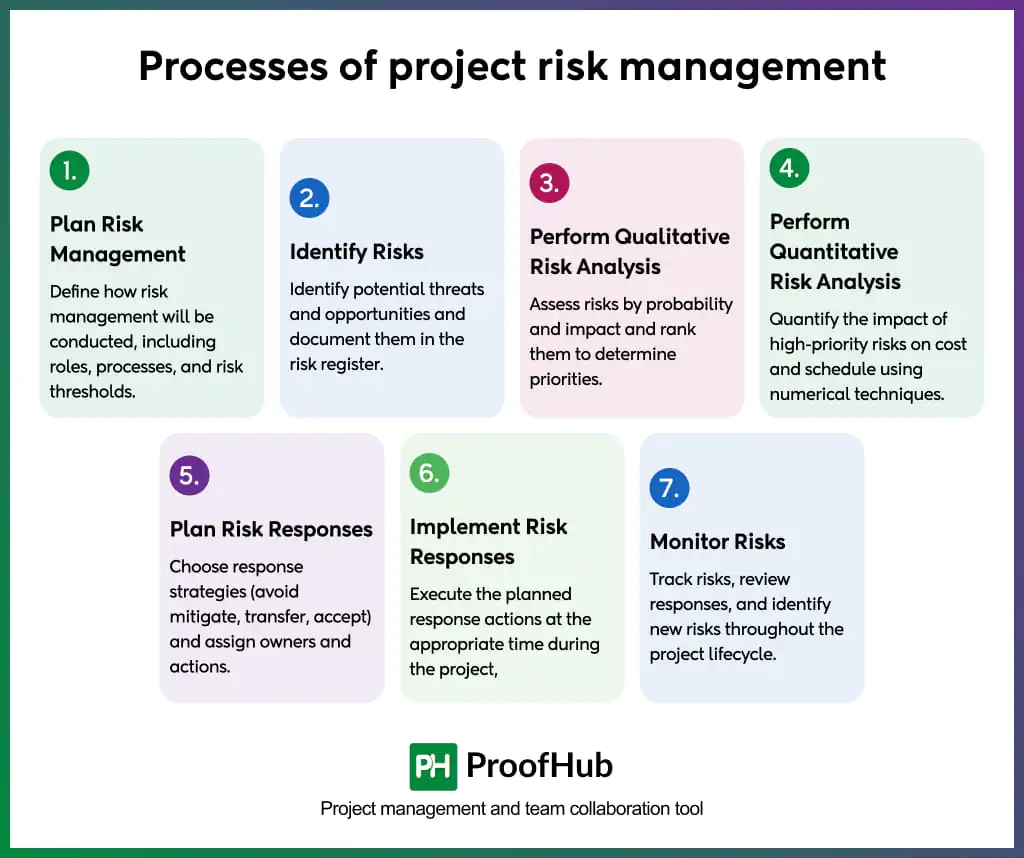
Here is the explanation of seven processes of risk management:
1. Plan risk management
Plan risk management defines how the risk management process will be conducted throughout the project. The project team establishes the methodology, roles, responsibilities, and budget for risk activities at this stage.
It sets the risk tolerance and thresholds that guide later decisions about which risks demand action. This process produces a risk management plan that becomes the reference document for every subsequent step.
Without it, teams approach risk inconsistently and lack a shared framework for prioritization.
2. Identify risks
Identifying risks captures both threats and opportunities that could affect the project’s objectives.
Use brainstorming sessions, checklists, and expert judgment to surface risks that might otherwise go unnoticed.
Brainstorming draws on the collective experience of the team, checklists apply lessons from past projects, and expert judgment brings in specialized knowledge for technical or industry-specific risks.
The output of this process feeds into the risk register, a living document that logs each risk along with its description, category, and potential triggers. The risk register becomes the central reference point for all later risk analysis and response activities.
3. Perform qualitative risk analysis
Performing qualitative risk analysis assesses each identified risk based on its probability and impact. You can use a risk matrix to plot risks visually, making it easy to compare them at a glance.
This process prioritizes risks by ranking them from highest to lowest concern, so teams focus their limited time and attention on the threats that matter most.
Risks that fall into the high-probability, high-impact zone of the matrix receive immediate attention, while low-priority risks get monitored less intensively.
This prioritization step prevents the team from spreading risk management effort evenly across risks of vastly different severity.
4. Perform quantitative risk analysis
Perform quantitative risk analysis assigns numerical values to risks, measuring their potential impact on cost and schedule using techniques like sensitivity analysis, expected monetary value, or Monte Carlo simulation.
This process applies primarily to high-priority risks identified during qualitative analysis, since quantifying every risk would consume excessive time and resources.
Quantitative analysis gives project managers concrete data, such as a dollar estimate or number of days, to support budget and schedule contingency decisions.
It strengthens the accuracy of forecasts and removes much of the subjectivity present in qualitative rankings.
5. Plan risk responses
Plan Risk Responses determines the specific actions the team will take for each significant risk.
The four core strategies are: avoid (eliminating the risk by changing the project plan), mitigate (reducing the probability or impact of the risk), transfer (shifting the risk’s consequence to a third party, such as through insurance or outsourcing), and accept (acknowledging the risk without proactive action, often because it falls below a meaningful threshold).
Choosing the right strategy depends on the risk’s severity, the cost of response, and the team’s risk tolerance. This process converts analysis into action by assigning owners and response plans to each risk.
6. Implement risk responses
Implementing risk responses puts the planned strategies into action. The assigned response plan is executed by the risk owners, whether that means purchasing insurance, adjusting the schedule, or allocating contingency budget.
This process ensures that risk planning doesn’t remain theoretical, translating documented strategies into real changes to the project’s execution.
Timely implementation prevents a known risk from materializing into an actual issue simply because the planned response was never carried out.
7. Monitor risks
Monitoring risks tracks identified risks throughout the project lifecycle while also watching for new risks that emerge as conditions change.
You conduct risk audits and risk reviews at regular intervals to evaluate whether existing response strategies are working and whether the risk register needs updates.
This process keeps risk management an active, ongoing discipline rather than a one-time exercise completed at project kickoff.
Continuous monitoring allows teams to catch emerging risks early and adjust their response strategies before those risks affect scope, schedule, cost, or quality.
What are the types of risks in project management?
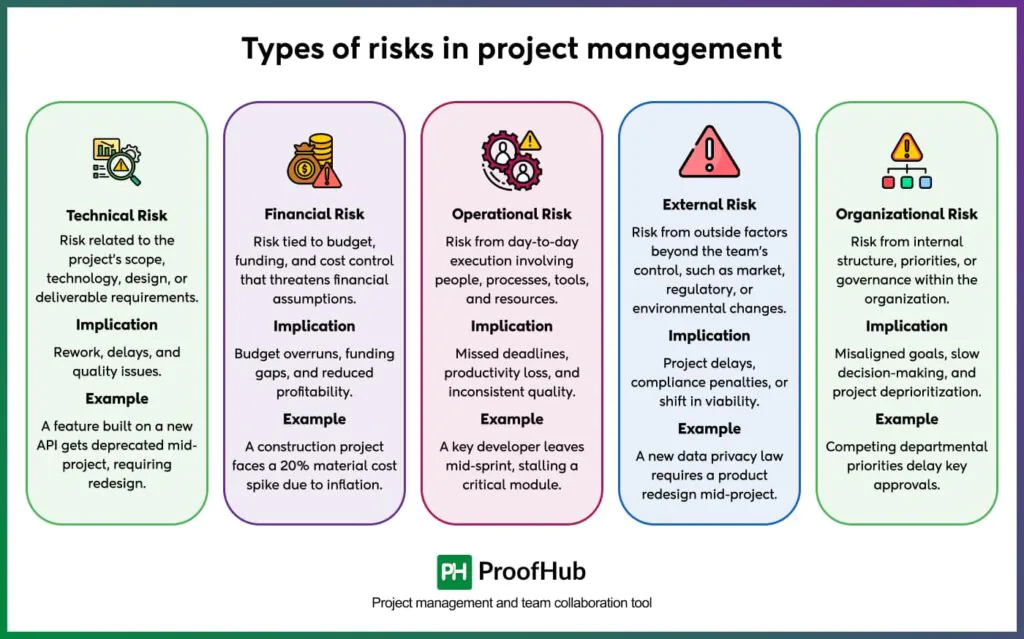
The five types of risk in project management are technical, financial, operational, external, and organizational risks. Each category threatens a different part of the project, including scope and delivery, budget, day-to-day execution, the outside environment, or internal structure, which requires a different response plan.
Here is a brief description of each category:
1. Technical risk
Exposure arising from the project’s scope, design, technology, or deliverable requirements. It surfaces when the solution depends on tools, methods, or specifications that haven’t been fully proven or validated.
This category also includes risk from technical debt carried over from earlier phases or related systems. The more complex or novel the technical approach, the higher this risk is.
Causes:
- Unproven or emerging technology
- Poorly defined requirements
- Design or architecture flaws
- Integration issues between systems
Potential impact: Rework, missed technical specifications, delivery delays, and quality shortfalls in the final product.
For example: A software team builds a feature on a new API that gets deprecated mid-project, forcing a redesign.
2. Financial risk
Financial risks are vulnerabilities tied to the project’s budget, funding, and cost control. It covers any factor that threatens the financial assumptions a project is built on, from estimation accuracy to funding continuity.
This risk compounds over time — a small early miscalculation can snowball into a major shortfall by the later phases. Projects with long timelines or external funding sources carry more exposure here.
Causes:
- Inaccurate cost estimation
- Currency or inflation fluctuations
- Funding cuts or delayed disbursement
- Scope creep is driving up spend
Potential impact: Budget overruns, funding gaps, and reduced project profitability or viability.
For example: A construction project faces a 20% material cost spike due to inflation, exceeding the allocated budget.
3. Operational risk
Operational risks are the threats stemming from day-to-day execution, including people, processes, and resources needed to run the project. It reflects how well workflows, tools, and staffing hold up under real working conditions.
This risk tends to surface gradually, through small inefficiencies and bottlenecks rather than a single dramatic failure. Groups with thin resourcing or immature processes face more of it.
Causes:
- Resource shortages or turnover
- Process breakdowns or unclear workflows
- Equipment or tool failure
- Poor task coordination across teams
Potential impact: Missed deadlines, productivity loss, and inconsistent output quality.
For example: A key developer leaves mid-sprint, stalling a critical module with no immediate backup.
4. External risk
Hazard originating from factors outside the project’s control, the market, regulations, or environment.
These risks originate beyond the organization’s boundary, so they can’t be eliminated through internal planning alone, only monitored and mitigated.
They’re often harder to predict and can strike with little warning. Industries with heavy regulation or global supply chains carry disproportionate exposure here.
Causes:
- Regulatory or policy changes
- Natural disasters or geopolitical events
- Supplier or vendor failure
- Market or economic shifts
Potential impact: Project delays, compliance penalties, or a shift in project viability altogether.
Example: A new data privacy law requires a product redesign partway through development.
5. Organizational risk
Organizational risks are uncertainties rooted in the company’s internal structure, priorities, or governance.
It stems from how the organization itself is run, its reporting lines, decision-making speed, and alignment across departments, rather than the project’s technical or external environment.
This risk is often invisible until a change in leadership or strategy exposes it. Larger, more siloed organizations tend to carry more of this risk by default.
Causes:
- Competing priorities across departments
- Unclear ownership or reporting lines
- Leadership or strategy changes
- Inadequate stakeholder buy-in
Potential impact: Misaligned goals, slow decision-making, and project deprioritization.
What are the best risk response strategies in project management?
The best risk response strategies are avoid, mitigate, transfer, and accept for threats and exploit, enhance, share, & accept for opportunities.
Escalation applies to both when a risk exceeds the project’s authority to handle it. Picking the right strategy determines whether a risk gets neutralized early or spirals into a costly delay.
Threat response strategies
- Avoid: Remove the threat by changing the plan. Cut the risky activity, swap the vendor, adjust the scope. This is the only strategy that eliminates the risk outright.
- Mitigate: Shrink the threat’s probability or impact. Add buffer time, run early tests, build in redundancy. The risk stays, but it loses its teeth.
- Transfer: Push the financial burden onto someone else. Insurance, warranties, and outsourcing contracts move the cost, not the risk itself.
- Accept: Take the hit if it happens. Reserve a contingency for active acceptance; do nothing and absorb the impact for passive acceptance.
Opportunity response strategies
- Exploit: Force the opportunity to happen. Assign top performers, commit resources, guarantee the win.
- Enhance: Boost the odds. Strengthen the conditions that make the opportunity more likely or bigger when it lands.
- Share: Bring in a partner better positioned to capture it. A joint venture beats going it alone when capability is the bottleneck.
- Accept: Stay ready. Take no action now, but move fast if the opportunity shows up on its own.
Escalation
Use escalation when a risk or opportunity sits outside the project authority or budget, and hand it to the program or portfolio level rather than trying to manage it internally.
What are the common challenges in project risk management?
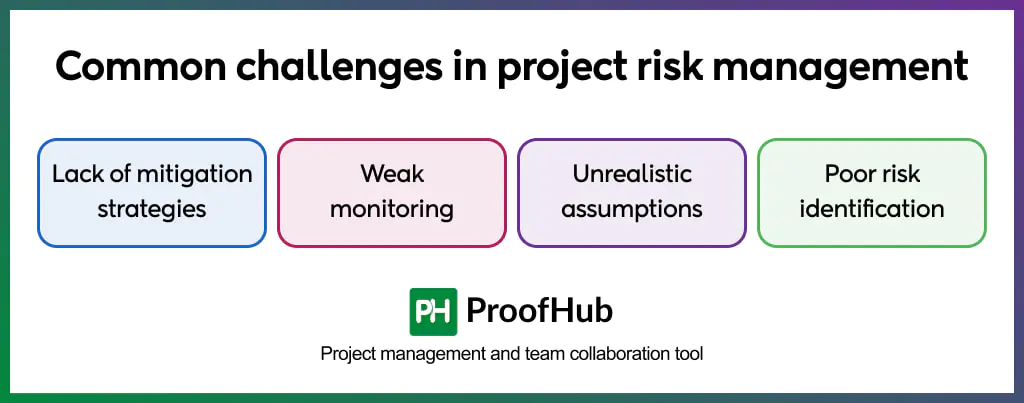
The common challenges in project risk management are poor risk identification, unrealistic assumptions, weak monitoring, and lack of mitigation strategies.
These challenges rarely appear in isolation, a gap in one area typically compounds the others, since missed risks can’t be monitored and unmonitored risks never get a mitigation plan.
Here’s a closer look at each:
- Poor risk identification: Teams often miss risks that fall outside familiar categories, especially in the early planning stage. This happens when risk assessment relies on a single person’s judgment instead of structured input from the full project team. Blind spots left here carry forward and surface later as unplanned issues.
- Unrealistic assumptions: Project plans frequently rest on optimistic timelines, resource availability, or stakeholder cooperation that don’t hold up in practice. Schedules and budgets get built around best-case scenarios rather than being tested against historical data. When assumptions break down mid-project, the resulting gaps force reactive, costly adjustments.
- Weak monitoring: Risk registers get created at project kickoff and then are rarely revisited as the project evolves. Without scheduled reviews, new risks go undetected and existing ones drift out of date. This leaves problems undetected until they’ve already affected scope, cost, or schedule.
- Lack of mitigation strategies: Many risks are documented without assigning clear ownership or response plans for each one. A risk log without action items functions as a list, not a management tool. When a risk materializes, a response has to be scrambled together instead of executing one that’s already prepared.
What are the Risk register and Risk matrix?
A risk register is a documented log that tracks every identified risk in a project, recording details such as its category, probability and impact scores, assigned owner, and planned response strategy. It serves as the project’s single source of truth for risk status, and it is updated continuously as risks evolve, get resolved, or new ones emerge.
A risk matrix, also known as a probability-impact matrix, complements the register by visually plotting each risk on a grid of likelihood versus severity. This visual layout allows teams to quickly rank risks and focus limited time and resources on the ones falling into the high-probability, high-impact quadrant, rather than treating every logged risk with equal urgency.
Used together, the register captures the full depth of detail needed for planning and accountability, while the matrix distills that detail into a clear, at-a-glance view for prioritization and reporting.
Most project management tools, including ProofHub, support both artifacts side by side, letting teams log risks in detail and still get a quick visual read on what needs attention first.
Here is a brief table to learn more about:
Practical Example of Project Risk Management in the IT Industry
Consider a software company building a customer-facing mobile app with a fixed six-month deadline for a client launch tied to a major marketing campaign.
1. Risk identification
During planning, the project team identifies several risks: the third-party payment gateway API is still in beta, two senior developers are also allocated to another project, and the client has a history of requesting late-stage scope changes.
2. Risk assessment
The team scores each risk by probability and impact. The payment gateway risk gets a high score (4×5=20) since beta APIs frequently introduce breaking changes close to launch.
Developer overallocation scores medium (3×4=12). Scope creep from the client scores high (4×4=16) based on past project history.
3. Risk response planning
- Payment gateway (mitigate): An abstraction layer gets built around the payment integration, so a gateway change only requires updating one module, not the entire codebase.
- Developer overallocation (transfer/mitigate): The project manager negotiates dedicated hours with the other project’s manager and identifies a backup contractor as a contingency.
- Scope creep (avoid/mitigate): Requirements get locked in a signed scope document, and a change request process is set up that routes new tasks through a formal review, protecting the timeline.
4. Monitoring
The risk register gets reviewed in biweekly sprint retrospectives. When the payment gateway provider announces an API version change in month four, the abstraction layer absorbs the update in two days instead of the two weeks it would have taken without one.
5. Outcome
The app launches on schedule. The residual risk, minor UI adjustments needed for the new API version, gets logged and resolved in a post-launch patch, while the client’s one scope change request gets pushed to a phase-two release instead of disrupting the original deadline.
Free project risk management template
Here’s a free template to help: a ready-to-use risk register paired with an auto-updating risk matrix, so you can start tracking risks in minutes instead of building a system from scratch.
Free project risk management template
Take control of uncertainty with a clear risk management approach. Download the Project Risk Management Template to identify potential risks early, track them effectively, and keep your projects on the right path, every step of the way.
Download the free template nowHow to use the free template
1. Open the “How to Use” tab for a quick walkthrough of what’s inside before you start entering data.
2. Log each risk in the Risk Register tab, one row per risk, with a clear description.
3. Set the category, probability, and impact using the built-in dropdowns. The Risk Score and Priority calculate automatically.
4. Assign a risk owner and choose a response strategy, then note the specific action plan.
5. Update the status as the project moves forward, Open, Monitoring, Closed, or Occurred.
6. Check the Risk Matrix tab for an auto-updating, color-coded view of which risks need attention first.
7. Revisit the register regularly, weekly or biweekly, so it stays current instead of going stale after kickoff.
What is the difference between risk management and issue management?
Risk management in a project is the process of identifying, assessing, and planning responses for uncertain events that could affect a project before they occur.
Issue management is the process of identifying, tracking, and resolving problems that have already happened and are actively affecting the project. The core distinction is timing: risk management is proactive and forward-looking, while issue management is reactive and deals with present-tense impact.
Here is the depth difference between the two:
Who is responsible for project risk management?
The project manager holds primary responsibility for project risk management, though the task is shared broadly.
The project manager owns the risk management plan, facilitates identification sessions, and ensures the risk register stays current.
Risk owners handle individual risks assigned to them, sponsors approve risk response budgets, and individual contributors flag risks they spot in their own work areas.
In larger organizations, a project management office (PMO) or risk manager may oversee risk standards across multiple projects.
How to calculate risk score?
Risk score is calculated by multiplying probability by impact: Risk score = Probability × Impact. Both factors are typically rated on a scale of 1–5 or 1–10, based on the likelihood of the risk occurring and the severity of its effect on cost, schedule, or quality.
A risk rated 4 (probability) × 5 (impact) scores 20, placing it higher priority than one rated 2 × 3, which scores 6. Teams plot these scores on a probability-impact matrix to sort risks into low, medium, and high priority tiers, guiding where response planning gets focused first.
Who is a risk owner in project management?
A risk owner is the individual assigned responsibility for monitoring a specific risk and executing its response plan. The role differs from the project manager’s broader oversight: a risk owner tracks one risk closely, watches for its triggers, and acts the moment it materializes or its likelihood changes.
Risk owners are typically chosen based on who has the most relevant expertise or authority over the risk area, such as a technical lead owning a technology risk or a procurement manager owning a vendor risk.
What is residual risk in projects?
Residual risk is the risk that remains after a response strategy has been applied. It exists because most mitigation, transfer, or avoidance strategies reduce a risk’s probability or impact rather than eliminate it completely.
For example: adding a code review process reduces the risk of software defects but doesn’t remove it entirely, the remaining exposure is the residual risk.
The project documents residual risks in the risk register and may set aside contingency reserves to cover them, distinguishing them from secondary risks, which are new risks created by the response itself.
How do AI tools improve project risk management?
AI tools enhance project risk management by identifying risks faster, predicting their likelihood more accurately, and automating the monitoring that teams often let slip. Machine learning models scan historical project data to flag patterns human reviewers miss, such as recurring vendor delays or seasonal resource shortages.
Natural language processing tools scan project documentation, emails, and status reports to surface emerging risks in real time rather than waiting for a scheduled review. Predictive analytics can also forecast schedule and cost overruns earlier by weighing current project variables against outcomes from comparable past projects.
Conclusion
Project risk management works best as an ongoing habit, not a one-time checklist. Teams that identify risks early, score them honestly, and assign clear owners stay ahead of problems instead of scrambling to fix them after the fact. A well-maintained risk register and matrix turn uncertainty into something manageable, keeping scope, schedule, cost, and quality on track. The difference between projects that stay on course and those that don’t usually comes down to preparation, not luck.
Start with the free template above, or track risks directly within your workflow using a tool like ProofHub.