
Every project operates within certain limits, whether it is budget, resources, or a deadline. These limits are known as project constraints. They influence how a project is strategized, executed, and delivered.
Understanding project constraints helps project managers balance priorities, set project boundaries, make informed decisions, and manage changes effectively.
Whether you manage a small or a large project, recognizing and managing constraints is essential for delivering successful project outcomes.
- 1.Project constraints are the limiting factors-scope, time, cost, quality, risk, and resources—that define the boundaries every project must operate within.
- 2.Scope, time, and cost make up the triple constraint, which serves as the foundational model of project management, with quality, risk, and resources built upon it.
- 3.Since all six constraints are interconnected, a change in one directly impacts the others, making continuous constraint management essential throughout the project lifecycle.
- 4.Understanding the difference between internal and external constraints helps teams identify what they can control and what they must monitor and anticipate.
- 5.Effective constraint management requires trade-off analysis, clear scope boundaries, stakeholder alignment, and data-driven tracking to keep projects on course despite uncertainty.
What are project constraints?
Project constraints are the limiting factors that define the boundaries within which a project must be planned, executed, and delivered. These boundaries span six key areas: scope, time, cost, risk, quality, and resources, each directly impacting every decision made throughout the project lifecycle.
Among these, scope, time, and cost form the triple constraint — the foundational model of project management upon which the remaining three are built.
Since all six are interconnected, a change in one affects the others. For example, a change in the budget influences the resources.
Why are project constraints important?
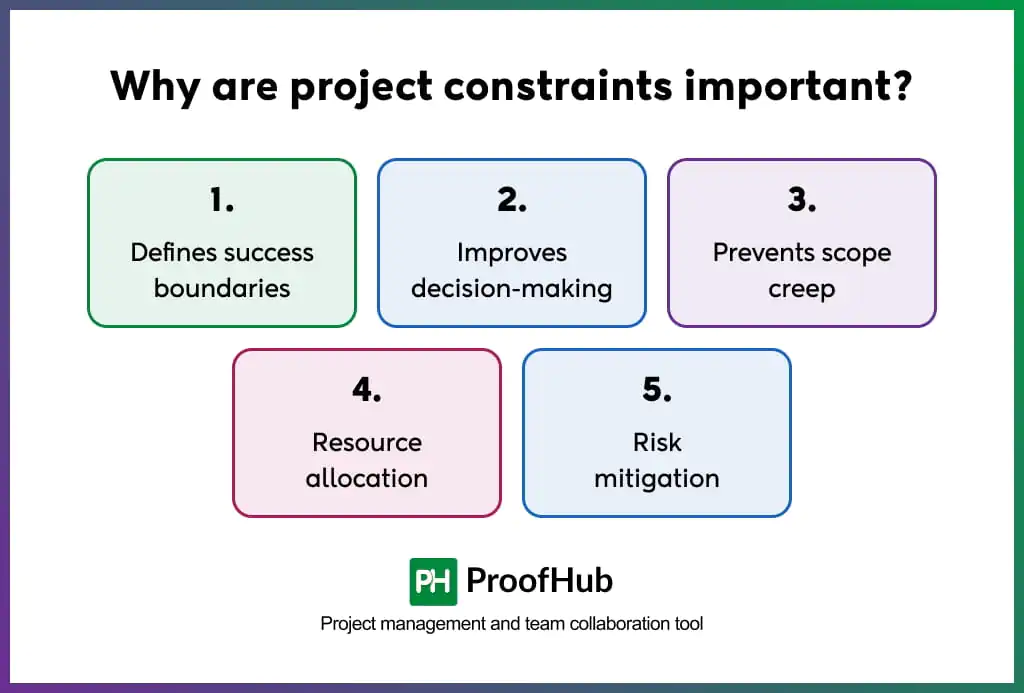
Project constraints are important because they define success boundaries, improve decision-making, prevent scope creep, enable resource allocation, and mitigate risks.
Here is why each matters:
- Defines success boundaries: Sets clear objectives, time frame, deliverables, and budget for the project. It helps stay aligned throughout the project lifecycle by providing clarity around expectations, priorities, and project outcomes.
- Improves decision-making: Maintaining a balance between scope, time, and cost helps evaluate and manage project trade-offs effectively, enabling swift decision-making.
- Prevents scope creep: Helps teams evaluate changes, maintain focus on approved objectives, and manage project growth structurally. Provides teams with a framework for adding or modifying changes to the original approved plan.
- Resource allocation: Enables teams to allocate and prioritize people, tools, and budget to the project, considering the project restrictions. It ensures resources are utilized effectively and efficiently according to the project demand.
- Risk mitigation: Surfaces potential risks and uncertainties before they become blockers. The risks anticipated and managed rather than reacted to mid-project.
What are the six main constraints of a project?
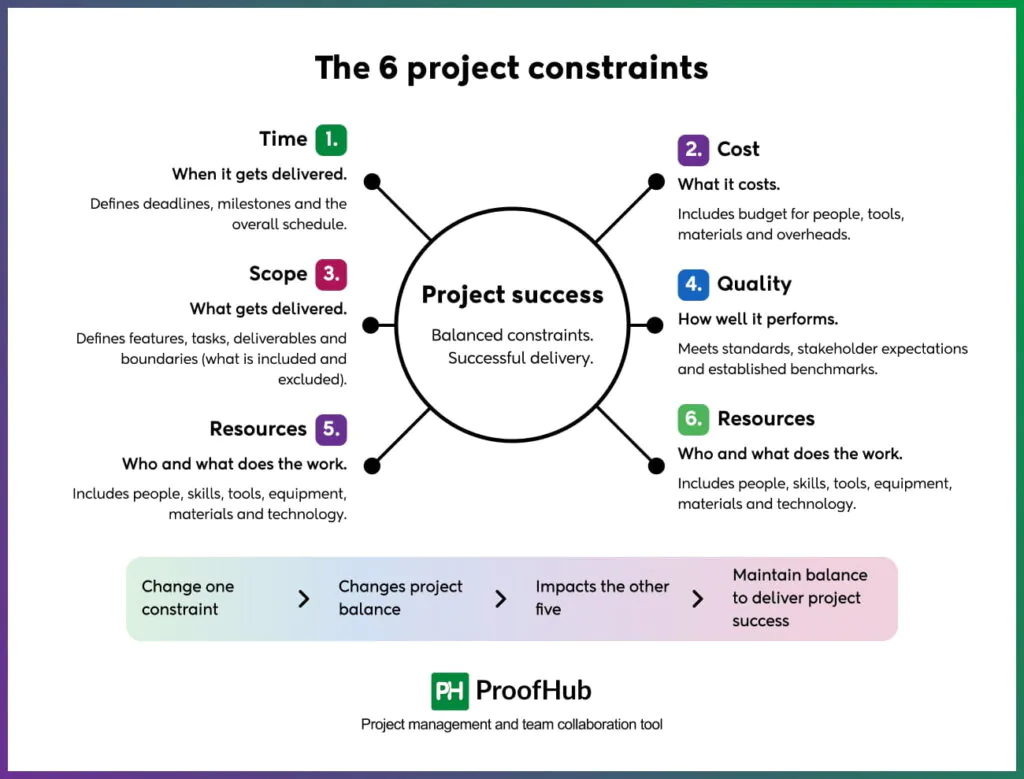
The six main project constraints are time, cost, scope, quality, risk, and resources. These limitations define the boundaries at every project stage; a change in any one of them directly impacts the rest. Working within the boundaries prevents the project from failing.
The following sections explain each constraint, its impact when left unmanaged, and the approaches used to manage it effectively.
1. Time
Time defines the duration within which a project moves from initiation to completion stage, covering deadlines, milestones, and task sequencing.
A clearly structured and realistic project timeline keeps scope stable, resources balanced, and costs within the agreed boundaries.
Poor time management leads to missed deadlines, resource wastage, budget overruns, reduced stakeholder confidence, and risks project failure.
To avoid time constraints, set realistic deadlines for each phase, continuously monitor progress, and address delays proactively before they impact the overall project lifecycle.
2. Cost
Cost refers to the total planned budget within which a project must be executed. The agreed budget covers the workforce, equipment, software, and overhead expenses.
Every change in scope or resources directly impacts the overall project cost. Reducing the budget without adjusting the timeline forces trade-offs between resources and quality.
Budget overrun is commonly caused by poor planning, misaligned priorities, or uncontrolled scope changes. If not addressed, the issues compound, resulting in reduced ROI or even a project halt.
To keep project cost under control, create an accurate budget estimation at the initiation stage, and regularly track actual versus planned project cost.
3. Scope
Scope defines what the project will deliver and what it will not, covering the features, deadlines, tasks, deliverables, and outcomes formally agreed upon at the initiation stage.
Clear boundaries between inclusions and exclusions keep all stakeholders aligned and prevent unwanted conflicts throughout the project lifecycle.
Uncontrolled and gradual addition of requirements without adjusting time or budget leads to scope creep.
To effectively manage project scope, document agreement with a structured change control process and share it with all stakeholders.
4. Quality
Quality refers to the standards needed to ensure that project outcomes meet the stakeholders’ expectations and established benchmarks.
Any compromises made in the scope, time, cost, or resources directly impact the project quality.
Substandard quality affects the final deliverable, causes rework, increases costs, and erodes the stakeholder’s trust.
To maintain project quality, ensure that scope, time, and cost are realistically defined from the outset and tracked throughout the project.
5. Risk
Risk refers to any uncertainty that arises at any stage of a project and creates conditions for change, delays task delivery, affects cost, or project scope. Every project carries risk to some extent across all consistent areas.
Industry research consistently shows that projects without structured risk management practices are significantly more likely to miss deadlines, exceed budgets, and fail to meet their original goals.
Teams that treat risk as a one-time planning exercise rather than an ongoing discipline consistently struggle to absorb uncertainty when disruptions occur.
To mitigate risk, detect risks early, prepare response plans, and treat risk as an ongoing discipline.
6. Resources
Resources are assets on which a project depends to operate, including people, equipment, materials, and technology.
Among them, human resources are the most critical asset, since the skills and capabilities of the team determine the project’s realistic success within its limits.
Imbalance of resources is mainly caused by poor resource planning. Under-allocation of resources causes burnout and compromise on quality, whereas over-allocation causes resource wastage and increases the cost of the project.
To mitigate resource constraints, balance resource allocation by identifying gaps and distributing workloads according to individual capabilities to keep the project stable within its timeline and budget.
What are the internal project constraints?
Internal project constraints are limiting factors that arise within the organization and directly influence the project. They include: cost, time, scope, quality, resources, organizational decisions, and risk.
Each constraint affects project execution in different ways and requires careful management.
1. Cost: Inaccurate cost estimation, resource allocation, and inefficient cost management directly affect the scope, quality, and success of a project. To minimize cost disruptions, create a realistic budget plan, monitor expenses regularly, and manage project costs efficiently.
2. Time: Unrealistic deadlines and poor progress tracking cause delivery pressure and operational bottlenecks. To ensure timely delivery, set realistic timelines, create an effective project schedule, and monitor progress regularly.
3. Scope: Unclear requirements or shifting priorities cause chaos, increase rework, and disrupt project alignment. Conduct requirement analysis and control change management to maintain alignment and reduce disruptions.
4. Quality: Inadequate internal quality control leads to delivery problems, customer dissatisfaction, and rework. Establish standardized processes and monitor quality regularly to maintain consistency throughout the project.
5. Resources: Misallocation of resources affects project stability and productivity. Implement effective resource planning and support skill development to improve productivity and reduce operational inefficiencies.
6. Organizational decisions: Rigid procedures and slow decision-making increase the chances of project failure. Establish clear communication channels and flexible decision-making processes to enhance project coordination and execution.
7. Risk: Technical failures, delays, communication gaps, and poor planning disrupt workflows and complicate project execution. Identify risks early and assess their potential impact to reduce disruptions and ensure seamless execution.
What are the external project constraints?
External project constraints are factors originating outside the project team’s direct control. They include economic shifts, environmental conditions, regulatory changes, security concerns, social constraints, and technological dependencies.
External constraints are unpredictable and uncontrollable. However, they can be monitored and managed to prevent disruption in project delivery.
1. Economic shifts: Inflation, fluctuating exchange rates, interest rates, and unstable market conditions are common economic limitations. A sudden rise in resource prices impacts the planned budget and reduces available financial resources.
2. Environmental conditions: Environmental limitations include changing weather, geographical boundaries, and government environmental regulations that influence project execution. Ignoring environmental conditions leads to disruptions, cost increases, and unplanned scope changes.
3. Regulatory changes: The project adheres to legislation that considers all laws, regulations, and compliance requirements imposed by governments and regulatory bodies. Neglecting legal compliance carries serious legal and financial consequences, disrupting project delivery.
4. Security concerns: Security constraints are external threats, including cybersecurity risks, data protection, and physical security requirements, that shape design and project delivery. Non-compliance exposes projects to breaches and legal liability, damaging organizational reputation and inflating costs.
5. Social conditions: They arise from the expectations and influences of societies and stakeholders involved in a project, including public opinion, cultural influences, and workforce demographics. Overlooking these factors causes project delays, conflicts, and reputational damage.
6. Technological dependencies: Technological constraints are limitations arising from technologies outside the organization’s control. New advancements and software compatibility issues interrupt deadlines and increase project costs.
Internal vs external project constraints
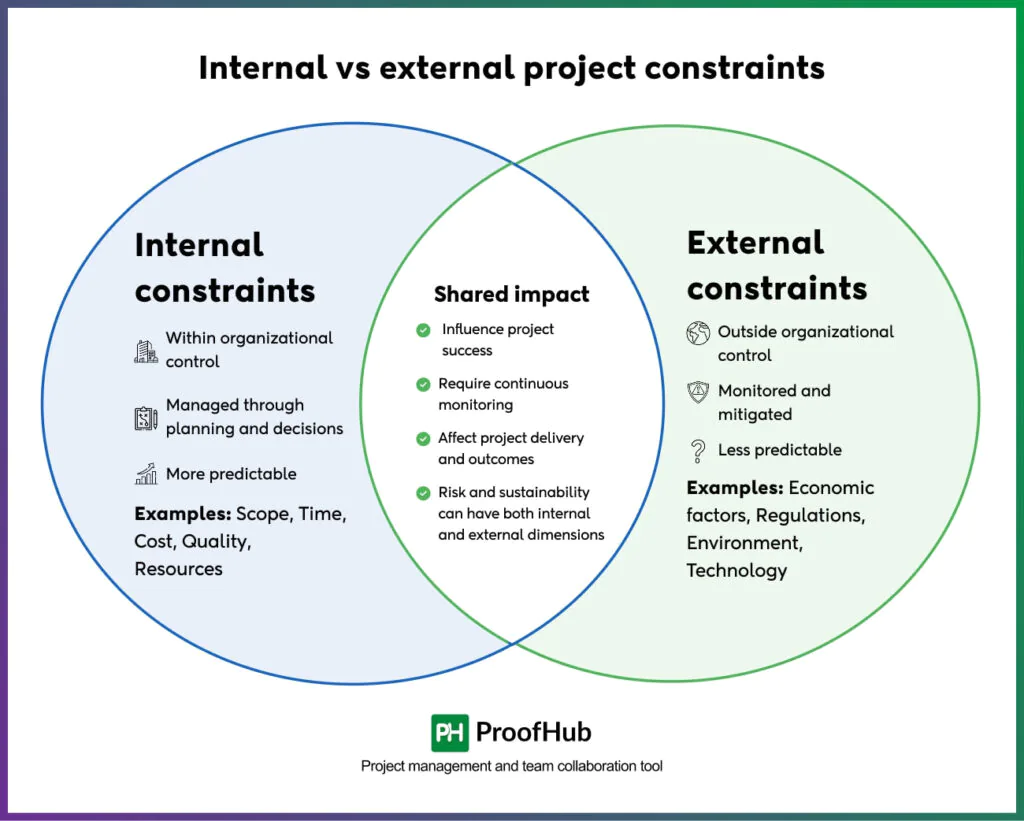
Internal project constraints originate from within the organization and are largely within the project team’s control. They include resource availability (budget, staffing, equipment), organizational policies, internal processes, and existing infrastructure.
For example, a project might be constrained by the number of skilled developers available in-house, or by company policy requiring specific approval workflows before deployment.
Because these constraints come from inside the organization, you have more flexibility to negotiate, escalate, or adjust them through internal channels, reallocating budget, requesting additional headcount, or revising timelines with stakeholder buy-in.
External project constraints, on the other hand, originate outside the organization and are typically beyond the project team’s direct control.
These include regulatory and compliance requirements, market conditions, vendor or supplier dependencies, client-imposed deadlines, and technological standards set by third parties.
For example: A project might be constrained by a government regulation mandating data security standards, or by a vendor’s delivery timeline for critical components. Since you can’t directly change external constraints, the focus shifts to risk management, contingency planning, and building buffers to absorb potential delays or disruptions caused by these outside factors.
How to identify project constraints?
To identify project constraints, the five steps are: analyze project documentation and resource availability, gather stakeholders’ insights, analyze external factors, and review assumptions and dependencies.
Identifying limitations early allows the team to gain better visibility into the limitations within which the project operates. Here is how to approach each one:
1. Analyze project documentation
Identify budget allocations, stakeholders’ commitments, and scope to surface predefined limitations at the initiation stage.
Analyzing project documentation provides the team a baseline from which all constraint identification starts.
2. Gather stakeholder insight
Engage with stakeholders early. Ask questions about budget limits, resources, and regulatory requirements.
Stakeholders often possess accurate, first-hand information that does not appear in formal documents.
3. Assess resource availability
Verify the availability of resources, including workforce, technology, and finances, and what can be allocated.
Assessing all available resources and their efficient allocation makes the project execution cost-effective. It clarifies the timing and requirements.
4. Analyze external factors
To identify all external forces, begin with an initial search on market conditions, economic insights, government regulations, and environmental factors.
By taking past and current insights, project managers can predict future outcomes and plan and manage the project according to those predictions.
5. Review assumptions and dependencies
Make a list of your assumptions and check task dependencies or how tasks are dependent on everyone.
Check real data and feedback from all involved stakeholders before execution. It helps to catch minor issues before they become big obstacles, making the project lifecycle smoother.
What are the major causes of project constraint management problems?
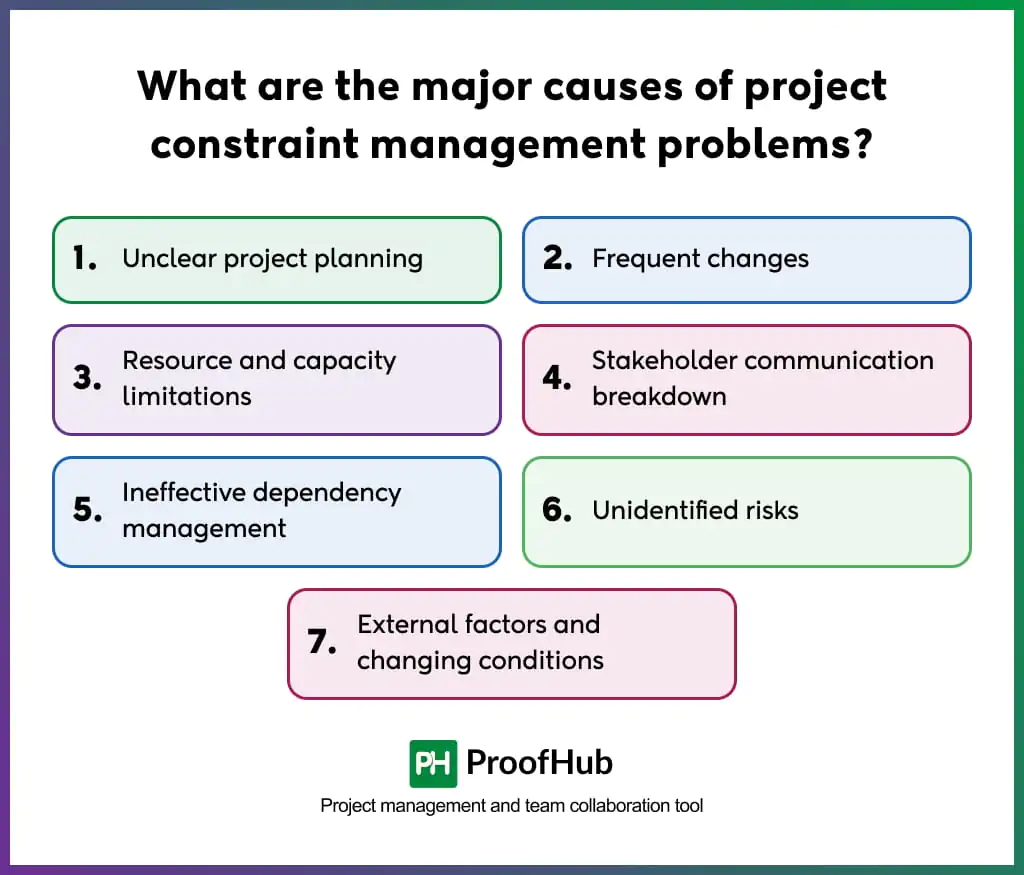
Constraint management problems occur due to unclear planning, constant changes, limited resources, communication gaps, unmanaged dependencies, unidentified risks, and external forces.
By promptly addressing gaps, teams can eliminate delays, cost overruns, and delivery failures.
Here is a closer look at what drives each one:
- Unclear project planning: Vague objectives lead to vague constraints. Without precise scope, budget, and timeline definitions upfront, teams have nothing solid to measure against. This makes every later constraint change look arbitrary instead of justified.
- Frequent changes: Constant scope or requirement changes destabilize the original baseline. Each change forces a fresh trade-off across time, cost, or quality. Without change control, this turns constraint management into constant firefighting.
- Resource and capacity limitations: Limited people, budget, or tools restrict how much flexibility a project actually has. When capacity is already stretched, even small constraint shifts become difficult to absorb without delays or burnout.
- Stakeholder communication breakdown: Misaligned expectations between stakeholders create conflicting priorities. When one group assumes a different constraint than another, decisions get reversed mid-project. This wastes time and erodes trust in the plan.
- Ineffective dependency management: Poorly tracked dependencies hide schedule risk until it’s too late. A delay in one task silently pushes everything linked to it. By the time it’s visible, the time constraint is already broken.
- Unidentified risks: Risks that go unnoticed during planning surface later as forced constraint changes. Without proactive risk assessment, teams are constantly reacting instead of preparing. This turns manageable issues into unexpected crises.
- External factors and changing conditions: Market shifts, vendor delays, or regulatory changes sit outside the team’s control entirely. These factors override internal planning regardless of how well constraints were originally defined. Adaptability becomes the only real defense.
How to manage project constraints?
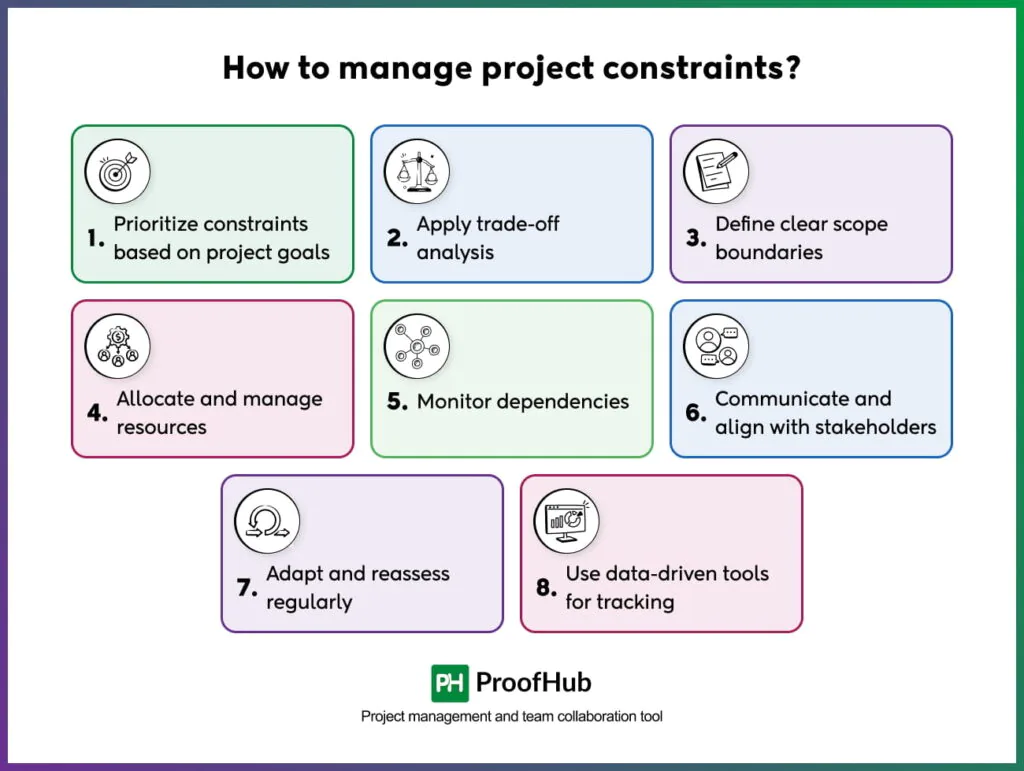
Managing project constraints requires prioritization of limitations, analyzing trade-offs, defining clear scope boundaries, managing and allocating resources, monitoring dependencies, aligning with stakeholders, reassessing boundaries regularly, and utilizing data-driven tools.
Unmanaged constraints compound over time, creating a ripple effect across scope, cost, time, and quality. Here is how to approach each one effectively:
- Prioritize constraints based on project goals: Not every constraint carries equal weight. Teams must rank them according to what matters most for project success, whether that’s cost control, deadline adherence, or scope integrity, and let that priority guide every trade-off decision made later.
- Apply trade-off analysis: When one constraint shifts, trade-off analysis identifies which other constraint absorbs the impact. This allows teams to make deliberate, informed decisions instead of reactive ones that create hidden costs elsewhere in the project.
- Define clear scope boundaries: Ambiguous scope is the leading cause of constraint failure. Documenting exactly what is included and excluded prevents scope creep from silently consuming the time and budget constraints already committed to stakeholders.
- Allocate and manage resources: Matching the right resources to the right tasks at the right time prevents bottlenecks. Misallocated resources strain the cost and time constraints simultaneously, even when the overall workload hasn’t changed.
- Monitor dependencies: Tracking task dependencies in real time reveals early warning signs of schedule risk, since a single delayed dependency can cascade through the entire project and compromise the time constraint before anyone notices.
- Communicate and align with stakeholders: Constraints shift when stakeholder expectations shift. Continuous communication ensures everyone understands current boundaries and agrees on priorities, preventing conflicting assumptions from derailing the project mid-execution.
- Adapt and reassess regularly: Constraints are not static, so scheduled reassessment at key milestones catches drift early. This allows teams to recalibrate before a minor imbalance becomes a major overrun.
- Use data-driven tools for tracking: Real-time dashboards and reporting tools replace guesswork with evidence. Allowing teams to have accurate visibility into constraint status, so decisions are based on current data rather than outdated assumptions.
Project constraints examples
The same boundaries appear to look different in various projects, as per the industry.
The table below shows how each constraint type applies in various industries, including construction, software development, healthcare, retail, and government projects.
| Constraint | Construction | Software development | Healthcare |
|---|---|---|---|
| Time | 12-month contract from foundation to handover | Six-month development cycle from design to deployment | System implementation within a regulatory-mandated timeline |
| Cost | Budget covering cost of materials, labor, equipment, and site overhead | Budget covering cost of licenses, salaries, infrastructure, and testing | Funding covering equipment, integration, training, and audits |
| Scope | Defined floors, rooms, and facilities within agreed safety standards | Agreed features, integration, and modules in the product backlog | Patient management system covering agreed workflows and compliance |
| Quality | Structural safety, material specifications, and building code compliance | Performance benchmarks, security standards, and functionality requirements | Clinical accuracy, data security, and regulatory compliance standards |
| Resources | Engineers, contractors, and equipment operators across each phase | Frontend, backend, QA, and DevOps roles across the lifecycle | Clinical staff, IT specialists, and compliance officers per phase |
| Risk | Geotechnical surveys, weather contingencies, and supplier reliability | API stability, security vulnerabilities, and compatibility reviews | Regulatory approvals, data migration, and staff adoption challenges |
What is a project constraint matrix?
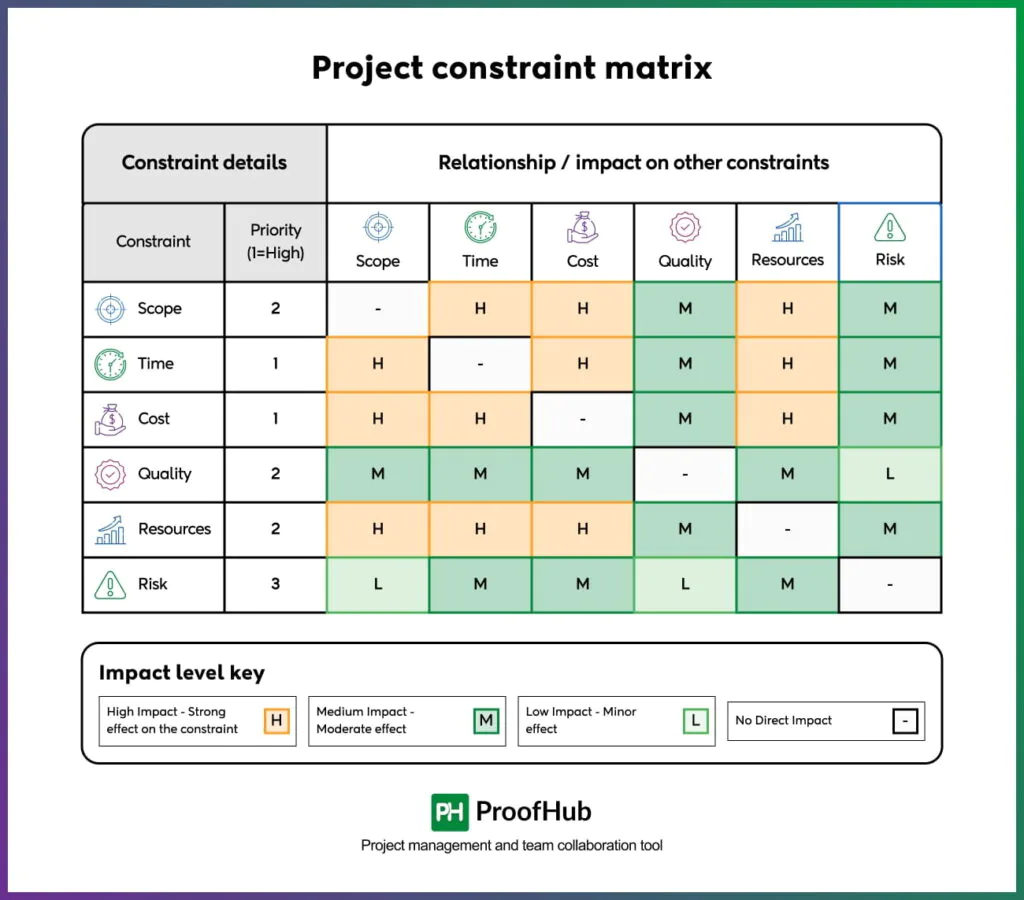
The project constraints matrix is a tool that helps analyze the project constraints (scope, time, cost, quality, resources, and risk) and their impact on the deliverables.
With a constraint matrix, you can list all the project constraints, define the constraint priority level, and identify impact and dependencies among constraints.
It helps balance project priorities and objectives, improves constraint management and supports decision-making.
What is Theory of Constraints?
The theory of constraints is a management methodology that helps managers identify the critical constraint creating the biggest bottleneck in achieving desired outcomes. Eliyahu Goldratt introduced the theory of constraints in 1984. It states that multiple constraints affect a process, but one primary constraint limits the system’s overall performance more than the others.
The “chain” is the best example to illustrate that it can carry weight only up to the limit allowed by its weakest ring. Once the limit weight is carried, the chain breaks from its weakest ring first. Similarly, the overall performance of a process depends on its most limiting constraint.
What is the relation between project constraints and dependencies?
Project constraints define the project boundaries, whereas dependencies define the sequence and relationship between tasks and activities. Dependencies influence how work progresses within project limits such as scope, time, cost, and resources.
For example, Software testing has a dependency on development. If development is delayed, testing is delayed. This can affect the project schedule, quality or cause project delay.
What is the difference between project constraints and project risks?
The main difference between project constraints and project risks is project constraints are known limitations that define the boundaries within which a project must operate and project risks are uncertain events that may occur during the project lifecycle.
| Factor | Project constraints | Project risks |
|---|---|---|
| Definition | Known limitations that define project boundaries | Uncertain events that may impact the project |
| Nature | Certain and defined from the outset | Uncertain and may or may not occur |
| When identified | Identified during project initiation | Identified throughout the project lifecycle |
| Impact | Continuously shape every project decision | Impact the project only if they materialize |
| Examples | Fixed budget, deadline, agreed scope | Supplier failure, key team member leaving, regulatory change |
| Management approach | Managed through planning and trade-off analysis | Managed through risk register and contingency plans |
| Visibility | Always visible and documented | May remain hidden until they occur |
When are project constraints defined during the project lifecycle?
Project constraints are defined during the initiation phase, refined in the project’s planning phase and monitored throughout the project.
In the initiation phase, constraints such as budget, scope, deadline, and resources are identified.
In the planning phase, the exact budget, scope, time, resources and quality standards are documented.
During execution and monitoring, constraints are tracked, and changes are managed.
What is the impact of constraint changes on a project?
The impact of constraint changes on a project is immediate and far-reaching. No constraint changes in isolation, and adjusting one boundary always forces further adjustments across the rest.
For example, if the scope is changed, then more resources are added, more time is required, and the deadline needs to be shifted across the project lifecycle.
Teams often fail to maintain quality when adding more work in scope or changing outcomes without altering the time.
Can project constraints change during a project?
Yes, project constraints can change during the project. As the project progresses, changes in priorities, expectations, scope, and quality standards lead to changes in project constraints.
For example, adding more features to the application may require additional resources, time or budget.