
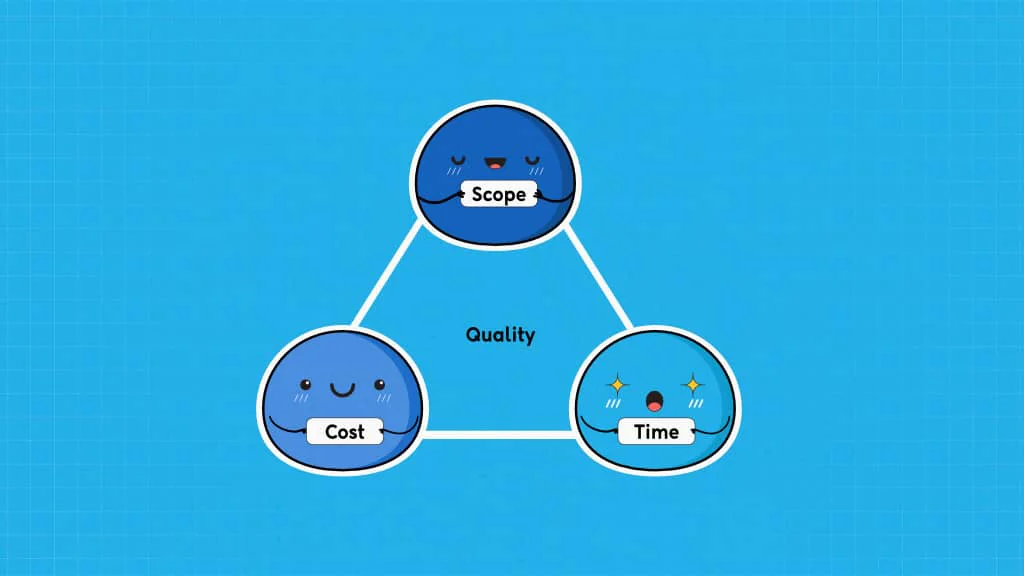
Every project operates within certain limitations. These limitations are known as project constraints. The most widely recognized constraints in project management are scope, time, and cost. These three elements determine what work needs to be completed, how long it will take, and how much it will cost to deliver the project work.
Together, these constraints form the triple constraint. They are also known as the Iron Triangle because a change in one constraint inevitably leads to a change in the other.
The relationship between these constraints and the quality of the project is described using the project management triangle, project triangle, or iron triangle.
In this article, we will understand what the triple constraints are, the relationship between these three constraints and the quality of the project, and how to manage these constraints in a project.
- 1.The triple constraints of a project are scope, time, and cost. Scope defines the work, time defines the schedule, and cost defines the financial resources required.
- 2.The three constraints are interdependent, meaning a change in one affects the others, or otherwise the quality will suffer.
- 3.Effective management requires clear scope definition, realistic scheduling, and accurate budget planning.
- 4.Challenges such as scope creep and unrealistic estimates can disrupt the balance between constraints.
What is the triple constraint?
The triple constraint (iron triangle, project triangle, or project management triangle) is a model that defines the relationship between three constraints of a project: scope, cost, and time, and their impact on the quality of the project. It states that a change in one constraint requires adjustments in the others, or the quality of the deliverables will suffer.
Here is the brief description of three constraints of the project:
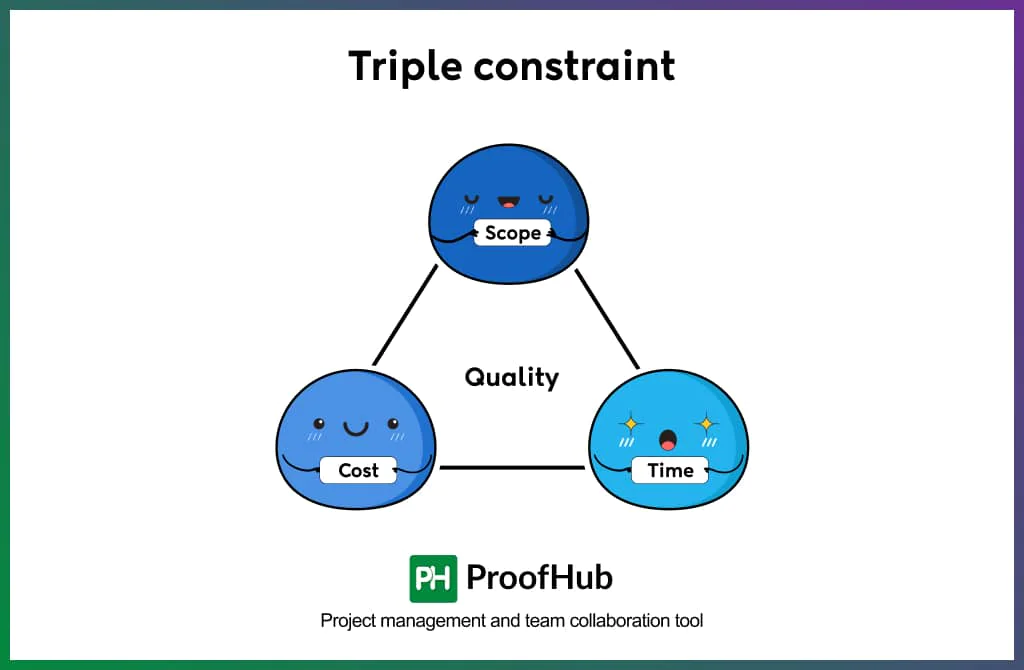
- Scope: Scope defines the work to be performed in a project, exactly what work is included and what is excluded. It includes defining project goals, objectives, and deliverables that must be accomplished for the project to be completed. For a website development project, the scope may include designing pages, developing features, and creating marketing graphics.
- Cost: The cost constraint refers to the amount of money available for the project to complete. For a website development project, costs may include developer salaries, design tools, hosting services, and marketing expenses.
- Time: The time constraint refers to the amount of time available to complete a project from start to finish. It defines when tasks start, how long they take, and when the project must be completed. For a website development project, the time constraint includes deadlines for the design approval and the deadline for the website launch.
Quality is not considered a separate constraint in a project. It is a critical aspect of a project that determines its success and is affected by the three constraints. When all three constraints are balanced, quality can be ensured. When the balance is not there, quality inevitably degrades.
What is the relationship between the three constraints?
The three constraints—scope, time, and cost are interdependent and must be balanced throughout the project to ensure the quality of project deliverables. A change in one constraint directly affects the others, requiring a trade-off to maintain the project’s quality.
For example, increasing the scope adds new tasks and deliverables, which increases the workload. This additional work requires either more time or a higher cost. If neither is adjusted, the team may rush the work, which reduces the quality of the final deliverables.
Thus, one cannot change scope, time, or cost without affecting the other two, or the quality of the outcome will suffer. This happens because increasing or limiting one constraint changes the amount of work, available time, or required resources.
This relationship is also explained by a common business concept of “Good, Fast, Cheap”: Pick any two. It means if you choose:
- Fast + Cheap = Scope suffers. The team delivers fewer features or simplified deliverables.
- Fast + Good = Cost increases. Additional resources are required to meet the project quality.
- Cheap + Good = Time increases. The team needs more time to deliver quality work with limited resources.
Project managers use the triple constraints model to evaluate trade-offs and decide what to adjust. The trade-off means adjusting or sacrificing one or two constraints to keep the project aligned with quality requirements.
Why is the triple constraint important for project managers?
Triple constraints help a project manager make an informed decision, set realistic expectations with stakeholders, and plan effectively for project risks.
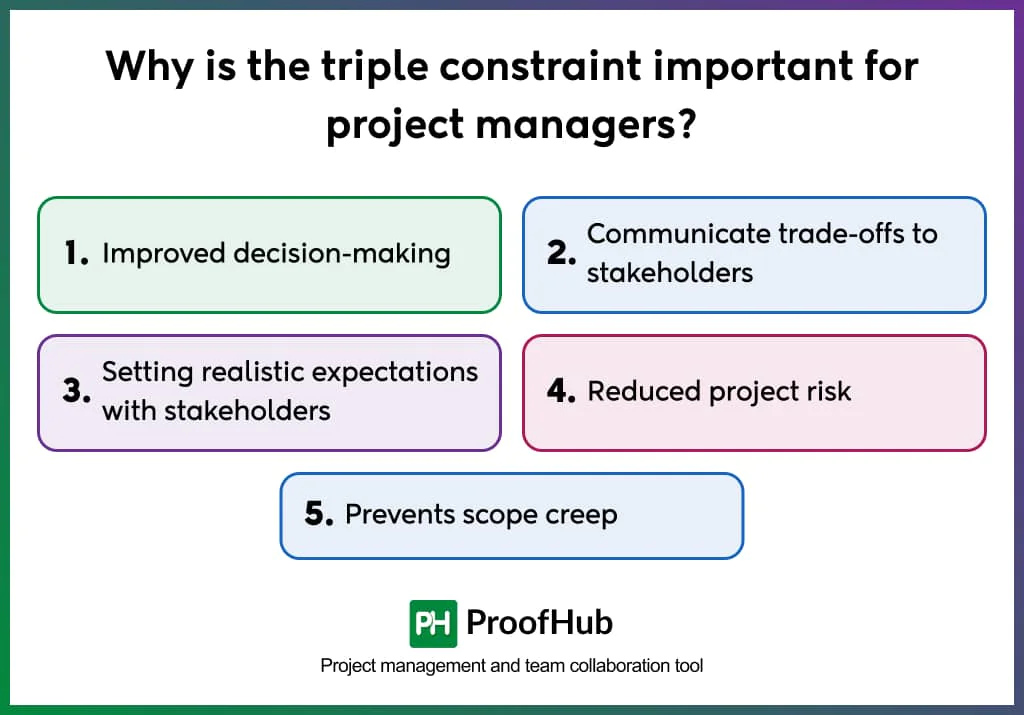
- Improved decision-making: Project managers clearly visualize how changing one constraint impacts the others, allowing for informed decisions on scope, cost, or time trade-offs.
- Communicate trade-offs to stakeholders: When communicating with the stakeholders, the project manager uses the triangle to help stakeholders visualize why changes in scope require budget or schedule adjustments. This makes it easier to communicate project limitations and trade-offs, which help stakeholders understand the impact of changes.
- Setting realistic expectations with stakeholders: When stakeholders can clearly see that scope, time, and cost are interconnected, they understand that increasing one element will require adjustments in the others. This prevents unrealistic expectations and improves alignment with stakeholders by creating a shared understanding of project limits and trade-offs.
- Reduced project risk: The triple constraint supports risk management by helping project managers identify how a change in one aspect impacts the entire project’s balance. This helps a project manager plan for risks and contingency reserves.
- Prevents scope creep: By understanding the relationship between time, cost, scope, and quality, a project manager establishes a formal change request to prevent unauthorized or unplanned additions to the project scope, as this can put the project balance at risk. When managers evaluate a situation, they can compare available options against project limits such as deadlines, budget capacity, and workload. This makes it easier to assess what is feasible, what needs adjustment, and what should be avoided.
How does the triple constraint work?
The triple constraint works by balancing scope, time, and cost throughout the project. Any change in one constraint requires adjustments in the other two; otherwise, quality will suffer.
Here is what it means in a project:
- Expanding scope: When a client asks for more features, managers assess whether to extend timelines or increase the budget before approving the change.
- Shortening time: When deadlines are shortened, they decide whether to add resources or reduce deliverables to stay on track.
- Reducing cost: When budgets are cut, they evaluate which features can be scaled back or whether timelines need adjustment.
If a project manager does not make changes in one of the constraints (scope, time, or cost), quality often becomes a trade-off and suffers.
How to effectively manage the triple constraints?
To effectively manage the triple constraints, define the scope, time, and cost, prioritize the constraints, communicate with the stakeholders, manage the change proactively, and use project management tools.
Below are each component along with actionable advice on how to make it fit your plan.
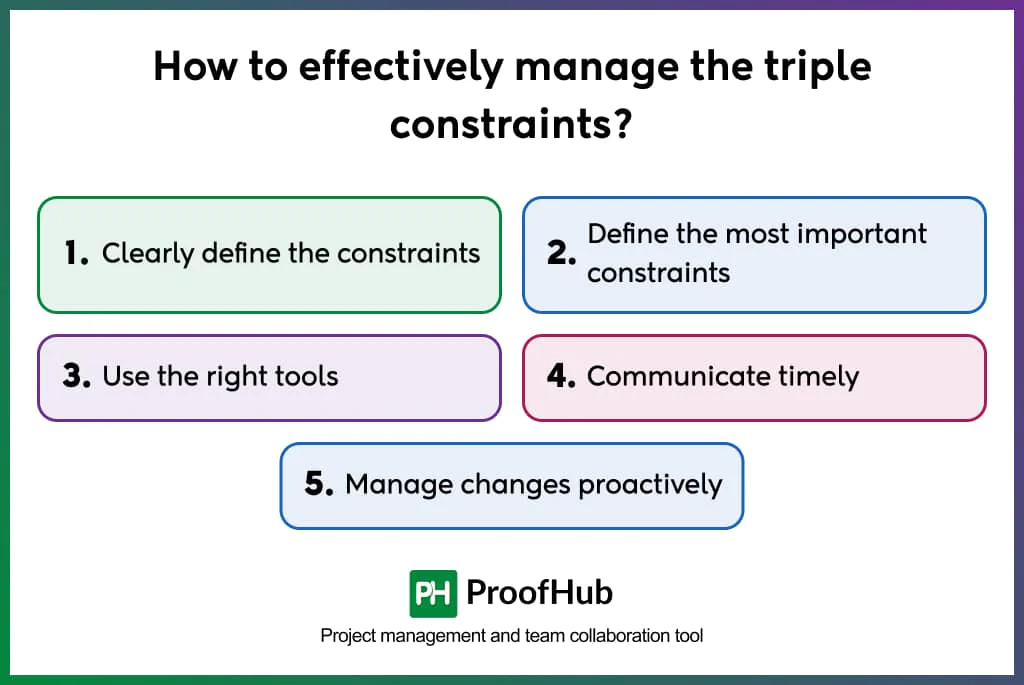
1. Clearly define the constraints
Clearly define the project’s scope, timeline, and budget.
- Scope: Clearly outline all deliverables, requirements, and boundaries at the start of the project. This ensures everyone understands what is included—and what is not—reducing confusion and preventing scope creep that can disrupt timelines and budgets.
- Timeline: Build schedules based on actual team capacity, task complexity, and dependencies. Avoid overly optimistic deadlines by including buffer time for delays, rework, or unforeseen issues, so the project stays on track even when things don’t go as planned.
- Budget: Set a clear budget baseline and break it down across tasks, resources, and phases. Regularly track actual spending against this baseline to identify overruns early and take corrective action before costs escalate.
This helps a project manager build a clear project scope, cost, and schedule baseline.
2. Define the most important constraints
Determine the most important constraint that can not be changed. Before any work begins, define which constraint is fixed (cannot change) and which is flexible. This shapes every decision you make throughout the project lifecycle.
To determine that constraint, discuss project priorities with stakeholders and understand what matters most for the project’s success. Ask which factor must remain fixed without compromise.
- If the deadline cannot be moved, time becomes the fixed constraint, and other elements must adjust.
- If the budget cannot increase, cost becomes the fixed constraint, requiring scope or timelines to shift.
- If all deliverables are mandatory, the scope becomes the fixed constraint, and time or cost must adapt.
3. Use a Gantt chart
Use the Gantt chart to see the impact of changes to the project’s constraints. A Gantt chart shows project tasks on a timeline, when each task starts & ends, and dependencies between tasks. This helps a project manager understand how different parts of the project are connected, monitor the progress, track the impact of the changes on the project, and identify where adjustments are needed.
4. Communicate timely
Share regular updates on progress, risks, and any potential impact on scope, time, or cost. Early communication builds trust, keeps stakeholders aligned, and prevents last-minute surprises that are harder to manage.
5. Manage changes proactively
Follow a structured approach before approving any change to scope, time, or cost. This ensures that every change is evaluated for its impact and does not disrupt the project’s overall balance.
Here is how to do it:
- Document the change request clearly
- Evaluate its impact on scope, schedule, and cost
- Review the request with stakeholders
- Approve, reject, or modify it before implementation
What are the common challenges in managing project constraints?
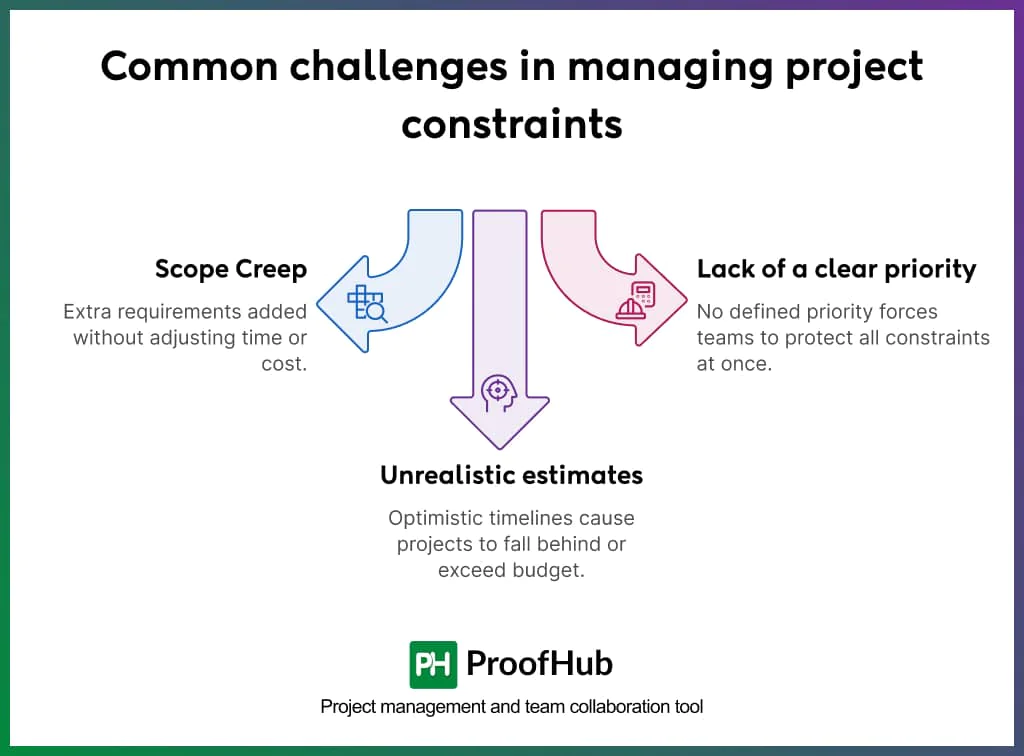
The most common challenges in managing project constraints are scope creep, unrealistic estimates, and unclear priorities. These challenges make it difficult for project managers to maintain a balance between scope, time, and cost.
1. Scope creep
Scope creep occurs when additional requirements are added during the project without adjusting time or cost. As more work is added, the team is forced to either stretch deadlines or work within the same budget, which puts pressure on both time and quality.
How to handle it:
- Evaluate every new request before approval
- Assess its impact on scope, time, and cost
- Use a clear change management process
2. Unrealistic estimates
Project managers often fail to balance constraints when timelines or budgets are set too optimistically. When the actual effort turns out to be higher than expected, the project starts falling behind schedule or exceeding budget, breaking the balance between time and cost.
How to handle it:
- Break work into smaller tasks
- Estimate based on past data and team capacity
- Avoid overly aggressive deadlines
3. Lack of a clear priority
When project stakeholders fail to define which constraint matters most, teams try to protect everything at once when one constraint changes. This makes it impossible to manage the change as they cannot keep all three constraints fixed.
How to handle it:
- Identify the most important constraint early
- Communicate it clearly to stakeholders
- Align decisions around that priority
Best practices to follow for managing the triple constraint
The five best practices for managing the triple constraint are prioritizing constraints early, building a realistic buffer, implementing a formal change request procedure, and communicating trade-offs clearly with the stakeholders.

- Identify the most important constraint early: Every project has one constraint that is fixed — scope, time, or cost. Identify it upfront with your stakeholders so every decision has a clear direction. If the deadline is fixed, then the scope or budget must be flexible.
- Build realistic buffers: Add contingency to your timeline and budget depending on project complexity. Apply an extra buffer to your highest risk tasks.
- Implement a formal change request process: Before approving any change, answer three questions: how does this affect the scope, the timeline, and the budget.
- Communicate trade-offs clearly to stakeholders: Explain the consequences of changes to stakeholders and involve them in the decision. For example, we can add this feature. It will cost two extra weeks or $8,000 more. Which do you want to adjust?
- Monitor and review constraints continuously: Check actual progress against your plan weekly. Review after every milestone and every approved change.
Practical example of the triple constraint
A practical example of the triple constraint is building a new software application.
Example: Developing a New Mobile App
Imagine you are managing the development of a CRM app with a 9-month timeline, a $250,000 budget, and a scope that includes lead management, sales reporting, and contact tracking.
What are the common mistakes to avoid when managing the triple constraint?
The four common mistakes in managing the triple constraint are treating constraints as independent, approving uncontrolled changes, and failing to identify the fixed constraint. These mistakes disrupt the balance between scope, time, and cost and often lead to project delays or budget overruns.
1. Treating the three constraints as independent
A common mistake is treating scope, time, and cost as separate. In reality, these constraints are connected. When one changes, the others are affected. Ignoring this leads to unrealistic plans and poor decisions. To avoid the mistake, treat all the constraints as interdependent.
2. Saying yes to every change
Saying yes to every request increases the project scope without adjusting time or cost. This creates scope creep and puts pressure on deadlines and budget, making the project unstable. To avoid this mistake, evaluate each change request carefully and adjust the schedule or cost before approving new work.
3. Not identifying the most important constraint
Projects become difficult when it’s unclear which constraint is most important. Without a clear priority, teams don’t know whether to adjust scope, time, or cost, leading to confusion and delays. To avoid this mistake, fix at least one constraint and change the other constraints according to the nature of the work.
What are the potential consequences of overlooking the triple constraint?
The three consequences of overlooking the triple constraint are project delays, financial pressure, and declining deliverable quality.
1. Project delays
When the scope increases but the timeline is not adjusted, the team is forced to complete more work in the same amount of time. This puts pressure on the schedule, leading to missed milestones and delays in project delivery.
2. Budget overruns
If changes in scope or timeline are not reflected in the budget, project costs begin to increase. Extra work, overtime, or additional resources can quickly push the project beyond its planned budget, breaking the cost constraint.
3. Decline in deliverable quality
When scope, time, and cost are all kept fixed without adjustment, quality often becomes the compromise. To meet deadlines and budget constraints, teams may rush work, reduce testing, or skip important checks, which can affect the final output.
What are the alternative models to project triangles?
While the project triangle (scope, time, and cost) is the most widely used framework, some project management models, such as the project management star and diamond model, expand this concept by adding additional constraints, such as risk or resources.
- The Project Diamond Model: The diamond model of the project triangle is an extension of the traditional iron triangle (scope, time, cost) that adds a fourth, central dimension—often quality or customer satisfaction—to manage modern project constraints. It highlights that balancing constraints requires prioritizing quality over simply meeting speed or budget goals.
- The Project Management Star Model: The Project Management Star expands the traditional project management triangle by including additional constraints such as risk and resources. In this model, risk represents potential uncertainties that may affect project outcomes, and resources refer to the people, tools, technology, and materials required to complete the project.
Who created the iron triangle?
The Iron Triangle was not created by a single person in a single moment. It evolved gradually over decades through the work of several key contributors in the field of project management. The most credited figure is Dr. Martin Barnes. In 1969, Dr. Barnes developed the concept of time, cost, and quality as the three fundamental parameters of any project while teaching a project management training course.
Can the project triangle be broken?
No. The project triangle cannot be broken because scope, time, and cost will always influence each other; otherwise, quality will suffer. However, the triangle can be adjusted or rebalanced depending on project priorities.
In practice, project managers sometimes appear to “break” the triangle when they try to increase scope, reduce time, and limit cost simultaneously, keeping quality intact. While this may be attempted, it usually results in hidden trade-offs, such as reduced quality, overworked teams, or increased project risks.
Is the Iron Triangle outdated or still useful?
Yes, the Iron Triangle is still relevant, but it has evolved over time. While the traditional model focuses on three constraints—scope, time, and cost—modern project management frameworks recognize that additional factors also influence project success, i.e., quality, risk, and resources. These additional constraints reflect the growing complexity of modern projects and the need to manage factors beyond the original triangle.
Do triple constraints differ in small vs large projects?
No. The core idea behind the Project Management Triangle, balancing scope, time, and cost, remains the same regardless of project size.
Which constraint should be protected during a crisis?
It depends on the project requirements. Here are some of the real-life scenarios:
- Protect time when: The deadline is externally imposed and unmovable. Missing it causes consequences that cannot be undone.
- Protect cost when: The budget is a hard ceiling that cannot be exceeded under any circumstances. Running out of money means the project stops entirely.
- Protect scope when: Every deliverable is contractually, legally, or technically mandatory. Cutting scope is not an option because the output must be complete to be useful or compliant.
How should project managers make decisions when constraints conflict?
Start by analyzing how the proposed change affects scope, schedule, and budget. Then, determine which constraint cannot change. This constraint becomes the decision anchor for the project. Once the protected constraint is identified, adjust the other constraints to maintain balance. Finally, clearly explain the trade-offs so stakeholders understand the decision’s implications. Transparent communication helps maintain alignment and prevents unrealistic expectations.
The bottom line
The triple constraint of project management—scope, time, and cost—forms the foundation for planning, executing, and controlling projects. These three constraints are interconnected, and any change in one will influence the others.
At the center of this balance lies quality. It is not a separate constraint but the outcome of how well scope, time, and cost are managed together. When these constraints are aligned, quality is maintained. When they are mismanaged, quality is the first to suffer.
You can manage the triple constraint by prioritizing constraints early, planning for uncertainty, controlling changes, and clearly communicating trade-offs. While doing so, challenges such as scope creep, unrealistic estimates, and poor monitoring often arise, making it harder to maintain balance. However, with the right practice, you can manage these challenges more effectively.