
A project comes into existence because there is a need to be addressed. The individual proposing the project (project sponsor) has some expectations to fulfil. These needs and expectations form the project’s basic requirements.
The role of a project manager is to clearly collect and document these requirements, which define the project’s scope. A project manager uses various tools and techniques to define, document, and manage the project’s scope.
At the surface, project scope management seems a simple process of collecting, defining, documenting, controlling, and managing project scope, but it is one of the most comprehensive and important aspects of the project, directly determining every other aspect: cost, time, and quality.
Let’s learn about project scope management.
- 1.A project scope is the formal description of the project work. It defines what is included and what is not.
- 2.Project scope management is the process of defining, managing, and controlling the project scope.
- 3.Project scope management key activities include collecting requirements from stakeholders, defining scope, creating a Work Breakdown Structure, formalizing acceptance of completed project deliverables, and controlling the project scope.
- 4.Common tools and techniques used in project scope management include data gathering, expert judgement, work breakdown structure, the requirements traceability matrix, and variance analysis.
- 5.Common challenges in project scope management are scope creep, unclear requirements, conflicting stakeholder priorities, ignored scope boundaries, and poor estimates.
What is project scope?
Project scope management is the process of defining, managing, and controlling the project scope.
It includes key activities such as collecting project requirements, defining scope, creating a WBS, formalizing project deliverables, and controlling changes to the scope baseline.
For example, if you are building a house for a client, the client informs you about: How many rooms do I need? What is the size of the room? Does a house include a garden? And so on. This helps you define what work you need to do in a project: what is included and what is not.
The major advantage of documenting the project scope at the beginning of the project is that it creates an approved boundary for the project. It serves as a key constraint for the project, along with time, quality, and cost.
What is project scope management?
Project scope management is the process of defining, managing, and controlling the project scope. It includes key activities such as collecting project requirements, defining scope, creating a WBS, formalizing project deliverables, and controlling changes to the scope baseline.
These activities help a project manager clearly define how to manage the project scope throughout the project lifecycle. Each activity is briefly explained after the next section.
Why is project scope management important?
Project scope management is important because:
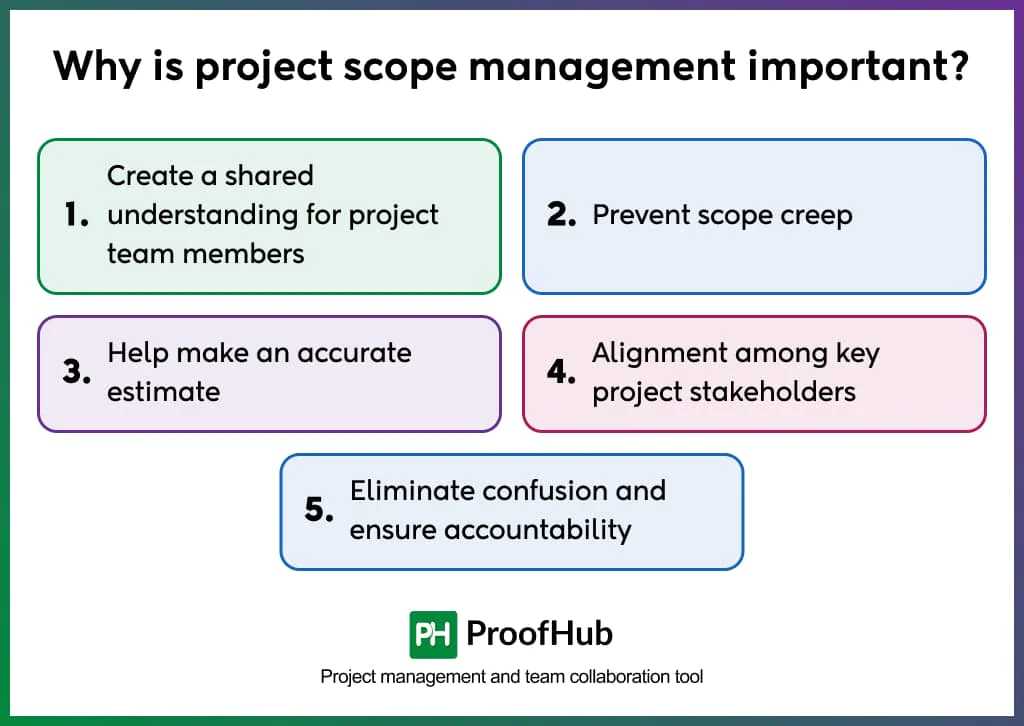
- It establishes a shared understanding of what to work on and what not to. It clearly identifies and documents the project’s goals, objectives, deliverable.
- Prevents scope creep by clearly outlining project boundaries and preventing uncontrolled changes. If additions are necessary, they are included through a formal change request.
- Helps accurately estimate the cost and time required to complete a task. It ensures the project has the necessary resources and helps create a realistic plan.
- Improves stakeholder alignment by establishing a shared understanding of project scope. It clarifies project deliverables, priorities, acceptance criteria, assumptions, and processes. It prevents conflicts and provides clarity to everyone on how the scope will be managed.
- Eliminates confusion and ensures accountability by creating a project scope management plan. It outlines the project roadmap and assigns responsibilities, defining what “done” looks like using a Work Breakdown Structure.
What are the processes of project scope management?
Project scope management has six processes: Plan scope management, Collect requirements, Define scope, Create WBS, Verify scope, and Control scope.
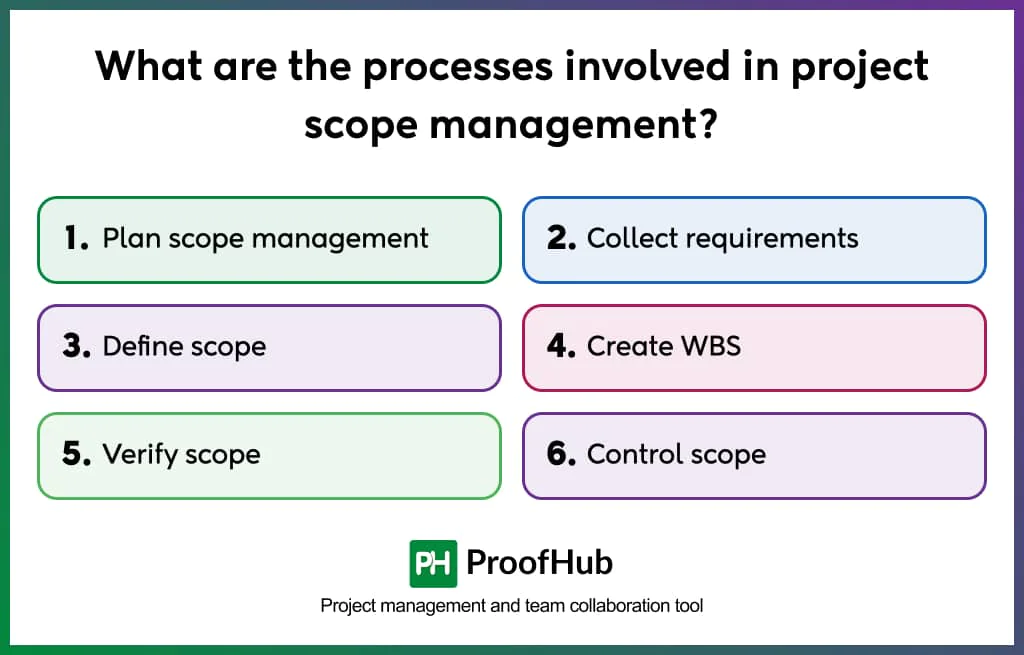
Each process requires input documents, tools and techniques, and produces outputs. The results of these processes are a complete scope management plan that tells how to define, manage, and control the project scope.
1. Plan scope management
Planning scope management determines how the project and product scope will be defined, validated, and controlled.
It provides guidance and direction on how the scope will be managed throughout the project.
A project manager considers the project charter, takes organizational processes into account, and uses expert judgment to create a scope management plan that describes how the scope will be defined, developed, monitored, controlled, and validated.
2. Collect requirements
Collecting requirements includes defining and documenting stakeholders’ needs and expectations.
A project manager analyses the ‘Project charter’ and the ‘Stakeholder register’, interviews stakeholders, and uses other data-gathering techniques to gather detailed requirements from them.
This results in the creation of ‘Requirements documentation’, which defines and documents stakeholders’ needs and expectations, and describes how individual requirements meet the project’s business needs.
The format ranges from a simple list of requirements grouped by stakeholder and priority to a detailed document with an executive summary, full descriptions, and attachments.
3. Define scope
Defining the scope includes developing a detailed description of the project and product, known as the project scope statement.
A project manager uses techniques like expert judgment to develop a project scope statement from a project requirements document.
A project scope statement defines what is included and what is excluded in a project (product scope description), product acceptance criteria, project deliverables, project exclusions, project constraints, and project assumptions.
4. Create WBS
Creating a WBS involves dividing project work (deliverables) into smaller, more manageable components.
A project manager takes a project scope statement and uses the decomposition technique to break high-level project deliverables into smaller, more manageable components, creating a work breakdown structure (WBS).
A work breakdown structure helps create the ‘scope baseline’, which serves as the basis for the project scope management plan and is included in the project management plan as a key artifact.
5. Verify scope
Verifying scope formalizes the acceptance of the completed project deliverables. A project manager inspects the produced deliverables by comparing them against the product acceptance criteria and requirements.
Deliverables that meet the acceptance criteria are formally signed off and approved by the customer or sponsor.
Deliverables that have not been formally accepted are documented, along with the reasons for non-acceptance, and require a change request for rework. The change requests are processed using formal change management systems.
6. Control scope
Controlling scope involves monitoring the project and product scope and managing changes to the scope baseline.
A project manager analyzes change requests, assesses their impact on the scope, cost, and schedule baseline, and implements the changes as defined in the change management plan.
Based on the analysis of all requested changes, the project manager recommended corrective or preventive actions through a formal change process.
5. Eliminate confusion and ensure accountability
Project scope management eliminates confusion and ensures accountability by establishing a plan.
A scope management plan describes the project’s roadmap and who is responsible for what, assigning specific work to specific people and defining what “done” looks like using a Work Breakdown Structure.
What are the tools and techniques for project scope management?
The tools and techniques used in the project scope management are data gathering techniques, expert judgement, work breakdown structure, the requirements traceability matrix, and variance analysis.
Here is the brief explanation of how these techniques work:
1. Data gathering techniques
Data gathering techniques such as interviews, surveys, and focus group discussions are used to collect project requirements from stakeholders by clearly identifying and documenting their needs and expectations.
Here is a brief breakdown of commonly used data gathering techniques:
- Interviews are used when a project manager needs depth from a specific person.
- Surveys are used when a project manager needs information breadth across many people.
- Focus groups and workshops are used when a manager needs to build consensus among multiple stakeholders at once.
- Brainstorming is used to generate ideas without judgment before filtering them.
- Benchmarking is used to compare the project’s expected outcomes against what similar organisations have achieved.
Each technique serves a different purpose. Skilled project managers know which one to reach for depending on the situation.
2. Expert judgement
Expert judgment utilizes specialized knowledge, experience, or training of an individual or a group to make an informed judgment to clearly define the project scope from requirements.
A project manager uses their experience and skills to define the scope. However, a project manager may not always have deep expertise in the project’s subject matter.
For example, if you are managing a software project, you may not be a developer.
In those cases, a project manager brings in those who do have that knowledge, such as senior team members, subject matter experts, consultants, or experienced colleagues, to provide expert judgment to help define the scope, assess whether requirements are realistic, and determine whether the WBS captures everything it should.
3. The work breakdown structure (WBS)
The work breakdown structure (WBS) breaks the project’s total work into smaller, manageable parts. It uses decomposition to break the work into smaller parts.
Each deliverable is broken down to a level where the work can be realistically and reliably scheduled, estimated, and assigned to a team member. The smallest unit of work in the work breakdown structure is called a work package.
The governing principle of the WBS is the 100% Rule: the WBS must capture 100% of the work the project requires; nothing more and nothing less. If a task is not in the WBS, it should not be done. If it needs to be done, it must be added to the WBS through the change control process.
4. The requirements traceability matrix (RTM)
The requirements traceability matrix creates a table that links requirements to their origins and traces them throughout the project life cycle.
Each row represents one requirement, and the columns track its source, priority, the WBS work package that delivers it, and its current status.
It ensures nothing falls through the cracks by providing a single place to see the status of every requirement at any point in the project.
5. Variance analysis
Variance analysis is a monitoring and analysis technique used to control the project scope.
It involves comparing what was planned (the baseline) with what is actually happening (actual project performance) to identify deviations.
Identifying the root causes of deviations allows a project manager to take corrective actions to keep projects on track.
What are the challenges in project scope management? (+Solutions)
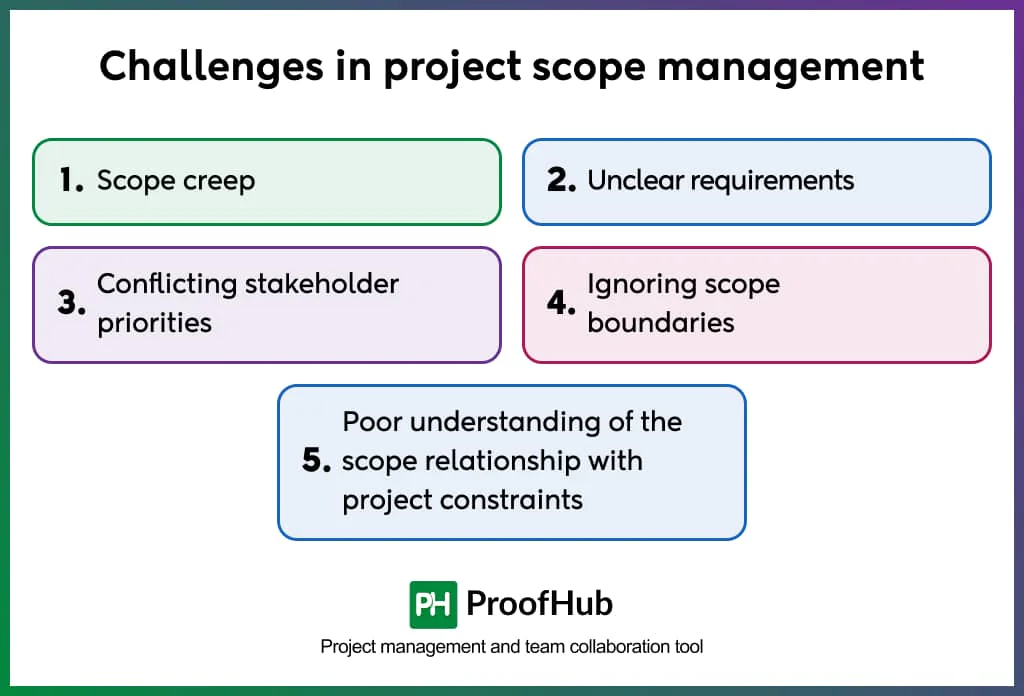
The five common challenges in project scope management are scope creep, unclear requirements, conflicting stakeholder priorities, ignored scope boundaries, and poor estimates.
1. Scope creep
Scope creep is uncontrolled changes to the project’s scope that go unanalyzed for their impact on the project’s budget and timeline. It extends the timeline and consumes budget.
Scope creep occurs when project stakeholders casually add small requests, which eventually accumulate and expand the scope.
Other causes of scope creep include gold-plating (adding unrequested features), poor resource estimates, and a lack of formal change requests (adding changes without accounting for their impact).
How to solve it?
- When someone requests a change to the scope, it must go through a formal process. Do not agree to scope changes verbally. Every approved change must be documented and reflected in updated baselines.
- Have stakeholders agree in writing on what is in and out of scope.
- Define the scope clearly and use estimation techniques to determine the resources required to complete a task.
2. Unclear requirements
Unclear requirements are vague, poorly defined, or incomplete requirements of a project. It often results in expensive rework, missed deadlines, and damaged trust between stakeholders and the project team because the deliverable produced does not match what the stakeholders actually need.
Unclear requirements occur when stakeholders are unsure of their needs, a project manager does not gather requirements appropriately, or there are communication gaps between stakeholders.
How to solve it?
- Conduct workshops to validate requirements before work begins. Ask clarifying questions early, not after work is done.
- Use the RTM to track every requirement.
- Do not assume requirements are complete in one round. Refine them through multiple discussions.
3. Conflicting stakeholder priorities
Conflicting stakeholders’ priorities mean different stakeholders have different expectations, priorities, and interpretations of the same requirement.
It leads to a scope that is impossible to deliver within the given constraints, as the team receives contradictory directions and wastes time seeking clarification.
Conflicting priorities arise from a lack of unified communication, hidden assumptions, and organizational silos.
How to solve it?
- Identify all stakeholders early on and facilitate alignment discussions.
- Use MoSCoW to force prioritisation conversations.
- Maintain a documented scope that everyone agrees on, and obtain formal sign-off.
4. Ignoring scope boundaries
Ignoring scope boundaries means failing to define what is excluded from the project (project exclusions).
This results in misunderstandings about the project’s scope, gold-plating, and a poor scope-control process. It happens when a project manager fails to define what is not included in the project.
How to solve it?
- Clearly document what is not part of the project. This prevents uncontrolled expansion of work when stakeholders refine their expectations.
5. Poor understanding of the scope relationship with project constraints
Scope doesn’t exist in isolation. Every time the scope expands, cost and time expand too, or quality suffers. A poor understanding of the relationship between scope and project quality, time, and cost leads to poor risk management and planning. It happens because a project manager lacks knowledge.
How to solve it?
- Use the project management triangle to understand the relationship between scope, cost, time, and quality.
- Clearly describe the items in the project scope to accurately estimate resources.
Best practices for project scope management
Here are some of the best practices a project manager can adopt for effective project scope management:
- Do not start work without a signed-off scope statement. Obtain formal approval on the final scope before starting work. Projects that begin with vague and unapproved scope almost always end in conflict.
- Document everything in writing. A verbal agreement is not an agreement in project management. Every decision, change, or clarification must be captured in writing and shared with the relevant stakeholders.
- Educate your team on the costs of scope creep. Every “small” addition has a hidden cost in time, attention, and momentum. Making this visible to the team reduces well-intentioned scope creep from within.
- Hold a scope review at every major milestone. Track changes to the scope throughout the project as needed. Don’t wait until the end to find out the scope has drifted.
- Use the WBS as the single source of truth. If it’s not in the WBS, it doesn’t exist as a task. This clarity prevents confusion about who is responsible for what.
A practical example of the project scope management
A restaurant chain with restaurants at 15 locations decides to build its own food delivery mobile app. Here is how scope management plays out on this project.
1. Plan scope management
The project manager begins by establishing rules for handling the scope — who can approve changes, how requests are submitted, and who signs off on deliverables.
2. Collect requirements
The project manager interviews the CEO, operations manager, marketing manager, and a group of customers to gather requirements. The findings are documented in a Requirements Traceability Matrix that tracks every requirement from its source to its delivery.
3. Define scope
Using the requirements documentation, the project manager writes the Project Scope Statement. Here is what it contains:
Project objective: Deliver a branded food delivery mobile application for iOS and Android that allows customers to place orders directly, earn loyalty points, and receive real-time order updates, integrated with the existing POS system, within six months and a budget of $180,000.
Deliverables:
- iOS mobile application
- Android mobile application
- Kitchen order display integration
- Loyalty points system
- POS system integration
Acceptance criteria:
- The app successfully processes a test order end-to-end on both iOS and Android
- Orders appear on the kitchen display within five seconds
- All payment methods process without error in a testing environment
Explicit exclusions on what this project will not deliver:
- A web browser version of the ordering system
- Integration with any third-party delivery platforms
- In-app customer chat or support functionality
Constraints:
- Budget is fixed at $180,000
- The project must go live within six months
- The app must work with the existing POS system without replacing it
Assumptions:
- The restaurant will provide all menu content, photography, and branding assets within the first three weeks
- The existing POS system has an accessible API for integration
The scope statement is reviewed by the CEO, IT director, and operations manager, and all three sign it. This becomes the agreed boundary of the project.
4. Create a WBS
The work is broken into a WBS covering design, development, testing, deployment, and project management, with every work package clearly assigned and described.
5. Control scope
Midway through the project, the marketing manager requests a table reservation feature. The project manager assesses the impact — three weeks and $12,000 — and presents it to the Change Control Board. It is rejected as non-essential to the launch. Later, a broken technical assumption requires a legitimate scope change, which is formally approved with a budget adjustment and documented accordingly.
6. Verify scope
At completion, deliverables are walked through against the signed acceptance criteria and formally signed off.
The project delivers on time. Every change was documented, every boundary was respected, and the final product matched exactly what was agreed at the start.
Who is involved in defining and managing project scope?
Primarily, a project sponsor, a project manager, key stakeholders, and subject matter experts are involved in defining the project scope. The project team and the change control board are also included in some cases.
- The project sponsor provides the high-level goals and has final authority over major scope decisions.
- The project manager leads the entire scope management process, facilitating, documenting, and controlling it.
- Stakeholders and end users contribute requirements and validate deliverables.
- The project team, particularly senior technical members, helps define what is realistically achievable and builds the WBS.
- A Change Control Board, comprising key stakeholders and the sponsor, reviews and approves or rejects scope changes.
Everyone plays a role, but the project manager is ultimately accountable for ensuring scope is defined, communicated, and protected throughout the project.
How do you prevent and control scope creep?
To prevent and control scope creep, write a detailed scope statement to explicitly list what is included and what is excluded, get formal written sign-off from all key stakeholders before work begins, and establish a change control process so that every request, no matter how small or big, must go through a formal review before being accepted.
Educate your team that agreeing to informal requests, even helpful ones, damages the project. Maintain a change log to track every request and its outcome. During execution, conduct regular scope reviews at milestones to confirm work aligns with the approved baseline.
Can the scope change during a project?
Yes, scope can change, and it happens in most real-world projects. However, the changes should not affect the approved project plan or absorb project resources. Every change must be managed formally, through a formal change request.
When a legitimate change is needed, a change request is submitted, the impact on cost, time, and risk is assessed, and the Change Control Board reviews and approves or rejects it. If approved, the scope statement, WBS, and schedule are updated to reflect the new baseline.
How does scope management relate to the triple constraint?
Scope management defines project deliverables and directly influences the triple constraints (scope, time, and cost). As the project’s scope increases, so do the schedule and cost. When the scope decreases, the schedule and cost also decrease.
Any change in the scope requires adjustment to the time and cost baselines. Uncontrolled scope causes schedule delays and budget overruns.
For example:
Adding features increases development time and resource costs
What is the difference between project scope and product scope?
The key difference between project scope and product scope is that project scope defines the required work, while product scope defines the features of the final deliverables.
What is the difference between a scope baseline and a scope statement?
The main difference between a scope baseline and a scope statement is that a scope baseline is the approved reference used for control, while a scope statement describes the project scope (what the project will and will not deliver).
The scope baseline includes the scope statement, WBS, and WBS dictionary. It measures and controls scope performance.
The scope statement defines deliverables, boundaries, assumptions, and constraints. It explains the scope in detail.
What is the difference between project scope and requirements?
The main difference between project scope and requirements is that scope defines the work and deliverables to meet the needs, while requirements define stakeholder needs.
Scope defines project boundaries and deliverables and translates them into actionable work.
Requirements describe features, functions, and expectations and serve as input for defining scope.
Does Agile use scope management?
Yes, but it approaches scope differently than traditional project management. In Agile, scope is intentionally flexible and evolves throughout the project, whereas in traditional projects, scope is defined upfront and changes are tightly controlled.