
Project quality management is what separates deliverables that actually work from ones that just look finished. It’s the practice of planning, monitoring, and controlling quality throughout a project, not inspecting for defects after the damage is done.
This blog breaks down everything you need to manage quality effectively: the three core processes (plan, manage, control), the real benefits beyond “fewer bugs,” and the techniques teams actually use, like control charts, Pareto analysis, and root cause analysis.
You’ll also learn the common quality issues that derail projects, the difference between quality control and quality assurance, and how to measure and ensure quality with practical, repeatable steps. By the end, you’ll know exactly how to build quality into your project instead of chasing it down later.
- 1.Quality management has three core processes: Plan Quality Management, Manage Quality, and Control Quality, each feeding into the next to ensure standards are set, followed, and verified.
- 2.Prevention costs less than correction. Building quality checks into planning is consistently cheaper than fixing defects after delivery.
- 3.Quality assurance and quality control serve different purposes. QA improves processes to prevent defects; QC inspects deliverables to catch them.
- 4.Unclear requirements are the root cause of most quality issues, leading to inconsistent work, rework, and missed expectations.
- 5.Techniques like control charts, checklists, and root cause analysis support different stages of the quality process, from diagnosis to verification.
- 6.Continuous monitoring and stakeholder validation keep quality on track throughout the project, rather than treating it as a final checkpoint.
What is project quality management?
Project quality management is the process of ensuring a project’s deliverables meet the standards required to satisfy stakeholder needs and project objectives. It involves planning, managing, and controlling quality throughout the project lifecycle, not just inspecting for defects at the end.
In practice, this means setting clear standards upfront, building processes that prevent errors rather than catch them later, and continuously monitoring performance against those standards.
The goal is twofold: a product that actually works as intended, and one delivered efficiently, without the rework, missed requirements, or scope creep that quality issues tend to cause.
This breaks down into three core processes:
- Plan quality: defining the standards and metrics a deliverable must meet
- Manage quality: auditing processes to confirm those standards are being followed
- Control quality: inspecting deliverables to verify they meet the defined standards
What are the benefits of project quality management?
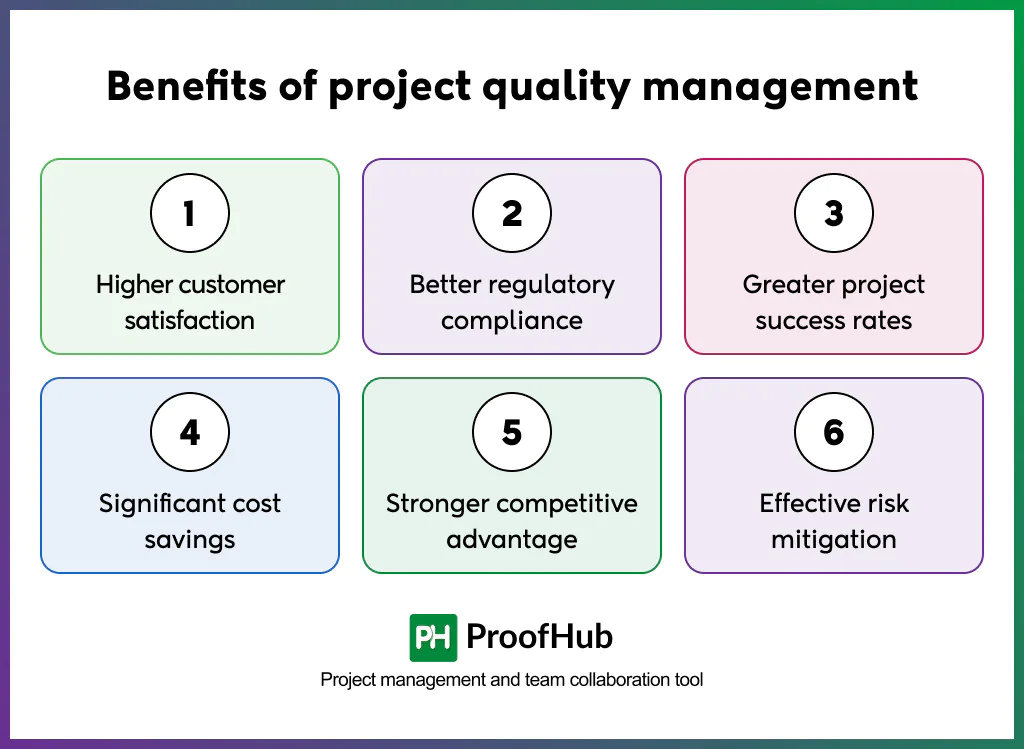
Project quality management improves customer satisfaction, regulatory compliance, project success rate, saves cost, gives competitive advantage, and helps in risk mitigation.
The project quality management shows up across nearly every dimension of a project, from how satisfied customers are to how much money gets saved.
When quality is managed deliberately rather than left to chance, it strengthens the project’s outcomes while reducing the costly surprises that come from poor planning or unchecked errors.
Here’s a breakdown of the key benefits:
- Improved customer satisfaction: When deliverables consistently meet or exceed expectations, customers feel heard and valued throughout the project. This builds trust and reduces the back-and-forth of complaints or revision requests. Over time, it strengthens client relationships and encourages repeat business.
- Better regulatory compliance: Structured quality processes make it easier to meet industry standards and legal requirements at every stage. This reduces the risk of penalties, audits, or legal disputes down the line. It also gives stakeholders confidence that the project is being run responsibly.
- Greater project success rates: Projects with strong quality management are more likely to finish on time and within budget. Fewer defects mean fewer disruptions to the schedule and less scope creep. This keeps the project aligned with its original objectives from start to finish.
- Significant cost savings: Catching issues early through quality checks is far cheaper than fixing them after delivery. It cuts down on rework, wasted materials, and emergency fixes that drain the budget. These savings add up significantly over the life of a project.
- Stronger competitive advantage: A reputation for consistently high-quality output sets a business apart from competitors. It signals reliability to prospective clients evaluating their options. Over time, this advantage supports long-term client retention and referrals.
- Effective risk mitigation: Proactive quality monitoring surfaces potential problems before they escalate into major failures. This gives teams time to course-correct instead of scrambling under pressure. It ultimately protects the project from being derailed entirely.
What are the key processes in project quality management?
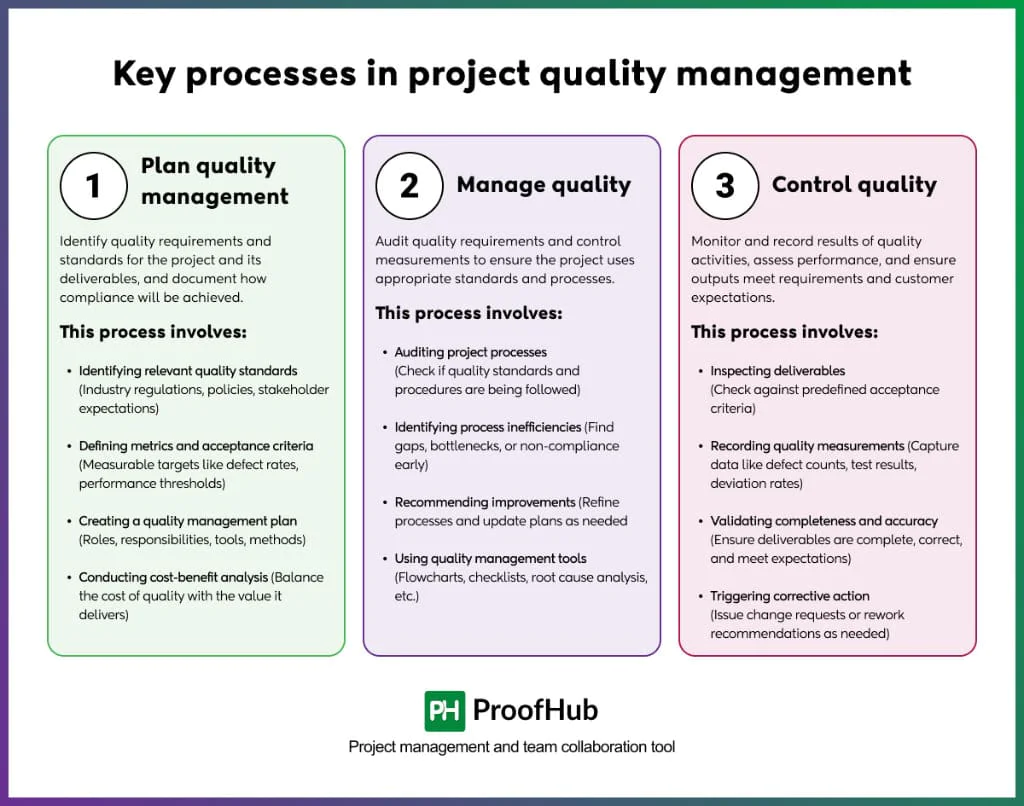
The key processes in project quality management are Plan Quality Management, Manage Quality, and Control Quality.
Together, they form a continuous loop that runs from the start of a project to its final deliverable, ensuring quality is designed in upfront rather than inspected for at the end.
Each process feeds into the next, with the output of one becoming the input for what follows.
Here’s how each one works:
1. Plan quality management
Plan Quality Management is the process of identifying quality requirements and standards for the project and its deliverables. It also involves documenting how the project will demonstrate compliance with those standards.
This happens early in the project planning phase, before any actual work begins. Retrofitting quality standards onto work that’s already underway almost always costs more than building them in from the start.
This process involves:
- Identifying relevant quality standards: Pull in industry regulations, organizational policies, and stakeholder expectations that the deliverable must satisfy, whether that’s ISO certifications, regulatory compliance, or internal benchmarks.
- Defining metrics and acceptance criteria: Translate broad quality goals into specific, measurable targets, such as defect rates, performance thresholds, or tolerance ranges, so quality isn’t left open to interpretation.
- Creating a quality management plan: Document how quality will be managed and controlled throughout the project, including roles, responsibilities, and the tools or methods that will be used.
- Conducting cost-benefit analysis: Weigh the cost of meeting a quality standard against the benefit it delivers, since over-engineering quality where it isn’t needed wastes budget and time.
2. Manage quality
Manage Quality is the process of auditing the quality requirements and the results of quality control measurements to ensure the project is using appropriate quality standards and operational definitions. Unlike Plan Quality Management, this process is execution-focused.
It checks whether the processes set up earlier are actually being followed, not just whether the final output looks correct.
This process involves:
- Auditing project processes: Review whether the team is following the quality standards and procedures defined in the planning phase, rather than waiting until deliverables are finished to check.
- Identifying process inefficiencies: Flag gaps, bottlenecks, or non-compliance early, when corrections are cheaper and faster to make.
- Recommending improvements: Feed insights back into the project to refine processes, which often surfaces change requests or updates to the quality management plan itself.
- Using quality management tools: Apply methods like process flowcharts, checklists, or root cause analysis to evaluate whether the project’s approach is sound, not just its output.
3. Control quality
Control Quality is the process of monitoring and recording results of executing the quality management activities. It assesses performance and ensures the project’s outputs are complete, correct, and meet customer expectations.
This is the inspection layer. Actual deliverables are measured against the standards defined at the start.
This process involves:
- Inspecting deliverables: Check the finished work, whether that’s a product, document, or feature, against the predefined acceptance criteria to confirm it meets requirements.
- Recording quality measurements: Capture data such as defect counts, deviation rates, or test results to maintain a verifiable record of performance.
- Validating completeness and accuracy: Confirm that nothing was missed and that the deliverable functions as intended before it moves to the next stage or sign-off.
- Triggering corrective action: Where deliverables fall short, this process generates change requests or rework recommendations, which loop back into Manage Quality or even Plan Quality Management if the standards themselves need revisiting.
What are the key concepts in project quality management?
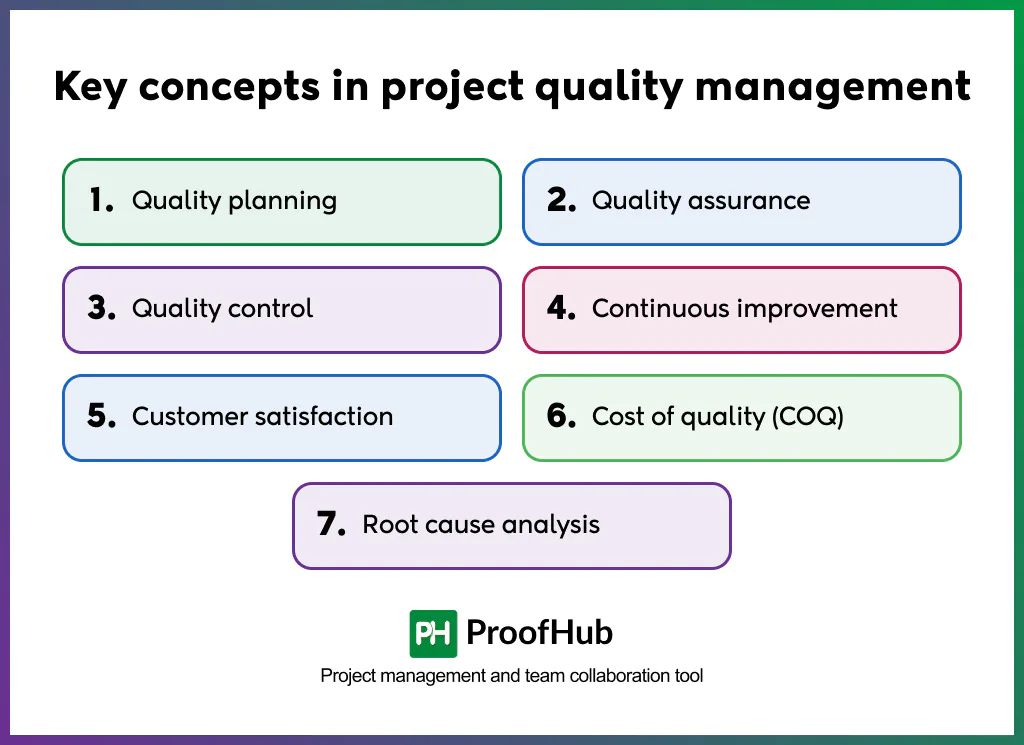
The key concepts in project quality management are quality planning, quality assurance, quality control, continuous improvement, customer satisfaction, cost of quality, and root cause analysis.
These concepts work together as a system, not as isolated checkboxes, where planning sets the bar, assurance and control keep work aligned to it, and continuous improvement raises that bar over time.
Here’s what each one means and why it matters:
- Quality planning: The process of defining the standards, metrics, and acceptance criteria a project’s deliverables must meet. It sets the baseline against which every later quality check is measured, so without it, assurance and control activities have nothing concrete to verify against.
- Quality assurance: The systematic evaluation of project processes to confirm they’re capable of meeting defined quality standards. It focuses on the “how” of the work rather than the “what,” catching process gaps before they turn into defective deliverables.
- Quality control: The process of inspecting actual deliverables to verify they meet the standards set during planning. It operates at the output level, flagging defects, deviations, or incomplete work before deliverables move forward or get signed off.
- Continuous improvement: The ongoing practice of refining processes, standards, and outcomes based on data gathered throughout the project. It treats quality as a moving target, using lessons from audits, inspections, and root cause findings to make the next cycle of work better than the last.
- Customer satisfaction: Customer satisfaction is the measure of how well a deliverable meets stakeholder expectations and requirements. It’s the ultimate test of quality management, since technically flawless work that misses what the customer actually needed still counts as a quality failure.
- Cost of quality (COQ): Cost of quality is the total cost incurred to prevent defects, plus the cost incurred when defects happen anyway. It splits into prevention and appraisal costs (money spent ensuring quality upfront) and failure costs (money spent fixing what went wrong), making the financial case for investing in quality early.
- Root cause analysis: Root cause analysis is a structured technique for identifying the underlying source of a defect or problem, rather than just its symptoms. It’s the diagnostic tool that connects quality control findings back to process improvements, closing the loop between detecting an issue and preventing its recurrence.
What are the best techniques for project quality management?
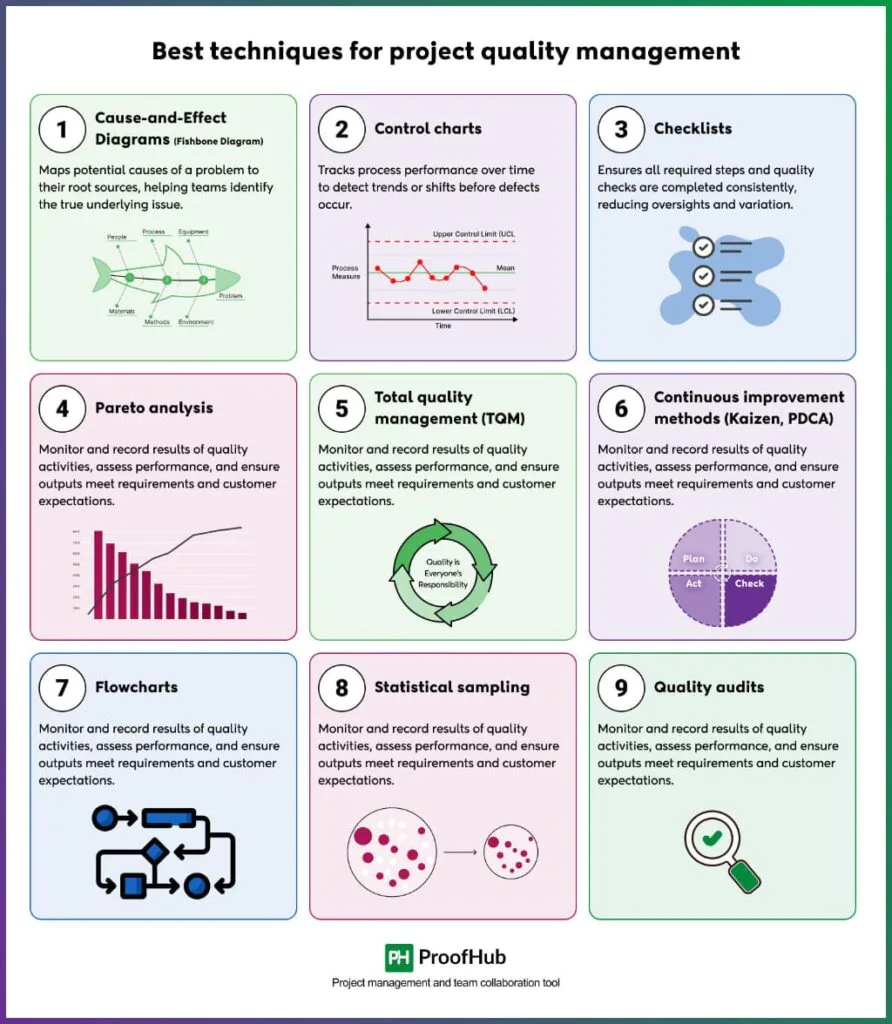
The best techniques for project quality management are cause-and-effect diagrams, control charts, checklists, Pareto analysis, total quality management (TQM), continuous improvement methods, flowcharts, statistical sampling, and quality audits.
Each technique serves a different stage of the quality process, from diagnosing root causes to verifying that deliverables stay within acceptable limits, and most mature quality programs use several of them in combination rather than relying on just one.
Here’s what each technique does and why it matters:
1. Cause-and-effect diagrams
A cause-and-effect diagram (also called a fishbone or Ishikawa diagram) is a visual tool that maps potential causes of a problem back to their root sources.
It forces teams to look past symptoms and organize possible causes into categories like people, process, equipment, and materials, making root cause analysis more structured rather than guesswork.
2. Control charts
A control chart is a graph that tracks process performance over time against upper and lower control limits.
It helps teams spot when a process is drifting out of acceptable variance before it produces defective deliverables, separating normal fluctuation from a real problem worth investigating.
3. Checklists
A checklist is a structured list of items or steps that must be verified before a task or deliverable is considered complete.
It reduces reliance on memory or judgment calls, ensuring the same quality checks are applied every time regardless of who’s doing the work.
4. Pareto Analysis
Pareto analysis is a technique based on the 80/20 principle, identifying the small number of causes responsible for the majority of problems.
It helps teams focus limited time and resources on fixing the few issues that will have the biggest impact, instead of spreading effort evenly across every defect.
5. Total Quality Management (TQM)
Total quality management is a management approach centered on continuous, organization-wide commitment to quality through employee involvement and process improvement.
Quality stops being one team’s responsibility and becomes embedded in how every department operates, which tends to produce more durable improvements than isolated quality checks.
6. Continuous Improvement Methods
Continuous improvement methods, such as Kaizen or Plan-Do-Check-Act (PDCA), are structured cycles for making incremental, ongoing process refinements.
Rather than treating quality as a one-time fix, these methods build a habit of small, repeated improvements that compound over the life of a project or organization.
7. Flowcharts
A flowchart is a visual diagram that maps out the steps in a process, including decision points and potential failure paths.
It exposes inefficiencies, redundant steps, or unclear handoffs in a workflow that might otherwise go unnoticed until something breaks downstream.
8. Statistical Sampling
Statistical sampling is the practice of inspecting a representative subset of deliverables rather than every single unit.
It makes quality control feasible at scale, especially for large volumes of output where 100% inspection would be too costly or time-consuming.
9. Quality Audits
A quality audit is a structured, independent review of whether project processes are being followed correctly and effectively.
Audits validate that the quality management plan is actually being executed as designed, not just documented on paper.
What are the common quality issues in projects?
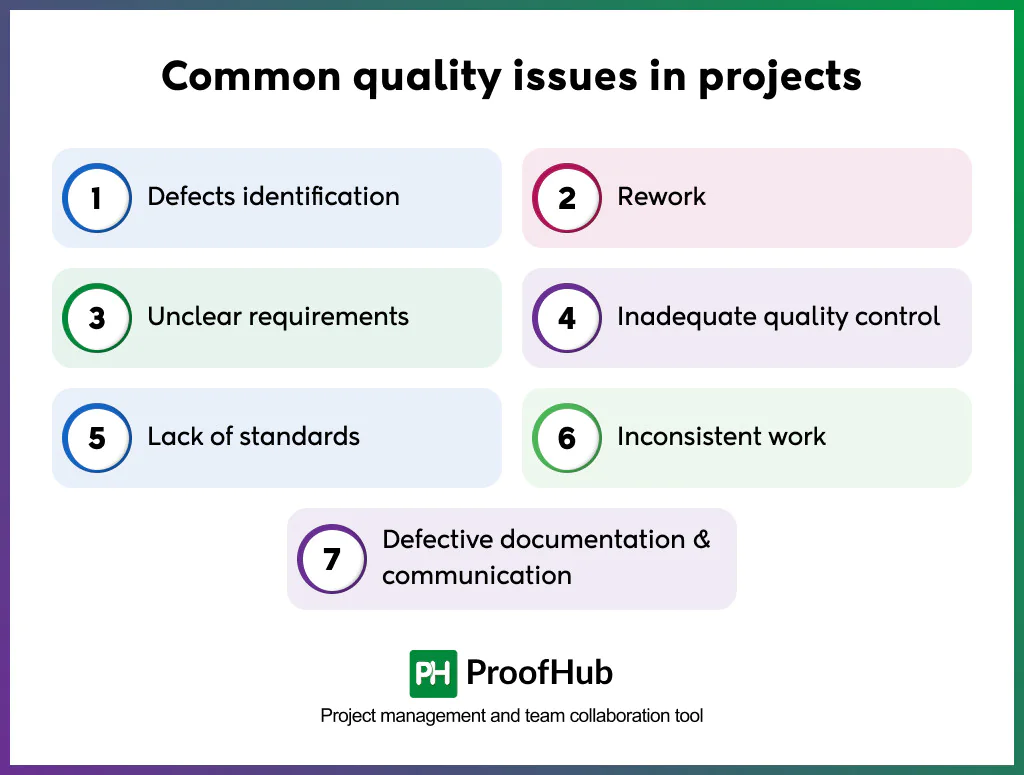
The common quality issues in projects are poor defect identification, rework, unclear requirements, inadequate quality control, lack of standards, inconsistent work, and defective documentation and communication.
These issues rarely show up in isolation. Unclear requirements tend to cause inconsistent work, which then drives up rework, and weak quality control lets all of it slip through undetected until it’s expensive to fix.
Here’s a closer look at each one:
1. Defects identification
Defect identification refers to the difficulty teams often face in catching flaws, errors, or deviations early enough to act on them.
When inspection happens too late or relies on inconsistent methods, defects surface only after a deliverable has moved several stages downstream.
By that point, fixing the issue means unwinding work that’s already been built on top of it, which is far costlier than catching it during the original task.
2. Rework
Rework is the need to redo work that didn’t meet quality standards the first time.
It’s usually a downstream symptom of other issues on this list, whether that’s unclear requirements, inconsistent execution, or missed defects.
Beyond the direct cost of redoing the work, rework eats into timelines, delays dependent tasks, and erodes team morale when the same work has to be repeated more than once.
3. Unclear requirements
Unclear requirements happen when stakeholders haven’t clearly defined what a deliverable needs to accomplish or what “done” actually looks like.
Teams end up filling in the gaps with assumptions, and those assumptions rarely match what the stakeholder actually had in mind.
This mismatch often isn’t caught until the deliverable is reviewed, at which point correcting course costs significantly more than clarifying requirements upfront would have.
4. Inadequate quality control
Inadequate quality control occurs when inspection processes are too infrequent, too shallow, or applied inconsistently across the project.
Teams may check for obvious errors but miss subtler issues, or only inspect a fraction of deliverables when more rigorous sampling was needed.
The result is that defects pass through checkpoints undetected, surfacing later as customer complaints or failed deliverables instead of being caught internally.
5. Lack of standards
Lack of standards means a project doesn’t have clearly defined benchmarks, metrics, or acceptance criteria against which quality can be measured.
Without a defined standard, every reviewer ends up applying their own judgment, which produces inconsistent decisions about what passes and what doesn’t.
This typically traces back to a weak or skipped quality planning phase at the start of the project.
6. Inconsistent work
Inconsistent work refers to variation in output quality across different team members, tasks, or project phases.
Some deliverables meet the bar while others fall short, even when working from the same requirements.
This usually points to gaps in training, unclear processes, or standards that exist on paper but aren’t being consistently enforced across the team.
7. Defective documentation & communication
Defective documentation and communication happens when requirements, decisions, or quality expectations aren’t recorded clearly or shared with the right people at the right time.
Critical details get lost between conversations and actual documentation, leaving team members to work from incomplete or outdated information.
This issue compounds quickly, since poor documentation around one quality issue often makes every other issue on this list harder to diagnose and trace back to its source.
Best practices for effective quality management
The best practices for effective quality management are setting clear standards, monitoring continuously, and validating with stakeholders throughout the project.
These practices work as a cycle: standards give teams something concrete to aim for, continuous monitoring catches deviations before they compound, and stakeholder validation confirms the work is actually solving the right problem, not just meeting internal benchmarks.
Use this checklist to put them into practice:
- Define clear quality standards before work begins. Document specific, measurable acceptance criteria for each deliverable instead of relying on vague descriptions like “high quality” or “good enough.”
- Build quality checkpoints into the project schedule. Don’t leave inspection until the end. Schedule reviews at key milestones so defects are caught while they’re still cheap to fix.
- Monitor performance against standards continuously. Track metrics in real time rather than waiting for a final review, so deviations are flagged early enough to course-correct.
- Validate requirements with stakeholders upfront. Confirm what “done” looks like before work starts, not after a deliverable is reviewed and found lacking.
- Get stakeholder sign-off at key milestones. Don’t wait until the final delivery to check alignment. Periodic validation catches misunderstandings before they multiply across multiple work streams.
- Conduct regular quality audits. Periodically review whether your processes, not just your outputs, are actually being followed as documented.
- Use root cause analysis on recurring issues. When the same defect shows up more than once, dig into why instead of just fixing the symptom each time.
- Document decisions and changes as they happen. Keep a clear record of quality-related decisions so context isn’t lost between team members or project phases.
- Standardize processes across the team. Make sure everyone is working from the same checklists, templates, and criteria to reduce inconsistency in output.
- Treat quality as a continuous improvement loop. Feed lessons from each project phase back into your standards and processes, rather than treating quality management as a one-time setup.
Real-world example of project quality management
A practical example of project quality management can be seen in a software project building a new mobile banking app. The project moves through planning, assurance, and control in sequence, with each phase building on the standards and findings of the one before it.
Here’s how each phase plays out in practice:
- Plan Quality Management: The project team defines specific quality standards before development begins, such as the app must process transactions in under two seconds, pass all OWASP(Open Worldwide Application Security Project). security checks, and maintain 99.9% uptime. These targets get documented in a quality management plan, along with the testing methods and acceptance criteria the team will use to verify them later, like automated unit tests, penetration testing, and load testing benchmarks.
- Manage Quality (Assurance): Midway through development, a quality assurance lead audits the development process itself, not the code yet, to confirm the team is following secure coding practices and running code reviews on every pull request. The audit reveals that two developers have been skipping peer code reviews under deadline pressure. This gets flagged and corrected immediately, since unreviewed code is far more likely to introduce defects that surface later during testing or, worse, after release.
- Control Quality: Once a feature, like the fund transfer module, is built, the QC team runs it through the predefined test suite. Automated tests flag that transaction processing time averages 3.2 seconds under load, missing the two-second standard set during planning. This triggers a change request, the engineering team optimizes the database query causing the delay, and the feature is retested until it meets the original benchmark before being approved for release.
Project quality management template
Use this template to set clear quality standards before work begins, track audits and inspections as the project moves, and see the real cost of quality, all in one place. Just fill in the sheets as you go.
Download free action plan template
Download ready-made action plan template. You can customize, add your own fields, and add documentation according to needs. Works with any XLSX file viewer, including Google Spreadsheets and Microsoft Excel.
Download the free template nowHow to use this template
- Start with the Quality Plan sheet before any work begins, define the standard, the metric, and the acceptance criteria for each deliverable. This becomes your reference point for everything downstream.
- As work progresses, use the Quality Audit Log to check whether your team is actually following the processes you set, not the output yet. Log findings and mark status using the dropdown.
- Once deliverables are ready, move to the Quality Control Log and inspect them against the acceptance criteria from your plan. Mark Pass or Fail, flag defects, and note corrective action.
- Log any cost tied to prevention, appraisal, or failure in the Cost of Quality sheet as it comes up.
- The Dashboard updates on its own, pulling totals from all three logs, so you always have a current view without checking each sheet separately.
How this benefits you
- Turns quality management from a vague intention into something you can actually track
- Catches defects while they’re still cheap to fix, instead of after they’ve moved downstream into expensive rework
- Gives you a clear record of what was checked, what passed, and what didn’t, so nothing depends on memory or assumption
- Makes the financial case visible through the Cost of Quality sheet, showing in real numbers whether prevention is costing less than failure
What is the difference between quality control and quality assurance?
Quality control is the process of inspecting actual deliverables to verify they meet defined standards, focusing on detecting defects in the finished output.
Quality assurance is the systematic evaluation of project processes to confirm they’re capable of producing deliverables that meet those standards, focusing on preventing defects by improving how the work gets done.
Here’s a side-by-side comparison:
Who is responsible for project quality management?
The project manager is primarily responsible for project quality management. They ensure that the project meets the defined quality standards by planning, managing, and controlling quality throughout the project lifecycle.
This includes setting quality benchmarks, monitoring deliverables, and implementing corrective actions when needed.
However, quality management is a shared responsibility, team members, stakeholders, and quality assurance specialists also contribute by following processes, maintaining standards, and continuously improving project outcomes.
How to measure quality in project management?
Quality in project management is measured by evaluating how well the project deliverables meet predefined requirements and stakeholder expectations.
This involves using key performance indicators (KPIs) such as defect rates, customer satisfaction, adherence to standards, and on-time delivery.
Tools like quality audits, testing, inspections, and performance reviews help assess whether processes and outputs align with quality benchmarks.
Additionally, comparing actual results with planned quality metrics and gathering stakeholder feedback ensures continuous monitoring and improvement of project quality throughout its lifecycle.
What is the cost of quality in project management?
The cost of quality in project management is the total cost incurred to ensure a deliverable meets quality standards, plus the cost incurred when it doesn’t.
It’s typically broken into two categories: the cost of conformance, which covers prevention and appraisal (training, process design, inspections, testing), and the cost of non-conformance, which covers failure (rework, defect repair, warranty claims, and reputational damage from delivered defects).
The underlying logic is straightforward: money spent upfront on prevention and appraisal is almost always cheaper than money spent after the fact fixing what went wrong.
A project that invests in clear standards and regular inspection tends to spend less overall than one that skips those steps and absorbs the cost of failures later, even though the early investment looks like an added expense at the time.