

Every project manager eventually asks the same question: how does our performance compare to others doing similar work? Benchmarking answers that question.
It is the structured process of comparing processes, metrics, and outcomes against internal standards, industry norms, or top performing organizations.
In project management, benchmarking gives teams a reference point for evaluating schedule adherence, cost control, resource use, and quality output.
Without benchmarking, teams have no way to know how well they are doing a task. How will the performance be evaluated? Which standards are important? Benchmarking gives a baseline that all well-performing teams must reach. If teams fail to do the bare minimum, then it becomes clear that improvements are needed.
This article explains what benchmarking is, why it matters, the types of benchmarking used in project management, how to prepare for it, the steps involved in the benchmarking process, and real examples of benchmarking in practice.
- 1.Benchmarking is the process of comparing performance, processes, or outcomes against a defined standard, competitor, or best practice.
- 2.It helps project managers measure performance, identify gaps, set realistic goals, and support better decision-making.
- 3.The main types used in project management are internal, competitive, strategic, technical, and performance benchmarking.
- 4.Effective benchmarking requires clear objectives, defined metrics, identified partners, and a reliable data collection method.
- 5.The benchmarking process follows a repeatable sequence: decide what to benchmark, collect and analyze data, create a plan, implement changes, and repeat.
- 6.Benchmarking supports quality management by giving teams a factual basis for improvement instead of relying on internal opinion alone.
What is benchmarking?
Benchmarking is the process of comparing your organization’s processes, performance metrics, or practices against industry best practices or top-performing competitors. It helps identify performance gaps, uncover improvement opportunities, and set realistic goals based on proven standards.
In project management, benchmarking is used to identify performance gaps in areas such as cost, schedule, quality, and resource efficiency. Once a gap is identified, benchmarking data becomes the foundation for targeted process improvement.
Why is setting benchmarks important?
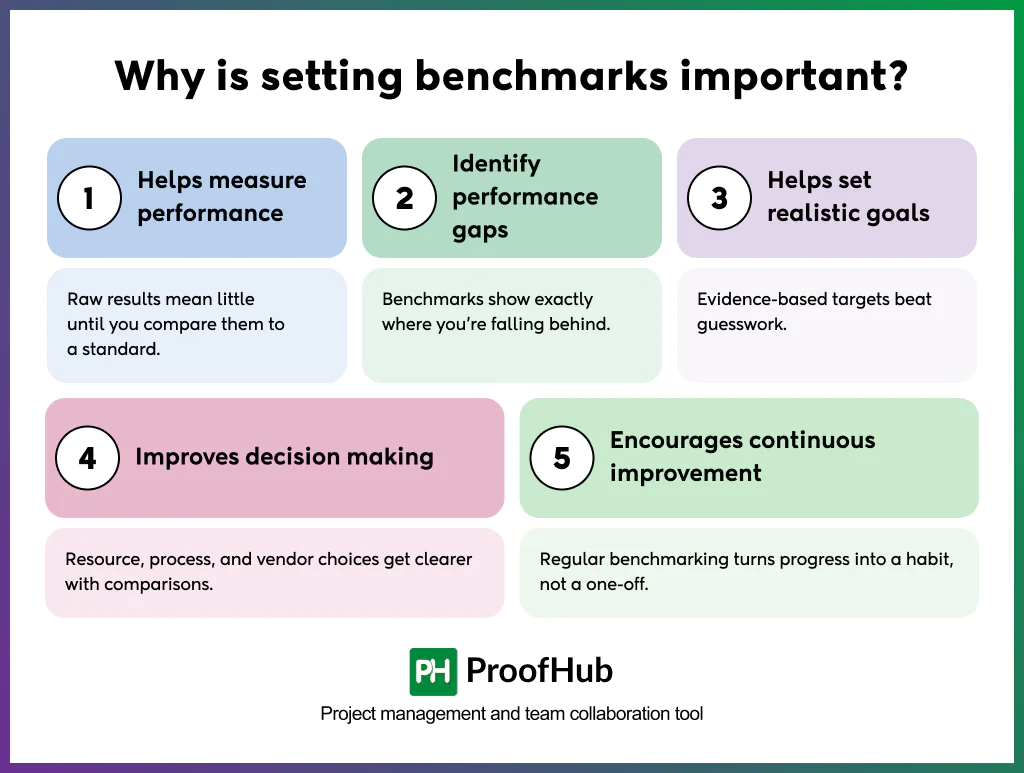
Benchmarking is important because it helps measure performance, identifies performance gaps, helps set realistic goals, improves decision-making, and encourages continuous improvement.
Benchmarks are not just reference numbers; they shape how a project team defines success and identifies areas needing attention. Without them, teams would not have any idea about what the normal or standard for a given project is.
The importance of benchmarking is explained below:
- Helps measure performance: Benchmarks turn raw performance data into something measurable and comparable, giving teams an objective read on how well they are actually doing. For example: A project completed in ninety days might sound reasonable until compared to a benchmark showing similar projects typically take sixty.
- Identify performance gaps: Comparing current output against a benchmark exposes weaknesses and points directly to the areas that need process changes. For example: A team might discover that its defect rate is twice the industry standard; based on the information, teams can take corrective actions.
- Helps set realistic goals: Goals set without reference data are often arbitrary, either too easy or unachievable. Benchmarks base goal setting on evidence. Benchmark metrics become a realistic and defensible target instead of an assumption.
- Improves decision-making: Provides factual grounds for decisions on resource allocation, process changes, and vendor selection. Instead of relying on instinct, decisions are tied to measurable comparisons, which makes them easier to justify to stakeholders and evaluate later.
- Encourages continuous improvement: Repeating it at regular intervals creates a feedback loop where teams continually measure, adjust, and improve. Over multiple cycles, the feedback loop builds institutional knowledge. As a result, future improvement efforts rely less on trial and error.
What are the types of benchmarking?
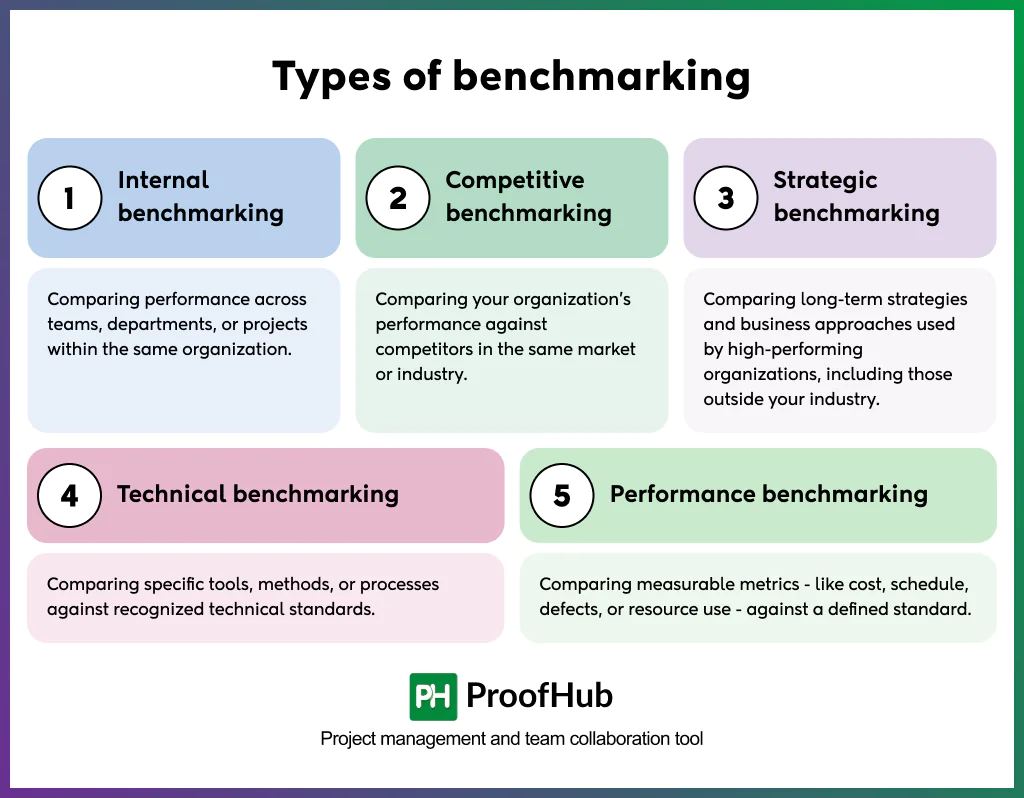
The five types of benchmarking are internal benchmarking, competitive benchmarking, strategic benchmarking, technical benchmarking, and performance benchmarking.
Benchmarking is not a single method. Depending on what a project manager needs to compare and against whom, different types of benchmarking apply. Each type serves a distinct purpose within project management and quality management.
The types of benchmarking are explained below:
1. Internal benchmarking
Internal benchmarking compares performance across different teams, departments, or projects within the same organization.
It is the easiest type, as the data is accessible, metrics are consistent, and there is no need to negotiate access with an outside party.
It is useful for identifying best practices that already exist within the organization but have not been standardized across all teams.
A common use case for internal benchmarking is comparing multiple project managers running similar projects in an organization. It makes it clear which scheduling or reporting habits correlate with fewer delays.
2. Competitive benchmarking
Competitive benchmarking compares an organization’s performance directly against competitors operating in the same market or industry. It shows how an organization’s project performance stacks up against the market standards.
It focuses on metrics that affect competitive positioning, such as delivery speed, cost efficiency, or customer satisfaction with project outcomes.
Competitive benchmarking is hard to execute as competitors rarely share detailed internal data voluntarily.
Organizations typically rely on public reports, industry surveys, or third-party research firms to gather comparable figures.
Industry associations sometimes aggregate anonymized data from multiple companies. They do it specifically to make comparison possible without exposing any single competitor’s raw figures.
3. Strategic benchmarking
Strategic benchmarking looks beyond operational metrics to examine long term strategies and business approaches used by high-performing organizations, regardless of industry.
Rather than comparing a single process, strategic benchmarking studies how successful organizations structure their overall approach to project selection, portfolio management, or resource planning.
It is used less frequently than the others because it requires broader research and a longer time horizon, but it can reveal structural improvements that operational benchmarking would miss.
Strategic benchmarking’s approach can reveal solutions that would never come up in a purely internal or competitive comparison.
4. Technical benchmarking
Technical benchmarking compares specific technical processes, tools, or methods used to complete project work.
This might include comparing software development practices, construction techniques, or manufacturing processes against recognized technical standards.
Technical benchmarking is common in industries where the method used to complete work directly affects quality and efficiency, such as engineering, IT, and manufacturing.
It focuses narrowly on how work gets done rather than on broader strategic or competitive positioning.
For example, a software team might benchmark its code review process, testing coverage, or deployment frequency. By benchmarking against practices documented by recognized industry bodies, they see whether their technical workflow matches accepted standards.
5. Performance benchmarking
Performance benchmarking compares specific, quantifiable performance metrics, such as cost variance, schedule variance, defect rates, or resource utilization, against a defined standard.
It is commonly used in day-to-day project management because it produces clear, numeric comparisons that are easy to track over time.
Performance benchmarking often draws on data from internal history, industry reports, or standards published by professional organizations such as PMI.
Because the metrics involved are numeric, this type of benchmarking is also the easiest to automate and track. It can be done through project management software. A tool can pull cost and schedule data directly from ongoing projects without manual reporting.
What are the steps in the benchmarking process?
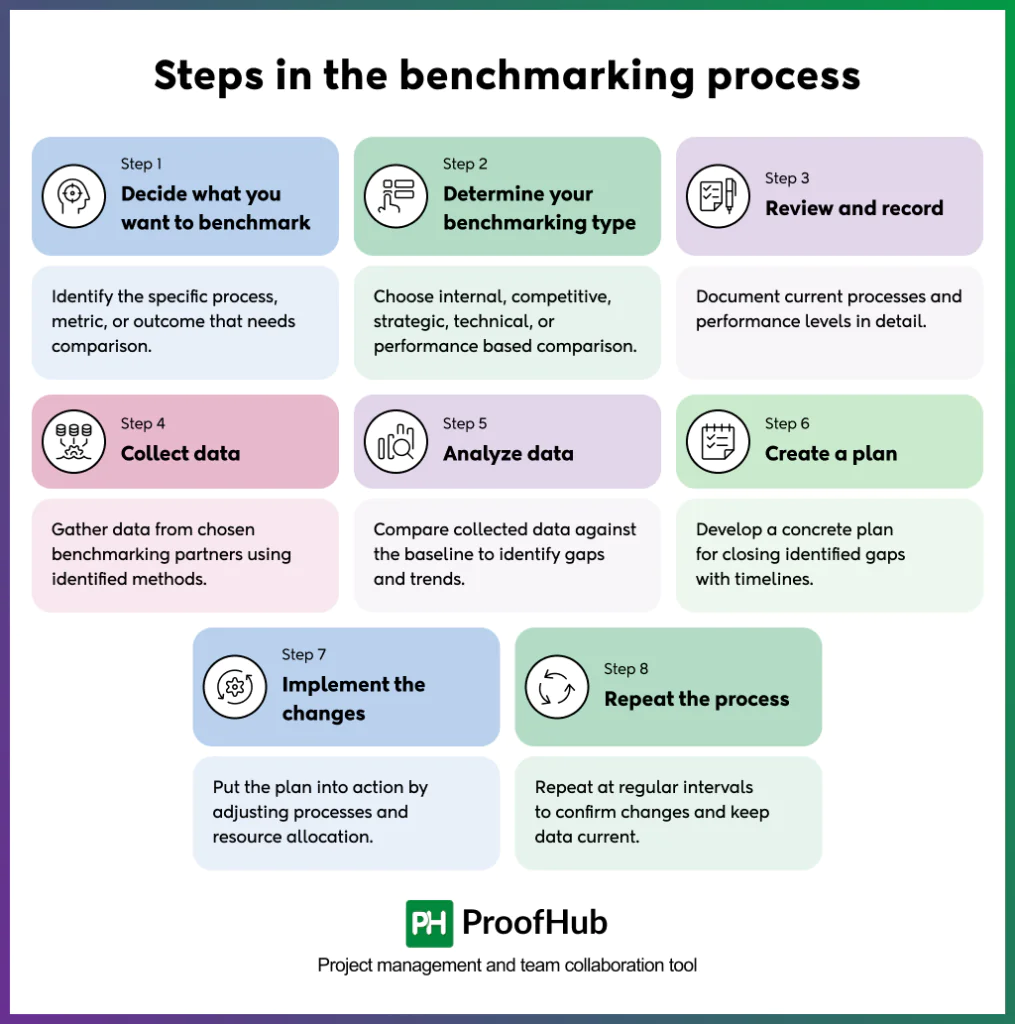
Steps in the benchmarking process include deciding what to benchmark, determining the benchmarking type, reviewing and recording, collecting data, analyzing data, creating a plan, implementing the changes, and repeating the process.
Once preparation is complete, benchmarking follows a repeatable sequence. Each step builds on the one before it, and the process is meant to be repeated regularly rather than treated as a single event.
Each step of the process is explained below:
1. Decide what you want to benchmark
Start by identifying the specific process, metric, or outcome that needs comparison. This should tie directly back to the objectives defined during preparation.
Trying to benchmark too many things at once dilutes focus and makes the results harder to act on.
2. Determine your benchmarking type
Choose whether the comparison will be internal, competitive, strategic, technical, or performance-based, depending on what is being measured and who the most relevant comparison point is.
This decision shapes where data will come from and how it will be interpreted.
3. Review and record
Document current processes and performance levels in detail before making any comparisons. This baseline record is what future comparisons will be measured against, so it needs to be accurate and complete.
Skipping this step makes it difficult to prove later whether a change actually improved performance, since there is nothing solid to compare the new results against.
4. Collect data
Gather data from the chosen benchmarking partners using the methods identified during preparation. This may involve pulling internal project records, requesting data from industry associations, or reviewing published benchmarking reports.
Data should be collected consistently across all comparison points, using the same definitions and time periods, so the resulting comparison is accurate rather than misleading.
5. Analyze data
Compare the collected data against the recorded baseline to identify gaps, trends, and areas of strength or weakness. Analysis should focus on understanding why differences exist, not just confirming that they exist.
A gap in cost variance, for example, might trace back to inaccurate initial estimation, scope changes, or delays in procurement, and each of these causes calls for a different response.
6. Create a plan
Develop a concrete plan for closing identified gaps, including specific actions, responsible parties, and timelines. A benchmarking exercise that ends at analysis without a follow-up plan produces insight without improvement.
The plan should tie each proposed action back to a specific gap identified during analysis, so progress can be tracked against the original finding.
7. Implement the changes
Put the plan into action, adjusting processes, resource allocation, or methods based on what the benchmarking data revealed. Implementation is where benchmarking insight actually converts into performance improvement. This stage often requires coordination across multiple teams, since a gap in schedule performance might require changes to both planning practices and day-to-day task tracking.
8. Repeat the process
Benchmarking is not a one-time exercise. Repeating the process at regular intervals confirms whether implemented changes worked and keeps performance data current as conditions change over time.
Each repetition also refines the baseline itself, since the most recent performance data becomes the new reference point for the next comparison.
Examples of benchmarking
The value of benchmarking comes from the same underlying pattern: a specific metric, a defined comparison point, and a clear gap that leads directly to an action.
Benchmarking that stops at identifying a difference without connecting it to a cause tends to produce interesting numbers without producing improvement.
- Schedule performance benchmarking: A construction company compares the average time to complete similar building projects across its own project history. If newer projects consistently take longer than older ones despite similar scope, the comparison points to a scheduling or resourcing issue worth investigating.
- Cost variance benchmarking: A software development firm benchmarks its typical budget overrun percentage against industry data published by a professional association. If the firm’s overruns are consistently higher than the industry average, it signals a need to review estimation practices.
- Quality benchmarking: A manufacturing team compares its defect rate per production run against a competitor known for tight quality control. The comparison identifies a specific quality gap and gives the team a concrete target for improvement rather than a vague goal of doing better.
- Resource utilization benchmarking: A marketing agency compares the average number of billable hours per project across its account teams. If one team consistently logs a higher proportion of non-billable hours than others handling similar work, the comparison points to an issue.
What is a benchmark report?
A benchmark report is a document that presents the results of a benchmarking exercise, typically including the metrics measured, the comparison data, the identified gaps, and recommended actions.
It serves as both a record of the analysis and a communication tool for sharing findings with stakeholders who were not directly involved in the benchmarking process.
A benchmark report includes the baseline data, the comparison data, a summary of the gap between them, and the specific plan developed to close that gap, so that anyone reading it later can follow the reasoning behind the recommended changes without needing to redo the analysis.
What are the challenges of benchmarking?
- Getting access to reliable comparison data, especially from competitors who have no obligation to share it.
- Metrics can be defined differently across organizations, making direct comparison misleading unless definitions are standardized first.
- Benchmarking takes time and resources to execute properly, and without a defined follow-up plan, the data collected can go unused.
- Comparing against the wrong reference point, one that operates under very different conditions, can produce conclusions that do not actually apply to the project at hand.
- Poorly scoped comparison often produces numbers that look alarming but reflect differences rather than an actual performance gap.
How often should a project’s performance be benchmarked?
There is no fixed schedule for benchmarking; it depends on the type of project.
Most long-running projects benchmark quarterly or at major milestones; shorter projects benchmark at phase transitions instead.
Industries that change quickly, such as software development, benefit from more frequent benchmarking.
Benchmarking too frequently can also be counterproductive. Some metrics need enough time to accumulate meaningful data before a comparison says anything reliable.
What is the role of benchmarking in managing project quality?
Benchmarking gives quality management a factual basis rather than relying on internal opinion about what counts as good performance. By comparing defect rates, rework percentages, and customer satisfaction scores against defined standards, project managers can identify specific quality gaps and track whether quality improvement efforts are actually working over time.
It connects directly to established quality management frameworks, such as ISO 9000 and AS9100, by providing the comparison data those frameworks rely on to define acceptable performance thresholds.
It also gives teams an early warning system, since a rising defect rate compared against a stable historical benchmark signals a problem well before it shows up in final project outcomes.
What should you do if benchmarking data is unavailable?
When external data is not accessible, internal benchmarking becomes the practical starting point. Compare current performance against the organization’s own historical data as a baseline.
You can use industry associations, professional bodies, and published research reports to fill gaps when direct competitor data is unavailable. In some cases, proxy metrics, such as general industry averages rather than data from a specific competitor, offer a reasonable substitute until more precise data becomes available.
Another option is informal benchmarking through professional networks, where project managers in similar fields share general performance ranges without disclosing sensitive company specific figures. This will not produce the precision of a formal benchmarking report, but it still gives a useful sense of where current performance falls relative to common practice.
What’s the difference between benchmarking and setting goals?
Benchmarking is a measurement and comparison activity; it establishes where an organization currently stands. Whereas goal setting is a forward-looking activity that defines a target to reach.
Benchmarks guide goals by providing the evidence needed to set realistic targets, but a benchmark itself is a comparison, not a target.
For example: A team might benchmark its current defect rate against industry data, then use that comparison to set a specific goal for reducing defects over the next quarter.
Conclusion
Benchmarking gives project managers a structured way to measure performance against a defined standard rather than relying on impression alone. It identifies specific gaps, supports realistic goal setting, and provides the factual grounding decision makers need to justify process changes. Treat it as a repeatable process rather than a one-time exercise; benchmarking becomes a permanent part of how a project team measures and improves its performance over time.