Every project begins with a question. What does the client, the team, or the business actually need?
Requirements gathering is the process that answers these questions. It sets the direction for planning, execution, and delivery. Without it, teams build the wrong thing, miss deadlines, and lose stakeholder trust.
This guide covers what requirement gathering means, why it matters, and how to do it well.
- 1.Requirements gathering identifies, collects, and documents what a project needs to succeed before development begins. Doing this upfront prevents scope creep, reduces costly rework, controls budgets, and aligns stakeholder expectations.
- 2.Project needs are divided into distinct categories, including business, stakeholder, solution, functional, and nonfunctional requirements. Transition requirements are also included to manage training and data migration during state changes.
- 3.Collecting requirements follows a sequential process: defining goals, identifying key stakeholders, choosing gathering techniques, eliciting inputs, documenting requirements, analyzing/prioritizing them, and securing formal validation.
- 4.Teams rely on various techniques tailored to project size and complexity, such as one-on-one interviews, group workshops, surveys, direct observation, document analysis, prototyping, and user stories.
- 5.Challenges like ambiguous goals, communication barriers, missing stakeholders, and frequent scope changes can derail execution. Implementing structured checklists and collaboration tools like ProofHub or Figma helps mitigate these risks.
What is requirements gathering in a project?
Requirements gathering is the process of identifying, collecting, and documenting what a project needs to succeed. It involves talking to stakeholders, reviewing existing processes, and capturing goals in clear language.
The output is a requirements document that guides planning, design, and execution. Good requirement gathering reduces confusion and keeps every team member aligned on the same objectives from day one.
What are the types of project requirements?
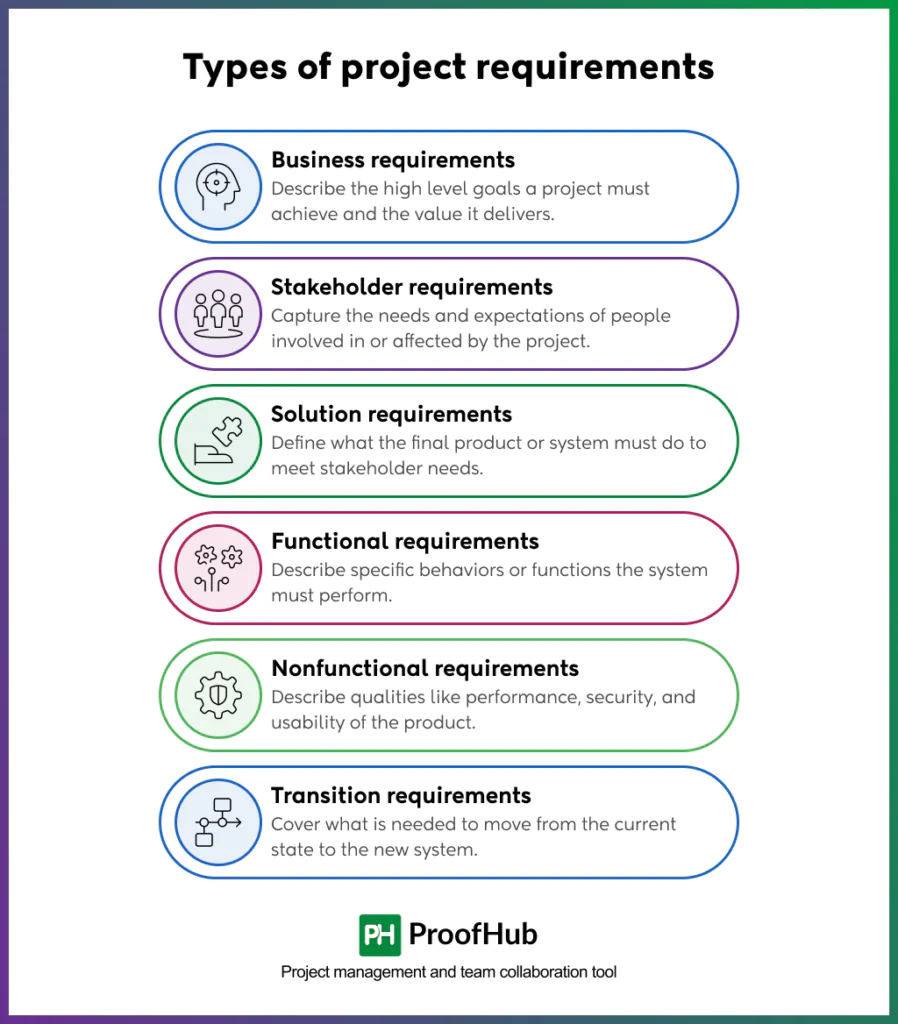
The six types of project requirements include business requirements, stakeholder requirements, solution requirements, functional requirements, nonfunctional requirements, and transition requirements.
Each type serves a different purpose during planning and delivery. Below, each of these are explained in greater detail:
- Business requirements describe the high level goals a project must achieve. They explain why the project exists and what value it delivers to the organization. Organizational leadership writes these requirements based on the goals they consider most important.
- Stakeholder requirements capture the needs and expectations of people involved in or affected by the project. They translate business goals into specific expectations. Every group has a different set of requirements.
- Solution requirements define what the final product or system must do to meet stakeholder needs. They bridge the gap between goals and design. The details of the solution can be very precise, based on what needs to be achieved. The more detailed the solution is, the easier it is to implement it.
- Functional requirements describe specific behaviors or functions the system must perform. They focus on what the product does. They specifically focus on what the product must do instead of what the product must solve.
- Nonfunctional requirements. Every project has a qualitative aspect to it in addition to a functional aspect. These describe qualities like performance, security, and usability. They focus on how well the product performs its functions.
- Transition requirements. Cover what is needed to move from the current state to the new system. They include training, data migration, and change management steps. Transition requirements cover what is needed to move from the current state to the new system, such as training users before go-live, migrating existing data, and managing the change for affected teams.
Why is requirements gathering important for a project?
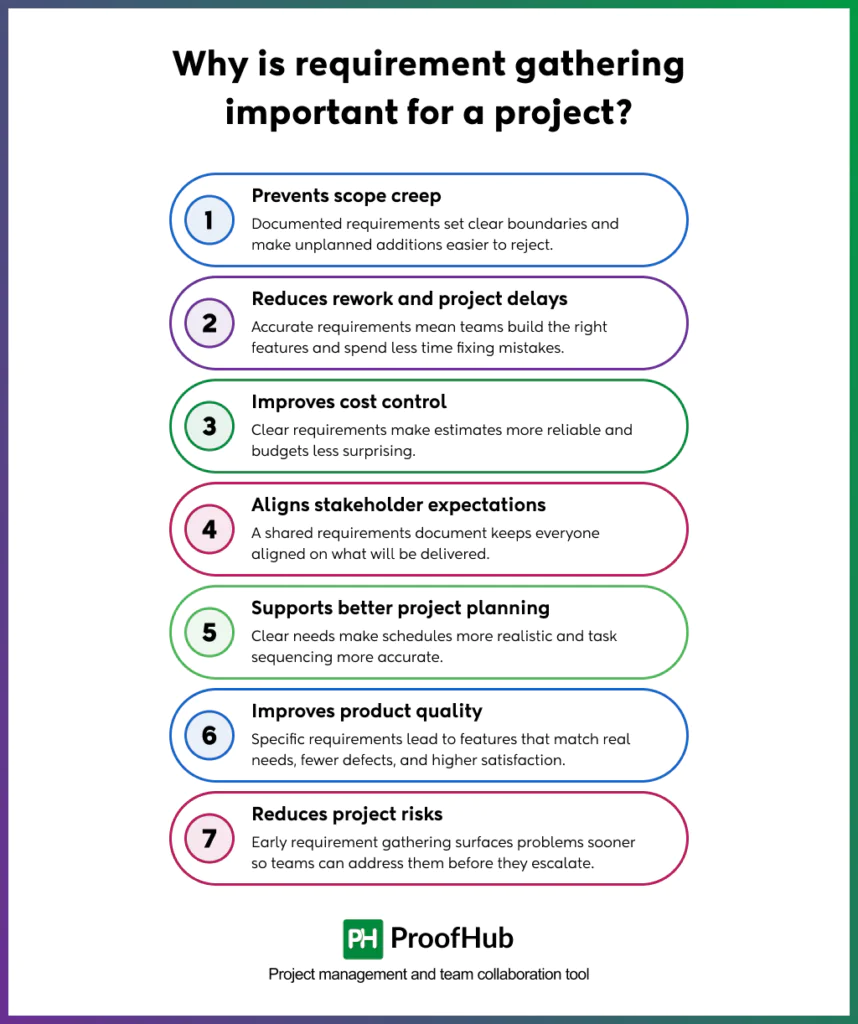
Requirements gathering is important for a project because it prevents scope creep, reduces rework and project delays, improves cost control, aligns stakeholder expectations, supports better project planning, improves product quality, and reduces project risks.
Clear requirement gathering shapes almost every outcome in a project. It affects timelines, budgets, and final quality.
Below, the importance is explained in greater detail:
- Prevents scope creep: Clearly documented requirements set boundaries early. This makes it easier to identify and reject unplanned additions later. Since the requirements have already been researched, the steps needed to achieve them are also predictable.
- Reduces rework and project delays: Accurate requirements reduce the chance of building the wrong feature. This saves time that would otherwise go into fixing mistakes.
- Improves cost control: When requirements are clear, estimates become more reliable. Teams can plan budgets with fewer surprises along the way. It reduces costly rework and scope changes later in the project, keeping spending closer to the original budget.
- Aligns stakeholder expectations: A shared requirements document keeps everyone on the same page. It reduces disagreements about what the project should deliver.
- Supports better project planning: Clear requirements make it easier to build realistic schedules. Planners can sequence tasks based on actual needs, not assumptions. The time required to complete the project is estimated from industry benchmarks.
- Improves product quality: When requirements are specific, teams build features that match real needs. This leads to fewer defects and higher user satisfaction. This is closely related to the functionality of the product, which is also part of the requirements gathering process.
- Reduces project risks: Thorough requirement gathering reveals potential problems early. This gives teams time to address risks before they escalate. Discovering costly problems mid-project are harder and more expensive to fix.
Step-by-step process for gathering project requirements
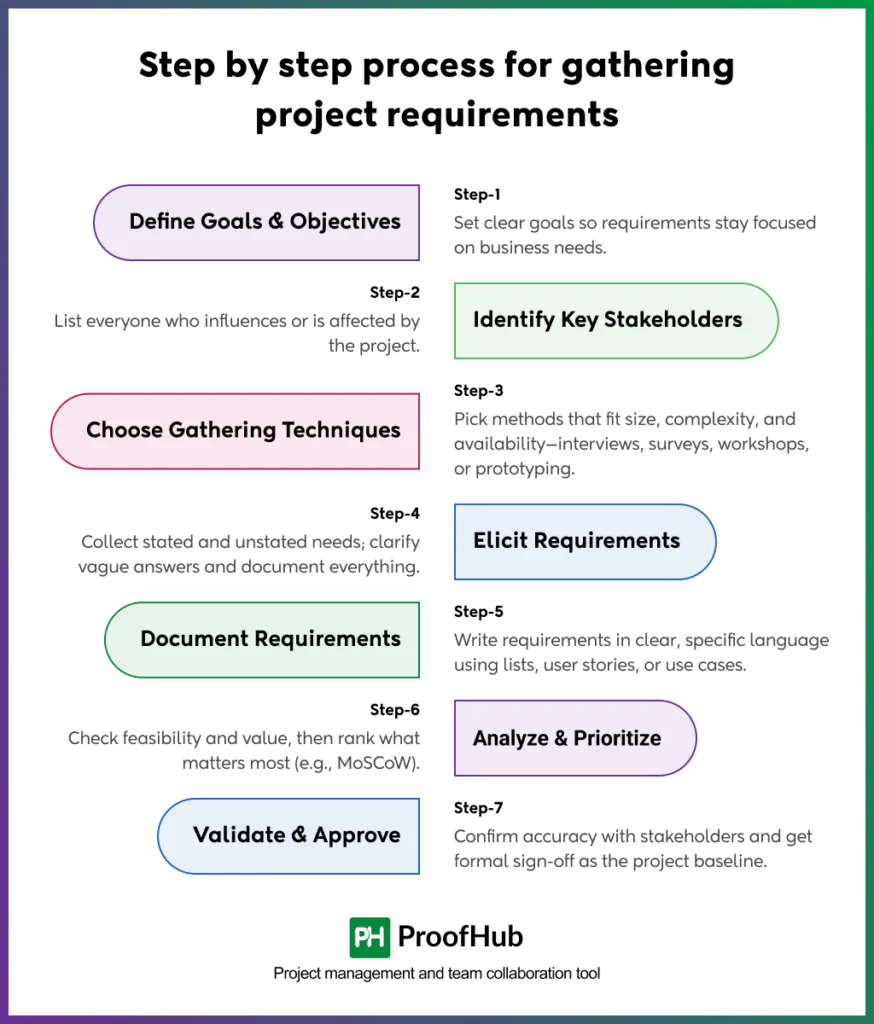
The seven steps involved in requirements gathering are defining project goals and objectives, identifying key stakeholders, choosing relevant gathering techniques, eliciting project requirements, documenting the requirements, analyzing the project requirements, and validating the requirements.
Requirements gathering follows a structured sequence. Each step builds on the one before it, creating a complete and validated set of requirements. All the steps are explained below:
1. Define project goals and objectives
Start by defining goals clearly, explain what the project intends to achieve and why it matters to the organization.
Define the goals into measurable, specific outcomes and turn them into objectives. Document goals in a simple language that everyone can understand.
2. Identify key stakeholders
Identify people or groups that influence or are affected by the project outcomes. Document groups such as clients, end users, sponsors, department heads, and technical teams.
Identify all the stakeholders early to avoid missing out on important perspectives. Make a stakeholder map or list to organize all the information clearly.
Note each stakeholder’s role, influence level, and specific interest in the project. Communicate regularly with all the groups throughout and keep expectations aligned and reduce the risk of last minute surprises during delivery.
3. Choose requirements gathering techniques
Choose the most suitable requirements gathering technique based on project size, stakeholder availability, and complexity. Interview or survey all the stakeholders involved.
For larger projects, organize workshops, prototype, or choose a combination of several methods. Make sure to consider time constraints and how detailed the project needs to be.
Choose the technique early on in the project to save on effort and to avoid gathering incomplete or unclear information.
4. Elicit project requirements
Collect all the relevant information from the stakeholders. Use a combination of methods including interviews, workshops, or observation.
Try to uncover both stated and unstated needs. Ask clarifying questions to avoid assumptions and vague answers.
Document everything as it is happening to maintain a clear record of both major and minor ideas. Exercise patience and active listening to elicit the most clear and technical feedback.
5. Document the requirements
Organize all the collected information into a clear requirements document. Describe each document in specific, unambiguous language.
Use a recognizable format, like requirements list, user stories, or case diagrams. Include enough detail for teams to act on it without requiring further clarification.
Categorize requirements by type, such as functional or nonfunctional to make the document easier to navigate.
6. Analyze and prioritize requirements
Analyze and review each requirement for feasibility, cost, and alignment with project goals. Prioritize and rank requirements based on business value and urgency.
Use techniques like MoSCoW to sort items into must haves, should haves, could haves, and will not haves. Address any arising issues promptly to avoid costly changes during later development stages.
7. Validate and approve requirements
Validate and confirm that documented requirements accurately reflect stakeholder needs. Review the requirements with stakeholders to check for accuracy and completeness.
Correct any misunderstandings right away before the actual development begins. Get formal approval through a sign off and create a baseline for the project.
Institute a formal change control process to change the requirements if any are needed down the line.
What are the different requirements gathering techniques?
Different requirements gathering techniques include stakeholder interviews, workshops and brainstorming, surveys and questionnaires, observation, document analysis, prototyping and wireframing, focus groups, use cases and user stories.
Several proven techniques help teams collect accurate and complete requirements. Each of the below techniques satisfy a unique need:
- Stakeholder interviews: One-on-one conversations with stakeholders that dig into individual needs and concerns. They work well for detailed, nuanced information. Since the stakeholders are the entities most affected by the project, they know exactly what they want.
- Workshops and brainstorming: Group sessions that bring multiple stakeholders together. They help formulate ideas quickly and resolve conflicts in real time. Because participants can question and refine ideas in real time, conflicting needs surface and get resolved on the spot, rather than through several rounds of follow up emails.
- Surveys and questionnaires: Structured forms that collect input from a large group. They work well when stakeholders are spread across locations. They also scale well for gathering input from a large number of users without requiring one on one interviews with each.
- Observation: Watching how users currently perform tasks. This reveals needs that people may not think to mention verbally. Although the findings of observation are not always accurate, they can inform project managers about hidden requirements that stakeholders miss.
- Document analysis: Reviewing existing manuals, reports, and process documents. This uncovers requirements based on current operations. Since documentation is internal to any organization, this technique deals with sensitive information. Therefore, project managers must handle the documents with proper care.
- Prototyping and wireframing: Building early visual models of a solution. Stakeholders can react to something tangible instead of abstract ideas. Examples include mockups or clickable prototypes.
- Focus groups: Small, guided discussions with selected participants. They help gather opinions on specific features or concepts. Project managers choose the participants of the focus groups based on how important they are to a project. Participants are typically chosen to represent the end users or customers who will actually work with the solution.
- Use cases and user stories: Narrative descriptions of how users interact with a system. They make requirements easier to understand from a practical standpoint by presenting them as a scenario. It also helps in establishing various user profiles that may use the product and how project managers can customize the project according to their needs.
Requirements gathering checklist
Having a requirements gathering checklist helps project managers checkmark after they complete each step, this keeps progress well-defined and tracked.
The checklist is given below:
What are the common requirements gathering challenges?
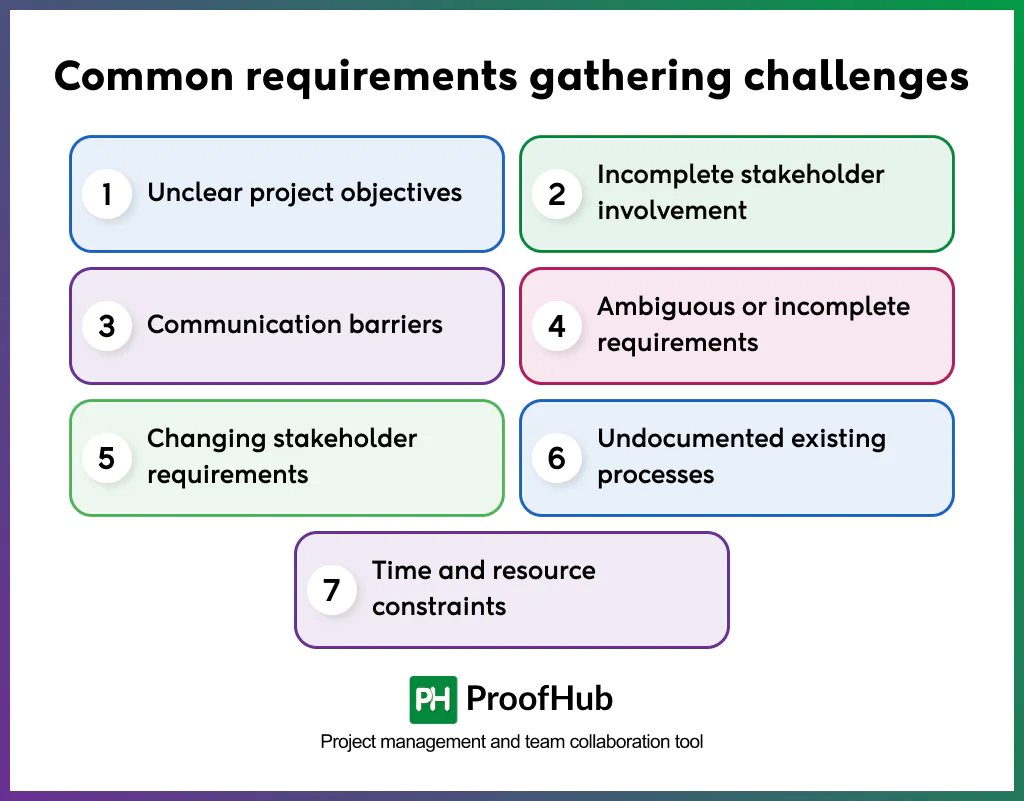
Common challenges project managers face during requirements gathering include unclear project objectives, incomplete stakeholder involvement, communication barriers, ambiguous or incomplete requirements, changing stakeholder requirements, undocumented existing processes, and time and resources constraints.
Even with a solid process, teams often face obstacles during requirement gathering. Below, the challenges are explained in greater detail:
- Unclear project objectives: Without a clear definition of what counts as project success, teams end up treating every incoming feature request as equally important, and scope keeps expanding. To fix it, define measurable success criteria and get stakeholder sign off on them before requirements gathering begins.
- Incomplete stakeholder involvement: When requirements come only from executives and skip end users or subject matter experts, important details about how the work actually gets done are missed. To fix, involve end users and subject matter experts from the start, not just as a final review step.
- Communication barriers: When business teams and technical teams use different terminology, requirements get misread. Reduce this by maintaining a shared glossary of terms and having both sides review requirements together, not in isolation.
- Ambiguous or incomplete requirements: Vague requirements force execution teams to guess, and those guesses often turn out wrong, leading to rework. Fix this by rewriting every requirement as a specific, testable statement.
- Changing stakeholder requirements: Requirements that keep shifting after the baseline is set throw off development schedules and cause the documentation to fall out of sync with what is actually being built. Address it with a formal change request process that reviews the impact on cost and schedule before any change is approved.
- Undocumented existing processes: When current workflows, manual workarounds, or compliance rules are never written down, a new system can quietly break them. Map and document existing processes formally before designing the new system.
- Time and resource constraints: Rushing interviews or workshops produces shallow requirements, and the real discovery work ends up happening later during design and build, where mistakes are far more expensive to fix. Protect enough time upfront for proper requirements gathering, since it costs less than fixing gaps after development starts.
What are the best tools for project requirements gathering?
Various requirements gathering tools include ProofHub, Google Forms, Lucidchart, Confluence, and Figma.
The right tools make requirement collection faster and more organized. The tools are explained below:
- ProofHub: Centralized discussions, file sharing, and task tracking. Teams can capture stakeholder input, assign action items, and keep requirement documents accessible in one shared workspace. This reduces the need to switch between separate tools during the elicitation and documentation phases.
- Google Forms: Useful for collecting information from a large number of stakeholders. Project managers can create questionnaires with multiple choice, short answer, rating, and other response types to gather requirements, preferences, feedback, or project constraints.
- Lucidchart: Helps teams understand requirements by turning processes, workflows, system interactions, and use cases into visual diagrams. Project managers can use flowcharts, process maps, and other diagrams to identify how a process currently works and what needs to change. Stakeholders can then review the visual representation and point out missing steps, dependencies, or incorrect assumptions.
- Confluence: Provides a central workspace for documenting and organizing project requirements. Teams can create requirement pages, maintain supporting documentation, record meeting notes, and link related information in one place.
- Figma: Useful when requirements need to be explored through interface designs or prototypes. Designers and project teams can create wireframes and interactive mockups that give stakeholders something concrete to review.
What is the next step after gathering project requirements?
After gathering requirements, the next step is documentation. Teams organize collected information into a clear, structured document. This document then goes through validation, where stakeholders confirm the requirements are accurate.
Once validated, requirements are prioritized based on business value and feasibility. Only after this sequence does the project move into detailed planning and design.
Who is responsible for gathering project requirements?
Business analysts often lead requirement gathering efforts, though responsibility can vary by organization. Project managers frequently coordinate the process alongside analysts.
In smaller teams, this task may fall to the project lead or product owner. Regardless of title, the responsible party must work closely with stakeholders across departments to capture accurate needs.
What are the consequences of poor requirements gathering?
Poor requirements gathering leads to scope creep, missed deadlines, and budget overruns. Teams may build features that do not match actual stakeholder needs. This causes rework, frustration, and delays in delivery. Poorly gathered requirements also increase the risk of project failure and damage stakeholder trust in the process.
What is the difference between functional and nonfunctional requirements?
Functional requirements describe what a system must do. They define specific behaviors, features, and functions such as login processes, data validation, report generation, or payment processing.
Nonfunctional requirements describe how a system performs its functions rather than what it does. They cover qualities like performance, security, scalability, usability, and reliability. For example, a system must load pages within two seconds or support one thousand concurrent users. These requirements shape user experience and system quality without adding new features.
What is the difference between requirements gathering and requirement elicitation?
Requirement gathering refers to the broad process of collecting requirements from various sources including stakeholders, documents, existing systems, and business rules. It is often used as a general term covering the entire collection phase.
Requirement elicitation is a more focused technique involving active engagement with stakeholders through interviews, workshops, surveys, observation, and prototyping. It emphasizes drawing out hidden, unstated, or unclear needs that stakeholders may not initially express.
What is the difference between requirements gathering and requirement analysis?
Requirements gathering is the initial stage where raw information is collected from stakeholders, documents, and observations. It involves identifying who the sources are and capturing their needs in whatever form they are expressed, without yet organizing, refining, or validating the information. It answers the question of what stakeholders want.
Requirement analysis happens after gathering and involves examining, organizing, and refining that raw information. It includes checking for conflicts, ambiguities, feasibility, and prioritization, then structuring requirements into clear, testable statements. Analysis transforms unorganized input into a validated, usable specification ready for design and development phases.
Conclusion
Requirements gathering forms the foundation of every successful project. By clearly identifying business, stakeholder, solution, functional, nonfunctional, and transition requirements, teams reduce ambiguity and build products that actually meet real needs. Following a structured process, from defining goals and identifying stakeholders to eliciting, documenting, analyzing, and validating requirements, prevents scope creep, controls costs, and minimizes rework.
Tools like ProofHub make collecting and organizing this information easier across teams of any size. Ultimately, investing time in thorough requirement gathering pays off through smoother execution, stronger stakeholder alignment, and higher quality deliverables that satisfy the original purpose of the project.