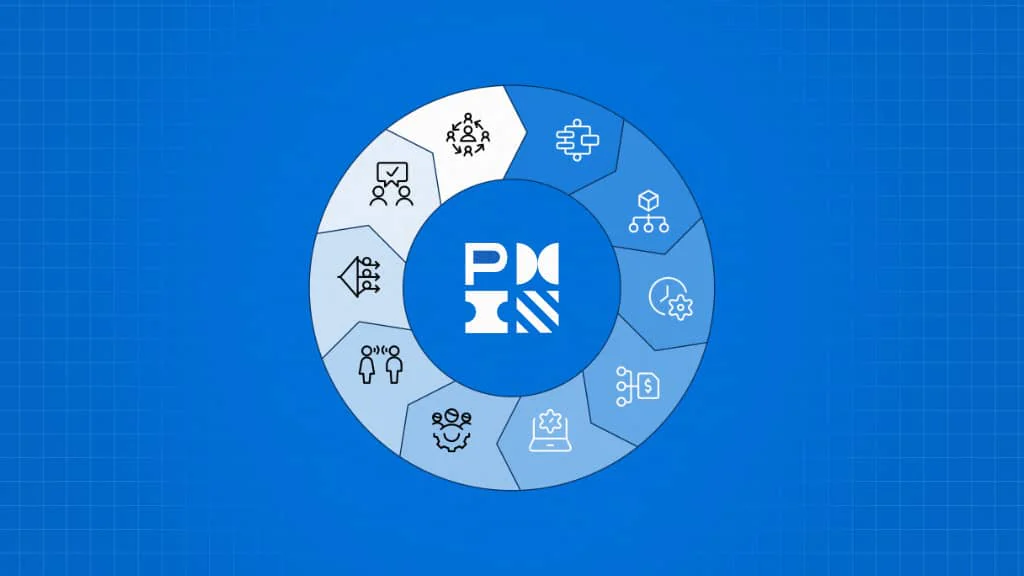
Project management knowledge areas provide the foundation every project manager needs to plan, execute, and deliver projects without missing critical elements.
Without a structured understanding of these areas, projects lose direction, accountability breaks down, and delivery suffers.
This guide covers all 10 knowledge areas, how they integrate with process groups, and how to apply them effectively across any project.
- 1.Project management knowledge areas are 10 distinct domains that cover every dimension of project work from planning to closure.
- 2.Each knowledge area has its own processes, tools, and techniques that address a specific aspect of project execution.
- 3.Without structured knowledge areas, teams face scope creep, budget overruns, and missed deadlines.
- 4.Knowledge areas define what needs to be managed while process groups define when that management happens across the project lifecycle.
- 5.The PMBOK 8th edition replaced the 10 knowledge areas with seven outcome focused performance domains.
- 6.Project integration management is the most critical knowledge area as it connects and coordinates every other area into one unified plan.
What are project management knowledge areas?
Project management knowledge areas are the 10 core domains defined by PMBOK that project managers must address to deliver a project successfully.
There are 10 project management knowledge areas: integration, scope, schedule, cost, quality, resource, communications, risk, procurement, and stakeholder management.
Each area groups related processes, skills, and tools that address a specific aspect of project execution.
Why are project management knowledge areas important?
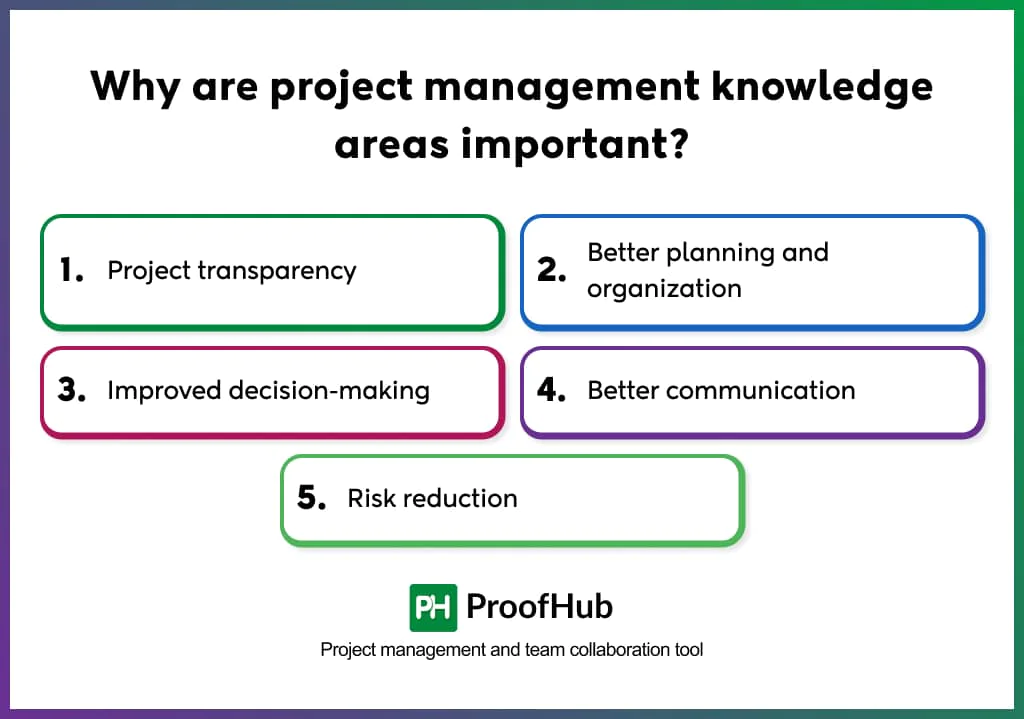
Project management knowledge areas are important because they give project managers a structured framework to handle every aspect of a project systematically. The five key benefits of project management knowledge areas are project transparency, better planning and organization, improved decision making, better communication, and risk reduction.
Together these benefits ensure projects are delivered with greater predictability, fewer surprises, and stronger stakeholder satisfaction from planning through to closure.
- Project transparency: Project transparency ensures information flows consistently across teams and clients when knowledge areas like communications and stakeholder management are actively managed, reducing confusion and building trust throughout the project lifecycle.
- Better planning and organization: Better planning and organization comes from scope, schedule, and resource management areas that provide the tools to break down work systematically, preventing gaps and ensuring every team member understands their responsibilities.
- Improved decision-making: Improved decision making happens when integration and risk management areas equip managers with frameworks to evaluate trade-offs quickly, minimizing guesswork during critical project moments.
- Better communication: Better communication is established when knowledge areas define clear channels and protocols for sharing updates, reducing misunderstandings and ensuring everyone stays aligned on goals, changes, and deliverables throughout the project.
- Risk reduction: Risk reduction is achieved when risk management processes help managers anticipate issues early, minimizing disruptions and protecting project timelines and budgets from unexpected setbacks.
What are the 10 project management knowledge areas?
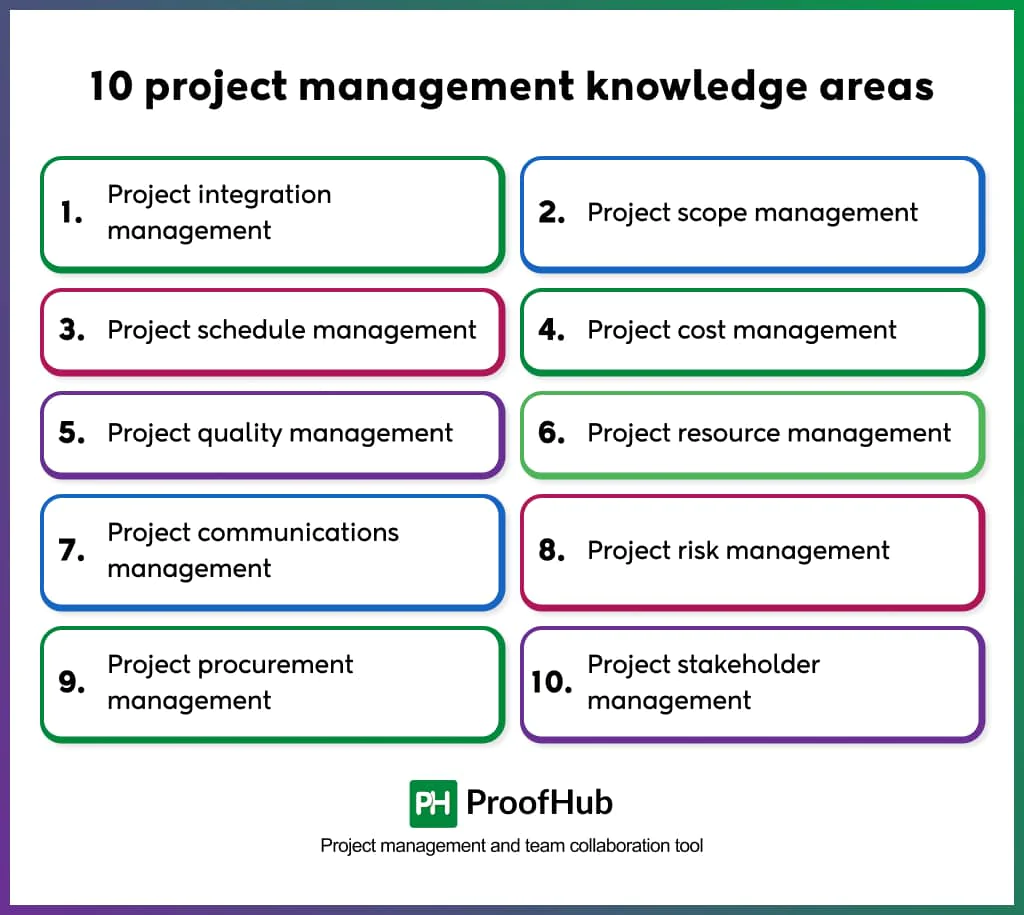
The 10 project management knowledge areas are: Project Integration Management, Project Scope Management, Project Schedule Management, Project Cost Management, Project Quality Management, Project Resource Management, Project Communications Management, Project Risk Management, Project Procurement Management, Project Stakeholder Management
These project management knowledge areas define the core disciplines every project manager must apply to deliver projects successfully. Each area focuses on a specific dimension of project work with its own processes, tools, and techniques.
Let’s read more about these project management knowledge areas in detail:
1. Project integration management
Project integration management is the knowledge area that ties all project activities into a single unified plan. It ensures that when scope changes, the schedule and budget update accordingly.
In practice, the project manager uses integration management to oversee every decision, change, and process across the project from start to finish.
Key processes:
- Developing the project charter
- Directing and managing project work
- Managing change control
- Closing the project or phase
What this means for your project: When integration management is missing, teams make decisions in isolation and changes in one area create conflicts that ripple across the entire project.
2. Project scope management
Project scope management defines exactly what is and is not included in the project. It ensures the team delivers what was agreed upon without allowing unplanned work to silently expand the boundaries.
In practice, scope management keeps the project focused by documenting requirements clearly and controlling any changes before they affect delivery.
Key processes:
- Collecting requirements
- Defining and creating work breakdown structure
- Validating scope
- Controlling scope changes
What this means for your project: Loosely defined scope is the leading cause of missed deadlines and budget overruns. Every uncontrolled addition quietly pushes the project further from its original delivery targets.
3. Project schedule management
Project schedule management ensures every task is planned, sequenced, and tracked so the project finishes on time. It gives the project manager full visibility into what is happening, when, and by whom.
In practice, schedule management helps translate the project plan into a working timeline that every team member can follow and execute against.
Key processes:
- Defining and sequencing activities
- Estimating activity durations
- Developing the schedule
- Controlling the schedule
What this means for your project: A schedule that is not actively maintained becomes unreliable. Untracked slippages in one task quietly push every downstream activity back without anyone noticing until deadlines are already missed.
4. Project cost management
Project cost management plans, estimates, and controls every financial resource allocated to the project. It ensures the project is completed within the approved budget without compromising scope or quality.
In practice, cost management gives the project manager a financial baseline to track spending against and flag overruns before they become unrecoverable.
Key processes:
- Planning cost management
- Estimating costs
- Determining the budget
- Controlling costs throughout execution
What this means for your project: Unmonitored spending accumulates silently. By the time cost overruns become visible, the project has already consumed resources that can’t be recovered without cutting scope or quality.
5. Project quality management
Project quality management ensures deliverables meet the standards and expectations defined at the start. It builds quality into every stage of execution rather than treating it as a final check before delivery.
In practice, quality management establishes measurable standards early and runs checks throughout execution to catch issues before they reach the client.
Key processes:
- Planning quality standards
- Managing quality assurance
- Performing quality audits
- Controlling quality of deliverables
What this means for your project: Defects caught late in execution cost significantly more to fix than those identified early. Projects that skip quality management consistently face rework, budget overruns, and damaged client relationships.
6. Project resource management
Project resource management identifies, acquires, and manages the people, tools, and materials needed to execute the project. It ensures the right resources are available at the right time without overloading or underutilizing team members.
In practice, resource management gives the project manager visibility into who is doing what and whether capacity is being used effectively across every phase.
Key processes:
- Planning and acquiring resources
- Developing the project team
- Managing the team effectively
- Controlling resource utilization
What this means for your project: Unbalanced resource allocation creates bottlenecks that slow delivery. When some team members are stretched beyond capacity while others sit idle, both productivity and morale deteriorate across the project.
7. Project communications management
Project communications management ensures the right information reaches the right people at the right time throughout the project lifecycle. It removes confusion from reporting and keeps every stakeholder aligned with project progress.
In practice, communications management defines who receives what information, through which channel, and at what frequency so nothing important gets missed or delayed.
Key processes:
- Planning communications strategy
- Managing information distribution
- Reporting project performance
- Monitoring and controlling communications
What this means for your project: Without defined communication channels and reporting schedules, critical information gets lost, decisions get delayed, and stakeholders lose confidence and start questioning project decisions, timelines, and outcomes.
8. Project risk management
Project risk management identifies, analyzes, and plans responses to threats and opportunities before they affect the project. It shifts the team from reactive problem solving to proactive risk prevention.
In practice, risk management runs throughout the entire project lifecycle, continuously identifying new risks and updating response plans as the project evolves.
Key processes:
- Identifying and analyzing risks
- Planning risk responses
- Implementing risk response actions
- Monitoring and controlling risks throughout execution
What this means for your project: Risks identified late leave the team with fewer response options and greater costs. Treating risk management as an ongoing process rather than a one-time exercise is what separates predictable delivery from constant firefighting.
9. Project procurement management
Project procurement management handles acquiring goods, services, and resources from external vendors and suppliers. It ensures outside contractors integrate smoothly into the project without disrupting delivery timelines.
In practice, procurement management governs the entire vendor relationship from selection and contracting through to final agreement closure.
Key processes:
- Planning procurement strategy
- Conducting vendor selection
- Managing and controlling contracts
- Closing procurement agreements
What this means for your project: Poorly defined contract terms and vendor expectations cause disputes and compliance issues that stall execution. Procurement decisions made without a clear framework create problems that are costly and time consuming to resolve mid-project.
10. Project stakeholder management
Project stakeholder management identifies everyone with an interest in the project and ensures their expectations are actively managed from initiation to closure. It goes beyond keeping stakeholders informed. It ensures their input shapes decisions at the right moments.
In practice, stakeholder management maps out who has influence over the project and builds an engagement plan that keeps relationships productive throughout delivery.
Key processes:
- Identifying and analyzing stakeholders
- Planning stakeholder engagement
- Managing stakeholder expectations
- Monitoring and controlling stakeholder engagement
What this means for your project: Unmanaged stakeholder expectations are one of the most common reasons projects fail at the final stage. Resistance, last minute change requests, and misaligned priorities surface when stakeholders feel excluded from the process.
How do knowledge areas integrate with process groups?
Knowledge areas and process groups intersect in a matrix: each knowledge area contributes specific processes to one or more process groups, and each process group draws processes from multiple knowledge areas.
Knowledge areas define what needs to be managed while process groups define when it gets managed. Every knowledge area contains specific processes that execute across one or more of the five process groups, ensuring no aspect of the project is addressed at the wrong time or skipped entirely.
The five process groups that knowledge areas map into are:
- Initiating — sets the project in motion
- Planning — defines how each area will be managed
- Executing — puts the plan into action
- Monitoring and Controlling — tracks progress and corrects course
- Closing — formally completes each area of delivery
Together the five process groups ensure every aspect of the project is addressed at the right stage, nothing gets skipped and nothing gets managed too late to make a difference.
The table below shows exactly how each knowledge area maps across the five process groups:
What is the difference between knowledge areas and process groups?
Knowledge Areas: Specialized domains of project management expertise, each covering a specific subject area (e.g., Scope, Cost, Risk) with its own set of concepts, tools, and techniques.
Process Groups: Logical groupings of project management processes based on when they occur in the project lifecycle (Initiating, Planning, Executing, Monitoring & Controlling, Closing).
The table below highlights the key differences between knowledge areas and process groups:
| Knowledge areas | Process groups | |
|---|---|---|
| Definition | Specific domains of expertise a project manager must apply | Phases that organize when project processes are executed |
| Focus | What needs to be managed | When management happens |
| Number | 10 knowledge areas | 5 process groups |
| Examples | Scope, cost, risk, quality | Initiating, planning, executing |
| Purpose | Groups related processes by subject matter | Groups processes by timing and lifecycle stage |
| Runs across | Entire project lifecycle | Each phase of the project |
How many project management knowledge areas and process groups are there according to PMBOK?
According to PMBOK, there are 10 project management knowledge areas and 5 process groups. Together the 10 knowledge areas and 5 process groups contain 49 project management processes, each belonging to one knowledge area and one process group simultaneously.
The combined framework ensures every project management activity is categorized by both what needs to be managed and when it needs to happen across the project lifecycle.
Is there any update in the knowledge areas in the PMBOK 8th edition?
Yes, there is an update in the knowledge areas in the PMBOK 8th edition. Released in November 2025, the 8th edition replaced the 10 knowledge areas with seven performance domains, making project management more flexible and adaptable to modern project environments.
Integration management became Governance, Cost management became Finance, and Stakeholder and Communications management merged into Stakeholders.
Quality was absorbed into Governance and Scope, while Procurement moved to an appendix rather than remaining a core domain.
What is the difference between knowledge areas and performance domains?
Knowledge areas: Specialized domains of project management expertise defined in PMBOK, each covering a specific subject area (e.g., Scope, Cost, Risk) with its own set of concepts, tools, and techniques. This is the process-based approach used through PMBOK 6th Edition.
Performance domains: Groups of related activities critical for effectively delivering project outcomes, defined in PMBOK 7th Edition. They are principle-based rather than process-based, focusing on outcomes across areas like Stakeholders, Team, Planning, Project Work, Delivery, Measurement, and Uncertainty.
The table below highlights the key differences between knowledge areas and performance domains:
| Knowledge areas | Performance domains | |
|---|---|---|
| Definition | Subject specific domains grouping related processes and tools | Outcome focused areas of project activity that drive results |
| Focus | Processes and tools | Behaviors and outcomes |
| Structure | Organized by discipline | Organized by activity and outcome |
| Number | 10 knowledge areas | 8 performance domains |
| Based on | PMBOK 6th edition | PMBOK 7th edition |
| Approach | Prescriptive | Principles based |
Which knowledge area is most critical for project success?
Project integration management is the most critical knowledge area for project success because it connects and coordinates every other knowledge area into one unified plan.
Without strong integration management, decisions made in scope, schedule, and cost operate in isolation and create conflicts that derail delivery.
Every other knowledge area depends on integration management to function effectively as a whole.
Conclusion
Project management knowledge areas give every project manager a structured foundation to plan, execute, and deliver projects without losing control over scope, cost, quality, or stakeholder expectations.
Each of the 10 knowledge areas addresses a specific dimension of project work, ensuring nothing critical gets overlooked from initiation to closure.
Understanding how knowledge areas integrate with process groups, align with performance domains, and evolve across PMBOK editions gives project managers the complete framework needed to manage projects predictably and deliver consistent results.