
Project schedule management is the process of developing and maintaining the project schedule to ensure timely completion. It involves planning, organizing, executing, monitoring, and controlling project activities in accordance with the project schedule to complete the project work within time, budget, scope, and quality standards.
In the PMBOK Guide (Project Management Body of Knowledge), project schedule management is a knowledge area that includes and describes the processes required to manage the timely completion of the project. It is one of the most comprehensive knowledge areas, encompassing various techniques, tools, methodologies, processes, and artifacts for managing project time.
In this article, we will look at the basics of project schedule management to help users become acquainted with the fundamentals. We will learn about the meaning and importance, key elements, process, techniques, common challenges, and best practices for project schedule management.
- 1.Project schedule management is the process of planning, organizing, developing, executing, and controlling the project schedule to complete the project on time.
- 2.Project schedule management provides a clear roadmap for the project schedule, ensures the necessary resources, helps proactively manage risks, creates accountability, and builds trust with stakeholders.
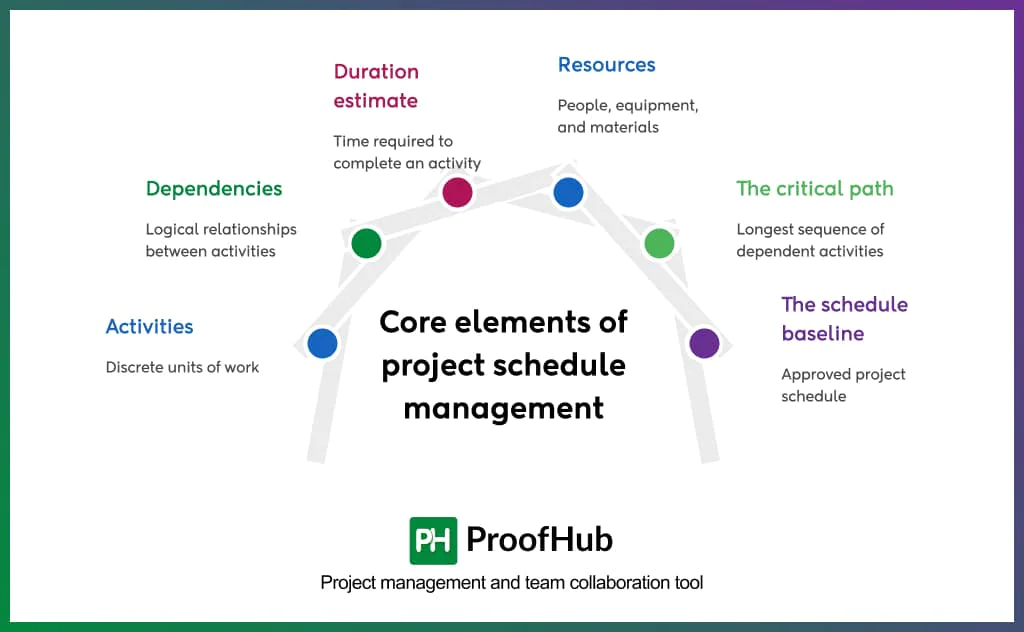
- 3.The core elements of project schedule management include activities, durations, dependencies, resources, the critical path, and the schedule baseline.
- 4.The six-step process of project schedule management includes plan schedule management, define activities, sequence activities, estimate activity durations, develop a schedule, and control schedule.
- 5.Common challenges in project schedule management include poorly defined project activities, inaccurate duration and resource estimates, incorrect dependency identification, inadequate risk management, and unapproved scope changes.
What is project schedule management?
Project schedule management is the process of planning, organizing, developing, executing, and controlling the project schedule to complete the project on time. It involves defining the activities to be performed in the project, sequencing those activities, estimating the duration and resources for each activity, developing the project schedule, and controlling the schedule to complete the project work on time.
Project schedule management uses a standard 6-step process (plan, define, estimate, control), various tools (critical path method, Gantt chart, and network diagrams), techniques (decomposition, role wave planning, and dependencies), and terminologies (milestones) to manage project time.
A few key terms to know:
- A project schedule is the timeline of a project that outlines the planned start and finish dates for project activities and milestones.
- Project activities are the smallest unit of work needed to complete a deliverable or work package of a project.
- A work package is the lowest level of breakdown in a Work Breakdown Structure (WBS), using which project activities are defined and the project schedule is developed.
- A work breakdown structure is the hierarchical breakdown of a project into smaller components.
Let’s understand the importance of project schedule management and key tools, techniques, and processes used.
Why is project schedule management important?
Project schedule management provides a clear roadmap for the project by identifying and sequencing all activities, ensuring the necessary resources for project work through accurate estimates, and proactively managing risks through timely risk management. This increases the likelihood of project success by completing it on time and within budget.
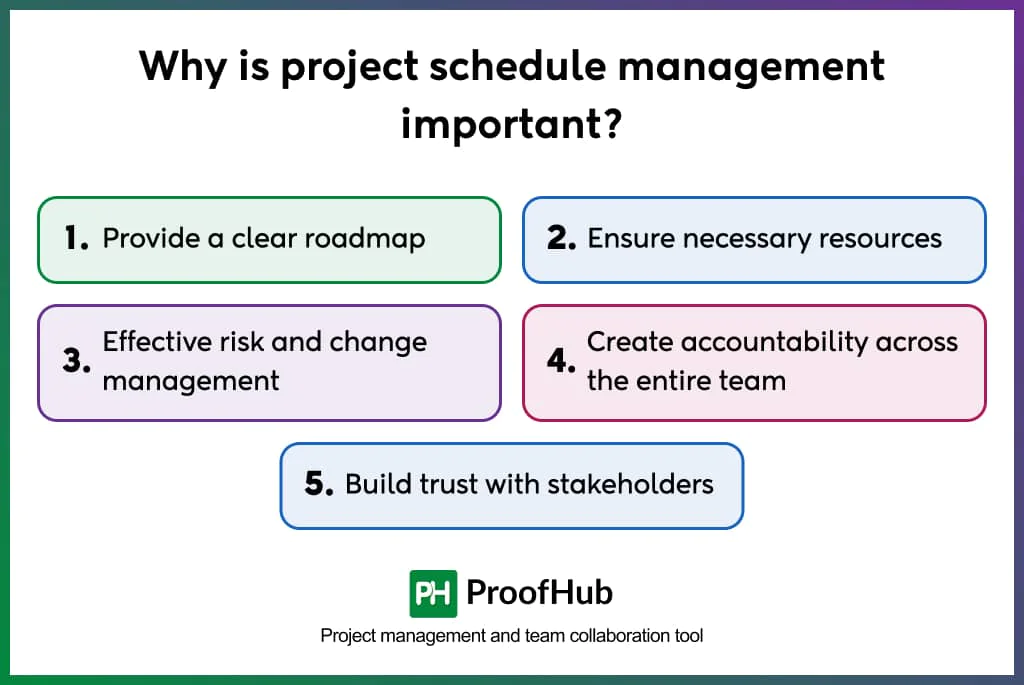
Here is the brief explanation of the key benefits of project schedule management:
- Provide a clear roadmap: Project schedule management provides all project stakeholders (the project manager, the project team, and the project sponsors) with a clear timeline of what will happen, when, and in what order. This helps them make informed and guided decisions.
- Ensure necessary resources: Project schedule management helps ensure the necessary resources—people, equipment, budget, and time—for each project activity by making accurate, detailed estimates. This helps build a realistic plan, make efficient use of resources (prevent burnout due to over-allocation and resource wastage due to under-utilization), and creates a shared visibility into the resource calendar to avoid planning errors.
- Effective risk and change management: Risks and changes are a part of a project, irrespective of how well a project plan is. Project schedule management helps in managing risks by identifying and planning. It defines risk mitigation measures and schedules contingency reserves to absorb the impact of identified risks without requiring a formal change request for minor disruptions. For unidentified changes, it helps build a formal change process to accommodate them.
- Create accountability across the entire team: A project schedule ensures every team member knows exactly what they are responsible for by clearly defining all project activities and assigning named individuals with specific start and finish dates. This creates accountability for everyone.
- Build trust with stakeholders: A project schedule helps a project manager build trust by presenting clear, data-driven status reports, accurately forecasting completion dates, and explaining variances with root causes and corrective plans. This enhanced visibility with data earns stakeholders’ trust and buy-in.
What are the core elements of project schedule management?
The core elements of project schedule management include activities, durations, dependencies, resources, the critical path, and the schedule baseline. Let’s understand what each element means.
1. Activities
Project activities are the fundamental building blocks of the project schedule. Each activity represents a discrete, smallest, schedulable unit of work that produces a defined output to contribute to completing a deliverable. Activities are derived from the Work Breakdown Structure (WBS) by decomposing work packages into manageable and actionable parts.
2. Dependencies
Dependencies define the sequence in which activities must be performed. They represent the logical relationships between activities — establishing which activities must precede others, which can run in parallel, and which must wait for others to complete before they can begin.
Dependencies are primarily of four types:
- Finish-to-start (FS): B cannot start until A finishes
- Start-to-start (SS): B cannot start until A starts
- Finish-to-finish (FF): B cannot finish until A finishes
- Start-to-finish (SF): B cannot finish until A starts
Beyond the type of relationship, dependencies can also be categorized into four types:
- Mandatory: Hard logic required by the nature of the work
- Discretionary: Best practice that can be changed if needed
- External: Outside the project team’s control, such as vendors or regulators.
- Internal: Within the project team’s control
3. Duration estimate
Duration is the number of work periods (hours, days, or weeks) required to complete an activity. It is simply the estimated time required for each task. It is distinct from effort, which is the total work hours required. An activity may require 16 hours of effort, but its duration can be 4 days if one resource works 4 hours per day on it.
4. Resources
Resources are the people, equipment, materials, and facilities required to perform project activities. Resource management and schedule management are inseparable: every activity requires resources, and resource availability directly determines when activities can realistically start and finish.
5. The critical path
The critical path is the longest sequence of dependent activities through the project network. It determines the minimum total duration of the project. Any delay to an activity on the critical path directly delays the project end date. Activities on the critical path have zero float. It means that they have no scheduling flexibility.
6. The schedule baseline
The schedule baseline is the approved project schedule agreed upon by the project manager, sponsor, and key stakeholders at the conclusion of planning. It represents the ‘contract’ version of the schedule: what was promised, when work would be done, and what the target completion date is. The baseline must never be changed without a formal change control process. It is the reference point for all performance measurements.
What is the 6-step process of project schedule management?
The six-step process of project schedule management includes: plan schedule management, define activities, sequence activities, estimate activity durations, develop a schedule, and control schedule.
This is a structured sequence of processes that helps a project manager identify all the activities to complete the project work, define how to manage the project schedule, and create a project schedule.
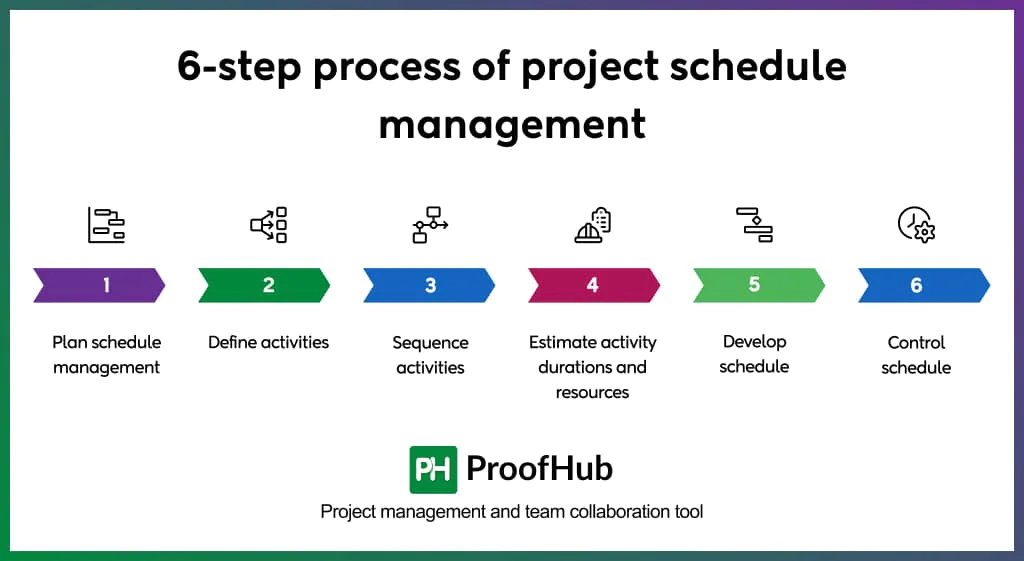
1. Plan schedule management: It defines how a project schedule will be developed, organized, monitored, controlled, and closed. It includes establishing the policies, procedures, and documentation for planning, developing, managing, executing, and controlling the project schedule.
2. Define activities: It is the process of identifying and documenting the specific actions to be performed to produce the project deliverables. It involves decomposing the work packages from the WBS (Work Breakdown Structure) into project activities that the project team must perform to complete a project.
3. Sequence activities: It is the process of identifying and documenting relationships among the project activities. It includes determining which activity must finish before others can start, which can run in parallel, and which can wait (lag) or overlap (lead).
4. Estimate activity durations and resources: It is the process of estimating the time and resources required to complete individual activities. This is one of the most skill-intensive steps in project scheduling, where a project manager estimates using various estimation techniques.
5. Develop schedule: It is the process of creating a project schedule that takes all the outputs from the four preceding processes. It includes analyzing activity sequences, durations, resource requirements, and schedule constraints to create the project schedule for execution and monitoring and controlling.
6. Control schedule: It is the process of monitoring the status of the project to keep the project schedule on track and update and manage identified changes to the schedule baseline. It includes comparing actual performance against the schedule baseline, analysing variances, forecasting future performance, and updating the project plan to manage changes to the baseline.
Techniques for effective project schedule management
The most important techniques in professional project schedule management are the critical path method, Gantt chart, program evaluation and review technique, rolling wave planning, and resource leveling. Here is the brief explanation of these most widely used techniques:
1. Critical path method (CPM)
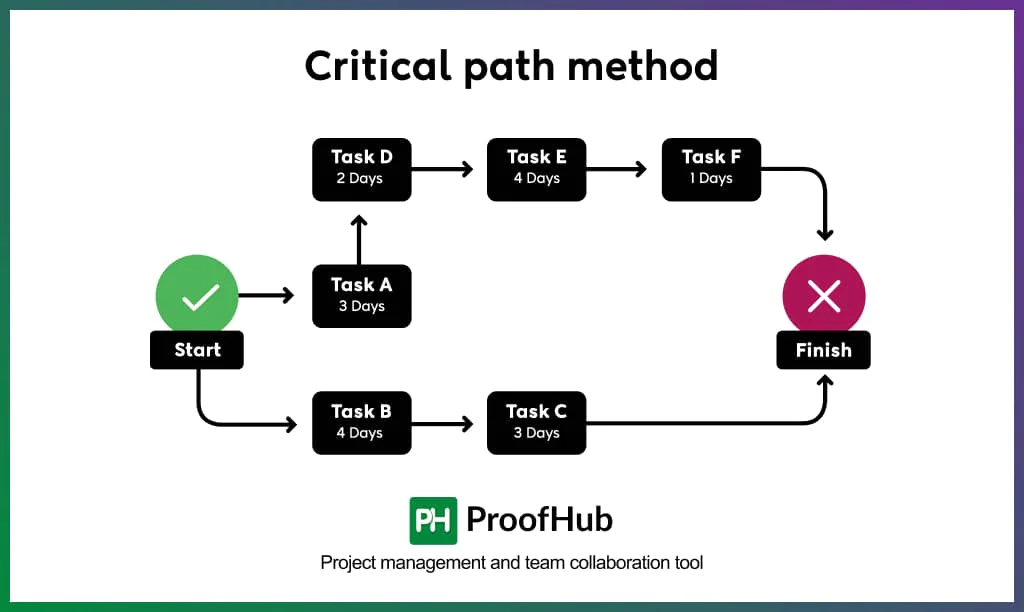
The Critical Path Method is the most foundational analytical technique in project scheduling. It uses the network diagram to logically map all activities and their dependencies to calculate the longest path through the project, which defines the minimum total project duration.
CPM performs a forward pass through the network to calculate the Earliest Start (ES) and Earliest Finish (EF) for each activity, and a backward pass to calculate the Latest Start (LS) and Latest Finish (LF). The difference between LS and ES (or LF and EF) yields the Total Float for each activity. Activities with zero Total Float lie on the Critical Path.
2. Gantt chart
The Gantt chart, developed by Henry Gantt in the early 20th century, is the most universally recognised and widely used scheduling tool in project management. It represents project activities as horizontal bars on a timeline, with each bar’s length proportional to the activity’s duration.
The Gantt chart enables project managers, team members, and stakeholders to instantly understand what work is planned, when it is scheduled, how long it will take, and whether activities are running on time. Most modern project management tools ( ProofHub, MS Project, Smartsheet, Monday.com) generate Gantt charts automatically from the schedule model.
3. Program evaluation and review technique (PERT)
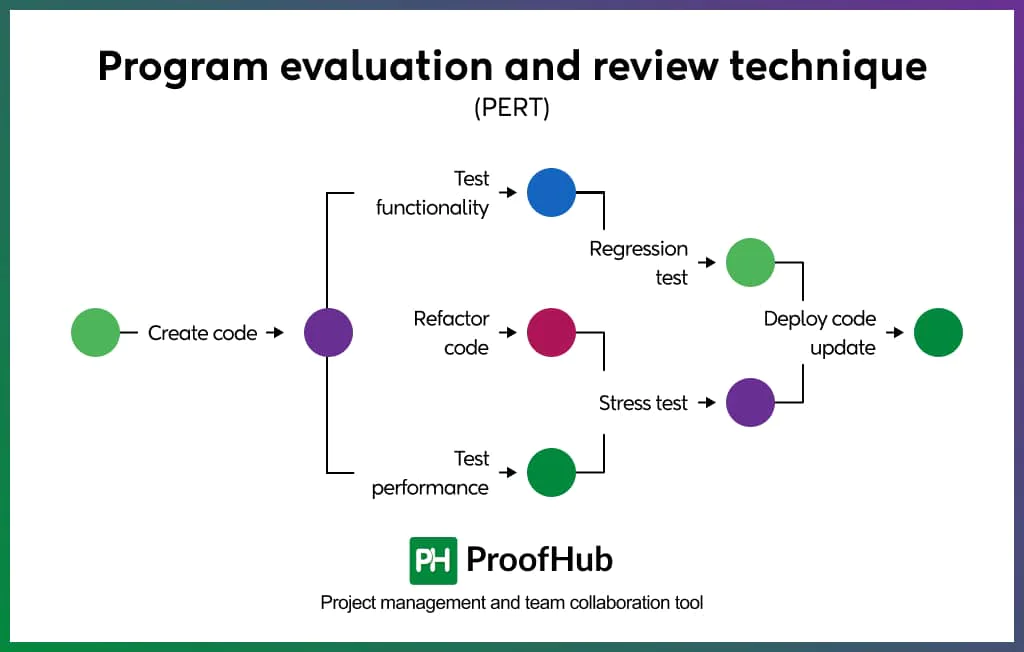
PERT is a probabilistic duration estimation technique that acknowledges a fundamental truth about project work: duration estimates are inherently uncertain. Instead of assuming a single deterministic duration for each activity, PERT uses three estimates to model the range of possible outcomes.
- Optimistic duration (O): The best-case scenario, assuming everything goes right.
- Most likely duration (M): The realistic estimate based on typical conditions.
- Pessimistic duration (P): The worst-case scenario accounting for significant difficulties.
These three points are combined using the PERT weighted average formula to produce an expected duration.
4. Rolling wave planning
Rolling wave planning is a progressive elaboration technique where near-term work is planned in detail, while future work is planned at a high level and refined as more information becomes available.
It is used for projects where all future work can be planned in detail at the outset because requirements are still evolving, technical approaches are not yet confirmed, or the project timeline extends far enough that work in the distant future is inherently uncertain.
The near-term work (the first four to eight weeks) is planned at the full activity level with detailed definitions, duration estimates, resource assignments, and dependency relationships, whereas the long-term work is planned at a higher level, i.e, work packages or phases will be elaborated in detail as the project progresses and more information becomes available.
This technique bridges traditional deterministic scheduling and Agile iterative planning.
5. Resource leveling
Resource leveling is a scheduling technique that adjusts the schedule to balance resource demand against resource availability. It involves adjusting project schedules, specifically start and finish dates, to balance resource demand with limited resource supply.
For example, if one person is assigned to multiple tasks simultaneously, it delays tasks, extending the project timeline and creating a realistic, sustainable workload rather than overwhelming the resource beyond its capacity.
This may extend the project duration, but prevents over-allocation of resources. This technique is used when key resources are shared across multiple projects, or when specialist skills are limited.
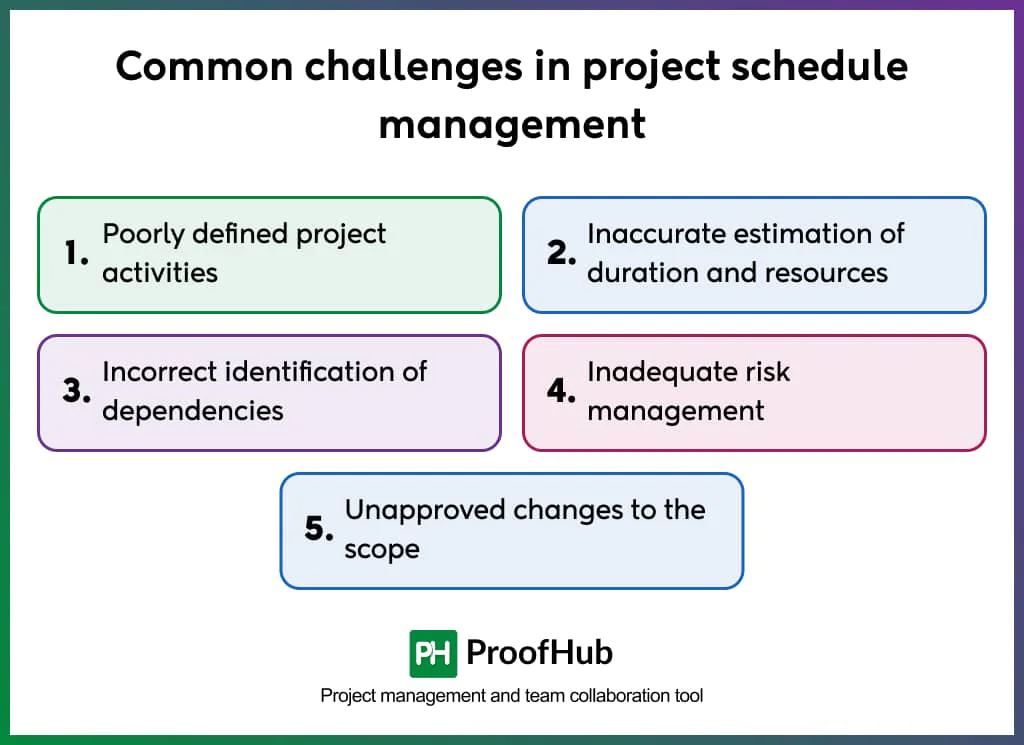
What are the common challenges in project schedule management?
Common challenges in project schedule management include poorly defined project activities, inaccurate duration and resource estimates, incorrect dependency identification, inadequate risk management, and unapproved scope changes. These challenges lead to projects running behind schedule, resource conflicts, and unrealistic deadlines.
1. Poorly defined project activities
The first actionable step of the project schedule management is identifying and defining the project activities. Sometimes, due to the lack of knowledge and skills, project managers end up writing a poor description of the project activities. This leads to an inaccurate estimation of project activities and poor planning of the project schedule.
Solution: Use the SMART framework to write descriptions and conduct timely meetings to establish shared understanding.
2. Inaccurate estimation of duration and resources
Project managers often underestimate how long and what resources activities will require. This happens due to optimism bias (a natural human tendency to assume the best-case), pressure from management to show an aggressive schedule, or simply not involving the right people in estimation.
Solution: Use Three-Point (PERT) estimation, involve the team members in estimation and use historical data.
3. Incorrect identification of dependencies
When dependencies are not properly identified, the network diagram has no integrity. Activities are sequenced incorrectly, critical path analysis produces incorrect results, and float calculations are unreliable, leading to rework
This challenge occurs when the relationships between activities are not properly identified, either because some dependencies are missed entirely or because the wrong relationship type is applied. It often happens when the project manager sequences activities alone without involving the team, or when the project is technically complex, and the interdependencies are subtle.
Solution: Involve the entire team in sequencing and reviewing network diagrams together.
4. Inadequate risk management
This challenge occurs when risks are either not identified at all or identified but never properly planned for. The risk register exists on paper but is never reviewed. No schedule contingency is allocated. When the risk event occurs, the project team is caught completely off guard.
Solution: Build a risk register, add scheduled contingency reserves, and conduct regular risk reviews.
5. Unapproved changes to the scope
Scope creep is the uncontrolled addition of new requirements, features, or work to the project after the baseline has been set, often without any formal approval or schedule adjustment. It happens gradually: a stakeholder requests a “small change,” a team member adds an extra feature believing it adds value, or requirements are interpreted more broadly than originally defined. Each addition consumes scheduled time invisibly.
Solution: Establish a strong change control process, define a clear scope baseline, and adopt a formal change request system.
A practical example of project schedule management
Let’s take an example of a Website Redesign and Launch project. A mid-sized e-commerce company has decided to completely redesign and relaunch its website. The project has been approved by the Board with a fixed budget of $25,000 and a hard deadline: the new site must be live within 20 weeks from project kickoff, ahead of the company’s peak sales season.
Step 1: Plan schedule management
Before any scheduling work begins, the project manager convenes a half-day planning session with the core team and produces the Schedule Management Plan, which establishes the following agreements:
- Scheduling methodology: Critical Path Method (CPM) for the overall project
- Scheduling tool: Gantt chart for the master schedule and Jira for sprint-level task tracking within the development team
- Units of measure: Days for all activities; project calendar = Monday to Friday, excluding public holidays
- Control thresholds: SPI below 0.85 or SV exceeding −₹1,50,000 triggers a formal escalation to the steering committee
- Change control: Any change to scope, schedule, or budget requires a formal Change Request reviewed by the steering committee
Step 2: Define activities
The project manager works with the team to decompose the project’s WBS into a detailed activity list.
The major work packages are:
- Discovery & Strategy, UX Design
- Visual Design, Content Development
- Technical Development
- Quality Assurance
- Go-Live & Stabilisation.
Each work package is broken down into specific, schedulable activities.
Key milestones are also defined:
- Requirements Sign-Off (end of Week 2)
- Design Approved (end of Week 7)
- Content Freeze (end of Week 14)
- UAT Sign-Off (end of Week 18)
- Go-Live (end of Week 20).
Step 3: Sequence activities
With the activity list complete, the team maps the dependencies. The most important dependency chain is identified immediately: Requirements must be complete before UX Design can begin; UX Design must be approved before Visual Design starts; Visual Design must be complete before Front-End Development begins; Development must be complete before QA can start; QA must pass before Go-Live.
Step 4: Estimate activity durations
The project manager facilitates an estimation session with the relevant team members. Designers estimate design tasks, developers estimate development tasks, and so on. Three-Point (PERT) estimation is applied to the activities with the highest uncertainty.
The project manager also adds a 5-day schedule contingency reserve to the baseline and allocates it specifically to cover the high risks.
Step 5: Develop a schedule
With all inputs assembled, the project manager builds the schedule model using a Gantt chart. CPM analysis reveals the Critical Path. The Schedule Baseline is formally approved and signed off by the sponsor at the project kickoff meeting.
Step 6: Control schedule
The project enters execution. The project manager conducts weekly schedule status reviews and publishes an EVM report every Friday. In case of discrepancies, the corrective action plan is developed and presented to the steering committee within 48 hours.
What are the key concepts in project schedule management?
The key concepts every project manager must understand are the Work Breakdown Structure (WBS), Dependencies, Float/Slack, Schedule Baseline, and Earned Value Management (EVM). Here is the brief description of these concepts:
- Work Breakdown Structure (WBS): It is the hierarchical decomposition of project work into smaller work packages.
- Dependencies: It is the logical relationships that define the sequence of activities
- Float/Slack: It is the scheduling flexibility available to non-critical activities
- Schedule baseline: It is the approved reference version of the schedule against which performance is measured
- Earned Value Management (EVM): It is the integrated system for measuring schedule and cost performance objectively.
What are the key KPIs to track a project schedule?
The key KPIs to track a project schedule are schedule variance (SV), schedule performance index (SPI), critical path length variance, float consumption rate, and milestone hit rate.
Not just the KPIs, a project manager should also be aware of essential tracking metrics, including milestone achievement rate, percentage of overdue/completed tasks, and planned vs. actual time spent. This helps a project manager make an informed decision about the project schedule progress.
Of these, SPI and SV are the most analytically rigorous because they are grounded in Earned Value data rather than subjective reporting.
However, Milestone Hit Rate is often the most visible and politically important KPI for stakeholders and sponsors who do not engage with EVM metrics.
Who is responsible for managing the project schedule?
A project manager is primarily responsible for managing the project schedule. Key responsibilities of a project manager include defining the activities, developing the schedule, maintaining the schedule baseline, monitoring performance, identifying variances, implementing corrective actions, communicating status to stakeholders, and managing team conflicts.
However, project schedule management is never a solo activity. On larger or more complex projects, a dedicated Project Scheduler may be responsible for the technical maintenance of the schedule model while the project manager focuses on decision-making and stakeholder management.
Team members carry a shared responsibility too. They are accountable for executing their assigned activities within the planned durations, reporting progress honestly, and flagging emerging delays early. A delay that is hidden at the team level and only surfaces at a status review is far harder to recover than one reported the day it is identified.
The Project Sponsor is ultimately accountable for approving the schedule baseline and authorising changes to it. In summary, everyone on the project has a role in schedule management — the project manager leads it, the team executes it, and the sponsor governs it.
Can schedule mismanagement affect project success?
Yes. It significantly affects project success in multiple dimensions simultaneously. Schedule mismanagement is one of the leading causes of project failure worldwide, and its consequences extend far beyond simply finishing late.
When the schedule is poorly managed, cost overruns almost always follow because delays mean resources are engaged longer than planned, and recovery actions like crashing add direct cost. Quality suffers too, because compressed timelines at the end of a slipping project force teams to rush testing, cut corners, and skip reviews.
Stakeholder trust erodes rapidly when schedule commitments are missed repeatedly. Sponsors lose confidence in the project manager’s competence. Clients may invoke contractual penalties.
How is managing a project schedule different from task tracking?
Task tracking and project schedule management are often confused, but they operate at fundamentally different levels.
Task tracking is operational. It answers the question: “Is this specific task done or not done?” It typically manages a simple list of tasks that records the status of individual work items. It does not include project dependencies, critical paths, float, baselines, or performance forecasting.
Project Schedule Management is strategic. It answers far more complex questions: “Is the project on track to finish on time? If not, why? What is the projected completion date? Which activities are critical? What are the options for recovery?” It manages the entire network of activities rather than a flat list of tasks.
What is the difference between a project plan and managing a project schedule?
A project management plan is the comprehensive document that defines how the entire project will be planned, executed, monitored, and closed, whereas a project schedule addresses the timing of project activities.
Managing the project schedule involves defining project activities, their sequences, durations, resources, and dependencies; monitoring performance against the baseline; identifying variances; implementing corrective actions; and controlling changes throughout the project lifecycle.
On the other hand, a project management plan is the complete blueprint for the project. It is an overarching document that includes project schedule management.
What is the difference between a schedule and a timeline?
A project schedule is a complete document of all project activities with defined dependencies, duration estimates, resource assignments, float calculations, a critical path, and a formal baseline, whereas a timeline is a high-level, linear representation of key events, phases, or milestones placed on a time axis.
The project timeline does not address dependencies, resource assignments, float, or performance measurement; rather, it serves as a communication tool for stakeholders, providing a summary of what will happen and when for executive presentations, stakeholder briefings, and project overviews.
On the other hand, a project schedule answers questions like: Which activities are on the critical path? How much float does this activity have? If this task slips by three days, does it affect the end date? What is our current SPI? A project schedule is both a planning and a control tool, whereas the timeline is primarily a communication tool.