
Project stakeholder management is the process of identifying, analyzing, and engaging individuals or groups who can affect or are affected by a project. The stakeholder management focuses on understanding stakeholder expectations, managing their influence, and ensuring continuous alignment throughout the project lifecycle.
Strong stakeholder management improves communication, reduces conflicts, and increases project success rates.
Let’s read further to understand its processes, challenges, tools, and best practices in detail.
- 1.Project stakeholder management identifies, analyzes, and engages individuals or groups affected by the project. Effective management improves communication, reduces conflicts, and increases project success rates.
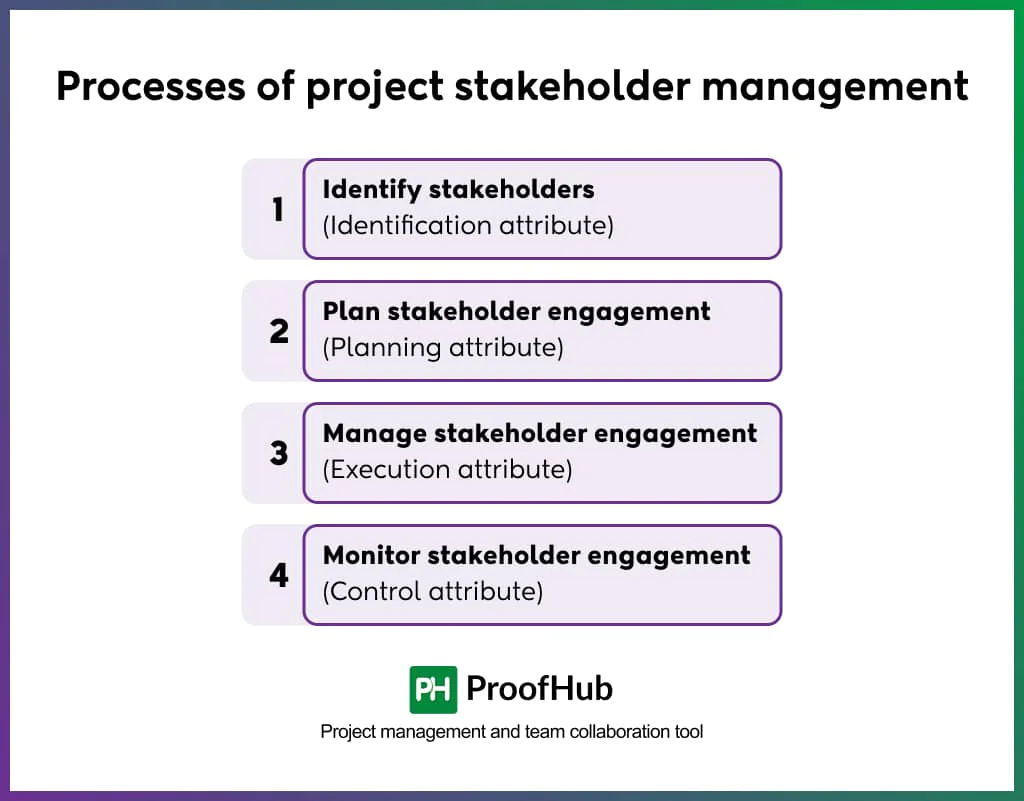
- 2.Stakeholder management follows four processes: Identify Stakeholders, Plan Stakeholder Engagement, Manage Stakeholder Engagement, and Monitor Stakeholder Engagement throughout the project lifecycle.
- 3.Projects face challenges such as conflicting interests, unclear expectations, lack of engagement, communication gaps, resistance to change, and imbalances in stakeholder influence, all of which require proactive management.
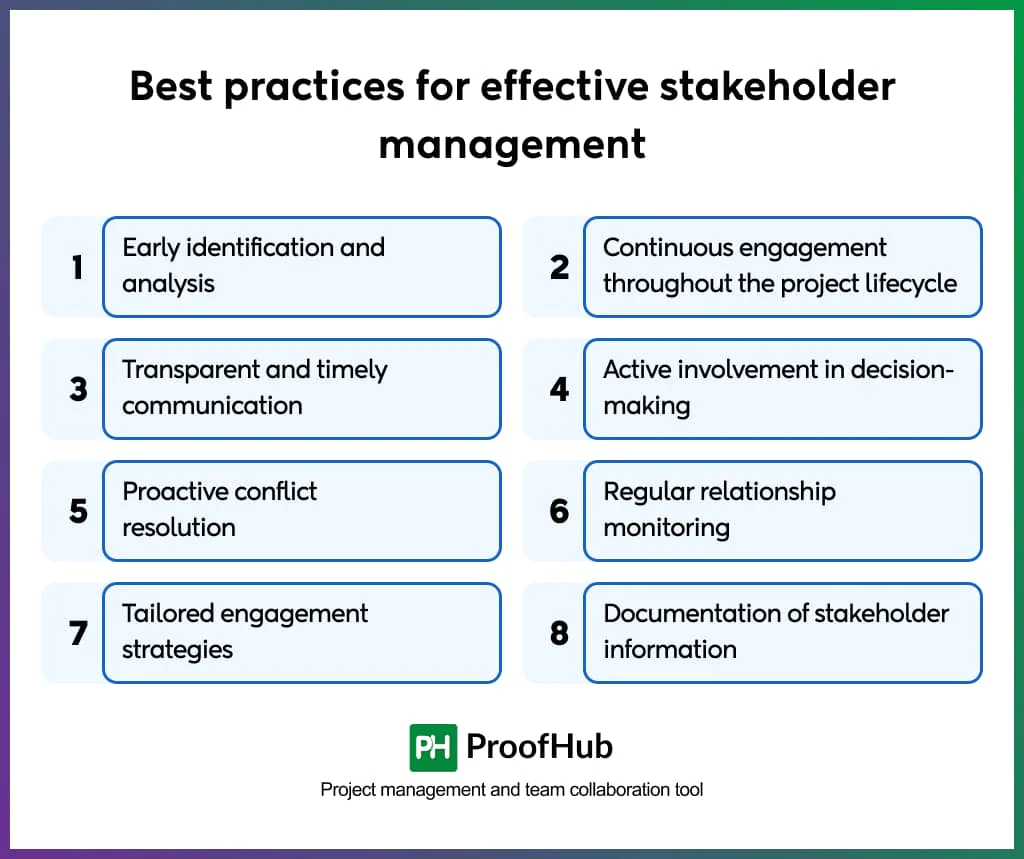
- 4.Successful stakeholder management requires early identification, continuous engagement, transparent communication, active involvement, proactive conflict resolution, regular monitoring, tailored strategies, and proper documentation.
- 5.Project managers need communication, negotiation, analytical thinking, relationship management, problem-solving, and organizational skills. Tools like ProofHub, ProjectManager, and Smartsheet streamline stakeholder tracking and engagement.
Who is a project stakeholder?
A project stakeholder is any person, group, or organization that can affect, be affected by, or perceive itself to be affected by a project.
Stakeholders can be internal (team members, management, employees) or external (customers, suppliers, investors, government agencies, community members). They have an interest or “stake” in the project’s outcome and can influence or be influenced by the project’s activities, objectives, and results.
What is project stakeholder management?
Project stakeholder management is the process of identifying, analyzing, engaging, and communicating with all individuals or groups who are interested in or affected by a project.
It involves understanding stakeholders’ needs and expectations, managing their influence, and ensuring their support to achieve project success.
Why is stakeholder management important?
Stakeholder management is important because it ensures that everyone involved in or affected by a project is aligned, informed, and supported. Proper management helps avoid misunderstandings, reduces risks, and increases the chances of project success.
A few benefits of stakeholder management are:
1. Improved communication: Clear and timely updates keep stakeholders consistently informed about progress and goals. Better understanding reduces confusion and keeps everyone on the same page.
2. Reduced conflict: Early identification of concerns helps address issues before they escalate. A proactive approach supports smoother collaboration and fewer disagreements.
3. Better risk management: Stakeholder insights reveal potential risks based on experience and expectations. Early awareness allows teams to plan and take preventive actions.
4. Better decision-making: Input from diverse stakeholders provides a broader perspective. Well-rounded information leads to more informed and effective decisions.
5. Reduced delays: Strong stakeholder alignment speeds up approvals and minimizes bottlenecks. Smooth coordination helps maintain project timelines.
6. Increased stakeholder engagement: Consistent involvement builds trust and strengthens relationships. Engaged stakeholders contribute more actively to project success.
7. Higher project success rate: Alignment between expectations and outcomes improves satisfaction. Effective coordination leads to better overall project performance.
4 Step process for managing project stakeholders
Project stakeholder management involves four processes: identifying stakeholders, planning stakeholder engagement, managing stakeholder engagement, and monitoring stakeholder engagement to ensure project success.
Let’s read more about these processes:
1. Identify stakeholders (Identification attribute)
Identifying stakeholders involves recognizing individuals, groups, or organizations that affect or are affected by the project. The process establishes the foundation of stakeholder management.
It includes identifying stakeholders and documenting key attributes such as interests, influence, expectations, and impact level in a stakeholder register.
Clear documentation enables an accurate understanding of stakeholder importance and the required level of involvement.
Effective identification ensures complete stakeholder coverage, supports targeted engagement strategies, and prevents risks caused by overlooked or misunderstood stakeholders.
2. Plan stakeholder engagement (Planning attribute)
Planning stakeholder engagement defines structured strategies for engaging stakeholders based on their needs, expectations, and influence.
The process includes identifying stakeholders, analyzing interest and power, selecting appropriate communication methods, defining interaction frequency, and setting engagement approaches.
Effective planning ensures stakeholders remain informed, aligned, and appropriately involved.
Strong planning reduces misunderstandings, prevents conflicts, and creates a clear foundation for consistent stakeholder collaboration.
3. Manage stakeholder engagement (Execution attribute)
Managing stakeholder engagement implements planned strategies through active communication and continuous collaboration.
The process includes addressing stakeholder expectations, resolving issues, facilitating discussions, and maintaining productive relationships.
Effective management ensures stakeholders stay supportive, engaged, and responsive throughout execution.
Strong execution builds trust, minimizes resistance, and keeps stakeholder contributions aligned with project objectives.
4. Monitor stakeholder engagement (Control attribute)
Monitoring stakeholder engagement evaluates stakeholder relationships and adjusts strategies throughout the project lifecycle.
The process includes comparing current engagement levels with planned levels, tracking stakeholder behavior, identifying gaps, and responding to changes in influence, expectations, or attitudes.
Effective monitoring ensures timely adjustments to engagement strategies.
Continuous monitoring prevents disengagement, mitigates risks, and maintains alignment between stakeholder expectations and project outcomes.
What are the common challenges in stakeholder management?
Common challenges in stakeholder management include conflicting stakeholder interests, unclear expectations, lack of engagement, communication gaps, resistance to change, and an imbalance in stakeholder influence.
These challenges create misalignment, delay progress, and reduce the effectiveness of project outcomes.
- Conflicting interests: Stakeholders often have different goals, priorities, and success criteria for a single project. Business teams may focus on cost reduction, while users may prioritize usability or quality. Such differences create tension during planning and decision-making, making it difficult to reach consensus. Negotiate continuously to balance competing demands and maintain project direction.
- Unclear expectations: Lead to confusion about scope, deliverables, and responsibilities. Stakeholders may interpret objectives differently, leading to mismatches in outputs and repeated revisions. Poorly communicated expectations increase rework, extend timelines, and reduce satisfaction. Document expectations and align stakeholders early to avoid misunderstandings throughout the project lifecycle.
- Lack of engagement: Reduces valuable input during the planning and execution stages. Limited involvement results in weak feedback, poor decision support, and reduced commitment to outcomes. Project teams may struggle to understand real needs without active engagement. Interact consistently and streamline communication to improve participation and strengthen stakeholder alignment.
- Communication gaps: Communication gaps create barriers between project teams and stakeholders. Missing updates, unclear messages, and inconsistent reporting cause misunderstandings and poor coordination. Important decisions fail to reach relevant stakeholders on time, directly affecting progress and eroding trust. Regular communication planning and standardized reporting eliminate gaps and ensure transparency.
- Resistance to change: Introduction of new processes, systems, or workflows faces stakeholder opposition. Concerns about uncertainty, added effort, and loss of control drive resistance. Opposition delays adoption and slows project implementation. Early involvement, clear communication of benefits, and strong change management practices overcome resistance and ensure successful adoption.
- Stakeholder influence imbalance: Differences in authority and power among stakeholders shape decision-making dynamics. Dominant stakeholders control discussions and restrict input from others. Such an imbalance limits diverse perspectives and leads to biased outcomes. Balanced facilitation and structured decision-making processes ensure fair representation and produce objective, well-informed decisions.
Best practices for effective stakeholder management
The best practices for effective stakeholder management are: early identification and analysis; continuous engagement throughout the project lifecycle; transparent, timely communication; active involvement in decision-making; proactive conflict resolution; regular relationship monitoring; tailored engagement strategies; and documentation of stakeholder information.
- Early identification and analysis: Begin identifying stakeholders during project initiation and continue throughout the lifecycle. Analyze stakeholder power, interest, influence, and expectations systematically. Classify stakeholders using appropriate models to determine engagement priorities. Early identification prevents surprises and allows sufficient time to build relationships before critical project phases begin.
- Continuous engagement throughout the project lifecycle: Maintain regular contact with stakeholders from initiation through closure rather than sporadic communication. Schedule periodic meetings, reviews, and updates aligned with project milestones. Consistent engagement builds trust, maintains awareness of changing needs, and ensures stakeholders remain informed and supportive as the project evolves.
- Transparent and timely communication: Share project information openly, honestly, and promptly with appropriate stakeholders. Communicate both successes and challenges without filtering negative news. Use clear, jargon-free language suitable for diverse audiences. Transparency builds credibility and trust while timely communication enables stakeholders to provide input when decisions need to be made.
- Active involvement in decision-making: Include relevant stakeholders in planning, problem-solving, and decision processes where input adds value. Solicit opinions, consider perspectives, and incorporate feedback into project approaches. Involvement creates ownership, increases buy-in, and leverages stakeholder expertise to improve project outcomes and reduce resistance to changes.
- Proactive conflict resolution: Address disagreements, concerns, and issues immediately before escalation occurs. Listen actively to understand the root causes of conflicts. Facilitate negotiations and seek win-win solutions acceptable to multiple parties. Quick resolution prevents minor issues from becoming major obstacles and maintains positive working relationships among stakeholders.
- Regular relationship monitoring: Continuously track stakeholder satisfaction, engagement levels, and relationship quality. Assess whether engagement strategies produce desired results. Identify shifts in stakeholder positions, influence, or expectations promptly. Monitoring enables timely adjustments to engagement approaches and prevents stakeholder dissatisfaction from undermining project success.
- Tailored engagement strategies: Customize communication methods, frequency, and content based on individual stakeholder needs, preferences, and characteristics. High-power stakeholders may require executive briefings while technical teams need detailed specifications. Personalized approaches demonstrate respect for stakeholder time and priorities, increasing engagement effectiveness.
- Documentation of stakeholder information: Maintain accurate, current records in the stakeholder register, including contact details, interests, influence levels, and engagement strategies. Update documentation as stakeholder situations change. Comprehensive records ensure consistency in engagement approaches, facilitate knowledge transfer among team members, and provide historical reference for future projects.
Real-world example of stakeholder management
Banking Mobile Application Development Project
A banking mobile application development project in an IT company shows how stakeholder management supports the successful delivery of a complex digital product. Multiple stakeholders participate, each contributing different expectations such as security, usability, performance, compliance, and customer satisfaction.
- Initiation Stage
Stakeholders identified, including bank management, product owners, end users, software developers, testers, security teams, and regulatory authorities. Functional requirements, compliance needs, and business goals are documented to define the clear project’s scope and objectives.
- Planning Stage
An engagement strategy was developed based on stakeholder roles. Communication channels are defined, including requirement-gathering sessions, sprint planning meetings, design reviews, and client approval checkpoints. Security and compliance requirements were prioritized due to the handling of sensitive financial data.
- Execution Stage
Active collaboration is maintained between development and client teams. Features such as fund transfer, account access, and transaction history were developed in iterative cycles. Continuous feedback from bank representatives is incorporated through sprint reviews. Change requests are managed carefully to maintain stability and compliance.
- Monitoring Stage
Ongoing tracking of stakeholder feedback and application performance. Testing results, security audits, and user feedback are reviewed regularly. Updates and improvements implemented in line with banking regulations, customer experience insights, and stakeholder priorities.
What are the best software for project stakeholder management?
The best software for managing project stakeholders is: ProofHub, ProjectManager, Smartsheet, Simply Stakeholder, and Tractivity.
What skills do you need for project stakeholder management?
The skills needed for project stakeholder management include communication, negotiation, analytical thinking, relationship management, problem-solving, organizational skills, and emotional intelligence.
Here we are sharing the skills in detail to understand:
1. Communication skills: Help convey project goals, updates, and decisions effectively. It reduces misunderstandings and keeps expectations aligned throughout the project lifecycle. Strong listening skills ensure stakeholder concerns are understood and addressed properly. Well-written reports and verbal clarity improve coordination across all stakeholder groups.
2. Negotiation skills: Help reach agreements that satisfy multiple parties without affecting project objectives. Strong negotiation builds trust and prevents conflicts from escalating into project delays or disruptions.
3. Analytical thinking: Enables managers to assess stakeholder influence, interests, and impact, supporting better prioritization. It helps identify risks, plan strategies, make data-driven decisions, and understand stakeholder behaviour patterns.
4. Relationship management skills: Builds trust and helps maintain positive relationships, ensuring continuous stakeholder support. The skills help manage expectations, reduce resistance, strengthen collaboration, and encourage long-term commitment. It improves stakeholder satisfaction and reduces conflicts during project changes.
5. Problem-solving skills: It helps maintain progress and avoid delays. Strong problem-solving supports faster decision-making under pressure. Identifying root causes and implementing corrective actions ensures smoother project execution and greater stakeholder confidence.
6. Organizational skills: Ensures timely follow-ups and smooth workflow. Proper scheduling and documentation reduce confusion and missed actions. It improves efficiency in handling stakeholder requests and project updates.
7. Emotional intelligence: Understanding stakeholder emotions and reactions improves engagement quality. Empathy and self-control help in handling difficult conversations professionally.
What is the difference between stakeholder management and communication management?
The main difference between stakeholder management and communication management is that stakeholder management focuses on engagement and relationships, while communication management focuses on information flow.
Conclusion
Project stakeholder management plays a critical role in ensuring alignment, engagement, and effective communication among all stakeholders. From identification and planning to execution and monitoring, structured processes help manage expectations, reduce risks, and improve decision-making. Overcoming challenges through best practices, using the right tools, and applying essential skills strengthens relationships and coordination. Effective stakeholder management ultimately leads to smoother project execution, higher satisfaction, and successful project outcomes.