The project management process group provides a universal framework that helps project managers plan, execute, monitor, and close projects effectively, regardless of industry or project type. By ensuring that every stage is addressed and continuously refined, process groups bring clarity, control, and consistency to project execution.
In this guide, we’ll cover everything you need to know about the project management process groups, their importance, common mistakes, and their purpose in the end-to-end project delivery.
- 1.Structured Framework: Process groups provide a structured and standardized framework to manage projects from initiation to closure, ensuring clarity, control, and consistency.
- 2.Five Process Groups: The five process groups are initiating, planning, executing, monitoring & controlling, and closing. They work together as an integrated system rather than isolated phases.
- 3.Iterative & Overlapping: Process groups are iterative and overlapping, allowing teams to revisit planning, adjust execution, and respond effectively to changes throughout the project lifecycle.
- 4.Project Success: Effective use of process groups improves project success by enhancing planning accuracy, enabling continuous monitoring, reducing risks, and maintaining quality.
- 5.Common Mistakes: Avoiding common mistakes like treating them as linear, poor planning, lack of monitoring, weak integration, and resistance to change is critical for achieving successful project outcomes.
What are process groups?
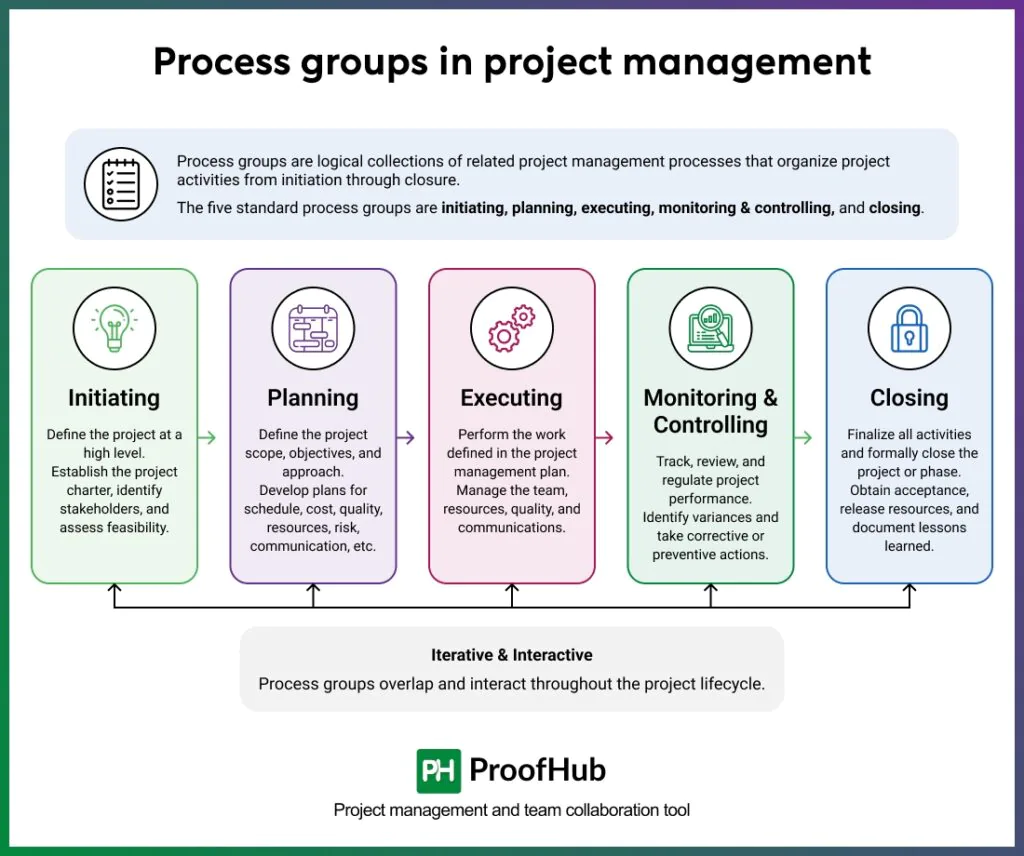
Process groups (Focus Areas according to PMBOK eighth edition) are logical collections of related project management processes that organize project activities from initiation through closure.
The five standard process groups are initiating, planning, executing, monitoring & controlling, and closing.
In the 8th edition of PMBOK, process groups are referred to as ‘focus areas.’ However, the underlying processes from initiation through closure remain unchanged.
The process groups provide a structured framework for systematically managing projects. They interact iteratively throughout the project lifecycle, ensuring comprehensive project governance and successful delivery of objectives.
Why are process groups important?
Process groups are important because they provide a standardized, systematic approach to managing projects from start to finish.
They ensure that no critical phase is overlooked, enable better coordination among team members, and create a repeatable framework that improves project outcomes.
By organizing work into distinct phases, process groups help managers maintain control, anticipate challenges, and deliver projects that meet stakeholder expectations consistently.
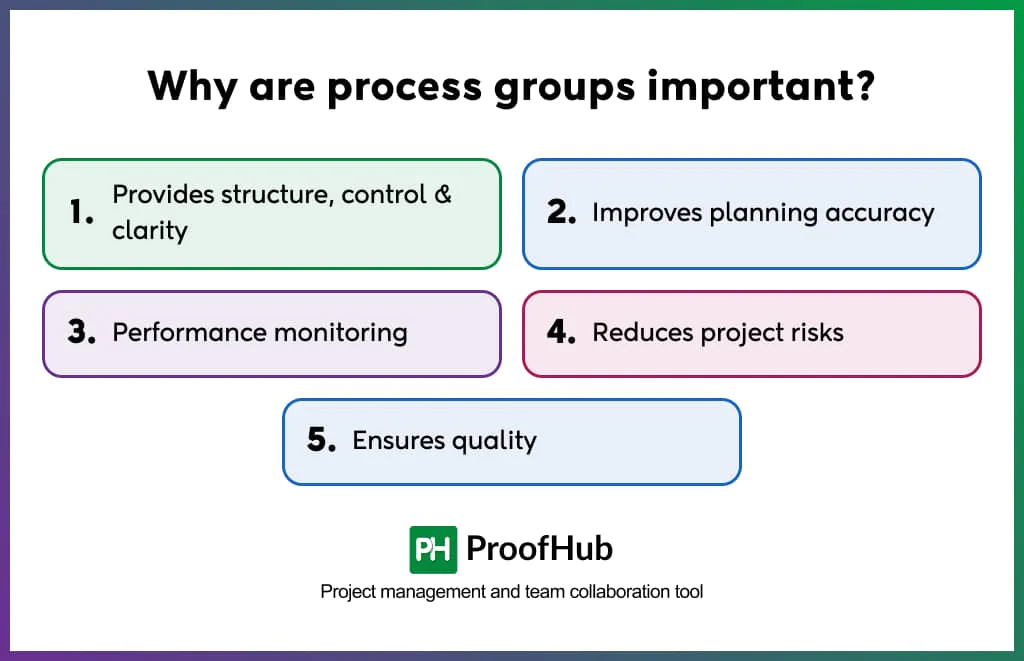
Here, sharing a few pointers on why the process group is important:
- Provides structure, control & clarity: Helps break down complex projects into manageable steps by defining distinct phases. The structured approach creates clear boundaries between different types of activities, making it easier for teams to understand what needs to be done and when. The framework eliminates confusion and ensures everyone follows a consistent methodology.
- Improves planning accuracy: Establishes a disciplined planning phase where requirements, resources, timelines, and budgets are thoroughly defined before execution begins. The systematic planning approach improves clarity, helps identify potential constraints early, and creates realistic schedules. Better planning leads to accurate estimates and fewer surprises during project execution.
- Performance monitoring: Enables managers to track progress, budget, schedule, and scope continuously throughout the project lifecycle. The monitoring and controlling process group provides tools and techniques to measure actual performance against planned baselines. The ongoing oversight enables early detection of variances and allows for timely corrective actions.
- Reduces project risks: Continuous oversight and deviation identification minimize potential threats to project success. Process groups build in regular review points where risks can be assessed, monitored, and mitigated before they escalate. The proactive risk management approach prevents small issues from becoming major problems that obstruct the project.
- Ensures quality: Integrates quality planning, assurance, and control activities throughout the project lifecycle. By embedding quality checkpoints at each phase, teams can verify that deliverables meet specifications and stakeholder requirements. The systematic quality focus prevents defects, reduces rework, and ensures the final product satisfies customer expectations.
What are the 5 process groups in project management?
The five process groups (Focus Areas) in project management are initiating, planning, executing, monitoring and controlling, and closing. The process groups represent distinct phases that guide projects from conception to completion, ensuring systematic management and successful delivery.
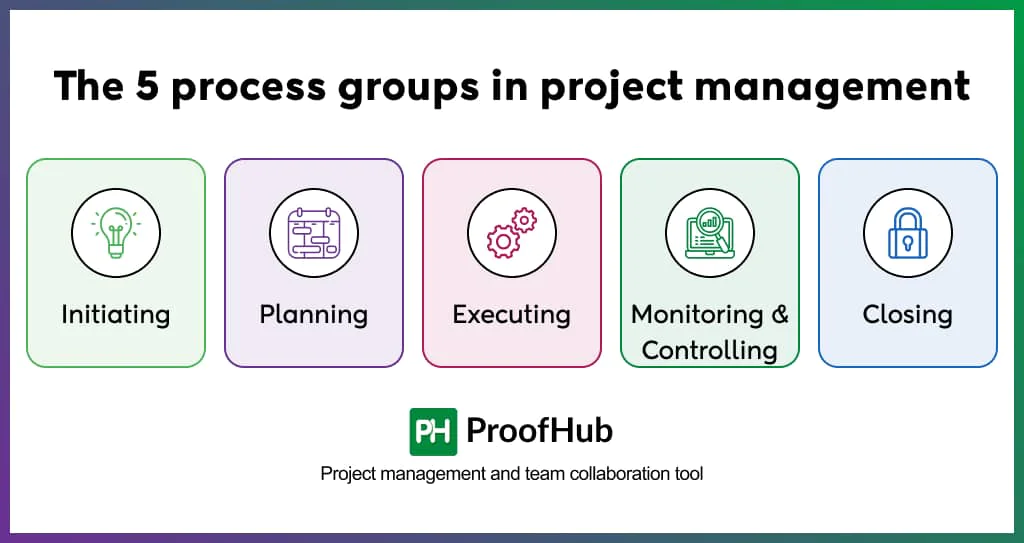
Here is the explanation of each process group:
1. Initiating process
The initiating process group marks the formal start of a project or phase, during which the project’s value and feasibility are assessed.
During this stage, project managers develop the project charter, which authorizes the project and documents initial requirements, objectives, constraints, and high-level risks.
The key stakeholders are identified and analyzed to understand their interests, expectations, and levels of influence. The initiating process group establishes the foundation by defining the project’s goals and why they matter to the organization.
Success in this phase ensures proper authorization, stakeholder buy-in, and alignment with business objectives before significant resources are committed.
For example: A software company identifies the need for a new customer relationship management (CRM) system. The initiation process involves conducting a feasibility study, securing executive sponsorship, creating a project charter outlining the business case and high-level objectives, and identifying key stakeholders, including the IT department, sales team, and end users.
2. Planning process
The planning process group develops a comprehensive roadmap that guides project execution and control activities. The planning phase defines the project scope, work breakdown structures, costs, duration estimation, schedules, and quality standards.
In this process, the risk management plans, communication strategies, procurement approaches, and resource allocation plans are also created.
The planning phase produces the project management plan, which is an integrated document that serves as the primary reference for how the project will be executed, monitored, and controlled.
Thorough planning reduces uncertainty, establishes realistic expectations, and provides a baseline for measuring performance throughout the project lifecycle.
For example: For the CRM implementation project, the planning process includes defining specific features and functionalities. When creating a detailed project schedule with milestones, estimating a budget, identifying required technical skills, developing a risk register highlighting data migration challenges, and establishing communication protocols for weekly status updates to stakeholders.
3. Executing process
The executing process group involves performing the actual work defined in the project management plan to deliver project deliverables.
During this phase, team members are acquired, developed, and managed to complete assigned tasks.
Quality assurance activities ensure deliverables meet established standards, while communication plans keep stakeholders informed. Procurement activities are conducted to obtain necessary resources, products, or services from external vendors.
The executing process group consumes the majority of the project budget and requires strong leadership, coordination, and problem-solving skills.
Success in execution depends on effective resource management, clear communication, adherence to quality standards, and maintenance of team motivation and productivity.
For example: In the CRM project execution phase, developers begin coding custom modules, and the project manager conducts weekly team meetings. On the other hand, the sourcing team finalizes contracts with third-party vendors for data migration services and organizes training sessions for end users. Whereas, quality assurance testers validate functionality against requirements to ensure the system performs as expected.
4. Monitoring and controlling
The monitoring and controlling process group tracks, reviews, and regulates project progress and performance to ensure objectives are met.
It includes measuring actual performance against the project management plan, identifying variances, and implementing corrective or preventive actions when necessary.
The key activities include scope verification, schedule control, cost control, quality control, risk monitoring, and change management.
In this process group, performance metrics and key performance indicators (KPIs) are analyzed regularly to assess project health. It runs concurrently with planning and executing processes, creating a feedback loop that enables adaptive management.
Effective monitoring prevents scope creep, budget overruns, and schedule delays through continuous oversight and timely interventions.
For example: During CRM implementation, the project manager monitors progress using earned value analysis and discovers that the project is over budget and two weeks behind schedule. Change requests for additional features are evaluated through a formal change control process; weekly status reports highlight risks, such as potential data security issues; and corrective actions include reallocating resources to critical path activities.
5. Closing
The closing process group formalizes project completion and ensures formal handover of deliverables to stakeholders.
The closing process group involves obtaining final client or sponsor acceptance, completing all contractual obligations, releasing project resources, documenting lessons learned, and archiving project records.
Financial accounts are settled, vendor contracts are closed, and a final project report summarizing achievements, challenges, and recommendations is prepared.
It also includes celebrating team accomplishments and conducting post-project reviews to capture valuable insights for future initiatives.
Formal closure ensures all loose ends are tied up, knowledge is preserved, and organizational learning is enhanced for continuous improvement.
For example: The CRM project concludes with formal user acceptance testing, followed by the project sponsor’s sign-off. Once all deliverables are verified, final payments are released to vendors. The team then conducts a lessons-learned workshop, where they document key insights, such as how clearer initial requirements could have prevented rework.
After closure activities, developers are released and reassigned to new projects. All project documentation is archived in the company repository for future reference. Finally, the organization hosts a small celebration event to recognize and appreciate the team’s contributions.
What is the difference between process groups and the project lifecycle?
The difference between the process group and the project lifecycle is Process Groups are logical collections of interrelated project management processes. They define how project work is organized and managed.
Whereas, Project Lifecycle refers to the series of phases a project passes through from initiation to completion, defining the work that needs to be accomplished. It represents the evolution of the project deliverable itself, outlining the sequential stages specific to the type of project being undertaken (construction, software development, product launch, etc.).
How do process groups interact across the project lifecycle?
Process groups don’t operate as a strict one-time sequence; they interact in a flexible, iterative flow throughout the project lifecycle. While they are often introduced as linear stages, in practice, they overlap and repeat within each phase.
For example, planning, executing, and monitoring can cycle multiple times as requirements evolve or risks emerge.
Each phase of the project may include its own mini set of initiating, planning, executing, monitoring, and closing activities. This repeating interaction allows teams to adapt, refine deliverables, and maintain control, ensuring the project stays aligned with objectives and stakeholder expectations.
What are common mistakes to avoid when managing process groups?
The common mistakes to avoid when managing process groups are: Treating process groups as linear, poor planning, lack of monitoring and control, poor integration between process groups, and failure to adapt to change.
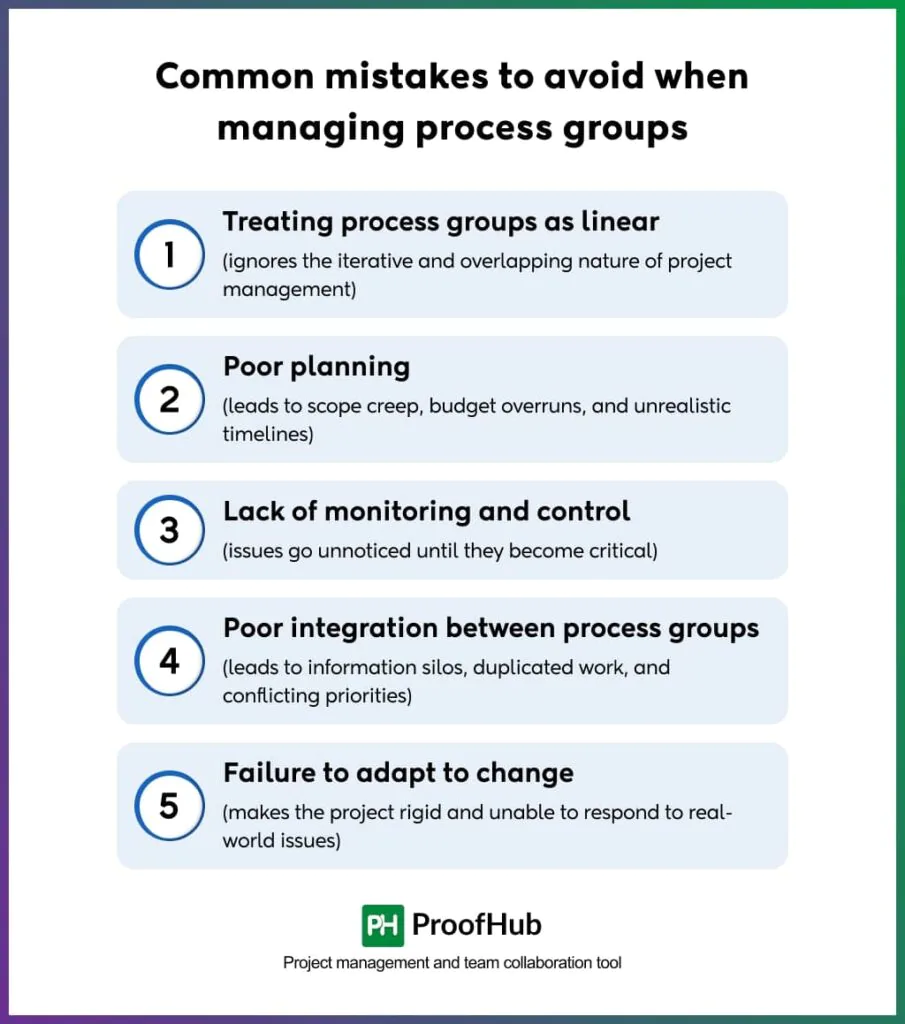
The detailed explanation of each mistake is:
1. Treating process groups as linear
Mistaking process groups as sequential phases that must be completed one after another, like a waterfall.
The rigid approach ignores the iterative and overlapping nature of project management, in which monitoring runs in parallel with execution and planning continues throughout the project.
Treating them linearly prevents necessary feedback loops, such as using performance data to refine plans or adjusting execution based on monitoring insights, ultimately leading to inflexibility and an inability to respond to emerging realities.
2. Poor planning
Inadequate planning at the start creates a weak foundation that causes cascading problems throughout the project lifecycle.
Rushing through planning or skipping critical processes results in scope creep, unrealistic schedule and project timeline, budget overruns and poor resource allocation.
3. Lack of monitoring and control
Failing to establish robust monitoring mechanisms reduces visibility into project performance, allowing small issues to escalate into major crises.
Effective project monitoring requires consistently tracking KPIs and performing regular variance analysis to stay aligned with goals and prevent disruptions to project success.
4. Poor integration between process groups
Poor integration between process groups creates information silos, preventing smooth flow of outputs and inputs across phases.
Teams may rely on outdated plans or miss critical updates when communication and change control are weak.
This leads to duplicated work, conflicting priorities, and inefficiencies. Strong coordination, clear communication channels, and structured change-control processes are essential to keep all process groups aligned and functioning as a unified system.
5. Failure to adapt to change
Failure to adapt to change disconnects projects from evolving requirements & emerging risks.
Treating plans as fixed leads to either rigid resistance or uncontrolled changes, both of which harm project outcomes.
Effective change management ensures that necessary updates are evaluated, controlled, and aligned with stakeholder needs, keeping the project relevant and responsive in a dynamic environment.
Are process groups sequential or iterative?
No, process groups are iterative, not strictly sequential. They are often presented in a sequence like initiating, planning, executing, monitoring, and controlling, and closing.
In real projects, they overlap and repeat. Teams frequently revisit planning during execution, adjust activities based on monitoring insights, and refine deliverables as new information emerges.
This iterative nature allows projects to stay flexible, respond to changes, and continuously align with objectives rather than following a rigid, one-time flow.
Do process groups improve project success rate?
Yes, process groups improve project success rates by creating a structured way of managing work.
According to Pulse of the Profession 2017 , organizations that consistently follow structured project management practices are often called “champions,” as they complete 80% or more of their projects on time, within budget, and aligned with business goals.
In contrast, organizations that rely on unstructured approaches are considered “underperformers,” with 60% or fewer successful projects. Process groups enhance planning, coordination, and monitoring, helping teams reduce risks and deliver better outcomes.
Are process groups used in agile projects?
Yes, project management process groups are used in Agile projects, but not rigidly or formally. Agile focuses on flexibility and continuous delivery rather than following a strict sequence of phases. Because of this, process group activities are embedded within everyday.
Agile practices instead of being treated as separate stages. Agile frameworks like Scrum or Kanban naturally incorporate process group activities within their workflows.
For example, initiating happens when defining a product vision or backlog, planning occurs during sprint planning, executing takes place in sprints, and monitoring and controlling happen through daily stand-ups and reviews. Closing is reflected in sprint reviews and retrospectives. Instead of being separate phases, these activities are embedded and repeated in every iteration, making process groups highly iterative and aligned with Agile principles.