

Basecamp is a popular project management tool known for its simplicity and collaboration-centric design. It takes a user-friendly approach, focusing on team communication and keeping projects organized without unnecessary complexity. As of December 2025, the company reports 2,52,000 paying customers and operates as a fully remote team of 171 people, which shows how far its “keep it simple” philosophy has scaled.
But when you compare Basecamp with the best project management tools available today, you quickly notice that it offers significantly fewer capabilities than most modern platforms. This might leave you wondering whether Basecamp is actually suitable for your project team or daily work. Hence, I have written this comprehensive review of the Basecamp project management.
To create this review, I evaluated Basecamp across the following areas:
- Ease of use, setup time, navigation, and the platform’s rigidity
- Pricing and value for money, ROI vs team size, features per plan, and additional cost
- Project management capabilities: key features and how they support project planning and collaboration
- Advantages and disadvantages of using Basecamp
- How Basecamp compares to one of its best alternatives
After signing up for a free trial and running dummy projects to test its core capabilities, I found Basecamp to be a straightforward platform best suited for teams that:
- Want a simple tool that keeps communication clear and calm for both internal teams and external stakeholders
- Handle projects with defined SOPs and predictable workflows
- Prefer a fixed structure instead of extensive customization
- Lean toward message-based collaboration rather than real-time chat
- Don’t need subtasks, dependencies, workflows, or advanced planning features
- Want something they can learn in minutes, without onboarding friction
- Don’t follow formal project management methodologies like Waterfall, Agile, Scrum, or Kanban
On the other hand, Basecamp may not be a good fit for teams that work with complex frameworks, need even basic reporting or progress tracking, or need granular control over project data. These limitations become more visible as teams scale or manage multi-layered project work that demands structure.
For teams whose project management and collaboration needs extend beyond Basecamp’s scope, I have also included a detailed comparative review of ProofHub below.
ProofHub is a project management and collaboration tool that offers a wide range of built-in features to help teams of all sizes plan, organize, and run projects from start to finish.
If you want to explore the complete set of features ProofHub offers, you can book a free demo with our customer support team, who will walk you through the platform and show how it fits your workflows and project management requirements.
What is Basecamp?
Basecamp is a cloud-based project management software designed by 37signals for businesses to manage projects, organize communication, and collaborate. It is famous for its straightforward design and “less tools, more work” approach to project management.

Basecamp’s journey began in 2003 as an internal solution by 37signals for managing web design projects, which quickly gained traction among clients and, by 2004, became a sellable SaaS product. By 2005, Basecamp generated more revenue than the original business model and became the company’s flagship product.
The platform has been around for more than two decades, shaping its reputation as a minimalistic project management software suitable for small and medium-sized businesses. I appreciate Basecamp’s philosophy of keeping things “no-nonsense, effective, and reliable,” focusing on core project communication and task management for small, close-knit teams rather than large enterprise environments.
However, like many other project management tools, Basecamp’s suitability for different use cases can vary. In the following sections, I will provide you with a deeper understanding of Basecamp’s philosophy for managing projects, its approach to collaboration, pricing model, and most importantly, its suitability for your projects and teams.
Key features of Basecamp for project management
When you manage a project, the hardest part is often not the work itself but keeping track of everything around it — the discussions, the files, the deadlines, and the responsibilities. Basecamp helps you by bringing all of those elements into one place. Instead of treating tasks, conversations, and documents as separate streams of work, it integrates them into a single environment so teams can see the full context of a project without jumping across multiple tools.
1. Message boards
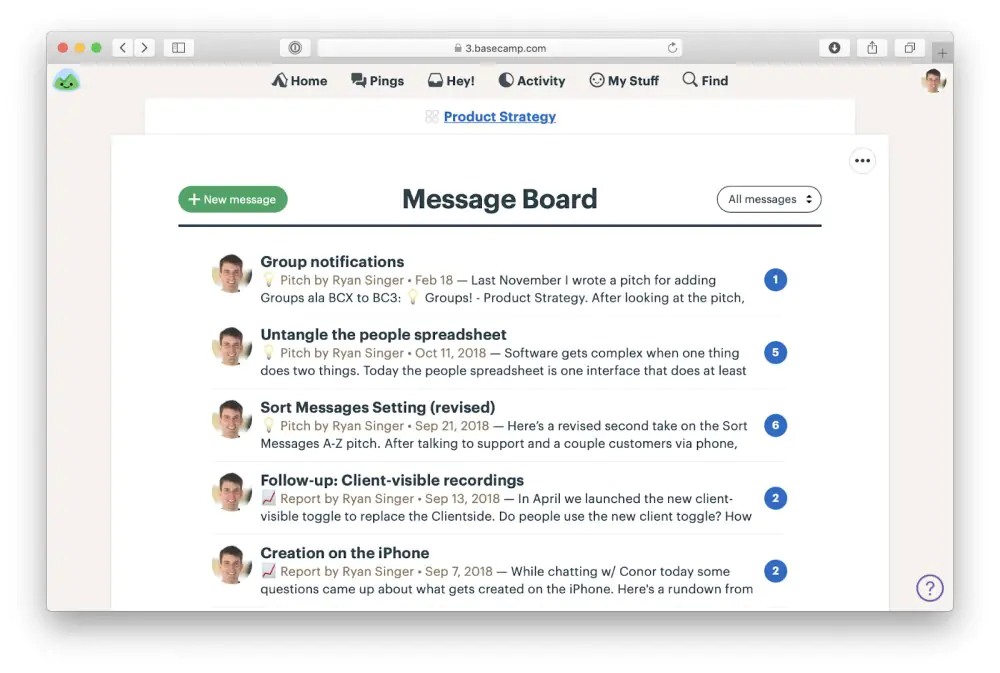
Basecamp’s message board allows teams to post structured updates and discussions in one central spot. Each post has a clear topic, and replies that stay grouped under it. This makes it easy to revisit past decisions, see how they were made, and onboard new members who need to catch up quickly. The emphasis on clarity and persistence reduces the need for status meetings and eliminates ambiguity.
2. To-dos

Basecamp’s to-do lists keep track of the actual work that needs to be done. Every task can be assigned to a specific person with a due date, which builds accountability into the process. The lists are flexible enough to be organized by phase, deliverable, or team, depending on how you prefer to structure a project.
Because tasks are visible to everyone on the project, they create transparency without requiring micromanagement. A project manager can glance at the hill chart above and immediately see what’s overdue, what’s in progress, and what’s finished.
3. Docs & files

In general, documentation and file sharing are often scattered across email attachments or cloud storage links. Basecamp solves this by embedding file storage directly into the project space. Teams can upload files, link documents, or create simple text docs that live alongside tasks and discussions. This keeps reference material within reach, ensuring that design drafts, strategy documents, or client contracts are always accessible in context.
However, I didn’t find the built-in organization efficient in preventing version confusion, which you often encounter with marketing assets. Since the most up-to-date file is always on top, Basecamp does save you the hassle of searching for files. But if you need to cross-reference multiple versions of the same, it becomes tedious.
4. Scheduling
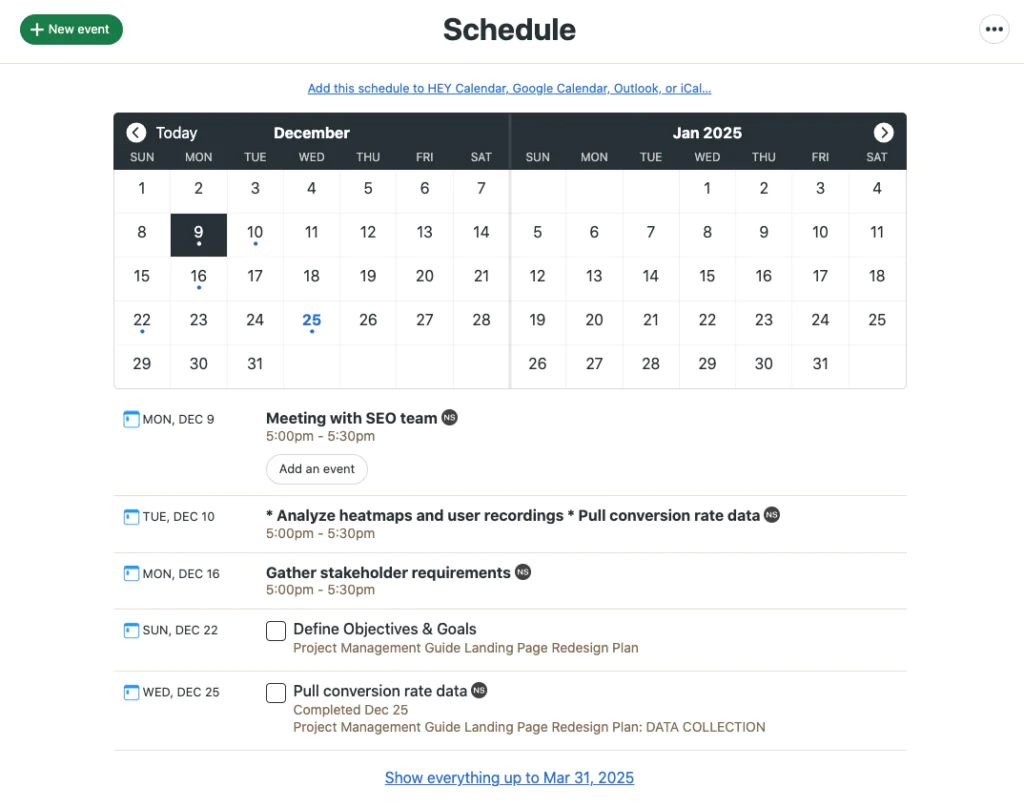
Projects move forward on the shared understanding of deadlines, and Basecamp provides a shared schedule where milestones and due dates live. It’s not designed to replace advanced timeline tools like Gantt charts, but it offers a straightforward calendar view that keeps important dates visible. This helps everyone align around key deliverables without needing separate planning tools.
However, if the plan changes, which is often the case with many projects, you might have to reschedule everything manually, even to accommodate minor shifts in deadlines. When combined with to-dos, the Schedule ensures that both high-level milestones and day-to-day responsibilities are clear.
5. Chat

For quick discussions that don’t require a full post, Basecamp includes “Chat” (formerly Campfire), a group chat space within each project. This allows teams to handle immediate questions or brainstorms without jumping into another tool. For one-on-one communication, Pings serve as private direct messages. These features are intentionally limited to prevent constant distraction, but they provide a way to handle conversations that don’t belong on the message board.
6. Automatic check-ins

One of Basecamp’s most distinctive features is its automatic check-ins. Instead of holding daily standup meetings or weekly syncs, managers can set up recurring questions, such as “What did you work on today?” or “What are you planning to focus on this week?” Team members respond at their own pace, and answers are collected into a single thread. This builds a routine of reflection and sharing without disrupting schedules. It also creates a written log of progress that managers can review at any time.
7. Hill charts
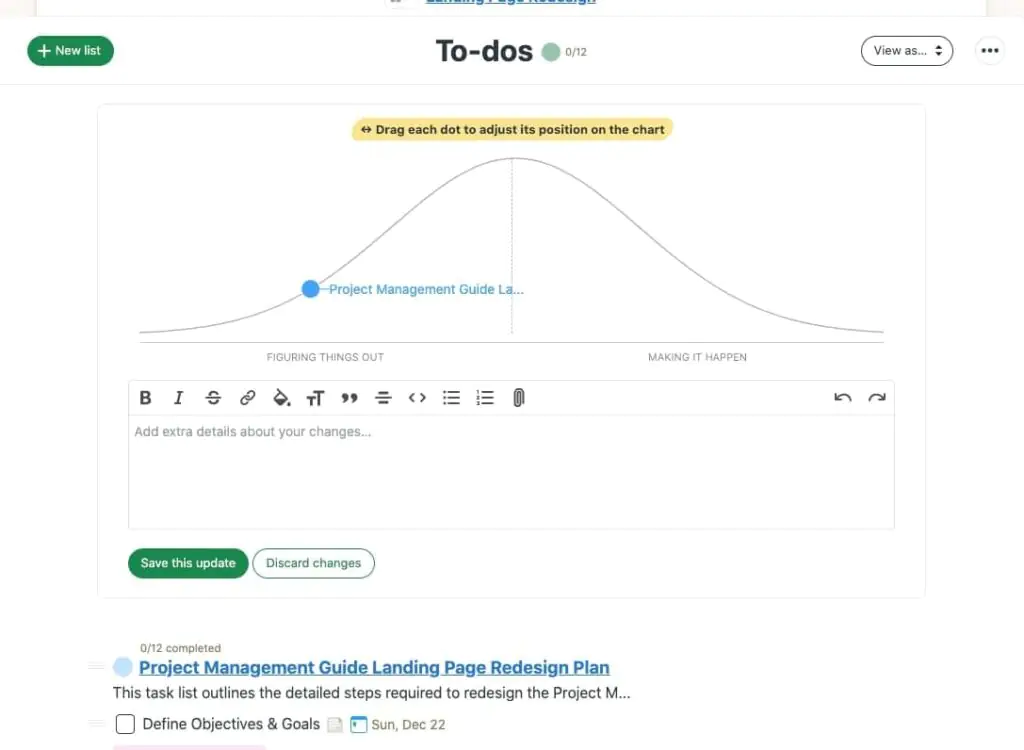
Hill Charts give you a quick, visual sense of where a piece of work truly stands—not by counting tasks, but by showing whether you’re still figuring things out (the uphill) or executing what’s already understood (the downhill). You place “scopes” of work on a hill-shaped curve and drag them as understanding and execution progress. This helps you communicate status without spreadsheets or burndown charts: if a scope sits on the left side, unknowns remain; on the right, it’s mostly about finishing touches.
Because teams can update Hill Charts in seconds, they’re practical for regular project check-ins and for surfacing risk: stuck-on-the-uphill signals, open questions, or blockers. For a portfolio-level glance, the Hilltop View lets you see all Hill Charts across your account on one screen, so leaders can spot patterns without poking into each project.
8. Card Table

Card Table is Basecamp’s take on a Kanban board. There are three sections, including “triage” stacked on top of “figuring it out” and the “in progress” column. They’re especially handy for reactive or inbound work where a visual flow makes triage and throughput clearer than a linear to-do list. However, it doesn’t allow you to add more stages or reflect a unique workflow. If your teams strictly follow agile frameworks like Kanban and Scrum, the card table functionality offers nothing.
Nonetheless, Basecamp supports a few practical touches like sharing a Card Table via a public link when you need stakeholders to view progress without logging in (e.g., weekly status for a partner or client). This keeps visibility high while keeping your internal tools and conversations contained.
9. Lineup
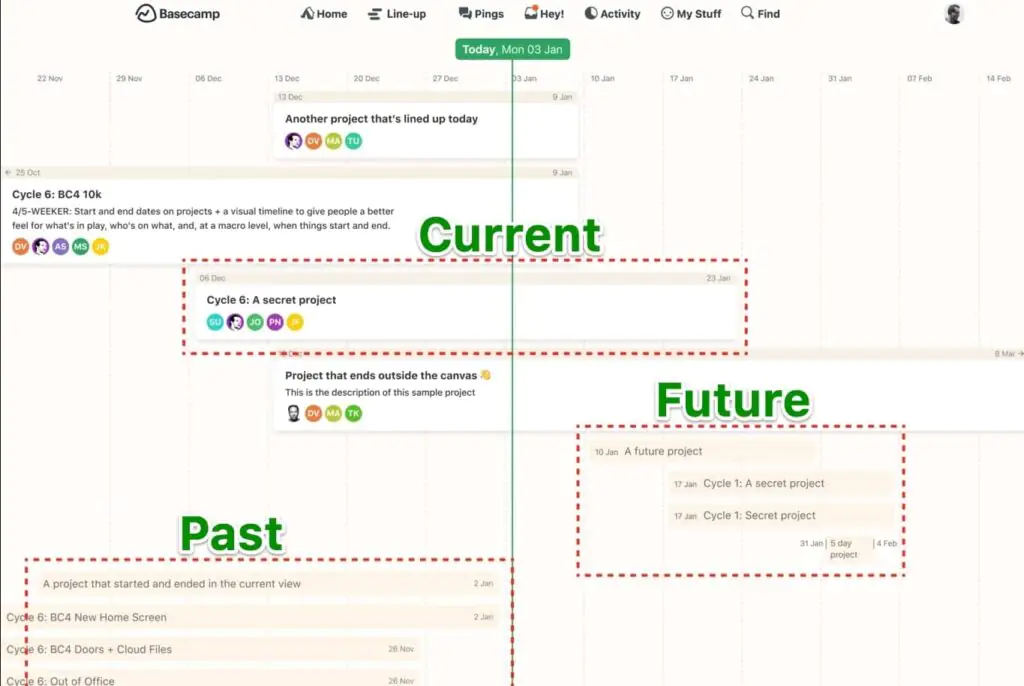
Lineup provides a 13-week, account-wide timeline centered on today: six weeks back, the current week, and six weeks ahead. It’s a “big picture” view that shows what’s in play, what’s next, and how projects overlap—useful for spotting collisions, planning capacity, and communicating expectations without building a complex Gantt. Because the view auto-shifts daily, it stays up to date without manual maintenance.
10. Timesheets
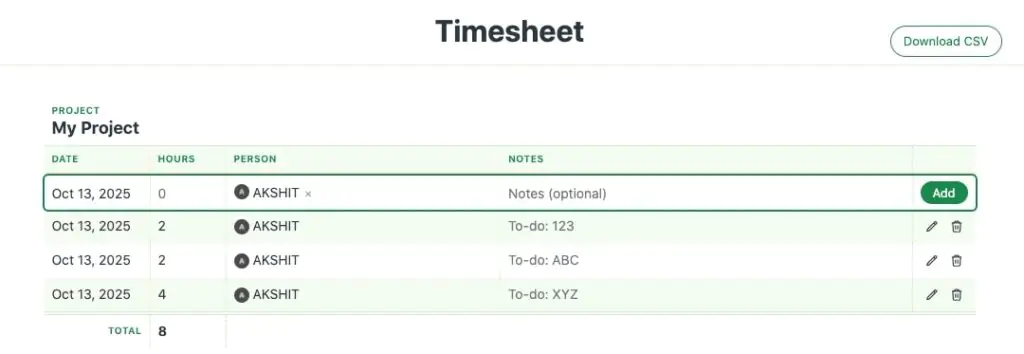
Basecamp includes built-in time tracking so teams can log time on specific items, using a simple timer input. Hours roll up on the project and into a Timesheet view for lightweight reporting and review. You can add notes with entries, capture work done outside Basecamp at the project level, and use it from mobile as well.
Each of these features is simple on its own, but their strength lies in how they interconnect. Discussions stay tied to the project rather than email. Tasks link directly to deadlines on the Schedule. Files live where the work happens. Check-ins reduce the need for recurring meetings. Together, these elements create a project environment that is organized, transparent, and sustainable, allowing teams to focus more on the actual work and less on managing the mechanics of collaboration.
How to use Basecamp for project management
Using Basecamp effectively is less about mastering dozens of tools and more about following a simple rhythm: set up the project, organize the work, keep communication clear, and steadily track progress until the project is complete. The platform is designed to make this rhythm intuitive, so teams can spend their energy on the work itself rather than on managing the process.
1. Setting up a new project
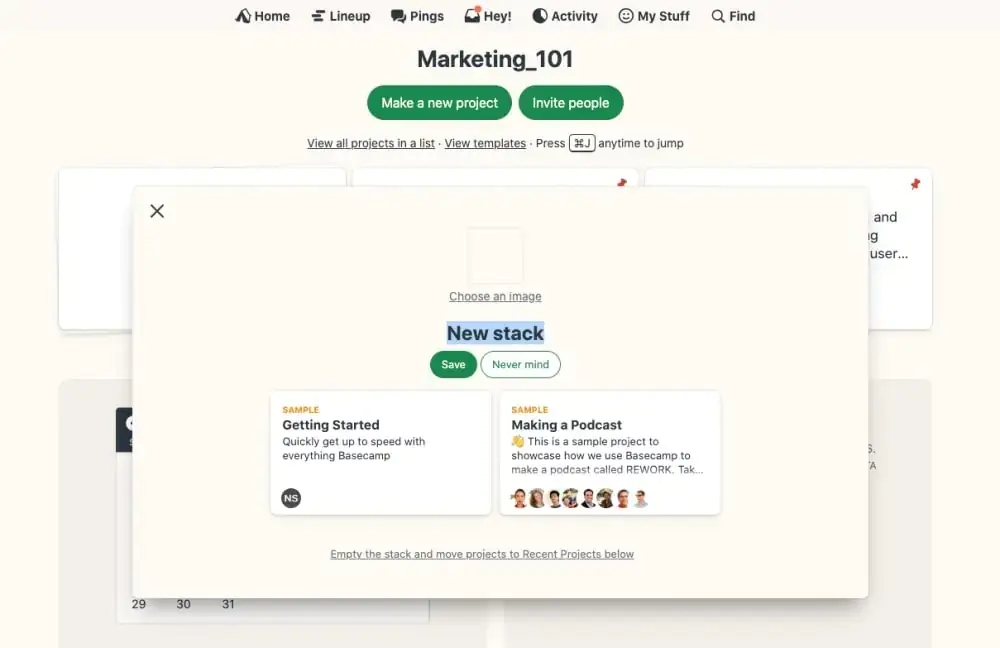
The first step is to create a dedicated project space for the work at hand. In Basecamp, each project is its own container for everything related to it—tasks, discussions, files, and deadlines. This ensures that people don’t mix updates from one initiative with another, and it gives every team member a single reference point. When setting up a project, you can give it a clear name, invite the right people, and decide whether to include external stakeholders (such as clients). From day one, everyone knows where to look for information.
2. Breaking down and assigning tasks
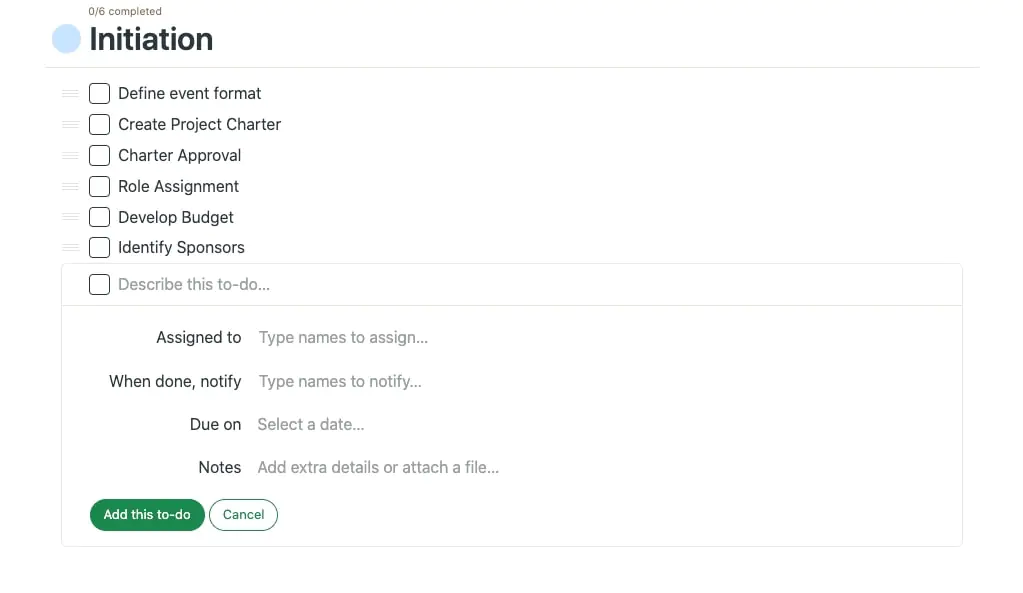
Once the project space is ready, the next step is to translate goals into actionable work. Basecamp uses to-do lists and cards to structure tasks. To-dos are practical for linear checklists, while cards provide a Kanban view of work as it moves through stages. Each item should be assigned to one owner with a deadline, which builds accountability into the system. By doing this at the beginning, you replace vague responsibilities with clear expectations, and everyone can see what’s expected of them without waiting for reminders.
3. Sharing files and documentation
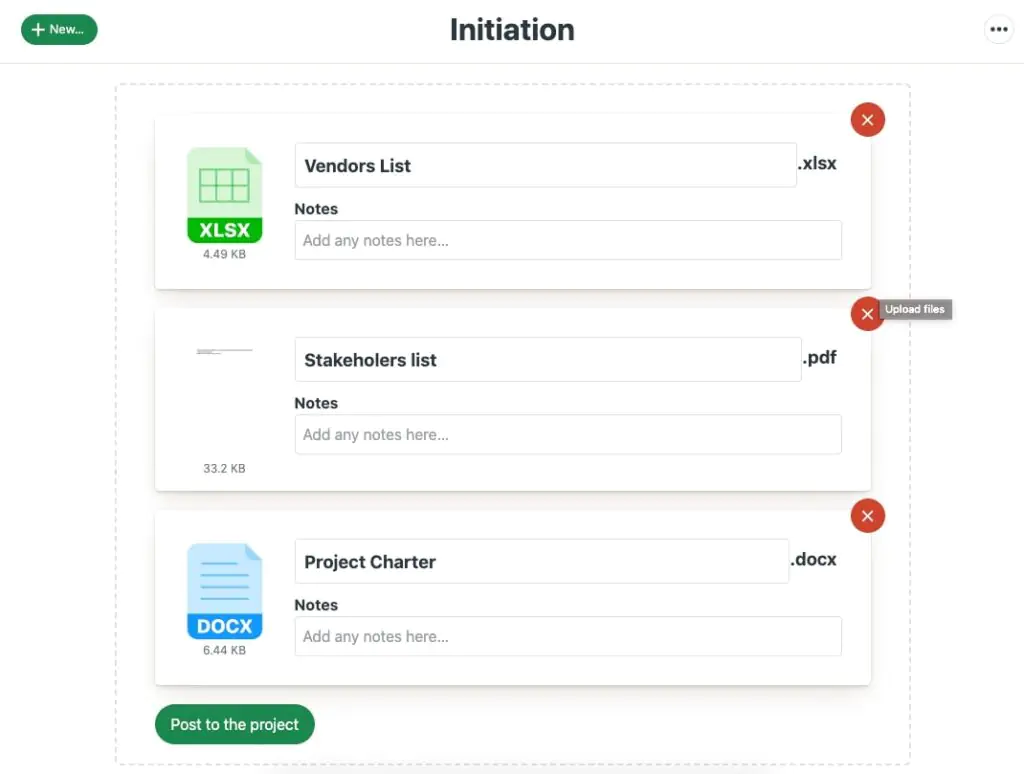
Every project generates a trail of documents, designs, and reference materials. Instead of scattering these across drives or email threads, Basecamp keeps them inside the project space in the Docs & Files section. You can upload files directly, create text docs, or link to external resources. Because they sit alongside the tasks and discussions, people always have context: the relevant design sits next to the decision that approved it, not buried somewhere else. This makes it much easier to keep projects coherent and prevents version confusion.
4. Structuring communication
Communication in Basecamp is mostly structured around async messages and updates. The platform offers several layers for this: Chat (formerly Campfire), Message Boards, Pings, and Automatic Check-ins. I found Chat useful for quick one-on-ones, short announcements, or instant feedback—essentially anything lightweight that doesn’t impact the full project.
Message Boards, on the other hand, are designed for structured updates and decisions that require a reliable record. Campfire works well for rapid group conversations when the team needs fast back-and-forth. Pings keep private, one-to-one discussions focused. Automatic check-ins handle routine updates without requiring meetings.
The key is matching the communication layer to the purpose: big decisions live on Message Boards, small clarifications go through Campfire or Pings, and recurring updates run through check-ins. Used this way, Basecamp keeps communication calm and prevents both information overload and the loss of important details.
5. Tracking progress and deadlines

As the project unfolds, Basecamp provides several ways to monitor progress without micromanaging. The Schedule gives you a shared view of milestones and due dates. Hill Charts help visualize whether parts of the work are still being figured out or are in execution mode. To-do lists and card tables update as tasks move forward, so everyone can see what’s done and what’s left. Regular check-ins ensure progress is documented in writing. Together, these tools give a real-time sense of how the project is moving without requiring constant status meetings.
When a project is complete, Basecamp makes it simple to wrap up. You can archive the space, which preserves every message, file, and task for future reference. This becomes a resource for learning: if a new project with similar goals comes up, the archived project serves as a blueprint for how things were handled previously. By closing projects cleanly, teams build an internal knowledge library rather than letting insights fade away once the work is delivered.
While Basecamp favors a minimalist, conversation-driven style of project management, other project management tools like Asana take a more structured approach to task dependencies, timelines, and team accountability. You can read our detailed breakdown in Asana vs Basecamp to understand how these two philosophies differ in practice.
Advantages of using Basecamp for project management
While Basecamp is not as extensive as many other project management tools, it offers several advantages in clarity, organization, and productivity. Here are a few of them:
- Centralized organization: Basecamp eliminates the need to juggle multiple apps for tasks, files, discussions, and schedules. By bringing these elements together into a single project space, teams spend less time searching for information and more time acting on it. This centralization reduces mistakes caused by version confusion and makes it easier for newcomers to catch up on a project’s history.
- Clarity of accountability: Every to-do, card, or task in Basecamp can be assigned to team members with a deadline. This removes the ambiguity of shared ownership and makes responsibilities visible to the whole team. Managers don’t need to micromanage because the system itself highlights what’s overdue or still open.
- Emphasis on asynchronous work: Basecamp’s communication model favors written, asynchronous updates instead of constant meetings or real-time chats. This gives people longer stretches of focused time and reduces the interruptions that often derail productivity. Automatic check-ins, for example, replace routine standups by collecting updates in writing.
- Sustainable pace of work: Basecamp is designed with a “calm company” philosophy that encourages teams to avoid false urgency and burnout. Features like Hill Charts and Lineup provide visibility without demanding round-the-clock monitoring. For teams that value consistency and thoughtful decision-making, this creates a healthier work rhythm.
- Client-friendly collaboration: The platform makes it easy to involve clients or external stakeholders without exposing every internal detail. Shared views give clients the information they need—such as updates, approvals, or files—without overwhelming them with the team’s internal chatter. This transparency builds trust while protecting the team’s workflow.
Disadvantages of using Basecamp for project management
Every tool has shortcomings that don’t become apparent until later, and Basecamp is no exception. Here are some of the disadvantages or trade-offs that I think a user must consider before investing in Basecamp:
- Not ideal for urgent or time-sensitive projects: Basecamp’s asynchronous-first approach can feel slow in environments where responsiveness to varying project constraints is critical. If a project demands constant iteration, rapid-fire communication, or immediate problem-solving (such as crisis response or fast-moving product launches), the system’s calm pace may become a liability.
- Limited advanced reporting and analytics: Unlike some project management platforms, Basecamp doesn’t provide in-depth analytics, risk management, workload forecasting, or custom reporting. For teams that rely on detailed metrics to make decisions, this limitation may require using additional tools alongside Basecamp.
- Assumes strong individual autonomy: Basecamp minimizes micromanagement, it works best with teams that are self-directed and disciplined. If individuals struggle with prioritization or need frequent guidance, the lack of structured oversight tools can allow tasks to slip through unnoticed.
- Less suited to highly complex workflows: Basecamp intentionally avoids heavy customization and advanced workflow automation. While this simplicity is an advantage for many, large organizations with complex dependencies or industry-specific processes may find it restrictive compared to platforms that allow deep tailoring.
Read more: 11 Best competitors and alternatives to Basecamp
Basecamp pricing
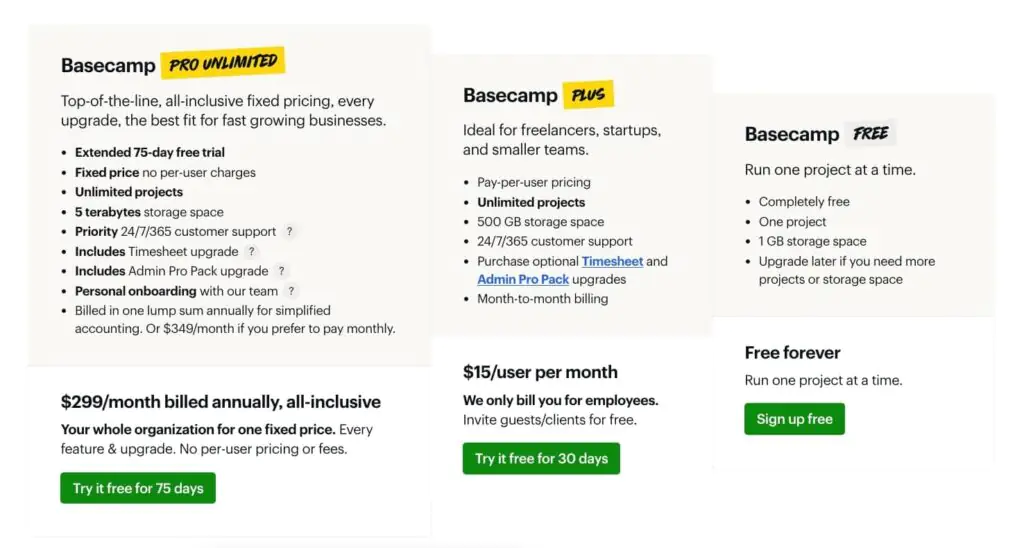
Basecamp keeps its pricing simple compared to many project management tools, which slice features into multiple tiers. Instead of charging extra for advanced functionality, Basecamp includes its full set of features in every plan and differentiates only on scale, storage, and billing style. This approach makes it easier for teams to choose a plan without worrying about having to upgrade later just to unlock a specific tool.
- Free plan: For individuals or very small teams just experimenting with Basecamp, there is a free plan with one project. It is limited in scope but useful for freelancers, side projects, or teams who want to test the platform before committing. It gives a taste of how Basecamp works without a financial commitment, though most teams quickly outgrow it once they begin managing multiple projects.
- Per-User plan: The standard paid plan costs $15 per user per month. For small to mid-sized teams, this pricing is often “good enough” because it scales gradually with the team size. A 10-person startup, for example, can run all its projects on Basecamp for $150 per month, with no feature restrictions. The trade-off is that costs grow linearly with team size, which can make it expensive at scale.
- Pro Unlimited plan: For larger organizations, Basecamp offers a flat-rate option at $299 per month when billed annually (or $349 monthly). This plan allows unlimited users and projects and expands storage to 5 TB. It also comes with priority support and onboarding. The flat-rate model becomes especially cost-effective for bigger teams, since adding new people doesn’t increase monthly costs. A 50-person team, for instance, pays the same as a 200-person team under this plan. However, for very small teams, the flat rate is usually unnecessary unless they value the storage or onboarding extras.
Who is Basecamp best suited for?
Basecamp is best suited for teams working on projects that require steady coordination, involve multiple contributors, but don’t demand heavy resource tracking or advanced dependency management. It fits particularly well in environments where the complexity of tasks or team size does not demand highly specialized or resource-intensive project management systems.
- Small and medium-sized teams: For early-stage projects, Basecamp often offers the right balance of tools and simplicity. These teams need a central place to organize tasks, share files, and communicate, without the overhead of setting up advanced workflows or learning complex systems.
For example, a 10-person startup building its first product can use Basecamp to keep design drafts, development updates, and marketing plans together in one space. At this stage, Basecamp is usually “good enough” because the team’s priority is speed, clarity, and collaboration, not detailed reporting or strict process management. As the team scales, however, they may find that Basecamp lacks the detailed planning features needed for larger, more complex projects.
- Client-based project work (agencies and consultancies): Agencies, studios, and consulting firms often handle multiple client projects at once. These projects demand smooth communication and transparency, but rarely need deeply technical workflows. Basecamp fits neatly into this environment by tying discussions, deliverables, and deadlines to each client project, which reduces the risk of losing context in endless email threads.
For example, a design agency working on branding for three clients can keep each project siloed within Basecamp, with shared message boards, tasks, and files visible to both internal staff and clients. However, if you are running multi-country campaigns with strict timelines and interdependent deliverables, Basecamp’s lack of workload balancing and progress analytics can be counterproductive.
- Remote or distributed teams: Teams spread across different time zones often struggle with synchronous communication and keeping everyone in sync. Basecamp’s asynchronous-first model helps reduce the need for constant real-time meetings. Written updates, automatic check-ins, and centralized files mean that progress can continue without waiting for overlapping working hours. A distributed nonprofit, for example, can use Basecamp to coordinate volunteers and staff across continents, ensuring all decisions and resources are visible regardless of location. Nonetheless, if the work involves real-time collaboration (e.g., fast-moving product sprints, crisis response, or live event coordination), Basecamp’s collaboration structure may feel too slow for immediate decision-making.
Basecamp fits small to mid-sized teams that prefer simple coordination over complex planning. If you are more inclined toward a feature-rich platform like ClickUp, check out our article on Basecamp vs ClickUp to explore how each tool approaches scalability and workflow management.
The best alternative for Basecamp project management: ProofHub
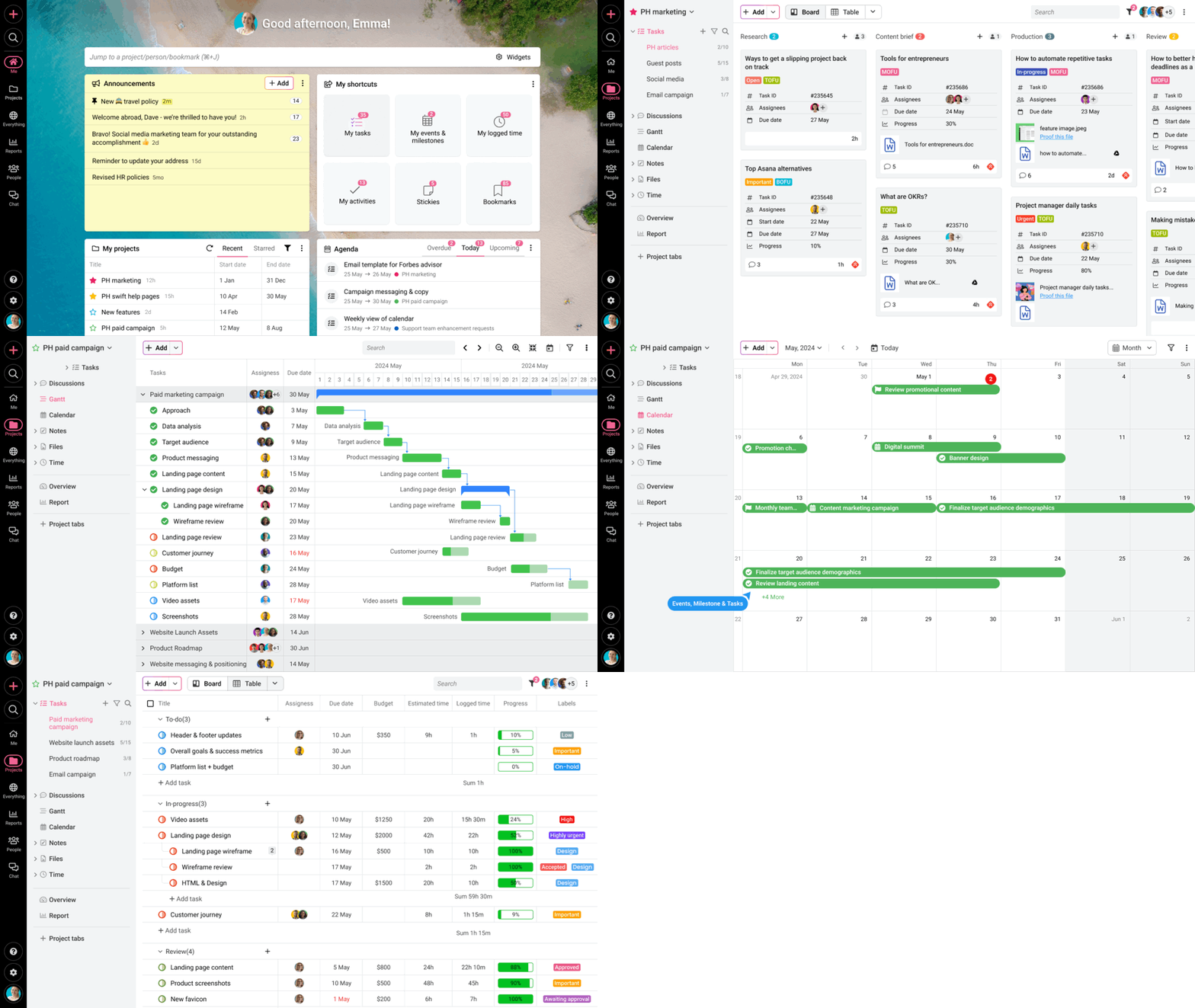
ProofHub is an all-in -one project management and team collaboration platform designed for teams of all sizes to plan, track, organize, and collaborate on projects of all types. Like Basecamp, ProofHub offers a clean, user-friendly interface but with a set of powerful features. It’s built to help teams stay organized, communicate effectively, and manage projects without unnecessary complexity.
One of Basecamp’s defining philosophies is that project management doesn’t need rigid systems, but this can become a drawback for larger cross-functional teams working at scale, following different approaches.
With ProofHub, teams can manage both traditional and agile projects and sprints, track timelines, or stick to simple task lists, all within the same platform. This balance between advanced functionality without the burden of complex administration makes ProofHub a strong alternative for teams who find Basecamp too limited.
Where Basecamp focuses primarily on communication and simplicity, ProofHub builds on those strengths while also introducing the structured planning, customization, and scalability that growing teams and complex projects demand. In short, it offers the clarity of Basecamp while adding the depth needed to support teams as they expand their projects and processes.
Key features of ProofHub:
1. Project setup
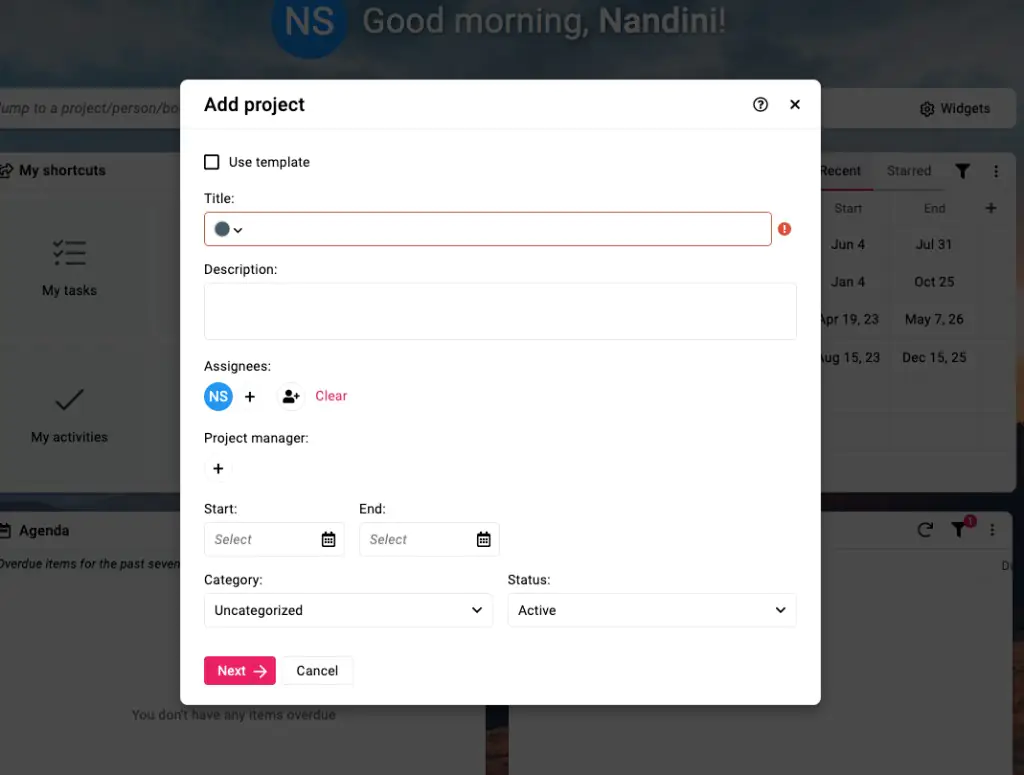
Setting up a project in ProofHub is straightforward. Teams can name a project, add descriptions, and assign members within minutes. You can also assign a dedicated project manager role during setup. This adds a layer of accountability, ensuring every project has someone responsible for oversight and coordination without requiring complex configuration.
2. Multiple views
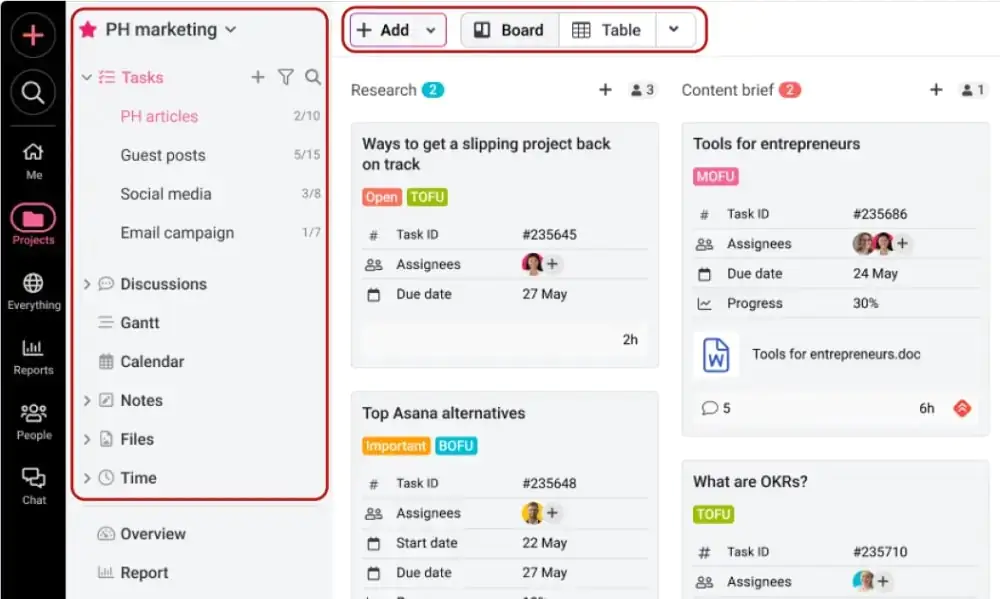
ProofHub allows team members to choose their preferred way of visualizing work by offering multiple views: Lists for simple overviews, Kanban boards for workflow management, Calendars for scheduling, and Gantt charts for timelines and dependencies. Because all views stay in sync, teams can switch between them without losing clarity.
3. Gantt charts
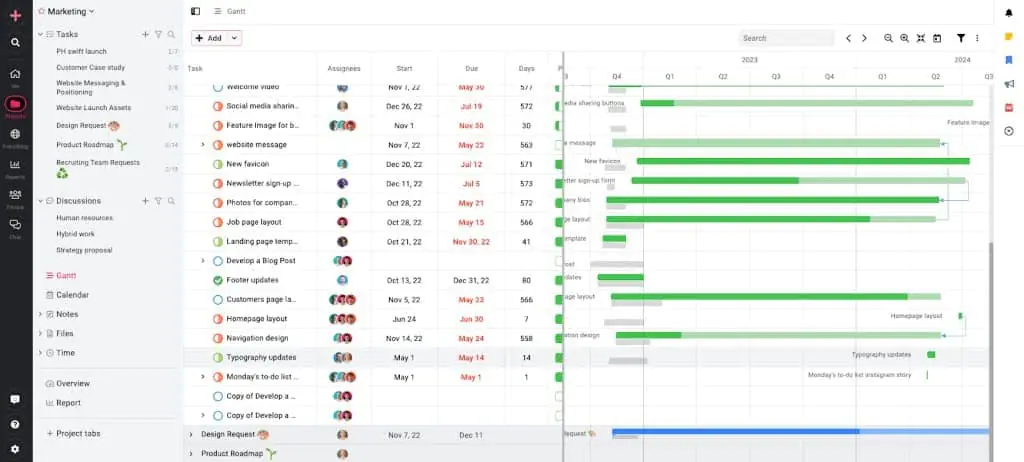
For projects with complex timelines, ProofHub’s interactive Gantt charts allow managers to map out tasks, set dependencies, and adjust schedules as priorities shift. The drag-and-drop interface with cascade changes functionality makes it easy to replan when deadlines change, while dependency management ensures that no delayed tasks go unnoticed. Teams can also apply the critical path method, making it easier to understand which tasks directly impact delivery dates.
4. Custom workflows
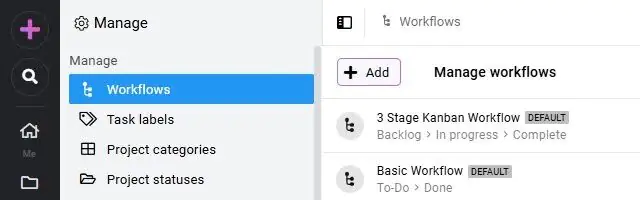
Custom workflows in ProofHub let teams define their own stages of work instead of sticking to fixed templates. Tasks can be moved across these stages to reflect progress, whether you are managing a simple content review or a complex product launch. This flexibility makes it easy to adapt the tool to any working style or methodology.
5. Project categories
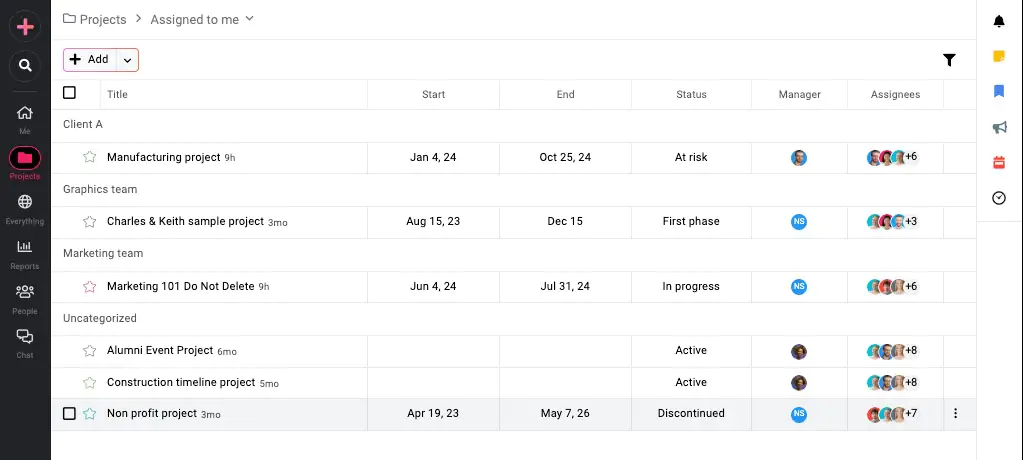
Projects in ProofHub can be grouped into categories for better organization. Teams can separate client work, internal initiatives, or departmental projects, making it easier to locate information and track progress across multiple streams. Categories provide a structured overview without complicating daily workflows.
6. Discussion
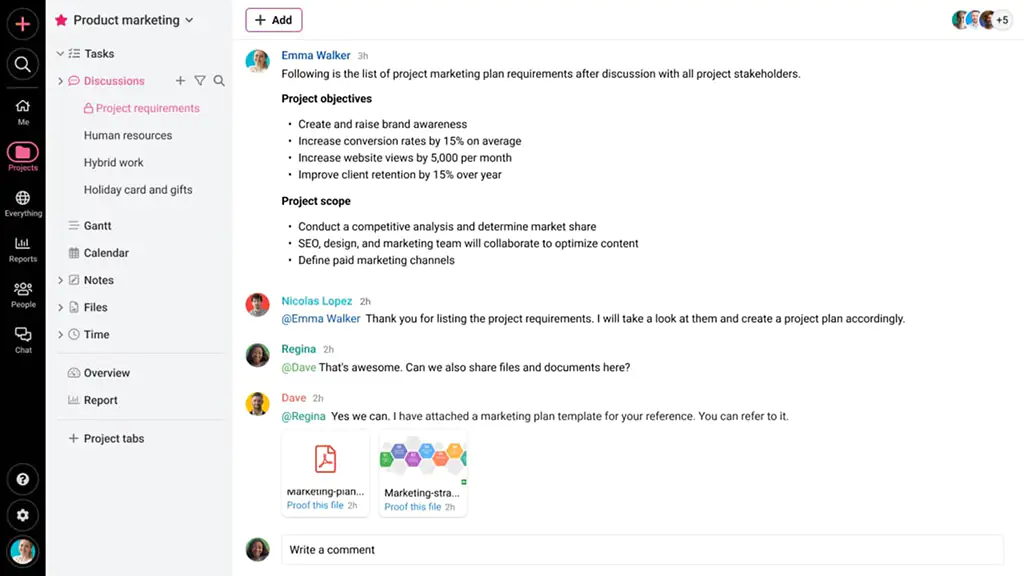
Discussions in ProofHub are organized into dedicated boards. Teams can create topic-specific threads, add subscribers, and share updates or files in one place. This reduces scattered emails and keeps all project-related conversations accessible and organized.
7. Time tracking
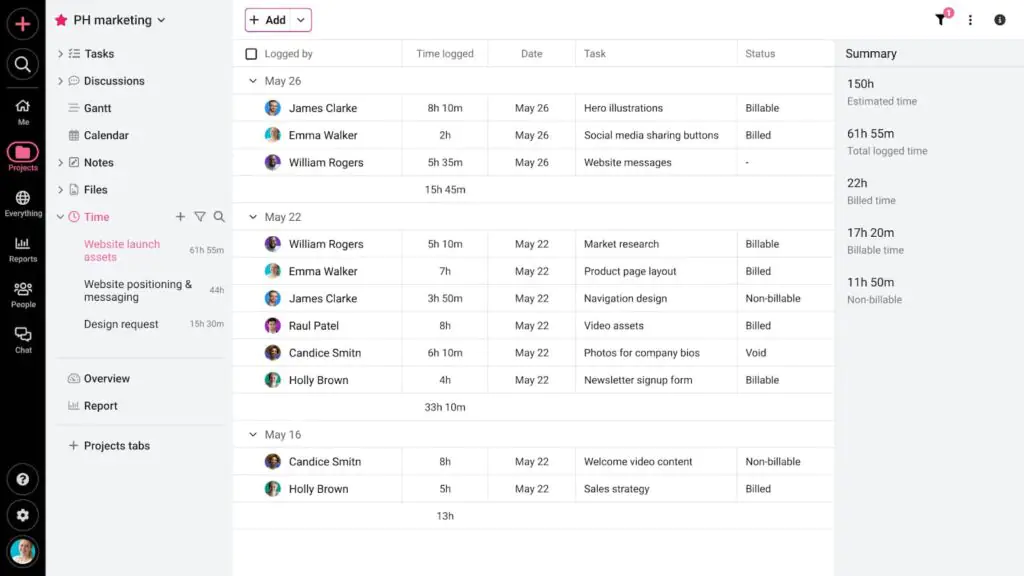
Time tracking is built directly into ProofHub. Team members can log hours manually or use timers to capture work against tasks. Managers can review timesheets and combine them with workload data to monitor productivity and distribute assignments fairly.
8. Built-in chat
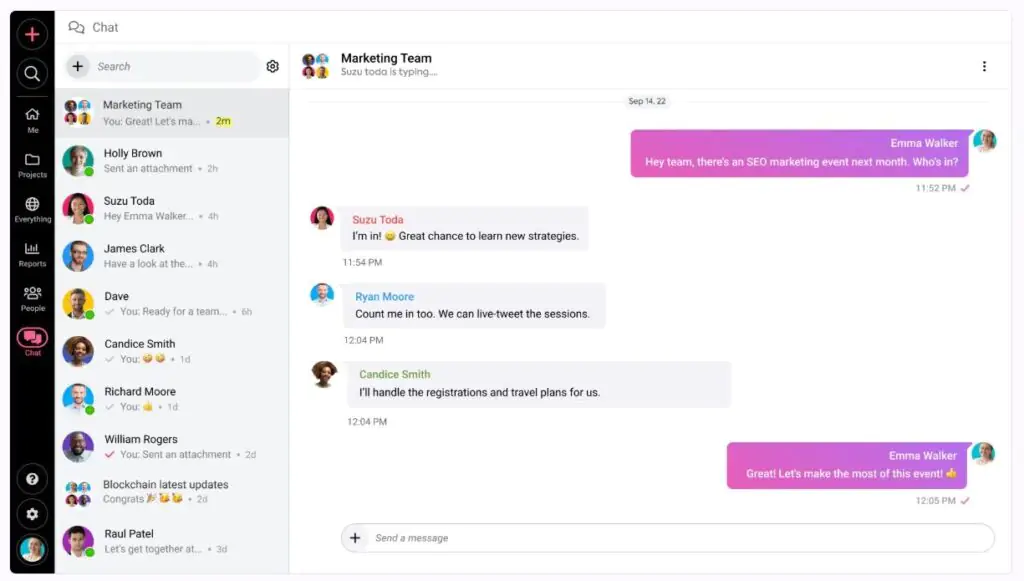
ProofHub includes a chat feature for instant messaging. Team members can share quick updates or feedback without switching platforms. Because it is integrated into the workspace, chat stays connected to ongoing projects.
9. Proofing
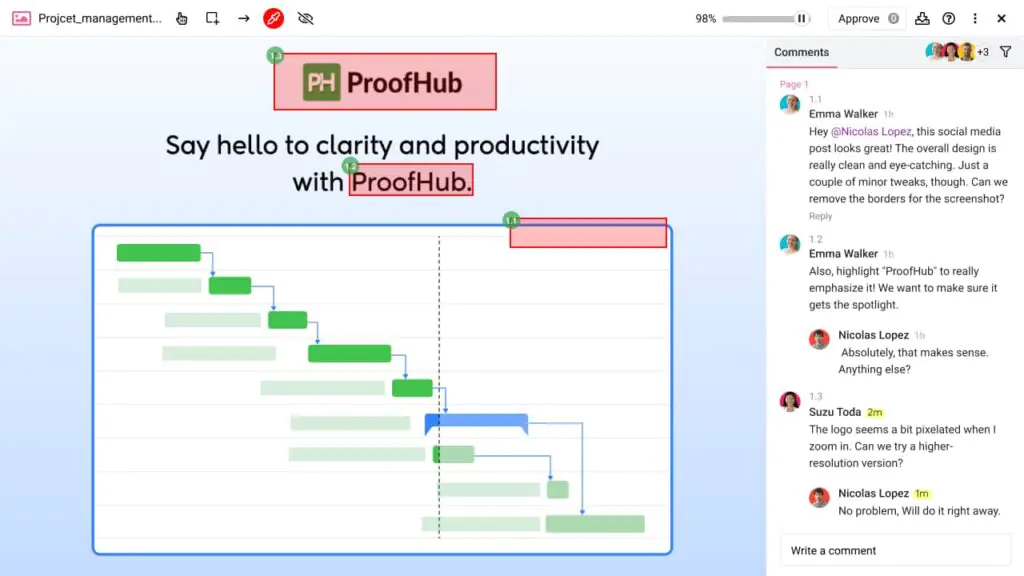
Proofing tools in ProofHub allow teams to review files, images, and documents directly in the platform. Comments and annotations can be added in real time, and version control makes it easy to track the latest updates. This speeds up approvals and reduces back-and-forth.
10. Reporting
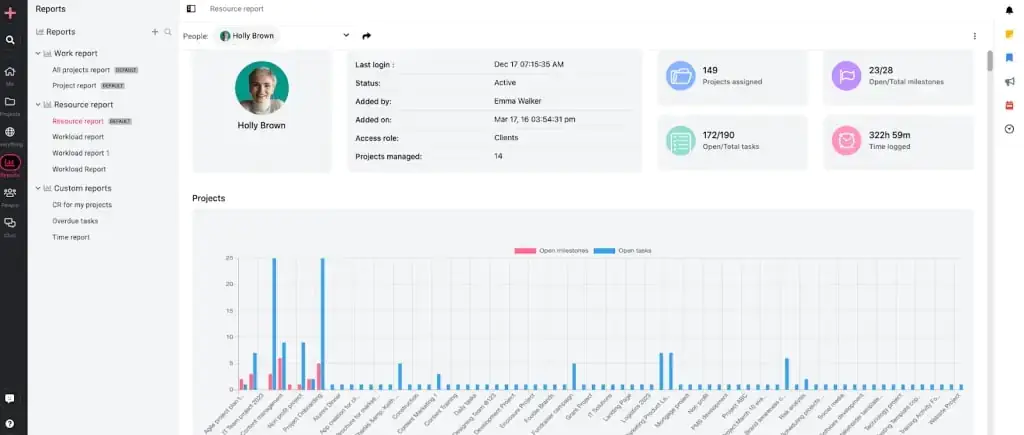
ProofHub generates automated reports on project progress, resource allocation, and team workload. Custom fields and filters let managers focus on the metrics that matter most. Reports can be tailored for team-level reviews or executive summaries.
11. Custom roles and access control
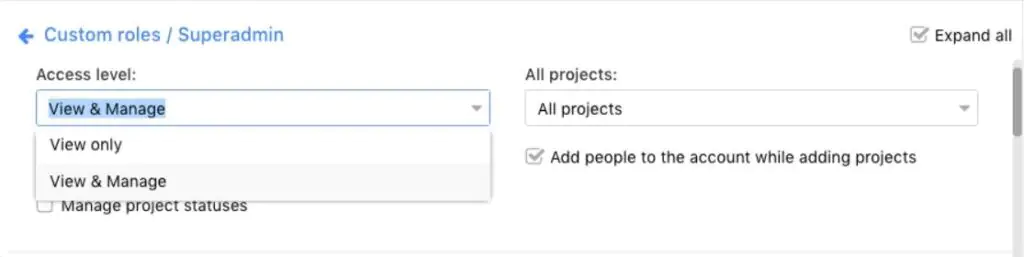
Custom roles in ProofHub let managers control who can access specific areas of a project. Teams, clients, and external contributors see only what is relevant to them, which keeps collaboration smooth while protecting sensitive information.
ProofHub pricing

ProofHub keeps pricing straightforward with two flat-rate plans that support unlimited users.
- Essential plan: Flat $45/month (annual) or $50/month (monthly)
- Ultimate Control plan: Flat $89/month (annual) or $99/month (monthly)
Because pricing doesn’t increase with the number of users, teams can grow without worrying about subscription costs escalating.
ProofHub changes how teams experience workflow. Instead of forcing teams to adapt to complex systems or cobble together multiple apps, it creates a single structured space with enough tools to handle all types of projects from start to finish. For organizations that have outgrown Basecamp’s simplicity but don’t want the overhead of enterprise tools, ProofHub offers a user-first platform that’s structured enough for complex projects yet simple enough to adopt quickly.
Basecamp vs ProofHub
| ProofHub | Basecamp |
|---|---|
| Multiple views, custom fields, dependencies, and critical path analysis for complex projects. | Minimal to-do lists only—no hierarchies, dependencies, or custom fields. |
| Discussions, chat, notes, and visual proofing tool for collaboration. | Message boards, Chat, auto check-ins for collaboration. |
| 1-2 hours to get started; requires workflow configuration for advanced workflows. | Hours to learn; zero configuration but inflexible. |
| Flat $45/month or 89/month (no per-user fees); best for teams of all sizes. | $15/user or $299 unlimited; best for 50+ users. |
| File versioning and visual proofing with markup and versions. | Cloud storage integrations but no document search. |
| Project, resource, time, and workload reports. | Only Hill Charts and basic task completion. |
Does Basecamp have Gantt charts?
Basecamp does not have Gantt charts, and this absence is entirely deliberate rather than an oversight. The platform’s creators believe Gantt charts represent the kind of complexity and planning theatre that wastes more time than it saves, and they have consistently refused to add this feature, despite it being one of the most frequently requested.
Basecamp provides a Schedule tool that displays events, deadlines, and milestones in a calendar view, showing when things are due but not visualizing dependencies, critical paths, or task relationships over time, as Gantt charts do.
The Hill Charts feature serves as Basecamp’s alternative to traditional progress tracking, showing whether work is in the uncertain, figuring-it-out phase or the clear execution phase, but this subjective assessment tool does not replace the timeline and dependency visualization that Gantt charts provide. For teams that need Gantt chart functionality, ProofHub is one of the best alternatives to Basecamp.
What is the learning curve for Basecamp?
The learning curve for Basecamp is remarkably gentle, with most users becoming productive within the first few hours of use and fully comfortable with the platform within a few days. The interface is intentionally simple and intuitive, built around familiar concepts like to-do lists, message boards, file folders, and chat, requiring no specialized knowledge to understand.
However, the minimal learning curve is both Basecamp’s greatest strength for adoption and a potential indicator of limitations. Tools that are easy to learn are typically easy because they do less, and Basecamp is no exception. The speed at which you become proficient with Basecamp should be weighed against whether the capabilities you quickly master are sufficient for your needs.
If your work fits within what Basecamp offers, the gentle learning curve means your team is productive almost immediately with minimal training investment. If your work requires more than Basecamp provides, the gentle learning curve just means you quickly discover what is missing rather than slowly unlocking features that eventually meet your needs.
If you don’t want to compromise the comfort of an easy learning curve for more functionality, ProofHub is one of the best options for you. The setup time for ProofHub is almost the same as Basecamp’s, and onboarding a new user is equally easy. Only if you are a manager or a leader might you have to spend a few hours getting the hang of using technically advanced features like Gantt charts and reports to their fullest potential.
Can Basecamp handle more than just simple task lists?
Basecamp is built around simplicity. It works very well for organizing to-dos, assigning tasks, and tracking basic progress. However, it does not include advanced project management features like detailed dependencies, workflow automation, or complex progress reports. If your projects are mostly straightforward, Basecamp is enough. For highly interdependent projects, you may find the structure limiting.
Does Basecamp replace the need for separate tools for communication and file sharing?
Basecamp brings tasks, messages, documents, and file storage into one place. This reduces the need to constantly switch between different apps. The tradeoff is that each feature is intentionally simple—chat, documents, and file management work well for most teams, but they don’t have the depth of specialized tools. The benefit is fewer distractions; the limitation is fewer advanced options.
Is Basecamp good for working with clients and external partners?
Yes, Basecamp makes it very easy to invite clients or outside collaborators into projects. Once added, they can see the project space, follow discussions, and provide feedback. The limitation is that access is broad—clients generally see all tools and discussions in a project rather than very restricted portions. This works well for transparent collaboration but may not suit teams that need detailed access controls.
Can Basecamp scale as our team and projects grow?
Basecamp can grow with you in terms of the number of projects and users—it handles unlimited projects and has a flat fee for unlimited team members. Where it doesn’t scale as well is in advanced project oversight. It doesn’t provide portfolio-level dashboards, complex reporting, or resource allocation tools. For small to mid-sized teams, this isn’t an issue, but very large organizations may need more structured systems.
Is Basecamp suitable for small businesses or startups?
Yes. Small teams and startups benefit most from Basecamp’s simplicity, predictable pricing, and ease of setup. It provides enough structure without overwhelming new teams with advanced features they may not need yet. However, as startups scale into more complex operations, they may eventually require a tool with deeper planning and reporting.
Can Basecamp integrate with other software tools?
Yes, but with limits. Basecamp integrates with Zapier and offers an API for connecting to other apps, but it lacks the extensive native integrations found in platforms like Asana or monday.com. For teams that rely heavily on third-party tools, this may require extra effort or workarounds.
Is Basecamp a good project management tool?
Yes, for the right context. Basecamp is excellent for teams that value clarity, simplicity, and collaboration over complex workflows. It’s not the best choice if you need advanced project planning, resource management, or integrations. Its strength lies in making everyday team coordination easy without steep learning curves.
