

Managing a project without clear milestones is like going on a long road trip without map markers. It is easy to lose track of where you are, how far you have come, and whether you are still on schedule.
When teams face a massive list of tasks without structured checkpoints, productivity drops, delays creep in, and keeping stakeholders informed becomes a constant headache.
Project milestones solve this problem by breaking down complex initiatives into clear, manageable moments of progress.
Whether you are launching a new product, managing an internal transition, or building a high-level schedule, understanding how to define, track, and adjust milestones is critical to keeping your team aligned and your deliverable on time.
In this guide, you will learn what project milestones are, why they are essential for team accountability, a step-by-step framework to set and monitor them effectively, and the common pitfalls to avoid along the way.
- 1.A milestone is a fixed point in time marking a significant phase, deliverable, or decision. Unlike tasks, it has no duration.
- 2.Milestones matter because they track progress, align teams, aid stakeholder communication, support decision-making, and surface schedule risks early.
- 3.Creating good milestones starts with reviewing project objectives/scope, then breaking work into phases and deliverables.
- 4.Common milestone types include initiation, planning, execution, monitoring/control, and closure milestones.
- 5.The most common scheduling mistakes are confusing tasks with milestones, setting unrealistic dates, ignoring dependencies, overlooking resource constraints, and skipping completion criteria.
- 6.Milestones on the critical path should be prioritized for monitoring since their delays most directly push back the project end date.
What are project milestones?
A project milestone is a fixed point in a project timeline that marks the completion of a significant phase, deliverable, or decision point.
Unlike tasks, milestones have no duration; they represent a moment, not an activity. Common examples include project kickoff, design approval, prototype completion, and final sign-off. Milestones sit on the project schedule alongside tasks and deliverables, giving teams clear checkpoints to measure progress against the baseline plan.
Why are project milestones important?
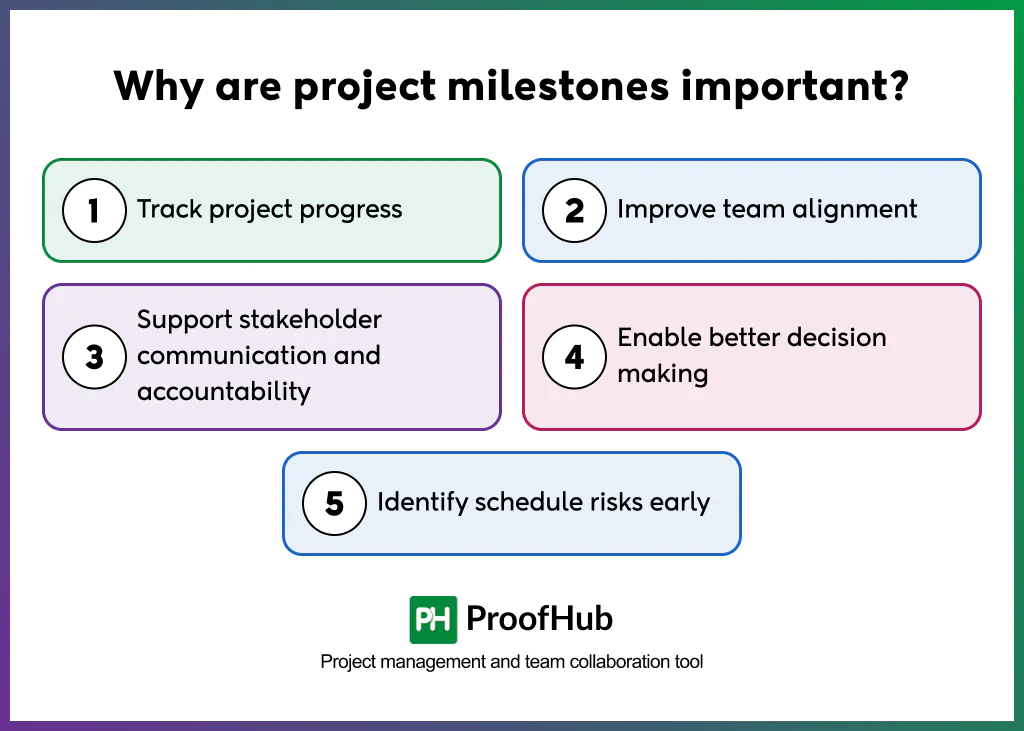
Project milestones are important because they help track project progress, improve team alignment, support stakeholder communication and accountability, enable better decision-making, and identify schedule risks early.
When a project doesn’t have any milestones, there is no way for the team members to divide the tasks into different stages. Everything is done continuously without any breaks. Because of this, the team members struggle to meet the deadline and are more likely to delay tasks.
The importance of project milestones is explained in detail below:
- Track project progress: Milestones provide a clear view of how much work has been completed against the project plan. They create natural checkpoints for communicating progress to the entire team. These checkpoints give you an opportunity to reassess priorities, timelines, and resources before the next phase begins.
- Improve team alignment: Milestones give the team shared checkpoints. Each one spells out what needs to be done and by when. This shared clarity cuts down on the back-and-forth of status meetings. Over multiple milestones, it keeps new members or shifting priorities from pulling the group off course.
- Support stakeholder communication and accountability: Provides stakeholders a simple way to follow progress without requiring every task update. Since the milestones are usually numbered, the stakeholders can base their calculations on concrete facts instead of vague platitudes.
- Enable better decision-making: Milestones are natural points to review scope, budget, and resources before moving forward with the project. You can plan the next part of the project better from the previous one, if any adjustments are needed. It is extremely valuable in Agile, which has formalized periodic reviews into its core philosophy.
- Identify schedule risks early: A missed milestone signals a delay before it grows into a bigger schedule variance. You can take preemptive action to bring the project back on track. The actions can include reprioritizing tasks, reallocation of resources, and identifying and eliminating blockers for team members.
How to identify and create the right project milestones?
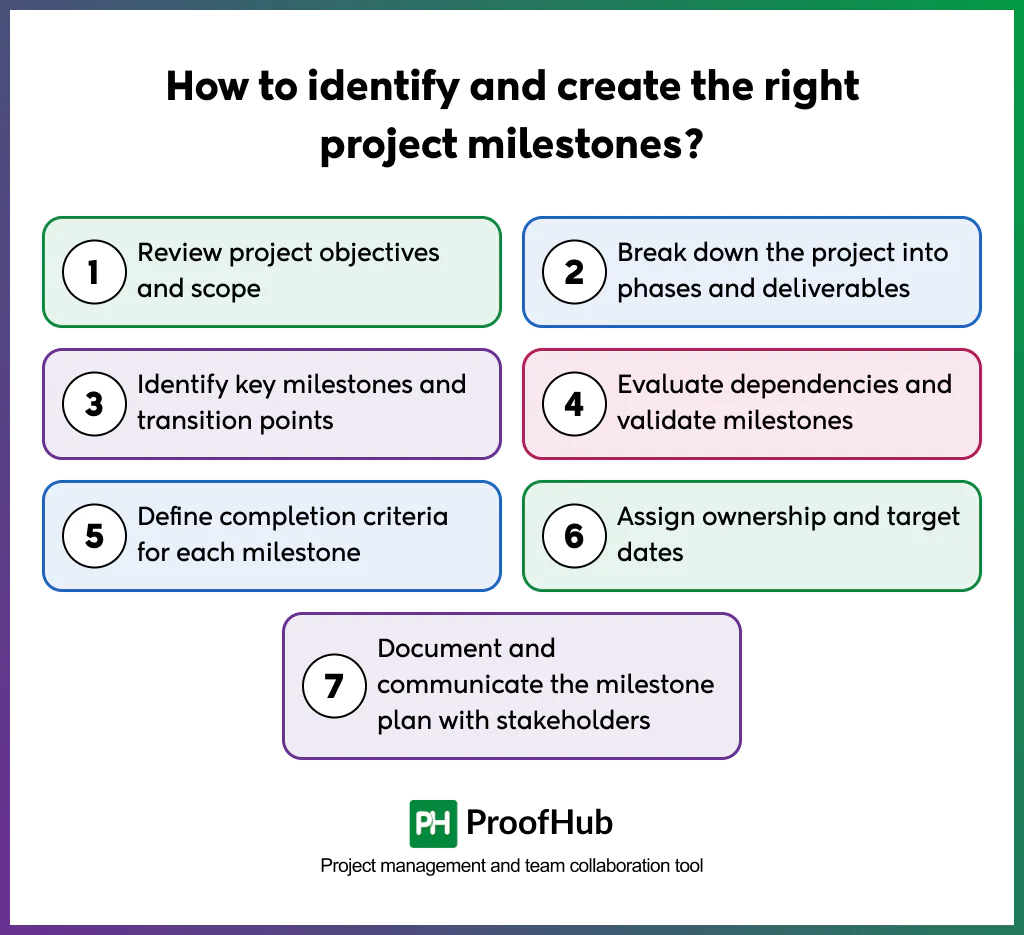
To identify and create the right project milestones, review project objectives and scope, break down the project into phases and deliverables, identify key milestones and transition points, evaluate dependencies and validate milestones, define completion criteria for each milestone, assign ownership and target dates, and document and communicate the milestone plan with stakeholders.
Following these steps ensures that the milestones do not hinder the progress of the project. Improperly created milestones can either put too much pressure on the team to deliver or make them complacent, which leads to delayed projects.
Here are all the steps explained in greater detail:
1. Review project objectives and scope
Start with the project charter and the defined scope before naming a single milestone. The objectives tell you what success looks like, and the scope tells you the boundaries of the work needed to get there.
Without this step, teams often mistake internal tasks for milestones or miss the checkpoints that actually matter to stakeholders. Read the objectives alongside the requirements document and note where major outcomes are expected.
Giving a reference point for every milestone added later, so each one ties back to a stated goal rather than an arbitrary date on the calendar.
Skipping this review is one of the most common reasons milestone schedules drift away from what the project was meant to deliver.
2. Break down the project into phases and deliverables
Use a work breakdown structure to split the project into phases such as initiation, planning, execution, monitoring, and closure.
Each phase should produce one or more clear deliverables, whether that is an approved design, a tested build, or a signed contract. Deliverables are the output; milestones mark the moment a deliverable is confirmed complete.
This distinction matters because teams that skip the breakdown step often end up with milestones that are really just large tasks in disguise, which makes the schedule harder to track and report on accurately.
3. Identify key milestones and transition points
Look for the points where one phase ends and another begins, since these transitions are usually the strongest candidates for milestones.
Examples include approval to move from design to development, or the shift from testing to deployment. These transition points matter because they often require stakeholder sign-off, a resource handoff, or a go/no-go decision.
Marking them as milestones creates visibility around the moments where the project could stall if approvals or resources are not ready.
A good rule is to ask whether missing this point would delay the rest of the project; if yes, it likely deserves milestone status rather than being treated as a routine task.
4. Evaluate dependencies and validate milestones
Check every milestone against its dependencies before it gets locked into the schedule. A milestone that depends on an external vendor delivery, a client approval, or another team’s output carries more schedule risk than one fully within your team’s control.
Map these dependencies using a Gantt chart or a dependency diagram so the critical path is visible. Validate each milestone by confirming that its prerequisite tasks and deliverables are realistic within the proposed timeframe.
This step catches conflicts early, such as two milestones relying on the same limited resource at the same time, which is a frequent cause of schedule slippage later in the project.
5. Define completion criteria for each milestone
A milestone without clear completion criteria is open to interpretation, and that ambiguity causes disputes about whether it has actually been reached.
Define what “done” means for each milestone in specific terms, such as a document approved by a named stakeholder, a build passing a defined set of tests, or a budget confirmed by finance.
Where possible, tie the criteria to measurable outputs rather than subjective judgment. Teams that document completion criteria upfront also find it easier to defend the schedule when questions come up during monitoring or after the project closes.
6. Assign ownership and target dates
Every milestone needs a named owner responsible for confirming it has been met, along with a realistic target date. Ownership prevents a milestone from becoming something everyone assumes someone else is tracking.
When setting the target date, account for dependencies, resource availability, and any buffer needed for review or approval cycles. Avoid setting dates based purely on what stakeholders want to hear; base them on the actual scope of work involved.
Assigning both an owner and a date turns a milestone from a note on a chart into an accountable commitment that can be tracked and reported on throughout the project lifecycle.
7. Document and communicate the milestone plan with stakeholders
Once milestones are defined, owned, and dated, document them in a milestone chart or schedule that is easy for stakeholders to reference.
Share this plan during project kickoff and keep it visible throughout execution, whether through a shared project management tool, a status report, or a recurring meeting.
Communication at this stage sets expectations early, so stakeholders know what to expect and when. It also creates a single source of truth that reduces confusion if priorities shift.
Revisiting the milestone plan regularly with stakeholders keeps everyone aligned and makes it far easier to flag risks before a milestone date is missed.
How to monitor project milestones effectively?
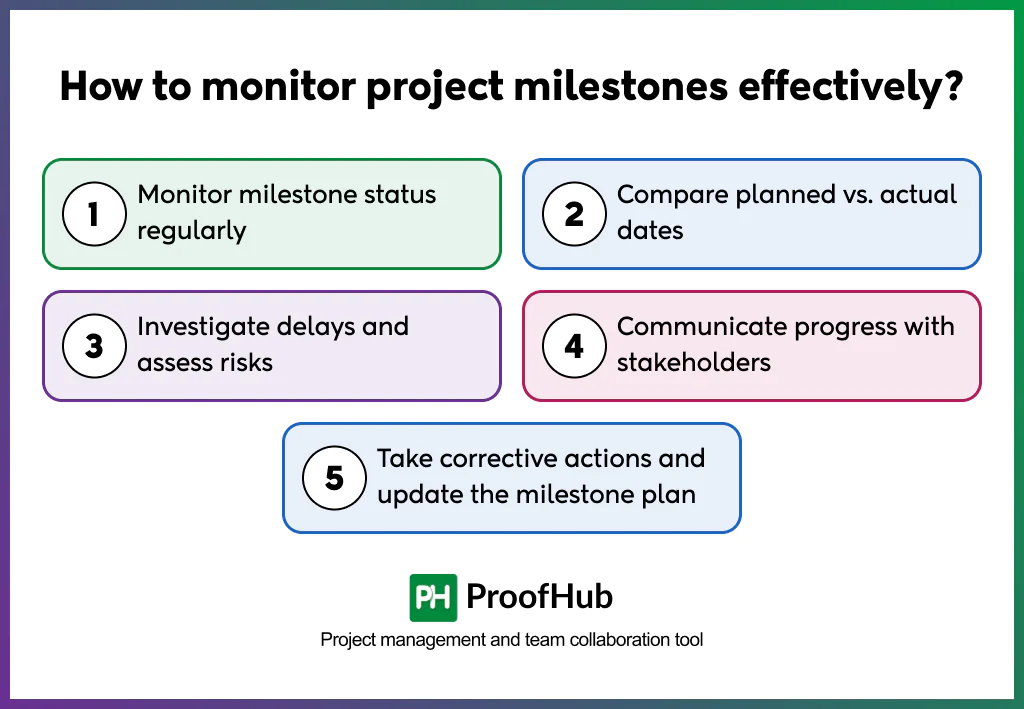
To monitor project milestones effectively, monitor milestone status reports regularly, compare planned vs. actual dates, investigate delays and assess risks, communicate progress with stakeholders, and take corrective action and update the milestone plan.
Monitoring milestones is crucial for any project because not monitoring them leads to milestones remaining unimplemented. You must remain vigilant about upcoming milestones to keep the project on track and communicate with the team about the schedule appropriately.
The pointers are explained below:
1. Monitor milestone status regularly
Set a fixed cadence, weekly or biweekly depending on project length, to check the status of upcoming and recently passed milestones.
Regular monitoring catches problems while there is still time to act, rather than discovering a missed milestone after the fact. Use your project management tool’s dashboard or milestone chart view so status is visible at a glance instead of buried in individual task lists.
Assign this review as a specific responsibility, often to the project manager, so it does not get skipped during busy weeks.
Consistent monitoring is what separates a milestone schedule that stays useful from one that becomes outdated within a few weeks of the project starting.
2. Compare planned vs. actual dates
Track the original target date for each milestone against the actual date it was reached, and keep this comparison visible over the life of the project.
This is the core of schedule variance analysis; a growing gap between planned and actual dates is an early warning sign of larger delays ahead.
Recording this data also helps with future project estimation, since patterns in past variance often repeat across similar projects.
Avoid quietly updating the planned date to match reality, since this hides the fact that a delay occurred. Keep both dates on record so the comparison stays honest and useful for reporting.
3. Investigate delays and assess risks
When a milestone slips, look into the root cause rather than just noting that it happened. Common causes include resource conflicts, dependency delays, scope changes, or underestimated effort.
Understanding the cause determines whether the fix is a schedule adjustment, a resourcing change, or a scope conversation with stakeholders.
Assess how the delay affects downstream milestones, particularly any on the critical path, since a delay there pushes the entire project end date.
Document the investigation so the same issue can be anticipated and avoided in future phases or future projects using a similar structure.
4. Communicate progress with stakeholders
Share milestone status with stakeholders on a consistent schedule, whether through a status report, a dashboard, or a short update meeting. Be direct about delays as soon as they are identified rather than waiting until a milestone is officially missed.
Stakeholders generally respond better to early, honest communication than to a surprise at the end of a phase. Include what caused the delay and what is being done about it, not just the fact that the date moved.
This keeps trust intact and gives stakeholders the chance to weigh in on decisions, such as adjusting scope or approving additional resources, while there is still time to act.
5. Take corrective actions and update the milestone plan
Once a delay or risk is understood, decide on a set of corrective actions, which usually includes reallocating resources, adjusting the scope, or revising the schedule for downstream milestones.
Update the milestone chart to reflect the new plan, so it stays an accurate reference rather than a historical document.
Communicate the change to the team and stakeholders together with the reasoning behind it. Avoid making silent changes to dates, since this erodes the value of the schedule as a tracking tool. A milestone plan that is actively corrected and kept current is useful.
Examples of milestones in project management
Different types of projects have different types of milestones. Some are created with the number of completed tasks in mind, while others are created with a different metric altogether (like the number of features added successfully in a product, or the number of sales made).
Here are the examples of project milestones:
1. Project initiation milestones: Initiation milestones mark the formal start of a project. They include project charter approval, stakeholder sign-off on the business case, and confirmation of the project budget. They establish authority and funding for the work ahead; without them, teams risk starting execution before scope and resources are actually confirmed. Initiation milestones are usually few in number but carry significant weight for everything that follows.
2. Project planning milestones: Planning milestones cover the completion of key planning documents and decisions. They include an approved work breakdown structure, a project schedule, a confirmed resource plan, and a signed-off risk management plan. They confirm the team has a validated roadmap before committing to execution. A well-marked planning phase gives the team a clear, documented baseline to measure the rest of the project against.
3. Project execution milestones: Execution milestones track the delivery of major work products as the project moves forward. They include completion of a prototype, approval of a design phase, delivery of a first working build, or completion of a major testing cycle. Execution milestones are important because it is usually the longest phase of a project, and without checkpoints it becomes hard to tell whether the project is actually on track.
4. Project monitoring and control milestones: Monitoring and control milestones mark points where the project’s performance is formally reviewed against the baseline plan. They include a scheduled budget review, a quality audit, a phase gate review, or a formal change request approval. They help catch scope creep, budget overruns, or quality issues before they compound. Without these checkpoints, it is hard to catch problems early enough to correct them without affecting the schedule.
5. Project closure milestones: Closure milestones mark the formal end of the project and the activities needed to wrap it up properly. They include final client acceptance, handover of deliverables, contract closure, and completion of a lessons learned review. These milestones confirm whether the project has actually delivered what it set out to do and that all obligations, contractual and otherwise, have been met. Skipping closure milestones leaves loose ends, such as unpaid invoices or undocumented lessons, that surface as problems on future projects.
Common mistakes to avoid when creating project milestones
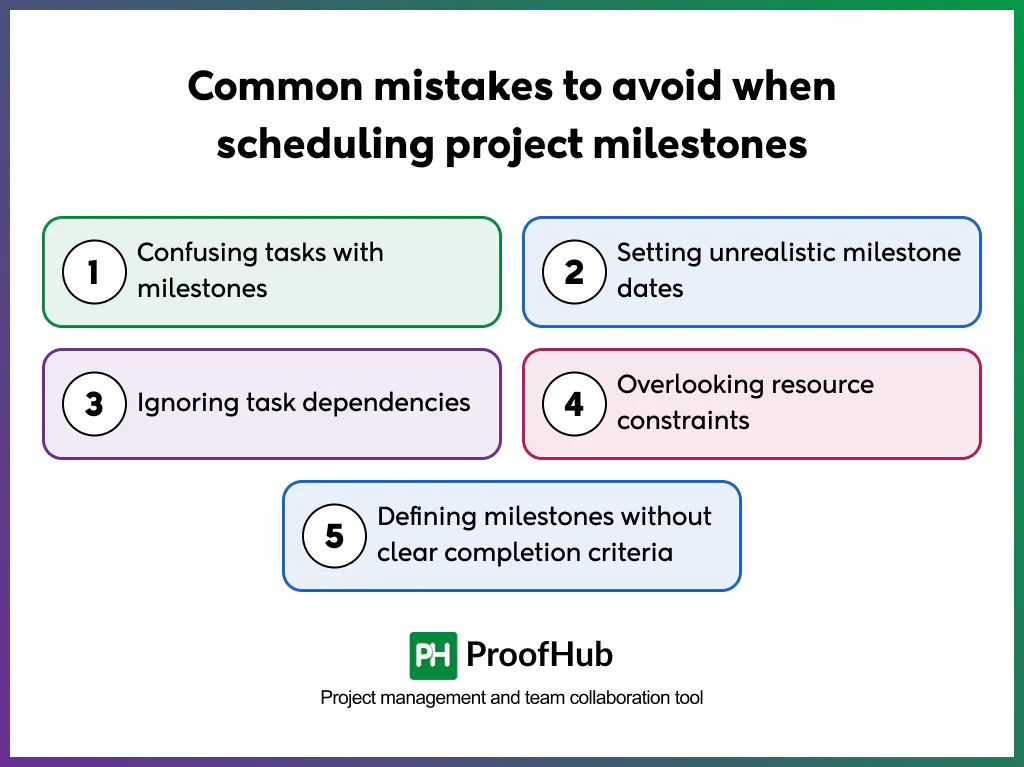
Common mistakes when creating project milestones are confusing tasks with milestones, setting unrealistic milestone dates, ignoring task dependencies, overlooking resource constraints, and defining milestones without clear completion criteria.
These common mistakes occur widely across various industries. But fortunately, avoiding them is also straightforward if you know the correct scope of project milestones. They are not meant as a tool to micromanage the team members, but the focus is rather on the project itself and its timely completion.
The mistakes are explained in greater detail below:
- Confusing tasks with milestones: A milestone marks a moment, not a piece of work with duration, and treating every task as a milestone makes the schedule cluttered and harder to read. Milestones should be treated as a point in time rather than as a list of things to do.
- Setting unrealistic milestone dates: Dates set without checking scope or resource availability lead to a schedule that fails from the start. Incorrectly set milestones can put unwarranted pressure on the team to perform above expectations, leading to mistakes, poor work quality, and delays.
- Ignoring task dependencies: Milestones set without mapping dependencies often conflict with other work or rely on deliverables that are not ready in time. This leads to a cascading effect where a delay in one task leads the team to miss the milestone altogether, further impacting the project deadline.
- Overlooking resource constraints: Assigning milestones without confirming the people or budget needed to meet them sets up avoidable delays. If the resources are not adequate for the milestone, then tasks rapidly pile up without completion.
- Defining milestones without clear completion criteria: Vague milestones lead to disagreement about whether they have actually been reached, which slows down reporting and decision-making. Completion criteria means clearly defining what reaching a milestone means. For example, for a milestone in software development, the completion criteria could be successful deployment of an update without bug reports for a specified number of days.
What is a milestone chart?
A milestone chart is a visual representation of a project’s key milestones plotted against a timeline, often shown as a simplified version of a Gantt chart.
It typically shows only the milestone dates rather than every underlying task, which makes it easier for stakeholders to follow progress at a glance. Milestone charts are commonly built within project management tools and updated as the schedule changes.
What is the difference between a project milestone, task, goal, and deliverable?
A project milestone is a specific point in time on a schedule that marks the completion of a major project phase or decision point. It carries zero duration and acts as a progress marker rather than a unit of work.
A task is an individual activity or action item that needs to be completed to advance the project. Unlike a milestone, every task has a defined duration and requires time and effort to finish.
A goal is a high-level outcome or objective that the project is intended to accomplish. It serves as the broader vision driving the project rather than a specific output or date-bound activity.
A deliverable is a tangible or intangible product created as a direct result of project work. It represents the concrete asset or outcome produced, which often leads to reaching a milestone upon approval.
| Term | Definition | Duration | Example |
|---|---|---|---|
| Milestone | A fixed point marking completion of a significant phase or decision | No duration; a single point in time | Design phase approved |
| Task | A unit of work required to move the project forward | Has a defined duration | Build wireframes for the homepage |
| Goal | A broad outcome the project is meant to achieve | Ongoing or long term, not date bound | Improve customer onboarding experience |
| Deliverable | A tangible output produced by the project | Tied to completion of specific work | Approved wireframe document |
How many milestones should a project have?
There is no fixed number; the right count depends on the size and complexity of the project. As a general guideline, most projects work well with somewhere between five and fifteen milestones, enough to mark meaningful progress without overwhelming the schedule with checkpoints that add little value.
Can project milestones change during execution?
Yes, milestones can and often do change as scope, resources, or risks shift during execution. Any change should be documented, communicated to stakeholders, and reflected in the updated milestone chart so the schedule stays an accurate reference rather than outdated information.
How can missed milestones affect project performance?
A missed milestone can delay downstream work, particularly if it sits on the critical path, which pushes back the overall project end date.
Repeated missed milestones also affect stakeholder confidence and can lead to budget overruns if additional resources or time are needed to recover the schedule.