Cost estimation is a foundational process in project management that predicts the total financial investment required to complete a project. Developing accurate estimates directly influences a project’s financial stability, strategic planning, and overall success.
This guide provides a comprehensive breakdown of project costs, step-by-step estimation workflows, core calculation techniques, and the essential tools used to manage project budgets effectively.
- 1.Cost estimation predicts the total financial resources a project needs, using historical data, scope, and resource requirements before work begins.
- 2.Accurate estimates give teams a financial baseline, support decision-making, secure funding, reduce risk, and improve the odds of project success.
- 3.Project costs fall into five categories: Direct, Indirect, Fixed, Variable, and Sunk — and misclassifying them skews your budget.
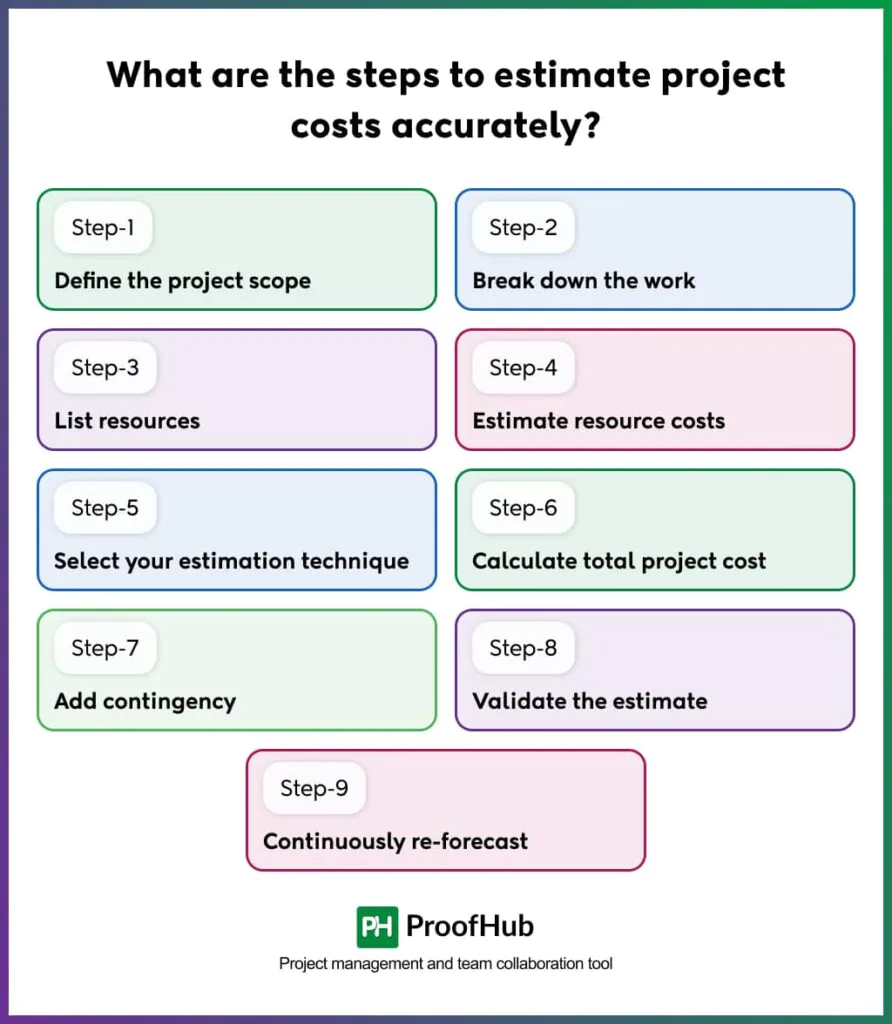
- 4.Accurate estimating follows a set sequence: Scope, Breakdown, Resources, Estimation, Calculation, Reserves, Validation, and Forecasting.
- 5.A contingency reserve of 5–15% of total cost should be built in to absorb unforeseen risks.
- 6.Bottom-up estimation is the most accurate but also the most time-intensive, since it builds costs up from the task level.
What is cost estimation?
Cost estimation is the process of predicting the financial resources needed to complete a project. It uses historical data, scope details, and resource requirements to calculate an approximate budget before work begins.
Project managers rely on it to plan spending, secure funding, and set realistic expectations for stakeholders throughout the project lifecycle.
Why is project cost estimation important?
Accurate cost estimation is important because it lays the foundation for realistic project planning, supports informed decision-making, and helps secure funding and stakeholder approval.
It also reduces financial risk, keeps resource allocation aligned with actual project needs, prevents scope-driven budget overruns, and builds stakeholder trust through transparent forecasting.
Here’s why accurate cost estimation is critical to project success:
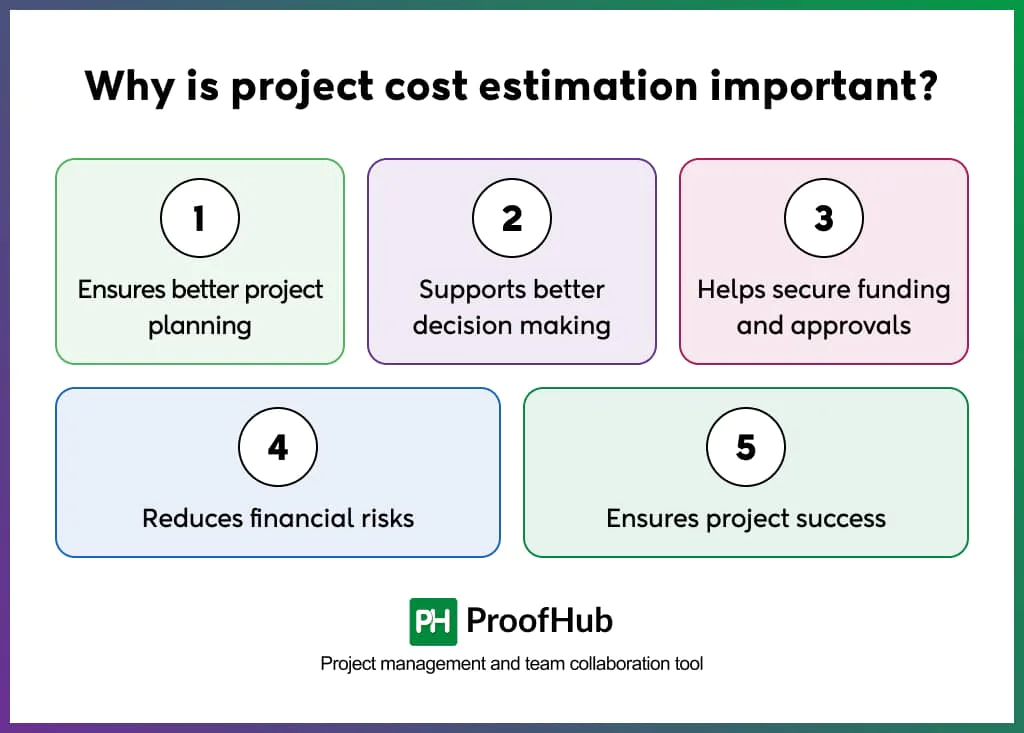
- Ensures better project planning: Cost estimation gives teams a clear financial roadmap before work begins. It forces project managers to break down tasks, assign resources accurately, and set realistic timelines. Without cost estimation, teams plan blindly and suffer from frequent missed deadlines and resource conflicts.
- Supports better decision making: Reliable cost data equips managers to compare options and choose the most efficient path forward. It highlights trade-offs between scope, quality, and budget, so teams can prioritize what matters most. The clarity provided by data prevents costly guesswork at critical decision points.
- Helps secure funding and approvals: Investors and stakeholders demand solid numbers before they commit budgets. A well-researched estimate builds credibility and demonstrates that the team understands the project’s true financial scope. Cost estimation’s transparency speeds up approvals and strengthens stakeholder confidence.
- Reduces financial risks: Estimating costs upfront exposes potential overruns before they happen. Teams build contingencies, negotiate better vendor terms, and avoid last-minute budget shocks. This proactive approach protects the project from financial derailment.
- Ensures project success: Projects that stay within budget consistently meet deadlines and satisfy stakeholders. Accurate cost estimation ties directly to on-time delivery and expected value. It sets the foundation for measurable, repeatable success across future projects.
What are the different types of project costs?
The different types of project costs are: direct costs, indirect costs, fixed costs, variable costs, and sunk costs. Understanding how these costs behave allows project managers to allocate funds more accurately. Misclassifying an expense can lead to major discrepancies between your initial estimate and your actual spending.
To build an airtight budget, you must master the differences between these core categories:
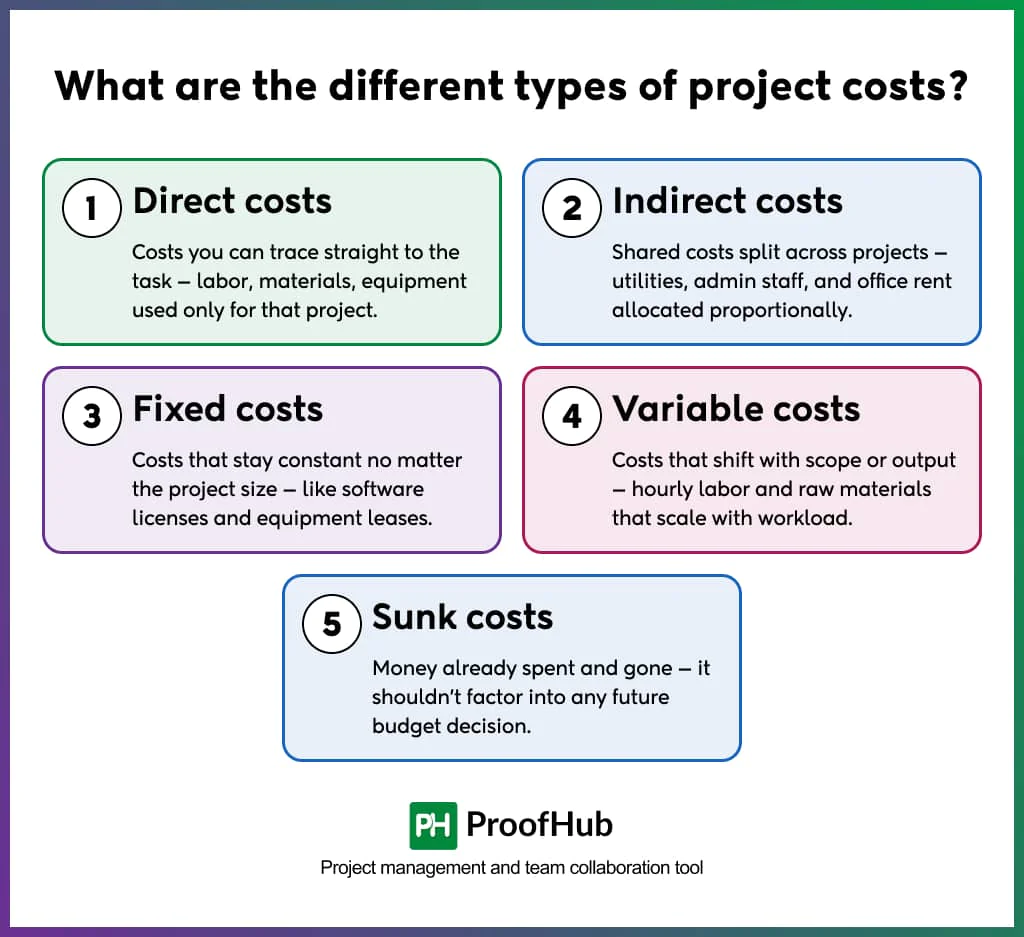
- Direct costs are expenses tied directly to a specific project task, such as labor, materials, and equipment used only for that project. Teams can trace them precisely to project activities, making them easy to track and control. Direct costs form the core of most budget estimates.
- Indirect costs are shared expenses that support multiple projects at once, like utilities, administrative staff, or office rent. Teams allocate them proportionally since no single project consumes them exclusively. Managing indirect costs well prevents budget dilution across departments.
- Fixed costs stay the same regardless of project size or duration, such as software licenses or equipment leases. They provide predictability, letting teams budget confidently without worrying about fluctuation. Fixed costs simplify long-term financial planning.
- Variable costs change based on project scope or output, including hourly labor and raw materials. They scale with workload, requiring closer monitoring as scope shifts. Variable costs demand flexible budgeting to accommodate changing needs.
- Sunk costs are expenses already spent that cannot be recovered, and they should not influence future budget decisions. Smart teams exclude them from future decisions, focusing only on forward-looking costs.
What are the steps to estimate project costs accurately?
The steps to estimate project cost accurately are: define the project scope, break down the work, list resources, estimate resource costs, select your estimation technique, calculate total project cost, add contingency, validate the estimate, and continuously reforecast.
Each phase of the process builds directly on the data gathered in the previous step. Skipping any part of this sequence can lead to major gaps and unforeseen budget overruns.
To ensure your final estimate is grounded in reality, you should follow this structured workflow:
1. Define the project scope
Outline deliverables, objectives, and boundaries to understand exactly what the project will and won’t include. A clear scope prevents scope creep, which is one of the biggest causes of budget overruns. Skipping this step leads to inaccurate figures that fail to hold up as the project progresses.
A well-defined scope ties every cost back to a specific deliverable, making the entire estimation process more precise and defensible.
2. Break down the work
Divide the project into a work breakdown structure. Splitting work isolates individual cost drivers instead of leaving the project as one large, hard to price block.
Finally, each task becomes a discrete, estimable unit within the overall cost estimate.
3. List resources
List all the available resources and identify everything a task requires, including people, equipment, materials, and services. Going task by task ensures nothing gets missed when resources are being tallied.
A comprehensive resource listing ensures a complete resource inventory that prevents gaps in the final cost estimate.
4. Estimate resource costs
Assign a price to each resource using market rates, vendor quotes, or historical data. This grounds costs in real data rather than guesswork and keeps the numbers defensible.
Follow the resource cost estimation methodology closely to convert resource lists into concrete cost figures ready for aggregation.
5. Select your estimation technique
In this step, choose the cost calculation method, such as bottom-up or parametric estimation, based on the available data and project complexity.
The selected estimation technique sets the level of accuracy and detail. This step helps in picking the best estimation approach that fits the project and produces a reliable cost figure, which can be used in further processes.
6. Calculate total project cost
To calculate the total project cost, sum all direct and indirect costs across every task. You can use any technique of your choice to do this, like bottom-up estimation.
Combining task-level costs produces one consolidated figure for the entire project. In the end, it produces an estimate for the working budget.
7. Add contingency
Set aside 10 to 14 percent of the approved budget as buffer funds to absorb unforeseen circumstances.
Even well-built estimates can’t fully eliminate uncertainty, so this reserve gives teams a financial cushion rather than leaving them exposed.
Having a contingency in place means unexpected issues get resolved with planned funds instead of derailing the budget altogether.
8. Validate the estimate
Have team members or subject matter experts independently review the cost estimate before it’s locked in.
Skipping this step means errors or blind spots can slip through unnoticed and surface later as budget surprises.
Independent validation gives the estimate credibility and ensures it’s accurate enough to serve as the final, approved budget.
9. Continuously re-forecast
Revisit and update the estimate as the project progresses and new information comes to light.
A budget left static from day one drifts further from reality with every change in scope, resources, or conditions.
Ongoing re-forecasting keeps the cost estimate aligned with actual performance throughout the project’s lifecycle.
What are the common techniques for project cost estimation?
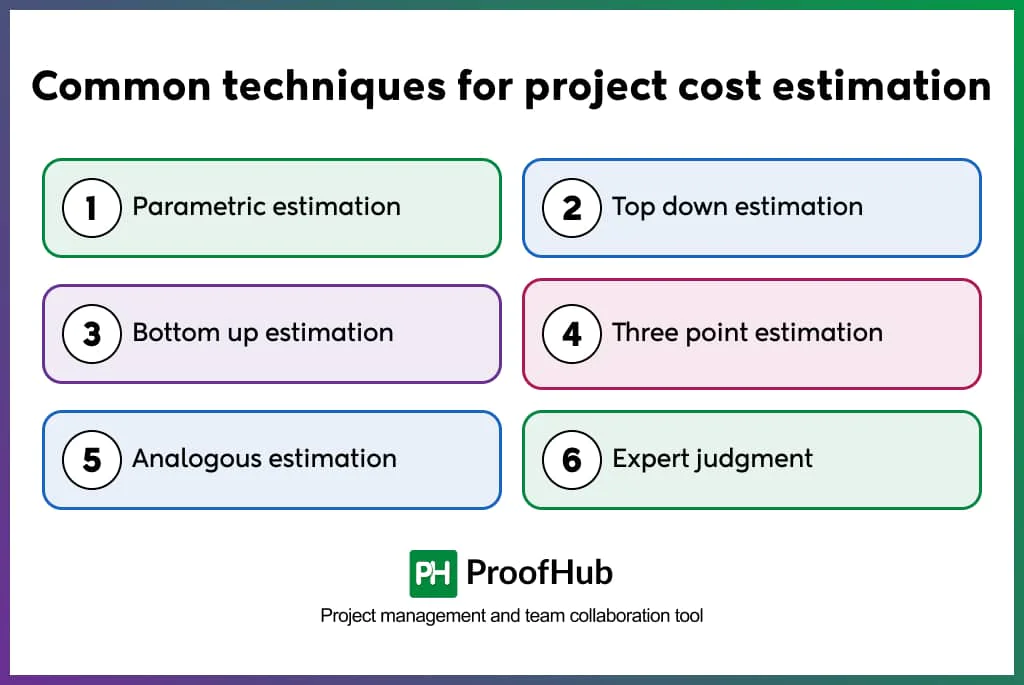
The common techniques for project cost estimation are parametric estimation, top-down estimation, bottom-up estimation, three-point estimation, analogous estimation, and expert judgment.
The method you choose will depend heavily on your current planning stage and data availability. Using the wrong formula can result in estimates that are either too vague or needlessly time-consuming.
You can choose the ideal approach for your timeline and goals from the Cost estimation techniques below:
1. Parametric estimation
Parametric estimation uses statistical relationships between historical data and specific project variables (such as cost per square foot in construction or lines of code in software development) to calculate cost projections.
It requires identifying the key cost drivers and applying mathematical scaling to the current project’s scope. It provides a data-driven, calculated estimate based on statistical formulas and defined project units.
It is highly effective, provided that the underlying historical data is accurate, the variables are scalable, and the project model is mature. It is incredibly efficient for repeatable types of work.
2. Top-down estimation
Top-down estimation starts with a macro-level budget figure, often dictated by executive leadership, historical benchmarks, or client constraints, and systematically divides it downward across major project phases, departments, or high-level tasks.
It is a high-level budget allocation that sets spending boundaries for major project components. Its effectiveness is low to moderate.
While top-down estimation is exceptionally fast and useful for early-stage feasibility checks or strict target-setting, it lacks granular precision and risks ignoring hidden operational costs.
3. Bottom-up estimation
The bottom-up estimation method involves meticulously estimating the costs of individual work packages or discrete tasks at the lowest level of the Work Breakdown Structure (WBS) and then rolling them up to calculate the total project cost.
It requires a highly defined project scope and input from the team members who will actually perform the work. It provides a granular, highly detailed, and completely itemized cost baseline. It is extremely effective.
Bottom-up estimation is widely considered the most accurate and reliable estimation technique, though it demands significant time, resources, and well-defined project details to execute.
4. Three-point estimation
Three-point estimation addresses risk and uncertainty by calculating three distinct cost scenarios: Optimistic (best-case), Pessimistic (worst-case), and Most Likely.
These figures are then run through a formula, either a simple average (Triangular distribution) or a weighted average that favors the most likely outcome (Beta/PERT distribution).
It gives a risk-adjusted, statistically weighted cost estimate that includes a calculated buffer for uncertainty. It is considered highly effective, particularly for unique or high-risk projects. By moving away from a single “guess,” three-point estimation gives stakeholders a realistic range and significantly improves budget resilience.
5. Analogous estimation
Also known as top-down benchmarking, this technique bases the current project’s estimate on the actual costs of a similar, completed past project.
It is heavily utilized when there is limited detailed information available about the current endeavor. It provides a swift, top-level estimate derived from historical precedent.
It is moderately effective. Analogous estimation is incredibly fast and cost-effective to produce during early project chartering, but its accuracy depends entirely on how closely the past project truly mirrors the new one.
6. Expert judgment
This approach relies on the specialized knowledge, intuition, and historical insights of industry experts, consultants, or senior team members who have extensive experience with similar work.
Rather than working in a vacuum, it is best used to calibrate, validate, or adjust the findings of the other quantitative estimation methods.
It gives an expert-validated estimate adjusted for real-world nuances, market conditions, and hidden complexities. Expert judgement is highly effective when paired with other methods.
How to choose the right project cost estimate technique?
To choose the right cost estimation technique, consider project stage, complexity, historical data, resources, and accuracy needs.
Weigh how much time you have against the level of precision required by stakeholders. Making the wrong choice can lead to wasted administrative hours or an inaccurate baseline.
Consider these critical guiding factors before locking in your estimation strategy:
1. Identify the project stage
Teams pick their technique based on where the project stands. Early-stage projects with limited details suit rough methods like analogous estimation, while later stages with defined scope call for precise techniques like bottom-up estimation.
2. Consider project complexity
Simple, repeatable projects work well with parametric estimation, since consistent rates apply across units. Complex projects with unique deliverables demand more detailed approaches, such as bottom-up estimation, to capture every variable accurately.
3. Review available historical data
Teams with access to strong historical records can rely on parametric or analogous estimation, since both methods depend on past project data. When historical data is scarce or unreliable, teams should shift toward bottom-up estimation, which builds costs from current, verifiable inputs.
4. Assess the time and resources available
Tight deadlines push teams toward faster methods like analogous or parametric estimation, which require less granular analysis. When teams have more time and resources, bottom-up estimation delivers greater precision by evaluating each task individually.
5. Determine the required accuracy
High-stakes projects with strict budgets need accurate techniques like bottom-up or three-point estimation. Projects still in the planning phase can tolerate rougher estimates, making analogous or parametric methods sufficient until more details emerge.
What are the common challenges in cost estimating?
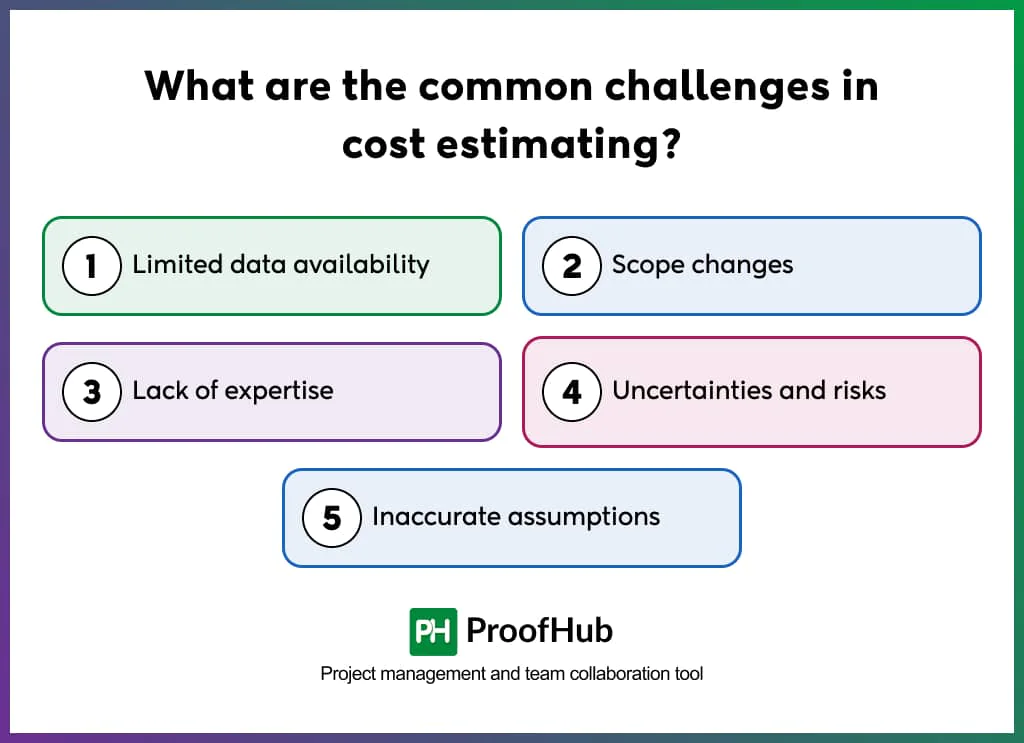
The common challenges in cost estimating are limited data availability, scope changes, lack of expertise, uncertainties and risks, and inaccurate assumptions.
Even the most thoroughly researched budgets can be derailed by sudden external market shifts. Awareness of these common pitfalls allows project managers to actively mitigate them during the planning phase.
Keep a sharp lookout for these frequent stumbling blocks as you build your budget:
- Limited data availability: Organizations not maintaining records of past project costs make it hard to benchmark new estimates against real historical performance. Without data, you rely on guesswork or generic industry averages that don’t reflect the specific project’s conditions. It can cause estimates to either overshoot with unnecessary padding or undershoot by missing real cost drivers, both of which weaken stakeholder confidence in the budget.
- Scope changes: Every time scope changes without a corresponding cost review, the original estimate becomes disconnected from what the project actually needs. This mismatch causes budgets to overrun, as the costs tied to the old scope no longer account for the added tasks, resources, or timeline extensions the new scope demands.
- Lack of expertise: When estimators lack this expertise, they tend to either underestimate complexity or overlook cost drivers entirely. The result is a budget that looks reasonable on paper but breaks down once execution begins, since it wasn’t grounded in an accurate understanding of what the work actually requires.
- Uncertainties and risks: Not accounting for volatilities such as market price fluctuations, resource unavailability, or regulatory shifts directly affects project costs. When these risks materialize without a buffer in place, they force emergency budget reallocations, delay timelines, and erode the credibility of the original cost estimate.
- Inaccurate assumptions: Unrealistic assumptions about resource availability, productivity rates, or task duration introduce hidden errors. For instance, overly optimistic assumptions in particular create estimates that look achievable but aren’t. It widens the gap between estimated and actual costs, often triggering budget overruns that could have been avoided with more rigorous validation upfront.
What are the common project cost estimate tools?
Common types of project estimation tools are: Spreadsheets, Project Management Software, and Dedicated Estimation Tools.
The complexity of the project and the size of the team will dictate which platform is the best fit. Using the right digital workspace drastically reduces calculation errors and saves valuable administrative hours.
Depending on operational scale, managers will likely rely on one of these Project cost estimation tools:
- Spreadsheets, such as Excel or Google Sheets, offer a flexible and low-cost option for smaller projects. These tools are not tailor-made for project management, and they hit limitations very soon when the project complexity increases.
- Project management tools, such as ProofHub, combine cost tracking with scheduling and task management in one platform. Many project management tools have add-ons or separate features specially for cost estimation.
- Dedicated cost estimation software, such as ProEst or CostX, provides advanced features for large or complex projects that need detailed cost modeling. They are highly specialized tools, and they are often used in conjunction with a project management tool.
What is the difference between cost estimation, budgeting and forecasting?
Cost estimation is the predictive process of calculating the total anticipated expenses required to complete a project or initiative. It breaks down individual resources, labor, materials, and risks, establishing a baseline cost before work begins to determine economic feasibility and initial funding requirements.
Budgeting is the formal process of allocating approved financial resources to specific tasks, departments, or project phases over a set timeframe. It transforms the initial cost estimate into an authorized fiscal plan, serving as a baseline control mechanism to track, manage, and restrict actual spending.
Forecasting is the ongoing practice of projecting future financial outcomes based on historical data, current spending trends, and remaining project scope. Unlike a fixed budget, it continuously updates throughout the project lifecycle to predict final costs and anticipate potential deficits or surpluses.
Who is responsible for estimating the project cost?
The project manager typically leads cost estimation, but rarely alone. They coordinate input from team members, subject matter experts, functional managers, and vendors who understand specific cost components (labor, materials, equipment).
On larger projects, a dedicated cost estimator or cost engineer may own the process, with the project manager reviewing and approving figures. The project sponsor or PMO often sets estimation standards and reviews final numbers before approval.
Ultimately, accountability for the estimate’s accuracy rests with the project manager, since they present it to stakeholders and are measured against it during execution, even though the work is collaborative.
Which cost estimation method is the most accurate?
Bottom-up estimating is generally the most accurate. It involves breaking the project into individual tasks or work packages, estimating each one’s cost separately, then summing them into a total.
This granularity reduces errors compared to top-down approaches like analogous estimating (comparing to past similar projects) or parametric estimating (using statistical relationships between variables).
Bottom-up requires more time, a detailed scope definition, and a completed work breakdown structure, so it’s typically used once planning has matured. Accuracy comes at the cost of effort; it’s impractical early in a project when scope is still uncertain, which is when rougher methods are used instead.
What is cost control in project management?
Cost control is the process of monitoring project spending, comparing actual costs against the approved budget, and managing changes to the cost baseline throughout the project lifecycle.
It involves tracking expenditures in real time, identifying variances, analyzing their causes, and taking corrective action to keep the project within budget. Techniques include earned value management, variance analysis, and forecasting.
Cost control also covers managing change requests that affect the budget, ensuring only approved changes are implemented, and keeping stakeholders informed of cost status. It’s a continuous activity from project start to closure, not a one-time check, aimed at preventing budget overruns.
What is cost-benefit analysis in project management?
Cost-benefit analysis (CBA) is a technique used to evaluate whether a project or decision is financially worthwhile by comparing its total expected costs against its total expected benefits, usually expressed in monetary terms.
It helps stakeholders decide whether to proceed with a project, choose between alternatives, or justify budget allocation. The analysis considers both tangible costs/benefits (money, resources) and intangible ones (reputation, customer satisfaction) where possible.
Common outputs include net benefit, benefit-cost ratio, and payback period. CBA is typically performed during project initiation or planning, before major resource commitments, to support informed go/no-go decisions.
Conclusion
Accurate cost estimation serves as the baseline for all subsequent project planning, resource allocation, and financial tracking. By systematically defining project scopes, selecting appropriate estimation methodologies, and leveraging specialized budget tools, project managers can significantly minimize the risks of budget overruns. Ultimately, maintaining a disciplined approach to cost estimation ensures that projects remain financially viable, stakeholder expectations are met, and organizational resources are utilized efficiently from initiation to completion.