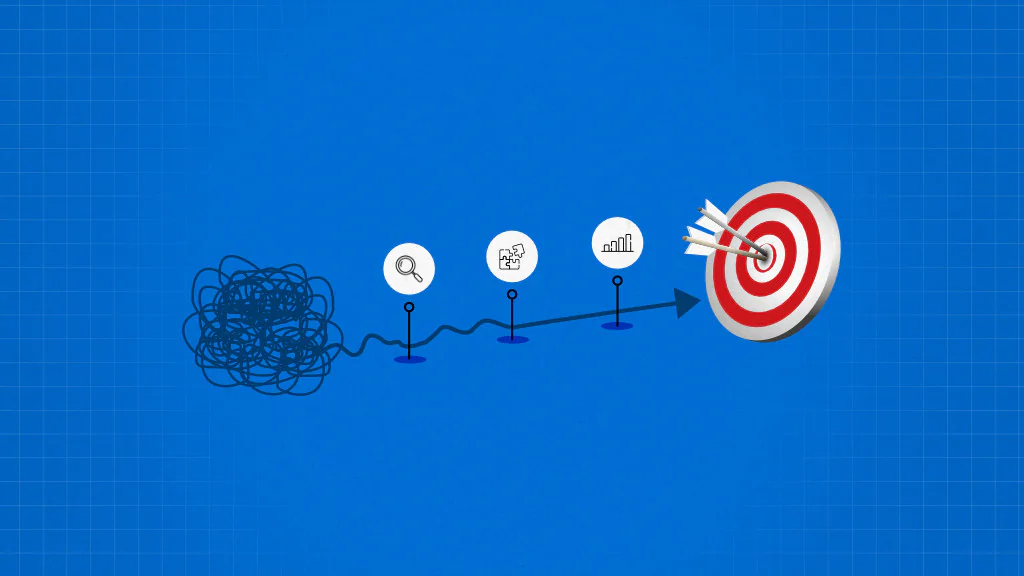
Progressive elaboration is a key concept in project management that helps teams deal with uncertainty by refining plans as more information becomes available. Instead of relying on fixed assumptions from the start, it allows project managers to continuously improve scope, estimates, and decisions throughout the project lifecycle.
The approach not only increases planning accuracy but also enhances flexibility, risk management, and stakeholder alignment.
In this guide, you’ll understand what progressive elaboration is, why it matters, how to implement it, and how it is applied across different industries.
- 1.Progressive elaboration, which improves accuracy over time, allows project teams to start with high-level plans and continuously refine scope, timelines, and estimates as more information becomes available, leading to better decision-making.
- 2.Helps manage uncertainty and risk effectively. By regularly updating project details, teams can identify potential risks early and take corrective action, reducing the likelihood of major disruptions.
- 3.Flexibility is a core advantage. Progressive elaboration enables teams to adapt to changing requirements, market conditions, and stakeholder expectations without losing alignment with project goals.
- 4.Strong change control is essential. Without proper processes, continuous refinement can lead to scope creep. Structured change management ensures that updates remain controlled and aligned with objectives.
- 5.It enhances collaboration and stakeholder alignment. Regular updates and refinements keep stakeholders informed and involved, improving communication, trust, and overall project success.
What is progressive elaboration?
Progressive elaboration is the iterative process of continuously refining and detailing plans, estimates, and project information as more knowledge becomes available.
It supports effective planning, scope management, risk reduction, decision-making, and project lifecycle control in the face of evolving requirements and uncertainty.
What is the purpose of progressive elaboration?
The main purpose of progressive elaboration is to improve project accuracy and adaptability by refining plans as new information becomes available. It helps project teams make informed decisions, reduce uncertainty, and manage changing requirements effectively.
Through continuous detailing of scope, schedule, cost estimates, and resources, progressive elaboration enhances project planning, supports risk management, and increases the likelihood of achieving project objectives throughout the project lifecycle.
Why is progressive elaboration important for project success?
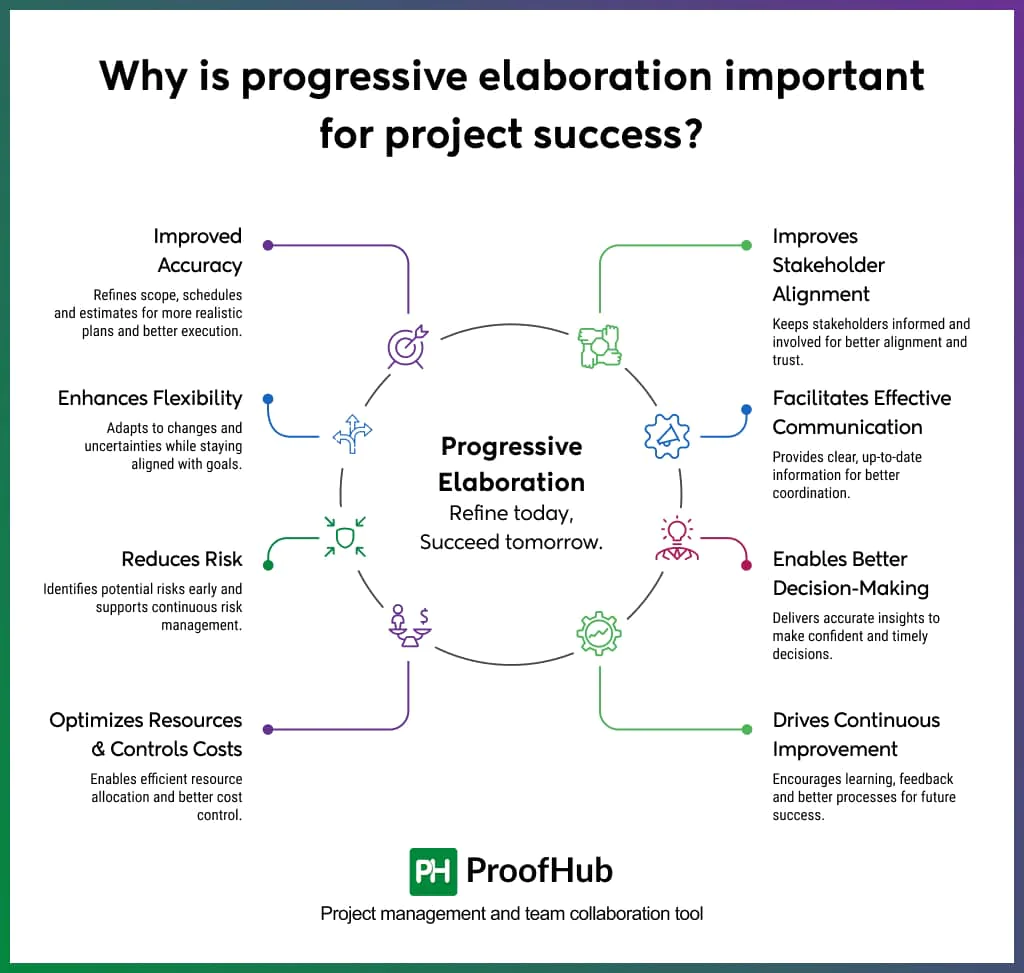
Progressive elaboration is important because it improves accuracy in project planning and execution, enhances flexibility and adaptability, supports risk management, enables efficient resource allocation and cost control, improves stakeholder engagement and alignment, facilitates effective communication, enables better decision-making, and provides a deeper understanding for continuous improvement.
Here, sharing the key reasons that explain why progressive elaboration is important for successful projects in Project Management:
- Improves project planning and execution accuracy: Increases planning accuracy by refining project scope, schedules, deliverables, and estimates over time. As additional information becomes available, it enables project managers to make more realistic decisions and adjustments, reducing errors and improving execution efficiency throughout the project lifecycle.
- Enhances flexibility and adaptability: Helps teams remain flexible by allowing continuous updates to plans and strategies. This adaptability enables organizations to respond effectively to unexpected challenges while maintaining alignment with project goals and stakeholder expectations.
- Supports risk management: Helps identify potential risks early by continuously reviewing and refining project information. Enables project managers to assess uncertainties, implement mitigation strategies, and monitor risks throughout the project.
- Enables efficient resource allocation and cost control: Clarifies project requirements and priorities over time, enabling more efficient resource allocation and cost control. It helps project managers optimize project resources, tools, and costs effectively.
- Improves stakeholder engagement and alignment: Ensures stakeholder expectations, objectives, and deliverables stay aligned throughout the project. It builds trust, encourages collaboration, and reduces misunderstandings among project participants.
- Facilitates effective communication: Supports better communication by regularly providing updated, detailed project information. Improves coordination, reduces confusion, and enhances overall collaboration during project execution.
- Enables better decision-making: Helps leaders take appropriate actions that improve efficiency, quality, and project outcomes by providing updated insights into project performance, risks, and opportunities
- Provides a deeper understanding for continuous improvement: Encourages evaluation, feedback, and knowledge sharing, which improves processes and decision-making by allowing teams to learn from ongoing activities and experiences.
What are the methods to help apply progressive elaboration?
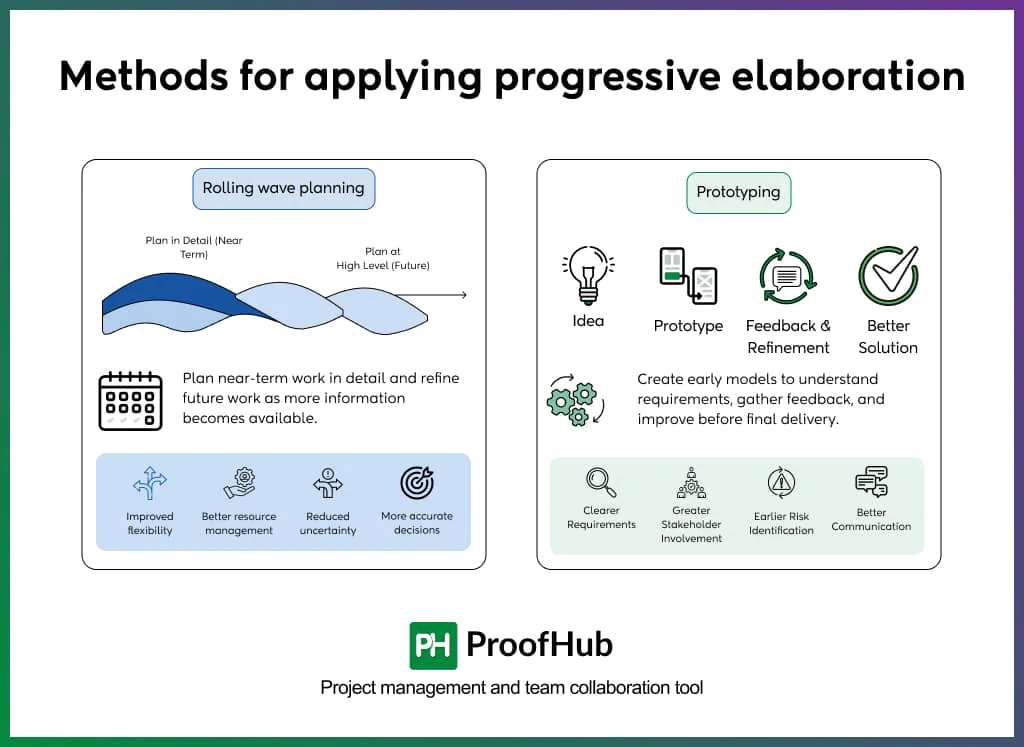
The methods for applying progressive elaboration are rolling wave planning and prototyping.
These methods improve planning accuracy, adaptability, communication, and overall project control throughout the project lifecycle.
1. Rolling Wave Planning
Rolling Wave Planning is a planning technique in which near-term project activities are planned in detail. Whereas, future activities are planned at a higher level of projects until more information becomes available. It allows project managers to continuously update schedules, resources, and deliverables as the project progresses.
The main benefits of rolling wave planning include improved flexibility, better resource management, reduced uncertainty, and more accurate decision-making. It is commonly used in complex or long-term projects where future requirements may change over time.
The technique is most suitable for projects operating in dynamic environments, such as software development, construction, research, and innovation-focused industries.
2. Prototyping
Prototyping is a technique for creating an early sample, model, or version of a product or solution to better understand project requirements and gather stakeholder feedback. It helps teams refine ideas, identify issues, and improve project outcomes before final implementation.
The benefits of prototyping include a clearer understanding of requirements, greater stakeholder involvement, earlier risk identification, and enhanced communication between teams and clients.
Prototyping is most suitable when project requirements are unclear, evolving, or highly dependent on user feedback and testing.
It is widely used in software development, product design, engineering, and user experience projects.
How to implement progressive elaboration?
Progressive elaboration is implemented by starting with a high-level plan, breaking work into smaller tasks, and refining requirements over time. It involves continuously updating plans, aligning with stakeholders, and managing changes through structured processes.
Explanation of key points
- Start with high-level planning: Begin with a broad overview of project goals, scope, and deliverables. This provides direction without over-detailing early stages, allowing flexibility to adapt as more information becomes available.
- Break down work into manageable components: Divide the project into smaller, actionable tasks or work packages. This improves clarity, accountability, and makes it easier to plan, execute, and monitor progress effectively.
- Refine requirements iteratively: Add detail to requirements as the project progresses. Continuous refinement ensures accuracy, reduces uncertainty, and aligns evolving project needs with real-world conditions.
- Update schedule and estimates continuously: Regularly revise timelines, budgets, and resource estimates based on new insights. This keeps the project realistic and helps prevent delays or cost overruns.
- Validate and align with stakeholders regularly: Engage stakeholders frequently to review progress and confirm expectations. This ensures alignment, builds trust, and minimizes misunderstandings or rework.
- Control changes through formal processes: Use structured change management to evaluate and approve modifications. This maintains project stability, prevents scope creep, and ensures all changes are properly documented and assessed.
What are the common challenges with progressive elaboration?
Common challenges in progressive elaboration include unclear early estimates, scope creep, stakeholder resistance to change, frequent changes to the plan, keeping documentation up to date, and team misalignment.
While it improves flexibility and accuracy over time, it also introduces complexities that must be carefully managed.
- Unclear early estimates: Initial cost and time estimates are often unclear because detailed requirements aren’t fully defined at project start. This uncertainty complicates budget approvals and resource allocation, making it difficult to set realistic stakeholder expectations and secure necessary funding commitments.
- Scope creep risk: Continuous refinement can lead to uncontrolled expansion of project scope as new details emerge. Without robust change control processes, stakeholders may add features or modify objectives at will, leading to budget overruns, missed deadlines, and a deviation from the original vision.
- Stakeholder resistance to changes: Many stakeholders expect fixed scope and timelines from the start and are uncomfortable with evolving plans. When stakeholders aren’t properly informed or actively involved in the decision-making process, this discomfort intensifies, leading to resistance, confusion, and frustration that can undermine project support and momentum.
- Frequent changes in plan: Regular updates to schedules, resources, and deliverables can create operational chaos and team destabilization. The constant flux requires robust change management and clear communication, while the replanning effort itself consumes significant time and resources that could be devoted to actual work.
- Keeping documentation updated: Evolving details require continuous revision of all project documentation, which is labor-intensive and often deprioritized under time pressure. Outdated documentation undermines decision-making, confuses new team members, and leads to rework when teams inadvertently follow superseded information.
- Team misalignment: Continuously evolving details can lead to divergent interpretations of requirements and priorities among team members. This misalignment results in duplicated efforts, conflicting deliverables, and integration challenges, requiring regular synchronization meetings and clear communication protocols to maintain collective understanding.
Practical examples of progressive elaboration across industries
Progressive elaboration is widely used across industries where requirements evolve over time and decisions improve with new information. It allows teams to start with a high-level plan and refine it continuously based on feedback, data, and changing conditions.
Here are simple, practical examples across different industries:
1. Software Development
In software development, teams often begin with a basic version of the product (MVP) and gradually enhance it through iterations. Features, design, and performance are refined based on user feedback and testing. This iterative approach ensures the final product aligns closely with user needs and market demands.
2. Construction
In construction projects, initial designs and cost estimates are created early, but details evolve as more information becomes available. Factors like site conditions, materials, and regulations may require adjustments during execution. Progressive elaboration improves planning accuracy and ensures smoother project delivery.
3. Marketing Campaigns
Marketing campaigns often start with assumptions about target audiences and strategies, which are refined over time using real performance data. Teams continuously optimize messaging, channels, and budgets based on analytics and trends. This approach maximizes ROI and keeps campaigns relevant in a dynamic market
Progressive elaboration is implemented by starting with a high-level plan, breaking work into smaller tasks, and refining requirements over time. It involves continuously updating plans, aligning with stakeholders, and managing changes through structured processes.
Where does progressive elaboration fit in the project lifecycle?
Progressive elaboration is applied throughout the project lifecycle, not just in a single phase.
It begins during initiation with high-level assumptions and continues into planning, where details are gradually refined.
During execution, plans, scope, and deliverables are updated based on new insights and feedback.
In monitoring and controlling, it ensures that changes are evaluated and aligned with project goals. Rather than being a one-time activity, progressive elaboration is a continuous process that improves accuracy and decision-making as the project evolves.
Can progressive elaboration work in waterfall projects?
Yes, progressive elaboration can work in waterfall projects, but only in a controlled, limited way. While waterfall follows a sequential structure with defined phases, some refinement still occurs, especially during the planning and design stages.
Teams may start with broad requirements and gradually add detail before moving to execution. However, unlike in agile environments, changes are less flexible once a phase is completed.
Progressive elaboration in the waterfall model is usually front-loaded, meaning most refinements occur early in the project. It helps improve clarity and reduce uncertainty, but must be managed carefully to avoid disrupting the methodology’s structured flow.
What is the difference between progressive elaboration and agile?
Progressive elaboration is a planning principle where details are refined over time as information emerges. Agile is a specific methodology that uses this principle through iterative sprints, emphasizing flexibility and continuous customer feedback.
What is the difference between progressive elaboration and rolling wave planning?
Progressive elaboration is the broad principle of continuously refining project details as more information becomes available throughout the entire project.
Rolling wave planning is a specific technique that implements progressive elaboration. It involves detailed planning for near-term work while keeping distant future work at a high level, then progressively detailing upcoming phases as they approach.
Can progressive elaboration increase scope creep?
Yes, progressive elaboration can increase the risk of scope creep if not managed properly. Since the approach encourages refining and expanding project details over time, there is a tendency to introduce new ideas, features, or requirements continuously.
Without a robust change control process, these additions can exceed the original project scope. This can lead to increased costs, extended timelines, and reduced focus on core objectives.
However, when supported by proper governance, approvals, and documentation, progressive elaboration can actually help control scope by making changes more transparent and intentional rather than accidental.
Can progressive elaboration reduce project risks?
Yes, progressive elaboration helps reduce project risks by enabling teams to make decisions based on evolving, more accurate information.
Instead of relying entirely on early assumptions, teams continuously validate and refine plans as the project progresses. This reduces uncertainty and helps identify potential issues earlier. It also improves stakeholder alignment by adjusting expectations in real time.
By breaking down work into manageable parts and refining them gradually, teams can respond to risks proactively rather than reactively.
However, its effectiveness depends on strong communication, monitoring, and change management practices.