

A strong foundation is critical to project success, making the initiation phase a key step in the project management lifecycle. During this stage, managers define the project’s purpose, scope, value, stakeholder expectations, and feasibility before moving into detailed planning.
In this article, we will walk you through the essential steps for effective project initiation, highlight the key documents required, and identify common mistakes to avoid.
- 1.Project initiation is the first phase of the project management lifecycle, where the project’s purpose, scope, and goals are defined before planning or execution begins.
- 2.Key documents created during this phase include the business case, project charter, team charter, and PID.
- 3.The project sponsor, project manager, key stakeholders, senior management, and subject matter experts all play a critical role in driving a successful initiation phase.
- 4.Core components such as feasibility assessment, scope definition, stakeholder analysis, and initial risk evaluation lay the groundwork for a smooth project execution.
- 5.Using the right tools and techniques, including SWOT analysis, stakeholder analysis, risk assessment, and project management software, makes the initiation phase more structured and reliable.
What is project initiation?
Project initiation is the first stage of the project management lifecycle, where managers define the project’s scope, purpose, and goals.
In this phase, the manager is typically responsible for carrying out the following activities to ensure smooth project execution:
- Creating a detailed business case. The document includes an executive summary, a problem or opportunity statement, a cost-benefit analysis, and alignment with strategic objectives.
- Evaluating the project’s feasibility to determine whether it has business value and is worth considering.
- Identifying the key stakeholders and understanding their expectations to drive project success.
- Developing the project charter, a formal document that authorizes the project and assigns responsibilities.
During initial stage, stakeholders can approve or deny projects, so it’s critical to lay the groundwork to secure their approval. Also, managers make crucial decisions, such as selecting project sponsors, assessing resource requirements, and defining success criteria.
Why is project initiation important?
Project initiation is important as it proves the project’s value, clarifies the purpose, aligns the project with business goals, defines a clear scope, identifies risks, and secures approval and resources.
It serves as a roadmap for the team, providing clear direction, minimizing uncertainty, and ensuring successful project delivery.
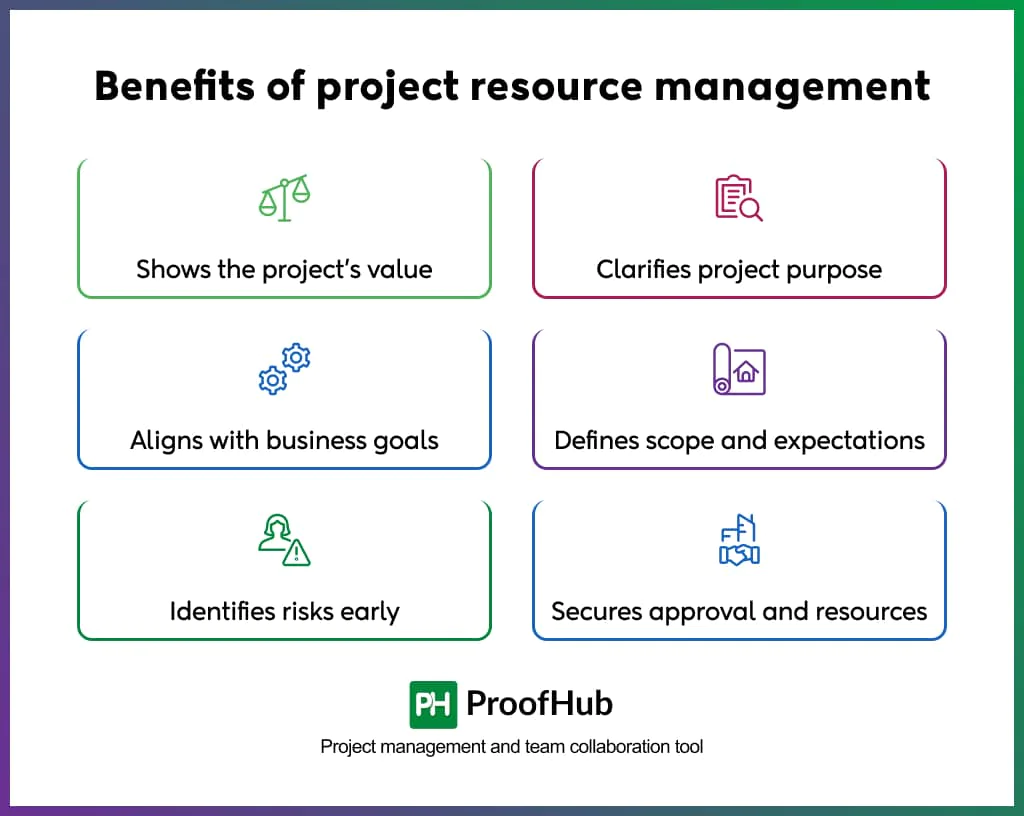
Let’s understand each of them in-depth:
- Shows the project’s value: Project initiation helps evaluate the value a project will deliver before committing significant resources. Preventing teams from investing time and effort into an initiative that isn’t worth pursuing in the first place.
- Clarifies project purpose: Ensures that everyone understands the project’s purpose, feasibility, and success criteria. Clarifying the goal at the start gives the team a shared direction, supporting alignment and consistency throughout the project lifecycle.
- Aligns project with business goals: Makes sure projects support the organization’s overall goals and priorities. The alignment allows managers to invest time and money in the project that directly contributes to the business’s long-term objectives.
- Defines scope and expectations: A strong initiation phase defines clear scope and expectations beforehand, minimizing costly rework during project planning and execution. Thus, teams stay aligned and collaborate effectively to reach the end goal.
- Identifies risks early: Project initiation helps identify potential risks and challenges early, enabling teams to prepare mitigation strategies. It prevents costly bottlenecks and keeps the project on track toward successful delivery.
- Secures approval and resources: The initiation phase allows managers to secure the necessary approvals, funding, and resources by conducting a feasibility study and developing a project charter. It gives teams the clear direction and organizational backing to move ahead with confidence.
Who are the key participants in the project initiation?
The key members involved in the project initiation process are the project sponsor, project manager, stakeholders, senior management, and subject matter experts.
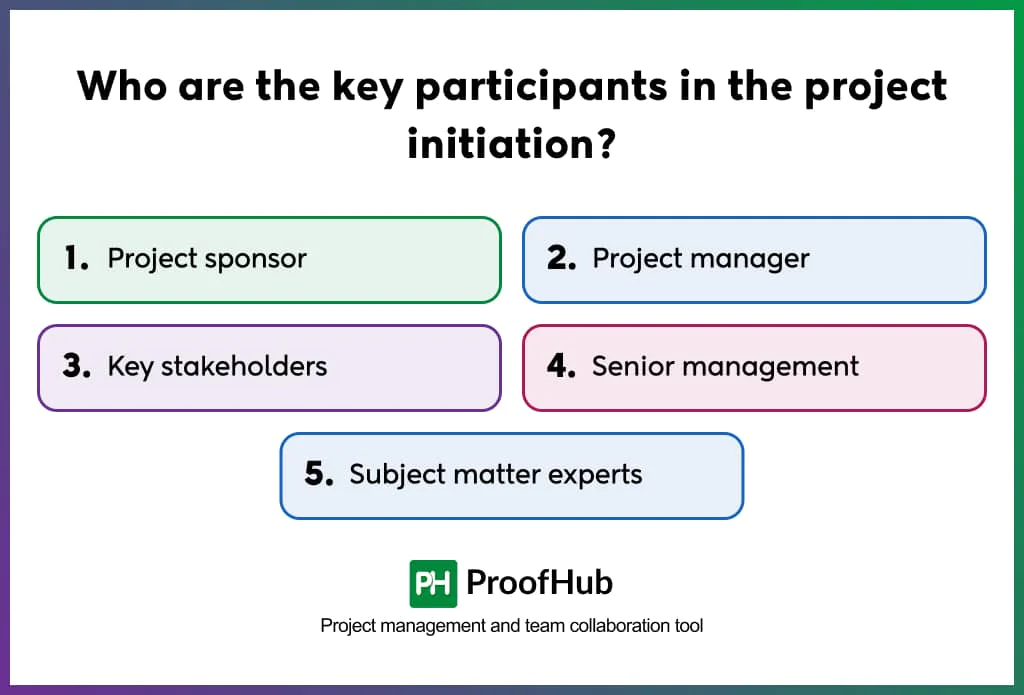
Here is a closer look at each of their roles:
1. Project sponsor
The project sponsor is a senior executive who oversees the project and secures the necessary resources and approvals. As the primary advocate, they approve the business case, address high-level challenges, make decisions, and provide authority to kick off the project.
2. Project manager
The project manager is responsible for managing the project from initiation to completion. They create the business case, define the scope, outline objectives, develop the project charter, coordinate with stakeholders, and lay the groundwork for smooth project execution.
3. Key stakeholders
Stakeholders include all individuals or groups with a direct interest in the project’s outcome. They can be department heads, clients, business leaders, and end users. Their input during initiation helps shape the scope, priorities, and success criteria before work begins.
4. Senior management
Senior leaders provide high-level oversight and strategic direction to the project. They analyze and approve the project’s scope, objective, and budget. During initiation, senior executives ensure the project aligns with business priorities and offer insights on risk management and resource allocation.
5. Subject matter experts
Subject matter experts are specialists who bring domain-specific knowledge and insights during initiation. Their expertise contributes to feasibility studies, operational risk assessments, and realistic estimates of resource needs and project timelines.
What documents are created in the project initiation phase?
The four key documents created during the project initiation phase are the business case, project charter, team charter, and project initiation document (PID).
They not only align the team and secure buy-in, but also play a critical role in setting the stage for an effective, robust project management plan.
Below is the breakdown of the most essential ones:
1. Business case
The business case is a detailed document that clarifies the project’s need and outlines the compelling reasons to proceed. It explains the project’s purpose, the value it will deliver, and how the project aligns with the business’s strategic goals.
Decision-makers use this document to evaluate the project’s feasibility and its overall impact on the organization before investing resources.
A business case should include:
- Executive summary covering the business problem or opportunity statement, suggested solution, and expected benefits.
- Implementation plan outlining the project scope, timelines, deliverables, and required resources.
- Cost-benefit breakdown covering project costs, return on investment (ROI), and key assumptions.
- Risk assessment identifies potential risks and the mitigation plan.
- Strategic alignment explains how the project supports organizational goals.
- Conclusion defining the project’s potential and outlining the next steps.
2. Project charter
The project charter is a high-level document that officially authorizes the project. Once signed off by the project sponsor, it gives the project manager the formal authority to use organizational resources and move the project forward.
A project charter typically includes:
- Project name, sponsor, and manager
- High-level objectives and key deliverables
- Timeline, budget, and constraints
- Known risks and assumptions
3. Team charter
The team charter defines how the team will work together throughout the project lifecycle. It sets clear expectations around roles, responsibilities, and working norms. The document is especially valuable for cross-functional or distributed teams where miscommunication is more likely.
A team charter typically includes:
- Each team member’s role and responsibility
- Decision-making process
- Communication preferences and tools
- Conflict resolution guidelines
4. Project initiation document (PID)
The project initiation document (PID) is the most comprehensive document, including all initiation details. The document serves as a central repository for all stakeholders to stay aligned throughout the project. It provides a single, reliable source of truth, offering clarity before the project moves into the planning phase.
It is commonly used in PRINCE2-based project environments.
A PID typically includes:
- Objectives and business case summary
- Scope definition and major milestones
- Key stakeholders and their roles
- Acceptance criteria
- Risk factors
- Governance structure and required approvals
- Quality management plan
What are the components of the project initiation phase?
The key components of project initiation include assessing project feasibility, defining the scope, identifying stakeholders, evaluating risks, and developing a project charter.
It also involves determining required resources, establishing a communication plan, outlining a work breakdown structure, and securing formal approval.
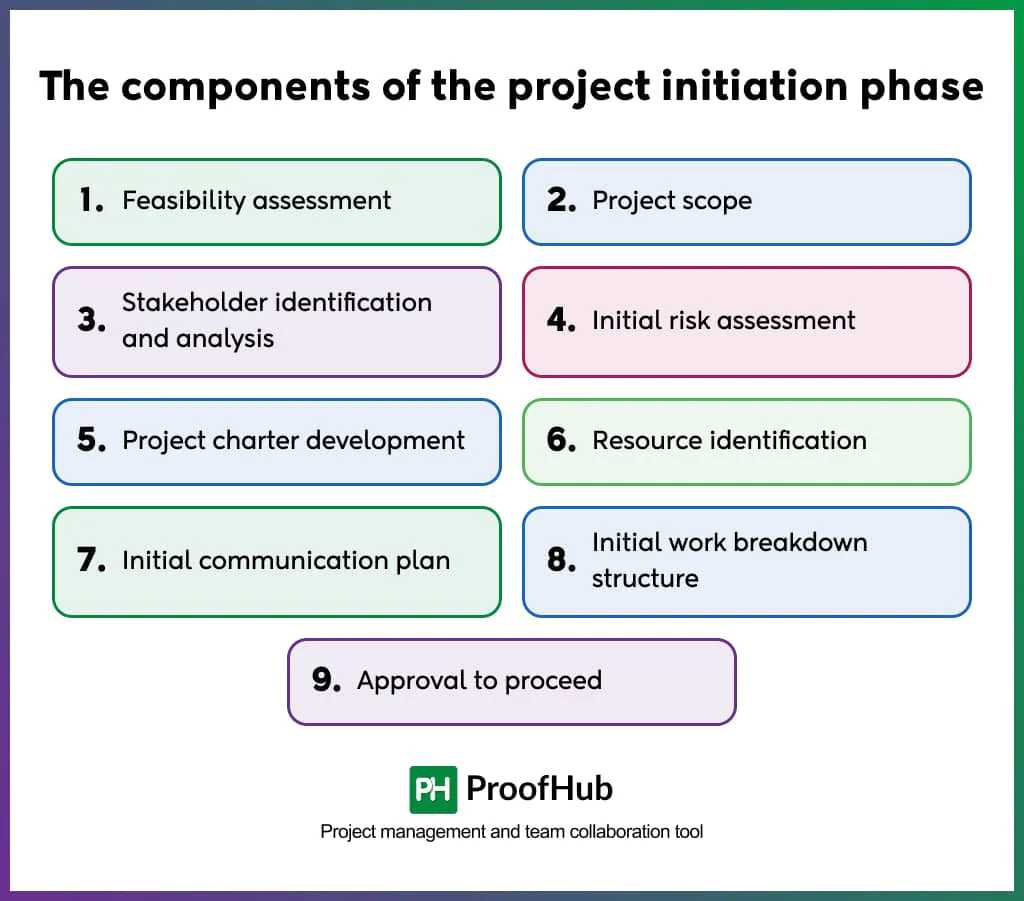
Here’s a step-by-step breakdown of how to go through this phase appropriately:
1. Feasibility assessment
A feasibility assessment evaluates whether the project is realistic and worth pursuing before committing any resources. It examines the project’s viability from a technical, financial, operational, and scheduling perspective to support an informed go/no-go decision.
Here’s a closer look at each of them:
- Technical feasibility: Does the team have the right tools, technology, and skills to deliver the project?
- Financial feasibility: Does the project make financial sense, considering the budget, projected ROI, and payback period?
- Operational feasibility: Can the existing team structure and internal processes support the project’s demands?
- Schedule feasibility: Is the proposed timeline realistic given the team’s current capacity and workload?
2. Project scope
Project scope refers to the detailed outline of all the work required to complete the project successfully. This high-level scope definition clearly defines the boundaries for what is included and excluded from the project. It outlines stakeholder requirements, key deliverables, known constraints, deadlines, tasks, budget, and the success criteria.
A well-defined project scope serves as a foundation for planning, execution, and monitoring. It reduces misunderstandings, keeps the team on track, and prevents the risk of scope creep during execution.
3. Stakeholder identification and analysis
Stakeholder identification involves identifying every individual, team, or group with an interest in or the ability to influence the project’s outcome. Each stakeholder is then analyzed to assess their level of interest and influence.
This evaluation helps ensure that every key stakeholder receives the right level of communication throughout the project lifecycle. Missing a critical stakeholder at this stage can lead to resistance, delays, or misaligned expectations later.
4. Initial risk assessment
The initial risk assessment is a high-level examination of all potential risks associated with the project. It considers factors such as technological issues, resource constraints, scope changes, and market volatility. After evaluation, managers can use a risk matrix to prioritize potential risks by likelihood and impact.
Accordingly, they can develop mitigation strategies, such as contingency planning, timeline adjustments, or resource redeployment, to address each identified risk. Catching such risks early on prevents surprises later and supports smooth project execution.
5. Project charter development
The project charter formally authorizes the project and gives the project manager the authority to use organizational resources. Developing the charter involves consolidating all initiation inputs in a single document. This outlines objectives, scope, stakeholders, risks, constraints, high-level milestones, and assumptions.
Once approved, the charter serves as the official reference point for all decisions made throughout the project lifecycle. This agreement keeps all team members and sponsors aligned before execution, guiding towards successful project delivery.
6. Resource identification
Resource identification gives the project sponsor and senior management a clear picture of what the project will require in terms of people, budget, equipment, and tools. At this stage, the goal is not to create a detailed resource plan but to confirm that the necessary resources exist and are accessible.
Early estimates help avoid capacity or skill shortages, prevent last-minute firefighting, and support planned hiring. When resources are identified upfront, teams can plan realistically, allocate efficiently, and move into execution confidently.
7. Initial communication plan
An initial communication plan defines how information will be shared between the project team and stakeholders. It outlines who needs to be informed, how often, through which channels, and who is responsible for delivering updates.
Clear, transparent communication keeps everyone aligned and reduces confusion and misinterpretations. When communications expectations are set upfront, teams spend less time chasing updates and more time focused on actual project work.
8. Initial work breakdown structure
The initial work breakdown structure (WBS) allows managers to break the project into smaller, manageable work packages. Giving teams a bird’s-eye view, it helps them estimate effort, understand the overall scope of work, and gain visibility into major deliverables.
It also gives stakeholders a clearer picture of what the project will actually deliver. When the WBS is outlined early, teams enter the planning phase with a structured foundation, making it easier to assign tasks, set timelines, and allocate resources accurately.
9. Approval to proceed
The initiation phase concludes with a formal approval from the project sponsor or senior management. Once all initiation components are in place and reviewed, a go/no-go decision is made.
The approval is the official authorization that signals the project has organizational backing and is ready to move into the planning phase. Without it, the project lacks the authority and resources it needs to move forward confidently.
What are the common mistakes to avoid during project initiation?
The common mistakes project managers should watch out for during the initiation phase include unclear objectives, insufficient stakeholder engagement, inadequate feasibility analysis, unclear scope, poor communication, and weak resource planning.
Another major issue is setting unrealistic expectations, which can lead to misalignment and project failure.
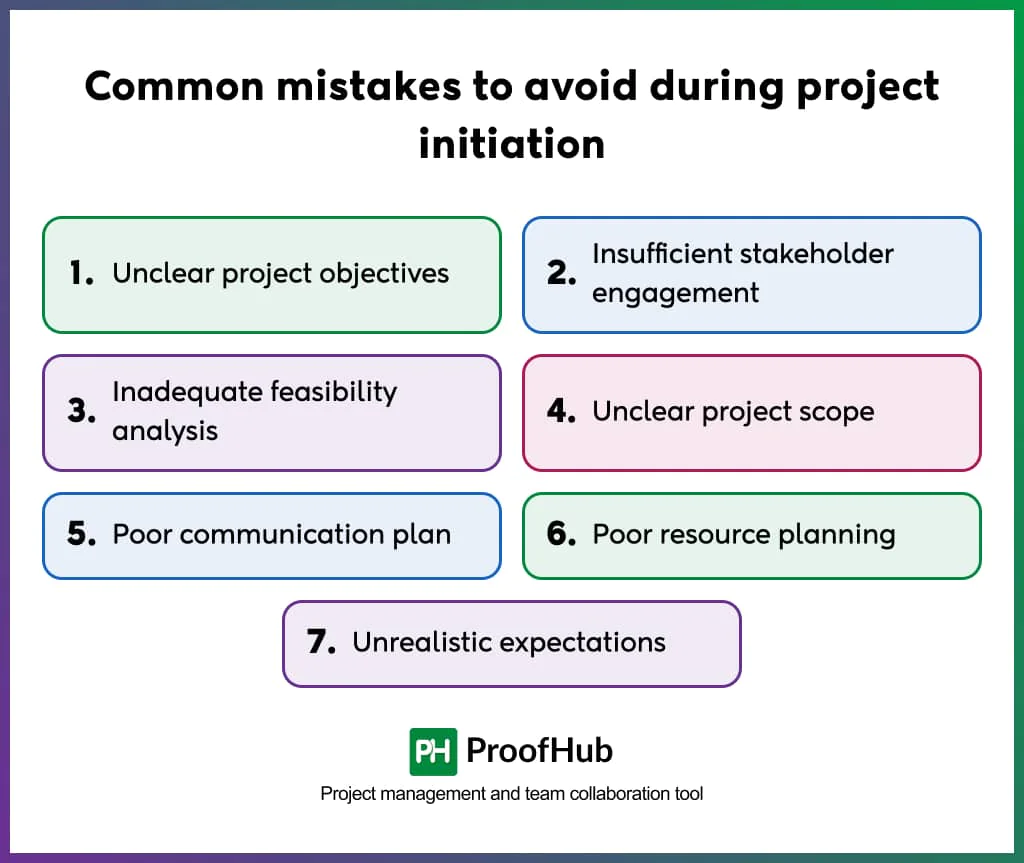
Here is a closer look at each one:
1. Unclear project objectives
Starting a project without clearly defined objectives leaves the team without clear direction. Undefined or vague goals leads to confusion, misaligned efforts, and scope creep.
Solution: Objectives should be SMART (specific, measurable, achievable, relevant, and time-bound). Ensure all key stakeholders agree upon them before the project moves forward.
2. Insufficient stakeholder engagement
Failing to identify and involve key stakeholders during the initiation phase leads to resistance, a lack of buy-in, missed requirements, and unexpected bottlenecks.
Solution: Identify and engage all stakeholders early in the process to avoid surprises later in the project lifecycle. Communicate with them to gather their input and expectations while keeping them informed of every new update.
3. Inadequate feasibility analysis
Skipping or rushing the feasibility study means committing resources to a project that may not be technically, financially, or operationally viable.
Solution: Conduct a thorough feasibility analysis to provide the team with the clarity needed to make an informed go/no-go decision. Evaluate potential risks and constraints before committing to the project to prevent unexpected challenges later.
4. Unclear project scope
A poorly defined scope can lead to scope creep. Without clear boundaries on what is included and excluded from the project, unplanned work accumulates over time, draining resources and pushing timelines.
Solution: Document the project scope clearly during initiation to provide the team with a reference point for managing and implementing changes effectively. Ensure all key stakeholders agree on the project scope.
5. Poor communication plan
Without a structured communication plan, teams struggle with misunderstandings, poor coordination, and confusion, thereby delaying work. This further leads to unnecessary back-and-forth and loss of trust.
Solution: Establish a clear communication plan at the outset to keep everyone aligned throughout the project. Outline how information will be shared among stakeholders, through which channels, and how frequently.
6. Poor resource planning
Failing to evaluate whether the resources required for a project are available can lead to severe consequences that can impact the project’s overall success. It can result in resource shortages, increased workload, subpar work quality, and poor outcomes.
Solution: Conduct a comprehensive resource planning process to evaluate whether necessary resources are available before initiating the project. Ensure you have the right people with the required skills available to complete the project successfully.
7. Unrealistic expectations
Overpromising expectations during initiation creates pressure that leads to shortcuts, burnout, and disappointed stakeholders. This usually happens when managers agree to unrealistic timelines or inflated deliverables without fully assessing what the team can actually handle.
Solution: Set honest, realistic expectations from the start to build trust and give the project a much stronger foundation to deliver what is expected. Align the project’s timeline, budget, and deliverables with what the team can actually deliver.
What are the tools and techniques in the project initiation phase?
The tools and techniques used during the project initiation phase include SWOT analysis, stakeholder analysis, risk assessment, and project management software.
Here’s a detailed evaluation of each of the tools:
1. SWOT analysis
SWOT analysis is a powerful tool for evaluating a project across four dimensions: strengths, weaknesses, opportunities, and threats. This analysis helps understand the overall external and internal factors that can affect the project’s success:
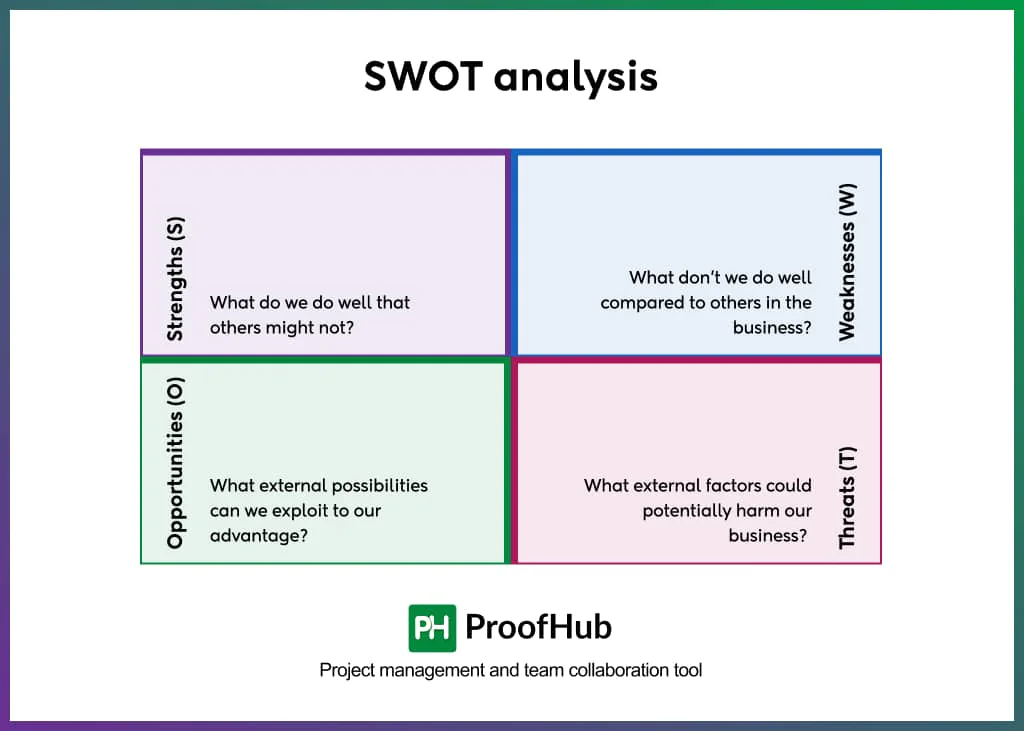
- Strengths: Assess the internal strengths the project can leverage, such as an experienced team, strong stakeholder support, and robust resources.
- Weaknesses: Identify internal limitations that could hinder project progress, such as budget issues, tight schedules, or skill gaps within the team.
- Opportunities: Evaluate external factors the project can leverage, including market trends, technological advancements, and regulatory changes.
- Threats: Analyze external risks that may affect the project, such as economic downturns, competitive pressures, or shifting business priorities.
2. Stakeholder analysis
Stakeholder analysis is the evaluation of stakeholders based on their level of interest and influence. It helps the project manager understand who needs active management, who needs to be kept informed, and who can be engaged periodically throughout the project lifecycle.
It involves three key steps:
- Identification: Listing all individuals or groups who can affect or are affected by the project.
- Classification: Categorizing stakeholders using a power-interest grid to determine how much attention each requires.
- Engagement planning: Developing tailored communication strategies for each stakeholder group to secure their support and address their concerns.
3. Risk assessment
Risk assessment helps the team anticipate potential risks that could affect the project’s success. Identifying and addressing risks early gives the team enough time to develop effective mitigation strategies before they escalate into larger problems.
It covers:
- Risk identification: Listing all possible risks from both internal and external sources.
- Risk analysis: Evaluating each risk based on its likelihood and potential impact.
- Risk mitigation: Developing early mitigation strategies such as contingency plans or scope adjustments for high-priority risks.
4. Project management software
A project management tool bring structure and visibility to the initiation phase. It centralizes project information in one place, making it easier for teams to collaborate, track progress, and ensure nothing gets missed during the early stages of the project.
Tools like ProofHub offers enhanced features to support the entire project lifecycle, from initiation to closure. It supports seamless team coordination, project tracking, scheduling and keeps everyone aligned from day one.
Free Project Initiation Document (PID) template
The template is structured as a spreadsheet with seven sheets, each covering a distinct phase of initiation, from basic project details on the Cover sheet to purpose, scope, stakeholders, timeline, risks, and ending with formal sign-off on Approval & Sign-Off.
If you have never built a PID before, the companion sample PDF shows every section filled in for a fictional project so you know exactly what to aim for.
Download free PID template
Use this ready-made PID template to define purpose, scope, stakeholders, risks, and sign-off before planning starts. Customize it for your project. Works with Excel and Google Sheets.
Get the free PID templateHow to use this template:
- Open the sample PDF and make a copy of it.
- Start with the Cover sheet. Enter your project name, manager, sponsor, and dates.
- Move to Overview & Purpose next. Sections 1 through 3 ask you to define why the project exists, whether it is feasible, what you are trying to achieve, and how success will be measured..
- Work through the Scope & Deliverables carefully. Section 4 asks you to list what is and is not included in the project. Being explicit here prevents scope creep later.
- Fill in Stakeholders & Comms before you start planning. Section 7 helps you identify everyone who can affect or be affected by the project. Section 8 defines how and how often you will communicate with each of them.
- Use Timeline & Budget to set realistic expectations early. Section 9 covers milestones, Section 10 confirms your resources, and Section 11 breaks down your cost estimate by category.
- Complete the Risks & Assumptions sheet before seeking approval. Section 12 asks you to identify and prioritise risks before they become problems.
- Finally, collect signatures from all approvers in Section 6: Formal Approval & Sign-Off. The project should not move into planning until this is done.
Who is responsible for project initiation?
The project manager is responsible for initiating the project. They coordinate the entire process and develop key documents, such as the project charter.
However, it is a shared responsibility. The project sponsor provides funding and final approval, while stakeholders, senior management, and subject matter experts all contribute their input to define and validate the project.
What’s the difference between the project initiation and the project planning phase?
The main difference between project initiation and project planning is project initiation authorizes the project, while project planning defines how the project will be executed, and controlled.
| Basis | Project Initiation | Project Planning |
| Purpose | Defines the project at a high level and gets approval to proceed | Creates a detailed roadmap for executing the project |
| Focus | Business case, objectives, feasibility, and stakeholders | Scope, schedule, budget, resources, and risk management |
| Level of detail | High-level and conceptual | Detailed and structured |
| Output | Project Charter / Initiation Document | Project Management Plan |
How long does project initiation typically take?
The duration depends on the project’s size and complexity. A small internal project may wrap up initiation in a few days, while a large enterprise project can take several weeks to define, assess, and obtain formal approval.
Can projects go wrong at the initiation phase?
Yes, the project can go wrong at the initiation phase. Many projects are set up to fail during initiation through small but costly oversights, such as vague objectives, missed stakeholders, or ignored risks. These gaps may not be visible right away, but they almost always surface during execution when they are far harder and more expensive to fix.
Conclusion
Project initiation is not just a starting formality. It lays the foundation for everything that follows, from planning and execution to monitoring and completion. When done right, it gives the team a clear direction, sets realistic expectations, and ensures the project has organizational support before planning begins. Take the time to get the initiation right, and it becomes significantly easier to manage, track, and deliver the project successfully.