

Every project involves people who influence its success, are affected by its outcomes, or have a vested interest in its progress. These individuals or groups are known as project stakeholders. Their decisions, expectations, and level of support directly impact whether a project stays on track, overcomes challenges, and achieves its intended goals.
Understanding stakeholders is essential because their expectations, influence, and involvement directly affect project planning, execution, risk management, and overall success.
Organizations that identify and engage the right stakeholders early are better equipped to make informed decisions, avoid costly delays, and deliver outcomes that create value for everyone involved.
- 1.A stakeholder is any person or group, inside or outside your organization, who has an interest in or is affected by your project.
- 2.Stakeholders matter because they define goals, drive decisions, flag risks, and ultimately determine whether your project succeeds or fails.
- 3.Stakeholders are of four types: internal, external, primary, and secondary; each with a different level of involvement and influence on the project.
- 4.Identify stakeholders early by reviewing project documents, asking the right questions, and mapping them by power and interest.
- 5.Manage stakeholders by involving them throughout the project, communicating clearly and consistently, and documenting their roles and expectations.
What is a project stakeholder?
A stakeholder is any individual, group, or organization with a vested interest in a project’s decisions, activities, or outcomes. Stakeholders can be internal (project managers, team members, shareholders) or external (clients, suppliers, government bodies).
Each stakeholder holds a different level of influence over the project’s outcome and is further classified as primary or secondary based on their involvement.
Why are project stakeholders important?
Stakeholders are important because they define project success, make decisions effectively, ensure alignment, identify risks, prevent project delays, and build credibility among the parties involved.
Stakeholders’ input shapes project goals, the decisions they make drive execution, and their feedback determines whether the outcome delivers real value.
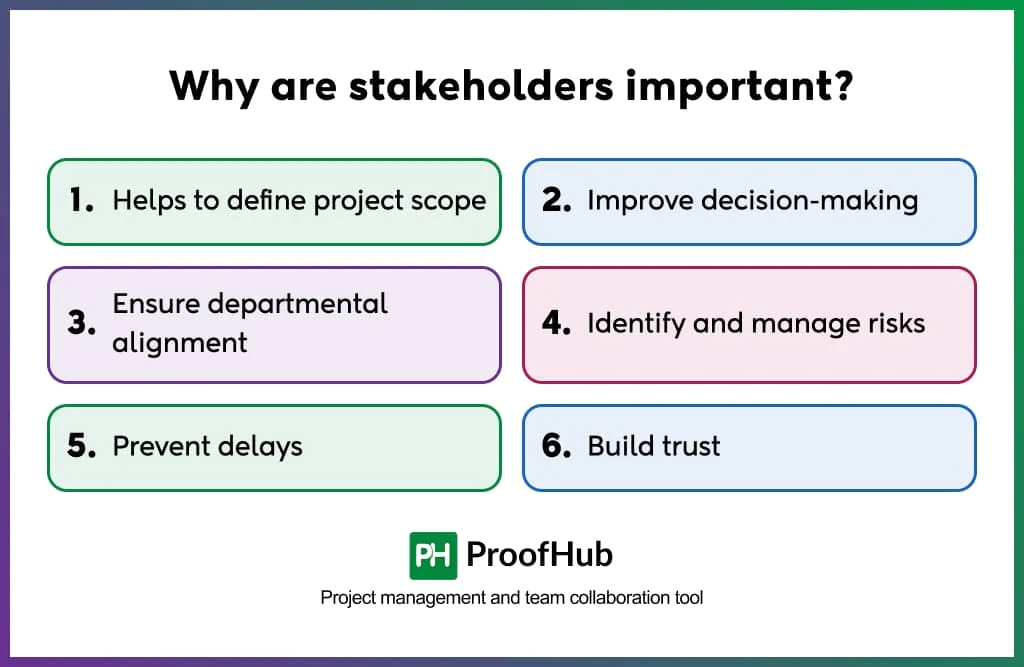
- Helps to define project scope: Stakeholders provide requirements that shape what the project delivers. This ensures the final output meets actual needs and agreed objectives from the start.
- Improves decision-making: Stakeholder’s insights and expertise enable faster, well-informed decisions. Early involvement reduces uncertainty and ensures that critical choices support both short-term progress and long-term project goals.
- Ensure departmental alignment: Brings different teams together, ensuring consistent communication and shared understanding. This helps maintain alignment and prevents conflicts during execution.
- Identify and manage risks: Stakeholders help identify potential risks early based on their experience, allowing teams to take proactive measures and minimize negative impacts on project progress.
- Prevent delays: Reduces last-minute changes that disrupt timelines. Keeping high-power stakeholders informed prevents sudden scope changes, even when budgets and deadlines are on track.
- Build trust: Transparent communication and consistent engagement build stakeholder trust. Informed stakeholders whose concerns are addressed become active supporters of project success.
What are the types of project stakeholders?
Stakeholders are of two types: internal and external, and their level of influence on the project is primary and secondary.
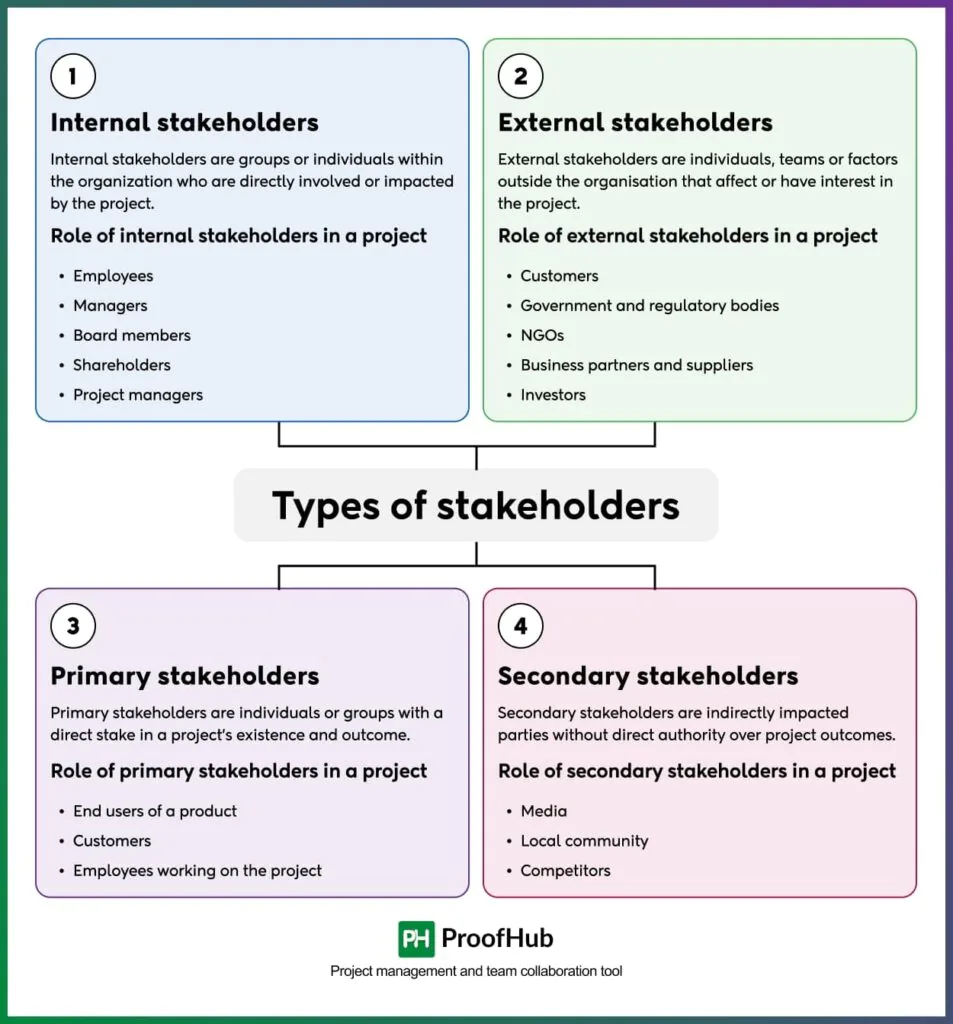
This structured classification enables you to effectively prioritize resources and focus on key stakeholders who possess the authority to decide whether a project is considered a success.
Internal stakeholders
Internal stakeholders are groups or individuals within the organization who are directly involved or impacted by the project. They include employees, managers, board members, and project managers who oversee daily operations.
Let’s understand the role of internal stakeholders in a project:
1. Employees: Employees directly support the project through daily execution. Project outcomes affect their job security, workload, and overall work environment.
2. Managers: Managers allocate resources and supervise teams to keep the project aligned with internal policies and performance standards. Their primary concern is the project’s impact on operational efficiency and internal performance benchmarks.
3. Board members: Board members set strategic direction and evaluate whether the project aligns with the organization’s long-term goals. Their interests are tied to the project’s contribution to business value and long-term organizational growth.
4. Shareholders: Shareholders monitor how the project affects company performance, profitability, and their financial investment. They are directly impacted by the project’s effect on stock performance, total revenue, and return on capital.
5. Project managers: Project managers lead the project from start to finish, managing tasks, timelines, budgets, and teams to deliver agreed objectives. Their professional reputation is directly tied to the project’s outcome.
External stakeholders
External stakeholders are individuals, teams or factors outside the organisation that affect or have interest in the project.
They influence project success through regulation, investment, or consumption. For example, customers, suppliers, government entities, and local communities.
Let’s understand the key external stakeholders and their role in a project:
1. Customers: Customers define the requirements and value they expect from the final deliverable. They are directly affected by the product quality and usability, which directly affect their experience. Their satisfaction determines whether the project is deemed a success.
2. Government and regulatory bodies: Government bodies set and enforce the legal, safety, and environmental standards a project must follow. Non-compliance directly exposes the project to legal risk and operational disruption.
3. NGOs: NGOs monitor how a project influences the broader environment and local communities. They intervene when organizations fail to meet ethical, social, or environmental responsibilities.
4. Business partners and suppliers: Suppliers provide the materials, goods, and services required to complete the project. Project success directly affects their revenue and continuity of business.
5. Investors: Investors supply the capital necessary to finance the project. Their primary concern is the project’s ability to generate returns on invested capital.
| Aspect | Internal stakeholders | External stakeholders |
| Position | Part of the organization. | Outside the organization. |
| Involvement | Directly manage, oversee, or execute project activities. | Influence the project through funding, regulations, partnerships, or product use. |
| Primary concern | Project delivery, operational efficiency, and organizational goals. | Product value, compliance, financial returns, or community impact. |
| Decision-making authority | Often have direct authority over project decisions and resources. | Usually provide input, requirements, or constraints rather than managing daily decisions. |
| Impact of project outcomes | Affects workload, performance, job responsibilities, and business success. | Affects customer experience, investment returns, supplier revenue, or public interests. |
| Communication | Communicate regularly throughout the project lifecycle. | Communicate at specific milestones or when their input is required. |
| Examples | Employees, managers, board members, shareholders, and project managers. | Customers, suppliers, investors, government agencies, and NGOs. |
Primary stakeholders
Primary stakeholders are individuals or groups with a direct stake in a project’s existence and outcome. Their support is essential; they hold the authority to approve, reject, or redefine project deliverables.
Let’s look at the role of primary stakeholders in a project:
1. End users of a product: End users focus purely on the final deliverable’s usability and functionality. Their satisfaction is the primary measure of project success.
2. Customers: As critical stakeholders, they expect quality and value. Their dissatisfaction directly defines the project as a failure.
3. Employees working on the project: Employees are the core team that executes the work. They rely on the project for their daily routines, job security, and professional benefits within the organization.
Secondary stakeholders
Secondary stakeholders are indirectly impacted parties without direct authority over project outcomes. While not involved in operational delivery, their interests in social, environmental, or economic impacts influence project evaluation.
Let’s understand the role of secondary stakeholders in a project:
1. Media: Journalists and media outlets that cover industry developments. Their reporting shapes public perception and influences how the project’s progress and success are viewed externally.
2. Local community: Residents and communities in the project’s operational area. Project execution directly affects their health, safety, job opportunities, and regional economic development.
3. Competitors: Organizations operating in the same industry or market. They monitor the project for market shifts or competitive advantages its success may create.
| Aspect | Primary stakeholders | Secondary stakeholders |
| Impact of the project | Directly affected by the project’s outcomes. | Indirectly affected by the project’s outcomes. |
| Influence on project decisions | Have significant influence and may approve, reject, or redefine deliverables. | Limited direct authority but can influence public perception and project evaluation. |
| Primary interest | Project success, functionality, quality, and business value. | Social, environmental, economic, or market-related impacts. |
| Level of involvement | Closely involved throughout the project lifecycle. | Usually observe, monitor, or respond to project outcomes. |
| Examples | End users, customers, and project team members. | Media, local communities, and competitors. |
How to identify project stakeholders?
To identify project stakeholders, start by understanding the purpose, review all stakeholders, define stakeholders’ needs, brainstorm, and prioritise your list of key stakeholders.
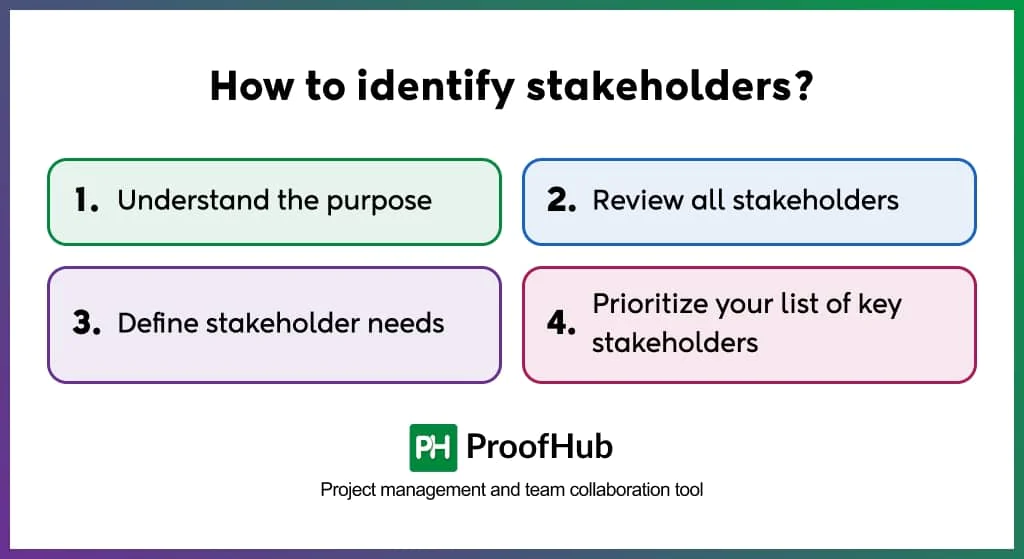
For clarity, categorize stakeholders into internal and external groups, and map their influence and interests to create a stakeholder list.
Let’s learn how to identify stakeholders in detail.
1. Understand the purpose
Start by clarifying the goal and scope of your project. Understanding why the project exists helps you determine who is relevant to it.
A clear purpose gives direction to the entire stakeholder identification process and prevents overlooking key individuals or groups.
2. Review all stakeholders
With the purpose in mind, compile a comprehensive list of everyone who may have an interest in or be affected by the project.
Include internal and external individuals, teams, and organizations. A thorough review ensures no critical stakeholder is missed from the outset.
3. Define stakeholder needs
Once all stakeholders are listed, identify what each stakeholder expects or requires from the project.
Needs may include timely updates, specific deliverables, risk transparency, or resource allocation.
Knowing these upfront helps align project goals with stakeholder expectations and reduces conflicts later.
4. Prioritize your list of key stakeholders
Rank stakeholders based on their level of influence, interest, and impact on the project. All stakeholders do not carry equal weight.
Prioritization helps you focus time and resources on those who matter most, ensuring critical relationships receive adequate attention and engagement.’
How to manage project stakeholders?
To manage stakeholders effectively, involve stakeholders throughout the project, use effective communication, and document each stakeholder’s roles and needs.
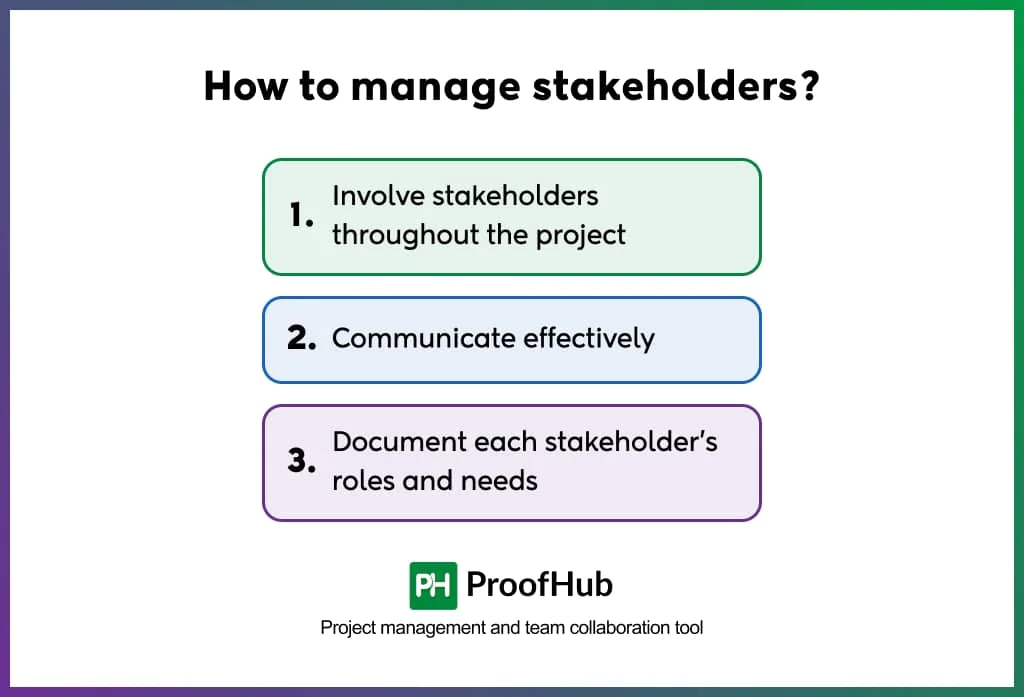
Effective stakeholder management keeps expectations aligned, reduces risk, and drives higher project success rates.
The following are ways to manage stakeholders in an organization:
1. Involve stakeholders throughout the project
Involving stakeholders at every stage of a project ensures their expectations remain aligned with project goals.
Regular participation allows them to provide valuable input, flag potential risks early, and feel a sense of ownership, all of which contribute to smoother execution and better outcomes.
According to the study, Understanding the underlying drivers shaping stakeholder perceptions of project success published in 2025 by Zoltán Sebestyén; János Erdei; Gergely Lülök states, “projects benefit when stakeholder expectations are better aligned, because this can improve communication, decision-making, and process efficiency.”
2. Communicate effectively
Clear and consistent communication with stakeholders helps in building trust, reducing misunderstandings, and keeping all parties aligned.
Effective communication allows stakeholders to feel valued, stay informed, and make timely decisions that keep the project moving forward.
3. Document each stakeholder’s roles and needs
Make a list for each stakeholder’s roles, responsibilities, and expectations. It creates a reliable reference point for the entire team.
It reduces clarity, ensures accountability, and helps project managers anticipate conflicts before they arise.
What are common challenges with stakeholders?
The common challenges with stakeholders are vague expectations and bad communication, competing priorities, lack of engagement, cultural differences, and conflicts and disagreements.
These challenges slow down projects and damage relationships if not handled early.

Let’s understand these common challenges in detail:
- Unclear expectations: When stakeholders have different assumptions about project goals, it leads to confusion, misaligned deliverables, and rework that wastes time and resources.
- Poor communication: Infrequent or unclear updates leave stakeholders uninformed, creating mistrust, misunderstandings, and decisions that are not aligned with project goals.
- Competing priorities: Different stakeholders often have conflicting interests and goals, making it difficult to reach consensus and keep the project moving in one direction.
- Lack of engagement: When stakeholders are disengaged or unavailable, approvals get delayed, critical feedback is missed, and the project loses direction and momentum.
- Cultural differences: Varying cultural backgrounds affect communication styles, decision-making, and expectations, which creates misunderstandings if not acknowledged and managed early.
- Conflict and disagreements: Stakeholders with opposing interests stall progress, disrupt team dynamics, and derail timelines if conflicts are not addressed quickly and professionally.
What is stakeholder theory?
Stakeholder theory is a business management concept that states a company’s success depends not only on satisfying shareholders but on creating value for all stakeholders, including employees, customers, suppliers, communities, and investors.
It argues that businesses have a responsibility toward everyone affected by their decisions, encouraging ethical decision-making, inclusive planning, and long-term sustainability over short-term profit.
The theory was introduced by R. Edward Freeman in 1984 through his book Strategic Management: A Stakeholder Approach. It challenged the traditional shareholder-first mindset popularized by Milton Friedman, who argued that a business’s sole responsibility is to maximize profits. Freeman’s framework shifted focus toward balancing the needs of all parties connected to an organization, laying the foundation for modern corporate responsibility and ethical business practices.
The theory establishes that project success is not solely measured by deliverables, but by how well the needs of all involved parties are addressed.
What is the difference between a project stakeholder and a shareholder?
The primary difference between a stakeholder and a shareholder lies in their relationship with the organization. Shareholders hold ownership through stocks and are primarily concerned with financial returns. Whereas stakeholders represent a broader group, including employees concerned with job security, customers invested in product quality, and communities impacted by environmental decisions.
It is important to note that while all shareholders are stakeholders, not all stakeholders are shareholders.
| Aspect | Stakeholder | Shareholder |
| Definition | Any person or group with an interest in the project or organization | A person or group that owns shares in the company |
| Relationship with organization | Broader connection through work, use, or impact | Ownership through stocks |
| Primary concern | Project success, job security, product quality, or community impact | Financial returns and stock performance |
| Who they are | Employees, customers, suppliers, communities, and more | Investors who own company stock |
| Scope | Broad: includes anyone affected by the organization | Narrow: limited to those who own shares |
| Are they the same? | Not all stakeholders are shareholders | All shareholders are stakeholders |
Are some project stakeholders more important than others?
Yes, some stakeholders hold more importance than others based on their level of influence, interest, and involvement.
Internal stakeholders such as employees, board members, and investors carry greater weight in organizational decision-making.
External stakeholders such as customers, investors, and business partners have comparatively less influence.
Because they are not directly involved in day-to-day project decisions and typically engage only at specific milestones or when their input is required. This is why stakeholder prioritization is a critical component of stakeholder management.
Can some project stakeholders have negative influence?
Yes, stakeholders can have a negative influence on a project. They can derail progress, lower team morale, influence others against the project, or even attempt to block it altogether.
This negative influence can take many forms, including failure to perform, failure to decide, withholding information, and procrastination. Stakeholders with strong influence who are negatively biased are particularly dangerous, as their authority within the organization can directly compromise the project’s success.
What happens if stakeholders are ignored or not involved?
When stakeholders are ignored and not involved, the consequences are severe. It causes delays in decision-making, approvals, and resource allocation. Scope changes and rework become common, pushing the project over budget.
It also damages the organization’s reputation and erodes trust. Ultimately, ignored stakeholders may withdraw their support, increasing the risk of project failure.
Conclusion
Stakeholders are the foundation of every successful project. Identifying who they are, understanding their influence, and managing their expectations determines whether a project delivers real value or falls short of its goals. Effective stakeholder management is not a one-time activity; it runs through every stage of the project lifecycle, from defining scope to managing risks and building trust. Stakeholders shape outcomes at every step. Organizations that treat stakeholder engagement as a core project discipline consistently achieve faster delivery, fewer disruptions, and stronger long-term relationships.