

A project organizational structure defines how a project team is set up, who is responsible for what, and how decisions get made throughout the project lifecycle.
Teams that lack a clear structure struggle with missed deadlines, overlapping responsibilities, and slow decision-making that affects overall project delivery.
This guide covers the definition, key components, types, steps to create one, common mistakes, and the most frequently asked questions around project organizational structure.
- 1.A project organizational structure defines who owns what, who reports to whom, and how decisions get made across the team.
- 2.Without a clear structure, accountability breaks down, communication stalls, and projects lose direction before they gain momentum.
- 3.The four structure types are functional, projectized, matrix, and hybrid- each serves different project sizes, complexity levels, and authority needs.
- 4.Core components like authority levels, reporting lines, and communication flow must all work together for a structure to be effective.
- 5.Building the right structure starts with project goals and ends with the entire team understanding and operating within it.
- 6.Repeated delays, role confusion, and team conflicts are not people problems — they are signs of a broken organizational structure.
What is a project organizational structure?
A project organizational structure is the framework that defines how roles, responsibilities, and authority are arranged within a project team to execute work effectively.
It determines reporting relationships, resource allocation, and the level of control a project manager holds over people and decisions.
The right structure aligns people, processes, and decision-making to support project goals efficiently.
Why is project organizational structure important for project success?
A project organizational structure is vital because it establishes clear roles and responsibilities, enhances communication, enables faster decision-making, efficient resource management, reduces project delays, and improves strategic alignment.
Without an organizational structure, teams operate in silos, accountability breaks down, and projects lose direction before gaining momentum. It brings clarity to every layer of the project, from who owns what to how decisions get made.
The key benefits of project organizational structure are:
- Clear roles and accountability: When everyone knows exactly what they own, tasks do not get missed or duplicated. Team members take more ownership because they know no one else will cover their responsibilities if they fall short.
- Enhanced communication: A defined reporting structure tells people exactly who to go to when problems arise. It keeps information moving to the right people instead of getting lost across the wrong channels.
- Faster decision-making: Clearly defines authority levels. Teams know who holds approval power at each stage, keeping progress moving without unnecessary back and forth.
- Efficient resource management: Prevents a few people from carrying the full load while others remain underutilized. A structured hierarchy makes it easier to distribute work based on capacity and skill.
- Reduced project delays: Removes the gaps between tasks that quietly push deadlines back without anyone noticing. Clear handover between phases means teams always know what comes next and who is responsible.
- Improved strategic alignment: When roles connect directly to project goals, daily work stays tied to what actually matters. Teams stop spending energy on tasks that do not move the project forward.
What are the key components of a project organizational structure?
The key components of a project organization structure are project leadership & management, project governance, organizational hierarchy and reporting, authority levels, project team, task allocation, resource allocation, and communication flow.
It is built on several interconnected components that together define how work is organized, managed, and delivered. Each component plays a specific role in ensuring the project runs with clarity, accountability, and efficiency.
The key components of a project organizational structure are:
- Project leadership and management refer to the individuals responsible for directing the project. They set objectives, guide the team, make critical decisions, and ensure the project stays on track with its goals and timeline.
- Project governance is the framework of rules, policies, and decision-making processes that guide project execution. It ensures accountability, defines approval workflows, and keeps the project aligned with organizational standards and stakeholder expectations.
- Organizational hierarchy and reporting define the chain of command within a project. It clarifies who reports to whom, establishes clear lines of authority, and ensures information flows correctly across all levels of the team.
- Authority levels determine who holds decision-making power at each stage of the project. They define the boundaries of each role, preventing confusion over approvals, resource control, and conflict resolution across the team.
- Project team refers to the group of individuals assigned to execute the project. Each member brings specific skills and expertise, working collaboratively under defined roles to deliver the project’s planned outcomes.
- Task allocation is the process of assigning specific responsibilities to team members based on their skills and capacity. It ensures work is distributed effectively, reduces overlap, and keeps every phase of the project progressing on schedule.
- Resource allocation involves distributing available resources, including budget, personnel, tools, and time, across project activities. It ensures critical tasks are adequately supported without overextending the team or exceeding project constraints.
- Communication flow defines how information is shared across the project team and stakeholders. It establishes formal and informal channels, reporting cadences, and escalation paths to keep everyone informed and aligned throughout the project lifecycle.
What are the types of project organizational structures?
There are 4 types of project organizational structures:
- Functional organizational structure
- Projectized organizational structure
- Matrix organizational structure
- Hybrid organizational structure
Organizations do not follow a single approach when structuring project teams. The right type depends on factors such as project complexity, team size, resource availability, and the level of authority the project manager needs to hold.
Choosing the correct structure directly impacts how efficiently a project is planned, executed, and delivered. Here are the brief explanation of each project organizational structure:
1. Functional organizational structure
In a functional organizational structure, team members are grouped by area of expertise. Each department operates under its own functional manager who controls resources, assigns work, and makes decisions.
When a project comes in, it is handled by the relevant department rather than by a dedicated project team.
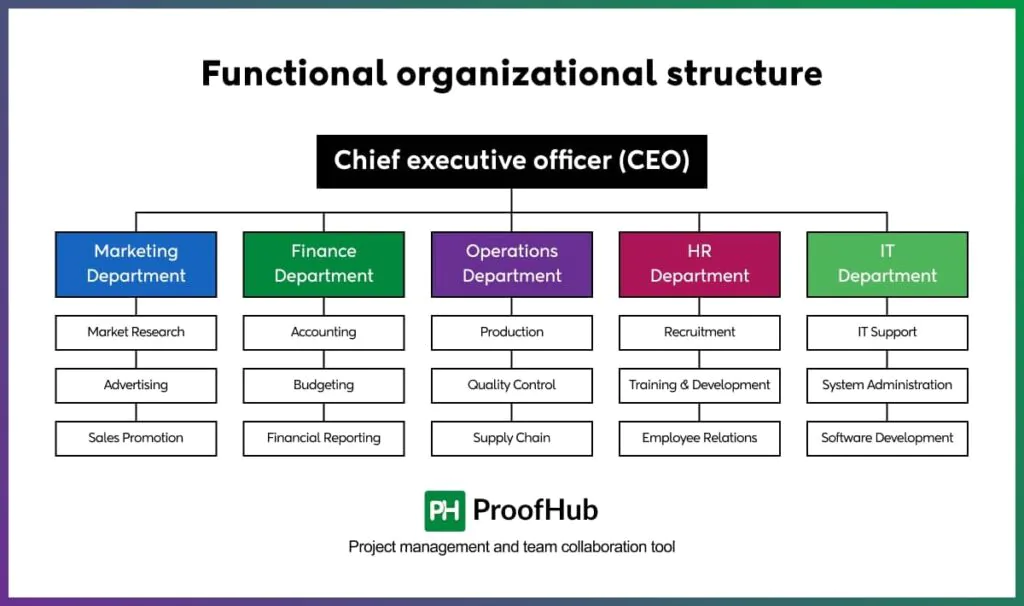
Key characteristics:
- Departmental grouping: Employees are organized by function or specialty, and project work is handled within each department independently.
- Single reporting line: Each team member reports to one functional manager, maintaining a clear and straightforward chain of command.
- Shared resources: Resources such as people, tools, and budgets are managed and owned at the departmental level rather than the project level.
- Limited project manager authority: The project manager, if one exists, has little formal power and relies on functional heads to direct team members.
- Stable team environment: Teams remain intact across projects, fostering deep specialization and consistent working relationships within departments.
Pros:
- Team members develop deep expertise in their specific area
- Resources are easy to manage since people stay within the department
- Clear reporting lines mean less confusion about who to approach
Cons:
- The project manager cannot control timelines or resource priorities
- Cross-department collaboration is slow and often gets deprioritized
- Projects that need input from multiple departments frequently face delays
Best use case: Internal projects that sit entirely within one department, routine operational work, or organizations where projects are secondary to core business functions.
Example: A legal team running an internal contract review process. The legal manager assigns tasks, controls the schedule, and makes all decisions without involving any other department.
Best suited for: Small to mid-sized organizations, teams running similar repeatable projects, and companies where departmental depth matters more than project speed.
2. Projectized organizational structure
A projectized organizational structure organizes the entire company around projects rather than departments. The project manager holds full authority over the team, resources, and budget. Team members are assigned exclusively to the project and report directly to the project manager for the duration of the engagement.
Each project gets its own people, its own resources, and its own chain of command. Resources are not shared between projects.
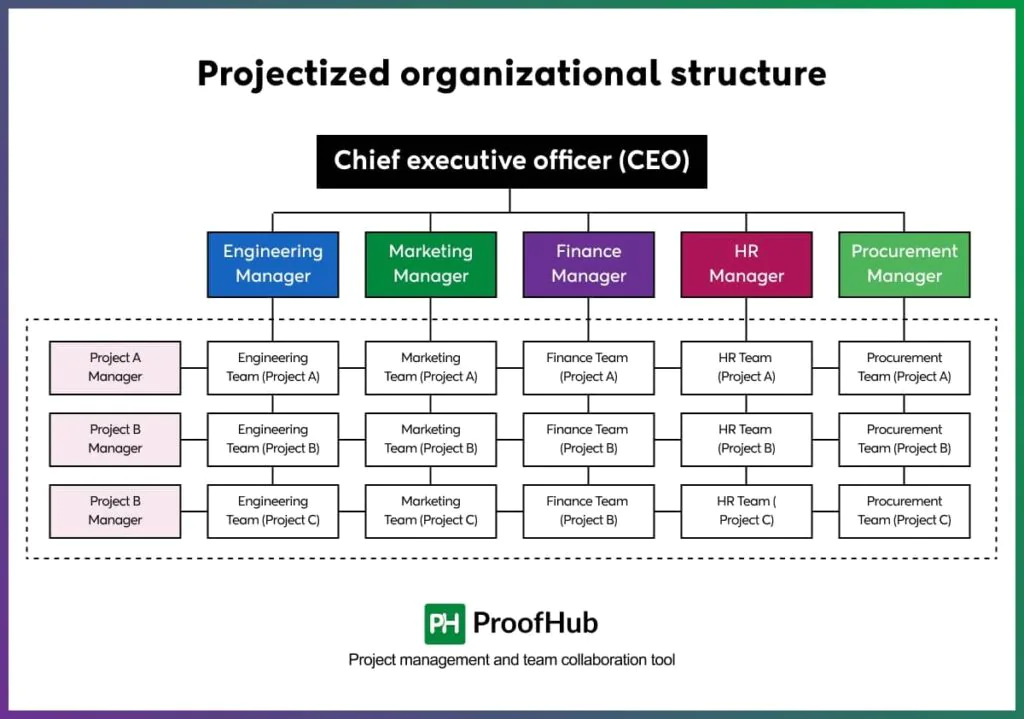
Key characteristics:
- Project-centric design: The organization’s entire structure revolves around delivering projects, with no permanent functional departments dominating resource ownership.
- Full project manager authority: The project manager holds complete decision-making power over the team, budget, and all project-related choices.
- Dedicated team assignment: Team members are assigned exclusively to one project at a time, ensuring full focus and commitment to a single deliverable.
- Independent project units: Each project operates as a self-contained unit with its own resources, reporting lines, and chain of command.
- Temporary team structure: Teams are formed at the start of a project and dissolved upon completion, with new teams assembled for each subsequent initiative.
Pros:
- Faster decision-making due to centralized authority
- Strong team bond from working closely on a single goal.
- Clear accountability since one person owns the entire outcome
Cons:
- Resources cannot be shared across projects
- Team members may have gaps between project assignments
- Expensive because every project needs its own dedicated people and resources
Best use case: Large, high-priority projects with a defined start and end date, especially those involving external clients or requiring full team focus throughout.
Example: A construction firm building a hospital. Once the project manager leads a dedicated team of architects, engineers, and site managers who stay on that project from the first day on site until the keys are handed over.
Best suited for: Construction companies, consulting firms, IT implementation teams, and organizations where delivering projects is the core business activity.
3. Matrix organizational structure
In a matrix organizational structure, team members report to two managers at the same time: a functional manager and a project manager.
Resources are shared across multiple projects, and authority is divided rather than sitting with one person.
How that authority gets divided depends on which version of the matrix the organization uses.
The matrix is not one fixed model. It exists on a spectrum from weak to strong, depending on where decision-making power actually sits.
The three types of matrix organizational structures are the weak matrix, the balanced matrix, and the strong matrix, each reflecting a different distribution of authority between the functional manager and the project manager.
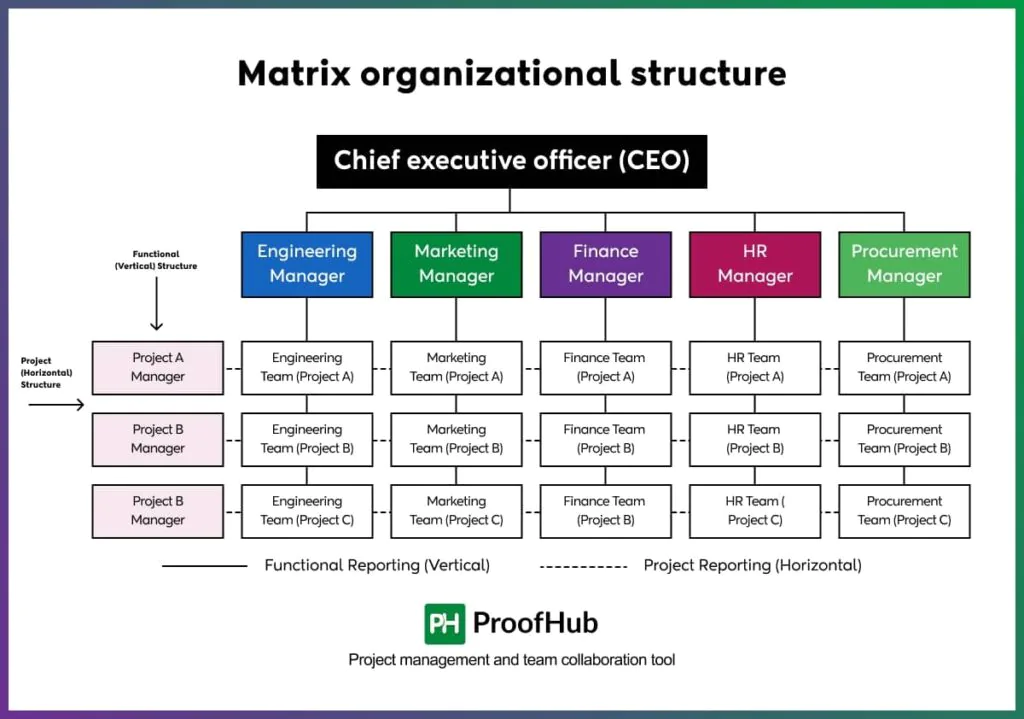
Key characteristics:
- Dual reporting structure: Each team member reports to both a functional manager and a project manager simultaneously, creating overlapping lines of authority and accountability.
- Shared resource model: Specialists and resources are distributed across multiple projects at the same time, maximizing utilization without duplicating headcount.
- Divided authority: Decision-making power is split between functional and project managers, with the balance determined by the type of matrix in use.
- Dual communication flow: Information moves both vertically through functional departments and horizontally across project teams, requiring clear coordination to avoid gaps.
Pros:
- Efficient use of specialists who can work across multiple projects
- Combines departmental expertise with project-focused delivery
- Flexible enough to scale up or down depending on project complexity
Cons:
- Dual reporting creates confusion about who has the final say
- Team members often feel pulled in two directions at once
- Without clear authority boundaries, functional and project managers conflict regularly
Best use case: Organizations running multiple projects simultaneously that need to share skilled resources without building a completely separate team for every initiative.
Example: A software company running three product launches at once. Developers and designers report to their department heads for technical standards, but work directly under a project manager for each product delivery.
Best suited for: Mid to large organizations, technology companies, marketing agencies, and teams running multiple projects simultaneously that share the same resources and people.
4. Hybrid organizational structure
A hybrid organizational structure doesn’t follow one fixed model. It combines elements from two or more structure types, depending on what each project or department actually needs.
Some teams might run functionally while others operate under a projectized or matrix setup, all within the same organization.
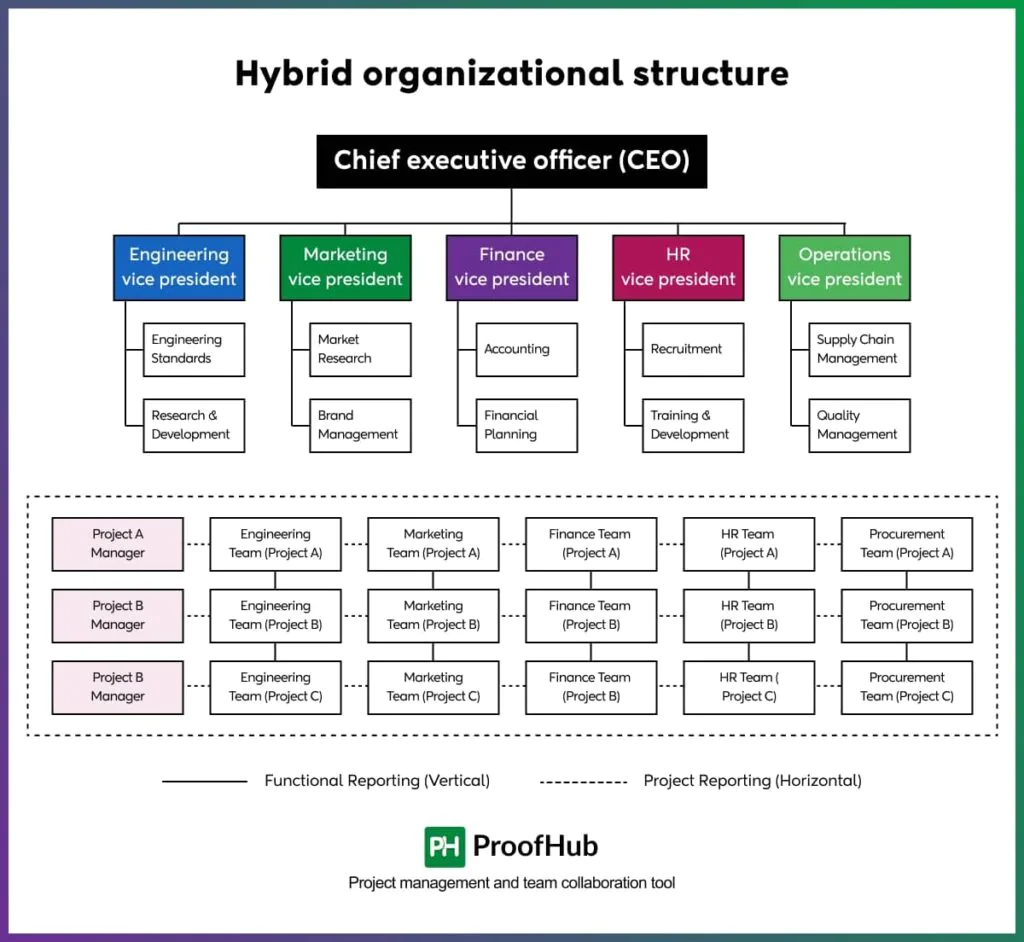
Key characteristics:
- Blended structural model: Elements from two or more structure types are combined, allowing the organization to tailor its approach based on the specific demands of each project.
- Concurrent structural variety: Different projects within the same organization can operate under different structures simultaneously, without disrupting overall operations.
- Variable authority and reporting: Decision-making power and reporting lines are not fixed, it’s defined based on the nature, size, and complexity of each individual project.
- Adaptive by design: The structure can be reconfigured as organizational priorities shift, making it flexible enough to accommodate changing project portfolios over time.
Pros:
- Can be configured to fit any project size or complexity level
- It keeps routine work standardized while strategic projects get more autonomy
- Avoids being locked into one structure that does not fit every situation
Cons:
- Creates confusion if roles and authority are not clearly defined for each project
- Harder to manage consistently across teams and departments
- Needs strong leadership to prevent the structure from becoming disorganized over time
Best use case: Large organizations managing a wide variety of project types where no single structure works across all initiatives.
Example: A global technology company runs HR and IT support as functional departments. New product development runs under a projectized structure with dedicated teams. Client implementations run under a matrix where developers are shared across multiple accounts at once.
Best suited for: Large enterprises, mature PMO environments, and organizations with diverse project portfolios that require different levels of control depending on the initiative.
| Functional | Projectized | Matrix (Weak) | Matrix (Balanced) | Matrix (Strong) | Hybrid | |
| PM authority | Little to none | Full | Low | Shared | High | Varies |
| Team dedication | Part-time | Full-time | Part-time | Part-time | Full-time | Mixed |
| Budget control | Functional manager | Project manager | Functional manager | Shared | Project manager | Depends on project |
| Decision speed | Slow | Fast | Slow | Moderate | Fast | Varies |
| Resource sharing | Within department | Not shared | Across departments | Across departments | Across departments | Flexible |
| Best for | Routine internal work | Large dedicated projects | Low-complexity shared work | Balanced resource needs | Complex cross-functional projects | Diverse portfolios |
| Key risk | PM has no authority | Resource duplication | Unclear PM role | Manager conflict | Functional manager sidelined | Inconsistent structure |
How to create a project organizational structure
To create a project organizational structure, follow the seven steps:
- Align the structure with organizational and project goals
- Evaluate Project Size, Complexity, and Type
- Define Roles and Responsibilities
- Define Authority and Reporting Structure
- Choose the Type of Organizational Structure to Use
- Create the Organizational Chart
- Share and Implement the Structure
Creating a project organizational structure requires deliberate decisions about how a team is arranged, who holds authority, and how work flows from planning to execution.
Here is a step-by-step breakdown of how to build one effectively.
Step 1: Align the structure with organizational and project goals
Start by reviewing the project’s objectives, deliverables, and strategic priorities.
Understand how the project connects to the company’s overall direction and what constraints or expectations exist at the organizational level.
It ensures the structure you build supports actual project outcomes rather than existing as an administrative formality.
Syncing organizational structure and goal improves decision-making, clarifies roles, and teams stay focused on what the project needs to deliver.
Step 2: Evaluate project size, complexity, and type
Before defining any roles or reporting lines, assess the scale and nature of your project.
A small, short-term project requires a leaner structure with fewer layers, while a large, cross-functional initiative demands clearly defined hierarchies and specialized roles.
Consider the number of stakeholders involved, the technical complexity of deliverables, the duration of the project, and the number of teams contributing.
Project type also matters since a construction project, software product, or organizational change initiative each carries different structural needs.
This evaluation gives you the foundation to build a structure that is appropriately sized, neither too rigid nor too loosely defined.
Step 3: Define roles and responsibilities
Every person involved in the project needs to know exactly what they are responsible for and what falls outside their scope.
Begin by listing all the functions the project requires, from leadership and planning to execution and reporting.
Map each function to a specific role, and assign that role to the right individual based on skills, availability, and experience.
Clearly document what each role owns, what decisions they can make independently, and where they need to collaborate with others.
Well-defined roles eliminate overlap, reduce confusion during high-pressure phases, and ensure accountability is built into the structure from the very beginning.
Step 4: Define authority and reporting structure
Authority and reporting lines determine who makes decisions and who receives updates at each level of the project.
Define which roles hold decision-making power over budgets, timelines, resources, and scope changes.
Establish clear reporting relationships so every team member knows who they escalate issues to and who they are accountable to.
Avoid ambiguity in authority, as unclear hierarchies slow down approvals and create conflict during critical moments.
A well-defined authority structure does not mean rigid top-down control; it means every level of the project team understands boundaries, can act within them confidently, and knows when to loop in leadership.
Step 5: Choose the type of organizational structure to use
Selecting the right structure type is one of the most consequential decisions in this process.
Common options include functional structures, where teams are grouped by department; projectized structures, where the project manager holds full authority; and matrix structures, which blend both approaches.
Your choice should be guided by the project’s complexity, the degree of cross-functional collaboration required, how much authority the project manager needs, and how the organization typically operates.
Each structure comes with trade-offs in flexibility, communication speed, and resource control.
Choosing the wrong type can create friction throughout execution, so evaluate the options carefully against your project’s actual demands.
Step 6: Create the organizational chart
An organizational chart is a visual diagram that maps out the roles, reporting relationships, and hierarchy within a project.
It translates the structure you have defined into a clear, shareable format that the entire team and stakeholders can reference.
A well-designed org chart is important because it removes ambiguity about who owns what, makes onboarding faster, and gives stakeholders a quick view of how the project is organized.
It also serves as a reference point when conflicts arise over authority or responsibilities.
To create one, start by listing all roles and grouping them by function or level. Place leadership roles at the top, followed by management, and then execution-level roles.
Draw reporting lines to connect each role to its direct superior.
Use simple, clean formatting so the chart is easy to read at a glance. Tools like Lucidchart, Microsoft Visio, or even PowerPoint work well for this. Keep it updated as the project evolves.
Step 7: Share and implement the structure
Creating the structure is only half the work; the other half is ensuring it is understood and adopted across the team.
Share the organizational chart and role documentation with all project members, stakeholders, and leadership before execution begins.
Walk the team through the structure in a kickoff meeting, giving everyone the chance to ask questions and clarify expectations.
Reinforce it through onboarding materials, project briefs, and regular check-ins.
Implementation means making the structure a living part of how the project operates, not just a document that sits in a shared folder. Review it periodically and adjust as the project scales or shifts direction.
What are the key roles in a project organizational structure?
The key roles in a project organizational structure are project manager, project sponsor, project team members, stakeholders, and functional managers.
Understanding these roles ensures accountability is clearly distributed and decision-making authority is properly assigned at every level.
Here are the key roles in a project organizational structure:
- Project manager: The project manager owns the day-to-day execution. They plan the work, coordinate the team, track progress, and are the first person accountable when something goes off track or needs a decision made fast.
- Project sponsor: The sponsor sits above the project manager and provides executive backing, approves the budget, and removes organizational roadblocks. The project manager cannot handle it alone and is the final escalation point for major decisions.
- Project team members: The people doing the actual work. Each member is assigned based on the skills the project needs and is responsible for delivering specific tasks on time without needing constant supervision.
- Stakeholders: Everyone with an interest in the project outcome, including clients, end users, department heads, and leadership. They do not run the project, but their input, feedback, and approvals directly influence the decisions made throughout.
- Functional managers: They manage the people, not the project. In functional and matrix structures, functional managers control who gets assigned to project work, how long they are available, and what technical standards they follow.
When do you need a project organizational structure?
A project organizational structure is needed when the project is large or complex to manage through informal coordination alone.
It is suitable when the project involves multiple departments, a dedicated budget, several stakeholders, or a timeline stretching beyond a few weeks.
Without an organizational structure, roles get confused, decisions stall, and accountability disappears. The more people and moving parts involved, the earlier the structure needs to be defined.
What are the signs of an ineffective organizational structure?
The early signs of an ineffective organization structure are: project delay, unclear roles and responsibilities, slow decision-making, poor coordination, resource overload, miscommunication, and low productivity.
These indicators rarely appear in isolation; each one reflects a deeper structural gap that, left unaddressed, compounds into project-level failure.
The signs of an ineffective organizational structure include:
- Project delays: They occur when unclear structure causes bottlenecks in approvals, task handoffs, or resource availability. Without defined workflows and accountability, timelines slip consistently because no one owns the responsibility of keeping execution on track.
- Confusion about roles and responsibilities: Team members are unsure who owns what, leading to duplicated effort in some areas and completely unattended tasks in others, creating gaps that directly impact delivery quality. Without clearly defined ownership, accountability erodes across every level of the project.
- Slow decision-making: Simple approvals stall for days because authority has not been clearly assigned, and decisions get escalated unnecessarily to senior levels. This bottleneck disrupts project momentum and reflects a fundamental gap in how decision-making power has been distributed across the structure.
- Poor team coordination: Departments operate in isolation and produce conflicting outputs because the structure provides no mechanism to connect interdependent workstreams. The absence of defined collaboration channels allows critical dependencies to go unmanaged until issues escalate beyond easy resolution.
- Resource overload or underutilization: Some team members are stretched beyond capacity while others sit idle, signaling that resource allocation within the structure is imbalanced and not tied to actual project demand. This imbalance directly undermines both delivery quality and sustained team performance.
- Conflicts or miscommunications: Teams and managers dispute priorities and ownership because the structure has never established clear boundaries between individual and shared responsibilities. Recurring conflict of this nature is a structural deficiency, not an interpersonal issue.
- Low productivity and performance issues: Output deteriorates not because of capability gaps, but because the structure itself generates friction and inefficiency at every stage of execution. When organizational design is the primary obstacle, even high-performing teams will consistently fall short of their potential.
Who is responsible for creating and managing the project organizational structure?
The project manager is primarily responsible for creating and managing the project organizational structure.
The project manager creates and owns the organizational structure, defining roles, establishing reporting lines, and documenting how authority flows across the team.
In organizations with a PMO, the PMO sets the standards that the project manager works within. The project sponsor approves the final structure and provides the organizational backing it needs.
As the project evolves and scope or team composition changes, keeping the structure updated and communicating those changes to everyone involved remains the project manager’s responsibility.
How does project organizational structure affect project success?
A project organizational structure directly affects project success as it defines how teams collaborate, make decisions, and allocate resources.
A clear structure accelerates decision-making, reduces confusion, and keeps execution aligned with project goals.
A poorly designed structure creates bottlenecks, role ambiguity, and miscommunication that derail timelines, budgets, and deliverables.
Can a project have more than one organizational structure?
Yes, projects can have multiple organizational structures. Large or complex projects often combine two structure types to cover different needs within the same initiative.
A company might run day-to-day operations through a functional structure while managing a product launch through a dedicated projectized team.
Inside a single project, a matrix structure might govern how shared resources are allocated while a sub-team runs under a projectized model for a specific deliverable.
The key is that each part of the structure has clearly defined authority and reporting lines so the combination creates flexibility rather than confusion.