Software teams used to spend months writing detailed specs, only to deliver a product the market had already moved past by launch day. The frustration pushed a group of developers to rethink how software is built, changing the way teams work far beyond just coding.
This article breaks down everything you need to know about Agile: what it is, where it came from, and why it took off.
You’ll get the story behind the Agile Manifesto, the four core values and twelve principles that guide it, and the key characteristics that set Agile teams apart.
Finally, it clears up common points of confusion, like how Agile differs from Waterfall and Scrum, and which projects suit it best.
- 1.Agile is an iterative project management and software development approach that breaks work into short, manageable cycles to quickly adapt to changing needs.
- 2.The philosophy prioritizes human interaction, working software, customer collaboration, and responsiveness to change over rigid tools, documentation, contracts, and fixed plans.
- 3.Essential roles include the Product Owner (representing the customer), the Scrum Master (facilitating the process), the Development Team (building the product), and stakeholders (providing feedback).
- 4.Frameworks under the Agile umbrella include Scrum (structured sprints), Kanban (continuous visual workflow), Extreme Programming (engineering quality), SAFe (enterprise scaling), and Lean (waste elimination).
- 5. Unlike the linear and rigid Waterfall model that defines requirements upfront, Agile is incremental, highly flexible, and relies on continuous customer involvement.
- 6.Agile is the overarching philosophy, while Scrum is a specific, structured framework for implementing it.
What is Agile?
Agile is an iterative approach to project management and software development that breaks work into small, manageable cycles rather than a single, long, sequential process.
Teams plan, build, test, and review work in short bursts called sprints or iterations. Teams also gather feedback continuously. This allows teams to adapt to changing requirements, deliver value faster, and reduce the risk of building something the customer no longer needs.
Why was Agile created?
Developers created Agile in response to the rigidity of traditional project management methods.
In earlier project management models, such as the Waterfall model, requirements were locked in early, and changes were costly and slow.
Software teams in the 1990s needed a way to respond to changing customer needs, evolving markets, and technical uncertainty without having to restart the entire process.
Agile offered a flexible, collaborative alternative built around incremental delivery and constant feedback.
What is the origin and history of Agile?
Agile’s roots trace back to the 1990s, when software teams grew frustrated with the Waterfall model’s rigidity. Its linear, phase-by-phase approach left little room for change once a project began.
Lightweight methodologies like Scrum, Extreme Programming (XP), and Crystal emerged independently around this time, each promoting iterative, adaptive ways of working.
In February 2001, seventeen software practitioners met at a ski resort in Snowbird, Utah, to discuss these emerging practices. They found common ground in their shared frustration with heavyweight, documentation-driven processes and their belief in flexibility, collaboration, and rapid delivery.
This meeting produced the Agile Manifesto, a concise document outlining four core values and twelve principles emphasizing individuals and interactions, working software, customer collaboration, and responsiveness to change.
What began as a reaction against bureaucratic development processes soon evolved into a global movement, reshaping not just software development but project management practices across industries.
What is an Agile Manifesto?
The Agile Manifesto is a foundational document created in 2001 by seventeen software practitioners that outlines the core values and principles of the Agile methodology.
It prioritizes four key values: individuals and interactions over processes and tools, working software over comprehensive documentation, customer collaboration over contract negotiation, and responding to change over following a rigid plan.
Supported by twelve underlying principles, the manifesto emphasizes flexibility, continuous delivery, and close collaboration between teams and customers.
It serves as the philosophical foundation for Agile frameworks like Scrum and Kanban, guiding teams toward adaptive, iterative, and customer-focused software development.
What are the four core values of Agile?
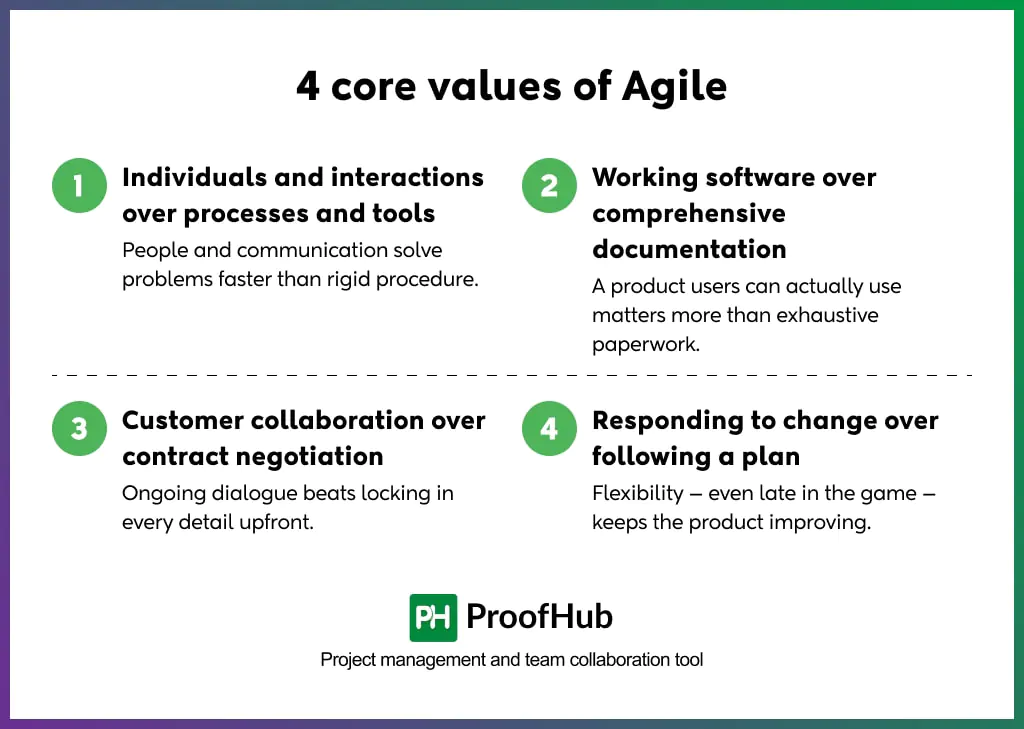
The Agile Manifesto identifies four fundamental values that prioritize people, functionality, collaboration, and adaptability over rigid processes and documentation. These values guide how Agile teams make decisions and approach software development.
These values guide teams in developing workflows that align with them; they are more like central ideas than actionable steps anyone can follow.
The four core values are as follows:
- Individuals and interactions over processes and tools: People and how they communicate matter more than the specific tools or procedures a team follows. Strong collaboration solves problems much more effectively than blindly following procedure.
- Working software over comprehensive documentation: Delivering functional software that meets user needs matters more than producing extensive documentation, though some documentation still supports the process. This means the focus is more on delivering a product that users or stakeholders can use, rather than solely satisfying bureaucratic obligations.
- Customer collaboration over contract negotiation: Ongoing dialogue with the customer throughout the project yields better outcomes than negotiating every detail up front. Requirements evolve, and collaboration keeps the work aligned.
- Responding to change over following a plan: Agile teams stay flexible and welcome changing requirements, even late in development, rather than sticking rigidly to an original plan. This supports continuous delivery, one of the central tenets of Agile, and keeps the product improving.
12 Key principles of Agile
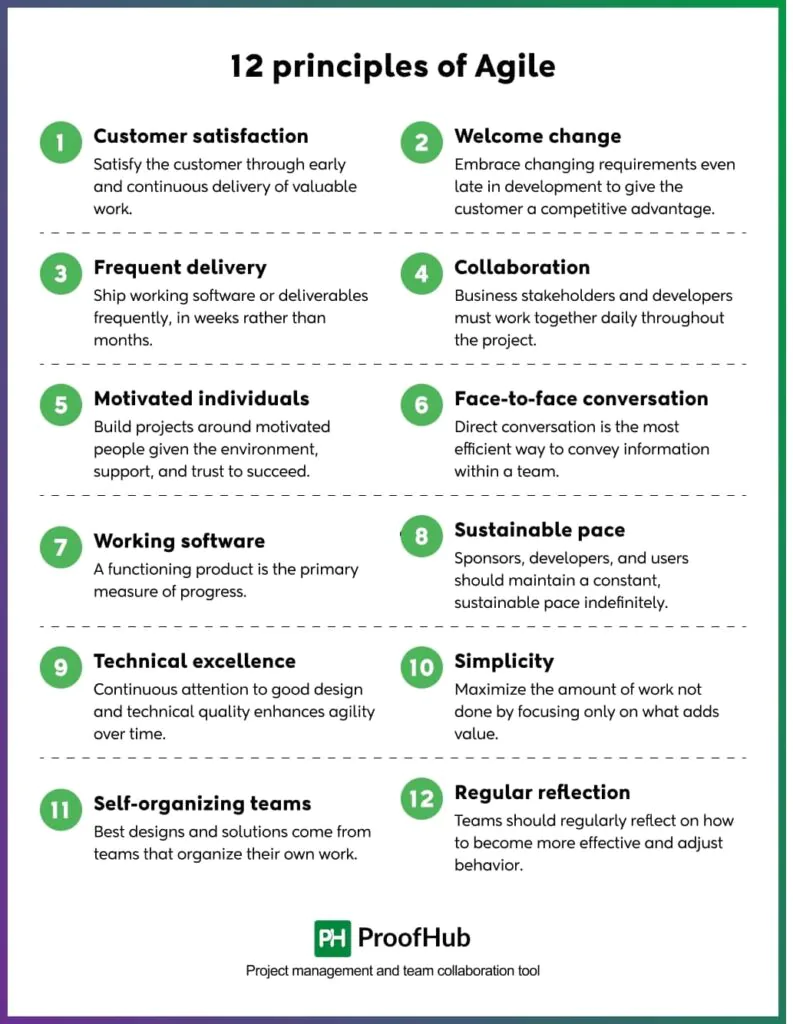
The 12 principles of Agile are customer satisfaction, welcoming change, delivering frequently, collaboration, motivating individuals, focus on face-to-face conversation, building software that actually works, working at a sustainable pace, maintaining technical excellence, elevating simplicity, allowing teams to self-organize, and regularly reflecting on the work done.
These Agile principles can be implemented more directly, and only the ground-level details need to be determined. These serve as the more actionable counterparts to the Agile values stated above.
All the Agile principles are explained below:
1. Customer satisfaction
The highest priority is satisfying the customer through early and continuous delivery of valuable work.
Teams fully satisfy customers by moving beyond bureaucracy and prioritizing their needs. High satisfaction leads to a better stakeholder image and an improved public image for the organization.
2. Welcome change
Agile teams embrace changing requirements even late in development, using change to give the customer a competitive advantage.
Change is not treated with fear, but as an opportunity that can lead to favorable results.
Being flexible leads to competitive advantage in a volatile market that can change at any time.
3. Frequent delivery
Working software or deliverables should be shipped frequently, in weeks rather than months.
This not only keeps the product continually improving but also gives stakeholders an opportunity to change the project’s direction before the approach becomes permanent.
4. Collaboration
Business stakeholders and developers must work together daily throughout the project.
This aligns with the core values of Agile, fosters a more harmonious progression of the project, and gives everyone a chance to continually negotiate the direction the project is moving in.
5. Motivated individuals
Projects should be built around motivated people who are given the environment, support, and trust to get the job done.
This is not only true for Agile but also for all project management methodologies, though Agile makes a special case for motivated team members through value sharing and the creation of a unified team.
6. Face-to-face conversation
Direct conversation remains the most efficient way to convey information within a team.
Meetings are kept to a minimum, as frequent meetings can disrupt the flow of a team’s progress. Rather, face-to-face communication is more effective at addressing misalignment.
7. Working software
A functioning product is the primary measure of progress.
This might sound obvious, but in Agile, the focus is not on satisfying a rigid project plan set at the start, but on delivering functionality and value through rapid cycles and continuous improvement.
8. Sustainable pace
Sponsors, developers, and users should be able to maintain a constant, sustainable pace indefinitely.
This means a team works at a constant bandwidth all the time, rather than working in bursts, which means working a lot during some periods, but not working as much during periods of lull.
9. Technical excellence
Continuous attention to good design and technical quality enhances agility over time.
All team members should be technically trained and know all the techniques that help them in their jobs. This also involves hiring the right people, who hold the right vocational education or degrees.
10. Simplicity
Maximizing the amount of work done is essential, focusing effort only on what adds value. Agile treats sophistication as a byproduct of simplicity rather than as a goal in itself.
Making things needlessly complicated leads to a poorly designed and badly implemented product.
11. Self-organizing teams
The best designs and solutions come from teams that organize their own work rather than being directed from the top down.
People working on the project day-to-day have more knowledge about how responsibilities should be delegated, rather than a project manager boxing people into rigid roles that are at odds with the project’s momentum.
12. Regular reflection
Teams should regularly reflect on how to become more effective, then adjust their behavior accordingly.
Most Agile workflows feature a retrospective meeting at regular intervals that encourages the team to reflect on how the project progressed and identify positive changes to implement in the next sprint.
What are the key characteristics of Agile?
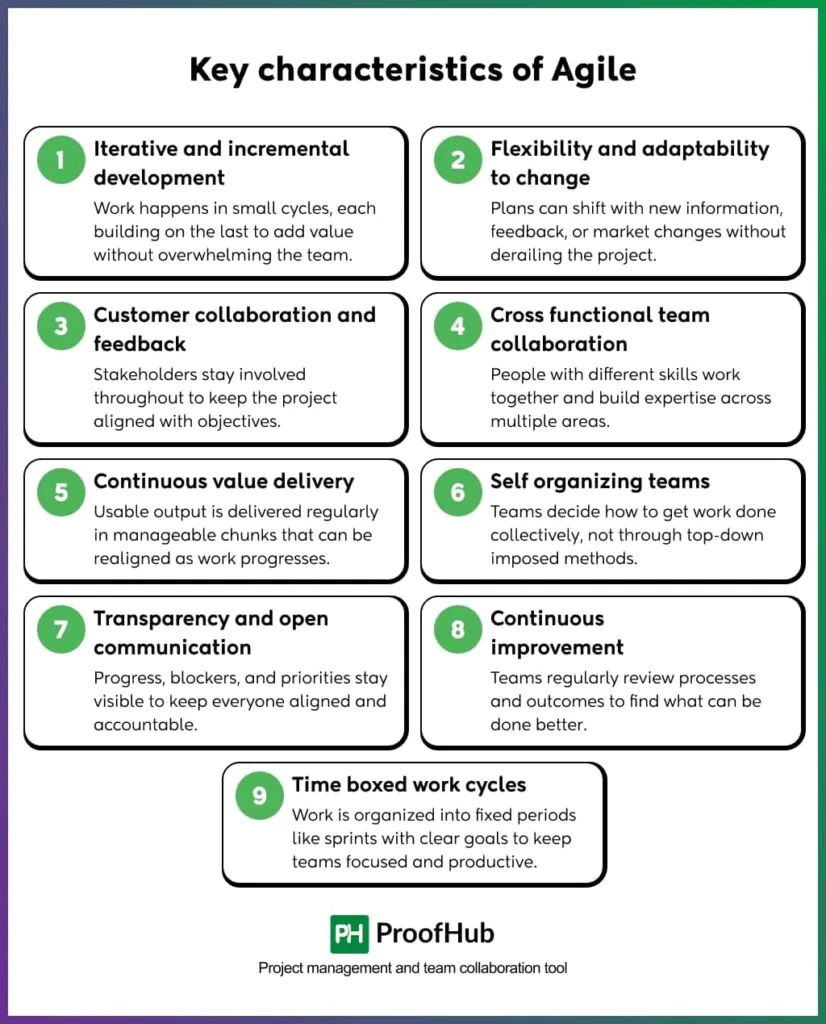
The key characteristics of Agile are: iterative and incremental development; flexibility and adaptability to change; customer collaboration and feedback; cross-functional team collaboration; continuous value delivery; self-organizing teams; transparency and open communication; continuous improvement; and time-boxed work cycles.
These characteristics define how teams implement Agile workflows. Please note that every team has its own unique way of implementing Agile, and these characteristics can change with circumstances and available information.
The common characteristics of Agile are described below:
- Iterative and incremental development: Work is completed in small cycles, with each iteration building on the previous one and adding functional value. This keeps expectations and deliverables manageable, and prevents team members from being overwhelmed all at once.
- Flexibility and adaptability to change: Plans can shift in response to new information, feedback, or changing market conditions without derailing the project. This is especially useful in software development where problems don’t have fixed or rigid solutions. Each task can be done in a variety of ways that may change over time.
- Customer collaboration and feedback: Customers or stakeholders are involved throughout the process, not just at the start and end. Integrating constant stakeholder feedback keeps the project aligned with objectives.
- Cross-functional team collaboration: Teams typically include people with different skill sets who work together rather than in isolated silos. Communication is encouraged, and team members are allowed to build expertise across a range of subjects rather than in a single domain.
- Continuous value delivery: Usable output is delivered regularly instead of waiting until the very end of a long project. This also breaks down the project’s scope into manageable chunks that can be continuously realigned as the project progresses.
- Self-organizing teams: Teams have the autonomy to decide how best to accomplish their work. Agile does not depend on a fixed, detailed itinerary of actionable steps. The team is free to choose the methodology that works best for it, rather than working with a method imposed from top down. It is a collective decision.
- Transparency and open communication: Progress, blockers, and priorities are visible to the whole team and relevant stakeholders. This helps keep everyone on the same page and encourages accountability within the team.
- Continuous improvement: Teams routinely evaluate their processes and outcomes to identify opportunities for improvement. This is in keeping with the incremental philosophy of Agile methodology where work and delivery are managed in chunks. Similarly, project evaluation is also a continuous process.
- Time-boxed work cycles: Work is organized into fixed-length periods, such as sprints, that keep teams focused and accountable. Work cycles also help teams be more productive. All Agile sprints have clear goals, which leads to less overthinking about what to do, so members can focus on accomplishing them rather than deliberating about them.
What are the stages of Agile workflow?
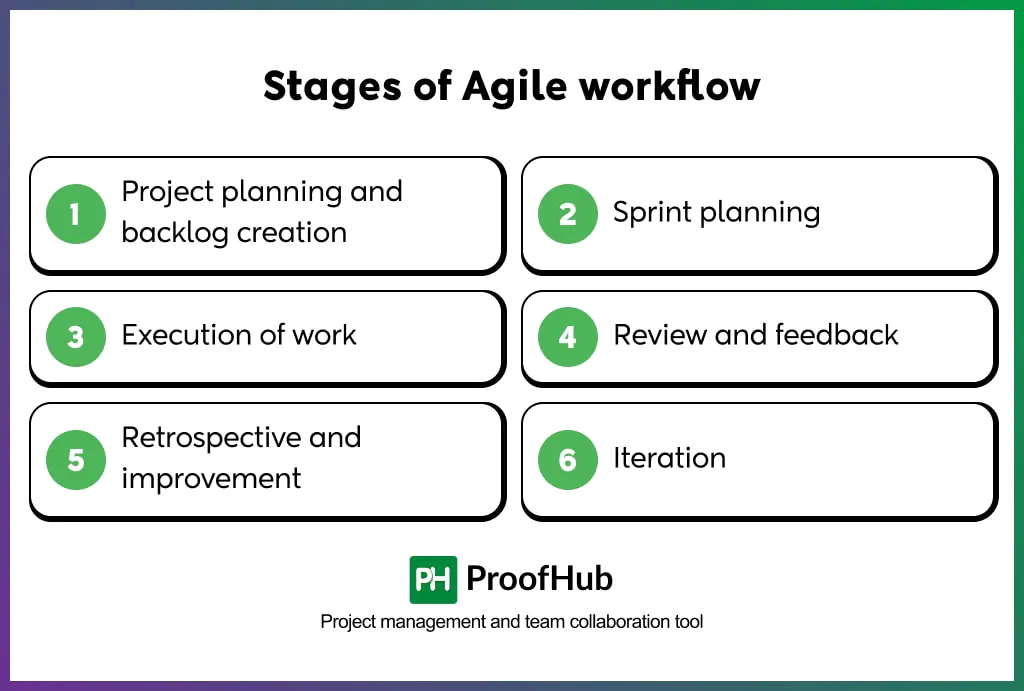
The stages of Agile workflow are: project planning, sprint planning, execution of work, review and feedback, retrospective and improvement, and iteration.
These stages reflect the cyclic and continuously improving philosophy of Agile workflows. Together they form a loop that can be repeated until the project is complete.
All the stages have been explained below:
- Project planning and backlog creation: The team defines the project vision through initial documentation, which is considered flexible, and creates a backlog, a prioritized list of features, tasks, and requirements. In Agile, a product backlog is a set of objectives that include adding new features, updating existing features, fixing bugs, changing the infrastructure, and other product-related tasks.
- Sprint planning: Select a set of backlog items to complete within the upcoming sprint or iteration, usually lasting one to four weeks. This is best done using a project management tool, where tasks are created as separate entities. Each sprint contains tasks and objectives that need to be completed during that sprint. If something goes wrong during the sprint, it serves as a basis for analysis and correction in the next sprint.
- Execution of work: Carry out the planned tasks, often with daily standup meetings to track progress and surface blockers. The daily routine of constant feedback and evaluation keeps the tasks on track and prevents delays. Standup meetings are crucial in preventing unnecessary meetings further down the line that suck up time and resources.
- Review and feedback: At the end of the sprint, the team demonstrates completed work to stakeholders and gathers feedback. This is done via a meeting. This aligns stakeholders with the project and its execution, enabling them to provide timely input wherever and whenever needed.
- Retrospective and improvement: Reflect on what went well and what did not, identifying changes to improve the next cycle. This is important because it is the mechanism that enables continuous improvement of Agile workflows. Without retrospectives, useful changes are very hard to implement.
- Iteration: The cycle repeats, with the backlog updated based on feedback, until the project or product reaches its goals. When the project achieves its goals or stakeholders are reasonably satisfied, the project ends. After that, a retrospective meeting is held in which the team analyzes the project and identifies areas for improvement to incorporate into the next project’s documentation.
What is Agile project management?
Agile project management is the practice of applying Agile values and principles to plan, execute, and deliver projects in short, iterative cycles rather than one continuous linear phase.
Instead of defining every requirement upfront, teams work from a prioritized backlog, adjusting scope as they learn more about the customer’s needs. Progress is measured through working deliverables rather than documentation or milestones alone.
This approach relies heavily on collaboration, transparency, and frequent checkpoints such as sprint reviews and retrospectives, allowing teams to catch problems early, respond to change quickly, and keep stakeholders continuously informed about progress.
What are the important roles in Agile?
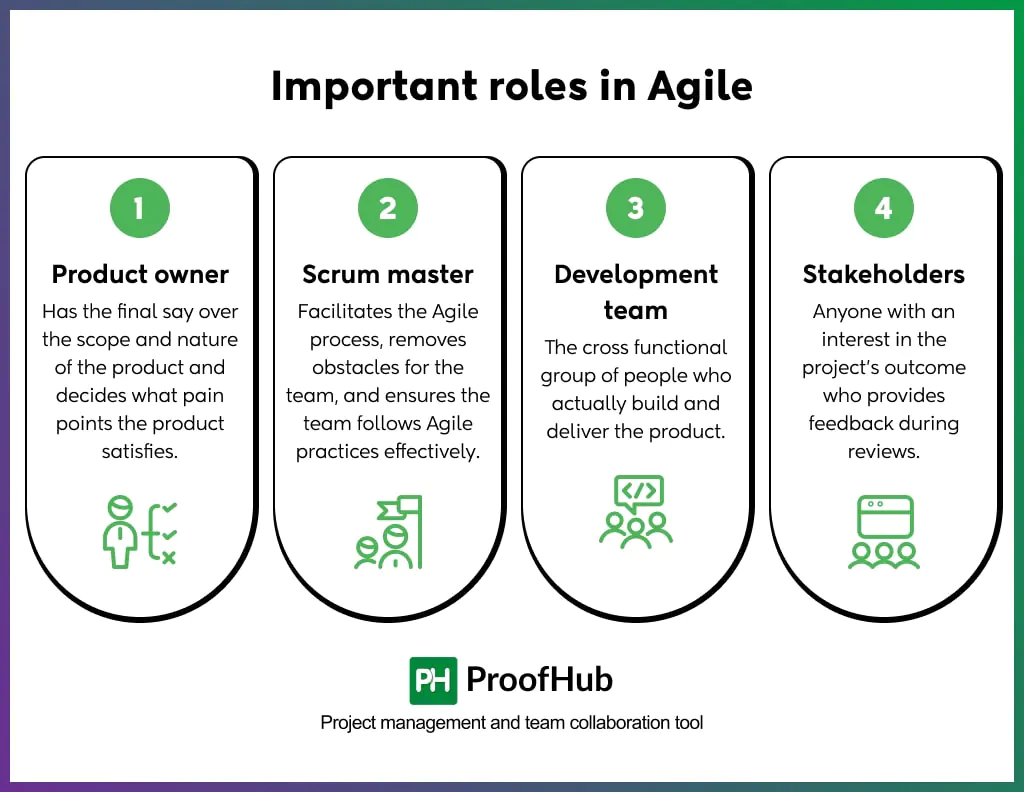
Important roles in Agile include: product owner, scrum master, development team, and stakeholders.
These roles help delineate responsibilities and create a reliable structure that can be replicated across industries and different team types. These roles are best suited for software development workflows where features and scope can change over time.
The different roles in Agile are explained below:
- Product owner: The product owner has the final say on the product’s scope and nature. They decide which pain points the product addresses and how it will do so. They work in close collaboration with stakeholders to understand their expectations for the product and gather input on the feature list. The request for additional features comes through the product owner to prevent scope creep.
- Scrum master: Facilitates the Agile process, removes obstacles for the team, and ensures the team follows Agile practices effectively. A scrum master falls into the category of “servant leadership”, meaning they work continuously in collaboration to help teams function in a seamless manner rather than taking a more domineering approach like a traditional project manager.
- Development team: The cross-functional group of people, such as developers, designers, and testers, who actually build and deliver the product. This is part of any Agile project, and it is the component that performs the tasks that achieve the project’s goals. As established above, the development team works in repeatable cycles with constant feedback and evaluation.
- Stakeholders: Anyone with an interest in the project’s outcome, including customers, sponsors, and business leaders, who provide feedback during reviews. They work with the product owner to establish what the product will do and how it will do it. They are not directly involved in the workflow, but only in a consultative capacity.
What are the popular Agile methodologies and frameworks?
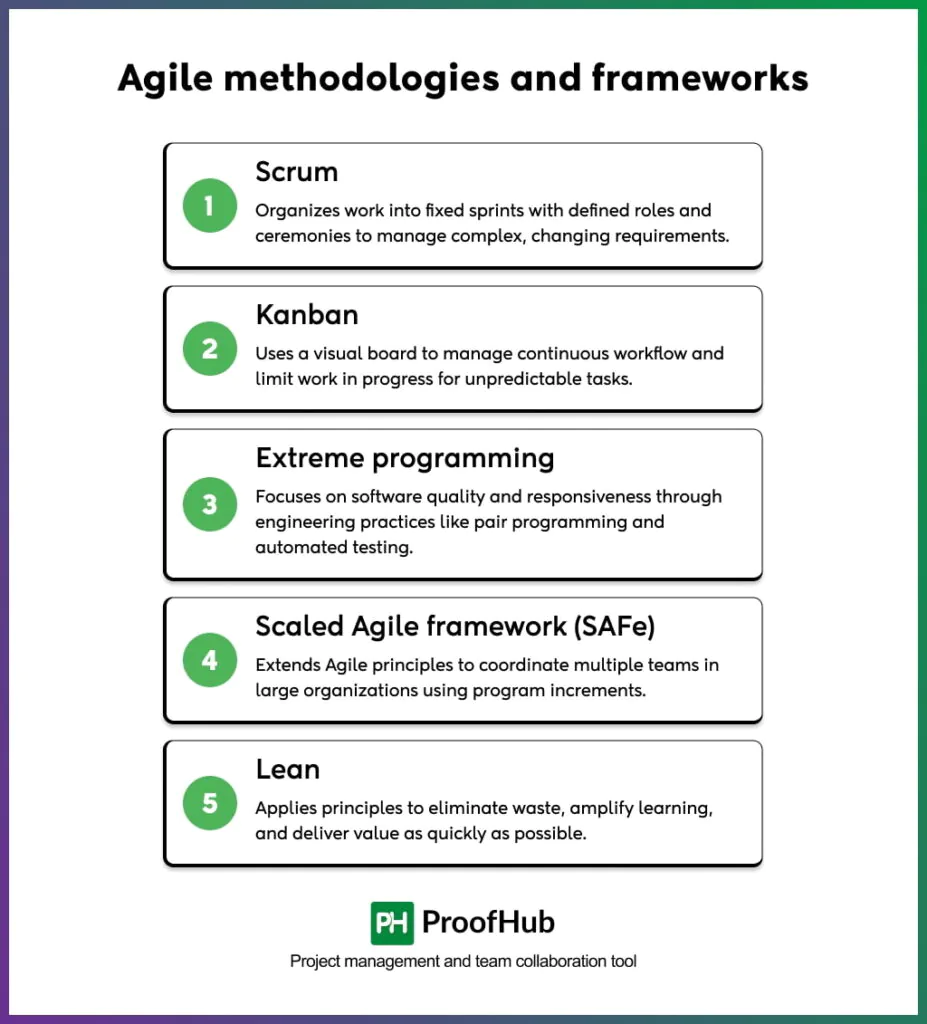
The popular Agile methodologies and frameworks are: Scrum, Kanban, Extreme Programming, SAFe, and Lean.
The choice of Agile methodology depends on the project type, the team, and the workflow. Scrum and Lean are specifically used in software development workflows, while Kanban is widely used in creative workflows such as marketing and design.
The various Agile methodologies are explained below:
1. Scrum
Scrum is the most widely used Agile framework, organizing work into fixed sprints, typically two to four weeks, with defined roles including a product owner, a scrum master, and a team.
It relies on ceremonies such as sprint planning, daily standup meetings, sprint reviews, and retrospectives to structure the workflow and maintain transparency.
Scrum uses a backlog, which defines what is to be done in a point-wise, orderly fashion, helping prioritize tasks and track progress through burndown charts.
It supports complex workflows that require substantial input to complete the project, and the requirements change frequently. For example, a team building automobiles can use Scrum to design, manufacture, and test cars.
2. Kanban
Kanban is a visual workflow management method that uses a board with columns such as To Do, In Progress, and Done to represent the flow of work.
Unlike Scrum, it does not use fixed sprints; instead, work items move continuously through the pipeline, and teams limit the amount of work in progress at any time to avoid bottlenecks.
Kanban emphasizes continuous delivery and flexibility, making it well suited for support teams or operations where tasks arrive unpredictably.
For example, an IT help desk might use a Kanban board to track incoming tickets from submission through resolution.
3. Extreme programming
Extreme programming, often called XP, is an Agile framework focused specifically on improving software quality and responsiveness to changing requirements through engineering practices.
It emphasizes practices such as pair programming, test-driven development, continuous integration, and frequent small releases.
XP places strong importance on technical excellence and code quality alongside customer collaboration. It works well for teams building software with high uncertainty or rapidly changing specifications.
For example, a development team might use pair programming and automated testing to catch defects early while adjusting features weekly based on customer input.
4. Scaled Agile framework (SAFe)
The Scaled Agile Framework, or SAFe, extends Agile principles to large organizations coordinating multiple Agile teams working on a single product or portfolio.
It introduces additional layers of planning, including program increments that align several teams around shared goals every eight to twelve weeks.
SAFe combines Agile, Lean, and DevOps practices to manage dependencies across teams while preserving the flexibility of individual Scrum or Kanban workflows.
For example, a large enterprise building a banking platform might use SAFe to align dozens of teams working on different modules toward a common release schedule.
5. Lean
Lean applies principles, originally developed by Toyota, to a variety of projects, focusing on eliminating waste, amplifying learning, and delivering value as quickly as possible.
It emphasizes deferring decisions until the last responsible moment, empowering teams, and building integrity into the workflow from the start.
Lean is less a strict framework and more a set of guiding principles that can complement Scrum or Kanban.
For example, a startup might apply Lean thinking to quickly test a minimum viable product with real users before investing further development effort.
What are the benefits of Agile?
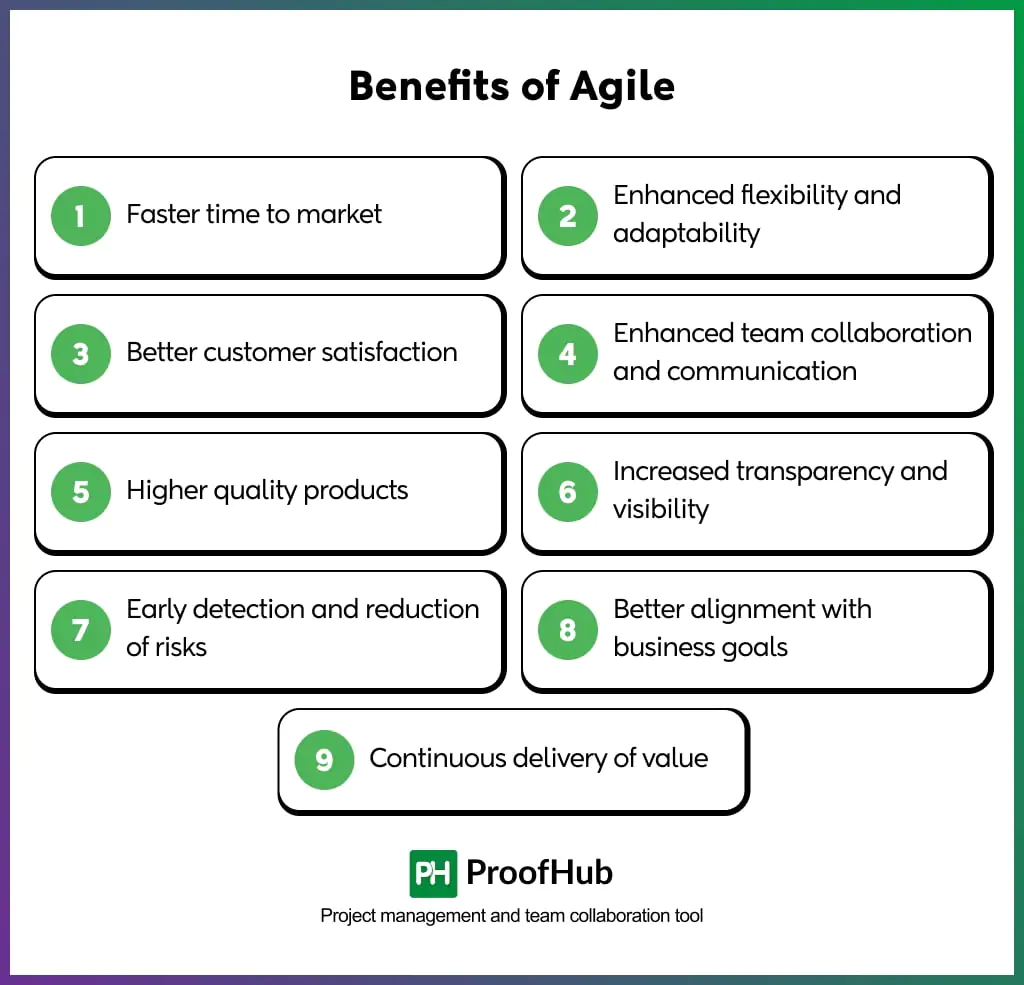
The benefits of Agile are: Faster time to market, enhanced flexibility and adaptability, better customer satisfaction, enhanced team collaboration and communication, higher-quality products, increased transparency and visibility, early detection and risk reduction, better alignment with business goals, and continuous delivery of value.
Due to its several benefits, Agile has become one of the most widely used methodologies across industries.
The main benefits of using Agile are explained below:
- Faster time to market: Iterative delivery allows usable features to reach customers sooner rather than waiting for a single final release. Customers can provide feedback, which the product owner and development team can use to improve the product in the next iteration.
- Enhanced flexibility and adaptability: Teams can adjust priorities and scope as requirements or market conditions change. Flexibility is required in domains where deliverables change frequently and require constant realignments. Flexibility is especially useful when the solution to a problem is not immediately apparent, as often happens in software development.
- Better customer satisfaction: Continuous customer involvement ensures the final product matches actual needs rather than assumptions made at the start. As a result, customers report better satisfaction from the product.
- Enhanced team collaboration and communication: Daily interaction and shared visibility keep everyone aligned on priorities and progress. The result of this ethos is that communication is treated not only as a tool but also as the foundation on which the team’s culture is built.
- Higher quality products: Frequent testing and review throughout the process catch defects earlier than a single end-stage review. Constant delivery also catches any uncaught errors that may have escaped QA.
- Increased transparency and visibility: Backlogs, boards, and regular ceremonies make progress and blockers visible to the whole team. This promotes a culture of self-accountability and high standards.
- Early detection and risk reduction: Problems surface during short iterations rather than remaining hidden until late in a long project. When the project finally finishes, the product is robust and well-built. Plus, any future teams working on the product find it easier to build on the previous work.
- Better alignment with business goals: Continuous feedback loops keep the work connected to actual business priorities rather than outdated assumptions. ROI improves, and projects finish well within budget.
- Continuous delivery of value: Customers receive usable increments of the product regularly rather than waiting for a single large release. They can evaluate the product in manageable chunks rather than conducting a long, unreliable one-time review that may overlook defects.
What are the challenges in adopting Agile?
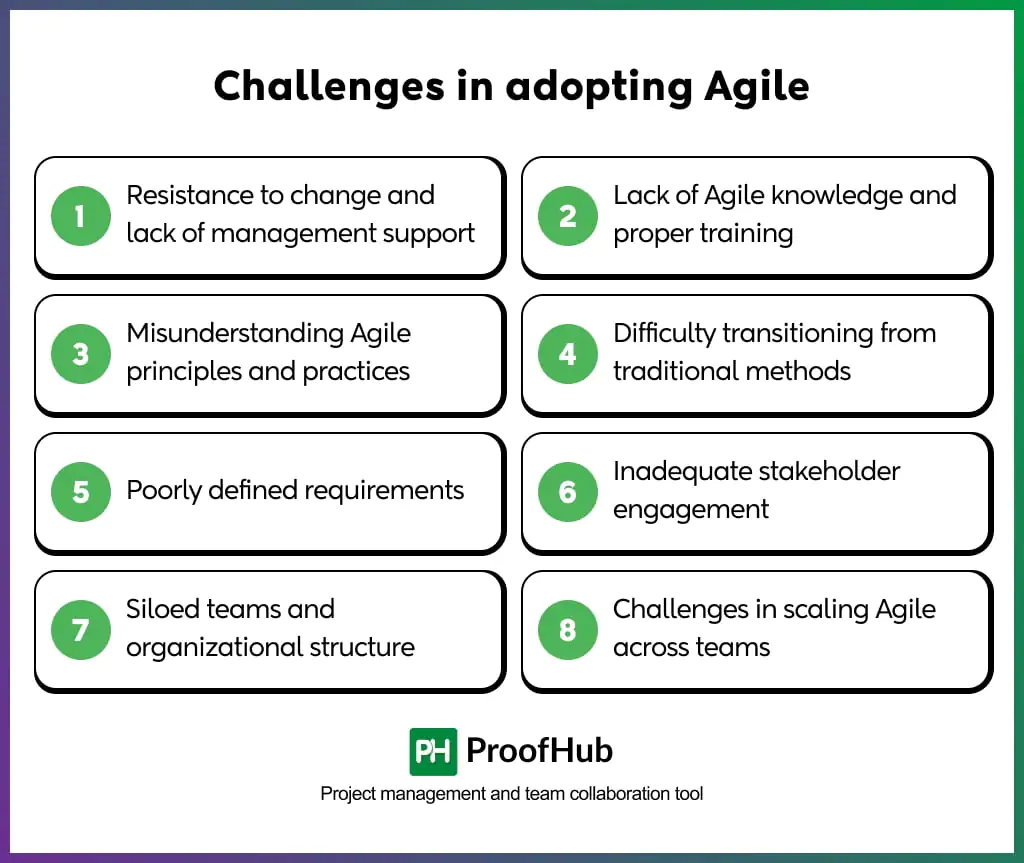
The challenges in adopting Agile are: Resistance to change and lack of management support, lack of Agile knowledge and proper training, misunderstanding Agile principles and practices, difficulty transitioning from traditional methods, inadequate stakeholder engagement, siloed teams and organizational structure, and scaling Agile across teams.
The common challenges in Agile adoption are explained below:
- Resistance to change and lack of management support: Agile requires a cultural mindset shift, not just a process change, which many organizations underestimate. Without strong management buy-in and sponsorship, teams lack the resources, authority, and consistency needed to implement Agile properly, causing initiatives to stall or fail entirely.
- Lack of Agile knowledge and proper training: Organizations frequently rush the transition, expecting teams to self-teach through trial and error rather than investing in structured coaching. Without formal training, teams end up running rituals without substance, and the expected gains in speed and quality never materialize.
- Misunderstanding Agile principles and practices: Agile emphasizes a balance between flexibility and rigor. Without a solid grasp of the principles, teams produce inconsistent, undocumented work that confuses anyone who joins the project or reviews it later.
- Difficulty transitioning from traditional methods: Agile requires continuous collaboration and shared ownership, which can feel disorienting to teams used to working in isolated phases. Without a deliberate transition plan, teams end up blending old and new practices in ways that satisfy neither model and further slow delivery.
- Inadequate stakeholder engagement: Stakeholders are often unavailable or unwilling to commit to the frequent touchpoints that Agile requires, leaving the team to handle them alone. Without consistent engagement, teams build increments that miss the mark, and the entire feedback loop that makes Agile effective breaks down.
- Siloed teams and organizational structure: Traditional org charts were built for handoffs between specialists, not for the cross-functional collaboration which Agile depends on. Without breaking down the silos, teams face constant delays waiting on other departments, undermining the speed Agile is meant to deliver.
- Scaling Agile across teams: Practices that work well at a small scale, such as daily standups and shared backlogs, don’t automatically translate to large teams. Without a deliberate scaling framework, teams end up duplicating effort, blocking each other, and losing the visibility that made Agile effective in the first place.
What is the difference between Agile and Waterfall?
Waterfall is a traditional, linear project management approach in which a project progresses sequentially through distinct phases, such as requirements, design, development, and testing.
Each phase must be entirely completed before the next begins, making changes difficult and costly once development is underway. It works best for predictable projects with fixed requirements and clear, unchanging end goals.
Agile is an iterative, flexible approach focused on continuous collaboration and rapid feedback. Projects are broken down into small, manageable cycles called sprints, allowing teams to deliver functional increments of software regularly.
This structure makes it easy to adapt to changing user needs and evolving requirements throughout the development lifecycle.
What are the differences between Agile and Scrum?
Agile is a broad philosophy for managing projects, built around values such as flexibility, collaboration, and delivering work in small increments rather than a single big launch.
It is guided by principles such as responding to change, prioritizing working results, and involving customers throughout the process. Agile itself is not a fixed method; it is a mindset that many different frameworks try to put into practice.
Scrum is one specific framework built on Agile principles. It organizes work into short cycles called sprints, assigns roles like Scrum Master and Product Owner, and uses ceremonies such as daily standups and sprint reviews. In short, Agile is the philosophy, and Scrum is one structured way to apply it.
What type of projects are best suited for Agile?
Agile works best for projects where requirements are likely to change, evolve, or remain unclear at the outset, such as software development, product design, and digital marketing campaigns.
It suits projects that benefit from frequent customer feedback and incremental delivery, allowing teams to adjust direction based on real results rather than assumptions made months earlier.
Agile is less suited to projects with fixed, well-defined requirements and strict regulatory or contractual constraints, such as certain construction or manufacturing projects, where Waterfall’s predictability may be more appropriate.
Which Agile certifications are best for project managers?
Several certifications help project managers validate their Agile expertise. The Certified ScrumMaster, offered by the Scrum Alliance, is one of the most recognized entry points into Scrum.
PMI’s Agile Certified Practitioner (PMI ACP) covers multiple Agile frameworks and is respected across industries for its broad scope. ICAgile offers a range of certifications covering fundamentals, coaching, and specific frameworks like Kanban.
The SAFe Agilist certification is valuable for professionals working in large organizations that use the Scaled Agile Framework.
The right certification depends on whether a project manager primarily works with Scrum, needs broad Agile knowledge, or operates in a scaled enterprise environment.