
Effective teamwork does not happen by chance. Teams need the right strategies to communicate clearly, coordinate responsibilities, share knowledge, and work toward common goals. Without a structured approach, even skilled teams can face miscommunication, duplicated work, delays, and conflicting priorities.
The right collaboration strategies can turn individual efforts into coordinated team performance. They help employees build trust, improve communication, use their strengths effectively, resolve challenges, and stay aligned throughout a project.
These strategies are especially important for modern teams working across departments, locations, and time zones.
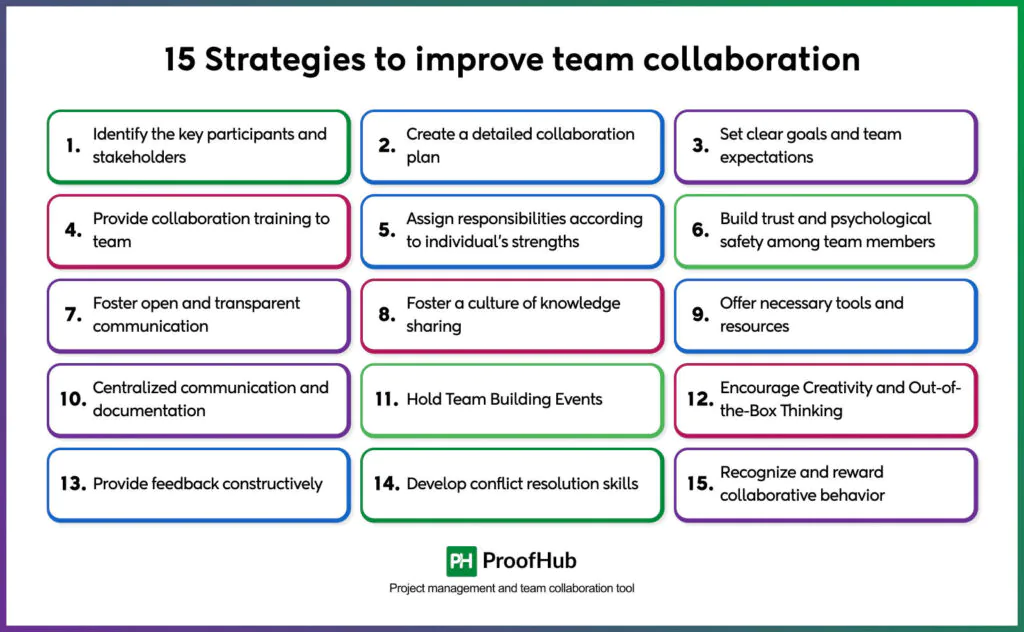
Let’s explore 15 practical collaboration strategies for improving teamwork and team efficiency.
1. Identify the key participants
Identifying key participants makes it easier to understand everyone’s roles, needs, and expectations, and how they are affected by the work.
Key participants are directly involved in the day-to-day work; they make decisions, carry out tasks, and take responsibility for results.
To identify key participants, look at job roles, team structure, workflows, and areas of expertise. This shows who has specific responsibilities, knowledge, or authority.
There are many methods to help with this process. For example:
- The power-interest grid, developed by Ackerman and Eden, maps stakeholders by their influence and interests.
- The salience model, developed by Mitchell, Agle, and Wood in 1997, ranks stakeholders by power, legitimacy, and urgency.
- Other approaches include mapping influence networks, studying cultural dynamics, or planning scenarios.
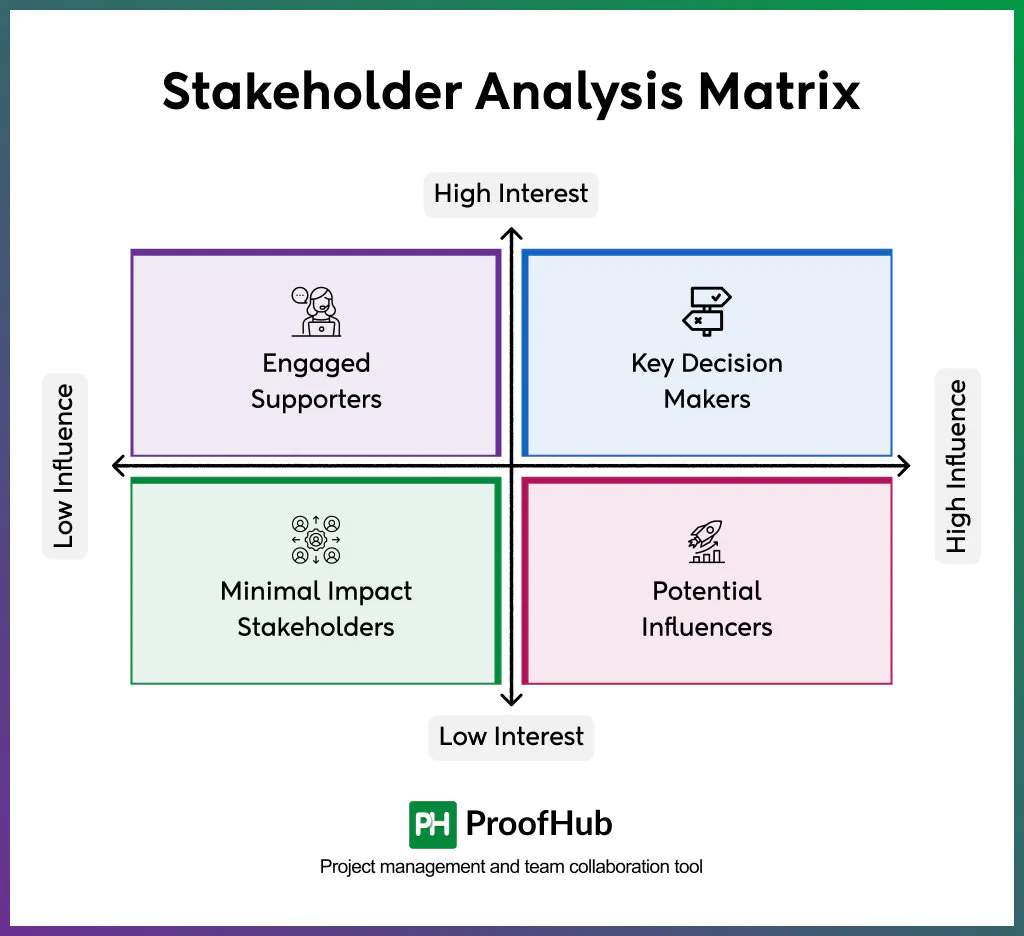
Doing this well clarifies responsibilities, reduces silos, tailors communication, guides resource sharing, and supports risk management. It ensures the team’s work stays aligned with broader goals.
2. Create a detailed collaboration plan
A collaboration plan provides a structured framework for communicating progress, coordinating work, and moving toward shared goals.
Creating a plan reveals hidden obstacles like mismatched collaboration styles or small handoffs, which often cause a project to derail. It helps anticipate these hidden friction points and builds safety guardrails around them.
To create a practical collaboration plan:
- Review how work actually happens: Go beyond the ideal process flow to map what actually occurs, where delays occur, where communication breaks down, and which tasks aren’t even tracked.
- Create a simple “Friction Map” to capture these insights: list pain points, their impact, and who’s affected.
- To surface individual working styles, ask questions like: “What conditions help you do your best work?”
Once the patterns are visible, establish communication frequencies and decision protocols that reduce friction.
For example, replace repetitive status meetings with short asynchronous updates where each person shares what they did, what they’re stuck on, and what they need help with.
For urgent issues, use quick instant messages. For decisions, set up short written or recorded summaries to clarify what was agreed upon and why.
These kinds of lightweight systems reduce confusion while respecting focus time.
Example of collaboration plan:
| Description | Frequency | Channel (ProofHub) | Audience | Owner |
| Daily status logs | End of each workday | Team Discussion Board | Project team | Each team member |
| Task-specific updates | As tasks progress | Task Comments | Assigned members + related teammates | Task assignee |
| Issue reporting & quick clarifications | Immediately after identified | Chat | Project manager + project team | Any team member |
| Key stakeholder updates | Bi-weekly or project phases | Announcements | Key stakeholders | Project owner / PM |
| Milestone documentation | Upon completion | Notes | Project team + stakeholders | Project owner / PM |
| Organization-wide announcements | As needed | Announcements | Entire organization | Project owner / leadership |
| Knowledge sharing / learnings | Ongoing | Notes / Discussions | Project team & new members | Any contributor |
| Brainstorming & idea exchange | At project start or review cycles | Discussions | Project team | Facilitator / Team lead |
3. Set clear goals and team expectations
Setting clear goals and team expectations reduces uncertainty and friction among team members.
Establish clear goals with a clear understanding of expectations, both at the individual and team levels, to create a predictable frameworks that enable team members to coordinate seamlessly.
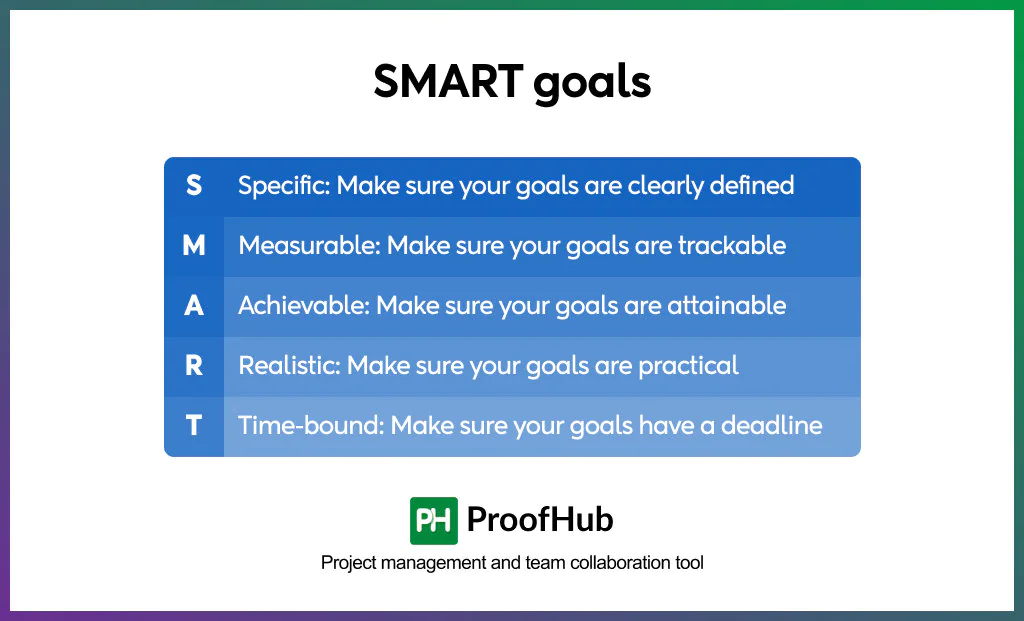
A good way to set goals is to follow the SMART framework: make sure goals are Specific, Measurable, Achievable, Relevant, and Time-bound.
For example, instead of just saying “improve cross-functional collaboration,” define goals clearly like “For next quarter, marketing, sales, and support teams will hold a 30-minute meeting once every two weeks to review priorities and action items; all members need to attend the meeting, and all the discussed points should be resolved within a week”.
When goals are framed clearly, progress is easy to track, teams are aligned, and decisions are clear. It also makes it easier for team members to prioritize, delegate, and take ownership without constant oversight.
Team expectations are performance standards you set for how people interact, make decisions, communicate, and resolve conflicts to produce the output.
Setting clear expectations reduces friction among team members and makes it easier for team members to prioritize, delegate, and take ownership without constant oversight.
Clarity in goals and expectations helps in understanding the role of each member in the team, eliminating misunderstandings and revealing interdependencies.
4. Provide collaboration training to the team
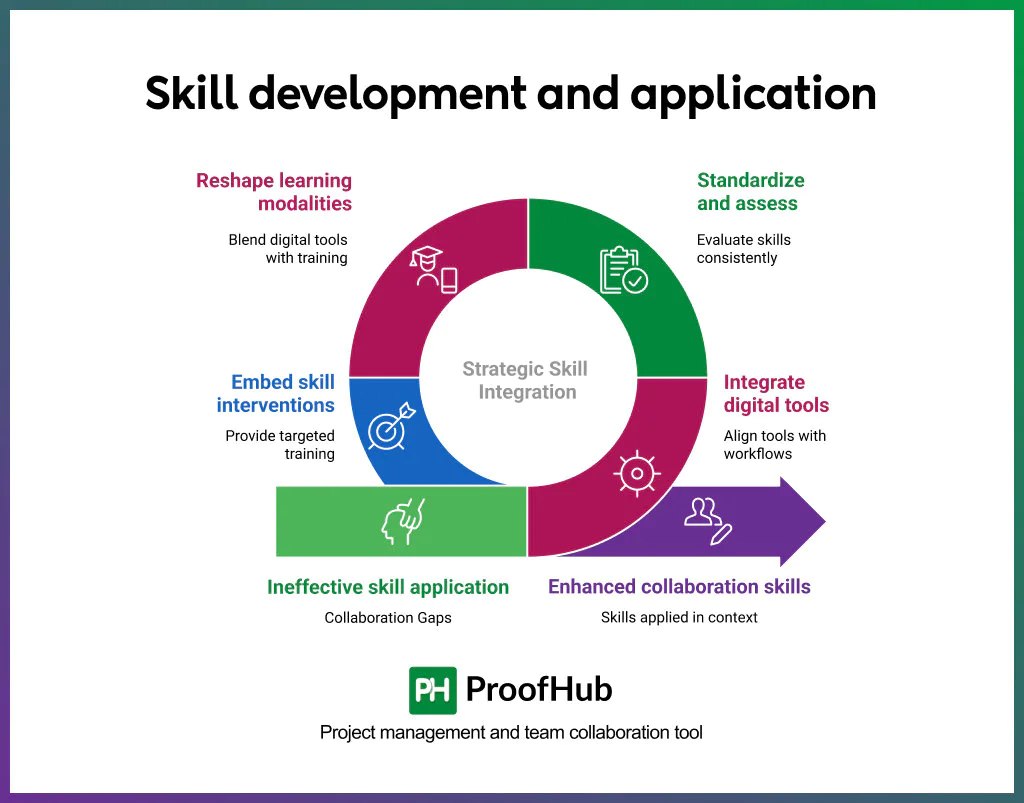
Collaboration training equips teams with the necessary skills, frameworks, and tools to work together more effectively.
Good collaboration training improves efficiency and performance. Teams avoid repeating work and understand how their actions affect others. Most importantly, they feel safe being honest, asking for help, and learning from mistakes. That’s when teamwork becomes truly effective.
To train your team, start by understanding how your team works. Are there communication gaps? Do team members speak up in meetings, or do they trust each other?
Once you spot the problems, design training programs around them. Create exercises, safe situations, or programs where team members see each other’s reliability and build respect.
5. Assign responsibilities according to individuals’ strengths
Assign roles based on strengths by matching people’s talents and working styles to their responsibilities. Instead of fixed roles, shape responsibilities around what people do best.
To assign the right responsibilities, distinguish between being great at your own tasks and the ability to support and coordinate with others. Someone might solve problems well on their own but struggle to collaborate with teammates.
Assigning them a mentoring or leadership role could backfire, not because they lack competence, but because their strengths don’t align with the role.
To avoid these pitfalls, use a simple strengths-to-responsibilities matching process. Start with a short self-assessment where team members reflect on their functional strengths and working styles when collaborating; it can be initiating discussions, handling details, or resolving conflicts.
To identify individual strengths, utilize the CliftonStrengths assessment technique. It helps teams surface their natural ways of thinking, relating, and getting work done.
However, no tool replaces judgment; it should be a starting point, not a substitute for conversations, context, or evolving team needs.
6. Build trust and psychological safety among team members
Trust and psychological safety are the foundations that make real collaboration possible. When team members feel safe, they can raise concerns, share ideas, and ask questions without fear of judgment or repercussions.
To build trust, teams need visible structures that make honesty normal and expected. Shift the focus from blaming to learning by examining failures without targeting individuals.
For example, organizations like NASA and Bridgewater institutionalize this through “issue logs” that capture mistakes in real-time, not to blame, but to detect patterns early.
Teams with higher psychological safety iterate faster, surface risks earlier, and make stronger decisions. According to a study by Gallup, employees who feel their opinions count contribute to a 27% reduction in turnover, 40% fewer safety incidents, and a 12% rise in productivity.
Leadership plays a key role in building an environment of trust in collaborative teams. Lead the team from the front by sharing your mistakes, inviting pushback, and counterarguments from the team.
For instance, at Amazon, managers begin reviews by admitting personal failures. At IBM, employees who challenge assumptions and prevent costly errors are publicly recognized rather than quietly dismissed. These practices make vulnerability visible, setting a standard the whole team can follow.
7. Foster open and transparent communication
Fostering open and transparent communication reduces misunderstandings, eases access to information, and promotes a shared understanding among teams.
It helps improve decision velocity and quality by collapsing the layers between information and decision-makers. When teams have access to relevant data, feedback, project blockers, and performance metrics, they don’t have to escalate or wait for top-down clarification.
Transparent communication is not about flooding people with more information. It means creating a system where everyone across levels, roles, and functions is on the same page.
Research on psychological safety and behavioural integration shows that when team members are encouraged to surface unfiltered data, it creates a more adaptive, truth-seeking decision culture.
The real goal is to ensure the right people have the right information at any given time.
8. Foster a culture of knowledge sharing
Creating a culture of knowledge sharing structures how information flows across the organization.
It allows teams to move from individual efforts to collective problem-solving, reduce dependency on specific people, and enables teams to operate within a common context.
Teams can access information from a shared system through documents, communication channels, or platforms that encourage exchange.
This reduces misalignment, redundant work, and the coordination efforts that usually slow teams down.
To create a collaborative culture, build rituals such as reflection sessions (retrospectives), demos, and onboarding to teach each other what they’ve learned. Reward behaviors that prioritize clear, contextual knowledge sharing over speed or siloed output.
When knowledge sharing becomes a culture, it makes teams resilient, responsive, and ready to solve problems as one.
9. Offer necessary tools and resources
Give your team the right tools and resources to collaborate effectively. Without them, teams end up working in silos, chasing status updates, or duplicating each other’s efforts.
Tools influence team accountability, how decisions are communicated, and how project progress is tracked and measured.
The right tools support work and shape how it gets done. When integrated into daily workflows, they become part of the organization’s operating system.
It centralizes information, visualizes tasks, and makes knowledge easy to find.
For instance, ProofHub is a comprehensive platform for team collaboration. Teams can create projects, map out tasks, set deadlines, share files, and assign owners, so accountability is always visible.
Collaboration software saves time, improves decision-making, reduces stress, and builds a culture where people can trust that the work in front of them is the real work that matters.
10. Centralized communication and documentation
Centralizing communication and documentation eliminates confusion, reduces duplication, and keeps teams aligned. It brings all the conversations, decisions, updates, and resources in one place.
Without a centralized platform, context is lost, time is wasted on looking for files and information, priorities get misinterpreted, and rationale for decisions taken is lost.
Centralization doesn’t require a single tool; it requires agreed-upon rules. Decide where different types of communication live. For example:
- All project updates go into a shared project board.
- All key decisions are documented in a living doc or tool like Confluence or Notion.
- All real-time conversations happen in a designated Slack or Teams channel, not private DMs.
- All reference documents are stored in a shared drive, not scattered across emails.
It reduces cognitive load, makes collaboration faster, prevents common questions from being repeated, and reduces burnout.
Make sure to balance synchronous and asynchronous collaboration. Not all decisions need a meeting. Use shared docs for idea gathering, quick status updates, or decision proposals.
This gives people time to think and contribute to their schedule, reducing the pressure of live discussions and allowing better input from quieter voices.
11. Hold team-building events
Team-building events are often considered optional or superficial. However, when designed with intent, they serve as a core driver of collaboration.
They help build the foundation for trust, communication, and problem-solving in the team.
The best team-building activities consistently do three things:
- Surface hidden strengths and styles. Activities that call for different kinds of thinking reveal who thrives in which situations, helping teams self-organize more effectively in real work.
- Normalize vulnerability and disagreement. Practicing light conflict in a safe context builds confidence to tackle real disagreements constructively.
- Reinforce shared identity. Celebrating achievements or creating group rituals reminds people they’re part of something larger than individual key performance indicators (KPIs).
To improve the effectiveness of the activities, ask “What worked? What surprised us? What can we apply to our day-to-day?”
Micro-rituals like 15-minute check-in rounds, rotating coffee chats, or peer recognition moments help maintain connection throughout the year without disrupting work. These “small doses” build a lasting baseline of trust and collaboration.
When approached with intention, relevance, and frequency, team building delivers more than morale. It improves decision-making speed, shortens conflict resolution cycles, and strengthens cohesion.
12. Encourage creativity and out-of-the-box thinking
Creativity opens new pathways for solving problems that rigid processes cannot address. Encouraging teams to think beyond the norms helps generate fresh ideas and challenge assumptions that may be limiting progress.
Encouraging your team to think out of the box creates a sense of possibility; problems are no longer seen as fixed constraints but as opportunities for invention.
Instead of converging on the safest solution, members can bring diverse perspectives, test and refine each other’s ideas.
Fostering creativity also reduces the fear of being wrong. When leaders make it safe to propose unconventional ideas, even if they don’t work out, teams develop psychological resilience.
A “failed” experiment becomes a source of collective learning rather than wasted effort. This builds trust and encourages members to contribute more freely, knowing their input will be valued.
To encourage creativity and innovation, create deliberate structures. For example, set aside time for ideation before decision-making, rotate facilitation roles to bring different voices forward, or run “what if” exercises to stretch the team’s imagination.
13. Provide feedback constructively
Constructive feedback allows you to share your honest opinion on how your team members are performing, how they can improve, and what the expectations are from them, without being critical.
Its main goal is to shift the focus from blame to growth and provide a clear plan for improvement. When feedback is received positively, it makes team members willing to improve, participate actively, admit mistakes, and ask for help when needed.
To offer feedback constructively, express your thoughts respectfully with genuine intent instead of judgements, and keep the focus on improvement.
Invite dialogue to further strengthen the feedback loop by ensuring it is two-way rather than top-down. Balance critique with recognizing strengths and appreciating what the individual is doing well.
When teams utilize constructive feedback, collaboration becomes more fluid and resilient. Challenges are addressed directly without damaging relationships, and growth is seen as a shared journey.
14. Develop conflict resolution skills
Developing conflict resolution skills is an essential part of effective collaboration. When diverse perspectives and strong ideas come together, disagreements in a team are inevitable.
Conflicts can damage trust, slow progress, and create an unhealthy work environment. When handled well, disagreements can actually sharpen thinking, strengthen relationships, and lead to better decisions.
To resolve conflicts effectively, identify the signs of tension early rather than waiting for issues to escalate. From there, focus on understanding the underlying concerns rather than just reacting to surface-level disagreements.
This requires active listening, patience, and a willingness to see the situation from multiple viewpoints. Set ground rules for discussions, ask clarifying questions, and summarize what’s been said to help keep conversations constructive.
15. Recognize and reward collaborative behavior
Collaboration thrives when it’s recognized and rewarded. It encourages people to work together, share their expertise, support team members, and work together towards common goals.
This improves team morale, strengthens trust, and creates a workplace culture where contribution is part of the everyday work.
To encourage collaboration, instead of rewarding individual achievement, reward behaviors that strengthen teamwork, such as sharing expertise, helping team members, resolving conflicts, and contributing to team goals.
Recognition does not require financial rewards every time; you can acknowledge collaborative contributions through team awards, public mentions, or better responsibilities.
For example, recognize an employee for helping a team member overcome a technical problem.
Make sure to follow a balanced approach that recognizes both individual and team contributions to avoid encouraging unhealthy competition.
Why is a collaboration strategy important for an organization?
A collaboration strategy is important because it aligns the team toward common goals, promotes knowledge sharing, reduces operational inefficiencies, enhances adaptability and boosts employee engagement.
It defines how individuals, teams, and departments work together to achieve shared goals. Without a clear strategy, collaboration becomes fragmented, reactive, and inconsistent, leading to duplicated efforts and missed opportunities.
- Aligns teams toward common objectives: Departments often operate with different agendas or workflows, and a strategy ensures coordination rather than conflict. It enables better prioritization, decision-making, and execution.
- Promotes knowledge sharing and transparency: Facilitates the exchange of expertise and feedback across functions, allowing ideas to evolve faster and solutions to emerge from diverse viewpoints.
- Reduces operational inefficiencies: Helps eliminate redundant resources, unclear responsibilities, and misaligned expectations. It establishes standards for using communication platforms, sharing documents, and collaborative decision-making, which prevents confusion and wasted time.
- Enhances adaptability: A strategic framework prepares teams to coordinate quickly during market shifts, transitions such as digital transformation, mergers, or crises.
- Boosts employee engagement: Fosters trust, clarity, and inclusion, the three key drivers of employee satisfaction. Teams perform better when they understand how their work contributes to broader goals and when they collaborate in psychologically safe environments.
What challenges are expected in implementing collaboration strategies?
The common challenges include resistance to change, tool overload, cultural misalignment, unclear roles, measuring success, and inconsistent leadership.
- Resistance to change: Employees may feel threatened by new systems, workflows, or expectations around transparency and accountability. Without buy-in, even the most well-crafted strategy fails.
- Tool overload: Introducing new platforms without retiring old ones results in fragmented communication. It causes confusion, slows work, and undermines trust in the strategy. A careful audit and consolidation of tools is critical during implementation.
- Cultural misalignment: Teams accustomed to working independently may not easily shift to open collaboration. Make sure to address the communication styles, expectations, work practices, and attitudes of the team towards collaboration.
- Unclear roles: It can create confusion about decision-making or task ownership, leading to duplicate work, delays, and frustration. Clear roles help teams coordinate and collaborate effectively with confidence.
- Measuring success: Without benchmarking, it is difficult to identify what’s working or where to improve. Set clear KPIs, expected behaviors, and outcomes for measuring the success of collaboration.
Addressing these challenges requires deliberate planning, honest feedback loops, and continuous adjustment, not just a one-time rollout.
How to measure the impact of collaboration strategies?
To measure collaboration strategy impact, combine quantitative metrics with qualitative feedback.
- Start by defining clear goals tied to collaboration, such as faster project completion, increased innovation, or improved cross-team engagement, and then track metrics that align with those goals.
- Use productivity indicators like task completion rates, project timelines, or cycle times to evaluate execution efficiency.
- Monitor communication tool usage (e.g., messages sent, meetings held, document sharing activity) to assess engagement, but avoid assuming high volume equals effectiveness.
- Survey employees to gauge perceptions of collaboration quality. Focus on clarity of roles, ease of accessing information, inclusiveness in discussions, and transparency in decision-making. Qualitative feedback often uncovers pain points that data alone misses.
- Collaboration network analysis can also reveal who collaborates with whom, how frequently, and whether certain teams or individuals are becoming isolated or overloaded. This helps optimize workflows and reduce bottlenecks.
- Track outcome-based metrics like customer satisfaction, employee engagement, or innovation pipeline growth, especially in projects that require extensive collaboration.
The key is to measure what matters, not just activity, but progress toward strategic goals enabled by collaboration.
What are the best tools that support implementing a collaboration strategy?
The best collaboration tools align with your team’s workflows, communication preferences, and security needs. No single platform fits all use cases, but commonly used categories include:
- Project management tools like ProofHub, Asana, and Trello for tracking tasks and deadlines.
- Communication platforms like Slack or Microsoft Teams are used for real-time messaging and cross-functional discussions.
- Document collaboration tools such as Google Workspace or Notion for co-editing and organizing knowledge.
- Video conferencing tools like Zoom or Google Meet to facilitate face-to-face interaction.
- File sharing and storage platforms such as Dropbox or OneDrive for version control and access management.
Choose tools that integrate well with one another and support both synchronous and asynchronous work. Prioritize user adoption and training to maximize their effectiveness.
How often should you review your collaboration strategy?
You should review your collaboration strategy at least twice a year, or more frequently during periods of organizational change. A biannual cadence allows you to assess alignment with evolving business goals, address emerging bottlenecks, and adapt to new technologies or team structures.
Quarterly pulse checks, such as short surveys or cross-functional feedback sessions, can complement formal reviews. These help catch early signs of misalignment or underperformance before they escalate.
Also, review your strategy immediately after major events like mergers, leadership changes, remote work shifts, or tool rollouts. These moments often introduce new collaboration dynamics that require realignment.
Ultimately, the frequency should match your business’s pace. Fast-moving environments may demand more agile, ongoing adjustments, while stable organizations can rely on structured semiannual reviews.