
The purpose of project management is to complete a project within budget and on time, meeting the required quality standards.
A project manager invests years in project management training, professional project management courses & certifications, and working on real projects to learn the skills needed to make projects successful.
In this guide, we will talk only about the basics of project management that every project manager should know.
It is the first step toward becoming a project manager with the formal knowledge to deliver on the promises of project management, i.e., to complete a project within the defined budget and time, with the required scope and quality standards.
- 1.A project is a temporary and unique initiative undertaken to create a specified result — a product, service, or outcome. It has a defined start and end date.
- 2.Project management involves applying knowledge, skills, tools, techniques, and strategies to plan, organize, and manage project activities to meet project requirements.
- 3.The project management lifecycle is a series of distinct phases every project passes through from beginning to completion, regardless of size or industry: initiation, planning, execution, monitoring & control, and closure.
- 4.The Project Management Institute’s PMBOK Guide (Project Management Body of Knowledge) defines 10 knowledge areas.
- 5.Common project management methodologies include Waterfall, Agile, Scrum, Kanban, and Hybrid.
What is project management?
Project management is the structured process of planning, organizing, and managing the work required to achieve the specified goals within defined constraints — scope, budget, time, and quality. It involves applying knowledge, skills, tools, techniques, and strategies to project activities to meet project requirements.
According to PMI, “Project management is the application of knowledge, skills, tools, and techniques to project activities to meet the project requirements.”
Why is project management important?
Project management provides direction, establishes a common understanding, makes efficient use of resources, proactively manages risk, and ensures clear communication.
According to PMI’s Pulse of the Profession report, organizations that invest in project management waste 28 times less money than those that do not.
Here are the key benefits of project management:
- Provides direction: Establishes clear goals, expectations, deliverables, roles, schedule, and KPIs from the outset. It provides a clear direction on the project roadmap, their individual responsibilities, and how each individual’s work connects to project success.
- Establish shared understanding: Aligns everyone around common goals, responsibilities, and vision by creating standardized documents, including a project management plan, project charter, statement of work, risk register, and stakeholder matrix.
- Efficient use of resources: Effective allocation of the resources, including financial, human, and technological, by carefully estimating and distributing the resources required to complete the project work.
- Risk reduction: Helps identify risks, forecasts their impact, and develops mitigation strategies in the early stages of the project.
- Build stakeholders’ trust: Provides clarity to the stakeholders with standard documentation, project governance policies, timely reporting, and regular communication. It builds stakeholders’ trust, which helps support them in decision-making down the line.
What is the project management lifecycle?
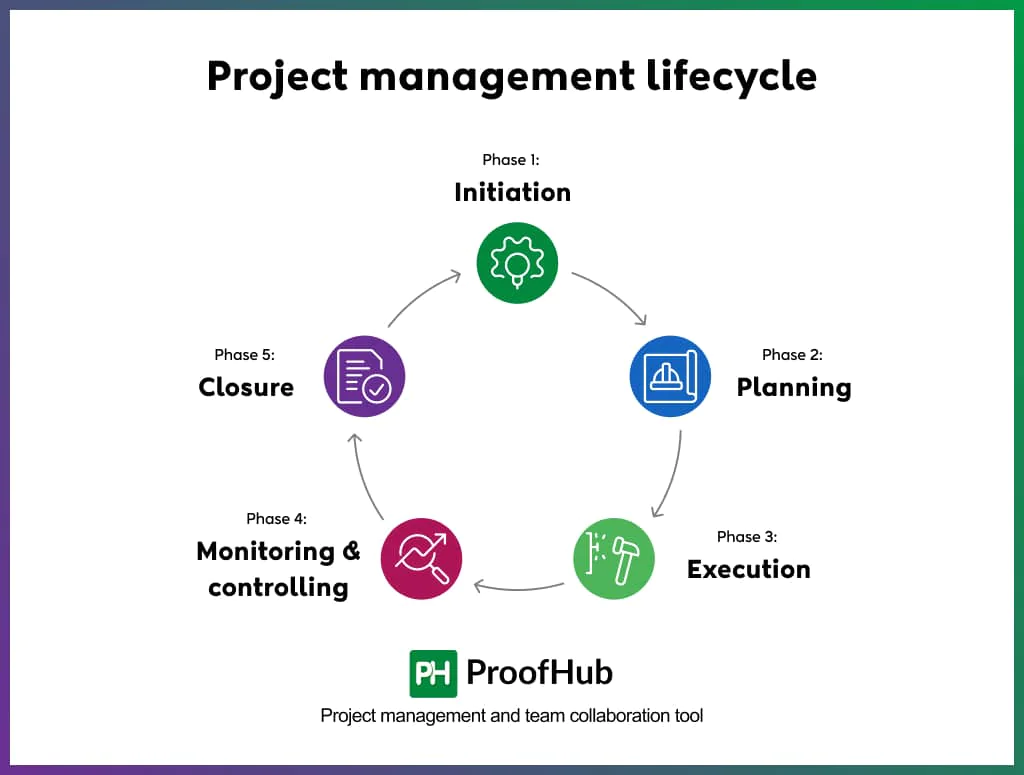
The project management lifecycle has five phases: initiation, planning, execution, monitoring & control, and closure.
This most widely recognized framework comes from PMI’s PMBOK Guide. Each phase includes key activities and creates key deliverables. Each deliverable serves as input to the next phase.
Phase 1: Initiation
Initiation is the first phase where the project comes into existence, its feasibility is assessed, and it is formally recognized.
A project manager gathers project requirements from project sponsors, assesses the project’s feasibility, and defines the project’s purpose, objectives, and high-level scope to formally authorize the project.
Phase 2: Planning
Planning is the most critical phase, as it involves creating a detailed roadmap for how the project will be executed, monitored, and closed. A project manager defines the detailed scope of the project ( what is included and what is not) and creates the project management plan.
Phase 3: Execution
Execution is the phase where the actual work happens. After the project kick-off meeting, the project manager shares the project management plan with the team and directs the team to execute the project work. Teams execute the tasks defined in the plan and deliver project outputs.
Phase 4: Monitoring & controlling
Monitoring and controlling is the phase that runs in parallel with execution. This phase involves tracking progress against the plan and taking actions as needed to keep the project on track.
A project manager tracks performance, controls scope changes, and manages changes through a formal change control process to ensure the project stays within scope, time, and budget.
Phase 5: Closure
Closure is the phase where all project deliverables are completed and accepted, formal sign-offs are obtained, lessons learned are documented, contracts are closed, and the project is formally closed.
These five phases of a project provide a structured roadmap from concept to completion.
What are the key project management knowledge areas?
The Project Management Institute’s PMBOK Guide (Project Management Body of Knowledge) defines 10 knowledge areas: project integration management, project scope management, project schedule management, project cost management, project quality management, project resource management, project communications management, project risk management, project procurement management, and project stakeholder management.
Each project management knowledge area covers a specific aspect of the project that one needs to know for effective project management.
Here is the brief explanation of the 10 project management knowledge areas:
What are the common methodologies used in project management?
Common project management methodologies include Waterfall, Agile, Scrum, Kanban, and Hybrid. A project management methodology is a structured set of principles, practices, and processes that guide how a project is managed. Have a look at the most common project management methodologies used in the modern-day world.
Waterfall
Waterfall is the oldest project management methodology, taking a linear, sequential approach to project management. In this methodology, work flows sequentially through distinct phases, and each phase must be completed before the next begins, like a waterfall flowing downward.
The core stages of waterfall project management include requirements, design, implementation, testing, and deployment.
Agile
Agile is a project management methodology that follows an iterative, incremental approach. It involves breaking the project work into smaller parts and working on these parts in short cycles called iterations.
Each iteration produces a deliverable, which is shared for stakeholder and customer feedback. The gathered feedback is used to make changes in the next cycle. This results in continuous improvement through continuous feedback and continuous release.
Scrum
Scrum is an Agile framework that involves work in fixed-length, time-boxed, iterative cycles, called sprints, usually of 1-4 weeks, with defined roles, events, and artifacts.
Each sprint ends with a deliverable that is valuable to the user (called a user story). The deliverable is released for stakeholder and customer feedback. The suggested improvements are being worked on in the coming sprints.
Kanban
Kanban is also an Agile framework that focuses on continuous release and continuous improvement by breaking a project into small user stories and working in short cycles. However, it does not use time-boxed sprints. Instead, it uses its own artifacts: a Kanban board and WIP limits.
A Kanban board is a visual workflow that represents user stories or features in columns such as To Do, In Progress, and Done.
A WIP limit is a number that limits the amount of work to be done in any workflow stage based on the team’s capacity.
The team pulls features or stories from the To-do column based on team capacity, works on them, and delivers continuously, providing feedback as soon as the user story or feature is completed.
Hybrid (Water-Scrum-Fall)
Hybrid project management is a methodology formed by combining two distinct project management methodologies.
For example, Water-Scrum-Fall is a hybrid project management methodology that combines elements of Waterfall and Scrum methodologies to manage projects that require both stability and flexibility. It utilizes the principles of Waterfall during planning and those of Agile-Scrum during execution and development. The closure again follows the structured process of final testing, integration, and delivery.
What are the important roles in project management?
Important roles in project management include project sponsor, project manager, project team members, project management office, and project stakeholders. Each role carries specific responsibilities. Understanding who does what and how these roles interact is fundamental to managing projects effectively.
1. Project sponsor
The project sponsor is the executive-level stakeholder who owns the project from a business perspective. They authorize the project, approve the budget, and provide strategic direction.
2. Project manager
The project manager is the operational lead responsible for planning, executing, and closing the project. The responsibilities of the project manager also involve coordinating the team, managing risks, controlling scope and budget, and serving as the primary communication bridge between the team and stakeholders.
3. Project team members
Project team members are the specialists who perform the project’s actual work. A project team includes developers, designers, engineers, analysts, and any domain experts required for the project.
4. Project management office (PMO)
The Project Management Office is a centralized organizational function that standardizes project management practices, governance, and processes across the organization. Rather than managing individual projects directly, the PMO establishes frameworks, templates, methodologies, and reporting standards that all project managers within the organization must follow.
5. Project stakeholders
Project stakeholders are individuals, groups, or organizations who may affect, be affected by, or perceive themselves to be affected by a decision, activity, or outcome of the project.
- Internal stakeholders: Project sponsor, project team, PMO, executives, and other departments.
- External stakeholders: Customers, vendors, regulators, community groups, investors
Responsibilities of a project manager
A project manager is responsible for the management and success or failure of the project. An organization assigns a project manager to the project who serves as the single point of coordination for the project team and stakeholders.
A project manager is primarily responsible for three categories of responsibilities: managing technical aspects of a project, managing the project team, and managing stakeholders
Here are the key details of the responsibilities of a project manager:
Managing technical aspects of the project
- Define scope & objectives: Work with stakeholders to clarify what the project must deliver and why.
- Develop the project plan: Create the roadmap covering schedule, budget, resources, and risk.
- Manage the budget: Track spending, forecast costs, and take action to prevent overruns.
- Manage the schedule: Ensure tasks are completed on time; re-plan if delays occur.
- Manage risks: Continuously identify, assess, and mitigate risks.
- Manage changes: Evaluate and control change requests through formal change control.
- Deliver quality: Ensure deliverables meet defined quality standards.
- Closing the project: Obtaining formal sign-offs and formally capturing lessons learned.
Managing the project team
- Build and lead the team: Recruit, organize, motivate, and develop the project team.
- Communicate: Provide clear, timely, and accurate information to all parties.
Managing stakeholders
Reporting to the stakeholders: Keep all stakeholders informed, engaged, and satisfied.
15 skills a project manager must have
A project manager needs a mix of hard (technical) and soft skills to perform their duties effectively. Below are the most important competencies every project manager must develop:
Hard skills
1. Project planning: The ability to break down complex goals into structured, sequenced tasks with realistic timelines and resource estimates. Competencies include creating detailed, realistic project plans using WBS, Gantt charts, and scheduling tools.
2. Budgeting and cost management: Creating accurate budgets, tracking expenditures, and making smart trade-off decisions to prevent overruns. Competencies include cost estimating, budgeting, and forecasting.
3. Risk management: Systematically identifying threats, assessing their probability and impact, and preparing mitigation or contingency plans. Competencies include risk identification, qualitative/quantitative analysis, and response planning.
4. Project scheduling: Proficiency with tools like Gantt charts, the Work Breakdown Structure (WBS), and the Critical Path Method to sequence work and create a schedule.
5. Knowledge of methodologies and project management tools: Fluency in Waterfall, Agile, Scrum, or Kanban — and knowing when to apply each, and proficiency in tools such as ProofHub, Jira, Asana, monday.com, Trello, etc.
Soft skills
6. Communication: The ability to convey information clearly and concisely to audiences ranging from project team members to stakeholders. Written, verbal, and presentation skills all matter.
7. Problem-solving: The ability to approach problems calmly, analytically, and creatively.
8. Negotiation: A manager should have the ability to negotiate to secure resources, resolve conflicts, and manage competing priorities.
9. Emotional intelligence: It is the ability to understand and manage one’s own emotions and those of others.
10. Conflict resolution: Mediating and resolving team or stakeholder disagreements constructively.
11. Decision making: Making timely, informed decisions under uncertainty and pressure.
12. Adaptability & negotiation: A great project manager should be able to adapt to the changing requirements without losing composure or direction.
13. Time management: Ability to manage the time as managing multiple workstreams, deadlines, and priorities requires exceptional personal organization and the discipline to focus on what matters most.
14. Leadership: Motivating and guiding teams, especially through ambiguity and pressure. Leadership does not require formal authority.
15. Stakeholder management: Building relationships, managing expectations, and navigating the competing interests of different parties involved in or affected by the project.
Essential techniques and tools for project management
Top techniques and tools include work breakdown structure, Gantt chart, Kanban board, Project charter, RACI matrix, Risk register, Power Interest Grid, Eisenhower matrix, Project reports, project management software, team communication apps, cloud storage apps, and other productivity & work management apps.
Here is the list of the essential tools you need for project management:
- Work breakdown structure (WBS): It divides a project into smaller, manageable components.
- Gantt chart: a visual timeline that shows project tasks, durations, and dependencies.
- Kanban board: a visual board for tracking workflow using columns such as To Do, In Progress, and Completed.
- Risk register: a document that identifies potential project risks, their likelihood and impact, and their mitigation strategies.
- RACI matrix: It clarifies roles and responsibilities for project tasks. RACI stands for Responsible (Person who performs the task), Accountable (Person ultimately answerable for the outcome), Consulted – Stakeholders who provide input, and Informed (People who need updates on progress).
- Project management software: To break a project into tasks and subtasks, set task dependencies, create a workflow, plan a project, assign resources, delegate tasks to the project team members, visualize progress, and create reports. Top project management software includes ProofHub, Asana, Jira, monday.com, and Trello.
- Communication apps: To facilitate communication with teams, send direct messages, share files, run video meetings, and place audio calls. Top communication apps include Slack, Microsoft Teams, and Zoom.
- Cloud storage app: To co-edit and collaborate with team members in real-time on documents, share feedback with comments, and track versions with file history. Top cloud storage apps include Google Docs, Confluence, and Dropbox.
- Productivity & work management apps: These include miscellaneous tools a project manager may use to improve productivity, such as time-tracking apps, online proofing tools, and whiteboarding software.
Tips for managing projects effectively
Here are some of the tips one can follow to manage a project effectively:
- Identify stakeholders early, communicate proactively, and manage expectations continuously.
- Always document a detailed scope at the start. Use a scope statement and WBS.
- Use historical data, expert judgment, and bottom-up estimating. Build in contingency.
- Plan resource requirements before execution begins.
- Create and regularly update a Risk Register. Don’t ignore risks, hoping they won’t happen.
- Implement formal change control. Never approve scope changes without assessing the impact on time and cost. Escalate resource shortfalls early.
- Communicate early, often, and clearly.
- Test tools, platforms, and integrations during planning, not during execution.
- Capture lessons learned throughout the project, not just at the end.
What are the highly rated project management certifications?
The most highly rated project management certifications include:
- PMP — Project Management Professional by PMI
- CAPM — Certified Associate in Project Management by PMI
- PMI-ACP — Agile Certified Practitioner by PMI
- Google Project Management Certificate by Google
- CSM — Certified ScrumMaster by Scrum Alliance
- PSM I/II — Professional Scrum Master by Scrum.org
- PRINCE2 — Foundation & Practitioner by PeopleCert
What is the triple constraint in project management?
The triple constraint (Project management triangle or iron triangle) in project management is the foundational concept that defines the relationship between the three core elements of a project — scope, cost, and time — and their effect on the project quality.
It defines change in one constraint necessitates changes in others to compensate, if you do not want to compromise on the quality. If one does not make changes in other constraints, quality will suffer. It is because the quality of work is constrained by the project’s budget, deadlines, and scope.
Here is a brief explanation of three constraints:
- Scope: Scope defines all the work that needs to be performed to deliver the project’s product, service, or result.
- Cost: Cost encompasses all the financial resources required to complete the project: labor, materials, equipment, software, overhead, and contingency.
- Time: Time refers to the project duration and the timeline for completing all work.
Quality: Quality is not a constraint; it is the outcome affected by other constraints. Project quality refers to the degree to which the project satisfies its requirements and stakeholder expectations. It sits at the center of the project management triangle. If you compromise any of the three constraints, quality is affected.
The Project Management Triangle, also known as the Iron Triangle, is named for the fact that you cannot change one constraint without affecting the others or compromising quality.
What are the common causes of project failure?
The common causes of project failure are poorly defined scope, unrealistic project plan, poor communication, weak risk management, inadequate resources, insufficient stakeholder engagement, and scope creep.
What are the 5 basic phases of project management?
The five phases of the project management lifecycle are: initiation, planning, execution, monitoring and controlling, and closure.
- Initiation defines the project’s purpose and feasibility.
- Planning establishes the detailed roadmap — scope, schedule, budget, and risk strategy.
- Execution is where the actual work is carried out.
- Monitoring and Controlling run in parallel with execution, tracking progress, and correcting deviations.
- Closure formalizes the project’s completion, releases resources, and captures lessons learned.
Each phase builds on the last, creating a structured path from idea to delivered outcome.
Is project management a good career?
Yes, project management is an excellent career choice, offering strong demand, competitive compensation, and remarkable versatility across industries.
The Project Management Institute projects a need for 25 million new project management professionals globally by 2030. Because the core skills — planning, communication, leadership, and risk management — are universally applicable, project managers can work in technology, healthcare, construction, finance, and beyond.
Entry points are accessible: many professionals transition into the role from adjacent fields. With experience and credentials such as the PMP certification, career growth and earning potential are both substantial.