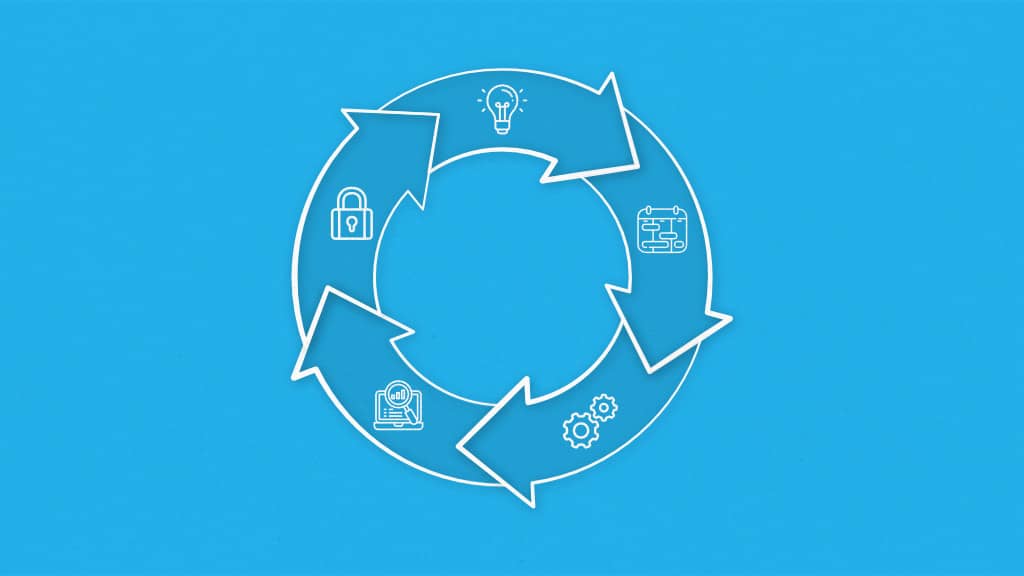
What is the project management lifecycle? What are the phases of a project? What are the five process groups of a project? The answer to all three queries is essentially the same: initiation, planning, execution, monitoring & control, and closure.
However, when you refer to the PMBOK Guide, you will find that it clearly states, “The Process Groups are not project phases.” The guide also clearly outlines the project lifecycle, including the project phases. Thus, it will be wrong to use these terms interchangeably.
As it is one of the most conceptually important things to understand about project management for beginners, applying project management correctly is essential.
In this post, we will address the confusion around the project lifecycle, project phases, and project process groups. We will define how the project process groups interact within the knowledge areas and how they differ from one another.
- 1.A project lifecycle is a series of stages a project goes through from beginning to completion, regardless of the project’s nature.
- 2.The commonly accepted five phases of the project lifecycle include initiation, planning, execution, monitoring & controlling, and closure.
- 3.Process groups in project management are a logical grouping of project management processes across five categories: initiating, planning, executing, monitoring & controlling, and closing.
- 4.A project management knowledge area is the dimension of a process that specifies which aspect of the process is being discussed.
- 5.The project lifecycle, project phases, project process groups, and project management knowledge areas work together to manage project activities.
What is the project lifecycle?
A project lifecycle is a series of stages a project goes through from beginning to completion, regardless of the project’s nature: small or large, simple or complex, and software or construction. It simply describes the journey of a project from start to end.
A typical lifecycle structure of a project includes:
- Starting the project
- Organizing and preparing
- Carrying out the work
- Closing the project
The PMI formally introduced this concept and the lifecycle structure. Corresponding to each stage of the lifecycle of a project, PMI describes a few key characteristics of the project:
- At the beginning of the project, resource requirements and effort are low. Stakeholder influences and uncertainty are greatest at the start of the project and decrease over its life.
- During planning, costs begin to ramp up, and the team grows. The cost of change in the original project requirements is lowest at the start and increases as the project progresses towards completion.
- The execution of a project consumes the most time, money, and resources. At this stage, it is difficult to influence the final characteristics of the project’s deliverables without increasing costs.
- The least resources and effort are required for the project’s closure stage.
- This helps a project manager make an informed decision on what to focus on during each stage of the project.
What are the 5 Phases of the project lifecycle?
The five phases of the project lifecycle include initiation, planning, execution, monitoring & controlling, and closure.
These phases are defined to correspond to the project’s stages, indicating the project’s state and the activities to be performed at each stage. Each phase has unique project activities and a set of outcomes that mark the phase’s end and serve as inputs to the next phase.

- Initiation: Formal recognition of the beginning of a project.
- Planning: Creating a project management plan to accomplish the purpose of the project.
- Executing: Carrying out the plan.
- Monitoring and controlling: Monitoring progress and taking corrective action when necessary.
- Closure: Completing the project, paperwork, and entering the history into a database.
Here is the table showcasing the five phases of the project lifecycle:
| Phase | Stage | Purpose | Key activities |
| Initiation | Starting the project | Formal recognition of the project | Collecting requirements, Feasibility analysis, Preparing project charter |
| Planning | Organizing and preparing | Creating a project management plan | Defining detailed scope, Estimating time and cost, Developing a plan, Assembling team |
| Execution | Carrying out the work | Executing the work outlined in the plan | Assigning tasks, Coordinating resources, Distributing information, Team works on tasks |
| Monitoring and Controlling | Carrying out the work | Monitoring progress and taking corrective actions | Tracking progress, Quality control, Controlling changes, Revisiting the plan with formal processes |
| Closure | Closing the project | Delivering project deliverables | Deliver project deliverables, Final sign-offs, Closing contracts, Documenting lessons learned |
What are process groups in project management?
Process groups (Now Called Focus Areas) in project management are logical groupings of project management processes across five categories: initiating, planning, executing, monitoring & controlling, and closing.
A process is a set of interrelated actions and activities performed to execute the project work or achieve a pre-specified product, result, or service. Each process is characterized by its inputs, the tools and techniques that can be applied, and the resulting outputs.
For example:
Process: Develop Project Charter
Developing a project charter involves creating a document that formally authorizes a project and documents the initial requirements that satisfy stakeholders’ needs and expectations.
Inputs:
- Project statement of work
- Business case
- Contract
Tools & Techniques:
- Expert judgment
Outputs:
- Project charter
What are the 5 process groups in project management?
Process groups are logically categorized into five groups: Initiating process group, Planning process group, Executing process group, Monitoring and controlling process group, and Closing process group. Each group represents the nature of processes present in it.
For example, the processes in the initiating process group help you initiate any task, work item, project deliverable, project, or phase of an existing project. Similarly, processes in the planning process group help you with the planning, and so on.
Here is the brief description of the project process groups:
- Initiating process group: It consists of processes that help in defining a new project.
- Planning process group: It consists of processes that support project planning, such as establishing the project scope, defining & refining project objectives, goals, and deliverables, and creating a project management plan.
- Executing process group: It includes processes that perform the work defined in the project management plan to meet the project requirements.
- Monitoring and controlling process group: It includes processes for tracking, reviewing, and controlling the project’s progress and performance; identifying areas where changes to the plan are required; and initiating the corresponding changes.
- Closing process group: It includes processes performed to formally close the project or phase.
| Process groups | Key processes |
| Initiating process group | Identifying stakeholders and developing a project charter |
| Planning process group | Defining scope, creating a WBS, estimating the cost of project activities, planning for risks, and developing a project management plan |
| Executing process group | Directing and managing a team, conducting procurements, distributing information, managing stakeholders’ expectations, and performing quality assurance |
| Monitoring and controlling process group | Monitoring and controlling the project work, verifying scope, and controlling scope |
| Closing process group | Obtaining acceptance by the customer or sponsor, conducting post-project review, recording impacts of decisions, and documenting lessons learned |
A total of 49 project management processes are identified, documented, and explained in the PMBOK Guide, 6th edition.
What are the key differences between the project lifecycle and project phases?
Project phases describe a generic project lifecycle structure with five commonly referenced stages to make it easy for project stakeholders to communicate project progress, understand activities to be performed, and decide whether to proceed, revisit, or stop at the end of the phase.
However, it is important to note that PMI, in its PMBOK Guide, refers to project phases as divisions within a project that require additional control to effectively manage the completion of a major deliverable, rather than as equivalent to project stages.
For example, in a large project, it can be divided into three phases based on deliverables: Phase 1, Phase 2, and Phase 3. With each phase having its own project lifecycle— initiation, planning, execution, monitoring and controlling, and closing.
Thus, the true definition of a phase is that it is a collection of logically related project activities that results in the completion of one or more deliverables and allows project managers to break down a large, complex project into manageable chunks.
For example, both software development and construction projects go through the same generic stages of a project lifecycle, i.e., starting the project, organizing and planning work, executing the work with monitoring and controlling, and closing the project. But both projects can be divided into different phases.
For example, a software development project’s typical phases may include:
- Concept & Feasibility
- Requirements
- Design
- Development
- Testing & Launch
Construction project phases may include:
- Site Assessment
- Design & Permits
- Foundation
- Structure
- Finishing
- Handover
The software development project has five phases, and the construction project has six phases, but both go through the same four stages of the project lifecycle.
The project lifecycle is a universal concept, while project phases can range from 3 to 5 to 7, or any number, depending on the size, complexity, and specificity of the project. Every project is unique. Thus, project phases can vary from one project to another.
What are the Key differences between the project lifecycle and process groups?
The key difference between the project lifecycle and process groups is that the project lifecycle is a sequential and linear progression that represents the journey of the project from beginning to the end, whereas processes in process groups are the project management activities to be performed in order to execute the project work at different times of the project.
Processes exist independently and repeat throughout the project.
Let’s understand what this means.
The project lifecycle answers the ‘when’ of the project, i.e., which stage a project is in. Whereas, process groups define the how of the project process and the nature of the project activity.
For example, your project is in the “planning” stage of the project lifecycle. It simply suggests your project is in the ‘planning stage’ of the lifecycle. Whereas, processes in ‘planning groups’ suggest which project activities you need to perform for the development of the project plan.
How do process groups interact with lifecycle phases?
The project lifecycle and its subsequent phases are a linear, sequential progression that only indicates the project’s state. Whereas project process groups operate independently and repeat themselves throughout the project.
It means processes in the five process groups are applied once to the entire project and also to each individual phase within the lifecycle, as each phase has its own processes of initiation, planning, execution, monitoring & controlling, and closing.
Let’s understand by example. Suppose your project is in the execution stage. It suggests the project is in the execution stage, where actual work is happening. But even in the execution stage, you need to apply the planning processes to plan for this phase of the project. Though the project is in execution, it is using the processes from the planning group.
For example, say, scope creep happened. Now, you have to revisit the plan. Your project is in execution, but you are applying the planning group’s processes to create a revised project plan.
Thus, five process groups can be applied repeatedly, without any sequence, to any phase of the lifecycle based on the requirements. This explains that process groups are not sequential and linear but independent and repetitive, and can be applied at any stage of the project.
What is the difference between Project knowledge areas and process groups?
Project management knowledge areas (Now Performance Domains) provide the knowledge related to the management of the various aspects of a project, such as scope, time, cost, quality, risk, communication, and stakeholders, whereas the process groups are the logical grouping of project management processes.
In simple words, project management knowledge areas answer ‘what aspect’ of the project, whereas process groups answer ‘how’ of the project.
Example 1: ‘Verify scope’ is a process of the ‘monitoring and controlling’ process group. Verifying is the ‘process,’ and scope is the ‘knowledge area.
A specific Process = Process Group (How) + Knowledge Area (What)
Example 2:
“Define scope” sits at Planning × Scope management.
Planning Process Group + Scope Knowledge Area = ‘Define Scope’ process
Example 3:
“Manage quality” sits at Executing x Quality management.
Executing Process Group + Quality Knowledge Area = ‘Manage Quality’ process
A project management knowledge area is the dimension of a process. Each process in 49 logically grouped project management processes sits at the intersection of one Process Group and one Knowledge Area.
What are the common misconceptions about the project lifecycle and process groups?
The biggest misconception about project lifecycle and process groups is that process groups are the same as the phases of the project lifecycle. This is not true, and we have clearly explained the differences between the two. Have a look at some of the common misconceptions about the project lifecycle and process groups.
Misconception 1: Process groups are the same as project phases.
This is the biggest myth that process groups are the same as project phases. They both have similar names: initiation, planning, execution, monitoring and controlling, and closure.
But the phases of the project lifecycle simply describe which stage a project is in, what deliverables will be produced, and in what order.
Whereas process groups describe how the project manager manages the work. Process groups are not linear and sequential like phases; instead repeat inside every phase of a project.
Misconception 2: A process group is applied only once.
Even after knowing the difference between process groups and project phases, many professionals think a process group is applied only once.
For example, a planning process group is applied only during the project’s planning phase.
But it is not true. The planning process group is applied in every project phase. Each phase requires a project manager to plan the activities needed to deliver the phase’s deliverables. Planning is a continuous activity that occurs throughout the project as risks, changes, and new information arise.
Not just planning, the monitoring process groups are also applied in most phases. For example, while you are planning, you are monitoring whether the planning itself is on track.
The moment the project is authorized, monitoring begins — and it continues until the project is formally closed.
Misconception 3: Monitoring and controlling come after executing.
This is a common misconception about the project lifecycle. Many beginners assume monitoring comes after execution, but it actually runs in parallel with execution.
Misconception 4: All 49 project management processes must be used on every project.
It is not true. It is not necessary to use all 49 project management processes. Some projects may use 20-30 processes, while others may use all 49.
PMBOK Guide is a framework, not a rigid methodology. The 49 processes are a comprehensive inventory of what could be done; not a checklist of what must be done on every project.
The project manager exercises professional judgment to tailor the process to the project’s needs, complexity, and organizational context.
Misconception 5: Project activity is the same as the project process.
Project activity is not the same or equal level to the project process. Instead, a project process is the collection of interrelated activities to produce the pre-specified result or objective.
A project activity is an action or step at the lowest level in the project work one performs. It is a scheduled, time-bound, and actionable step within a project plan that must be completed to reach specific, measurable objectives.
Real-world example: Lifecycle and process groups in action
Consider the construction of a commercial office building. The project follows six industry-specific lifecycle phases:
- Concept & Feasibility (Initiation)
- Design & Engineering (Planning)
- Procurement (Execution)
- Construction (Execution)
- Commissioning & Testing (Monitoring and controlling)
- Handover & Closeout (Closure)
Each phase produces a tangible deliverable—a feasibility report, approved drawings, signed contracts, a completed building, certified systems, and, finally, a handed-over property. Each phase ends with a formal go/no-go decision before the next begins.
Now here is where most people get confused. The project manager does not apply the five process groups once across the entire project — they apply all five process groups inside every lifecycle phase.
Take the Construction phase as an example.
- Initiating: Before breaking ground, the project manager initiates the phase by mobilizing the site team and establishing site governance.
- Planning: They plan the detailed construction programme, resource schedule, and risk register.
- Executing: During execution, they oversee the physical build — foundations, structure, façade, and fit-out.
- Monitoring and controlling: Simultaneously, they monitor and control progress, track schedule performance, manage contractor change orders, and control quality at inspection hold points.
- Closing: Finally, they close the phase by obtaining the practical completion certificate and handing it over to the commissioning team.
This same cycle of initiating, planning, executing, monitoring & controlling, and closing repeats inside every one of the six lifecycle phases. The distinction is straightforward: lifecycle phases define what is being built and when.
Process groups define how the project manager manages each phase. One is driven by the product’s nature. The other is a universal management framework applied regardless of industry. They do not replace each other. They operate simultaneously on different dimensions of the same project.
How everything fits together
Here’s how all the concepts relate:
| Concept | What it answers | Universal? |
| Project lifecycle | What is the overall generic journey from start to finish? | Yes – same for all projects |
| Project phases | What are the major milestones and deliverable stages? | No – varies by project |
| Process groups | How is project management work organized? | Yes – same on all projects |
| Knowledge areas | What is the area of focus of the process? | Yes – same on all projects |
| Processes (49 total) | What specific management activities need to happen? | Yes – defined by PMBOK |
Why do many professionals confuse lifecycle phases and process groups?
Professionals confuse lifecycle phases and process groups because both concepts share surface-level similarities: they involve sequences, are often shown in left-to-right diagrams, and use language like ‘phases’ and ‘stages’ in casual conversation.
In addition to that, many introductory courses teach the process groups as if they were the phases of a project, i.e., first, you initiate, then you plan, then you execute. While this is not entirely wrong at the project level, it misses the nuance that process groups repeat across phases and that they describe management activities, not deliverable work.
The clearest question to separate them: Is this describing what is being built, or how it is being managed? If it describes what is being built (requirements, design, construction, testing), it is a lifecycle phase. If it describes how the PM manages (authorizing, planning, executing, tracking, closing), it is a process group.
Are project lifecycle phases and process groups the same?
No. They are distinct concepts that operate at different levels.
Lifecycle phases are industry-specific, product-driven stages in the creation of a deliverable. They vary by project. A pharmaceutical project will have phases like Preclinical, Phase I Trial, Phase II Trial, Phase III Trial, and Regulatory Submission. A construction project will have phases like Site Assessment, Design, Permitting, Foundation, Structure, and Handover.
Process groups are universal management categories. The same five process groups (Initiating, Planning, Executing, Monitoring and Controlling, and Closing) apply to the pharmaceutical project, the construction project, and every other project in between. They describe the management logic applied to each phase, not the content of each phase.
Do process groups occur in every lifecycle phase?
Yes. This is one of the most important principles to understand. Process groups are not a single pass through the project. They repeat within each lifecycle phase. Every phase begins with some form of initiation (phase authorization), involves planning (detailed planning for that phase’s activities), executing (performing the phase’s work), monitoring and controlling (tracking that phase’s progress), and closing (formalizing the phase’s completion before moving to the next).
This is why process groups are not project phases. Some phases may be short and informal (a two-week requirements phase may have a brief planning meeting, rapid execution, and a simple sign-off), while others may be long and elaborate, but the management logic repeats regardless.
Are lifecycle phases always sequential?
Not necessarily. While traditional (predictive or waterfall) projects run phases sequentially, where one phase completes before the next begins, modern project management recognizes several other patterns:
- Sequential phases: Phase 2 does not begin until Phase 1 is fully complete. Offers the most control and clarity, but the least flexibility.
- Overlapping phases: Phase 2 begins before Phase 1 is fully complete, accepting some risk in exchange for a compressed schedule. Common in construction, where site preparation may begin while detailed design is still being finalized.
- Iterative phases: The project cycles through a set of phases, each producing a more refined or complete version of the deliverable. Common in agile software development, where development sprints repeat until the product meets requirements.
Is the 5-Phase lifecycle mandatory for all projects?
No, the 5-phase lifecycle is a generic reference model, not a requirement. In practice, projects use whatever phase structure makes sense for their industry, organization, and complexity. A simple internal project might have just three phases: Initiation, Delivery, and Review. A complex project might have 10 or more phases, with strict phase-gate reviews at each transition.
Does Agile use the same process groups?
Agile methodologies (Scrum, Kanban, SAFe, etc.) do not use the term ‘process groups,’ but the underlying management logic is present — just applied differently.
In Scrum, for example:
- Initiating: Product backlog creation and Sprint Planning authorization
- Planning: Sprint Planning to define what will be built in the next two weeks
- Executing: The Sprint itself for the development team builds the sprint backlog items
- Monitoring and Controlling: Daily Standups, Sprint Burndown Charts, velocity tracking
- Closing: Sprint Review and Sprint Retrospective — accepting the sprint deliverables and improving the process
The process groups are present as concepts, even if the vocabulary and frequency differ. A key difference is frequency: in traditional projects, you may go through the process group cycle once per phase (every few months); in agile, you cycle through it every sprint (every one to four weeks). The application differs, but the management logic is the same.