

Every project has people and groups who care about its outcome. Some fund it. Some approve it, some simply feel its effects once it is delivered. Keeping track of all these people in one place is what a stakeholder register does.
It gives a project manager a single, organized view of who is involved, what they expect, and how much attention each of them needs.
Without this record, projects run on guesswork, and guesswork leads to missed expectations, poor communication, and avoidable conflict.
This article explains what a stakeholder register is, why it matters, what it contains, and how to build one that actually gets used.
- 1.A stakeholder register is a living document that lists every person, group, or organization with a stake in a project.
- 2.It supports better communication, stronger engagement, and more informed decision-making throughout the project life cycle.
- 3.Its core components are stakeholder identification, stakeholder analysis, an engagement plan, current status and history, and a project impact assessment.
- 4.Building one involves identifying stakeholders, gathering their information, assessing influence and interest, planning communication, and updating the register regularly.
- 5.PMBOK groups the information into three categories: identification information, assessment information, and stakeholder classification.
What is a stakeholder register?
A stakeholder register is a living document maintained throughout the project that deals with stakeholder management. It helps identify, assess, and classify all the stakeholders relevant to a project.
Some important domains of a stakeholder register include names, designations, interest in the project, influence on the project, stakeholders’ communication preferences, and finally, an assessment of the impact they can have on the project.
When pursued as a strategic discipline, a stakeholder register helps you sustain support for the project from both internal and external stakeholders.
Why is creating a stakeholder register important?
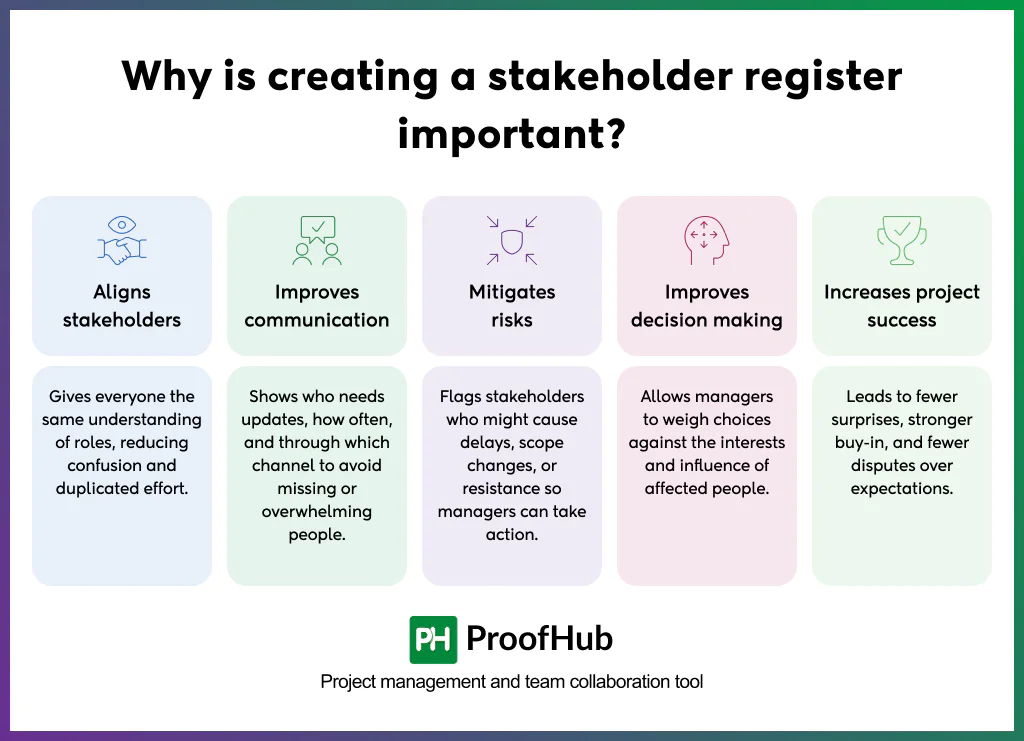
A stakeholder register is important because it aligns stakeholders, improves communication, mitigates risk, improves decision-making, and increases project success.
A stakeholder register contributes importantly when teams are planning the project, programming, forming teams, defining success criteria, and even when developing and assigning tasks and responsibilities.
Below, the importance of the stakeholder register is explained in greater detail:
- Aligns stakeholders by giving everyone the same understanding of who is involved and what part they play, which reduces confusion and duplicated effort. It helps formulate tailored communication plans for various stakeholder classes, keeping everyone on the same page.
- Improves communication by showing who needs updates, how often, and through which channel, so no one is left out or overwhelmed with irrelevant information. Each individual profile maintained in the stakeholder register serves as the basis for making unique communication strategies for different stakeholders.
- Helps mitigate risks by flagging stakeholders who are ignored or misunderstood. It helps avoid delays, scope changes, or resistance, which allows you to take appropriate action based on the relevant stakeholder profile.
- Improves decision-making by allowing you to weigh choices against the interests and influence of the people the decisions affect. For example, you can align the product backlog based on the information collected as part of stakeholder register creation. The product is not only improved, but it also becomes more useful for the people who are using it.
- Increases the chance of project success, since projects that manage stakeholder relationships well face fewer surprises, gain stronger buy-in, and close out with fewer disputes over expectations. The stakeholders are invested in the success of the project and engage with its implementation.
A stakeholder register turns a scattered set of names and assumptions into one organized reference that the whole project team can rely on.
What are the key components of a stakeholder register?
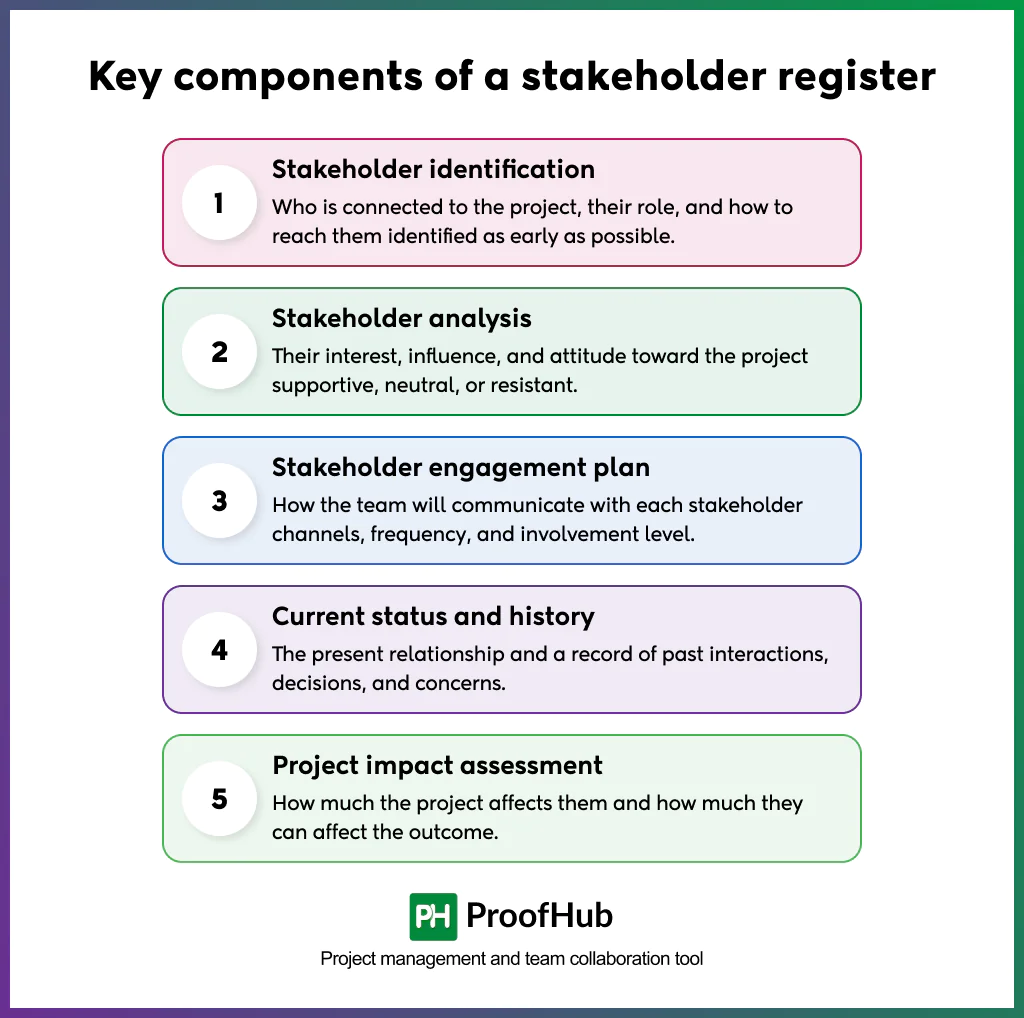
The main components of the stakeholder register are: stakeholder identification, stakeholder analysis, stakeholder engagement plan, current status and history, and project impact assessment.
These practices help prepare a comprehensive stakeholder register that provides maximum value to the project. Unorganized or scattergun document creation can backfire, as it can make the stakeholders opposed to the project.
The components are described below:
1. Stakeholder identification
Stakeholder identification is the foundation of the register. It captures basic details such as name, job title, department, organization, role in the project, and contact information.
The goal is to answer a simple question: who is connected to this project, and how do we reach them?
Identification should happen as early as possible, since a stakeholder discovered late often introduces changes that cost more to accommodate.
2. Stakeholder analysis
Once stakeholders are identified, the register records an assessment of each one, typically their level of interest, their level of influence or power, and their attitude toward the project, whether supportive, neutral, or resistant.
This analysis helps you decide who needs close attention and who can be monitored with less effort.
3. Stakeholder engagement plan
The stakeholder engagement plan outlines how the project team intends to interact with each stakeholder.
It includes preferred communication channels, frequency of updates, and the type of involvement expected, such as approval authority, consultation, or simple notification.
Stakeholders with a higher priority require a dedicated communication strategy to effectively manage their impact on the project. Without a stakeholder register, communication becomes a shot in the dark that may or may not be useful.
4. Current status and history
The register tracks the present state of the relationship with each stakeholder along with a short history of past interactions, decisions, or concerns raised.
The history gives context for future engagement and prevents the team from repeating the same conversations.
The historical trend of stakeholder engagement also gives valuable information about the style, stance, and predisposition of a stakeholder that can be utilized to gain an advantage for the project at hand, for example, better funding.
5. Project impact assessment
Project impact assessment evaluates how much a stakeholder can be affected by the project, and in turn, how much that stakeholder can affect the project outcome.
It helps prioritize where engagement efforts should go. If the stakeholder is low-impact, they can be safely ignored.
If the stakeholder has high impact, take their influence into consideration while making any project-wide decisions.
How to create a stakeholder register?
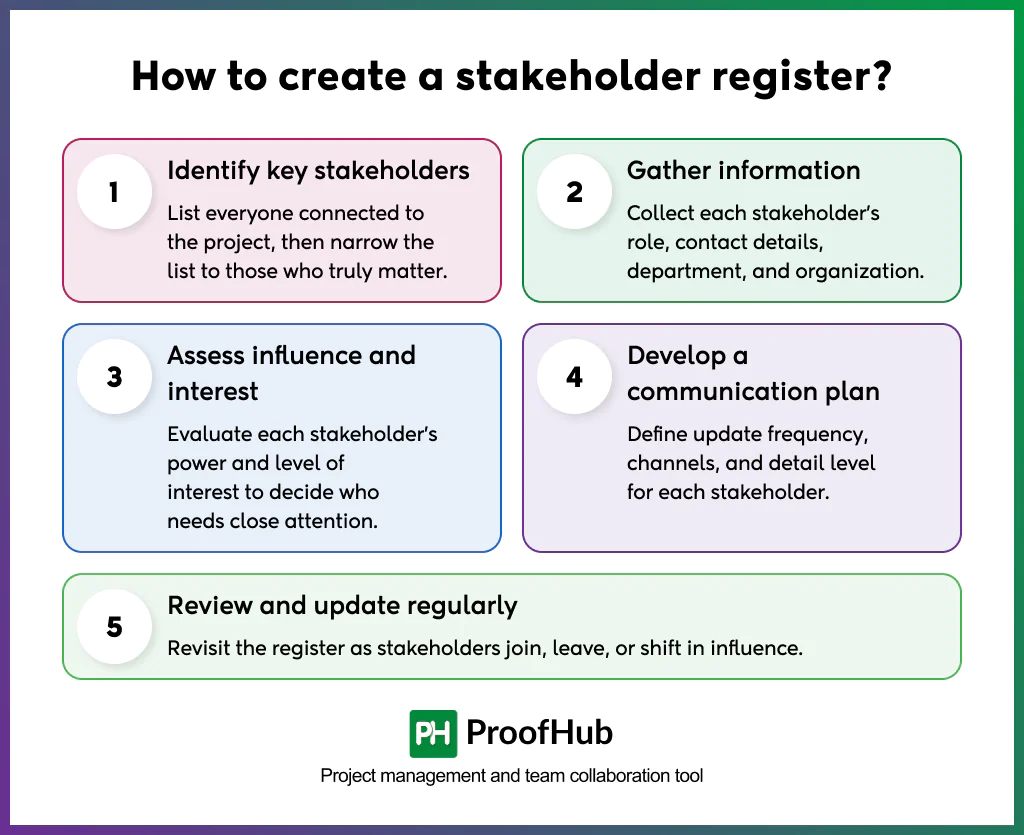
The five steps to create a stakeholder register are identifying key stakeholders, gathering information, assessing the influence and interest of stakeholders, developing a communication plan, and reviewing and updating it regularly.
The stakeholder register does not remain static. It is a living document that needs to be updated regularly based on new information and when a stakeholder changes their stance or when their influence increases or decreases over the project.
The process is described below in detail:
1. Identify key stakeholders
Start by listing everyone with a connection to the project, including sponsors, team members, senior management, clients, suppliers, regulators, and any group affected by the outcome.
Review project documents such as the charter and business case, and consult subject matter experts to avoid missing anyone. Some stakeholders may not be apparent or their influence explicit.
Create a list of all the people or groups affected by the project, and then narrow or filter the list based on the active definition of a stakeholder.
2. Gather information
After narrowing down the list, gather all the information about a stakeholder that helps establish their level of influence and whether they are antagonistic to the project.
It helps in outlining the communication strategy appropriate for that particular stakeholder. For each stakeholder, collect their role, contact details, department, and organization.
Make sure information is accurate and kept updated, since outdated contact details make the register far less useful.
3. Assess influence and interest
Evaluate each stakeholder based on how much power they hold and how much interest they have in the project. The evaluation step determines how much attention and communication each person or group requires.
The assessment includes labels like seniority, policy influence, level of willingness to be involved in the day-to-day workings of the project, and other such information. As a result of this process, you get a priority list of all stakeholders.
4. Develop a communication plan
Decide how often to update each stakeholder, through which channel, and with what level of detail.
High-influence, high-interest stakeholders usually need frequent, direct communication, while others may only need periodic summaries.
For example, a stakeholder may be deeply affected by the outcomes of the project, but may not have the willingness to engage with the project for personal reasons.
Such cases demand careful attention, because the stance of the stakeholder can change at any time.
5. Review and update regularly
A stakeholder register is not a one-time exercise. Stakeholders join or leave, their interest and influence shift, and new information surfaces.
Reviewing the register at regular intervals keeps it accurate and useful throughout the project. It also keeps all the variables in sight, avoiding any unnecessary surprises when the status of a stakeholder does change abruptly.
An updated stakeholder register predicts such changes much better than a static document.
How to categorize information in the stakeholder register?
According to PMBOK, the information in a stakeholder register falls into three broad categories: identification information, assessment information, and stakeholder classification.
The formatting of the document changes according to the discretion of the person preparing it. In addition to these broad categories, the information is also categorized in a myriad of other ways.
The three main categories comprising a stakeholder register are explained below:
1. Identification information
Identification information covers basic identifying details such as name, organizational position, location, role in the project, and contact information.
It answers who the stakeholder is and how to reach them. This is usually the first section of any stakeholder register and establishes the identity of all the stakeholders as separate entities.
The subsequent sections deal with developing the profiles of the stakeholders in terms of stance assessment and classification.
2. Assessment information
Assessment information includes major requirements and expectations, potential influence on project outcomes, and the phase of the project life cycle where the stakeholder has the most interest or impact.
The purpose of this section is not only to analyze the different ways a stakeholder can influence the project but also to maintain a record of all the external risk factors.
Stakeholders can also turn into a risk for project success, and therefore they also become a part of the risk management conducted for the project.
3. Stakeholder classification
Stakeholder classification groups stakeholders based on characteristics such as internal or external, supportive or resistant, and level of influence or interest.
Classification helps the project team decide how to prioritize engagement across a large stakeholder list. The stakeholders can be classified into the following categories:
- Champion: A champion supports the project and is actively engaged in the successful completion of it.
- Neutral: A neutral is a person or a group that does not have stakes or interest in the project. They may or may not be a stakeholder. But for stakeholder register purposes, only stakeholder neutrals are recorded.
- Antagonist: An antagonist does have a stake in the project but actively opposes it, and may lay roadblocks in the path of project progression.
- Stoic: A stoic has a stake in the project, but does not care about the project or actively participate in the project progression.
- Ignored/Invisible: These are people or groups of people who do have a stake in the project but do not have much power to influence the project. You can ignore these entities while formulating a stakeholder management plan. Important to note here: the status of an ignored entity can change with time, and they may come to have increased influence over the project.
Stakeholder register template
A typical stakeholder register template includes the following columns: stakeholder name, role or title, organization or department, contact information, internal or external classification, level of interest, level of influence, attitude toward the project, key expectations, communication method and frequency, and notes on engagement history.
Teams can adjust the columns based on project size and complexity, but these fields form a solid starting point for most projects.
You can download a ready-made stakeholder register template below. Perfect for use in Microsoft Excel or Google Sheets.
Free stakeholder register template
Download the free template to create and manage project stakeholders
Download the free template nowWhen should you create a stakeholder register?
A stakeholder register should be created early in the project planning process, ideally during initiation, and used throughout the entire project life cycle.
It should be referenced whenever communication plans are built, decisions are made, or risks are assessed, and updated whenever stakeholder circumstances change.
What information should be added to a stakeholder register?
At minimum, a stakeholder register should cover each stakeholder’s name, role, contact information, level of interest, level of influence, and preferred communication approach.
More detailed registers also include engagement history, key expectations, and notes on attitude toward the project.
What is the difference between a stakeholder register and stakeholder engagement plan?
A stakeholder register is a list that identifies and classifies stakeholders, while a stakeholder engagement plan builds on that list to define specific strategies for interacting with each stakeholder.
In short, the register tells you who the stakeholders are, and the engagement plan tells you how you intend to work with them.