
Stakeholder analysis is the foundation of project communication, risk management, and decision-making. Projects often run into challenges not because the plan is weak, but because someone with influence was overlooked, misread, or engaged too late. A structure analysis brings these gaps to light while they are still inexpensive to fix.
Here in this guide we are covering why stakeholder analysis matters, the steps to conduct it, tools to support it, and the mistakes to avoid. Also, you’ll find a free excel template that can be used immediately.
- 1.Stakeholder analysis identifies who affects or is affected by a project and rates their power, interest, and expectations, so teams know whom to engage and how.
- 2.Conduct it at project initiation, before scope, budget, and communication plans are finalized, and review it at every major milestone or change.
- 3.The process runs from identifying stakeholders and collecting evidence to prioritizing them, mapping relationships, and planning engagement.
- 4.Tools such as the power-interest grid, salience model, and stakeholder register work best when combined, since each shows a different side of a stakeholder’s position.
- 5.Most failures come from missing stakeholders, relying on assumptions, treating everyone the same, and leaving the findings unused.
- 6.Analysis builds the understanding, mapping organizes it, and management turns it into action, so all three must work together.
What is stakeholder analysis?
Stakeholder analysis is the process of identifying everyone who affects or is affected by a project and assessing their interest, influence, and expectations.
It is used for deciding whom to involve in the project processes, how often to communicate with different stakeholders, and how to address concerns early.
Why is stakeholder analysis important?
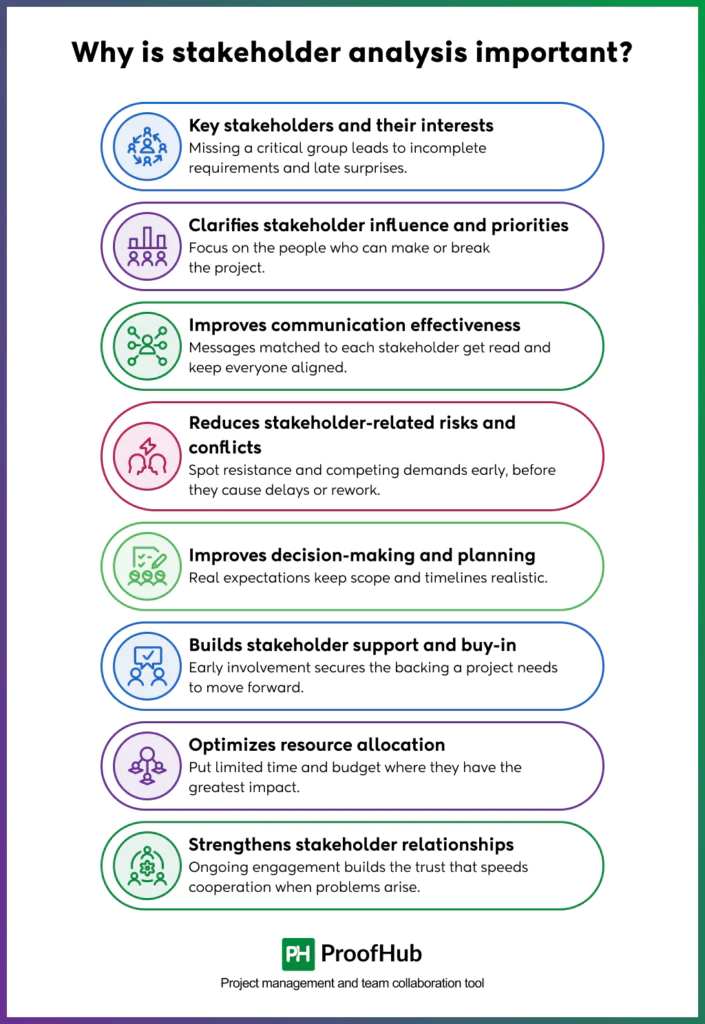
Stakeholder analysis is important because it helps identify key stakeholders and their interests, clarifies their influence and priorities, improves communication, reduces risks and conflicts, strengthens decisions and planning, builds support, optimizes resource allocation, and strengthens relationships.
Every project involves people with different goals, and overlooking even one group can derail progress. Stakeholder analysis gives you a clear map of who matters, what they need, and how to engage them. It is done at the start of a project and revisited as things change.
- Key stakeholders and their interests: Projects fail when a critical group is missed or misunderstood. Knowing who is involved and what they want keeps requirements complete and prevents late surprises.
- Clarifies stakeholder influence and priorities: Not every stakeholder carries equal weight. Understanding who can make or break the project lets teams focus attention where it affects the outcome most.
- Improves communication effectiveness: Generic updates often get ignored or cause confusion. Messages matched to each stakeholder’s needs get read and acted on, which keeps everyone aligned.
- Reduces stakeholder-related risks and conflicts: Unaddressed resistance and competing demands often cause delays, rework, and disputes. Spotting them early makes them cheaper and easier to fix.
- Improves decision-making and planning: Plans built on assumptions break when real expectations surface. Stakeholder insight gives decisions a factual basis, so scope and timelines hold up.
- Builds stakeholder support and buy-in: Stakeholders who feel ignored can block approvals or withdraw backing. Early involvement secures the support a project needs to move forward and survive change.
- Optimizes resource allocation: Teams have limited time and budget, and spreading them evenly wastes both. Stakeholder analysis directs effort to the groups with the greatest impact.
- Strengthens stakeholder relationships: Projects depend on trust, especially when problems arise. Ongoing engagement builds goodwill that speeds up cooperation and conflict resolution.
How to conduct stakeholder analysis?
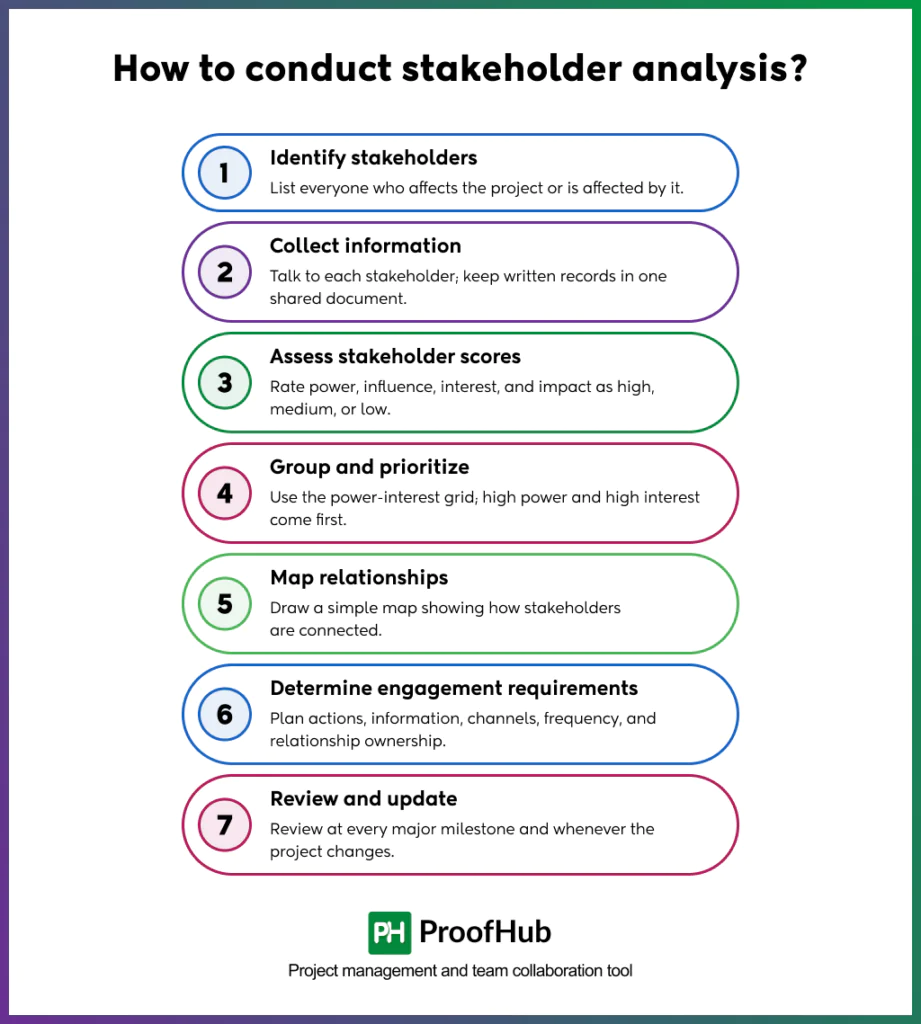
To conduct stakeholder analysis, identify the stakeholders, collect and document stakeholder information, assess stakeholder power, influence, interest, and impact, group, and prioritize the stakeholder, map stakeholders and their relationships, determine appropriate engagement requirements, and review and update the analysis.
The analysis consists of different steps and each step builds a base. The first step builds a factual base, the middle steps turn that data into priorities, and the final steps convert insight into an engagement strategy that says current.
1. Identify the stakeholders
Start by listing everyone who affects the project or is affected by it. Check project documents, team, charts, and contracts, then brainstorm with the team to catch anyone missing.
Include people inside the company, such as sponsors and department heads, and people outside it, such as customers, vendors, and regulators.
Do not forget indirect stakeholders. A group missed in this step often appears later with demands that cause delays. A complete list of the foundation for every step that follows.
2. Collect and document stakeholder information
Learn about each stakeholder by talking to them. Taking short interviews, surveys, or team meetings reveal what they expect, what worries them, and how they like to receive updates.
Keep written records of everything in one shared document, often called a stakeholder register.
Keep notes factual and polite, since others may read them, and update the register whenever something changes. Good records stop the team from guessing and make later decisions easier.
3. Assess stakeholder power, influence, interest, and impact
Score each stakeholder by answering four simple questions i.e. Power: can this person approve or block a decision? Influence: can they change other people’s opinions? Interest: how much do they care about the outcome? Impact: how much does the project affect them?
Rate each answer as high, medium, or low, using facts from the earlier steps rather than guesses. These scores show who can speed the project up and who can slow it down.
4. Group and prioritize the stakeholders
Place each stakeholder into a group based on their scores. The most popular method is the power-interest grid shown above, which splits people into four groups: manage closely, keep satisfied, keep informed, and monitor.
Stakeholders with high power and high interest come first, since their support or opposition affects the project most.
Sorting out the stakeholders in this way helps teams spend time and effort where it counts, instead of treating everyone the same.
5. Map stakeholder and their relationships
Show how stakeholders are connected with each other. Draw a simple map with lines between people who work together, report to each other, or disagree.
This reveals hidden influence, such as a trusted colleague who shapes a manager’s opinion, and it shows where conflicts may arise.
With this picture, project managers decide who should deliver key messages, whom to talk to first, and how to build support.
6. Determine appropriate engagement requirements
Decide how to work with each stakeholder. First, check where each person stands today, such as unaware, resistant, neutral, supportive, or leading, and where the project needs them to be.
Then plan simple actions to close the gap. Decide what information each person gets, how often, through which channel, and who handles the relationship
7. Review and update the analysis
Stakeholder analysis is not finished after one round. People change roles, priorities shift, and new stakeholders join as the project moves forward. Review the analysis at every major milestone and whenever the project changes in scope, leadership, or risk.
Update ratings, groups, and engagement plans as needed, and check whether the current approach is working. Regular reviews keep the analysis accurate and the plan useful from start to finish.
What are the common tools and techniques for stakeholder analysis?
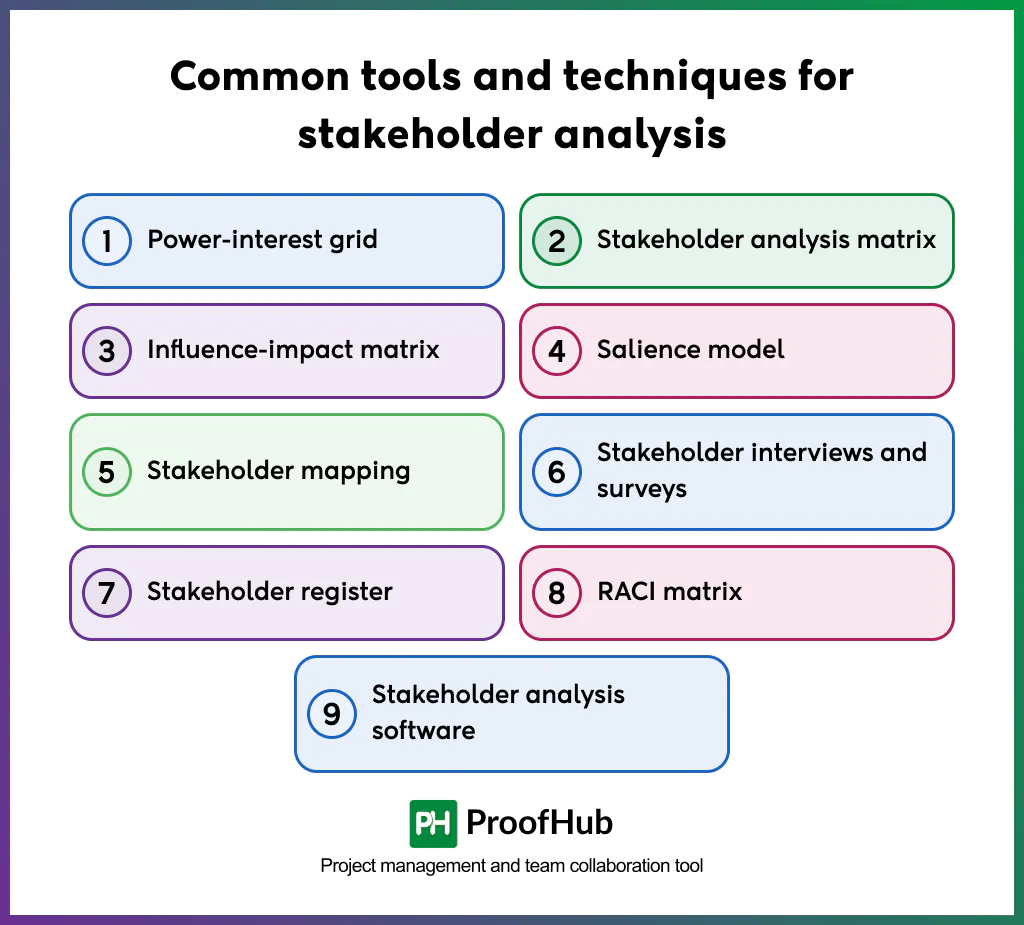
The common tools and techniques for stakeholder analysis are the power-interest grid, stakeholder analysis matrix, influence-impact matrix, salience model, stakeholder mapping, stakeholder interviews and surveys, stakeholder register, RACI matrix, and stakeholder analysis software.
- Power-interest grid: A two-by-two grid sorts stakeholders by their power over the project and their interest in it. The four quadrants (manage closely, keep satisfied, keep informed, monitor) show where to direct effort.
- Stakeholder analysis matrix: Teams list each stakeholder in a table alongside their role, expectations, concerns, and support level. The snapshot makes it easy to compare needs and plan responses.
- Influence-impact matrix: Stakeholders appear on a grid that compares their ability to shape the project with how strongly it affects them. Teams quickly see who steers results and who needs extra support.
- Salience model: Stakeholders earn a ranking based on power, legitimacy, and urgency. Those holding all three traits need immediate attention, while those with only one can wait.
- Stakeholder mapping: A visual map charts stakeholders and their links, including reporting lines, alliances, and conflicts. Hidden influence becomes visible, and teams can pick the right person to deliver key messages.
- Stakeholder interviews and surveys: Direct conversations and questionnaires collect first-hand input on expectations, concerns, and communication preferences. Real feedback replaces assumptions and strengthens every other tool.
- Stakeholder register: One central document stores each stakeholder’s role, contact details, expectations, and engagement level. Teams update it throughout the project, so it stays a reliable reference.
- RACI matrix: Each task or decision gets assigned to people as responsible, accountable, consulted, or informed. Clear roles remove confusion and show who needs involvement at every stage.
- Stakeholder analysis software: Digital platforms store data, build maps, and track engagement in one place. Large or complex projects benefit most, since automation saves time and keeps information current.
What are the common mistakes to avoid in stakeholder analysis?
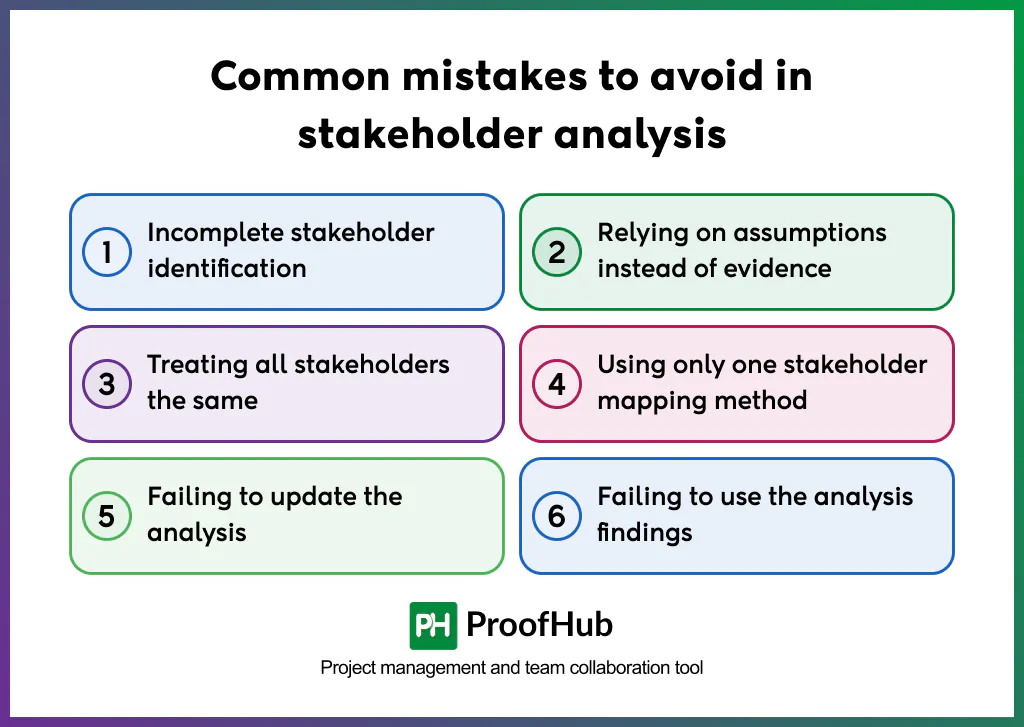
The common mistakes to avoid in stakeholder analysis are: incomplete stakeholder identification, relying on assumptions instead of evidence, treating all stakeholders the same, using only on stakeholder mapping method, failing to update the analysis, and failing to use the analysis findings.
1. Incomplete stakeholder identification: Focusing only on sponsors, project teams, and clients can leave out important groups. End users, vendors, regulators, support teams, and other departments can also affect project outcomes. Not identifying can lead to unexpected objections, delays, and extra costs.
2. Relying on assumptions instead of evidence: Assuming what stakeholders think or want can lead to inaccurate analysis. Use interviews, surveys, past decisions, and observed behaviour to understand stakeholders interests and concerns. Evidence-based assessments help identify potential resistance and support early.
3. Treating all stakeholders the same: Not every stakeholder needs the same level of attention. Their influence, interest, and impact on the project should guide how they are managed. Focus on stakeholders who can significantly affect outcomes, while keeping others informed through appropriate communication.
4. Using only one stakeholder mapping method: A single mapping method may not capture every aspect of a stakeholder’s role. For example, the power/interest grid assesses influence and interest, while the salience model considers power, legitimacy, and urgency. Using different methods provides a clearer picture of stakeholder priorities and engagement needs.
5. Failing to update the analysis: Stakeholder interests and influence can change as the project progresses. Changes in scope, budgets, leadership, or project phases can affect their priorities. Review the analysis at key milestones and whenever major changes occur to keep it accurate and relevant.
6. Failing to use the analysis findings: Stakeholder analysis is useful only when its findings guide project decisions. Use the results to improve communication, identify risks, and plan engagement activities. Assign clear responsibilities for follow-up actions to ensure the analysis leads to practical results.
Stakeholder analysis example with template
Download stakeholder analysis template below, replace the sample data with your own, and review it at every project milestone.
Stakeholder Analysis Template
Use this ready-to-use excel template to record stakeholders, rate their power and interest, and plan how to engage each one. The template includes a completed example, a blank register with dropdowns, and a priority grid that updates automatically.
Download the free template nowHow to use this template:
- List every stakeholder. Add internal teams, external parties, and indirectly affected groups in the Stakeholder, Role, and Type columns.
- Record expectations and concerns. Note what each stakeholder needs from the project and what could cause them to resist it.
- Rate power and interest. Select High or Low from the dropdowns. The Priority Quadrant fills in automatically and shows how closely to engage each stakeholder.
- Set current and desired engagement. Choose a level from Unaware to Leading for each stakeholder. The Gap column shows how far engagement needs to move.
- Plan actions and review regularly. Add the engagement action, communication method, owner, and status, then update the sheet at every major milestone or change in scope.
When should you conduct a stakeholder analysis?
You should conduct a stakeholder analysis at project initiation, before the scope, budget, and communication plan are finalized. Identifying stakeholder needs and concerns early helps you make better decisions and address potential risks. Review the analysis at every major project phase and whenever significant changes occur, such as scope revisions, leadership changes, budget adjustments, or new regulations. Stakeholder needs and influence can change over time, so the analysis must be updated throughout the project.
What is the difference between stakeholder analysis and stakeholder mapping?
What is the difference between stakeholder analysis and stakeholder management?
Conclusion
Stakeholder analysis works best when it is treated as a continuing practice, not a one-time task. Start it before the plan is finalized, base every rating on evidence, and match your engagement effort to each stakeholder’s influence and interest. Then revisit it at every major milestone, because stakeholder priorities change as projects do. Used this way, it gives you clearer decisions, earlier risk detection, and stronger support from the people your project depends on.