Uncertainty is part of any project. Especially during large, long-running projects, many things can go wrong if not carefully planned for.
These unwanted surprises can derail the schedule, lead to budget overruns, and even shut down the project completely. That is why risk management strategies were first implemented.
Risk management is a fundamental part of any project, and it is proactive rather than reactive. It is more concerned with responding to a situation than with controlling it entirely, which is not possible.
This article details how managers and leaders can plan and implement risk management strategies, and explains their significance.
- 1.A risk management strategy is a structured plan to identify, assess, and respond to potential threats to a project.
- 2.It reduces uncertainty, protects budgets, and supports informed decision making.
- 3.Common types include avoidance, reduction, transference, acceptance, and contingency planning.
- 4.Building a risk management strategy requires identifying risks, prioritizing them, assigning owners, and reviewing progress regularly.
What is a risk management strategy?
A risk management strategy is a documented approach for identifying, evaluating, and addressing risks that could affect a project’s outcome.
It outlines how a team will detect potential problems, judge their likelihood and impact, and decide on the right response. The goal is to protect timelines, budgets, and deliverables from avoidable disruption.
Why is creating a risk management strategy important?
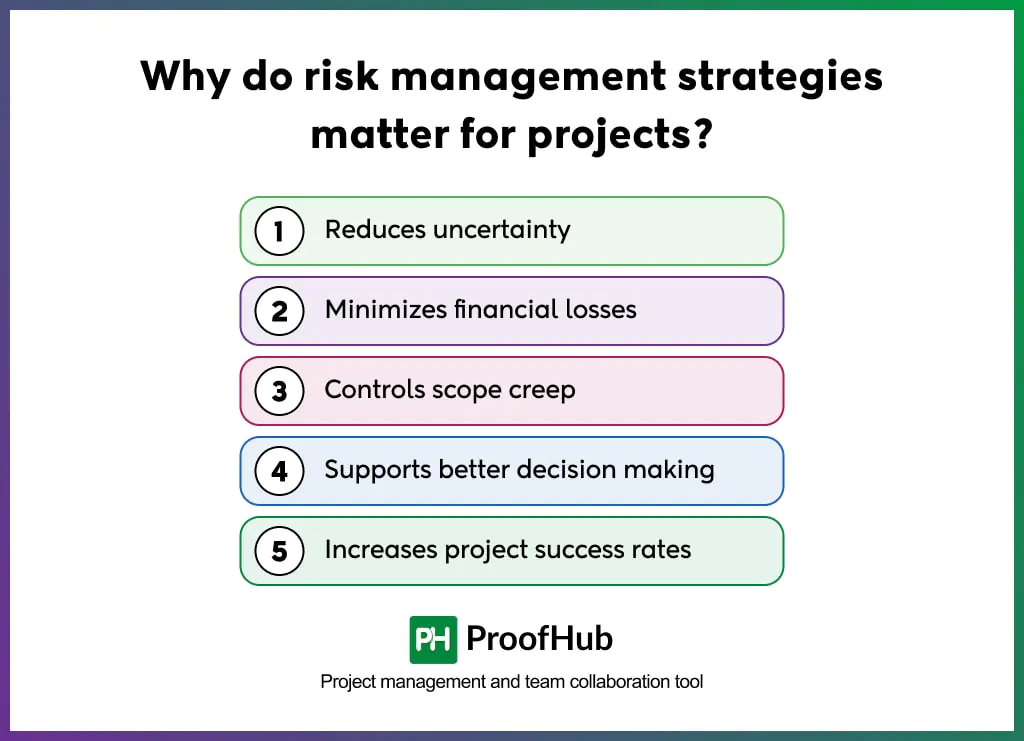
Creating a risk management strategy is important because they reduce uncertainty, minimizes financial losses, controls scope creep, supports better decision-making, and increases the project success rate.
Projects rarely go exactly as planned, and a defined strategy gives teams a repeatable way to handle disruptions rather than reacting on the fly. It turns risk from a vague concern into a manageable, trackable part of project execution.
Here is why risk management strategies matter for project success, in greater detail:
- Reduces uncertainty: Limits the factors that can unwantedly influence a project. As a result, uncertainty around the project decreases, and stakeholders can make more reliable predictions about its future progress.
- Minimizes financial losses: Prevents projects from being affected by unforeseen events that can alter the project timeline, inflate the budget, and increase routine task expenditures. When the number of variables is under control, the financial aspect also becomes much easier to manage.
- Controls scope creep: Scope creep is the addition of tasks to the project that were not part of the original scope. Projects without a proper strategy for managing risks must constantly update their scope to address changing circumstances, a process that is very expensive.
- Supports better decision-making: Provides stakeholders with the full picture, including potential risks and ways to address them, empowering them to make better, more informed decisions that benefit everybody.
- Increases project success rates: Conducting regular risk reviews keeps the project on schedule and within budget, according to PMI’s Pulse of the Profession report. Without that ongoing tracking, unaddressed risks compound quietly until they surface as missed deadlines or cost overruns severe enough to threaten the organization’s survival.
What are the types of risk management strategies?
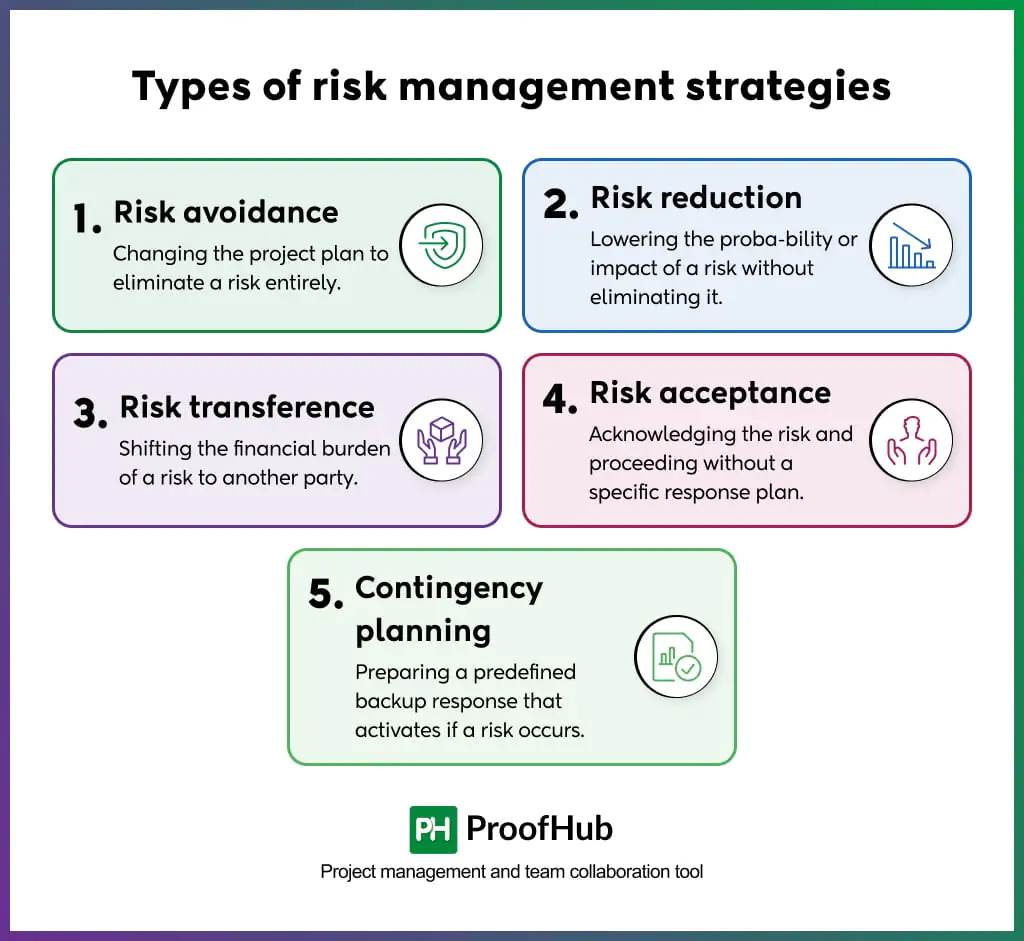
The five types of risk management strategies are: risk avoidance, risk reduction, risk transfer, risk acceptance, and contingency planning.
Project teams typically choose from these five recognized types of risk management strategies, often combining more than one depending on the project’s risk profile.
Here are all of these explained in detail:
1. Risk avoidance
Risk avoidance means changing the project plan, which includes avoiding activities or decisions that could lead to adverse situations, to eliminate a risk entirely rather than managing its effects.
For example, a software team might avoid the risk of a third-party API outage by building the feature in-house instead of relying on an external vendor.
This strategy is helpful when a risk carries severe consequences and a safer alternative path exists. Since the risk is removed at the source rather than managed after the fact, teams eliminate the associated threat completely, protecting the project from that specific disruption before it can ever occur.
2. Risk reduction
Risk reduction focuses on lowering the probability or impact of a risk without eliminating it completely by taking preventive measures or monitoring risks around the clock to prepare for it when it finally appears.
For example, a construction firm might reduce safety risks by adding extra inspections and training, even though some level of risk remains inherent in the work.
This strategy is useful when a risk cannot be avoided outright, but its likelihood or severity can still be managed down to an acceptable level. The result is fewer incidents and smaller losses when issues do occur, keeping the project on track even though the underlying risk hasn’t disappeared entirely.
3. Risk transference
Risk transference shifts the financial burden of a risk to another party, commonly through insurance, warranties, or outsourcing contracts.
For instance: A manufacturer might transfer the risk of equipment failure by purchasing an extended warranty from the supplier.
This strategy is valuable when a third party is better positioned to absorb or manage a specific risk than the project team is. The result is reduced financial exposure for the organization, since the cost of the risk materializing falls on the party that assumed it, rather than draining the project’s own budget.
4. Risk acceptance
Risk acceptance applies when the cost of addressing a risk outweighs its potential impact, so the team acknowledges the risk and proceeds without a specific response plan.
For example, a company that owns a social media platform risks its platform going offline due to server issues. Eliminating server downtime entirely is much more expensive (not to mention nearly impossible) than establishing a set of preparatory measures to follow when the server does go down.
This strategy makes sense when the cost of mitigation would exceed the cost of the risk itself. The result is that teams conserve time and budget for higher-priority risks, rather than spending resources on managing something with minimal potential impact.
5. Contingency planning
Contingency planning prepares a predefined backup response that activates if a specific risk occurs. It involves taking measures that immediately bring the situation under control and stop the risk from becoming a bigger problem.
For example: An event planning company might prepare an indoor backup venue in case of bad weather, ensuring the event proceeds without a full-scale disruption.
This strategy is helpful for risks that are likely enough to warrant preparation but not severe enough to avoid altogether. The result is faster recovery and minimal disruption when the risk does materialize, since the team can execute a ready-made response instead of scrambling to react in real time.
How to create a risk management strategy?
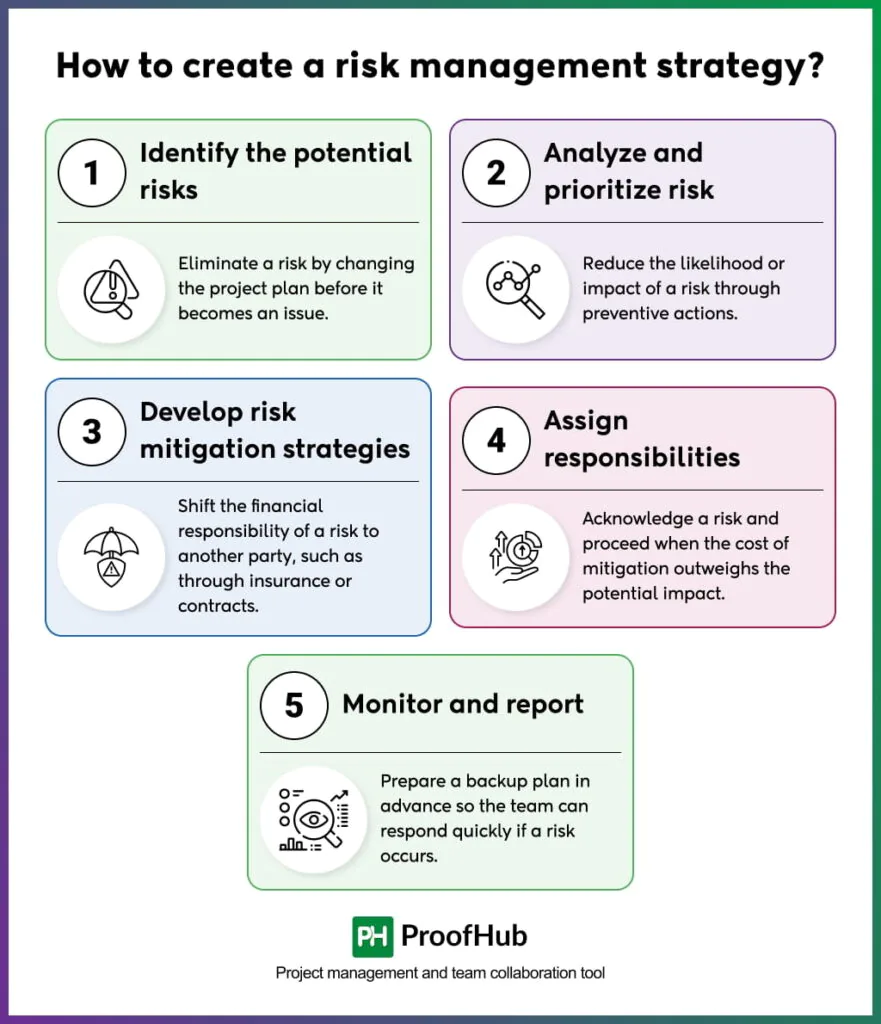
To create a risk management strategy, identify the potential risks, analyze and prioritize risks, develop risk mitigation strategies, assign responsibilities, and monitor and report on their impact.
Building a risk management strategy follows a clear sequence, and sticking to this pipeline ensures it is robust and effective.
Here are all the steps explained in greater detail:
1. Identify the potential risks
Risk identification is the process of listing everything that could threaten the project’s timeline, budget, or deliverables. This includes technical, resource, market, and even vendor- or third-party risks.
The process usually starts with brainstorming sessions involving the project team, stakeholders, and subject matter experts, and managers also draw on historical data, past project reports, and lessons-learned logs to spot patterns that recur across projects.
Tools like SWOT analysis, checklists, and risk breakdown structures help make sure nothing important gets missed. Together, these tools help build a risk register: a documented, categorized list of risks that becomes the foundation for every step that follows.
2. Analyze and prioritize risk
Risk analysis is the process of determining which risks on the register deserve the team’s attention and which can wait. This means judging each risk on two fronts: how likely it is to happen, and how much damage it would cause if it did.
Teams typically score each risk on a numbered scale for likelihood and impact, then plot the results on a probability-and-impact matrix, so patterns become visible at a glance.
Some teams go further with quantitative methods, such as expected monetary value or Monte Carlo simulation, when a risk is significant enough to justify the extra rigor.
The result is a ranked list, sorted from critical to negligible, that tells the team exactly where to spend its limited time and budget first.
3. Develop risk mitigation strategies
Risk mitigation planning is the process of matching each significant risk to a specific response before it occurs.
To develop a risk management strategy, assess whether a risk can be designed out of the project entirely, reduced to a more tolerable level, shifted onto another party through insurance or contracts, or simply accepted because the cost of acting outweighs the damage.
The choice depends on the risk score from the prioritization step, as well as practical constraints such as budget, timeline, and available resources.
Some teams build out a full response plan for each high-priority risk, including trigger conditions and estimated cost of the response. What comes out of this step is a documented action plan attached to every risk that matters, so the team is never deciding on the fly when something goes wrong.
4. Assign responsibilities
Risk ownership assignment is the process of assigning a named individual to each risk on the register, not just to the response plan as a whole.
Project managers typically make this assignment based on who has the visibility and authority to spot early warning signs of a specific risk, whether that is a technical lead for a system risk or a procurement manager for a vendor risk.
Each owner tracks the status of their assigned risk, monitors trigger conditions, and executes the predefined response the moment they materialize.
Assigning a team member to an entity in the risk register closes the gap where risks would otherwise fall through the cracks from unclear accountability.
5. Monitor and report
Risk monitoring is the process of keeping the risk register up to date throughout the project rather than treating it as a one-time document.
This involves periodic risk review meetings, often tied to existing project checkpoints or sprint reviews, where owners report on the status of their assigned risks, and the team reassesses whether new risks have emerged or old ones have changed in severity.
Dashboards and status reports are shared with stakeholders on a set cadence, so decision-makers always have current visibility into the project’s risk exposure.
The outcome is a living risk register that adapts as the project evolves, keeping the entire strategy accurate rather than letting it go stale after the initial planning phase.
Who is responsible for developing a risk management strategy?
The project manager typically leads the development of a risk management strategy, often working alongside team leaders and, on larger projects, a dedicated risk manager.
Input from stakeholders and subject matter experts helps ensure the strategy accounts for risks specific to the project’s domain.
What is the difference between the risk management strategy and risk management plan?
A risk management strategy defines the high-level policy, governance, and overarching framework an organization uses to address uncertainty across all operations. It establishes overall risk appetite, methodologies, and principles to align risk-taking with long-term strategic goals.
In short, the strategy dictates the general philosophy and baseline rules for managing risk enterprise-wide.
A risk management plan is an actionable, project-specific document that applies that overarching strategy to a concrete initiative. It outlines specific risk registers, mitigation procedures, assigned roles, tracking schedules, and contingency budgets.
While the strategy provides the broad directional framework, the plan details exact execution steps: who does what, when, and how.
| Aspect | Risk Management Strategy | Risk Management Plan |
|---|---|---|
| Focus | Overall approach to handling risk | Specific document outlining processes and procedures |
| Scope | Broad, guides decision making | Detailed, project specific |
| Content | Principles for avoidance, reduction, transference, acceptance | Roles, tools, timelines, risk register format |
| Timeframe | Can apply across multiple projects or the organization | Tied to a single project’s lifecycle |
| Purpose | Sets direction for how risk is treated | Provides the operational steps to execute that direction |
Can multiple risk management strategies be used together?
Yes, you can use multiple risk management strategies. Most projects combine multiple risk management strategies rather than relying on just one.
A team might transfer financial risk through insurance while simultaneously reducing operational risk through added training, since different risks on the same project often call for different responses.
How often should a risk management strategy be reviewed?
A risk management strategy should be reviewed at key project milestones and whenever significant changes occur, such as scope adjustments or new stakeholder requirements. Many teams also schedule fixed reviews, such as monthly or biweekly check-ins, to keep the risk register accurate throughout the project.
Conclusion
A solid risk management strategy gives project teams the structure needed to anticipate problems rather than react to them after the fact. By combining clear identification, assessment, response, and monitoring processes, teams can protect budgets, timelines, and outcomes across any project type. Tools that centralize risk tracking, task ownership, and reporting, such as ProofHub, make it easier to keep the entire process visible and up to date as the project evolves.