

Project communications management is the process of planning, sharing, and controlling how information flows in a project. It ensures the right people get the right information at the right time, clearly and without confusion.
In this guide, we’ll explain what project communications management is, why it is important, and how it works in practice.
You’ll also explore key processes, communication models, channels, common challenges with solutions, real examples, and a simple template to help you apply it effectively.
- 1.Project communications management ensures the right information is planned, shared, and controlled so that all stakeholders stay informed and aligned throughout the project.
- 2.Communication management in a project improves project success by reducing misunderstandings, enhancing collaboration, speeding decision-making, and increasing client trust through clear, timely communication.
- 3.The three core processes are Plan Communications Management, Manage Communications, and Monitor Communications, which together structure how information is created, shared, and evaluated.
- 4.Effective communication uses different models (sender-receiver and interactive) and channels such as emails, meetings, dashboards, and collaboration tools to ensure clarity and engagement.
- 5.Common challenges such as information overload, lack of clarity, stakeholder misalignment, and cultural barriers can be overcome through clear planning, structured communication, including centralized tools, and consistent feedback loops.
What is project communications management?
Project communications management is the process of planning, creating, distributing, monitoring, and controlling project information. It ensures stakeholders receive the right information at the right time, without any confusion throughout the project.
Effective management reduces misunderstandings, aligns expectations, and supports decision-making.
The two main components of project communication management are:
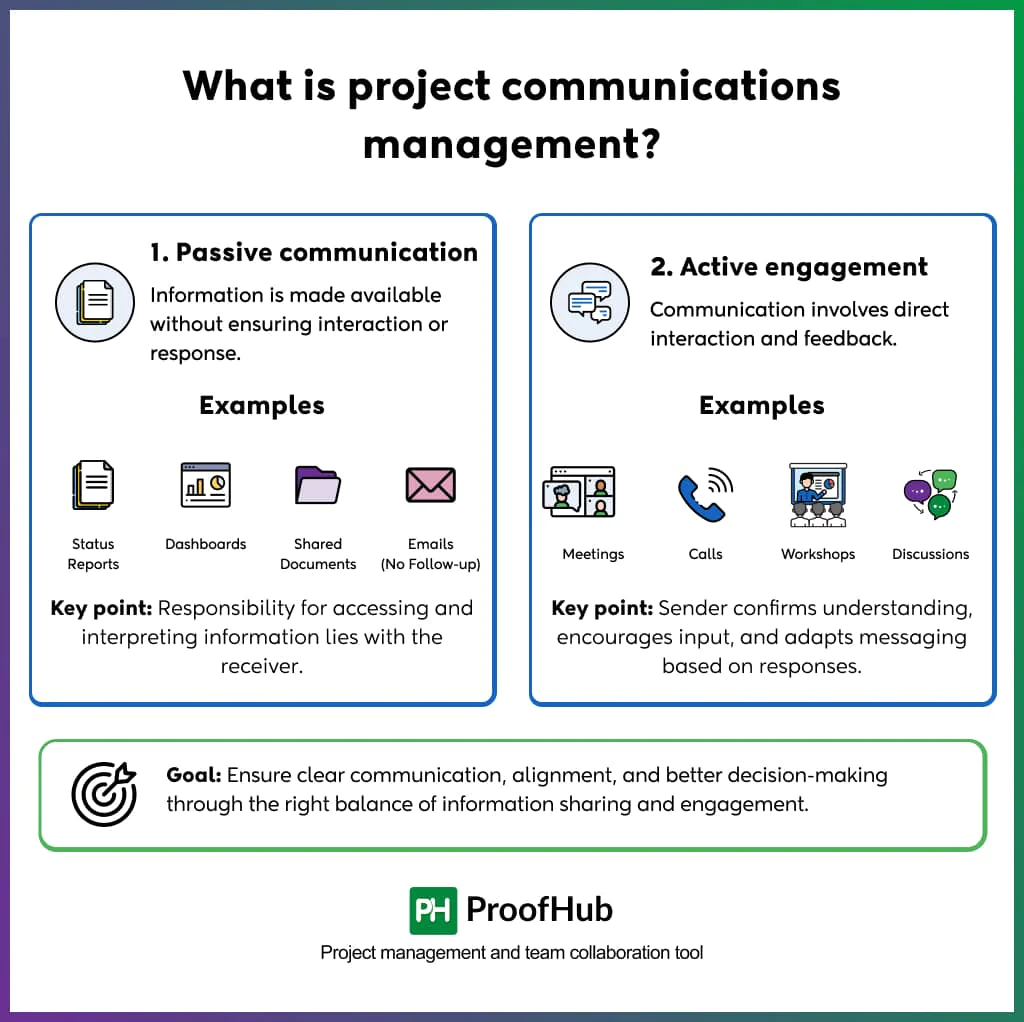
- Passive communication: Information is made available without ensuring interaction or response. Examples include status reports, dashboards, shared documents, and emails sent without follow-up. Responsibility for accessing and interpreting information lies with the receiver.
- Active engagement: Communication involves direct interaction and feedback. Examples include meetings, calls, workshops, and discussions. Sender confirms understanding, encourages input, and adapts messaging based on responses.
Why is project communications management important?
Project communication management is important because it ensures accurate, timely, and relevant information flows among stakeholders. It helps in enabling alignment, coordination, and informed decision-making throughout the project.
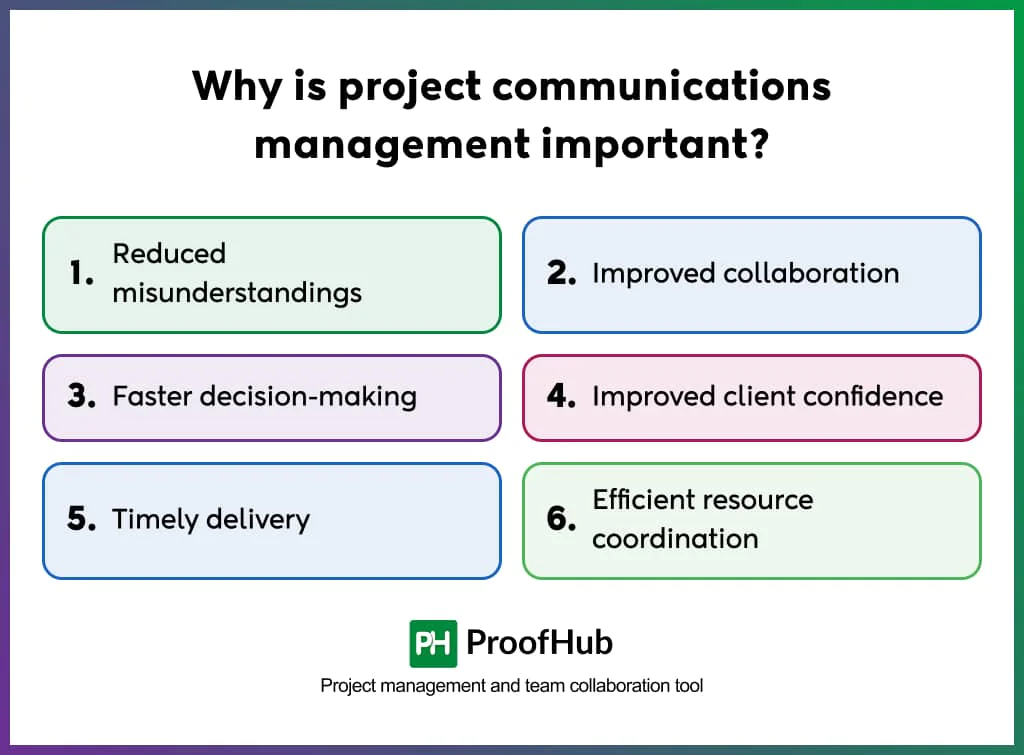
The project communications management brings structure, transparency, and consistency in how information is shared.
The key benefits include:
1. Reduced Misunderstandings: Clear, consistent communication ensures all team members interpret project requirements, deliverables, and expectations the same way. Minimizing the errors, rework, and confusion that can derail timelines. When everyone has accurate information, the project runs more smoothly with fewer costly mistakes.
2. Improved Collaboration: Effective communication channels foster teamwork by enabling seamless information sharing across departments and teams. It breaks down silos and encourages collective problem-solving. This collaborative environment leads to innovative solutions and stronger team cohesion.
3. Faster Decision-Making: Timely access to relevant information empowers stakeholders to make informed decisions quickly without delays. Communication management establishes clear escalation paths and reporting structures. This agility helps projects adapt to changes and overcome obstacles efficiently.
4. Improved Client Confidence: Regular updates and transparent communication build trust with clients and sponsors by demonstrating project progress and professionalism. Clients feel involved and reassured that their investment is being managed responsibly. This confidence strengthens relationships and can lead to future business opportunities.
5. Timely Delivery: Structured communication ensures milestones, deadlines, and dependencies are clearly communicated and tracked across the team. Early identification of risks and bottlenecks allows for proactive mitigation. This coordination keeps the project on schedule and prevents last-minute surprises.
6. Efficient Resource Coordination: Clear communication about resource availability, allocation, and requirements prevents conflicts and optimizes utilization. Team members know what’s expected, when, and what support they can access. This efficiency reduces waste, avoids burnout, and maximizes productivity across the project lifecycle.
What are the key processes in project communications management?
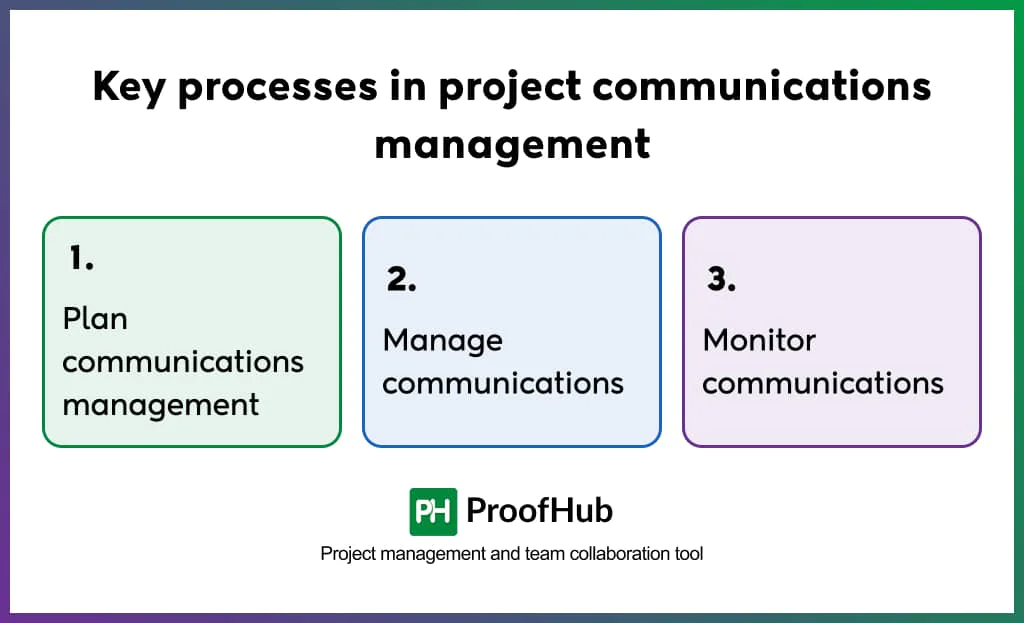
The key processes in project communications management are: Plan Communications Management, Manage Communications, and Monitor Communications.
1. Plan Communications Management
Plan Communications Management is the process of developing an appropriate approach and plan for project communications activities based on stakeholder or group information needs.
It also considers available organizational assets and overall project requirements to ensure effective communication.
Process Group: Planning
Key Activities:
- Analyze stakeholder communication requirements and information needs
- Determine communication methods, frequency, and formats
- Identify who needs what information, when they need it, and how it will be delivered
- Define communication technologies and channels to be used
- Establish escalation processes for issue resolution
Key Output: It is a component of the project management plan that describes how project communications will be planned, structured, monitored, and controlled.
Value: Ensures a systematic approach to effective communication that meets stakeholder expectations and supports project success.
2. Manage Communications
Managing Communications is the process of ensuring the timely and appropriate collection, creation, and distribution of project information.
It includes storage, retrieval, management, monitoring, and final disposition of project information.
Process Group: Executing
Key Activities:
- Create, collect, and distribute project information in accordance with the communications management plan.
- Facilitate effective information flow between the project team and stakeholders.
- Respond to information requests and ensure stakeholders receive necessary updates.
- Manage and update project documents and records.
- Conduct meetings, presentations, and status reports.
Key Outputs: Project communications (status reports, dashboards, presentations), project management plan updates, and organizational process assets updates.
Value: Keeps stakeholders informed and engaged, ensuring information flows efficiently to the right people at the right time.
3. Monitor Communications
The process of ensuring the information needs of the project and its stakeholders are met throughout the project lifecycle.
Process Group: Monitoring and Controlling
Key Activities:
- Assess the effectiveness of communication activities and adjust as needed
- Verify that stakeholders are receiving appropriate information
- Monitor communication metrics and stakeholder engagement levels
- Identify communication gaps, barriers, or issues
- Recommend corrective actions to improve communication effectiveness
Key Outputs: Work performance information, change requests, and updates to the project management plan and project documents.
Value: Ensures communication strategies remain effective and responsive to changing.
What are the common project communications models?
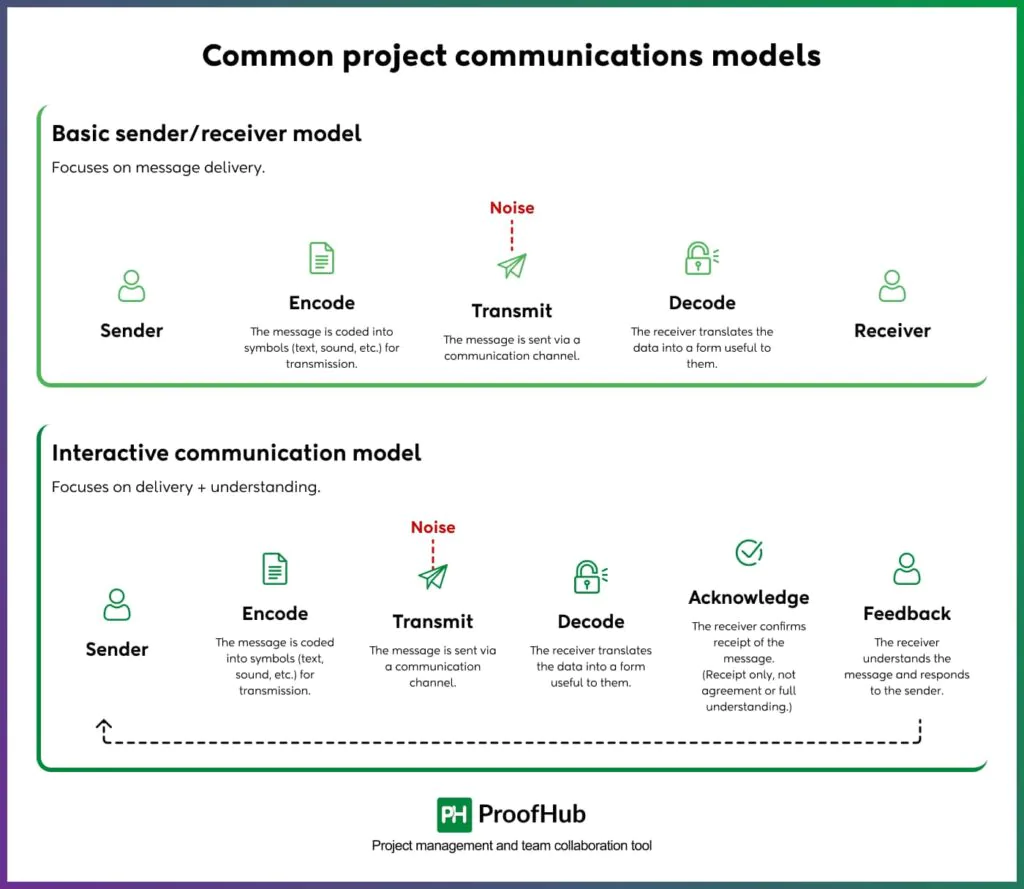
The common project communication models are the sample basic sender/receiver and the interactive communication model.
1. Sample basic sender/receiver communication model: It is a process and consists of two parties: the sender and the receiver. The model is concerned with ensuring that the message is delivered rather than understood.
The sequence of steps in a basic communication model is as follows:
- Encode: The message is coded into symbols, such as text, sound, or some other medium, for transmission (sending).
- Transmit message: The message is sent via a communication channel. The transmission of this message may be compromised by various physical factors such as unfamiliar technology or inadequate infrastructure. Noise and other factors may be present and contribute to the loss of information in the transmission and/or reception of the message.
- Decode: The data received is translated by the receiver into a form useful to it.
2. Sample interactive communication model: Interactive communication happens between a sender and a receiver. The sender sends a message, the receiver receives it, and tries to understand it. Both sides take part in the communication.
This model checks whether the receiver properly understands the message.
Here, noise means anything that hinders understanding of the message, such as distractions, different interpretations, lack of knowledge, or lack of interest.
The additional steps in an interactive communication model are:
- Acknowledge: The receiver confirms receipt of the message. It only shows a receipt, not an agreement or a full understanding.
- Feedback/Response: Receiver understands the message and responds to the sender. If the reply matches the original message, communication is successful. Active listening helps improve feedback quality.
What are the common challenges in project communications management?
Common challenges in project communication management include information overload, stakeholder misalignment, lack of clarity, and cultural barriers. These challenges affect message understanding, coordination, and project performance.
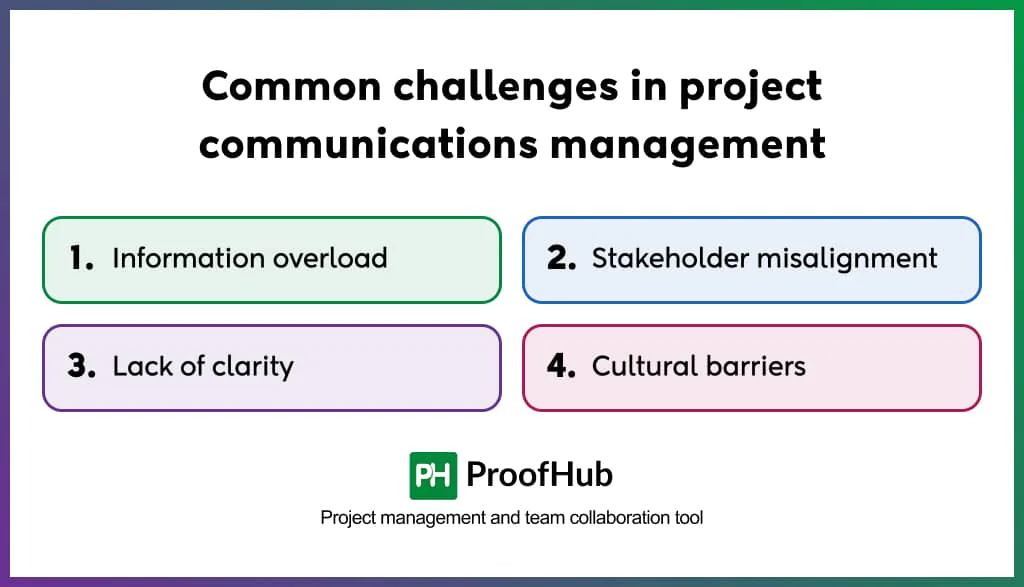
Let’s jot these challenges down here:
1. Information Overload
Excessive emails, reports, meetings, and updates make it difficult to distinguish critical information from routine noise.
Important messages are missed, ignored, or overlooked. It leads to reduced engagement and decision paralysis as information processing becomes overwhelming.
Solutions:
Prioritize and filter communications to send only relevant information to appropriate recipients.
Use clear subject lines, prominently highlight action items, and establish communication protocols that define which information should be shared, when, and through which channels.
2. Stakeholder Misalignment
Stakeholders have different expectations, interests, priorities, and understandings of project goals.
This creates competing demands, resistance to decisions, difficulty achieving consensus, and potential project derailment.
Stakeholders pull the project in different directions or feel their needs aren’t being addressed.
Solutions:
Conduct a comprehensive stakeholder analysis early to identify needs, expectations, and levels of influence.
Hold regular alignment meetings to maintain shared understanding of objectives and progress, and document all key decisions with clear rationale to ensure transparency and buy-in across all stakeholder groups.
3. Lack of Clarity
Communicating vaguely or using difficult terminology leaves recipients confused about project requirements, task assignments, deadlines, or expected outcomes.
Stakeholders work with incomplete or misunderstood information, which leads to misinterpretations, assumptions, rework, delays, and frustration.
Solutions:
Use specific, definite language with clearly defined action items, responsibilities, and deadlines in all communications.
Always provide necessary context and background information, and implement feedback mechanisms, such as acknowledgements or confirmations, to verify that recipients have correctly understood the message.
4. Cultural Barriers
Different communication styles (e.g., direct vs indirect), language differences, cultural norms and different interpretations lead to potential misunderstandings, reduced trust, and hindered collaboration.
Solutions:
Provide cultural awareness training to team members and foster an environment of openness where people feel comfortable discussing cultural differences.
Use simple and clear language, avoiding idioms, slang, and culture-specific references. Demonstrate flexibility by accommodating different communication preferences, time zones, and working styles to create an inclusive project environment.
What channels are used for project communication?
The channels used for project communication are: project management tools, email, meetings, instant messaging, dashboards, reporting tools, and collaboration software.
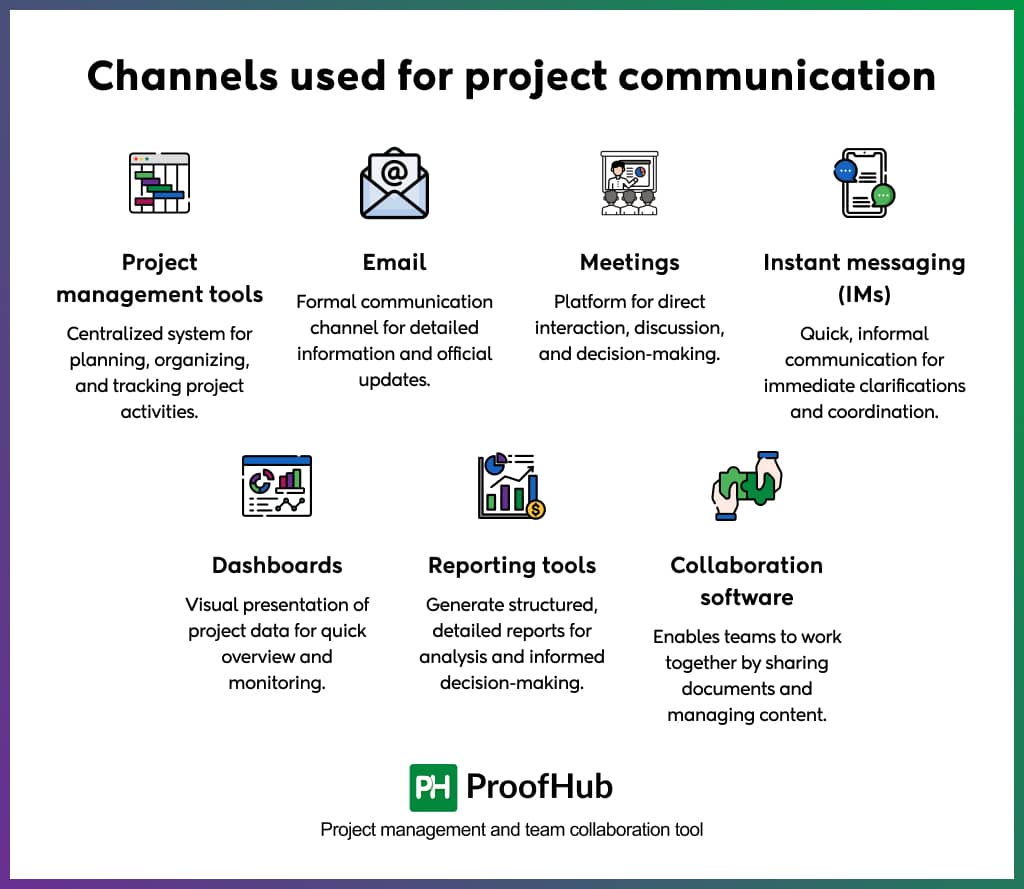
These channels ensure smooth information flow, better coordination, and effective decision-making throughout the project lifecycle.
Let’s read more about these channels:
1. Project Management Tools
Project management tools are used to plan, organize, and track project activities while enabling communication within a centralized system.
Tools like ProofHub, Trello, Basecamp, and Asana allow teams to assign tasks, set deadlines, share files, and post updates in real time.
They also maintain a clear record of discussions, progress, and responsibilities, which improves accountability and coordination.
2. Email
Email is a widely used formal communication channel for sharing detailed information, official updates, approvals, and external communication. It provides a written, traceable record that is useful for documentation and future reference.
Emails are suitable for communicating with clients, stakeholders, and distributed teams.
However, excessive emails can create clutter and lead to missed messages. Proper subject lines, concise content, and structured formatting are essential to ensure clarity and effectiveness in email communication.
3. Meetings
Meetings provide a platform for direct interaction, discussion, and decision-making among team members and stakeholders.
They can be conducted in person, via video conference, or via virtual call. Meetings help clarify complex topics, resolve issues quickly, and align team members on goals and expectations.
They encourage participation and immediate feedback. However, poorly planned or unnecessary meetings can waste time. Clear agendas, defined objectives, and proper time management are essential to make meetings productive.
4. Instant Messaging (IMs)
Instant messaging tools enable quick, informal communication among team members. Platforms like Slack and Microsoft Teams allow real-time messaging, group chats, and quick file sharing.
These tools are useful for immediate clarifications, quick updates, and day-to-day coordination. They reduce delays compared to email communication.
However, overuse or lack of structure in messages can lead to confusion and loss of important information. Clear and concise messaging helps maintain effectiveness.
5. Dashboards
Dashboards present project data visually using charts, graphs, and key performance indicators. They provide a quick overview of project status, progress, risks, and performance metrics.
Dashboards help stakeholders easily understand complex information without wading through lengthy reports. They support real-time monitoring and enable faster decision-making.
By providing a centralized, visual summary, dashboards improve transparency and keep all stakeholders informed about current project conditions.
6. Reporting Tools
Reporting tools generate structured, detailed reports, including status, progress, and performance reports. These tools help track project objectives, timelines, risks, and resource utilization.
Reports provide in-depth insights that support analysis and informed decision-making. They are especially useful for communicating with senior management and stakeholders who require detailed project information.
Consistent and well-structured reporting ensures clarity, accountability, and alignment across the project.
7. Collaboration Software
Collaboration software enables teams to work together by sharing documents, managing content, and communicating within a shared environment.
Tools like Google Workspace, ProofHub, and Notion support real-time document editing, file sharing, and knowledge management.
These platforms improve teamwork by enabling multiple users to contribute simultaneously and stay up to date.
They help maintain organized documentation and reduce duplication of work, which enhances efficiency and overall project communication.
Example of project communications management
A software development project for a mobile app involves stakeholders such as the project manager, developers, designers, testers, and the client.
Communication is managed throughout the project.
Let’s have a look:
- Planning Stage (Plan Communications Management)
A communication plan is created that defines what information will be shared, with whom, how often, and through which channels.
For example, weekly status reports are planned for the client, daily updates are provided to the internal team, and urgent issues are defined for immediate escalation.
- Execution Stage (Manage Communications)
Project information is created, shared, and managed according to the plan. The team uses tools like ProofHub and Asana to assign tasks and track progress. Quick discussions take place on Slack, while formal communication and approvals are handled through email.
Regular meetings are conducted to review progress and resolve issues.
- Monitoring Stage (Monitor Communications)
Communication effectiveness is tracked to ensure all stakeholders receive relevant and timely information. Dashboards and reports are used to monitor progress and performance. Feedback from the client and team is collected to identify gaps, delays, or misunderstandings, and improvements are made to maintain smooth communication flow.
This structured approach ensures clear communication, better coordination, and successful project delivery.
Project communications management template
The project communication management template acts as a structured guide to ensure that communication in your project is clear, consistent, and purposeful. Instead of ad-hoc messaging, it helps you plan who communicates what, when, and how.
It helps you:
- Improve clarity by defining communication types and their purpose
- Align stakeholders so everyone knows when and how updates will happen
- Reduce confusion by standardizing channels (email, meetings, dashboards, etc.)
- Enhance accountability by assigning communication responsibilities
- Save time by avoiding unnecessary or repetitive communication
- Track progress effectively through scheduled updates and reports
Below is a simple template you can copy and adapt for your project. Fill in stakeholders, frequency, and communication channels as needed. Adjust rows and columns based on your requirements.
This template is a basic starting point using manual tools.
How to use this template:
- Use this table as a reference to design your own project communication plan
- Customize communication types based on your project needs
- Add or modify stakeholders, channels, and frequency
- Align it with your team structure and workflow
- Use it to ensure all key communications are planned in advance
- Apply it as a standard guide throughout the project
This template helps you quickly build a structured and effective communication plan without starting from scratch.
What are the types of project communications?
The types of project communications are: formal and informal, internal and external, written and verbal. These types of project communication define how information is shared based on structure, audience, and method.
1. Formal Communication
Formal communication is structured, official, and follows defined rules or formats. It is used for important project information that needs documentation and approval. It ensures accountability and provides a clear record for future reference.
Example: Project status reports, official emails, project documentation, and approval letters.
2. Informal Communication
Informal communication is casual, flexible, and less structured. It is used for quick interactions and immediate clarifications among team members. It helps improve coordination speed but is usually not officially recorded.
Example: Quick chats on messaging apps, informal team discussions, and spontaneous calls.
3. Internal Communication
Internal communication happens within the project team or organization. It focuses on sharing updates, assigning tasks, and coordinating work among team members. It helps maintain alignment and smooth workflow within the project.
Example: Team meetings, internal emails, and task discussions.
4. External Communication
External communication occurs between the project team and external stakeholders. It ensures transparency and builds strong relationships with clients, vendors, and partners. It is often more formal and carefully structured.
Example: Client presentations, vendor coordination emails, and stakeholder reports.
5. Written Communication
Written communication involves sharing information in documented form. It provides clarity, consistency, and a permanent record that can be referred to later. It is useful for complex or official information that needs accuracy.
Example: Emails, reports, meeting minutes, and project plans.
6. Verbal Communication
Verbal communication involves spoken interaction between individuals or groups. It allows real-time discussion, quick clarification, and faster decision-making. It is effective for brainstorming and resolving issues quickly.
Example: Meetings, phone calls, video conferences, and face-to-face discussions.
What are the key project communication skills a project manager should have?
The key communication skills of a project manager include:
The ability to clearly convey information, active listening, and adapt communication based on the audience.
Strong writing skills help in preparing reports and documentation, while verbal skills support effective meetings and discussions.
A project manager must also have emotional intelligence to understand team concerns and resolve conflicts.
Stakeholder management and feedback handling are essential to ensure alignment and smooth project execution.
What is the sender-receiver communication model in project management?
The sender-receiver communication model explains how information flows between two parties.
The sender encodes a message and transmits it through a communication channel.
The receiver decodes the message and interprets its meaning.
Noise refers to any disturbance that affects message clarity, such as misunderstandings or distractions.
Feedback ensures that the message is understood correctly, making communication a continuous, interactive process.
How does poor communication impact project success?
Poor communication leads to misunderstandings, delays, and errors in project execution. It results in unclear requirements, rework, and wasted resources. Team coordination breaks down, affecting productivity and collaboration.
Stakeholder dissatisfaction increases due to a lack of timely and accurate updates. Overall, poor communication reduces project quality and increases the risk of failure.
What are the early signs of a communication breakdown in a project?
Early signs include repeated misunderstandings, missed deadlines, and unclear task ownership. Team members may show confusion about requirements or project goals.
Increased conflicts and a lack of response to messages also indicate communication issues. Delayed decision-making and inconsistent updates further highlight a breakdown in communication flow.
What is the role of a project manager in communication?
A project manager acts as the central communication hub in a project. Responsibilities of project manager include planning communication strategies, ensuring timely information flow, and selecting appropriate communication channels.
The project manager facilitates meetings, manages stakeholder expectations, and ensures clarity in all communications. Monitoring communication effectiveness and resolving gaps is also a key role in ensuring project success.