
The first step to learn project management is to understand what a project is. A project is a temporary, unique initiative undertaken to create a product, service, or result. This is a simple, easy definition, but it does not fully explain the scope of a project, including key characteristics, the project lifecycle, project constraints, and related concepts.
In this article, we will explain what a project is in its full scope.
- 1.A project is a temporary endeavor with a defined start and end, and a specific objective to deliver a unique product, service, or result.
- 2.Every project operates within 6 interdependent constraints: scope, quality, schedule, budget, resources, and risk. A change in any one constraint directly impacts the others.
- 3.Projects are classified primarily by 2 types: industry and methodology.
- 4.Every project follows the same 5-phase lifecycle: Initiation, Planning, Execution, Monitoring and Controlling, and Closure. But the time, effort, and resources spent in each phase vary by project type and complexity.
What is a project?
A project is a temporary, unique initiative with a clear beginning and end, undertaken to create a product, service, or result. Temporary means a project has a defined start date and end date. Unique means every project delivers a product, service, or result that has not been produced before.
The Project Management Body of Knowledge (PMBOK® Guide) defines a project as: “A project is a temporary endeavor undertaken to create a unique product, service, or result.”
Key elements of a project include scope, budget, timeline, quality, risks, and resources. These elements also act as constraints (discussed later) within which every project operates.
Most individuals often confuse projects with operations. Therefore, it is important to understand what is not a project.
What is not a project?
Any work that is continuous, repetitive, and delivers no unique output is not a project. It is an operation. A project distinguishes itself from operations in that it is temporary and produces unique outcomes, whereas operations are continuous and produce repetitive outcomes.
For instance, creating a company’s website is a project, but organizations processing payroll every month, teams handling customer support every day, and IT departments performing system maintenance on a recurring schedule are operations.
Pro tip: To identify what is not a project, ask one question: “When does this end, and what does it deliver?” If it does not have an endpoint or a distinct outcome, the work is not a project.
What are the characteristics of a project?
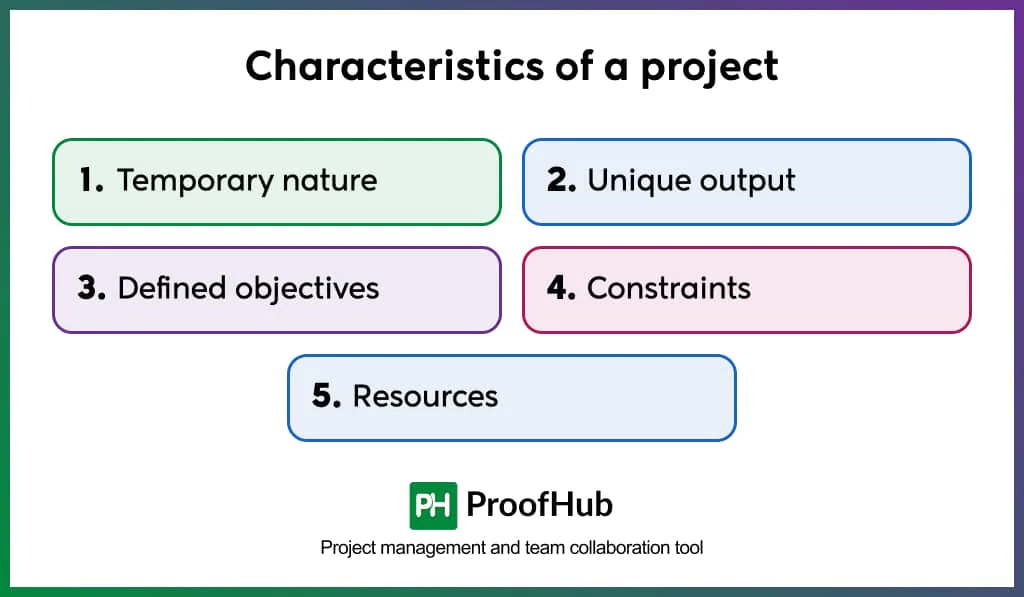
Key characteristics of a project are its temporary nature, unique output, defined objectives, constraints, and resources.
Every project, regardless of size, industry, or complexity, is defined by 5 characteristics.
1. Temporary nature
A project has a defined start date and a defined end date. Temporary does not mean short; it means the project has an endpoint.
According to PMBOK, “The temporary nature of projects indicates a definite beginning and end. The end is reached when the project’s objectives have been achieved or when the project is terminated because its objectives will not or cannot be met, or when the need for the project no longer exists.“
2. Unique output
Every project delivers a product, service, or result that has not been produced before. Even if a project is similar to the one previously developed, each project has unique work to be done, a budget, and a set of stakeholder requirements, making every project unique.
For example, a software company developing its 10th application still initiates a new project because the functional requirements, stakeholders, and constraints differ every time.
3. Defined objectives
Every project is initiated to achieve one specific objective. Without a defined objective, the project team has no completion criterion, and the project cannot be formally closed.
4. Constraints
A project operates within the boundaries of scope (extent of work), schedule, quality, budget, benefit, and risk. These constraints are interdependent; adjusting one directly impacts the others.
For example, when a stakeholder expands the project scope, the project manager evaluates the impact on the schedule and cost before approving it, because no constraint changes in isolation (discussed later).
5. Resources
Every project is executed with a defined set of resources allocated specifically for its duration. Resources include the people, budget, equipment, and materials assigned to deliver the project objectives.
For example, a construction project allocates engineers, site managers, machinery, and a sanctioned budget. Once the project reaches closure, all allocated resources are formally released.
Every project shares these 5 characteristics, but projects differ in their structure and execution. This is why projects are classified into distinct types.
What are the types of projects?
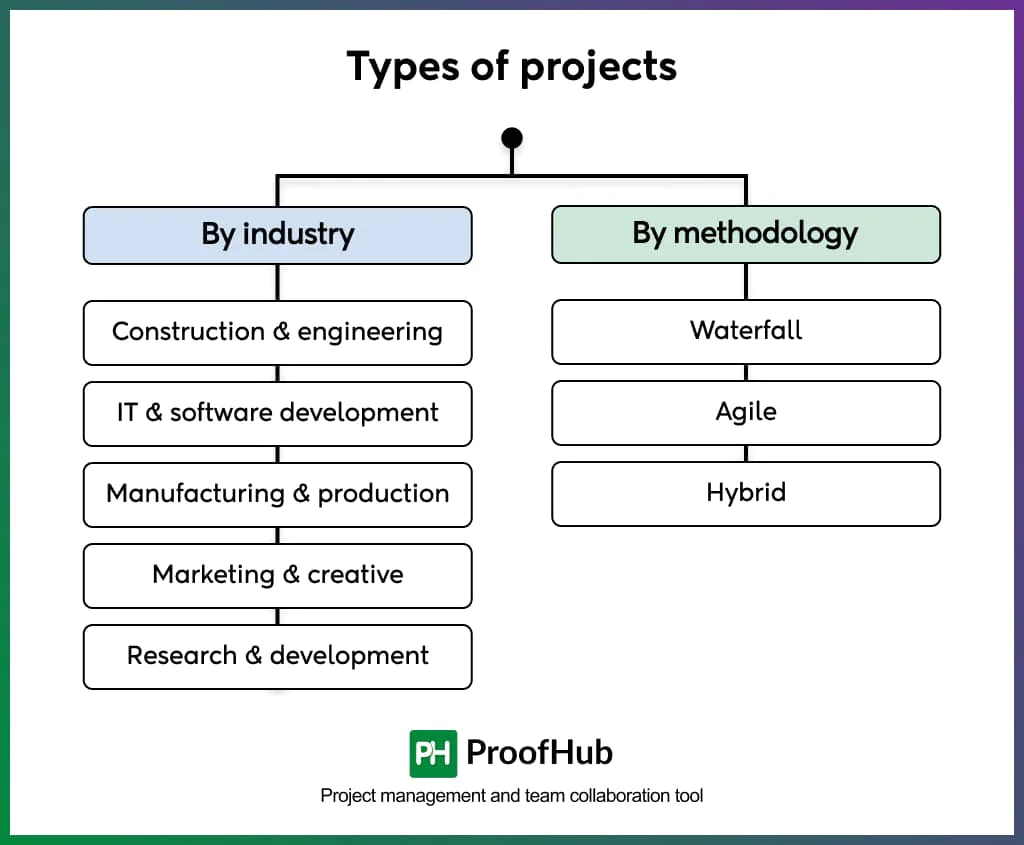
Projects are classified by 2 primary dimensions: industry and methodology. Industry determines the nature of the project, and methodology determines how it gets delivered. While broader classifications exist, these 2 categories are the most widely applied in project management practice.
By industry
The 5 industry-based project types are construction and engineering, IT and software development, manufacturing and production, marketing and creative, and research and development.
1. Construction & engineering– A construction project is any coordinated effort to build physical infrastructure. For example, building a road, a bridge, a building, or an industrial facility.
2. IT & software development– A software project is a time-bound effort to build, upgrade, or deploy a technical solution. For example, developing a mobile banking app, an e-commerce platform, or a customer-facing web application is an IT industry project.
3. Manufacturing & production– A manufacturing project targets a specific, measurable problem in the production process. For example, designing, prototyping, and launching a new product to market is a manufacturing industry project.
4. Marketing & creative– A marketing project produces a campaign, brand asset, or piece of content by a fixed deadline. For example, planning and delivering a product launch campaign across digital, print, and broadcast channels is a marketing project.
5. Research & development– An R&D project investigates whether something new is feasible or worth pursuing. For example, feasibility studies and making prototypes are projects in the research industry.
By methodology
The 3 methodology-based project types are Waterfall, Agile, and Hybrid.
1. Waterfall- Waterfall projects follow a linear, sequential delivery model where each phase is completed before the next begins. For example, constructing a highway or commercial building where the design is finalized, materials are procured, and a plan is created before the construction begins; step by step progression.
2. Agile- Agile projects are delivered in short, iterative cycles called sprints, where requirements are refined continuously based on feedback. For example, building a SaaS product where features are delivered in 2-week sprints based on a prioritized backlog.
3. Hybrid- Hybrid projects combine a linear delivery approach for fixed-requirement phases and an iterative approach for evolving-requirement phases within the same project. For example, developing a banking platform where regulatory architecture follows the Waterfall and customer-facing features are built in short, iterative cycles.
The following examples illustrate how these project types appear in practice across industries and methodologies.
What are some project examples?
Some common examples of projects according to their types are:
1. Construction & engineering
Highway expansion project: Building a highway to ease the traffic congestion.
2. IT & software development example
System upgrades: Migrating a legacy ERP to a cloud-based platform or upgrading a company-wide CRM.
3. Manufacturing & development examples
Process improvement: Reducing assembly line defects by redesigning inspection checkpoints.
4. Marketing and creative examples
Brand development: Creating a brand identity system including logo, visual guidelines, and messaging framework.
5. Waterfall projects example
Compliance & regulatory systems: Implementing a government compliance system with fixed regulatory requirements and a mandated delivery date.
6. Agile projects example
Digital marketing programs: Running a digital marketing program where assets are tested and optimized with every sprint.
7. Hybrid projects example
Product launch: Launching a product where the supply chain follows a fixed plan while the marketing campaign adapts iteratively.
Every project, regardless of type, follows the same structured sequence: the project lifecycle.
What is the typical lifecycle of a project?
The typical project lifecycle consists of 5 key phases- Initiation, Planning, Execution, Monitoring & Controlling, and Closure.
Every project, regardless of industry, follows this structure:
1. Initiation
The initiation phase formally authorizes the project to begin. In this phase, the project manager gathers project requirements from the project sponsors, assesses whether the project is worth pursuing, and defines the project’s purpose, objectives, and scope to formally authorize the project.
2. Planning
In this phase, the project manager creates a detailed plan for executing, monitoring, and closing the project. This plan entails defining the detailed scope of a project, creating a work breakdown structure (breaking a project into small parts with defined tasks and milestones), establishing a project budget, setting quality standards, identifying risks, and making a communication plan.
3. Execution
The actual work happens in this phase as the team executes the project work according to the project plan created. A project manager directs and manages the team by assigning tasks, coordinating resources, facilitating communication, and keeping the team aligned with project goals.
4. Monitoring & controlling
In this phase, the project manager tracks the project’s progress and compares actual performance with the original plan. This phase happens at the same time as the execution phase, not after it. The project manager monitors key performance indicators (KPIs) to see whether the project is staying on schedule, within budget, and within scope. If any issues or changes arise, they are reviewed and handled through a formal change control process to keep the project on track.
5. Closure
The project formally ends in this phase. The client accepts all deliverables, confirming the project has met its defined objectives. Project records are archived, and lessons learned are documented to inform future projects.
What are the main constraints of a project?
Project management was built on three core constraints: scope, time, and cost, widely known as “Triple Constraints.” However, over time, these constraints evolved into six, recognizing that delivery alone does not equal success and adding three more constraints: quality, risk, and benefits are equally critical to achieving project objectives.
1. Scope
Scope defines what the project will deliver and what it will not. Every project requirement falls within the scope boundary. Any addition to the scope without adjusting the schedule, budget, or resources puts the project at risk.
2. Quality
Quality defines the standard that the project deliverables must meet to satisfy stakeholder requirements. Delivering on time and within budget means nothing if the deliverable fails to meet the agreed quality standards.
3. Time
Time defines when the project starts, when it ends, and every milestone in between. Every activity and deliverable is mapped to a timeline and measured against the approved schedule baseline.
4. Cost
The budget defines the total amount authorized to spend for a project. PMBOK identifies this as the funding limit established by the project sponsor. Every resource allocation, activity, and procurement contract is executed within this approved cost baseline.
5. Benefits/Resources
Benefits represent the value the project is expected to deliver to the organization. Benefits are defined at the start of the project and tracked throughout the project lifecycle. This ensures that every decision made during execution on scope, resources, or schedule is evaluated against the value the project is meant to deliver.
However, some standards refer to “resources” as a constraint rather than “benefits,” because removing or reassigning a key team member or resource can derail a project even when cost and scope remain unchanged. Thus, resources (people, equipment, and materials) also become a constraint.
6. Risk
Risk is any uncertain event that can impact project objectives positively or negatively. Every identified risk is documented in the risk register (a project document that records each risk, its likelihood, its impact, and the planned response) and monitored throughout the project lifecycle.
Every project carries challenges that threaten its baseline. Identifying them before execution begins is the first step to managing them.
What are the common project challenges?
The 7 most common project challenges are poor communication, scope creep, resource constraints, risk management, stakeholder management, quality control, and change management.
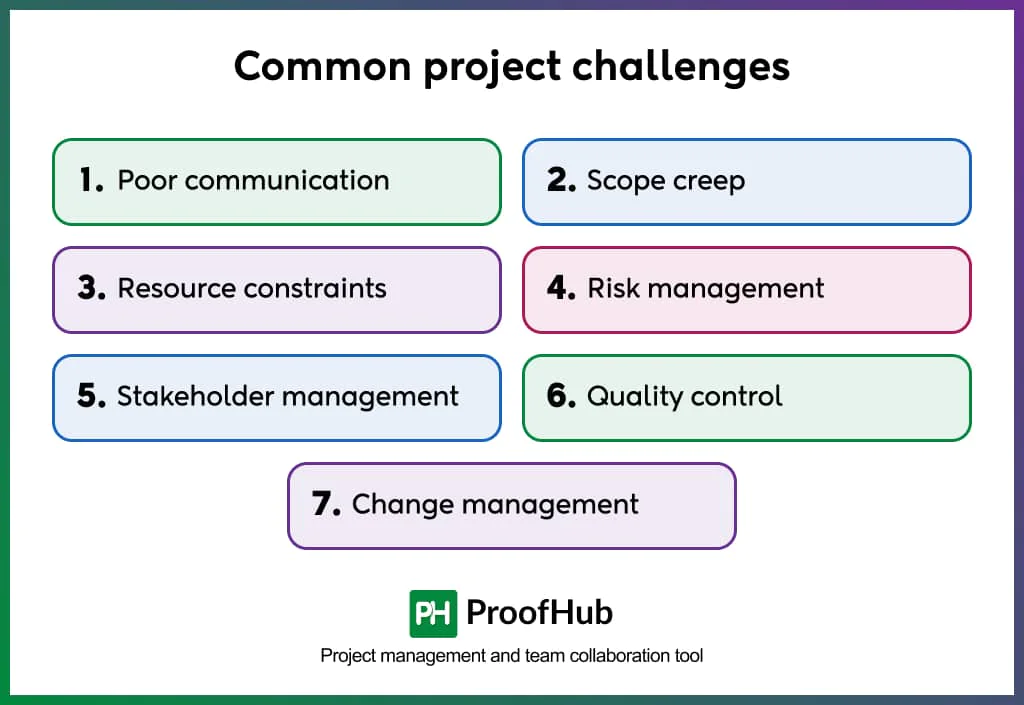
Every project faces these challenges; identifying them early determines whether the project delivers on time, within budget, and to the agreed standard.
1. Poor communication
Poor communication is the fastest way to misalign a team and miss deliverables. When the right information does not reach the right people at the right time, teams build to the wrong specification, and stakeholders make decisions on outdated assumptions.
2. Scope creep
Scope creep is one of the leading causes of project failure. Every uncontrolled addition to the scope consumes time and budget that was never planned for. By the time it is visible, the damage to the baseline is already done.
3. Resource constraints
A project cannot deliver what it does not have the resources to produce. When people, equipment, or materials fall short of what the plan requires, deliverables slip, quality drops, and the team absorbs pressure that compounds across every remaining phase.
4. Risk management
Every risk that is not identified and planned for will eventually surface as a problem. Risks do not disappear when they are ignored; instead, they escalate, and by the time they become visible, the window to respond without impacting the baseline is over.
5. Stakeholder management
Stakeholders who are not engaged during planning and execution make it difficult for a project to be completed on time. Late requirements, withheld approvals, and conflicting priorities from disengaged stakeholders are among the most disruptive forces a project can face mid-execution.
6. Quality control
A deliverable that reaches the customer without passing quality verification is not a completed deliverable; it is a rework. Late identification of defects significantly increases the cost of fixing them. Every phase through which a flawed deliverable advances without inspection multiplies the cost of correction.
7. Change management
An uncontrolled change does not just affect one part of the project; it disrupts all 6 constraints simultaneously. Scope expands, schedule shifts, budget absorbs the impact, resources are redirected, quality standards are compressed, and new risks are introduced, all because a change was allowed to move forward without formal review.
Why is defining a project important?
A clearly defined project aligns stakeholders and sets measurable objectives before execution begins. Without this clarity, resources are allocated without direction, and deliverables have no agreed standard to meet.
Projects that skip this step consistently result in cost overruns, schedule delays, and unmet stakeholder expectations. Every successful project traces its outcome back to how clearly it was scoped at initiation.
When does a project start?
A project starts when a Project Charter is created and formally approved. The Project Charter is a document that officially authorizes the project to begin. It outlines the project’s aims, who is responsible, and the resources needed. Once it is signed off by the relevant stakeholders, the project manager has the authority to assemble the team and begin project execution.
When does a project end?
A project ends when its objectives have been met and deliverables have been formally accepted. This means that once all the planned work is completed and the client or stakeholders confirm that the outcomes meet their expectations, the project is considered closed. The project manager completes project closure by transferring the final deliverables, releasing the team, and documenting lessons learned throughout the project.
How is a project different from daily operations?
A project is temporary and delivers a unique output, while daily operations are continuous and deliver repetitive outcomes. A project has a defined start, a defined end, and a specific objective to meet. Operations run indefinitely to sustain business continuity.
For example, building a new payroll system is a project. Processing payroll every month is an operation. Once the project delivers its output, it closes. Operations never end; they are inherently repetitive.
What is the difference between a project and a task?
A project is a collection of tasks organized to deliver a unique output within a defined timeline and budget, while a task is a single unit of work that contributes to that output.
A project has a defined objective, assigned resources, and a structured plan to reach completion. A task has none of these; it is one step within that plan, assigned to one resource, with a defined start and end.
For example, launching a website is a project. Writing the homepage copy is one task within that project. The task contributes to the project, but it cannot deliver the final output on its own.
Can an organization’s internal initiatives be classified as projects?
Yes, an internal initiative qualifies as a project when it has a defined objective, a fixed timeline, an allocated budget, and assigned resources. Not every internal initiative meets this criterion, and those that do not are operations, not projects.
For example, rebuilding the organization’s internal website is a project. It has a defined scope, a delivery deadline, an approved budget, and resources assigned specifically for its duration. Updating website content every week is a process.
Does every project follow the same lifecycle?
Yes, every project follows the same 5 phases: initiating, planning, executing, monitoring and controlling, and closing, but the time, effort, and resources spent in each phase vary by project.
For example, a construction project spends the majority of its lifecycle in planning because structural decisions cannot be reversed during execution. A software project cycles through executing and monitoring repeatedly as requirements evolve. The lifecycle is consistent; how each phase is applied depends on the nature of the project.