
A project manager is the individual responsible for planning, executing, and managing a project. Every organization assigns a project manager to manage a project.
A project manager creates a project plan, guides the project team in executing the work, and communicates project progress to stakeholders and clients.
To be effective in the role of a project manager, a project manager needs sound knowledge of project management, leadership skills to guide the team, and strong business acumen and communication skills to understand stakeholders’ needs and communicate project progress effectively.
In this post, we will understand the roles and responsibilities of a project manager throughout the project lifecycle.
- 1.A project manager is an individual responsible for planning, executing, and managing a project, leading the team, and communicating with stakeholders.
- 2.The key roles of a project manager include planning, leading, and communicating.
- 3.The key responsibilities of a project manager include defining the project scope, developing the project management plan, managing the project team, reporting progress to stakeholders, and controlling the project to keep it on track.
- 4.Common challenges for a project manager include scope creep, stakeholder misalignment, resource constraints, unrealistic deadlines, and poor communication.
- 5.The must-have skills of a project manager include a mix of hard skills and soft skills: project planning, budget management, knowledge of project management methodologies, communication, leadership, and adaptability.
Who is a project manager?
A project manager is an individual responsible for planning, executing, and managing a project. Organizations assign a project manager to formally manage the project. The aim of the project manager is to ensure a project achieves its objectives: complete on time, within budget, to the required quality standards, and within the agreed scope.
The primary responsibilities of a project manager include managing the technical aspects of a project, such as creating a project plan, guiding the project team, assigning tasks, and communicating progress to stakeholders.
A project manager can play various roles depending on an organization’s needs and structure.
What are the key roles of a project manager?
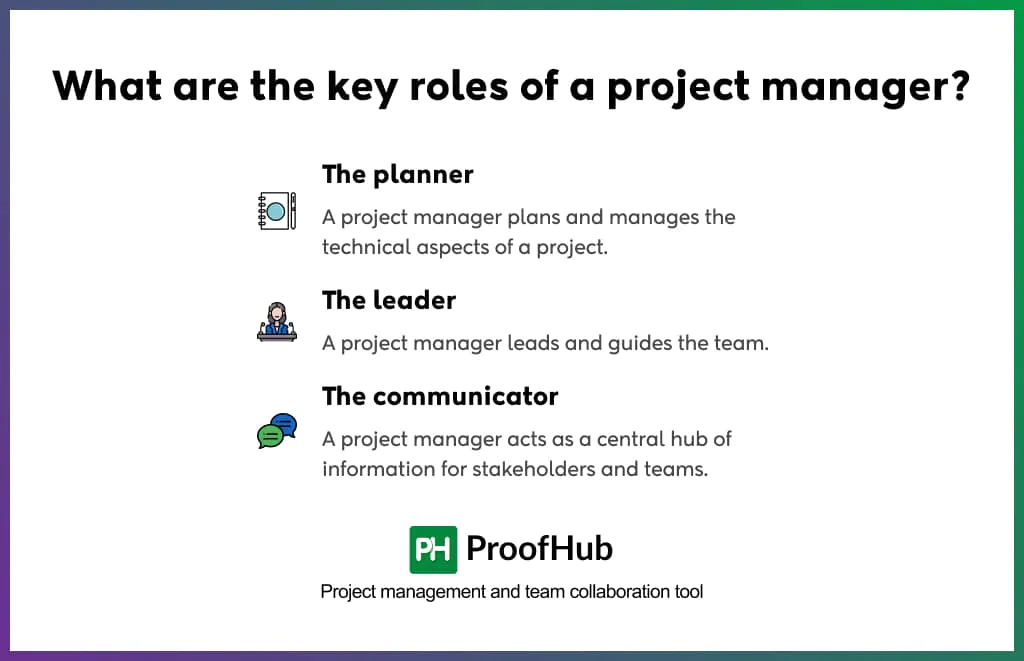
The key roles of a project manager include planning, leading, and communicating.
1. The planner
A project manager plans and manages the technical aspects of a project.
For example, defining the scope of a project, breaking down project objectives into tasks, milestones, and deliverables, creating a project management plan, planning risks, and taking corrective actions to complete a project within budget and time.
2. The leader
A project manager leads and guides the team. For example, communicating with the team to keep everyone aligned toward the common goals, resolving conflicts to avoid friction, and motivating the team to perform to the best of their capabilities.
3. The communicator
A project manager translates stakeholders’ business needs into actionable work and communicates project progress to the stakeholders, acting as a bridge between stakeholders and the team.
Thus, a project manager is ultimately responsible for the project’s success.
What are the responsibilities of a project manager?
The key responsibilities of a project manager include defining the project scope, developing the project management plan, managing the project team, reporting progress to stakeholders, managing and controlling the project to keep it on track, and obtaining formal sign-offs.
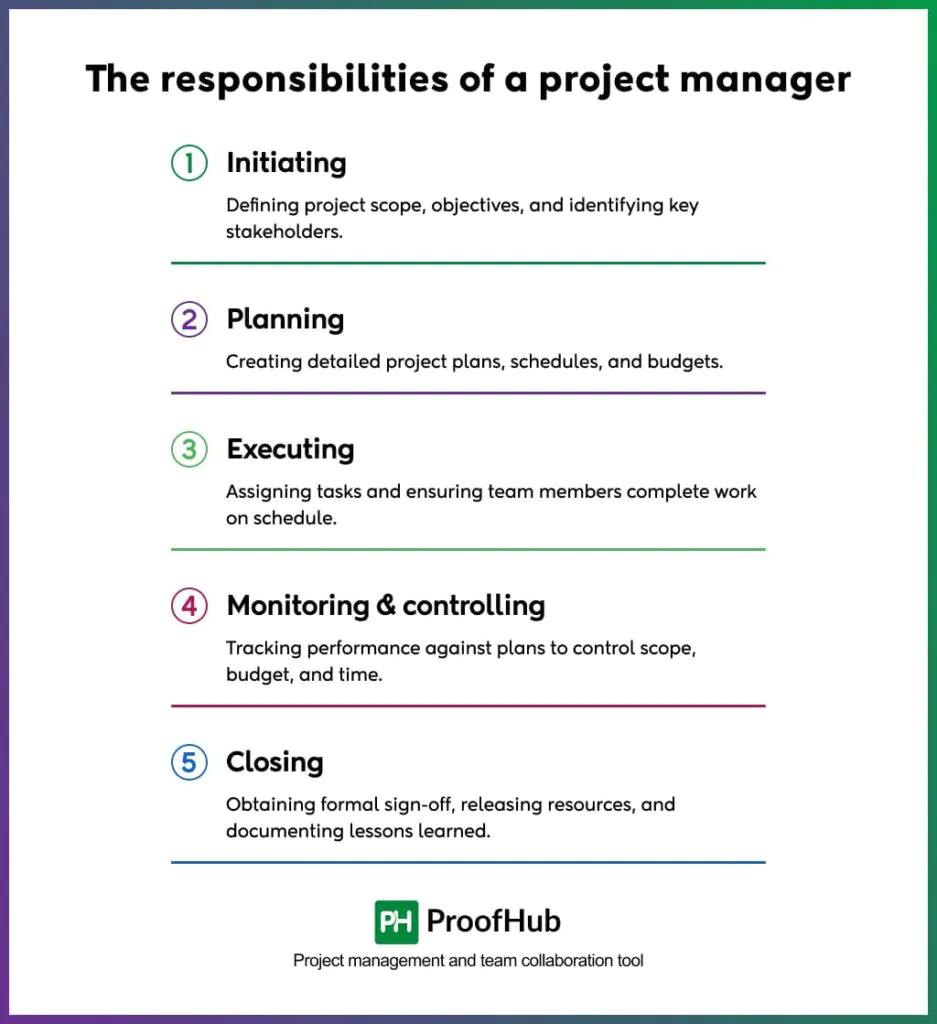
A project manager performs various duties throughout the project lifecycle, from initiation to closure.
- Initiating: Defining project scope, creating a project charter, and identifying key stakeholders.
- Planning: Creating detailed project plans, schedules, and budgets.
- Executing: Assigning tasks and ensuring team members complete work on schedule.
- Monitoring & controlling: Tracking performance against plans to control scope, budget, and time.
- Closing: Obtaining formal sign-off, releasing resources, and documenting lessons learned.
1. Collecting project requirements
A project manager meets with stakeholders to understand their needs and expectations. A project manager uses various data gathering techniques, such as surveys, interviews, and discussions, to collect requirements from stakeholders and document those requirements into a “project requirements document”.
2. Feasibility analysis
A project manager performs the feasibility analysis to find out whether a project is worth pursuing or not technically, economically, and operationally.
A project manager may consult subject matter experts when the required expertise is absent. A manager presents an honest feasibility assessment to leadership, recommending whether to proceed, modify, or abandon the project. If approved, they document that approval in writing.
3. Create a project charter
A project manager creates a project charter, which includes writing down the project’s purpose, objectives, goals, high-level deliverables, and success criteria, a summary of the budget and timeline, names the key stakeholders, and the PM’s own authority level. A project manager presents this document to the project sponsor for review, incorporates any feedback, and gets it signed off to officially authorize the project.
4. Identify the stakeholders
A project manager creates a list of stakeholders to identify and manage their expectations throughout the project.
A project manager identifies who is impacted by the project and documents relevant information about their interests, involvement, and impact on project success, including mapping each person’s role, level of interest, level of power over the project, and communication preferences.
5. Define the project scope
A project manager defines and documents what is included and what is not included in the project. The manager facilitates workshops with stakeholders and the team to clarify questions and resolve disagreements about what’s in and out of the project scope.
The final scope is written into a scope statement, which defines what is included and what is excluded in a project (product scope description), product acceptance criteria, project deliverables, project exclusions, project constraints, and project assumptions.
6. Create a Work Breakdown Structure (WBS)
A project manager works with the team to create a work breakdown structure. The work breakdown structure (WBS) breaks the project’s total work into smaller, manageable parts.
Each deliverable is broken down to a level where the work can be realistically and reliably scheduled, estimated, and assigned to a team member.
7. Develop project baseline
A project manager takes the project scope statement and work breakdown structure to create the project scope baseline.
The governing principle of the WBS is the 100% Rule: the WBS must capture 100% of the work the project requires; nothing more and nothing less. The approved WBS creates a scope baseline.
A project manager takes every task from the WBS and arranges them in sequence, defines the task dependencies, and estimates how long each task will take.
The manager builds this into a visual schedule, typically using a Gantt chart, which creates a project schedule. After getting it approved by stakeholders, it creates a schedule baseline.
Similarly, a project manager works with the project team to estimate hours and resources (material, human, and technological) required for each task, cost out every item, and add a contingency buffer for unexpected costs to create a project budget. The approved project budget creates the cost baseline.
8. Develop a project management plan
A project manager assigns a task owner to each task in the WBS based on skills, availability, and capacity of the individuals (building a RACI matrix), identifies and logs risks (creating a risk register), defines the project management methodologies to be used, creates the subsidiary management plans (such as communication, quality, and stakeholder), and document the tools, processes, and guidelines to be used to create a project management plan.
9. Kick off the project with a formal kickoff meeting
A project manager runs the kickoff meeting to align the project team, sponsors, and key stakeholders on project goals, scope, and plan before execution begins. It serves as the official launch of a project.
In this meeting, a project manager creates space for questions to resolve any confusion and sends out the meeting notes and the final project plan to create a shared understanding.
10. Delegate tasks and coordinate activities
A project manager assigns tasks to team members in the project management tool, sets deadlines, provides the information required to complete each task, and checks with each team member to ensure they have everything they need to start.
In the event of any gaps, a project manager immediately addresses the issue, ensuring no team member is blocked from starting a task.
11. Track progress against the plan and hold regular status meetings
A project manager regularly compares planned to actual progress and holds status meetings to track and discuss task progress.
It helps identify tasks that are running late and surfaces the issues the team is facing. Based on the identified gaps, a project manager takes corrective action to keep tasks on schedule and support the team.
12. Communicate updates to stakeholders
A project manager prepares and sends regular status reports to stakeholders to summarize progress made, milestones achieved, upcoming work, budget status, and any risks or issues.
A manager communicates proactively to raise the issue before the stakeholder asks, along with a proposed solution. This proactive transparency is what builds long-term stakeholder trust.
13. Ensure quality standards
A project manager sets up quality checkpoints throughout execution.
They review deliverables themselves or assign a quality reviewer, check them against the agreed acceptance criteria, and send back anything that doesn’t meet the standard with specific feedback.
14. Track KPIs
A project manager regularly pulls data from the project management tool to calculate key metrics, such as schedule variance, budget variance, and quality metrics, to determine whether we are ahead or behind schedule, whether we are over or under budget, and how many rework issues have been logged.
They analyze trends and use these metrics to have evidence-based conversations with the team and stakeholders.
16. Manage risks and resolve issues
A project manager activates the response plan when a risk actually occurs. They coordinate the team’s response, communicate the impact to stakeholders, and update the risk register.
For unanticipated risks, a project manager assesses the situation quickly, decides on a response, and adds it to the risk register for ongoing monitoring.
17. Manage change requests
When someone requests a change, a project manager first documents the request formally and then assesses the impact.
For example, how many additional hours does this add up to? How does it affect the timeline, and does it change the budget? They present this impact analysis to the relevant decision-maker and get a formal approval or rejection rather than just absorbing the change informally.
If approved, they update the scope, schedule, and budget accordingly and communicate the change to the team.
18. Maintaining performance reports
A project manager maintains project and team performance reports to show the project’s current health across schedule, budget, risks, and milestones.
They share these reports in stakeholder meetings as the basis for discussion. When something is at risk, a project manager comes prepared with an explanation of why and what action they are taking.
19. Update the project plan as needed
A project manager updates the schedule, budget, and risk register when approved changes, new risks, or actual progress deviates from the original plan to reflect the current reality.
They communicate the updated plan to the team so everyone is working from accurate and current information, and update the baseline if a significant approved change warrants it.
20. Manage the change control process
A project manager logs every change request, whether from a stakeholder, a team member, or a vendor. The manager evaluates each one for its impact on scope, schedule, budget, and risk, then routes it through the appropriate approval authority.
They maintain a running record of every change that was requested, approved, rejected, and implemented. This log allows the project manager to explain, with evidence, why the project evolved from its original baseline.
21. Confirm all deliverables have been completed and accepted
A project creates a deliverable checklist and goes through it item by item to confirm each deliverable has been completed and formally reviewed by the relevant stakeholder.
For each one, they get written confirmation of acceptance. They do not consider the project done until every deliverable on the list is ticked off and accepted.
22. Get formal sign-off and approval
A project manager prepares a project completion document that summarizes what was delivered, when, and how it aligns with the original objectives.
They present this to the project sponsor and formally request sign-off. Once signed, this document closes the project manager’s formal accountability for the project. A project manager files it in the project archive and notifies all stakeholders that the project is officially closed.
This moment permanently transfers ownership of the deliverables to the client or business. A project manager formally communicates to each team member that their project responsibilities are complete and coordinates with their line managers to reallocate them.
23. Document lessons learned
A project manager facilitates a retrospective session with the team, asking structured questions: What went well and should be repeated? What went wrong and why? What would we do differently? They capture every insight, organize them by theme, and write them into a lessons learned document.
They then submit this document to the organization’s project knowledge base so future project managers can access and benefit from the team’s real experience.
A project manager collects every project document — the charter, plans, schedules, budgets, change logs, status reports, contracts, meeting notes, and lessons learned — organizes them into a logical folder structure, and stores them in the organization’s central repository.
What are the must-have skills for a project manager?
The must-have skills of a project manager include a mix of hard skills and soft skills: project planning, budget management, knowledge of project management methodologies, communication, leadership, and adaptability.
Hard skills
- Project planning: Ability to break down work, build timelines, and create realistic plans
- Budget management: Tracking costs, forecasting spend, and identifying variances
- Risk management: Identifying, assessing, and mitigating risks proactively
- Project management tools: Proficiency with tools like ProofHub, Asana, Jira, Trello, or monday.com
- Project management methodologies: Understanding of different project management methodologies, such as Waterfall, Agile, and Scrum.
Soft skills
- Communication: Communicate clearly, concisely, and appropriately to different audiences.
- Leadership: Inspiring a team to do their best work, even under pressure, even without direct authority over them.
- Emotional intelligence: Understanding your own emotions and those of others.
- Problem-solving: Ability to think clearly, analyze options, and make decisions often under time pressure.
- Adaptability: Ability to pivot, recalibrate, and keep moving when things do not go exactly as planned.
- Time management: The ability to manage time and prioritize what needs attention right now vs. what can wait is a daily exercise.
- Conflict resolution: Addressing disagreements directly, fairly, and constructively before they damage the team or the project.
What are the day-to-day tasks of a project manager?
Day-to-day tasks of a project manager include:
- Reviewing emails and flagging urgent issues
- Run a 15-minute daily standup with the team
- Review the project dashboard for schedule or budget variances
- Have a one-on-one with a struggling team member
- Jump on a call with a stakeholder to give a status update
- Review and approve a change request from the client
- Update the project plan based on yesterday’s progress
- Resolve a conflict between two team members about task ownership
- Prepare a weekly report for leadership
- Review a deliverable for quality before it goes to the client
However, no two days look exactly the same. That’s part of what makes a project manager role both demanding and exciting.
What are the common challenges faced by a project manager?
Common challenges faced by a project manager include scope creep, stakeholder misalignment, resource constraints, unrealistic deadlines, and poor communication.
- Scope creep: Stakeholders keep adding new requirements after the project has started, without adjusting the timeline or budget. It’s the single most common reason projects fail.
- Stakeholder misalignment: Different stakeholders have different needs. Sometimes, opposing goals, priorities, and expectations.
- Resource constraints: Not having enough people, time, money, or tools to do the work properly.
- Unrealistic deadlines: Leadership or clients set deadlines based on business needs rather than what is actually achievable.
- Poor communication: Information doesn’t flow properly, leading to team members working on the wrong things, stakeholders being surprised by bad news, or decisions not being documented.
How to become a project manager?
To become a project manager, start by building foundational knowledge through online courses on platforms like Coursera, LinkedIn Learning, or PMI’s own resources.
Study core concepts such as project lifecycle, scheduling, budgeting, and risk management. Gain practical experience by volunteering to lead small projects at your current job, even informal ones count. Build familiarity with project management tools like ProofHub, Asana, or Jira.
Then pursue certifications: start with CAPM (entry-level) if you’re new, or PMP (Project Management Professional) once you have experience.
What is the difference between a project manager and a program manager?
A project manager manages a single project with a clear start and end date focused on delivering specific outputs on time and within budget, whereas a program manager oversees a collection of related projects that together contribute to a larger strategic business goal.
A project manager executes daily project tasks, while the program manager ensures that all projects within the program are aligned, interdependencies are managed, and the overall business outcome is achieved.
What is the difference between a project manager and a Scrum Master?
A project manager has end-to-end responsibility of managing scope, budget, timeline, stakeholders, and risk, whereas a Scrum Master is a specialized role within Agile/Scrum teams that facilitates processes such as running sprint ceremonies (standups, sprint planning, retrospectives), removing team blockers, and coaching the team on Agile principles.
How much can a project manager earn?
Earnings for project managers vary significantly by country, industry, experience, and certification. In the United States, entry-level PMs earn around $65,000–$80,000 per year, mid-level PMs earn $90,000–$120,000, and senior PMs or program managers can earn $130,000–$180,000+. PMP-certified professionals consistently earn 20–25% more than non-certified peers.