
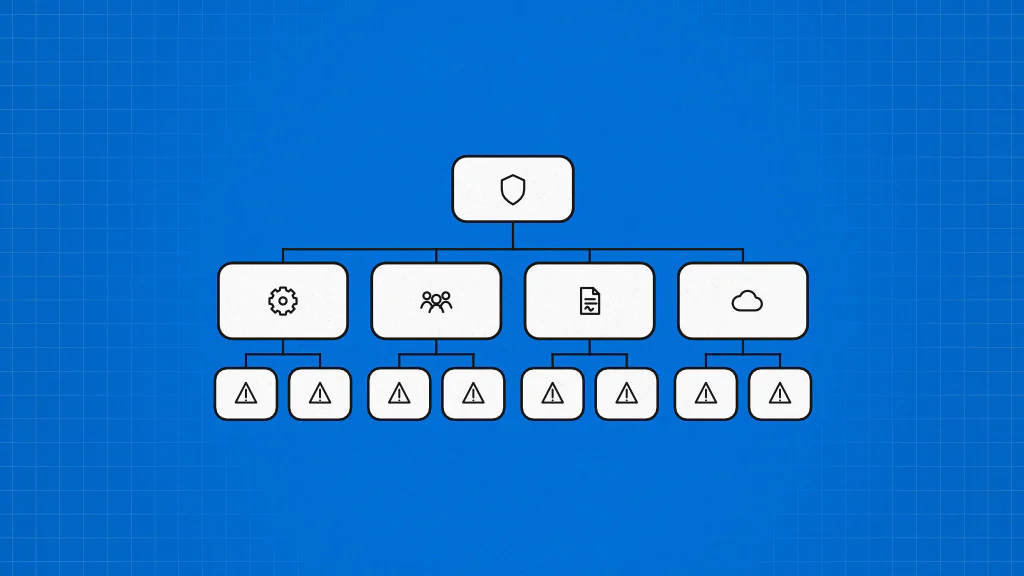
A risk breakdown structure organizes project risks into a clear hierarchy, moving from broad categories like technical, external, organizational, and management risks down to specific, actionable items.
It works the same way a work breakdown structure does, except it maps out potential problems instead of tasks. Building one gives project managers a structured way to spot risk concentrations, communicate exposure to stakeholders, and feed a live risk register.
This guide covers what an RBS is, why it matters, how to build one, and where its limitations lie.
- 1.A risk breakdown structure groups project risks into a hierarchy, starting with broad categories and narrowing down to specific, trackable risks at the lowest level.
- 2.PMBOK defines four common top-level categories: technical, management, commercial, and external risk, each with its own set of subcategories.
- 3.Building an RBS involves defining project scope first, then identifying categories, mapping specific risks, and validating the structure with stakeholders before it goes live.
- 4.An RBS works best when integrated with a risk register, since the structure alone doesn’t track probability, impact, or ownership.
- 5.Despite its usefulness, an RBS has real limitations, including oversimplified categorization, missed unknown risks, and the need for regular updates as the project evolves.
What is a risk breakdown structure (RBS)?
A Risk Breakdown Structure (RBS) is a hierarchical, tree-like decomposition of project risks organized by category and subcategory, rather than by source or activity alone.
It groups potential risks into a structured taxonomy, helping teams identify, categorize, and analyze risk exposure systematically. The RBS mirrors the Work Breakdown Structure’s logic, enabling clearer risk identification, assessment, and response planning across a project.
Why is a risk breakdown structure important for a project?
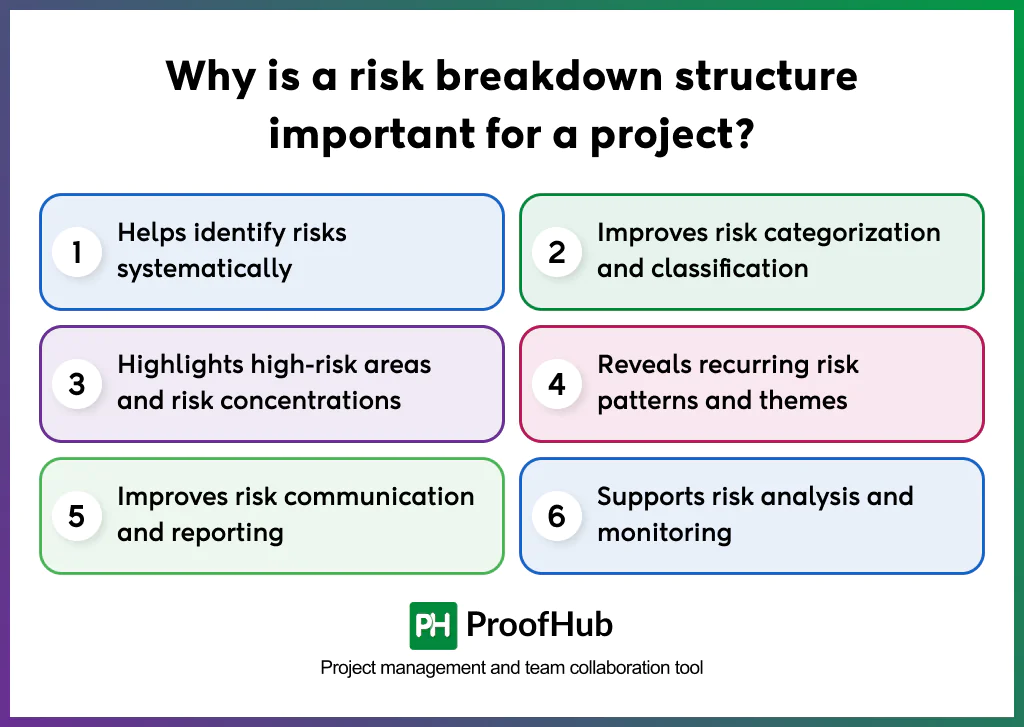
A risk breakdown structure is important for a project because it helps identify risks systematically, improve risk categorization and classification, highlight high risk areas and risk concentration, reveals recurring risk patterns and themes, improves risk communication and reporting, and supports risk analysis and monitoring.
RBS turns risk management from a guessing game into a structured process, making it easier to plan for problems before they actually happen.
- Helps identify risks systematically: Instead of randomly listing risks as they come to mind, the RBS breaks them down category by category, so nothing important gets missed. This structured approach ensures teams cover technical, external, organizational, and management-related risks in one go.
- Improves risk categorization and classification: Every risk is placed under a relevant category and subcategory, making it easy to understand where it belongs. This classification helps teams quickly locate related risks and avoid duplicate or overlapping risk entries.
- Highlights high-risk areas and risk concentrations: When risks are grouped visually, it becomes obvious which categories carry the most risks. This helps project managers focus their attention and resources on the areas that need the most protection.
- Reveals recurring risk patterns and themes: By organizing risks hierarchically, teams can spot repeating issues across different categories or past projects. Recognizing these patterns early allows teams to build better preventive strategies instead of solving the same problem again and again.
- Improves risk communication and reporting: A well-structured RBS makes it simple to explain risks to stakeholders, since everything is presented in a clean, logical format. This reduces confusion and helps decision-makers quickly grasp where the project stands in terms of risk exposure.
- Supports risk analysis and monitoring: Because risks are already sorted and categorized, it becomes easier to track them over time and measure how they evolve. This ongoing monitoring helps teams respond faster when a risk starts to escalate.
How does a risk breakdown structure work?
A risk breakdown structure organizes project risks into a hierarchy, moving from broad categories at the top down to specific, detailed risks at the bottom. At the highest level, risks are grouped into major categories, such as technical risks, external risks, organizational risks, and project management risks.
Each of these top-level categories is broken down into subcategories that narrow the focus. They are then divided into specific risk items that the team can identify, assess, and act on.
The structure works like a family tree for risks. Broad categories act as parent nodes. More specific risks sit underneath as child nodes, all linked to their main category.
As you move down each branch, risks become more concrete and easier to evaluate. At the same time, they stay connected to the larger category they came from.
The approach lets teams work at the level they need. Leadership can review category-level risks for a quick overview. Project managers and risk owners can focus on detailed risks to plan responses. Because everything sits in one structure, teams can zoom in or out without losing context.
What are the common categories of risk breakdown structure?
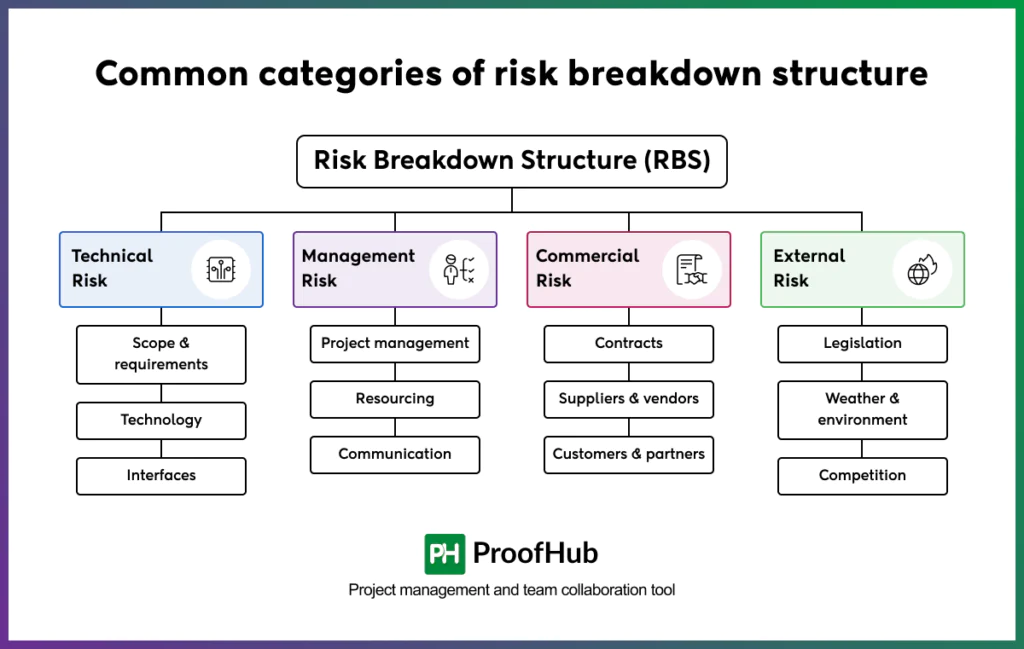
The risk breakdown structure is organized into four common top-level categories, according to PMBOK: Technical Risk, Management Risk, Commercial Risk, and External Risk.
Each category is further divided into specific subcategories that help teams pinpoint exactly where a risk originates.
Here’s what each one covers:
- Technical risk: Covers risks tied to defining and delivering the actual solution, including scope definition, requirements definition, estimates, assumptions, and constraints, technical processes, technology choices, and technical interfaces. Unclear or shifting technical foundations can derail the entire project’s deliverables, no matter how well it’s managed otherwise, which makes this category critical to monitor early.
- Management risk: Deals with how the project and organization are run day-to-day, including project management, program/portfolio management, operations management, organization, resourcing, and communication. Even a technically sound project can fail if it’s poorly planned, under-resourced, or communicated badly across teams, so these risks often decide whether execution stays on track.
- Commercial risk: Focuses on the business and contractual side of the project, including contractual terms and conditions, internal procurement, suppliers and vendors, subcontracts, client/customer stability, and partnerships and joint ventures. Financial and legal missteps here can directly impact budgets, timelines, and relationships with external parties, making close coordination with legal and finance teams essential.
- External risk: Captures risks that originate outside the project and organization’s direct control, including legislation, exchange rates, site/facilities, environmental/weather conditions, competition, and regulatory factors. Prevention isn’t usually possible for these risks, so the focus tends to shift toward monitoring conditions closely and building contingency plans to absorb their impact.
How to create a risk breakdown structure for a project?
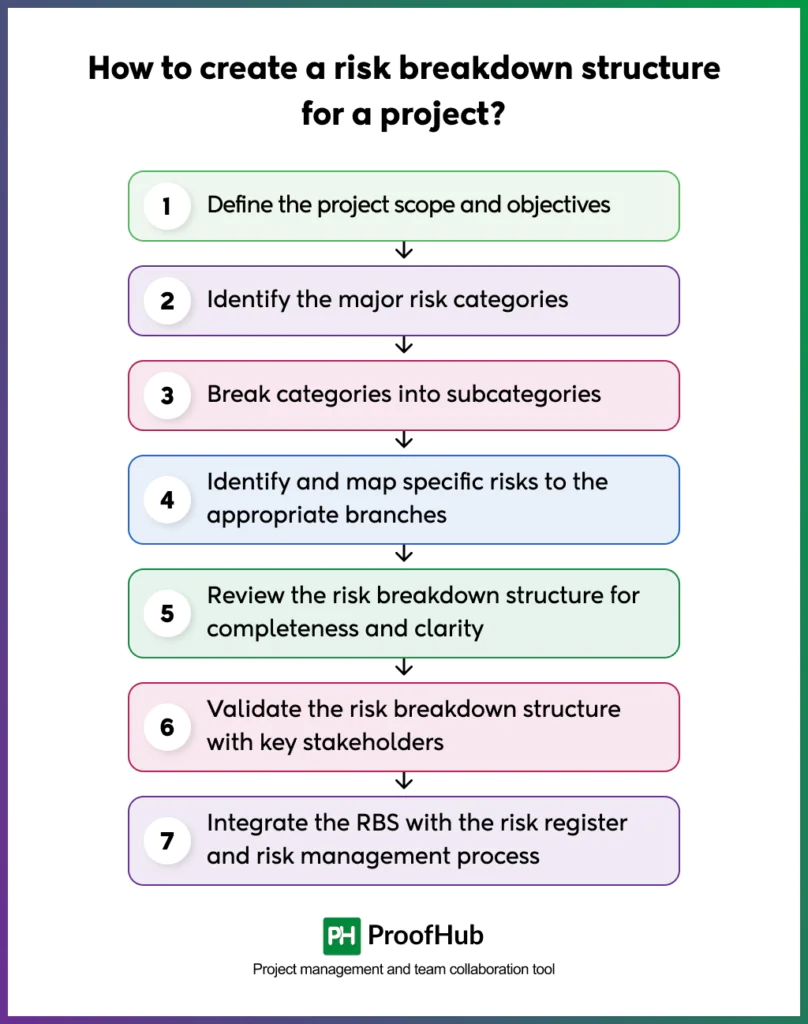
To create a risk breakdown structure for a project you need to define the project scope and objectives, identify the major risk categories, break categories into subcategories, identify and map specific risks to the appropriate branches, review the risk breakdown structure for completeness and clarity, validate the risk breakdown structure with key stakeholders, integrate the RBS with the risk register and risk management process.
Here’s how to build one, step by step.
1. Define the project scope and objectives
Start by getting clear on what the project actually involves before you think about risks. Pin down the deliverables, timeline, budget, and the outcomes stakeholders expect.
This groundwork matters because risks don’t exist in a vacuum. A risk only makes sense in relation to what you’re trying to achieve. If the scope is fuzzy, you’ll end up with a risk structure that misses important threats or wastes time on ones that don’t apply.
Review the project charter, talk to key stakeholders, and confirm boundaries and assumptions. This gives you the foundation to identify risks that are actually relevant to your specific project.
2. Identify the major risk categories
Once scope is locked in, group potential risks into broad categories. Common ones include technical risks, external risks, organizational risks, and project management risks.
Some teams also add categories like financial, legal, or environmental risks depending on the industry. These top-level buckets sit at the first level of your RBS and give the whole structure its shape.
Pull from historical project data, lessons learned documents, and industry-standard risk taxonomies to make sure you’re not missing an obvious category. Getting this level right matters because every risk you identify later needs to fit somewhere here.
3. Break categories into subcategories
Broad categories are useful, but they’re too general to act on directly. The next step is splitting each one into more specific subcategories.
Technical risks might break down into design risks, technology risks, and complexity risks. External risks might split into vendor risks, regulatory risks, and market risks. This layer adds detail without overwhelming you with individual risks just yet.
Subcategories make the structure easier to navigate and help ensure thorough coverage, since brainstorming within a narrow subcategory tends to surface risks that a broad category alone would overlook.
4. Identify and map specific risks to the appropriate branches
Now comes the actual risk identification work. Run brainstorming sessions, checklists, expert interviews, and reviews of past project data to surface concrete risks, then slot each one under the right subcategory.
For example, “key supplier delivery delay” would fall under vendor risks within external risks. This mapping step turns your RBS from a generic template into something specific to your project.
Keep descriptions clear and specific rather than vague, since a well-defined risk is easier to assess and manage later. Aim for a reasonably exhaustive list at this stage rather than a partial one.
5. Review the risk breakdown structure for completeness and clarity
Once every branch has risks mapped to it, step back and review the whole structure critically. Check for gaps where a category has few or no risks listed, which often signals an area the team hasn’t thought through carefully.
Look for duplicate risks that appear in more than one branch, and reword anything that’s ambiguous or overlaps with another risk. Clarity matters here because a confusing RBS defeats its own purpose.
This review works best as a structured walkthrough rather than a quick skim, ideally done by someone other than the person who built the first draft.
6. Validate the risk breakdown structure with key stakeholders
A risk breakdown structure built in isolation misses blind spots, so bring it to project sponsors, subject matter experts, and other stakeholders for feedback.
They often catch risks that weren’t obvious to the person who built the structure, especially ones tied to their specific area of expertise.
This step also builds buy-in, since stakeholders who helped shape the RBS are more likely to take it seriously during execution. Walk through each category and ask directly whether anything is missing or misclassified.
Treat this as a working session rather than a formality, and update the structure based on what comes up.
7. Integrate the RBS with the risk register and risk management process
The RBS isn’t meant to sit on its own. Link each risk in the structure to an entry in your risk register, where you’ll track probability, impact, ownership, and response plans.
This connection makes the RBS a living reference point instead of a static diagram. It also feeds directly into risk monitoring, since project teams can revisit the RBS during status reviews to check whether new risks have emerged in categories that previously looked low-risk.
Over time, this integration turns the RBS into a practical tool that shapes how risk gets managed, not just how it gets documented.
What are the challenges and limitations of a risk breakdown structure?
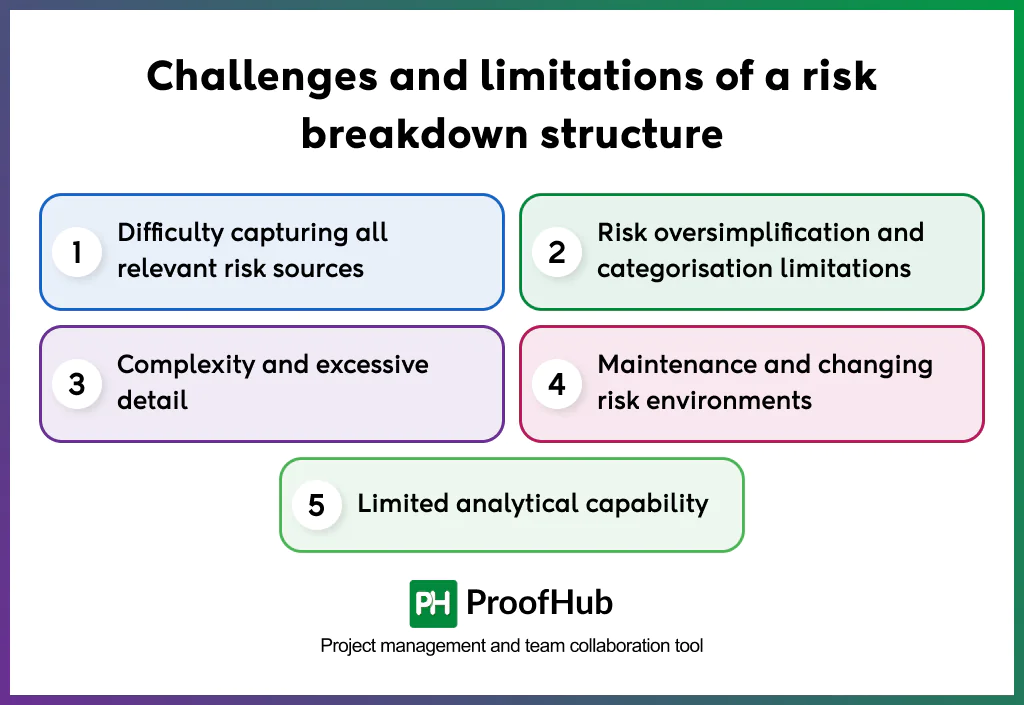
The challenges and limitations of a risk breakdown structure are difficulty capturing all relevant risk sources, risk oversimplification and categorisation limitations, complexity and excessive detail, maintenance and changing risk environments, and limited analytical capabilities.
These issues don’t make the RBS useless, but they do mean it works best as one tool among several, not a standalone solution for managing project risk.
- Difficulty capturing all relevant risk sources: Even a well-built RBS relies on the knowledge and foresight of the people creating it. Unknown or unprecedented risks, especially in new or fast-changing industries, often slip through because nobody thought to include them.
- Risk oversimplification and categorisation limitations: Many risks don’t fit neatly into a single category or branch. A supplier risk might also carry financial and legal dimensions, but the RBS forces it into one box, which can hide its full impact.
- Complexity and excessive detail: Breaking risks into too many categories and subcategories can make the structure hard to use in practice. Teams end up spending more time maintaining the framework than actually managing risk.
- Maintenance and changing risk environments: Projects evolve, and so do their risks. An RBS built at the start of a project can go stale quickly if nobody updates it as new risks emerge or old ones become irrelevant.
- Limited analytical capability: The RBS shows what risks exist and where they sit, but it doesn’t quantify probability, impact, or urgency. Teams still need tools like risk registers or Monte Carlo analysis to actually prioritize and respond to risks.
Example risk breakdown structures
Since every project, sector, and industry has a unique set of challenges and potential risks, we recommend tailoring your RBS to your organization’s specific needs. You can use these sample RBS templates to start your own RBS chart.
Ready to turn your risk plan into action?
Not sure where to start? Use our sample RBS charts, one for a generic project and one built for software teams, as a starting point, then customize the categories to match your own project's risks.
Explore ExamplesWho is responsible for creating the risk breakdown structure?
The project manager typically leads the creation of the risk breakdown structure, often working closely with the project team, risk management specialists, and key stakeholders.
Subject matter experts are usually consulted for their respective categories, since technical leads understand technical risks best, while procurement or contracts teams offer insight into commercial risks. Ultimately, ownership stays with the project manager, but building an accurate RBS requires collaborative input from across the project.
How many levels should a risk breakdown structure include?
Most risk breakdown structures include three to four levels of hierarchy, starting with broad top-level categories and narrowing down to specific, actionable risks.
Level 1 usually represents major categories (like Technical or Commercial Risk), Level 2 breaks these into subcategories, and Level 3 or 4 lists individual, specific risks.
The right number of levels depends on project complexity: smaller projects may only need two or three levels, while large, complex projects may require additional depth for clarity.
How often should a risk breakdown structure be reviewed and updated?
A risk breakdown structure should be reviewed at key project milestones, during regular risk review meetings, and whenever significant changes occur, such as scope changes, new stakeholders, or shifts in the external environment.
Many teams review it monthly or bi-weekly for active projects, though high-risk or fast-moving projects may need weekly check-ins. Regular updates ensure the RBS stays relevant and continues reflecting the project’s actual risk landscape rather than becoming an outdated, one-time document.