
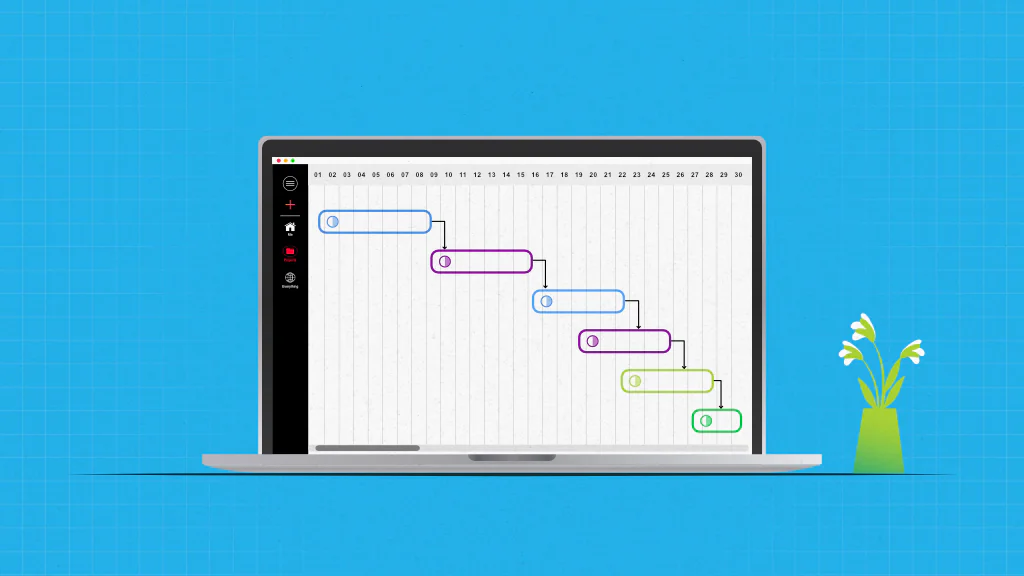
A project is essentially a collection of interdependent tasks. Project dependencies help the project team understand how one task is dependent on others. In the absence of clear project dependencies, project schedule delays, budget overruns, and handoffs missed, resulting in project failure.
In this article, we will learn what project dependencies are, why identifying them matters, their types, how to identify and manage them, and best practices for managing them.
- 1.A project dependency is a relationship between tasks where one task cannot start or finish until another is completed.
- 2.Dependencies fall into 4 types by task relationship: Finish-to-Start, Start-to-Start, Finish-to-Finish, and Start-to-Finish, and vary further by source (logical, resource-based, preferential, external, or cross-team).
- 3.When dependencies are not managed, one delay leads to another, costs go up, and resources get stuck.
- 4.Managing dependencies is an ongoing discipline. There will always be a need to map, track, and revisit them throughout the project.
What is a project dependency?
A project dependency is a relationship between tasks in a project in which one task relies on another to start or finish. Identifying these relationships helps a project manager determine the task order, plan resource allocation, and evaluate how a delay in one task affects the others.
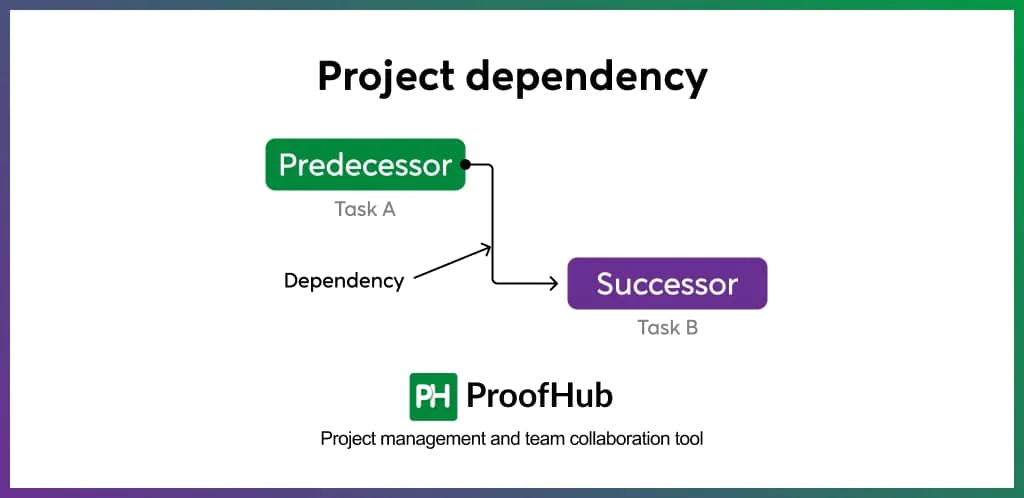
Example: A marketing team cannot launch a campaign until the design team delivers the final creatives. The campaign launch depends on the creatives being ready. That relationship between the two tasks is a dependency.
Why is it important to identify project dependencies?
Identifying project dependencies helps managers map how tasks relate to each other, create accurate schedules, optimize resource allocation, manage risks proactively, improve workflow coordination, prevent costly rework, and better stakeholder communication.
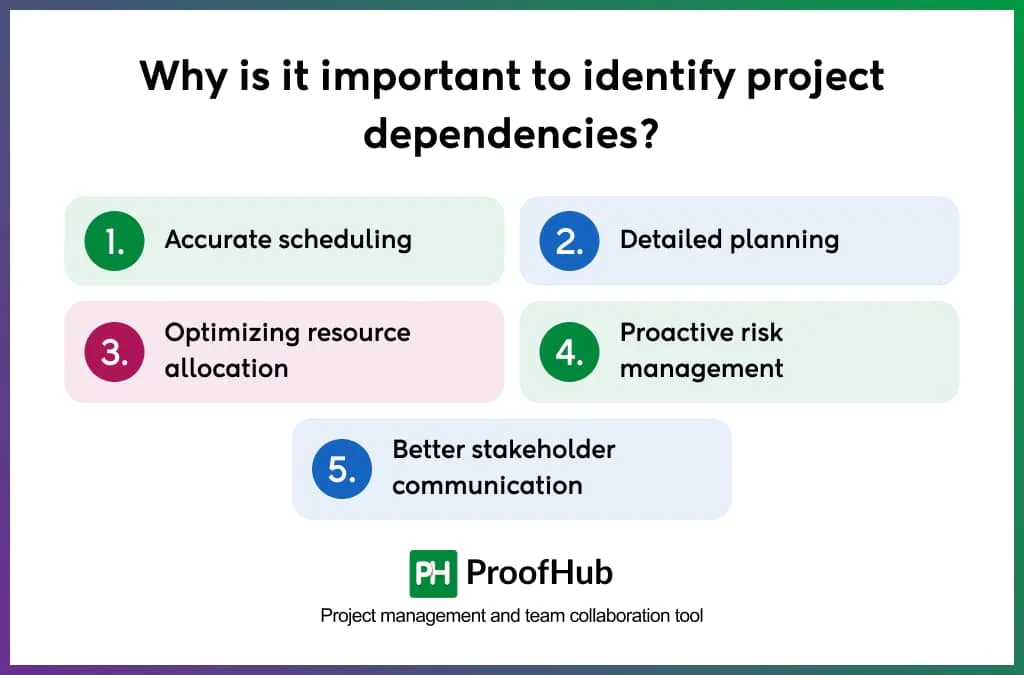
1. Accurate scheduling
Project dependencies help create an accurate schedule by laying out the sequence of tasks. When task relationships are clear, and the project team has all the information (when to start, what inputs they need, and how their work connects to others), it prevents out-of-order execution and improves coordination, reducing delays and costly rework.
2. Effective planning
Project dependencies help in effective project planning by mapping the sequence of dependent tasks and locating the critical path. A critical path is the longest sequence of dependent tasks in a project where any delay in a task on this path directly delays the entire project. By understanding the critical path, a project manager can manage project time and plan for risks effectively by allocating contingency reserves to high-risk tasks.
3. Optimizing resource allocation
Dependency mapping helps project managers optimize resource allocation by assigning finite resources, such as people, materials, and budget, to the right tasks. When a project manager clearly identifies task relationships and which tasks need resources first, it helps prevent resource conflicts and eliminates waiting time between tasks, keeping the project moving forward effectively.
4. Proactive risk management
Identifying project dependencies highlights potential roadblocks such as vendor delays, regulatory approvals, or external dependencies early on. This allows project managers to build contingency and mitigation plans in advance, ensuring risks are addressed before they impact project delivery.
According to the PMI Pulse of the Profession 2018 report, resource dependency contributed to 26% of project failures, while task dependency contributed to 12%. Early dependency mapping highlights potential roadblocks before they escalate into costly failures.
5. Better stakeholder communication
Dependency mapping shows a project manager how tasks are linked, what impact a delay has, and how changes affect the overall schedule. This helps a project manager communicate timelines and changes to stakeholders clearly with confidence, reducing misunderstandings, building trust, and making it easier to manage expectations.
Now that you know why dependencies matter, the next step is understanding the different types you will encounter in a project.
What are the types of project management dependencies?
Project dependencies are categorized primarily into two types: task relationship-based dependencies, including Finish-to-start, Start-to-start, Finish-to-finish, and Start-to-finish, and source-based dependencies, including logical, preferential, resource, external, and cross-team (internal).
Understanding these categories is important for building a realistic project roadmap.
1. Task relationships
These dependencies describe the logical links that determine when a task can start or finish relative to another. The 4 types are Finish-to-Start, Start-to-Start, Finish-to-Finish, and Start-to-Finish.
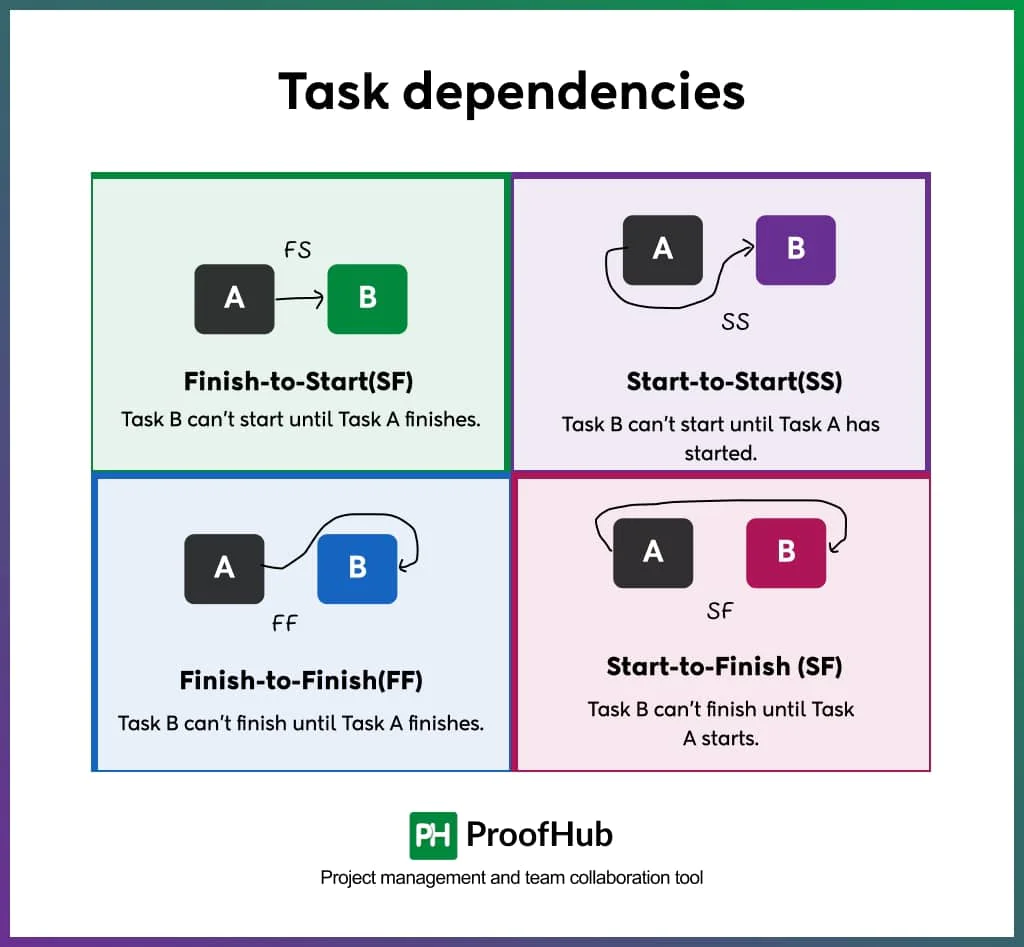
- Finish-to-Start (FS): The first task needs to be completed before the second task can start. This is the most common dependency type. For example, the development team cannot begin building the product until the design team finishes the final mockups.
- Start-to-Start (SS): The following task can’t begin until the first task has started. This applies to tasks that run in parallel. For example, the marketing team cannot start writing launch content until the development team starts building the product.
- Finish-to-Finish (FF): The second task can’t be finished until the first task has been done. For example, the QA team cannot finish testing until the development team completes all features.
- Start-to-Finish (SF): The first task must start before the second can be completed. This is the least common type. For example, the old product version cannot be retired until the new version starts going live.
2. Dependency source
A dependency source identifies where the constraint originates, either within or outside the organization. The 5 types of project dependencies based on source are mentioned below:
Logical dependencies (Causal or hard logic dependencies)
Logical dependencies are mandatory sequencing relationships that arise from the fundamental nature of the work. In these dependencies, the successor task (the task that comes after and depends on the predecessor) is logically impossible to begin until the predecessor (the task that comes before and influences another task) completes.
For example, an article must be written before it can be edited. The editing task cannot begin until a completed draft is available, regardless of how much time is available.
Preferential dependencies (Discretionary or soft logic dependencies)
Preferential dependencies are discretionary dependencies chosen based on team judgment, professional standards, and organizational best practices rather than any hard constraint.
For example, a writer chooses to wait until all research is collected before starting the first draft, not because writing cannot begin earlier, but because starting with incomplete research often leads to rewrites.
Resource-based dependencies
Resource-based dependencies occur when multiple tasks require the same resource, such as a person or tool. It happens when one task must be completed before the resources can be allocated to the next.
For example, 2 project tasks requiring the same subject-matter expert cannot proceed in parallel if that expert is already assigned to a task at a time.
External dependencies
External dependencies are constraints that originate outside the organization over which the project team has no control. It includes the following:
- Vendor delays: a supplier ships materials late, stalling construction or manufacturing
- Regulatory approvals: a government body must review and approve plans before work can legally proceed
- Permits: building or operational permits need to be granted before a phase can begin
- Weather events: conditions like rain or extreme temperatures can pause outdoor work, such as concrete pouring
Cross-team dependencies
Cross-team dependencies involve deliverables, approvals, or information provided by another department or business unit within the same organization (internal dependencies).
For example, a product launch cannot proceed until the legal team finishes its compliance review; the whole team waits until the legal team completes its part.
How to identify project dependencies?
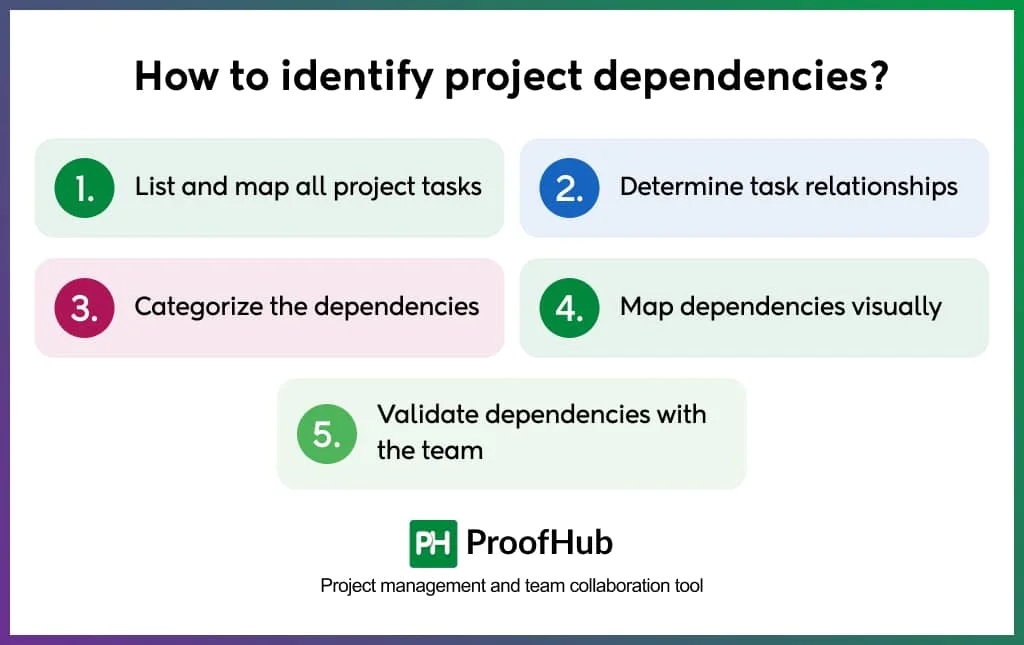
To identify project dependencies, list all tasks required to complete the project, determine task relationships (which tasks require others to finish first), categorize dependencies, visualize them, and validate them with the project team.
1. List all project tasks
Document every task required to complete the project. Break large deliverables into specific, actionable, and assignable tasks. This helps a project manager identify and document all the tasks.
For example, if the project goal is to build and launch a web application, start with high-level tasks such as planning, development, testing, and deployment, and then break these into smaller steps.
Project: Build a web application
Phase 1: Planning
Deliverable: Approved project plan
- Define requirements
- Create system architecture
Phase 2: Designing
Deliverable: Approved design specifications
- Create UI/UX wireframes
- Define a visual design system
- Review and approve designs
Phase 3: Development
Deliverable: Functional application
- Design database schema
- Build backend APIs
- Develop frontend UI
Phase 4: Testing
Deliverable: Tested and bug-free application
- Unit testing
- Integration testing
- User acceptance testing (UAT)
Phase 5: Deployment
Deliverable: Live application
- Set up production environment
- Deploy application
- Post-launch monitoring
At this level, every task is clear and ready to be assigned, which removes confusion during execution.
2. Determine task relationships
To determine task relationships in a project, for each task, answer what needs to happen before this task can start, and what can run in parallel. This helps a manager determine the order of tasks and identify their relationships.
For example, in a software development workflow:
- ‘Backend API development’ depends on the ‘database schema’ being finalized
- ‘Frontend UI development’ depends on the ‘backend APIs and finalized designs.’
- ‘Integration testing’ depends on both the ‘backend and the frontend’ being complete
By defining these relationships, the tasks move from a static task list to a structured workflow, where the work sequence is clear and predictable.
3. Categorize the dependencies
Categorize the dependencies by their source: Logical, Resource-based, Preferential, and External, and by task-based relationship: Finish-to-Start (FS), Start-to-Start (SS), Finish-to-Finish (FF), and Start-to-Finish (SF).
This categorization helps a project manager understand how a dependency creates a bottleneck, making it easier to manage and plan for dependencies by scheduling tasks accurately.
For instance, if ‘backend API development’ has a Logical + Finish-to-Start dependency on ‘database schema design’, it confirms that ‘API development’ cannot begin until the schema is finalized. Therefore, any delay in schema design will directly delay all backend development.
4. Map dependencies visually
Map dependencies visually by laying out tasks to see how each task leads to the next and where dependencies exist. This clarifies the sequence of tasks, making it easier to identify where work may stall and which steps must be completed on time to maintain the project schedule.
For example:
Define requirements → Database schema → Backend APIs → Frontend UI → Integration testing → UAT → Deployment
5. Validate dependencies with the team
Validate dependencies with the team by reviewing the complete dependency map with all team members to confirm accuracy and completeness.
Team members doing the actual work know about problems that aren’t visible on paper, such as missed steps, recurring delays, or overlooked connections between tasks. This ensures the plan reflects what actually happens on the ground.
After identifying the dependencies, the next step is putting a system in place to manage them throughout the project.
How to manage project dependencies?
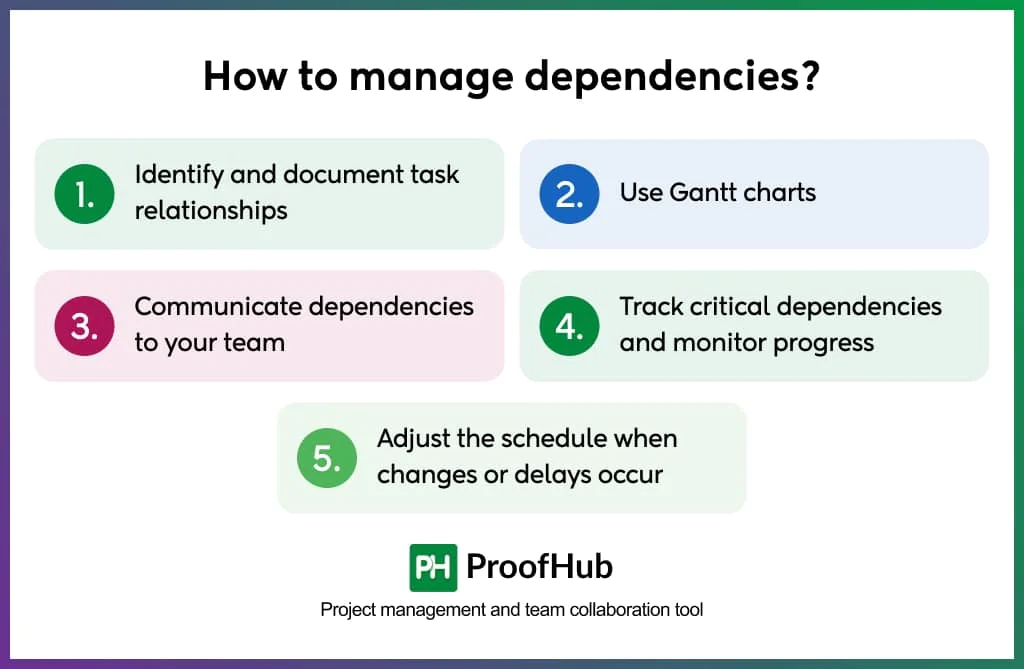
To manage project dependencies, identify and document task relationships, use a Gantt chart, communicate dependencies to your team, track critical dependencies and monitor progress, and adjust schedules when changes or delays occur.
Let’s learn about the tools and techniques to manage dependencies!
1. Identify and document task relationships
Start by identifying which tasks depend on others, and map the predecessors that must finish or start first, and the successors that cannot begin until these are complete. Each relationship can be classified as finish-to-start, start-to-start, finish-to-finish, or start-to-finish, so the team understands how tasks are linked. Use a visual timeline to make these connections clear and show the order of work.
2.Use Gantt charts
Use Gantt charts to manage project dependencies. It helps display task sequences and relationships on a timeline, making it easy to understand the task dependencies. A Gantt chart also highlights the critical path, indicating that any delay in a task will have a direct impact on the project timeline.
Project management tools like ProofHub come with built-in Gantt charts, making it easy to create, adjust, and manage dependencies in real time. Teams can quickly adapt to changes and keep projects on track without confusion.
3. Communicate dependencies to your team
Clearly communicate to the team how tasks are connected, along with timelines and expectations, to ensure there’s no confusion about handoffs. Make dependencies a regular part of team check-ins to keep everyone aligned and aware of potential risks. Encourage team members to flag delays early rather than wait until they become bigger issues. This way, problems are addressed quickly, and work continues without unnecessary disruptions.
4. Track critical dependencies and monitor progress
Focus on tracking critical dependencies, which include the tasks on the critical path that will push the end date if they are delayed. Regularly track progress to reflect real-time changes or unexpected delays. This keeps timelines accurate and prevents a single delay from cascading across dependent tasks.
5. Adjust the schedule when changes or delays occur
Fix the plan right away when a task gets delayed. Use the contingency reserve to accommodate the delay and mitigate the impact. If the task is not on the critical path, move the delayed task forward and shift all the tasks that depend on it.
This keeps the timeline realistic and avoids confusion later. If dependent tasks are on the critical path, use techniques like “crashing” (adding resources) or “fast-tracking” (performing tasks in parallel) to regain time.
If the delay is beyond management, inform stakeholders immediately and discuss recovery strategies. If the dependencies don’t adjust early, the entire project will be affected.
Even with a management system in place, it is important to understand what happens when dependencies are not handled properly.
What are the risks of not managing project dependencies?
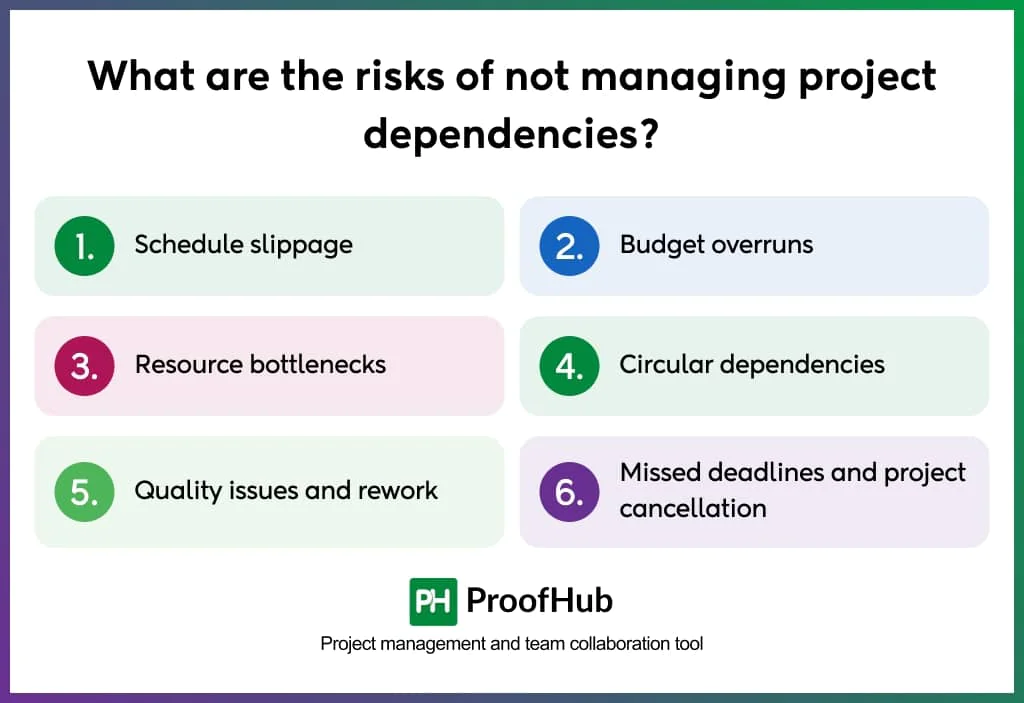
The risks of poor project dependencies include schedule slippage, budget overruns, resource bottlenecks, quality issues and rework, missed deadlines, and project cancellation.
The following are the risks that can occur if project dependencies are not handled effectively:
- Schedule slippage: A delay in one task creates a ripple effect across dependent tasks. This pushes deadlines and disrupts the entire project timeline.
- Budget overruns: When timelines extend, costs increase due to additional time and effort. Fixing delays later often requires more resources than planned.
- Resource bottlenecks: Teams end up waiting for inputs or competing for the same resources. This leads to inefficiencies and slows down overall progress.
- Circular dependencies: When two or more tasks depend on each other to start or finish, the project enters a deadlock in which no task can proceed.
- Quality issues and rework: Teams that work without proper inputs often produce errors and misaligned outputs. This forces teams to redo work, consuming time and budget that was never planned for.
- Missed deadlines and project cancellation: Continuous delays and confusion make it harder to meet project goals. Over time, this can lead to missed objectives or a complete project breakdown.
Now that you know what can go wrong if project dependencies are not managed effectively, here are the practices that help you make sure it doesn’t.
What are the best practices for managing project dependencies?
The best practices for managing project dependencies include adding more buffer time, applying lag and lead times to task sequencing, preparing a contingency plan, tracking tasks against the original baseline, framing decision-making around the critical path, and reviewing the dependency map at every phase.
Now that you know what can go wrong, here are the practices that help you make sure it doesn’t.
1. Add buffer time around uncertain and external dependencies
Always assume that external inputs or uncertain tasks take longer than expected. By adding buffer time, there will be more flexibility around tasks, and small delays won’t disrupt the entire schedule.
2. Apply lag and lead time when sequencing tasks
Every task doesn’t start or finish immediately after another. Adding lead (start earlier) or lag (delay start) time helps create a more realistic and manageable workflow.
3. Prepare a contingency plan for every high-risk dependency
For tasks that can impact the entire project, have a backup plan ready. This ensures that everyone knows exactly what to do if something goes wrong, instead of reacting under pressure.
4. Track every dependent task against its original baseline
Compare actual progress with the initial plan to identify delays early. This helps identify where things are slipping and take corrective action before they escalate.
5. Frame the decision-making around the critical path
Focus on tasks that directly impact the project deadline. Prioritizing these ensures that the team’s efforts go where they matter most.
6. Review the dependency map at every phase transition
Projects evolve, and dependencies change accordingly. Revisiting the dependency map at key stages helps to catch new risks, adjust plans, and stay aligned as the project moves forward.
What are some examples of a project dependency?
The examples of project dependencies are-
1. Website Redesign – Developers cannot begin coding until the design team delivers final mockups.
2. Product Launch – Marketing cannot publish promotional content until the legal team completes its compliance review.
3. Construction – Electricians cannot begin wiring until the building’s structural framework is completed.
4. Software Release – QA testing cannot start until developers finish building the feature.
5. Content Publishing – An article cannot go live until the editor completes the final proofreading and approval.
Key project dependencies terminologies to know
The key project dependencies terminologies to know as a project manager:
Critical path- The longest sequence of dependent, essential tasks in a project plan that must be completed on time to meet the deadline.
Resource constraint- A situation, project, or entity that operates with limited essential inputs, such as time, funding, personnel, equipment, or technology, which restricts its capability to perform or expand.
Contingency plan- An alternative strategy designed to help an organization or individual respond effectively to potential risks.
Scope- The defined boundaries of what the project will and will not deliver.
Work breakdown structure- A deliverable-oriented, hierarchical decomposition of the total scope of work to be executed by the project team. This structure breaks a project down into phases, deliverables, and work packages.
Who is responsible for managing project dependencies?
The project manager is primarily responsible for managing project dependencies. They identify and document dependencies, map task relationships, resolve resource conflicts, coordinate cross-team handoffs, and flag external constraints before they disrupt the schedule.
However, responsibility does not stop with the project manager. Every team member who owns a task must communicate its status, especially when another task is waiting on their output. When dependencies cross departmental lines, department heads and team leads share responsibility for meeting agreed-upon handoff dates.
For external dependencies such as regulatory approvals or vendor deliveries, the project manager cannot resolve delays directly; instead, they monitor progress closely and prepare a backup plan in case the external party misses their deadline.
What happens if a dependency is overlooked?
Overlooking a dependency disrupts the project schedule, increases costs, and puts the final delivery at risk. When a required task is missed, all tasks connected to it cannot proceed. Resources are wasted while teams wait for missing input, teams are forced into unplanned workarounds, and rework costs grow when tasks are done out of sequence.
If the missed dependency lies on the critical path, the entire project deadline can shift. Without identifying the dependency early, there is no contingency plan in place, so teams end up reacting to problems rather than proactively managing them.
Can project dependencies overlap?
Yes, project dependencies can overlap. Tasks don’t always follow a single line in which one must end before another can begin. Many tasks can happen simultaneously.
Here is a simple breakdown of how this works:
- Starting together: In a Start-to-Start relationship, a second task can begin as soon as the first one starts.
- Finishing together: In a Finish-to-Finish relationship, two tasks can run in parallel, but they must both be completed for the next phase to proceed.
- Multiple Links: Tasks can share the same dependency. This means several different activities can happen at once while waiting for the same “leader” task to finish.
Project managers use Gantt charts to clearly map these overlaps. A Gantt chart displays each task as a horizontal bar on a timeline, showing which tasks run in parallel and how delays in one task affect the others.
How do project dependencies impact project timelines?
Project dependencies directly impact how long a project takes to complete. Every project contains tasks that must follow a specific order; that sequence determines the minimum time required from start to finish.
When 2 tasks compete for the same resource or team member, they cannot run simultaneously and must be sequenced one after the other. Each task added in the sequence adds time to the overall timeline. Also, when dependencies involve external parties, such as vendor deliveries or regulatory approvals, the timeline is entirely beyond the project team’s control.
How do project dependencies affect the critical path?
Project dependencies directly impact the critical path by determining the sequence and duration of tasks that must be completed on time for the entire project to be completed on time. When tasks are linked by dependencies, they form a chain, and the longest chain of dependent tasks becomes the critical path. Any delay in a dependent task on this chain delays the entire project.
Note: The critical path cannot exist without dependencies; they are its foundation.
Are dependencies handled in Agile same as traditional projects?
No, dependencies are not handled the same way in agile and traditional projects.
In traditional projects, dependencies are mapped upfront and drive the critical path. In Agile, they are identified and resolved iteratively, sprint by sprint, with the focus on removing blockers as they emerge rather than pre-planning the full chain.
What is the difference between internal and external dependencies?
Internal dependencies exist between tasks within the same project or team, giving the project manager direct control. For example, testing cannot begin until development is complete. External dependencies involve inputs from outside the project, such as waiting for a vendor to deliver software licenses or a client to approve a design, making them harder to control and a greater risk to the schedule.
What is the difference between project dependencies and project risks?
Project dependencies are known relationships between tasks or external inputs that must occur in a specific order; they are certain and plannable.
For example, construction cannot begin until permits are approved. While project risks are uncertain events that may or may not occur and, if they do, impact the project. For example, a key resource might resign, or a vendor might delay delivery.
What is the difference between project and task dependencies?
Task dependencies link activities within a single project; e.g., testing cannot start until coding is complete, while project dependencies link entire projects to one another; e.g., a data migration project must be completed before a new CRM system project can launch. The difference is that task dependencies manage sequence within a project; project dependencies manage sequence across projects at a portfolio level.