

Content collaboration is the structured process of creating, reviewing, and publishing content through shared workflows. It brings writers, editors, designers, and stakeholders into a single system to make production faster.
It improves content quality, increases productivity, strengthens creativity, ensures a consistent brand voice, and maintains balanced workflows across teams. However, collaboration is not a single approach. It takes different forms depending on who is involved and how teams work together, including internal, external, asynchronous, synchronous, and hybrid.
For collaboration to scale and remain effective, teams need clearly defined workflows. This requires establishing a clear purpose, mapping each stage of the content lifecycle, assigning clear roles and responsibilities, selecting the right collaboration tool, and continuously refining the process based on performance and feedback.
Without these foundations, collaboration becomes inefficient. Teams face challenges such as the absence of content standards, unclear ownership, unsuitable collaboration tools, and unmanaged contributor participation. Without structure, collaboration leads to delays, inconsistent output, and unnecessary revision cycles that affect productivity and quality.
To address these challenges, the team should follow best practices, including defining clear goals, communicating effectively, delegating responsibilities clearly, giving constructive feedback, and working within a centralized platform that keeps collaboration organized and aligned.
What is content collaboration?
Content collaboration is the structured process where multiple contributors create, edit, review, and distribute content within a shared workflow. Its purpose is to improve content quality, speed, consistency, and scalability by enabling writers, editors, designers, subject-matter experts, and stakeholders to work together using defined roles, shared tools, and aligned objectives.
Earlier, content collaboration was largely linear and manual. Teams worked in silos, exchanging files through emails or shared drives. Feedback was delayed, version conflicts were common, and approvals depended heavily on individual follow-ups rather than clearly defined processes.
Today, content collaboration is workflow-driven and systemized. Contributors work within shared environments where responsibilities, review stages, and approvals are predefined. Each participants, including writers, editors, designers, and stakeholders, contribute at the appropriate stage without disrupting others. Feedback, revisions, and approvals remain attached to the content itself rather than scattered across emails or chat threads.
What are the benefits of content collaboration?
Content collaboration improves content quality, accelerates production and productivity, increases creativity and innovation, ensures a consistent brand voice and messaging, and creates balanced, efficient workflows.
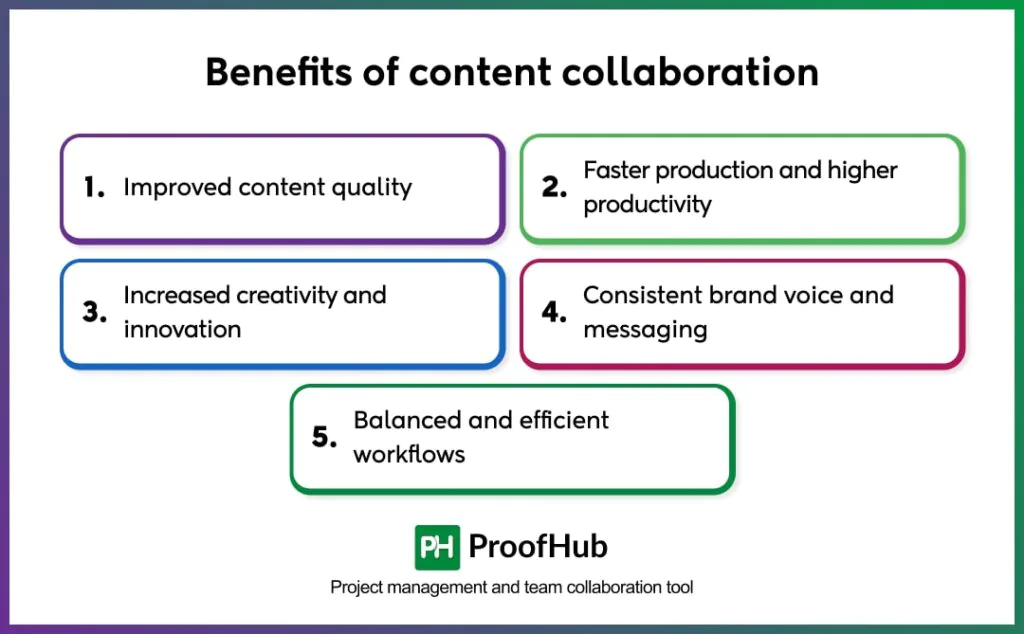
1. Improved content quality
Content collaboration improves content quality by integrating writers, subject-matter experts, editors, and designers into a shared workflow that validates accuracy, removes inconsistencies, and strengthens messaging before publication. Reviewing content from multiple functional perspectives increases accuracy, reduces bias, and aligns messaging more closely with audience intent and business goals.
2. Faster production and higher productivity
Content collaboration improves production speed and productivity by enabling parallel contributions, real-time editing, feedback, and approvals, eliminating sequential handoffs and delays. Simultaneous work across drafting, reviewing, and design reduces idle time between stages and allows teams to deliver more content in less time.
3. Increased creativity and innovation
Content collaboration increases creativity and innovation by bringing diverse roles into a shared ideation and feedback process that challenges assumptions and generates original ideas. Continuous discussion and iteration refine concepts into stronger narratives and more innovative content formats.
4. Consistent brand voice and messaging
Content collaboration ensures a consistent brand voice by aligning all contributors around shared guidelines, templates, and centralized approvals that correct inconsistencies early. Unified standards maintain cohesive messaging across channels, strengthening brand recognition and audience trust.
5. Balanced and efficient workflows
Content collaboration creates balanced and efficient workflows by defining clear roles, responsibilities, and handoffs within a shared production system. Clear accountability reduces duplication and confusion, enables smooth transitions between stages, and keeps workloads evenly distributed from ideation to publication.
What are the types of content collaboration?
Content collaboration can be categorized by who participates in content creation and by how contributors work together. These two classifications by participants and by working style help teams choose collaboration models that best fit their structure, workflows, and content goals.
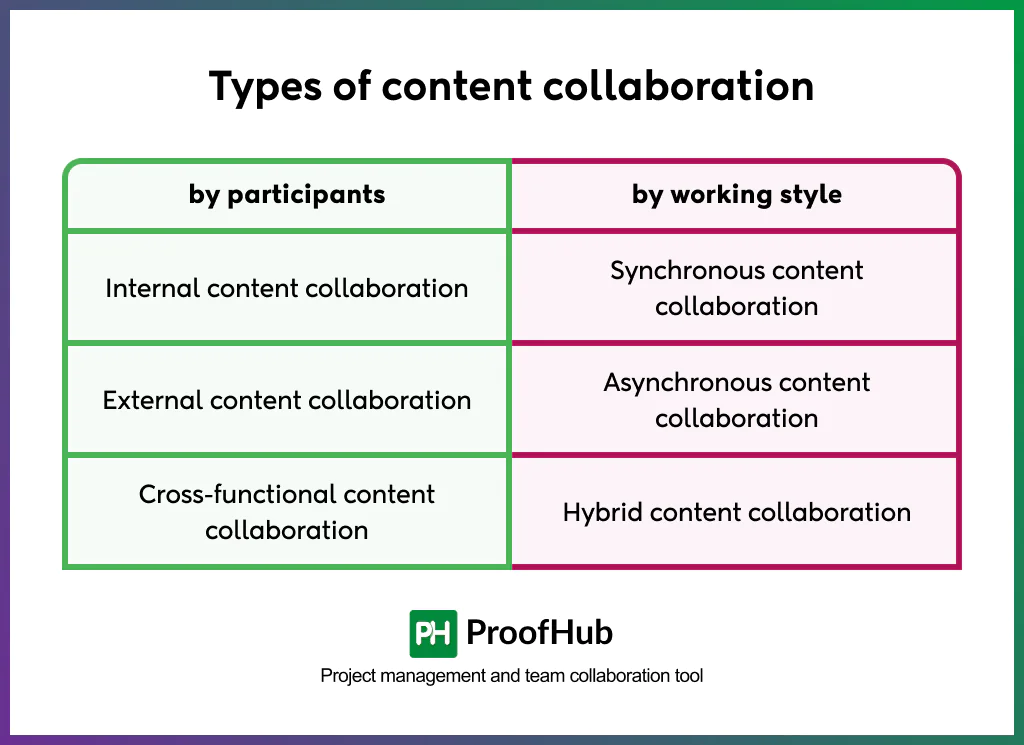
Types of content collaboration by participants
Content collaboration by participants focuses on who contributes to content creation and how responsibilities are distributed across teams.
- Internal content collaboration
Internal content collaboration involves team members within the same department working together through defined goals and workflows. Strategists, writers, editors, and publishers follow a defined standardized processes that ensure smooth handoffs, consistent quality, and efficient delivery from creation to publication. This alignment improves consistency, reduces rework, and helps teams deliver content more efficiently by following shared standards and objectives.
- External content collaboration
External content collaboration occurs when organizations partner with external contributors such as freelancers, agencies, content studios, or partner brands. These contributors follow the organization’s brand guidelines, content strategy, and approval processes, allowing teams to scale production, access specialized expertise, and introduce fresh perspectives without disrupting internal workflows.
- Cross-functional content collaboration
Cross-functional content collaboration brings contributors from different departments together to create content aligned with broader business objectives. Teams such as product, marketing, sales, and design contribute domain expertise that improves accuracy, relevance, and audience alignment across content initiatives.
Types of content collaboration by working style
Content collaboration by working style defines when and how contributors interact during the content lifecycle.
- Synchronous content collaboration
Synchronous content collaboration involves contributors working together in real-time. Live co-editing, brainstorming sessions, meetings, or real-time reviews enable quick decision-making and alignment, making this approach effective for planning, ideation, and early-stage collaboration.
- Asynchronous content collaboration
Asynchronous content collaboration allows contributors to work independently across different timeframes. Team members share feedback, make edits, and add comments through collaborative tools without needing to be online simultaneously, supporting flexibility, focus, and effective collaboration across distributed teams.
- Hybrid content collaboration
Hybrid content collaboration combines real-time collaboration with synchronous and asynchronous approaches. Teams collaborate in real-time, such as kickoffs, brainstorming, or final reviews, while managing drafting, editing, and updates independently, balancing structure with flexibility, throughout the content lifecycle.
How to create a content collaboration strategy?
A content workflow is created by defining clear goals, structuring each stage of production, assigning ownership, selecting the right tools, and continuously optimizing the process. Instead of following a rigid template, effective teams design a workflow that aligns with content goals, team structure, and working styles.
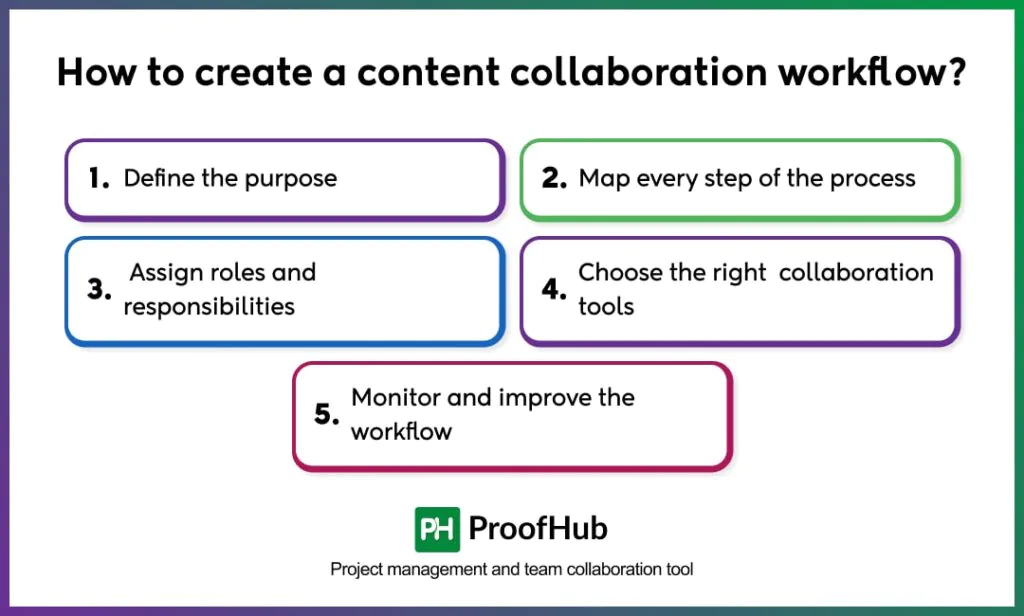
1. Define the purpose
Begin by clearly identifying the goal of the content and the outcome you want to achieve. Identify the content objective, the most suitable format and the contributors required to execute it.
For example, if the goal is to explain a new feature to the existing users, select the appropriate format, such as a blog post or a video and assign contributors best suited for that task. A clearly defined purpose ensures everyone works toward the same outcome. A clearly defined purpose ensures that everyone involved works toward the same outcome.
2. Map every step of the process
Create a clear, end-to-end map of every stage required to complete the content. A typical workflow includes: planning, creation, review, approval, publishing, and reuse. Arranging these stages in sequence and making them visible to all contributors prevents missed steps, reduces delays, and keeps content progressing without unnecessary delays.
3. Assign clear roles and responsibilities
Assign clear ownership to each step of the workflow to ensure accountability. Define who is responsible for drafting, design, review, editing, and final approval, along with clear deadlines. For example, ‘Alex completes the first draft by Tuesday’ removes ambiguity, reduces confusion, and keeps projects on schedule.
4. Choose the right collaboration tools
Select collaboration tools that support seamless collaboration throughout all workflow stages. Use a co-editing tool for writing, a project management tool for tracking tasks, a design tool for visuals, and a communication platform for quick discussions. Fewer, well-integrated tools reduce friction and help teams collaborate more efficiently than managing multiple disconnected platforms.
5. Monitor and improve the workflow
Regularly review workflow performance and refine it based on team feedback. Identify delays, unclear responsibilities, or tool-related challenges, and make incremental improvements such as adjusting deadlines, clarifying ownership, or changing tools. Continuous optimization helps teams become faster, more aligned, and more effective over time.
What are the common challenges of content collaboration?
Collaboration breaks down when teams lack clear standards, defined ownership, suitable tools, and structured contributor participation. Without these foundations, collaboration becomes fragmented, inefficient and difficult to scale.
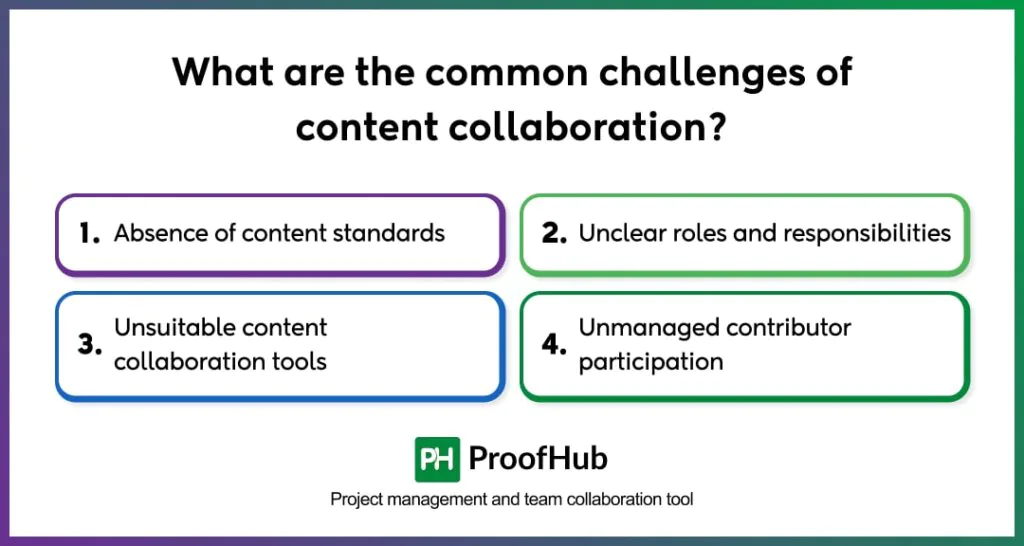
1. Absence of content standards
Content collaboration suffers when teams lack clear content standards such as style guides, templates, and brand rules. Without shared guidelines, contributors interpret requirements differently, leading to inconsistent structure, tone, terminology, and formatting. Feedback becomes subjective and repetitive, forcing editors to fix inconsistencies instead of improving content strategically and extending review cycles unnecessarily.
2. Unclear roles and responsibilities
Content collaboration becomes inefficient when roles and ownership are not clearly defined. Uncertainty around who drafts, reviews, approves, or publishes content leads to duplicated work, delayed feedback, and stalled decisions. Contributors either wait for direction or overlap responsibilities, slowing progress and creating friction across the team.
3. Unsuitable content collaboration tools
Content collaboration breaks down when teams rely on tools that do not support real-time collaboration and version control. Scattered documents, email threads, and chat-based feedback fragment information and force sequential work. Teams spend time tracking files, reconciling changes, and resolving conflicts instead of focusing on content creation, reducing speed and accuracy.
4. Unmanaged contributor participation
Content collaboration becomes difficult to manage when contributor participation is not clearly structured. Too many contributors without defined decision authority lead to overlapping feedback, conflicting suggestions, and excessive revisions. As ownership blurs and approvals slow, timelines extend and collaboration shifts from producing content to managing opinions.
What are the best practices to follow for content collaboration?
Content collaboration works best when goals are clearly defined, communication is structured, ownership is explicit, feedback is purposeful, and collaboration happens within a shared system. These practices provide the clarity and structure teams need to collaborate efficiently without slowing down production.
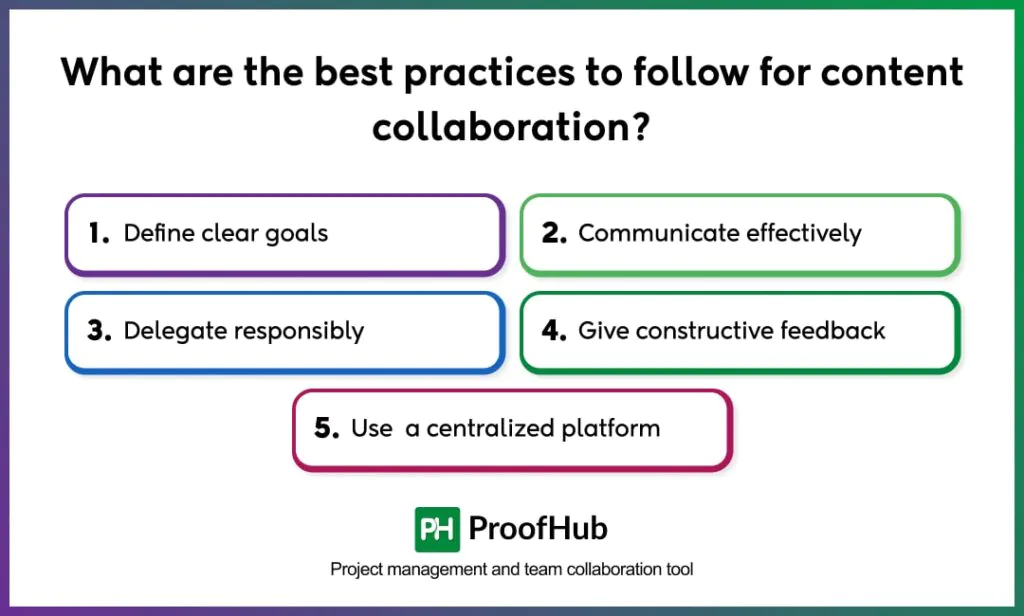
1. Define clear goals
Clear goals keep content collaboration aligned around a shared outcome. Each content initiative should define its purpose, target audience, key message, and success criteria before work begins. Documented goals guide creation, review, and approval decisions, reducing subjective changes and unnecessary revisions while enabling contributors to work independently without losing direction.
2. Communicate effectively
Structured communication prevents confusion, delays, and misalignment during collaboration. Teams should clearly define where updates, feedback, discussions, and decisions take place so information is easy to find and act on. Consistent communication practices surface issues early and prevent assumptions that lead to rework.
3. Delegate responsibly
Clear delegation ensures accountability at every stage of content creation. Each task, drafting, reviewing, approving, and publishing, should have a single owner responsible for progress and decisions. Assigning responsibilities based on expertise and capacity reduces duplication, minimizes bottlenecks, and keeps work moving forward.
4. Give constructive feedback
Constructive feedback keeps content collaboration productive and focused. Feedback should be specific, objective, and tied to defined goals and guidelines rather than personal preferences. Purposeful feedback shortens review cycles, maintains contributor confidence, and improves content quality without slowing momentum.
5. Use a centralized platform
A centralized platform creates a single source of truth for content collaboration. Drafting, editing, feedback, and approvals should happen in one shared system to prevent version conflicts and scattered information. Centralization ensures contributors work on the latest version, track changes clearly, and maintain continuity across the workflow.
What are the best tools for content collaboration?
The best content collaboration tools are those that support real-time editing, structured feedback, version control, and clear workflows across teams. Tools such as ProofHub, Notion, Google Workspace, ClickUp, Figma, Dropbox, Trello, and Asana support collaboration by centralizing drafting, feedback, approvals, and asset management, helping teams coordinate efficiently from ideation to publishing.
What are the key roles in content collaboration?
The key roles in content collaboration are Content Owner, Creator, Editor, Reviewer, Approver, and Publisher. These roles establish clear ownership, controlled feedback, and predictable content workflows, enabling scalable and effective content collaboration.
- Content Owner: The content owner defines objectives, scope, and success criteria for the content. This role maintains accountability for outcomes, aligns content with business goals, and resolves conflicts across contributors, establishing direction before creation begins.
- Content Creator: The content creator produces the initial content based on defined requirements. This role transforms inputs into structured drafts, applies guidelines, and incorporates feedback while maintaining clarity and relevance.
- Content Editor: The content editor ensures accuracy, consistency, and adherence to standards. This role refines structure, tone, and logic, eliminates ambiguity, and prepares content for formal review.
- Content Reviewer: The content reviewer validates subject-matter accuracy and completeness. This role provides contextual feedback, identifies gaps or risks, and confirms that content meets functional or domain-specific requirements.
- Content Approver: The content approver authorizes content for publication or distribution. This role evaluates readiness, ensures compliance, and provides final sign-off to prevent unapproved releases.
- Content Publisher: The content publisher manages formatting, scheduling, and distribution. This role ensures content is delivered through the correct channels, in the correct format, and at the intended time.
What KPIs measure the success of content collaboration?
The success of content collaboration is measured through engagement, reach and awareness, conversions, and internal efficiency. Tracking these KPIs helps teams evaluate content quality, audience response, brand visibility, and the effectiveness of collaborative workflows in supporting business goals.
Engagement metrics indicate how actively audiences interact with the collaboratively created content. Indicators such as likes, comments, shares, watch time, or time on page reveal whether content resonates, delivers value, and encourages participation. High engagement signals that collaboration has improved relevance, clarity, and audience appeal.
Reach and awareness metrics measure how effectively content collaboration expands brand visibility. Traffic, impressions, follower growth, and new audience acquisition indicate whether collaborative content reaches wider or new audiences. Growth in these metrics reflects successful distribution and increased brand presence.
Conversion metrics indicate how well collaborative content drives desired business actions. Leads, demo requests, newsletter sign-ups, gated content downloads, and purchases show whether content influences decision-making and supports business objectives.
Internal efficiency metrics assess how effectively teams collaborate within the content workflow. Content cycle time, approval turnaround, revision counts, contributor participation, and workflow completion rates highlight process alignment and operational health. Improved efficiency reflects fewer bottlenecks and a more effective collaboration culture.
What is the difference between content collaboration and content management?
Content collaboration focuses on how people work together to create content, while content management focuses on how content is organized, published, governed, and maintained. Both serve distinct but complementary roles across the content lifecycle.
Content collaboration focuses on the human side of content creation. It involves brainstorming ideas, co-editing drafts, sharing feedback, and aligning multiple contributors toward a shared outcome. The emphasis is on communication, teamwork, and collective decision-making to improve content quality and speed up the creation process.
Content management focuses on controlling and maintaining content after creation. It includes storing, organizing, publishing, updating, securing, and tracking content across channels. Content management systems ensure content is structured, searchable, version-controlled, and compliant with brand, governance, and regulatory standards.
What is the difference between content collaboration and content co-creation?
The key difference between content collaboration and content co-creation lies in the level of participant involvement and ownership. Content collaboration emphasizes coordinated execution within defined roles, while content co-creation involves shared ideation, decision-making, and ownership throughout the process.
Content collaboration is a structured process where contributors work together toward a predefined goal within clearly defined roles and workflows.
Participants are responsible for specific tasks such as writing, editing, designing, or reviewing, with ownership typically retained by a central team or organization. The focus is on efficiency, consistency, and quality through coordinated teamwork.
Content co-creation is a highly collaborative approach where all participants actively shape ideas, decisions, and outcomes from start to finish. Contributors, including customers, partners, or communities, are involved throughout ideation, refinement, and decision-making. Roles are fluid, feedback is continuous, and creative direction evolves collaboratively, often resulting in deeper engagement and more innovative outcomes.
Can collaboration improve content quality?
Yes. Collaboration improves content quality by integrating multiple perspectives into the creation and review process. This collective review strengthens accuracy, removes inconsistencies, and produces clearer, more dependable content than work created in silos.
How can teams avoid collaboration overload when producing content?
Teams can avoid collaboration overload by setting clear roles, responsibilities, and approval paths from the start. When decision makers, reviewers and executors are clearly identified, unnecessary feedback loops and delays are eliminated. Limiting reviewers to relevant stages, reducing unnecessary meetings, and relying on structured workflows, shared documentation, and asynchronous updates prevent excessive feedback loops and interruptions. Using templates, brand guidelines, and predefined frameworks minimizes repetitive decisions, while streamlined tools and realistic timelines help teams maintain momentum without confusion or burnout.
What role do feedback and review play in content collaboration?
Feedback and review improve content collaboration by strengthening accuracy, clarity, and alignment before publishing. They help refine ideas, correct errors early, and ensure the content matches brand standards, audience needs, and strategic goals. When feedback comes from the right contributors at the right stage, it enhances the content without slowing production. Structured review processes reduce confusion, limit unnecessary revisions, and keep workflows efficient, resulting in polished, consistent, and high-impact content.
How to improve content collaboration in teams?
Content collaboration improves when teams establish clear roles, structured workflows, centralized tools, and a purposeful feedback culture. Defining responsibilities and expectations removes ambiguity, while centralized platforms keep files, feedback, and progress in one place to prevent version silos. Structured workflows with defined stages streamline reviews and reduce delays and unnecessary edits. Encouraging open, trust-based feedback, automating repetitive tasks, maintaining shared guidelines and templates, and recognizing team contributions sustain alignment, motivation, and collaboration momentum.