
Collaborative brainstorming is a structured, dynamic process in which teams work together to generate, refine, and expand ideas to solve problems and develop innovative solutions. It brings diverse perspectives and open discussion to produce more creative and practical outcomes.
Teams use collaborative brainstorming to boost creativity, improve problem-solving, strengthen communication, and increase team engagement. By combining different perspectives in one discussion, teams evaluate challenges more thoroughly and produce more practical, well-rounded solutions.
Teams use various techniques for collaborative brainstorming, including mind mapping, brainwriting, starbursting, storyboarding, Round-Robin brainstorming, whiteboarding, six thinking hats, SCAMPER, affinity diagramming, nominal group technique, and crazy eights. These techniques help structure idea generation, ensure balanced participation, and move from raw ideas to organized insights.
To make brainstorming effective, define clear goals, create a judgment-free environment, start with individual idea generation, assign a facilitator, capture ideas visually, and focus on generating volume before evaluating quality. Digital tools such as Miro, Mural, FigJam, ProofHub, ClickUp, and Lucidspark support real-time idea sharing, organization, and execution.
What is collaborative brainstorming?
Collaborative brainstorming (also known as crowdstorming) is a group ideation process where team members work together to generate ideas, solve problems, and explore creative solutions through open discussion and shared thinking.
The original concept of “brainstorming” was introduced by Alex Osborn, an advertising executive and co-founder of BBDO, in the 1940s. Osborn developed brainstorming as a structured method to improve creative idea generation by encouraging open, judgment-free participation.
Unlike traditional brainstorming methods, which involve thinking in isolation, collaborative thinking builds on the idea that “two heads are better than one.” This strategy enables individuals to resolve problems, find effective solutions, and plan for efficient execution.
What are the benefits of collaborative brainstorming?
The benefits of collaborative brainstorming are: increased creativity, improved problem solving, cross-functional innovation, structured idea capture and prioritization, improved teamwork and communication, and higher engagement and ownership.
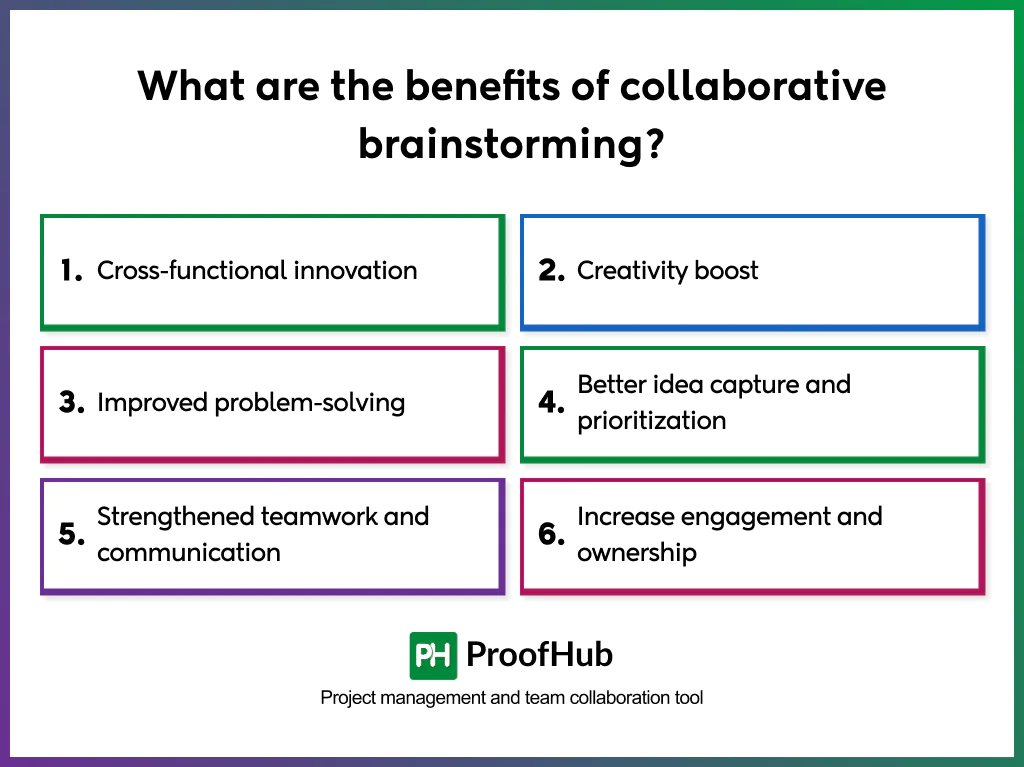
Let’s understand these benefits briefly:
1. Creativity boost
Multiple perspectives stimulate creative thinking during idea generation. One person’s suggestion can inspire new directions for others, leading to unexpected and innovative outcomes. When the focus shifts from being “right” to exploring possibilities, even quiet team members are more comfortable contributing. This supportive environment increases both the quantity and originality of ideas while strengthening participants’ creative confidence over time.
2. Improved problem-solving
Collective intelligence helps resolve complex problems by bringing diverse viewpoints in one place. Different individuals focus on various aspects of a problem, such as process gaps, customer pain points, or cost concerns and combining these perspectives gives the team a full picture. This balanced examination leads to more informed decisions and stronger solutions.
According to the study “Cognitive Stimulation and Interference in Groups: Exposure Effects in an Idea Generation Task” by Bernard A. Nijstad, Wolfgang Stroebe, and Hein F. M. Lodewijkx, published in the Journal of Experimental Social Psychology (November 2002), when team members are exposed to others’ ideas, they can stimulate cognitive processes that activate new associations. This cognitive stimulation increases the likelihood of generating more original and creative solutions.
3. Cross-functional innovation
Bringing people from different departments expands the range of ideas explored during brainstorming. Marketing, design, and customer-facing teams contribute distinct insights that produce more practical and well-rounded solutions.
4. Better idea capturing and prioritization
When all ideas are captured in a shared workspace, the team can evaluate them together, group similar suggestions and prioritize the most valuable ones. This makes it easier to identify patterns, filter out weaker ideas, and focus on those that create the most impact. It also prevents useful ideas from being overlooked during discussions or forgotten after meetings, ensuring brainstorming leads to clear, actionable next steps.
5. Strengthened teamwork and communication
When team members brainstorm together, they regularly exchange ideas, respond to different perspectives, and build on each other’s suggestions. This encourages open discussion and active listening across the group. Over time, it improves how team members communicate, making collaboration smoother and discussions more productive.
6. Increase engagement and ownership
When individuals contribute ideas and see them considered during decision-making, they feel more involved in the outcome. This sense of participation creates stronger ownership of the final solution and ensures that ideas discussed are successfully implemented.
What are the best techniques for collaborative brainstorming?
The best techniques for collaborative brainstorming include Mind mapping, Brainwriting, Starbursting, Storyboarding, Round-Robin brainstorming, Whiteboarding, Six thinking hats, SCAMPER, Affinity diagramming, Nominal group technique, and Crazy eights.
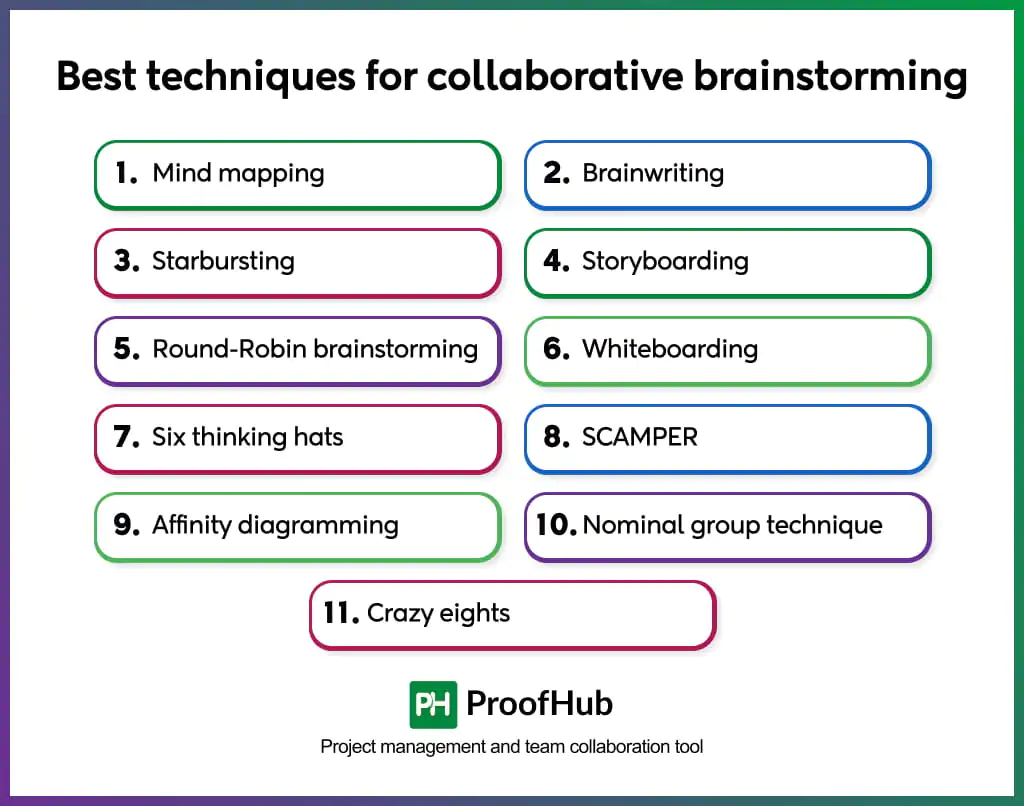
These techniques help in generating diverse ideas to solve a problem by encouraging open, judgment-free thinking.
1. Mind mapping
Mind mapping organizes ideas in a tree-like structure, with a central concept at the center, main ideas branching outward, and sub-ideas extending from those branches.
When used collaboratively, it allows teams to build on each other’s thoughts, mirroring natural thinking patterns, using keywords, images, and colors to make connections visible and memorable. This approach helps groups see how ideas relate to one other in real-time, participate equally by adding branches, and identify patterns or gaps in their thinking.
2. Brainwriting
Brainwriting is a silent, written approach in which participants individually write down ideas on paper or a digital board before sharing them with the group. This method prevents groupthink, dominance by louder voices, and the pressure to respond immediately, helping introverts and thoughtful processors to contribute equally.
A popular version is the ‘6-3-5 method’ where six people each write three ideas in five minutes, then pass their sheets to the next person who builds on those ideas or adds new ones, creating multiple rounds of silent ideation. By separating the generation phase from the discussion phase, brainwriting ensures that all ideas are captured without interruption or premature judgment, often resulting in a higher quantity and diversity of contributions.
The written format also creates an automatic record of all ideas, makes it easier to track who contributed what, and reduces anxiety for those uncomfortable with spontaneous verbal creativity, making it effective for diverse teams or sensitive topics where people hesitate to speak up immediately.
A meta-analytic synthesis of three experiments reported in “Alternating Individual and Group Idea Generation: Finding the Elusive Synergy” by Korde and Paulus (2016) found that switching back and forth between working alone and working in groups led to more ideas than doing only individual brainstorming or only group brainstorming. These results support Osborn’s original idea that combining individual and group thinking leads to better creative outcomes than using just one approach.
3. Starbursting
Starbursting focuses on generating questions rather than answers, using a six-pointed star with “Who,” “What,” “Where,” “When,” “Why,” and “How” at each point to encourage a comprehensive and systematic exploration of a concept before moving to solutions.
Create a six-pointed star on a white board or digital canvas. Write the idea, project or problem in the middle of the star. Write one of the W’s on each point of the star. After generating a list of questions, the team can work through them to identify potential issues and unanswered questions before moving forward with solutions.
This technique is particularly valuable in the early stages of project planning, product development, or problem-solving because it helps teams identify potential challenges, uncover assumptions, and reveal gaps in their understanding before committing resources or making decisions.
4. Storyboarding
Storyboarding uses a sequence of drawings, sketches, or images to map out ideas, user experiences, or processes. Groups collaboratively sketch out key moments, transitions, and interactions in a tangible format that everyone can see, discuss, and refine together, making abstract concepts concrete and identifying potential issues or opportunities that might not emerge through verbal discussion alone.
Storyboarding turns abstract thoughts into a sequential story with images and captions, making complex ideas easier for everyone to understand and discuss. It allows teams to step into the user’s shoes, putting the user’s perspective at the forefront of the brainstorming process. This helps ensure that the final solution meets real needs.
5. Round-Robin brainstorming
Round-robin provides structure by allowing each team member to share one idea in turn. This ensures equal participation and prevents dominant personalities from monopolizing the discussion.
The group sits in a circle, and the facilitator asks the first person to share an idea. The group then proceeds around the circle, with each person contributing one idea at a time. The facilitator records the ideas as they are shared. No criticism or elaboration on ideas is allowed until everyone has had a turn. Each participant writes down an idea on a card or sheet of paper. They pass the card to the person on their left, who reads the idea and adds to it.
This technique encourages equal participation, fosters collaboration, and provides structure to the idea-generating process.
6. Whiteboarding
In whiteboarding, teams use a physical whiteboard or a digital board to freely write, draw, sketch, and connect ideas in real time. It encourages spontaneous thinking and active participation because everyone can see the discussion unfold visually.
A facilitator starts by writing the main problem or topic at the center of the board. Team members then add ideas around it, draw arrows to show relationships, group similar thoughts, or sketch simple diagrams. Because the content can be easily erased, moved, or reorganized, whiteboarding supports flexible thinking.
This approach is useful for mapping processes, workflows, user journeys, systems, or complex relationships. It also benefits visual thinkers who prefer seeing ideas represented graphically rather than discussed verbally.
7. Six thinking hats
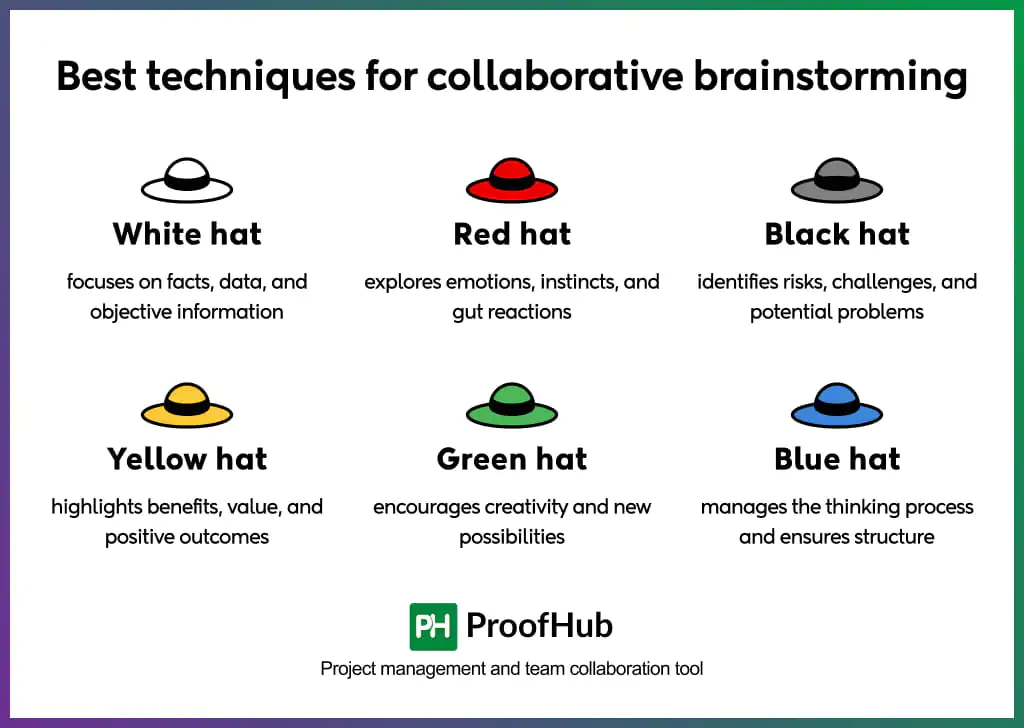
Six Thinking Hats, developed by Edward de Bono, guides teams to look at a problem from six distinct perspectives. Each “hat” represents a different mode of thinking:
- White hat: focuses on facts, data, and objective information
- Red hat: explores emotions, instincts, and gut reactions
- Black hat: identifies risks, challenges, and potential problems
- Yellow hat: highlights benefits, value, and positive outcomes
- Green hat: encourages creativity and new possibilities
- Blue hat: manages the thinking process and ensures structure
Instead of mixing all perspectives at once, the team focuses on one “hat” at a time. For example, everyone first discusses only the facts, then switches to identifying risks, and later moves to creative alternatives.
This separation reduces conflict and confusion because participants are aligned in their thinking mode. It ensures balanced evaluation and prevents discussions from becoming overly negative or overly optimistic.
8. SCAMPER
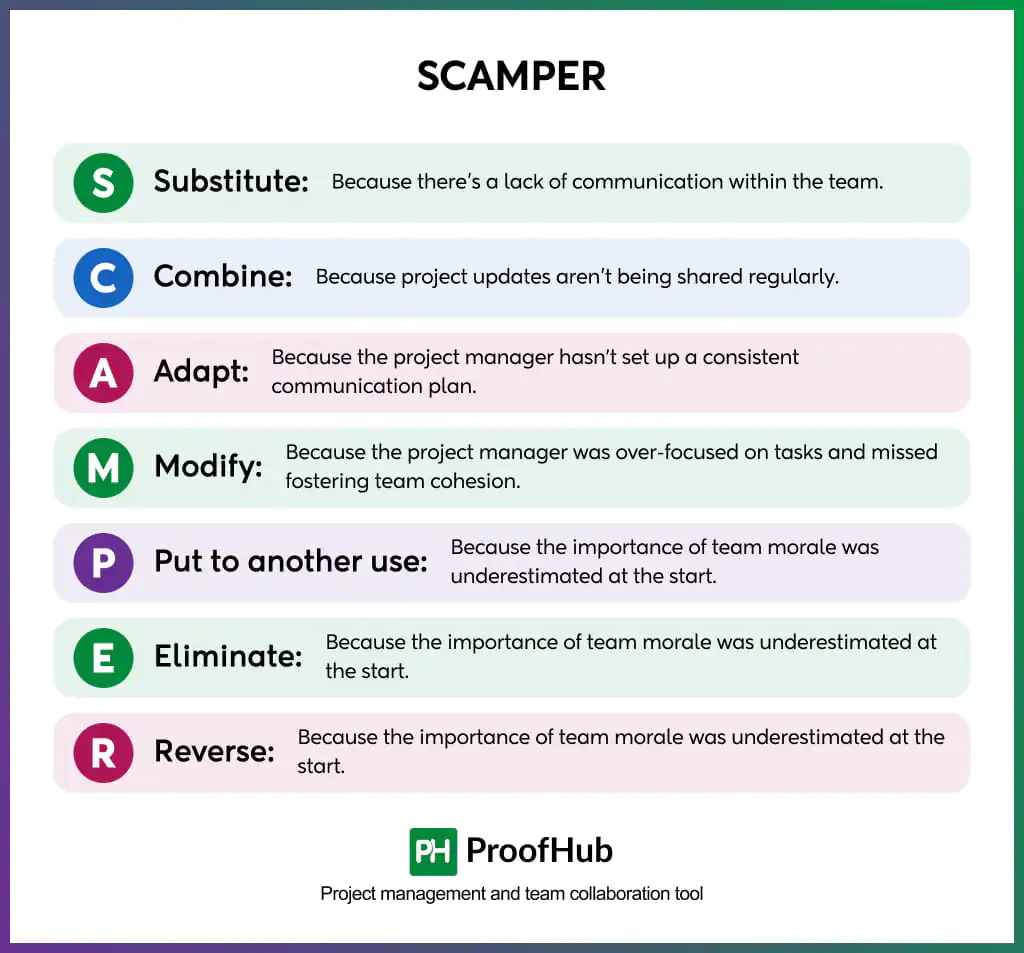
SCAMPER helps teams improve or rethink existing products, services, or processes. The name is an acronym for seven prompts:
1. Substitute: What can be replaced?
2. Combine: What can be merged?
3. Adapt: What can be adjusted from another context?
4. Modify: What can be changed, enlarged, or reduced?
5. Put to another use: Can it serve a different purpose?
6. Eliminate: What can be removed or simplified?
7. Reverse: What can be rearranged or turned around?
Teams apply each prompt to the current idea and generate possible improvements or variations. For example, they may ask, “What if we eliminate this step?” or “What if we combine two features?”
SCAMPER is particularly effective for innovation because it pushes participants to look at familiar ideas in new ways. It works well when improving existing solutions rather than starting from scratch.
9. Affinity diagramming
Affinity diagramming is used to organize a large number of information, ideas, or data into meaningful groups based on their natural relationships or similarities.
The process typically begins by writing each idea on a separate sticky note. The team then groups similar ideas based on natural relationships, without predefined categories. Once clusters are formed, the group discusses and labels each category to reflect the common theme.
This method helps teams identify patterns, trends, and key insights that may not be obvious when ideas are scattered. It is useful in research analysis, customer feedback reviews, and complex problem-solving sessions where clarity and structure are needed before decision-making.
10. Nominal group technique
The Nominal Group Technique is a structured decision-making process that ensures balanced participation and clear prioritization.
The process usually follows these steps:
- Participants write down ideas individually.
- Each person shares one idea at a time in a round-robin format.
- The group discusses ideas for clarification (not criticism).
- Participants privately rank or vote on the ideas.
- Votes are counted, and the highest-ranking ideas are prioritized.
This technique minimizes the influence of dominant personalities and reduces groupthink. Because voting is done privately, participants can express their true opinions without social pressure. It is effective when a team needs to select the best option from many alternatives.
11. Crazy eights
Crazy Eights is a fast-paced creativity exercise often used in design workshops and innovation sessions. Participants fold a sheet of paper into eight sections and sketch one idea in each section within eight minutes (one minute per idea).
The time pressure forces quick thinking and prevents overanalysis. Instead of trying to perfect a single concept, participants focus on generating multiple variations. Even rough sketches are acceptable; the goal is speed and quantity.
After the exercise, participants share their ideas with the group. The team then discusses, combines, or refines the strongest concepts. Crazy Eights is useful when teams are stuck, as it helps break mental blocks and encourages bold thinking.
What are the challenges of collaborative brainstorming?
The main challenges of collaborative brainstorming include unequal participation, groupthink, lack of structure, idea overload, insufficient tools, and failing to convert ideas into action.
Unequal participation is one of the biggest challenges. When a few dominant voices take over the discussion, while quieter team members hesitate to contribute, it can lead to idea bias and reduce diversity of thought.
Groupthink, commonly occurs when teams agree too quickly on ideas, without challenging or exploring unconventional alternatives. When teams prioritize consensus over exploration, creativity drops.
A lack of structure can disrupt brainstorming; without a clear goal and time limit, sessions often go off track, leading to scattered ideas and no clear direction. Similarly, too many ideas at once without filtering can make it challenging to evaluate and analyze the best ones. Teams may end up spending too much time exploring ideas without implementing any.
Lacking proper tools can create technological barriers, especially in remote teams. Poor tools or unstable connectivity can slow down collaboration and create frustration.
When the teams fail to convert ideas into action, brainstorming becomes just an exercise. Without defined next steps, ownership, prioritization, or end-goal brainstorming, ownership, prioritization, or end-goal brainstorming becomes an isolated activity rather than a meaningful part of the workflow.
Addressing these challenges requires structure, inclusive participation, and effective tools to ensure the brainstorming process leads to valuable outcomes rather than unproductive discussions.
Best practices for successful collaborative brainstorming
The best practices include setting clear goals and ground rules, creating a judgment-free, inclusive environment, and structuring the session to generate a high volume of ideas before evaluating them. Encourage new ideas, build on other’s suggestions, and use visual tools to help capture and develop concepts, while ensuring there is time for individual preparation and post-session follow-up.
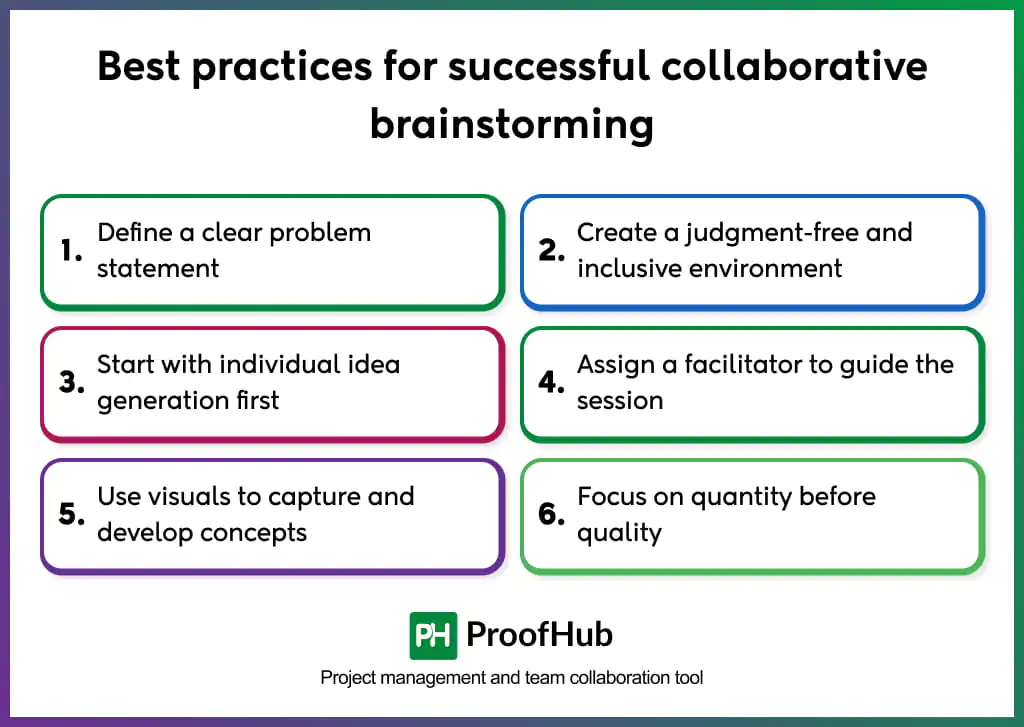
1. Define a clear problem statement
The team should know exactly what challenge they are solving, who it impacts, and what outcome the session aims to achieve. A well-framed problem keeps ideas focused, avoids unnecessary tangents, and ensures everyone is working toward the same goal.
2. Create a judgment-free and inclusive environment
Set simple norms, no idea is a bad idea, don’t interrupt, avoid early criticism, and encourage building on others’ thoughts. This creates a space where people feel free to share openly—especially quieter or less senior members. When the room feels safe, teams generate more authentic, diverse, and original ideas.
3. Start with individual idea generation first
Give 5-10 minutes for everyone to jot down ideas privately. This prevents louder voices or leadership presence from shaping early thinking. It also helps introverted thinkers contribute on equal footing. By the time the group begins sharing, you already have a richer, more varied pool of ideas.
4. Assign a facilitator to guide the session
Designate one person to keep the discussion focused, manage time, encourage balanced participation, and redirect off-topic conversations. A facilitator helps maintain structure and momentum throughout the session.
5. Use visuals to capture and develop concepts
Use whiteboards, sticky notes, or digital canvases like Miro or FigJam, or simple charts to map ideas visually. Visuals make it easier to identify patterns, organize thoughts, and strengthen promising concepts effectively.
6. Focus on quantity before quality
Early in the session, encourage teams to generate as many ideas as possible without evaluating them. High volume leads to unexpected connections and combinations. When participants feel free from judgment, they explore bolder and more unconventional ideas, which often become the foundation for breakthrough solutions.
What are the best tools for collaborative brainstorming?
The best tools for collaborative brainstorming are Miro for mind mapping and visual idea sharing, Mural for structured brainstorming sessions, FigJam for product and design teamwork, ProofHub for brainstorming connected to task management, ClickUp for whiteboard collaboration within projects, and Lucidspark for real-time visual ideation and organizing ideas.
Miro allows multiple users to work together on digital boards with sticky notes, flowcharts, and templates, making it great for remote teams. Mural is helpful when teams want more structure, such as design thinking templates, timers, and guided brainstorming activities.
For product and design teams, FigJam supports real-time editing and includes tools like diagrams, widgets, and visual elements that help teams sketch and develop ideas together.
If teams want to connect brainstorming directly to tasks and execution, ProofHub is useful because it combines discussions, notes, proofing tools, and task management in one place.
ClickUp also offers whiteboards that link ideas directly to tasks and project workflows, helping teams move from ideas to action.
Lucidspark is another strong option for visual brainstorming. It allows teams to use sticky notes, vote on ideas, draw, and organize thoughts in real time, whether working together live or at different times.
Collaborative brainstorming tools help teams generate, organize, and refine ideas in real time. Whether they’re working in the same room or across different locations, teams can visualize thinking, structure ideation, and use seamless communication features to support both synchronous and asynchronous collaboration.
Choosing the right tool depends on team size, workflow, and the level of structure needed, but the best tools make idea generation easy, visually engaging, and accessible to everyone involved.
What are the workplace applications of collaborative brainstorming?
Collaborative brainstorming has several workplace applications, including:
Product development and innovation: Engineers, designers, product managers, and customer-facing teams can come together to combine technical feasibility with customer needs. It speeds up innovation, reduces blind spots, and often leads to breakthrough product concepts.
Marketing and campaign planning: Collaborative brainstorming provides the structure for generating diverse campaign ideas, messaging angles, content themes, and creative directions. Bringing people from different roles—content, design, product, and sales—helps create campaigns that are not only creative but also aligned with customer insights and business goals.
Strategic planning and business visioning: Collaborative brainstorming helps identify growth opportunities, analyze emerging trends, and evaluate scenarios that might otherwise be overlooked. Collaborative strategic sessions promote alignment across leadership teams and build shared ownership of the long-term vision.
When should you use collaborative vs solo brainstorming?
You should use collaborative brainstorming when you need different perspectives and shared input and solo brainstorming when you need quiet focus or independent thinking.
Collaborative brainstorming works best for complex problem-solving or when creativity is important. People can build on each other’s ideas and think of solutions that one person might not consider alone.
Solo brainstorming is useful in the early stages of idea development or when a topic is sensitive. Working solo allows thinking freely without interruptions or pressure and saves time when quick ideas are needed.
What is the difference between collaborative brainstorming and co-creation?
The key difference between collaborative brainstorming and co-creation is the purpose and scope. Collaborative brainstorming focuses on idea generation, whereas co-creation is active participation to create and refine real solutions.
Collaborative brainstorming is an activity where team members come together to explore possibilities and solve problems. The outcome is a collection of creative ideas.
Co-creation, on the other hand, involves developing solutions in which participants help shape, test, and improve the final product or solution.
How can you reduce collaboration overload during brainstorming?
To reduce collaboration overload during brainstorming, start every session with a clear purpose and invite only those who are directly involved. Keep sessions time-bound, and led by a facilitator who ensures equal participation and prevents tangents.
Encourage participants to share ideas asynchronously through shared documents or digital tools so collaboration continues without constant meetings. End every session with clarity by summarizing key takeaways, assigning ownership, and setting next steps. This keeps brainstorming productive, focused, and energizing rather than overwhelming.
How do you keep brainstorming sessions from derailing?
To prevent brainstorming sessions from derailing, begin with a clear goal so everyone understands the exact problem or question being discussed. Set simple ground rules, such as not criticizing ideas during the idea-generation phase and allowing one person to speak at a time, to keep the session respectful and productive.
Manage time by dividing the session into short segments, so the group does not spend too long on one idea.
Use a facilitator to guide the conversation to ensure that off-topic comments are redirected and everyone has a chance to contribute.
Write ideas down where everyone can see them to keep the group focused and reduce repetition.
If unrelated ideas come up, place them on a separate “parking lot” list. This allows the group to stay on track while still valuing those contributions. End the session with a short summary and clear next steps to maintain direction and prevent further discussion from drifting.