
Collaboration is coordinated work where individuals, teams, or departments work together to achieve shared goals. It brings together different expertise, distributes responsibility for execution, and creates collective accountability within a structured workflow.
Communication is the exchange of information that helps people understand goals, expectations, updates, and decisions. It creates clarity and shared awareness that support coordination and alignment.
The main difference between collaboration and communication lies in their functional purposes. Collaboration produces results. Team members coordinate their efforts, rely on each other’s work, and move toward a shared outcome. Communication produces understanding. People share information, so others know what is happening, what is expected, and what has changed.
Both are essential in organizations. Collaboration enables coordinated performance, manages dependencies, and supports collective ownership. Communication improves transparency, clarifies decisions, integrates feedback, and maintains operational stability. When combined, communication provides alignment, and collaboration drives execution.
What is defined as collaboration?
Collaboration is a dynamic, intentional process in which individuals, teams, or departments work together to achieve common goals. It involves coordinated exchange of ideas, knowledge, skills, and resources, supported by clear communication, defined accountability, and coordinated decision-making.
In the workplace, collaboration aligns diverse expertise to manage complex workflows, handle interdependencies, and produce outcomes that reflect collective contribution. It requires active participation, shared responsibility, and mutual trust across roles and functions.
Collaboration improves organizational performance by reducing silos and encouraging shared ownership. It integrates distributed effort into measurable results and maintains stability through collective accountability.
Here are some benefits of effective collaboration in the workplace:
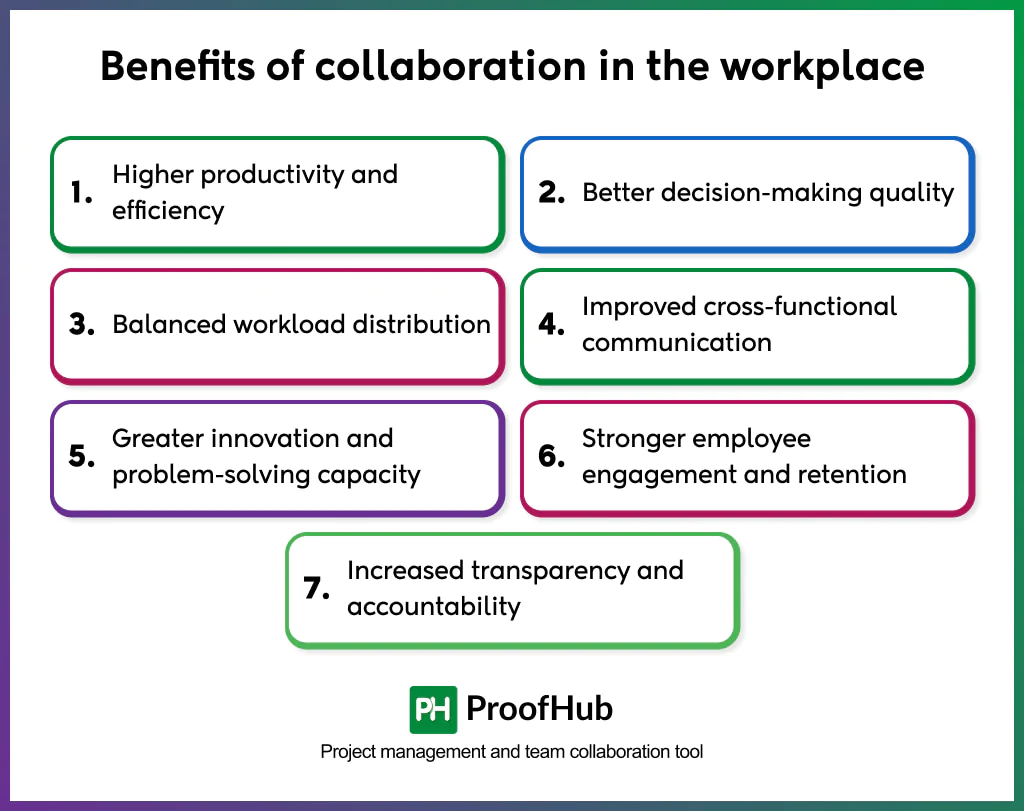
- Higher productivity and efficiency: Coordinated effort reduces duplication, streamlines workflows, and accelerates goal achievement.
- Better decision-making quality: Diverse expertise improves evaluation of alternatives, reduces blind spots, and strengthens strategic outcomes.
- Balanced workload distribution: Shared visibility across tasks prevents bottlenecks and ensures equitable allocation of responsibilities.
- Improved cross-functional communication: Collaboration enhances clarity, reduces ambiguity, and strengthens alignment across departments.
- Greater innovation and problem-solving capacity: Integrated perspectives generate creative solutions and improve response to complex challenges.
- Stronger employee engagement and retention: Shared ownership and active participation reinforce a sense of belonging, motivation, and long-term commitment.
- Increased transparency and accountability: Clear role definition and dependency mapping support measurable progress and execution stability.
What is defined as communication?
Communication is the exchange of information between individuals or groups to create shared understanding, clarity, and alignment. It involves sharing ideas, instructions, feedback, or updates through verbal, written, or digital channels within a defined context.
In the workplace, communication clarifies goals, expectations, responsibilities, and performance standards. It ensures that information flows across teams, departments, and leadership levels so that decisions are understood, and priorities remain visible. Communication reduces ambiguity, prevents misunderstandings, and supports coordination across distributed teams.
Communication functions as the alignment infrastructure of an organization. It defines context, maintains information continuity, and preserves transparency across operational systems.
Here are some benefits of effective communication in the workplace:
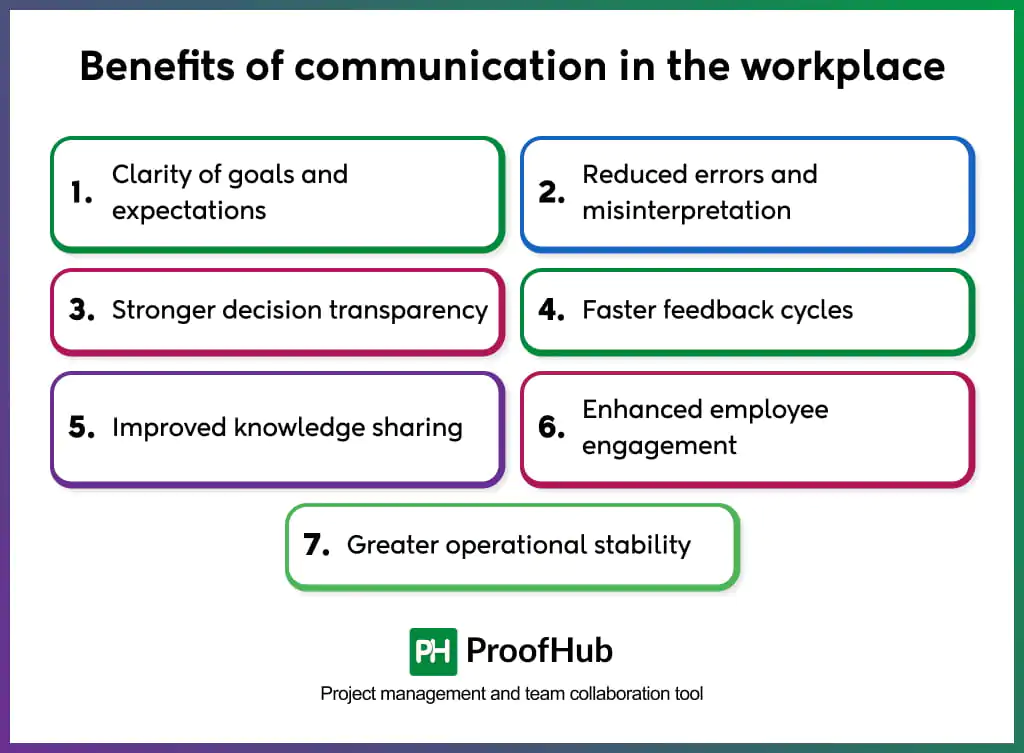
- Clarity of goals and expectations: Clear information exchange reduces confusion and ensures employees understand priorities, responsibilities, and performance standards.
- Reduced errors and misinterpretation: Effective messaging minimizes ambiguity, reducing the risk of rework, delays, and operational friction.
- Stronger decision transparency: Clear articulation of rationale and direction improves trust and organizational alignment.
- Faster feedback cycles: Open information flow accelerates performance reviews, corrective action, and continuous improvement.
- Improved knowledge sharing: Systematic communication preserves institutional knowledge and strengthens cross-team awareness.
- Enhanced employee engagement: Transparent dialogue reinforces inclusion, visibility, and cultural cohesion.
- Greater operational stability: Consistent information flow maintains alignment during change, growth, and strategic shifts.
What is collaborative communication?
Collaborative communication is outcome-oriented information exchange that enables shared execution, joint decision-making, and collective accountability.
It differs from general communication because it occurs within an execution framework. Information is shared to build understanding, coordinate interdependent work, manage dependencies, and advance shared goals.
Collaborative communication combines clarity, coordination, and commitment. Clarity defines goals, roles, and expectations. Coordination aligns tasks across dependencies. Commitment establishes shared ownership of outcomes. Each exchange affects how work is executed.
It occurs when team members discuss progress, remove blockers, adjust strategies based on performance data, or evaluate options before making a decision.
Communication provides information. Collaboration drives joint execution. Collaborative communication ensures that information continuously guides execution, and that execution continuously updates shared understanding.
In organizations, it strengthens workflow alignment, decision transparency, visibility into dependencies, and shared accountability across teams.
What are the key differences between collaboration and communication?
Collaboration is coordinated execution that produces shared outcomes, while communication is structured information exchange that produces shared understanding. Understanding this distinction prevents conceptual overlap and enables more precise organizational design.
Here is a brief comparison table of collaboration and communication, followed by a detailed analysis:
1. Core objective
The main objective of communication is to clearly transmit messages such as updates, instructions, context, or feedback to create shared understanding. The primary goal is clarity and alignment, not joint execution of work.
Collaboration goes beyond exchanging information and involves combining skills, effort, and decision-making. The objective is to understand the work, collectively execute, and produce outcomes.
2. Outcome
The result of communication is clarity, awareness, and alignment. People know the goals, the decisions made, and the actions expected. The outcome is informational.
The result of collaboration is a completed task, a collective decision, or a tangible deliverable. Something is created, solved, improved, or finalized through coordinated effort. The outcome is practical and measurable.
3. Level of interdependence
Interdependence is low. A person can send or receive information without relying on others to act in sync. Understanding does not require simultaneous contribution.
Interdependence is high. People rely on each other’s work to move forward. One person’s output becomes another person’s input. Progress depends on coordinated contribution and timing.
4. Participation requirement
Participation can be one-way, such as an announcement, email, or report. Even in two-way discussions, active contribution from everyone is not required. Someone can receive information without being directly involved in producing results.
Collaboration requires active involvement from all members. Participants contribute ideas, make decisions, solve problems, and execute tasks. Without contributors’ engagement, collaboration cannot function effectively.
5. Responsibility structure
Responsibility centers on message clarity and accuracy. The sender must ensure that the information is understandable and complete. Responsibility for taking action usually exists outside the communication process itself.
Responsibility is shared among all contributors. Success or failure depends on the group’s combined efforts. Each person is accountable not only for their part, but also for contributing to the overall result.
6. Process depth
Communication does not require ongoing coordination or follow-through. It occurs in a single interaction, such as a message, meeting, or brief exchange.
Collaboration is an ongoing process. It involves planning, coordination, problem-solving, feedback, adjustment, and execution over time. It requires structure and continuity to move work forward.
7. Relationship to work execution
Communication supports work by providing updates, instructions, clarifications, and alignment, so individuals know what to do. It enables execution but does not perform the work itself.
Collaboration is the work process in which team members plan, solve problems, and execute tasks together. The work advances through coordinated action, not just by sharing information.
The interconnection between communication and collaboration
The interconnection between collaboration and communication is built on structural dependency. Communication creates shared understanding, and collaboration depends on it to coordinate action and deliver results.
Communication is how people share information. It helps team members understand goals, deadlines, roles, and expectations. When everyone knows what needs to be done and who is responsible, confusion is reduced.
Collaboration happens when people use that shared understanding to work together. It is not just talking about tasks; it is actually coordinating efforts, supporting each other, and moving toward a common goal.
For example:
Communication answers “What are we doing?”
Collaboration answers “How are we doing it together?”
When teams communicate clearly, they collaborate better. They can solve problems faster, manage dependencies, and avoid duplicate work. As work progresses, teams continue to communicate updates, challenges, and results. This keeps everyone aligned and helps them adjust when needed.
Communication helps teams share ideas and make decisions. Collaboration ensures those decisions are acted on.
Real-world examples of collaboration
Some examples of collaboration are:
- Cross-functional product launch: Teams across marketing, engineering, and design jointly plan, build, and release a product. Responsibilities are distributed, dependencies are managed collectively, and success is measured against a shared outcome.
- Strategic planning workshop: Leadership and department heads define organizational objectives together, align priorities, and commit to coordinated execution. Decisions carry shared accountability across functions.
- Agile sprint execution: Product owners, developers, and testers work within a structured workflow to deliver sprint goals. Task ownership is defined, but outcome responsibility remains collective until delivery.
Real-world examples of communication
Some examples of communication are:
- Weekly status report: A manager distributes performance updates outlining progress, risks, and milestones. Information is shared for visibility, not joint execution.
- Policy announcement email: Leadership communicates organizational changes, deadlines, or compliance requirements. The objective is shared understanding across the workforce.
- Performance feedback conversation: A supervisor provides constructive feedback to an employee on performance expectations and areas for improvement. The focus is clarity and alignment, not collective task execution.
How collaboration and communication work together
Collaboration and communication work together as an integrated system where communication establishes shared understanding and collaboration executes that understanding through coordinated action.
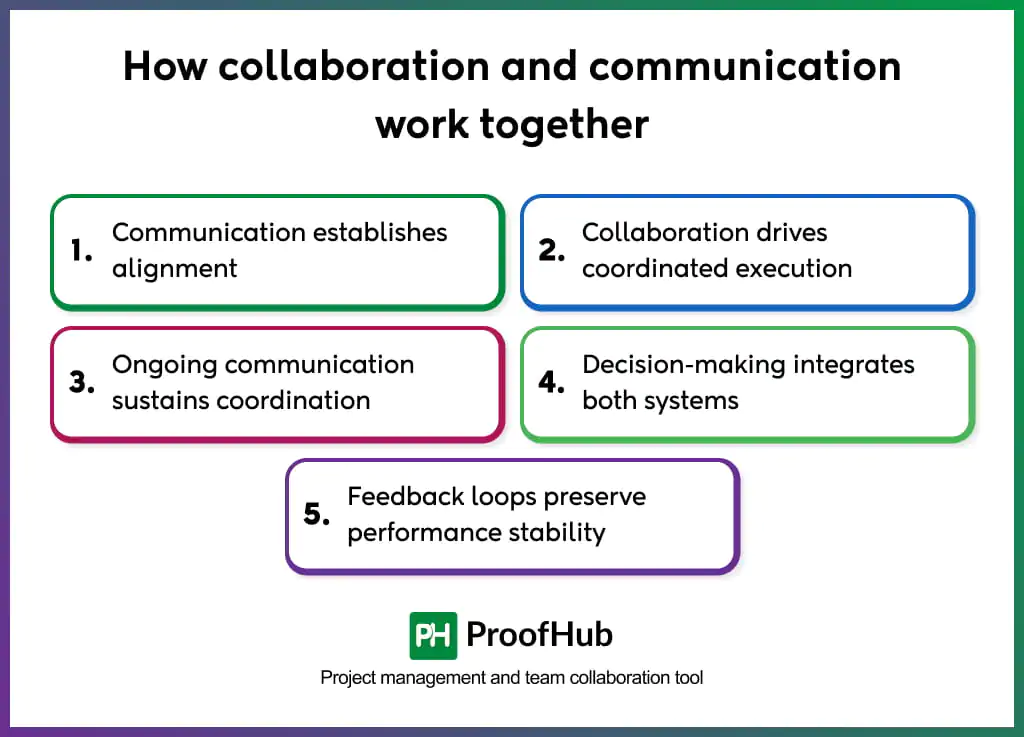
- Communication establishes alignment: Communication defines shared goals, expected outcomes, responsibilities, priorities, and decision boundaries. It clarifies accountability and makes dependencies between teams visible. This clarity creates the structure needed for coordinated work. Without clear expectations and transparent information flow, joint execution lacks direction and consistency.
- Collaboration drives coordinated execution: Team members take shared ownership, manage dependencies, and align their work within defined workflows. Responsibility for execution shifts from isolated to collective. Communication provides clarity about what needs to be done, and collaboration ensures the work moves forward.
- Ongoing communication sustains coordination: Team members share progress updates, adjust responsibilities when constraints appear, and resolve new dependencies. Each stage of execution creates new information that supports stability. Continuous communication keeps alignment intact throughout implementation.
- Decision-making integrates both systems: Ideas are communicated, discussed, evaluated, and refined. They are then executed through shared responsibility. Communication allows teams to evaluate decisions together. Collaboration ensures those decisions are implemented in a coordinated way.
- Feedback loops preserve performance stability: Structured feedback connects communication to ongoing execution. Performance data guides adjustments. New risks lead to collaborative problem-solving. Updated priorities are redistributed across teams. Communication reflects what is happening in reality, and collaboration adapts accordingly.
When communication fails without collaboration?
Communication fails without collaboration when people only exchange information but do not work together to execute it. Teams share updates, reports, and feedback, but without a clear action plan and shared responsibility, these conversations remain informational rather than productive.
Everyone understands what is happening, but that does not mean anyone is clearly responsible for getting the work done. Information is shared through meetings, emails, and reports, but the roles of task ownership, decision-making authority, and accountability are unclear. As a result, communication increases, but coordinated progress does not.
To mitigate this, structure communication around collaborative execution. In each discussion, clarify who owns the next step, how tasks connect across teams, and the expected outcome. When ownership, authority, and dependencies are clearly defined, information exchange enables coordinated progress.
When collaboration fails due to poor communication?
Collaboration fails when teams work together without clear communication, alignment, or structured management of dependencies. They commit to work towards shared goals, but unclear expectations disrupt coordination and reduce performance.
When task ownership is unclear, two things usually happen: either multiple people work on the same task, or no one takes responsibility for it.
If decision-making authority is not defined, small issues take too long to resolve. This slows down progress and creates frustration.
When teams rely on each other, but communication isn’t streamlined, work gets blocked. One team waits for input. Another team does not realize something is pending. Everyone wants to collaborate, but without clear communication, coordination breaks down.
Strong collaboration requires structured communication. At the beginning of any project, teams should clearly define:
- How teams depend on each other
- Who owns each task
- What the expected outcome looks like
- Who has decision authority
Collaboration fails when communication is unclear or inconsistent. When communication improves, collaboration becomes stronger and more effective.
What role does leadership play in aligning collaboration and communication?
Leadership aligns collaboration and communication by creating a clear structure for how information flows and how work gets coordinated.
Leaders define shared goals, set clear standards for execution, and establish accountability. This prevents communication from staying theoretical and collaboration from becoming disorganized. They clarify who makes decisions, who owns each task, and how teams depend on each other. This reduces teamwork failures, coordination problems, and misunderstandings.
Leadership also aligns communication with actual work. Status updates are tied to milestones so progress can be measured. Meetings are used to resolve dependencies and remove blockers. Documentation clarifies responsibilities and keeps decisions consistent over time. This ensures communication stays focused on outcomes and aligned with shared organizational goals.
Leaders support shared ownership while maintaining clear individual responsibility. Teams work toward common outcomes within defined responsibility boundaries. This prevents confusion about accountability, reduces siloed execution, and maintains alignment across cross-functional, distributed, and remote teams.