
Workplace collaboration statistics provide actionable insights from raw, qualitative, or quantitative data, enabling evidence-based decision-making rather than relying on intuition. It helps organizations identify collaboration trends, understand how teams coordinate, learn about communication preferences, measure performance across collaboration channels, and predict future behaviors to improve operational efficiency.
Understanding workplace collaboration statistics helps decision-makers evaluate tools, workflows, and collaboration practices with evidence rather than assumptions. These statistics help leaders measure what improves productivity, what causes inefficiency, and where collaboration breaks down. Teams can use this data to identify communication gaps, time wastage, and engagement issues that directly affect performance.
As organizations adopt remote and hybrid work models, collaboration statistics provide insights into how employees interact across teams, how collaboration affects results, and the practices that support consistent execution, enabling planning and improving collaboration.
45 important workplace collaboration statistics for effective teamwork
Workplace collaboration studies show a growing disconnect between employee expectations and the reality of collaboration tools and practices, and highlight the incredible potential for increased productivity through better digital collaboration. As remote and hybrid work environments continue to reshape team dynamics, understanding these shifts is critical.
Here are some of the top trends in workplace collaboration.
Top trends in workplace collaboration
Effective collaboration influences performance, sparks innovation, and determines a company’s ability to meet its goals. However, collaboration also has its challenges – inefficiencies, role confusion, and wasted time that hinder progress, especially in larger or remote teams.
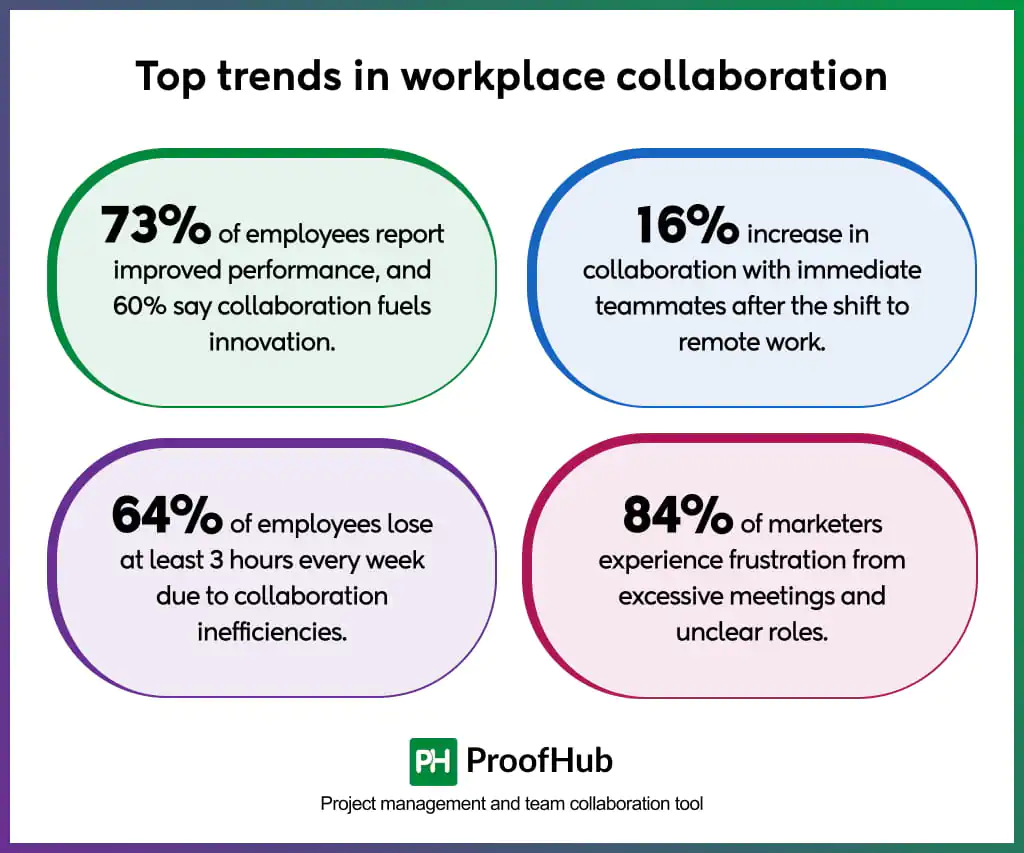
1. According to Deloitte’s study “Delivering on the Promise of Digital Collaboration” published in January 2018, 73% of employees engaged in collaborative work report improved performance, while 60% say it fuels innovation. This highlights how effective teamwork and collaboration directly drive individual productivity and overall team success.
2. According to a 2022 Global Collaboration Survey by Corel Corporation, 64% of employees lose at least three hours each week due to collaboration inefficiencies, while 20% waste as much as six hours, representing a substantial productivity drain – time that could be redirected toward higher-value work with the right collaboration tools and well-defined processes in place.
3. A Gartner survey of 329 marketing leaders and 78 cross-functional leaders conducted between July and August 2023 found that 84% of marketers report frustration and inefficiency caused by excessive meetings, redundant feedback loops, and unclear roles. These collaboration breakdowns reduce job satisfaction and directly impair an organization’s ability to achieve revenue targets, underscoring the strong link between ineffective collaboration and business performance.
The same survey reveals that CMOs reduce collaboration drag by as much as 23% through targeted skill-building initiatives and strategic talent investments. Organizations unlock significant productivity gains by fostering a culture of effective collaboration.
4. A 2021 Future of Work report by Humanyze revealed that the pandemic drove a 16% increase in collaboration with immediate teammates—employees whom people rely on most and interact with regularly. At the same time, collaboration with peripheral colleagues outside one’s core team declined by 21%. This shift toward remote work has significantly reshaped how employees interact, potentially constraining cross-functional innovation, since these weaker ties are often a critical source of new ideas and perspectives.
5. According to the report “It’s Time to Talk About People Success” by the Executive Learning Exchange (ELE), companies that implemented agile engagement programs, such as conducting four or more regular check-ins per year, achieved growth rates up to 10× higher within 12 months than organizations using traditional approaches, highlighting the measurable impact of frequent feedback and agile engagement on organizational performance and reinforcing their role as powerful drivers of sustained growth.
6. According to the 2023 Work in America Survey, nearly three-quarters of office workers report having control over where they work within the office, and 81% of employees with a positive workplace experience cite workspace choice as essential, showing physical workspaces are a critical element of effective collaboration. A flexible environment significantly influences how employees feel and perform. Modern offices now offer a mix of spaces for focused work, collaboration, and rejuvenation, creating a balanced environment that supports productivity.
7. According to McKinsey’s 2022 research, “Hybrid work: Making it fit with your diversity, equity, and inclusion strategy,” 75% of employees prefer hybrid work models, but the study highlights that without intentional design, hybrid work poses risks to diversity, equity, and inclusion outcomes, without quantifying specific mitigation rates.
8. A report on “AI-powered success—with more than 1,000 stories of customer transformation and innovation” by Microsoft found that organizations achieved 50% faster decision-making and a 40% reduction in analytics errors. Artificial intelligence is actively enhancing collaboration by enabling teams to adapt faster, make better-informed decisions, and move forward with greater confidence, supporting a more adaptive and responsive approach to team projects.
9. According to a Fierce, Inc. survey on workplace collaboration, published at the ASTD 2011 International Conference & Exposition in Orlando, FL (May 23, 2011), 86% of business leaders attribute workplace failures to a lack of collaborative teamwork, showing how critical teamwork is to success, suggesting that nurturing collaboration helps prevent project delays and inefficiencies.
10. The Q12®: The world’s leading employee engagement survey by Gallup found that highly engaged teams experience up to an 18% increase in sales productivity, driven in part by stronger collaboration. By enabling better coordination and shared accountability, collaborative efforts directly translate into higher revenue, highlighting the bottom-line impact of effective teamwork.
11. According to HubSpot’s 2025 report, The State of Marketing, 28% of marketers say collaboration improves visibility. This indicates that cross-team collaboration in marketing helps expand reach and strengthen brand awareness and recognition.
Growing use of collaboration tools
The shift toward digital collaboration is accelerating, with businesses increasingly relying on technology to bridge distances and support remote teams. As more organizations adopt collaboration software, the market is poised for significant growth, driven by the demands of hybrid and remote work.
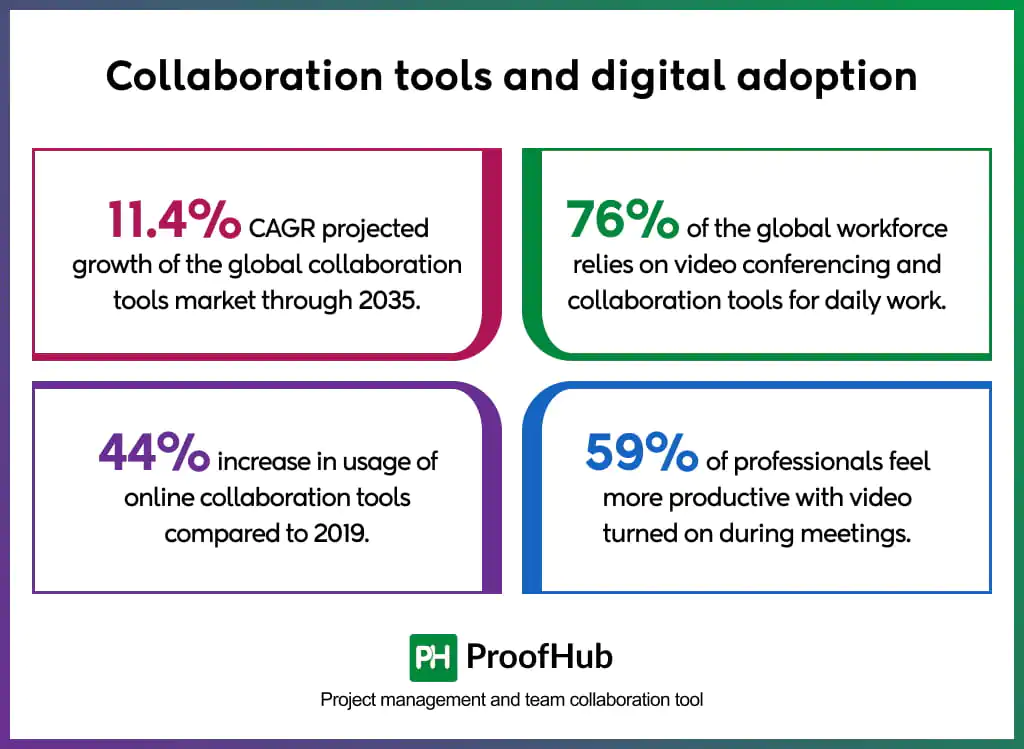
12. According to the report “Collaboration Tools Market Size and Share Forecast Outlook 2025 to 2035,” the global collaboration tools market is expected to expand from USD 48.9 billion in 2025 to USD 143.9 billion by 2035, growing at a strong CAGR of 11.4% over the forecast period. This sustained growth underscores the rising demand for collaboration tools that enable distributed work, improve workflow efficiency, and drive productivity across teams.
13. The 2021 Work Trend Index Report by Microsoft found that 76% of the global workforce relies on video conferencing and other collaboration tools, making virtual meetings a core part of daily operations, especially as hybrid work models continue to expand.
14. According to Gartner’s 2021 Digital Worker Experience Survey, the use of online collaboration tools increased by 44% compared to 2019, spurred by remote work demands. In the same year, 48% of organizations planned to increase their collaboration software budgets, underscoring the growing importance of these tools in sustaining productivity and team cohesion in distributed work environments.
15. A survey report, “Young employees aren’t embracing video conferencing any more than older colleagues,” by Forbes India, revealed that 47% of Baby Boomers never turn on their cameras during video meetings, compared to just 22% of Gen Z employees, highlighting a clear generational gap in comfort and willingness to use video during remote collaboration.
16. According to a 2021 survey commissioned by Zoom and conducted by Morning Consult, 59% of professionals feel more productive with video on, and 61% report improved job performance, underscoring the role of video in increasing engagement, focus, and perceived professionalism during remote interactions.
The growing reliance on collaboration tools showcases their importance in building effective teams, with companies reporting streamlined communication, increased productivity, and alignment with organizational goals.
Remote and hybrid work collaboration
Relying on collaboration tools without a clear strategy creates fragmentation. As remote work matures, businesses implement structured collaboration approaches to unify home and office teams.
A LinkedIn poll titled “Which collaboration style works best for remote teams?” conducted by Vartika Kashyap, CMO at ProofHub, found that 40% of professionals consider daily standups the most effective way to stay connected in remote work. Another 22% preferred informal check-ins, while 20% prioritized periodic feedback. Together, these responses underscore the need to balance structured routines with flexible, relationship-driven interactions in distributed teams.
The findings also point to a broader challenge for hybrid teams: sustaining consistent collaboration and productivity when employees operate across both remote and in-office environments.
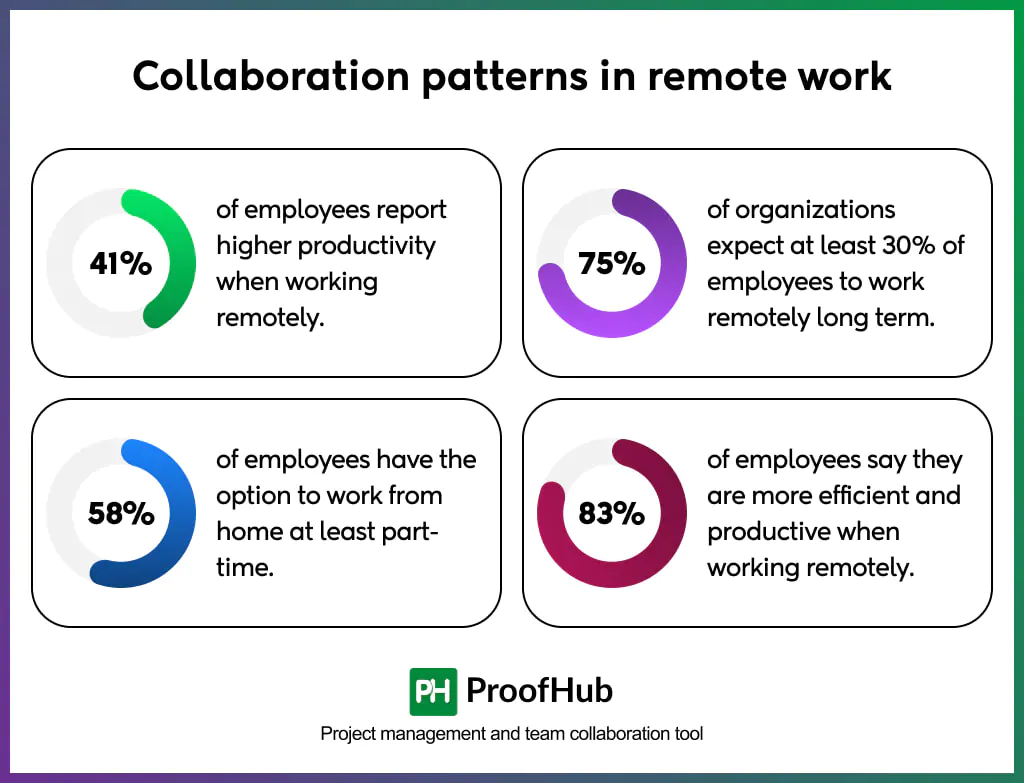
17. A McKinsey report titled “What’s Next for Remote Work: An Analysis of 2,000 Tasks, 800 Jobs, and Nine Countries” by Susan Lund, Anu Madgavkar, James Manyika, and Sven Smit (November 2020) found that 41% of employees reported higher productivity when working remotely than in traditional office settings. As employees gained experience with remote work, confidence in their productivity increased, indicating that effective collaboration extends beyond physical offices when supported by the right tools and practices.
18. A Capgemini Research Institute report titled “The Future of Work: From Remote to Hybrid,” published in 2020, indicates that 75% of organizations expect at least 30% of their employees to work remotely, while over 30% anticipate that 70% of their workforce will be remote. This shift is strongly influenced by the entry of Gen Z into the workforce, who place a high priority on flexible work arrangements.
19. According to Gallup’s 2022 “Global Indicator: Hybrid Work” research, fully remote work arrangements are expected to continue declining from three in 10 remote-capable employees in June to two in 10 in the long term, despite 34% of employees expressing a preference to work from home permanently.
20. According to a McKinsey poll conducted between March 15 and April 18, 2022, based on responses from 25,062 adults aged 18 and older across the continental United States, Alaska, and Hawaii, 83% of employees report being more efficient and productive in remote work settings. However, a notable disconnect remains: only half of HR leaders consider productivity a primary benefit of remote work. This perception gap creates a critical challenge for managers, who must reconcile employee experiences with organizational expectations.
21. The third edition of McKinsey’s American Opportunity Survey reveals that 58% of employed respondents have the option to work from home at least part-time, highlighting the growing acceptance of remote work as an integral part of company culture.
22. According to a McKinsey report titled “What’s next for remote work: An analysis of 2,000 tasks, 800 jobs, and nine countries” by Susan Lund, Anu Madgavkar, James Manyika, and Sven Smit (November 2020), about 38% of corporate executives expect employees to work remotely for two or more days a week post-pandemic, indicating a strong trend towards hybrid models that combine both remote and in-office collaboration. However, only 19% anticipate employees working three or more days remotely, suggesting a balance is sought between flexibility and the benefits of in-person teamwork.
The shift toward hybrid work environments requires planning and thoughtful collaboration models to ensure that all team members, whether at home or in the office, work together efficiently.
The cultural aspects of collaboration
With teams becoming more interconnected, understand how cultural factors, including strong leadership and diverse perspectives, contribute to high-performing teams.
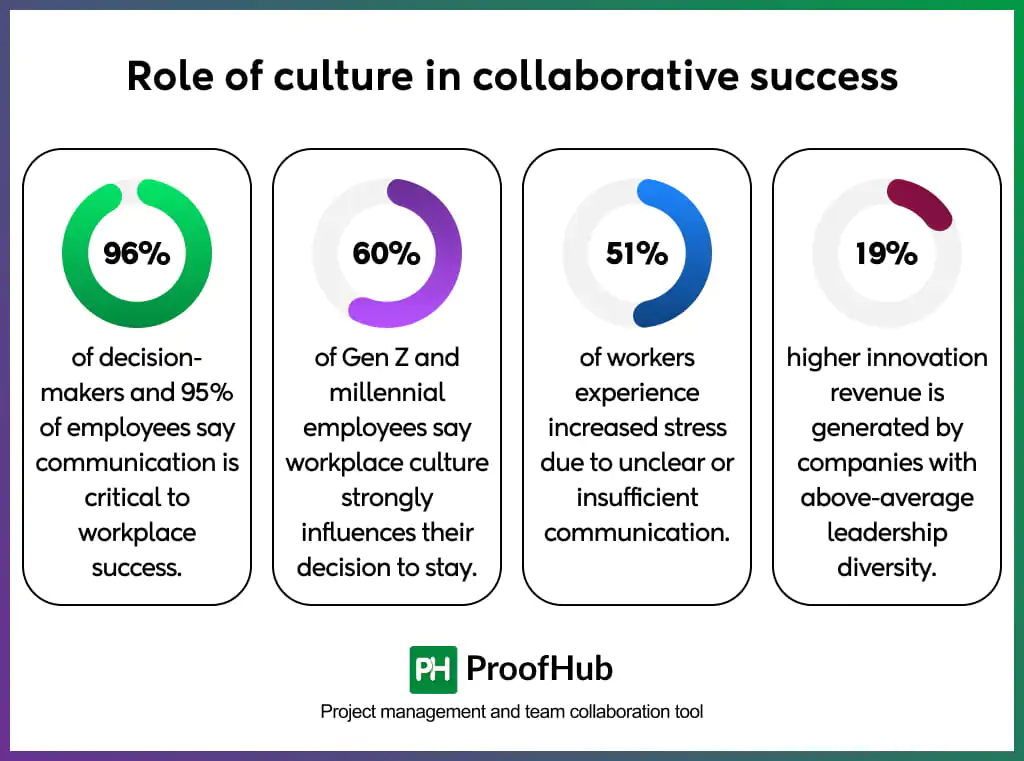
23. According to Microsoft’s Work Trend Index Special Report (2022), 96% of decision-makers and 95% of employees consider communication critical to workplace success. As teams become increasingly interconnected, clear communication helps prevent misunderstandings, keeps projects on track, and reduces unnecessary stress.
24. An EY US 2025 Generation Survey found that 60% of Gen Z and millennial employees say workplace culture has “a great deal” of influence on their decision to stay with their current employer, underscoring the importance of building a positive, inclusive culture to retain younger talent, who place a high value on cultural alignment and day-to-day work environment when evaluating long-term commitment.
25. According to the 2024 State of Business Communication report by Grammarly, 51% of workers report increased stress caused by unclear or insufficient communication, underscoring the importance of clear, structured communication in reducing cognitive strain and supporting both team well-being and sustained productivity.
26. According to a Bain & Company study of 1,250 companies, research across top leadership teams in 11 industries shows that the most effective teams consistently demonstrate five behaviors: strategic alignment, disciplined execution, collaboration, adaptability, and drive. Yet, a 2020 survey by the Center for Creative Leadership found that 65% of executives still rate their own leadership teams as ineffective, highlighting a persistent gap between what effective leadership requires and how teams operate.
27. According to BCG’s 2017 diversity and innovation survey, companies that reported above-average diversity in their management teams also generated significantly higher innovation revenue – 19% points more than companies with below-average leadership diversity (45% of total revenue versus 26%), demonstrating a strong link between leadership diversity and an organization’s capacity to innovate and commercialize new ideas.
From enabling high-value collaboration and offering flexible work environments to investing in agile engagement models and modern technology, organizations have clear pathways to strengthen teamwork. For companies willing to commit to these areas, the returns transform both the employee experience and overall organizational performance.
Challenges to collaboration
Organizations address collaboration barriers to reduce miscommunication, break down silos, and support remote teams. Communication breakdowns and organizational silos create more obstacles to collaboration than workload or team dynamics.
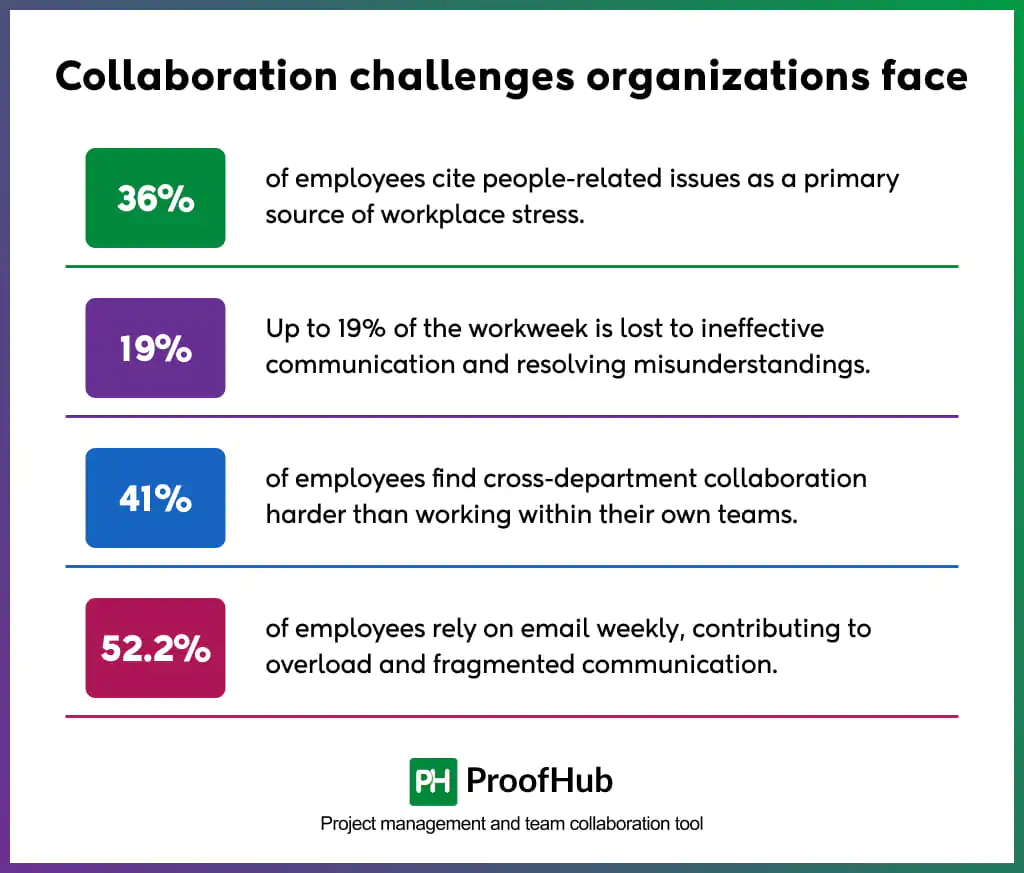
28. According to the 2019 StressPulseSM survey by ComPsych, with 36% of respondents citing people-related issues as a primary source of stress, it’s clear that poor team interactions significantly amplify workplace stress, underscoring the need for effective collaboration frameworks.
29. According to The State of Business Communication report by the Harris Poll on behalf of Grammarly, business leaders estimate that the consequences of ineffective communication, including time spent resolving misunderstandings, missed deadlines, and repeated follow-ups, consume up to 19% of their team’s workweek. Structured communication channels are essential to keep teams aligned and productive.
30. A 2025 Gallup report, State of the Global Workplace, found that 41% of employees find it more challenging to collaborate across departments than within their own teams, indicating a need for improved coordination across organizational silos.
31. According to the survey titled “Global Indicator: Employee Engagement” conducted by Gallup in 2023, unengaged and actively disengaged employees contribute to an estimated $1.9 trillion in lost productivity across the U.S. annually. Effective managerial support plays a pivotal role in reducing disengagement, thereby improving productivity and collaboration in the workplace.
32. According to research titled “Workplace Communication Statistics: Fresh Data for 2026” conducted by EmailTooltester, email remains the most widely used workplace communication tool, with 52.2% of employees relying on it at least once a week. However, this heavy reliance on email often leads to information overload, delayed responses, and fragmented conversations, hindering seamless collaboration and effective team communication.
33. A Skillsoft survey, “Skillsoft’s Workplace Challenges and Preparedness Research,” conducted in 2024 among 2,100 workers, found that just 48% understand their organization’s priorities, with only 40% clear on their role in achieving them, highlighting a significant gap in alignment and role clarity across teams.
34. According to the study “Workplace isolation: Salespeople and supervisors in the USA” by Mulki, J. P., and Jaramillo, F., published in The International Journal of Human Resource Management (2011), remote employees experiencing isolation report a 21% drop in performance, highlighting the importance of inclusive, connected team environments to sustain performance.
These challenges highlight the urgent need for clear communication channels, transparency, and more cohesive frameworks to help teams work together, in-person or remotely.
Making collaboration a strategic priority
Effective collaboration is a strategic necessity for aligning teams, accelerating execution, and sustaining performance at scale. Intentionally designed collaboration strategies improve productivity, reduce burnout, and strengthen employee engagement.
35. According to the “Inclusive Collaboration at Work” survey conducted by RallyBright in June 2022, organizations with high levels of collaboration report employee burnout at 20.7%, compared to 41.9% in low-collaboration environments, cutting burnout rates in half through stronger support networks. A collaborative environment serves as an emotional buffer, promoting resilience and engagement.
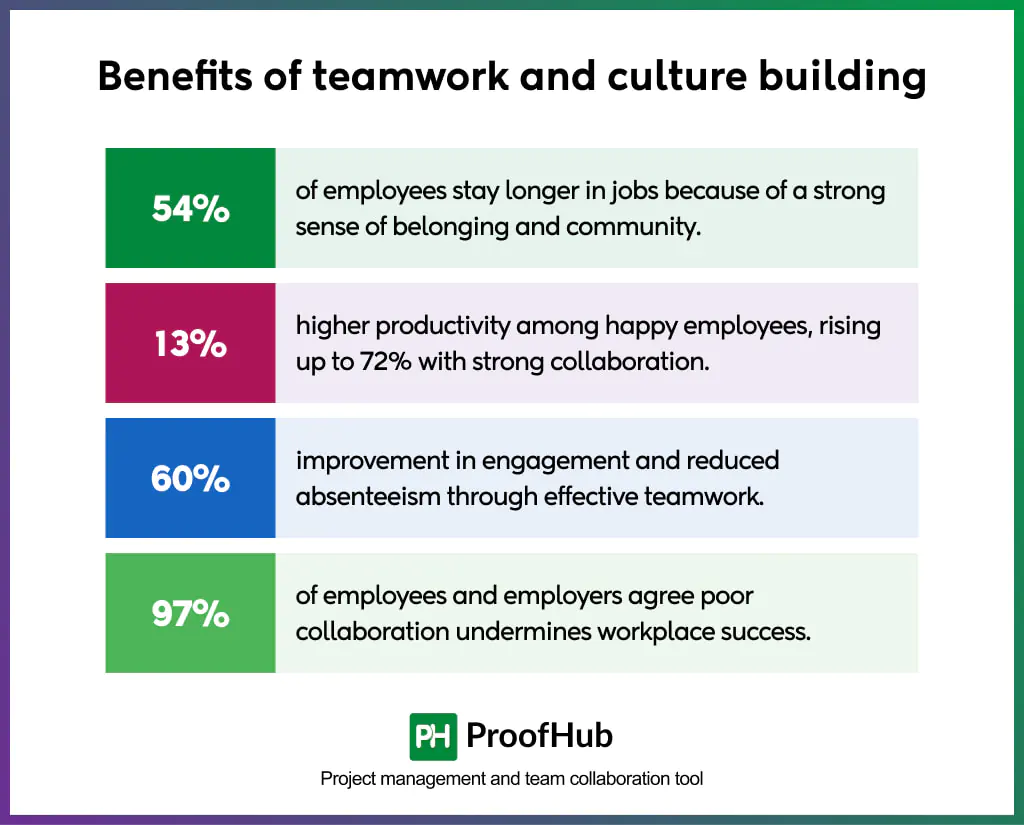
36. According to Gusto’s Community at Work report, conducted online by Google Consumer Surveys on July 21, 2016, 54% of employees stayed in a job longer than was in their best interest because of a strong sense of belonging and community – driven by supportive coworkers, shared celebrations, and a common mission, highlighting how interpersonal connections often outweigh rational career decisions.
37. A research study, “Does Employee Happiness Have an Impact on Productivity?” by Oxford University’s Saïd Business School, conducted in collaboration with British multinational telecom firm BT and led by Jan-Emmanuel De Neve (University of Oxford), George Ward (MIT), and Clément Bellet (Erasmus University Rotterdam), revised in 2023, revealed that happy employees are 13% more productive, with effectiveness increasing by up to 72% when collaboration levels are high. Positive team dynamics amplify these gains by reinforcing both morale and performance.
38. According to a research study, “Enhancing the Effectiveness of Work Groups and Teams” by Steve W.J. Kozlowski and Daniel R. Ilgen, published in 2006, effective teamwork can reduce absenteeism and enhance engagement by 60%, supporting a culture of commitment to shared goals.
39. A Fierce, Inc. survey on workplace collaboration, published at the ASTD 2011 International Conference & Exposition in Orlando, FL (May 23, 2011), revealed that 97% of employees and employers agree that a lack of collaboration undermines workplace success, underscoring the critical role of teamwork in achieving organizational goals.
40. A research titled “An Experimental Study of Team Size and Performance on a Complex Task” by Andrew Mao, Winter Mason, Siddharth Suri, and Duncan J. Watts, published on April 15, 2016, reveals that teams of three to five members perform best when solving complex problems, as they share and validate ideas efficiently. However, two-person teams completed assembly tasks faster than larger teams, suggesting that team size should be tailored to task complexity.
By keeping collaboration at the forefront, companies create a more productive, connected, and resilient workforce, one that not only achieves goals but surpasses them.
Managerial impact on engagement and culture
Managers play a vital role in cultivating collaborative and engaged teams. Effective leadership and a culture of trust are fundamental to employee satisfaction and retention.
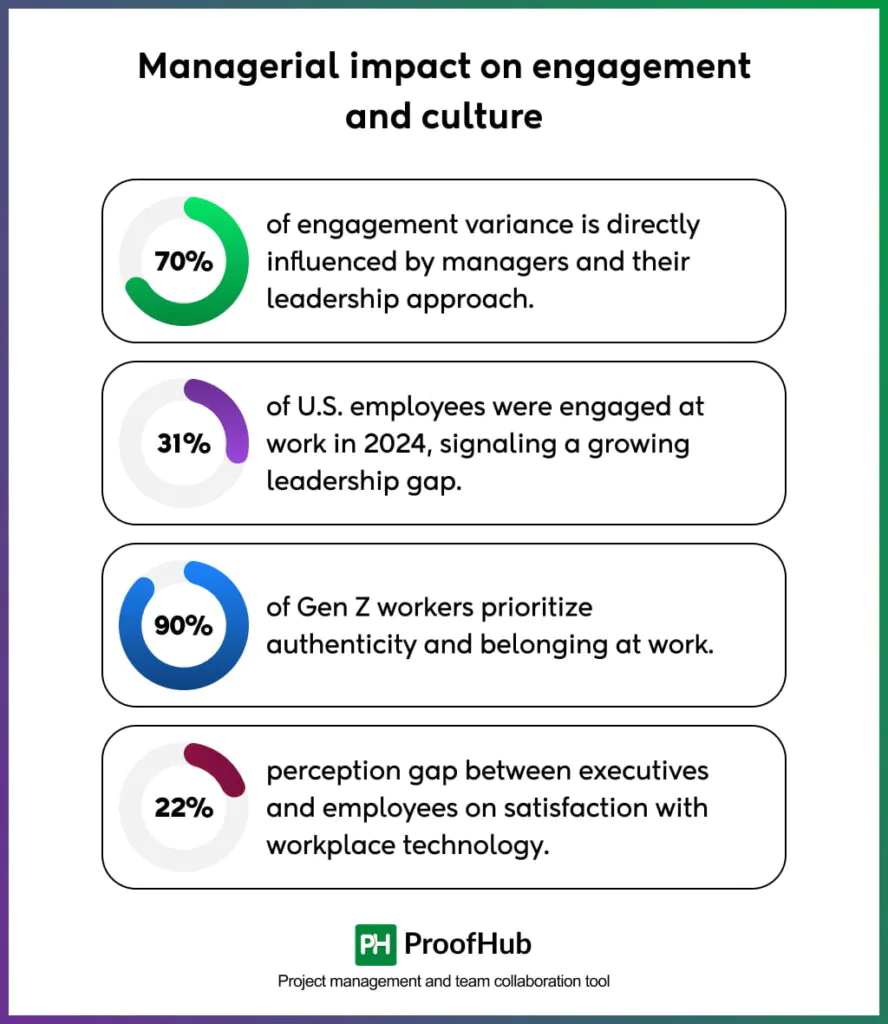
41. According to the Gallup Q12® Meta-Analysis: 11th Edition, titled “The Relationship Between Engagement at Work and Organizational Outcomes” by James K. Harter, Corey E. Tatel, Sangeeta Agrawal, Anthony Blue, Stephanie K. Plowman, Jim Asplund, Sabrina Yu, and Andy Kemp in 2024, managers account for 70% of the variance in employee engagement, underscoring their influence in building collaborative teams. Managers who actively collaborate with employees drive higher engagement and, consequently, performance.
42. According to the survey titled “Global Indicator: Employee Engagement” conducted by Gallup, only 31% of U.S. employees were engaged at work throughout 2024, a decline from the peak engagement rate of 36% in 2020. This engagement gap highlights the need for managers to actively strengthen team connections, set clear expectations, and support employees’ alignment with organizational goals to enhance collaboration.
43. A 2023 EY Gen Z Segmentation Study titled “How can understanding the influence of Gen Z today empower your tomorrow?” found that over 90% of Gen Z workers prioritize authenticity, indicating that being true to oneself is among their highest values. If they feel they cannot be their authentic selves at work, they are likely to seek opportunities elsewhere. This statistic underscores the necessity for managers to create environments that support individual authenticity and promote a sense of belonging.
44. A survey titled “Our status with tech at work: It’s complicated,” conducted by PwC in October 2018, revealed that while 90% of C-suite executives are satisfied with the technology their company provides for critical work, only 68% of employees feel the same way. This gap underscores the need for managers to actively seek feedback from their teams and address their unique technology challenges.
45. According to a survey titled “Decision making in the age of urgency” conducted by McKinsey & Company in April 2019, organizations that empower employees to make delegated decisions are 3.9 times more likely to succeed. When managers provide coaching and create safe spaces for experimentation, they build a collaborative culture with a strong sense of ownership and accountability across the team.
When managers support authenticity, address employee needs, and empower decision-making, they create engaged, aligned, and resilient work cultures. Managerial effectiveness influences how well teams collaborate and sustain performance over time.