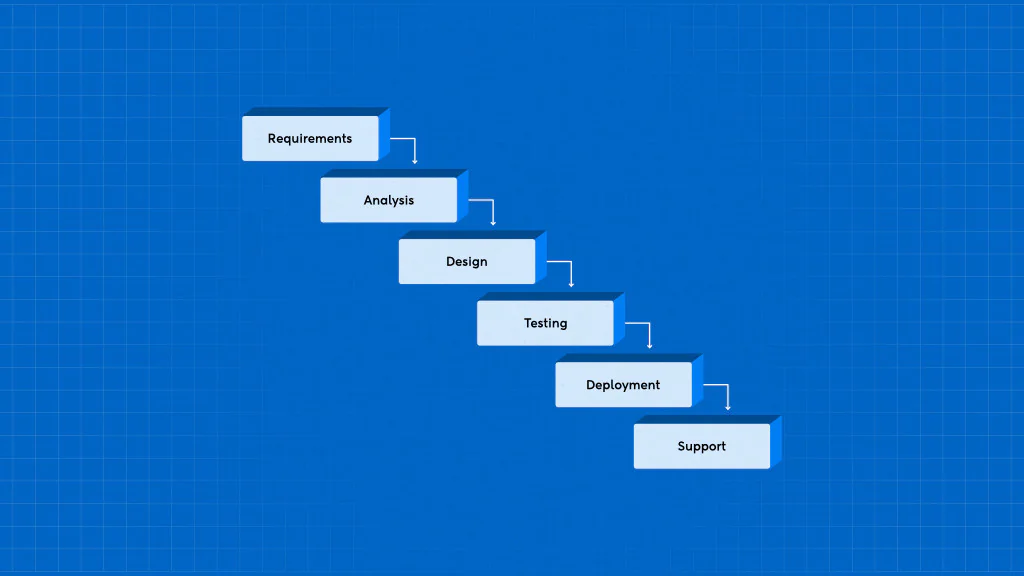
The Waterfall methodology is one of the oldest and most structured approaches to project management. It breaks projects into distinct phases, with each stage completed before the next begins.
This makes planning, budgeting, and tracking progress more predictable. However, its rigid structure can make adapting to changes difficult.
So, when does Waterfall make sense, and when should teams consider another approach? Let’s explore its phases, advantages, disadvantages, and practical use cases.
- 1.Waterfall methodology is a linear, sequential project management approach. Each phase finishes before the next one begins.
- 2.The six phases are requirements, design, implementation, verification, deployment, and maintenance.
- 3.Waterfall suits projects with stable requirements, strict regulation, and strong sequential dependencies.
- 4.Its main weaknesses are limited flexibility, delayed testing, late feedback, and late delivery of working software.
- 5.Agile uses short iterative cycles. Waterfall relies on upfront planning and formal phase approvals.
- 6.Many teams combine both approaches in a hybrid methodology, using waterfall for planning and Agile for execution.
What is Waterfall methodology?
Waterfall methodology is a linear, sequential approach to project management. Work moves through fixed phases in order, such as requirements, design, implementation, verification, deployment, and maintenance.
Each phase must finish and receive approval before the next one starts. The scope, schedule, and budget are defined upfront and the plan is followed. The name reflects progress flowing downward from one phase to the next, like a waterfall.
Brief history and origins of the Waterfall methodology
The waterfall methodology was first described by Winston Royce in his 1970 paper on managing large software systems. Royce actually pointed out the risks of a strict single pass approach and recommended feedback between stages.
The term waterfall was applied later, and the methodology spread through the 1970s and 1980s. Government agencies, including the US Department of Defense, adopted it for large software contracts. It became the foundation of traditional plan-driven project management and the software development life cycle.
What are the advantages of using Waterfall methodology?
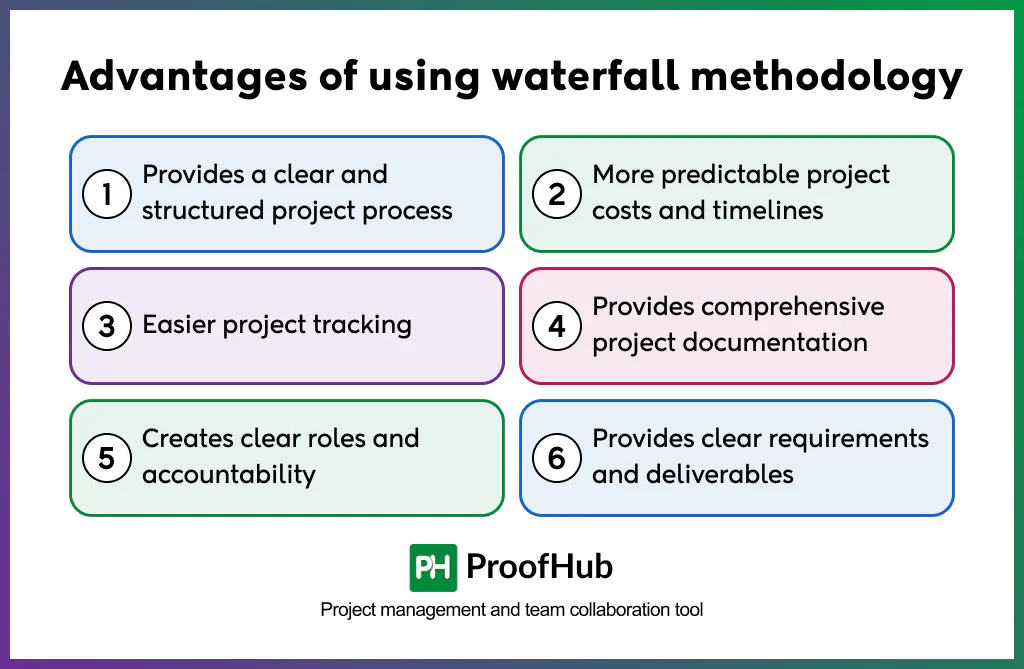
The key advantages of using waterfall methodology includes: a clear and structured project process, more predictable project costs and timelines, easier project tracking, comprehensive project documentation, clear roles and accountability, and clear requirements and deliverables.
Waterfall is beneficial for large projects with many contributors and strict oversight. It follows the same principle: define everything first, then execute in order.
- Provides a clear and structured project process: Every phase has a defined start, end, and set of tasks. Team members know what happens next and what is expected of them. It reduces confusion, especially on projects with large teams, multiple departments, or outside vendors.
- More predictable project costs and timelines: Produces a fixed scope, baseline schedule, and budget estimate. Stakeholders can forecast spending and delivery dates early. Fixed price contracts and long term resource planning depend on this predictability.
- Easier project tracking: Milestones and phase gates give managers clear checkpoints. It enables managers to measure progress against the original plan and detect deviations from the baseline early.
- Provides comprehensive project documentation: Each phase produces written deliverables such as requirements specifications, design documents, and test reports. It supports audits, onboarding, and future maintenance. Project knowledge stays available even when team members leave.
- Creates clear roles and accountability: Each phase assigns responsibilities to specific people, so everyone knows their area of responsibility. It makes it easier to resolve issues, review performance, and assign follow up work.
- Provides clear requirements and deliverables: Requirements are agreed and documented before design starts. Teams and clients share the same expectations about outputs. This reduces scope disputes and gives everyone a reference for acceptance criteria and final sign off.
What are the disadvantages of Waterfall methodology?
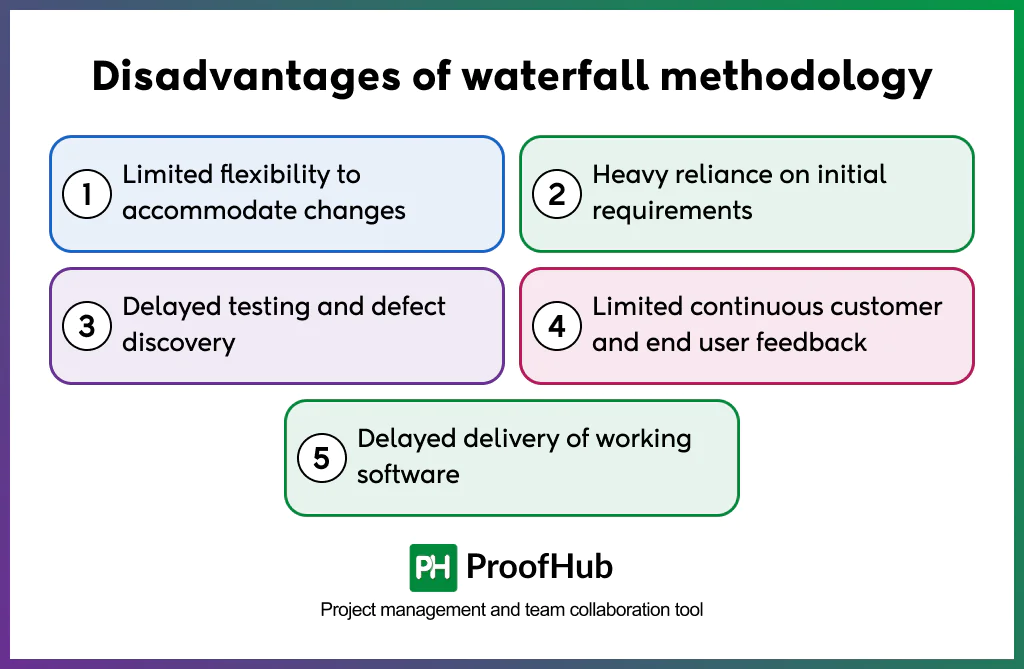
Disadvantages of the waterfall methodology are: limited flexibility to accommodate changes, heavy reliance on initial requirements, delayed testing and defect recovery, limited continuous customer and end user feedback, and delayed delivery of working software.
These risks grow with project size and uncertainty.
- Limited flexibility to accommodate changes: Once a phase closes, going back is difficult. Change requests require formal review and often trigger rework, schedule delays, and extra cost. Teams struggle to respond to new market conditions or shifting business priorities.
- Heavy reliance on initial requirements: The whole plan rests on requirements gathered at the start. Missing, vague, or incorrect requirements carry through every later phase. Errors often surface late, after design and build work is already complete.
- Delayed testing and defect discovery: Verification happens only after implementation ends. Defects in design or code are found late, when fixes cost more. A strict sequential methodology does not let testing overlap with development.
- Limited continuous customer and end user feedback: Clients review work at phase gates, not during construction. Users may see the product only at launch. Mismatches between the delivered product and real needs appear too late to correct cheaply.
- Delayed delivery of working software: Nothing usable ships until late in the lifecycle. Stakeholders wait months or even years for value. Competitors or changing needs can make the final product less relevant by the time it is released.
What are the phases of the Waterfall methodology?
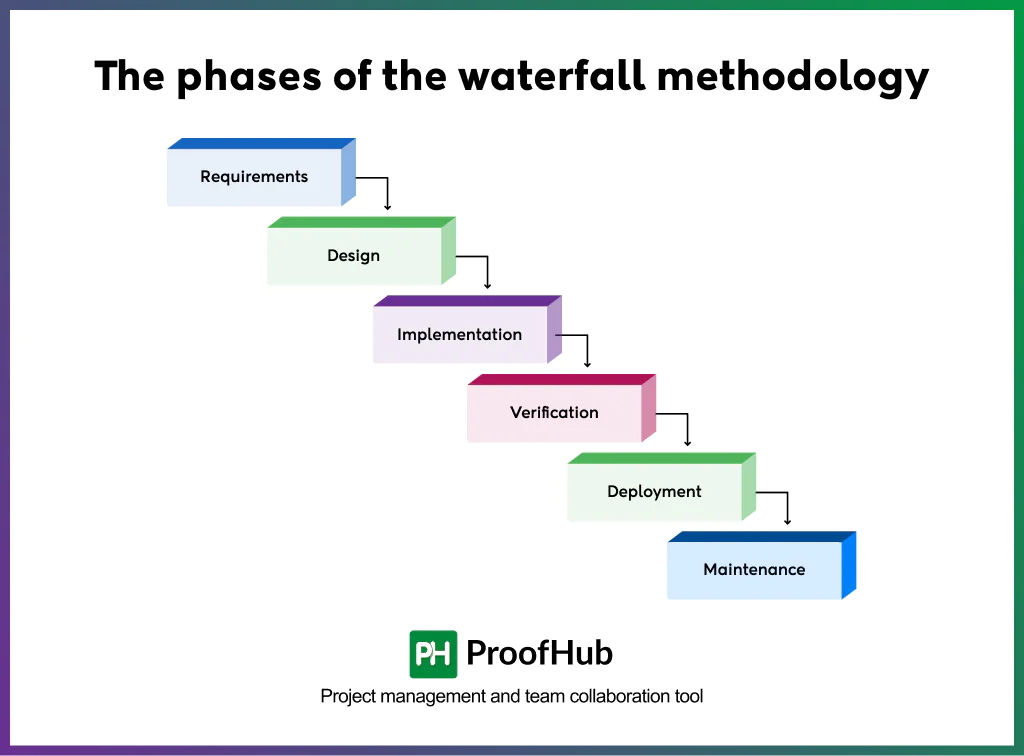
The six phases of the waterfall methodology are requirements, design, implementation, verification, deployment, and maintenance.
Each phase has defined inputs, activities, and outputs. A phase gate review confirms that deliverables meet standards before the team moves on. Names vary by organization, but most versions of the waterfall lifecycle follow the six phases below. Together they take a project from initial concept to long-term support.
1. Requirements
The requirements phase defines what the project must deliver. Needs from stakeholders, users, and regulators are gathered through interviews, workshops, and document reviews. Functional and nonfunctional requirements are recorded in a requirements specification.
Scope, constraints, risks, and acceptance criteria are set by the project manager. Stakeholders sign off on the document, which becomes the baseline for every later phase and the reference for change control.
2. Design
The design phase turns requirements into a technical and structural plan. System architecture, data models, interfaces, and user flows are defined by Architects and designers.
They often work in two levels: high-level design for overall structure and detailed design for components. Teams produce and review design documents, wireframes, and technical specifications. Approval locks the design so developers can build without ambiguity.
3. Implementation
In the implementation phase, the product is built by developers according to approved design. Code is written, components are integrated, and infrastructure is configured.
The work is divided into modules or tasks and assigned according to the specialty. Project progress is tracked against the project schedule and milestones.
Unit testing also occurs in this phase, but full system testing is done in the verification phase. Changes to scope require formal change control.
4. Verification
The verification phase ensures the product meets the documented requirements. Check integrations, performance, user acceptance criteria and overall systems. Log defects, fix, retest until quality criteria are met and record the test reports.
Because testing starts after the build phase, defects found here require rework in earlier phases. Customer acceptance closes this phase.
5. Deployment
The deployment phase releases the finished product into the live environment. Teams migrate data, install or configure systems, and complete release checks.
Users receive training and support materials. Some projects use a phased rollout, while others launch all at once. Operations teams take handover, and the project formally moves toward closure after final approval.
6. Maintenance
The maintenance phase keeps the product working after release. Teams fix bugs, apply security patches, and make small enhancements. They also handle user support and performance monitoring.
Major changes may start a new waterfall cycle with fresh requirements. This phase often lasts longest and carries ongoing costs. Good documentation from earlier phases makes maintenance faster and cheaper.
When should you use the waterfall methodology?
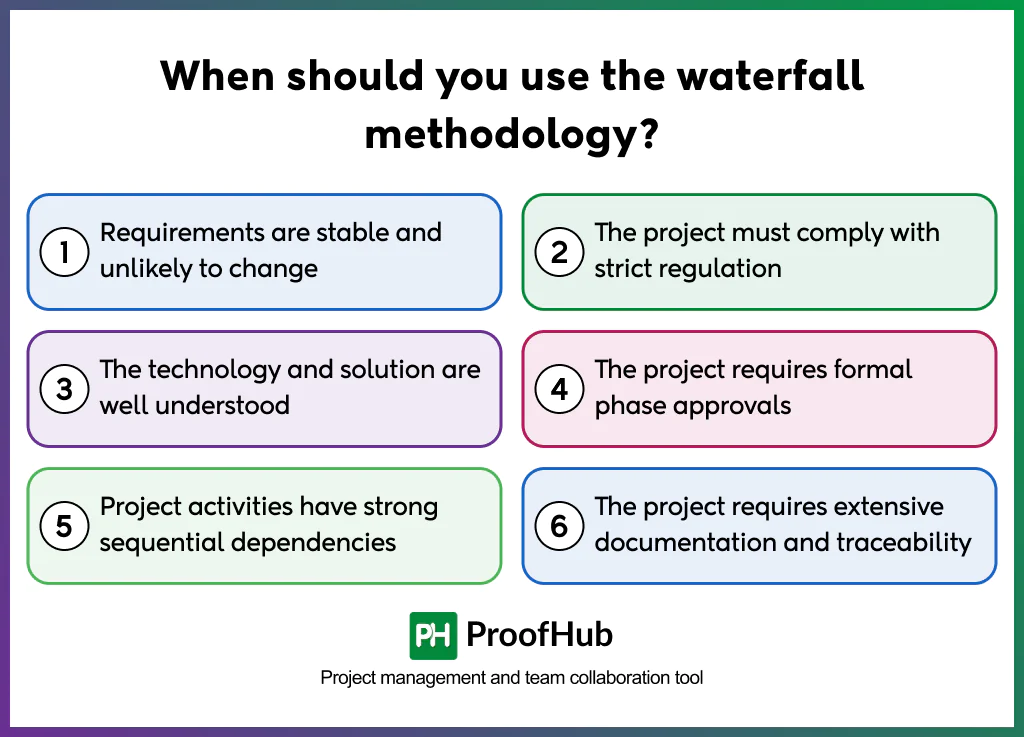
Use the waterfall methodology when: requirements are stable, project requires strict regulatory compliance, technology is well-understood, phases are formally approved, dependencies are sequential, and project needs extensive documentation.
The more conditions that apply, the stronger the case for choosing it. Teams in construction, defense, and healthcare often meet several of them.
Let’s understand in detail when to use the waterfall methodology:
- Requirements are stable and unlikely to change: Fixed requirements let teams plan fully up front. The sequential process reduces rework and keeps scope under control. Clear, signed-off needs are the strongest sign that waterfall fits the project.
- The project must comply with strict regulation: Regulated sectors require documented evidence of key decisions and tests. Waterfall phase gates and written records create the audit trail that regulators expect. Examples include medical devices, aviation, and public sector systems.
- The technology and solution are well understood: When the team has built similar products before, few unknowns remain. Estimates are reliable, and design decisions can be made early. Low technical uncertainty reduces the need for experimentation.
- The project requires formal phase approvals: Some organizations require sponsor or committee sign-off at each stage. Waterfall phase gates match these governance rules. Funding can be released in stages tied to approved deliverables.
- Project activities have strong sequential dependencies: Some tasks cannot start until others finish, such as pouring a foundation before framing a building. A linear plan matches this logic and prevents out of order work.
- The project requires extensive documentation and traceability: Contracts, audits, and safety cases need records that link requirements to design, tests, and results. Waterfall produces these artifacts as a normal output of each phase.
When should you avoid the waterfall methodology?
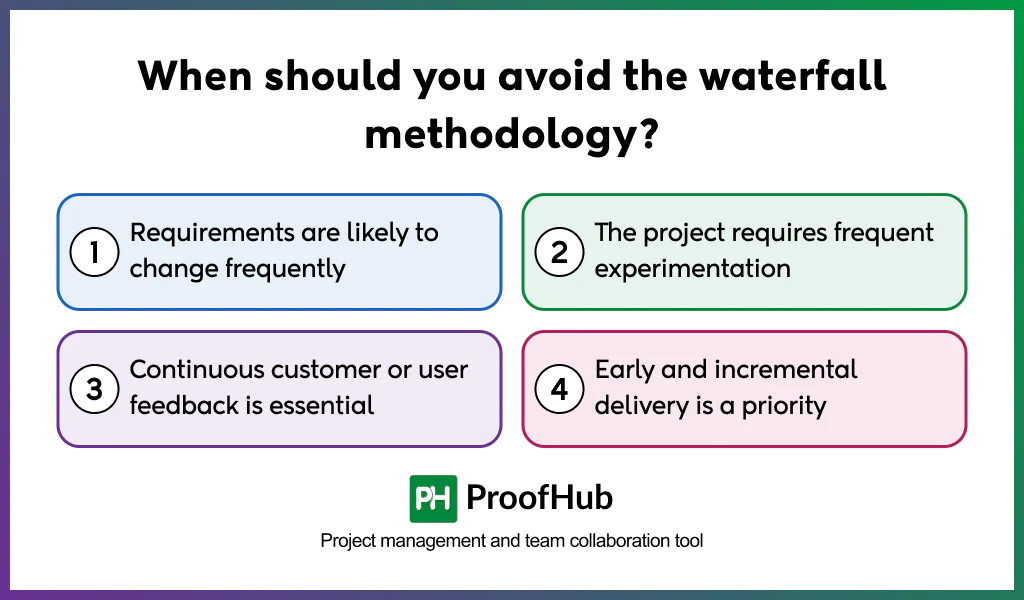
Avoid the waterfall methodology when the requirements are likely to change frequently, the project requires frequent experimentation, continuous customer or user feedback is essential, and early and incremental delivery is a priority.
Waterfall methodology is a poor fit when uncertainty is high. A rigid sequence makes it hard to adapt, test ideas, or respond to users.
Projects that depend on discovery, rapid learning, or changing priorities need a more flexible approach. Agile approaches such as Scrum and Kanban handle these conditions better.
Choosing the wrong methodology often leads to missed deadlines and rework. Check for the signs below early in planning.
- Requirements are likely to change frequently: Market shifts, evolving client needs, or unclear goals make early requirements unreliable. Each change in a waterfall plan can trigger formal review and rework. An adaptive approach absorbs change at lower cost.
- The project requires frequent experimentation: Product discovery, research work, and new technology builds depend on trial and error. Waterfall assumes the solution is known up-front. Iterative cycles let teams test hypotheses and adjust quickly.
- Continuous customer or user feedback is essential: Products shaped by user behavior need regular reviews and demos. Waterfall delays feedback until late phases. Agile sprints give stakeholders working increments to react to every few weeks.
- Early and incremental delivery is a priority: If the business needs value quickly, waiting for a single final release is risky. Incremental delivery ships usable features early. This approach also reduces financial exposure if priorities change.
How is the waterfall method different from Agile methodology?
Waterfall and Agile methodology are two different approaches to managing project work. Waterfall is a sequential, plan driven methodology where phases run in order and scope is fixed early. Agile is an iterative, adaptive methodology that delivers work in short cycles called short iterations (sprints in Scrum).
Waterfall favors documentation, predictability, and formal approvals. Agile favors collaboration, flexibility, and frequent feedback. Waterfall suits stable, regulated projects. Agile suits evolving products with uncertain requirements. Teams usually choose between them based on risk, change, and customer involvement. The table below compares the main differences.
Examples of Waterfall methodology used in project management
The examples below show how organizations apply waterfall phases in practice. Each one relies on upfront planning, formal approvals, and thorough documentation to control risk and cost. These cases also show why teams in these fields rarely change scope midway.
1. Construction projects
Construction follows a natural waterfall. Architects and clients agree to requirements and approve designs before any building begins. Site preparation, foundation, framing, and finishing must happen in order.
Permits and inspections act as phase gates. Changes after construction starts are expensive, so detailed blueprints and specifications are completed first. This sequence keeps cost, safety, and quality under control on large builds.
2. Government information systems
Government agencies often use waterfall for large information systems such as tax, benefits, or records platforms. Procurement rules require fixed scope, budgets, and contract milestones. Each phase ends with documented approval from oversight bodies. Detailed requirements and audit trails support transparency and accountability.
Formal verification and acceptance testing confirm compliance before systems go live. This structure suits public funding and long system lifecycles.
3. Medical device development
Medical device development must meet strict regulatory requirements, including the FDA Quality Management System Regulation (21 CFR Part 820), ISO 13485 for quality management systems, and ISO 14971 for risk management. Teams document design inputs, design outputs, verification, and validation in sequence.
Traceability links each requirement to a test and a result. Phase reviews confirm safety before the next stage. This waterfall style supports the evidence regulators need for approval. It also reduces patient risk caused by untested changes.
Is waterfall methodology still relevant?
Yes. Waterfall methodology remains relevant for projects with fixed scope, regulatory demands, and sequential dependencies. Construction, defense, healthcare, manufacturing, and public sector programs still rely on it. Agile has become popular in software, but many organizations still use waterfall or hybrid methodologies. The right choice depends on requirement stability, risk, and customer involvement, not on trend.
Can a project use both waterfall and Agile methodologies?
Yes. This combination is called hybrid project management. Teams often use waterfall for high-level planning, budgeting, and compliance, then use Agile sprints for development. Some hardware projects follow waterfall for physical design and Agile for software components. A hybrid methodology keeps governance and predictability while allowing iteration where requirements are uncertain.
How is risk managed in waterfall methodology?
Waterfall manages risk through early and thorough planning. Teams identify risks during requirements and design, record them in a risk register, and assign owners and responses. Phase-gate reviews check risks before approval. Contingency budgets and schedule buffers absorb surprises. Change control limits scope creep. The main weakness is that technical risks may surface late, during verification.
What is the difference between Waterfall and V-Model?
The V-Model extends waterfall by pairing each development phase with a matching testing phase. Waterfall tests after implementation. The V-Model plans tests early, alongside requirements and design. Both are sequential and plan driven. The V-Model is common in safety-critical systems.
How are project requirement changes handled in the Waterfall methodology?
Changes follow a formal change control process. A stakeholder submits a change request, and the team assesses its impact on scope, cost, schedule, and quality. A change control board approves, rejects, or defers it. Approved changes update the requirements baseline and project plan. Late changes may require rework in completed phases, which is why waterfall discourages them.
How are project delays managed in Waterfall methodology?
Project managers manage delays by reviewing the critical path, reallocating resources, and adjusting task sequences. Options include adding staff (crashing), overlapping tasks (fast-tracking), or reducing scope. Together they are called schedule compression. Stakeholders approve any revised timeline. Since phases depend on each other, a delay in one phase pushes back every later phase.
How are project requirements documented in Waterfall?
Requirements are recorded in a formal requirements specification, often called a software requirements specification or business requirements document. It lists functional and nonfunctional requirements, constraints, assumptions, and acceptance criteria. A traceability matrix links each requirement to design elements and tests. Stakeholders review and sign the document, and version control tracks approved changes.
Conclusion
Waterfall methodology is a linear, phase-based approach built on upfront planning, documentation, and formal approvals. Its six phases give projects structure, predictability, and clear accountability. Its limits are rigidity, late testing, and delayed feedback. The methodology fits stable, regulated, and dependency-driven work such as construction, government systems, and medical devices. Agile or hybrid approaches suit uncertain, fast-changing work. Evaluate requirement stability, regulatory needs, and customer involvement before choosing. Match the method to the project’s stability, risk, and customer involvement.