

Collaborative leadership is a leadership approach where authority, decision-making, and problem-solving are shared across teams to achieve aligned outcomes through transparency, trust, and collective accountability. This approach increases decision accuracy, strengthens alignment, and accelerates problem-solving by integrating diverse expertise into every stage of execution.
Collaborative leadership operates on core principles of inclusivity, transparency, mutual trust, empowerment, shared vision, adaptability, shared decision-making, constructive conflict resolution, and open communication. These principles create a structure in which teams have equal access to information, contribute to decisions, and move in the same direction with clarity.
There are a few challenges that leaders must navigate, including maintaining continuous communication, avoiding decision delays, resolving conflicts, managing diverse viewpoints, and supporting teams that hesitate to adopt shared ownership.
In this article, we discuss collaborative leadership: its definition, importance, benefits, core principles, implementation, common challenges, and examples.
What is collaborative leadership?
Collaborative leadership is a management approach where leaders share authority, problem-solving, and decision-making with teams to achieve aligned goals through transparency, open communication, and collective accountability.
This leadership style creates a structure where leaders enable participation, distribute influence, and coordinate expertise instead of directing work through top-down control. It emphasizes interaction quality, shared context, and coordinated execution so teams operate as a unified system.
Collaborative leadership focuses on building trust, clarifying expectations, and empowering members to contribute insights that strengthen decisions.
Why is collaborative leadership important?
Collaborative leadership is important because it improves decision quality, strengthens team alignment, accelerates problem-solving, and increases accountability across an organization.
This leadership approach integrates multiple perspectives, reducing blind spots and producing decisions supported by broader expertise. It improves alignment by ensuring teams understand shared goals, execution priorities, and interdependencies.
Collaborative leadership enhances adaptability as teams respond promptly to changing conditions when information flows openly, and authority is distributed. It increases accountability by making contributions visible and tying ownership to collective outcomes instead of individual authority. This creates a work environment where transparency, trust, and participation consistently improve performance.
What are the benefits of collaborative leadership?
Collaborative leadership enhances decision quality, accelerates execution, and builds an environment where teams perform better by sharing ownership of outcomes.
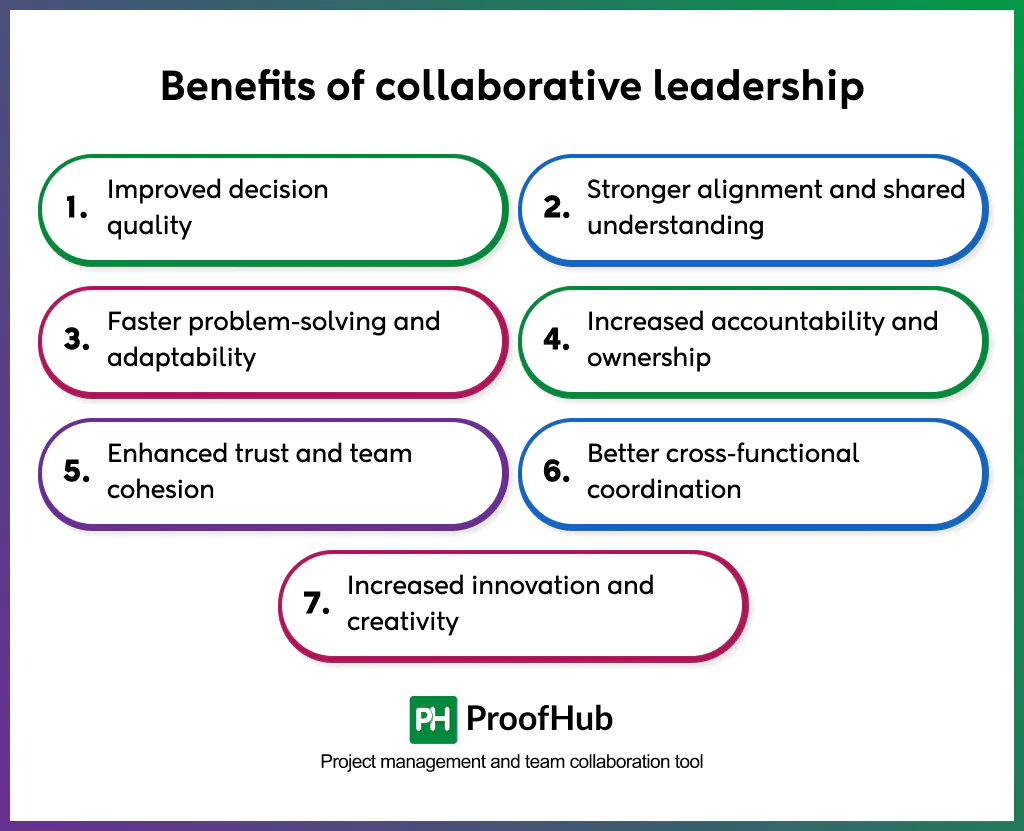
Here are the key benefits:
1. Improved decision quality
Collaborative leadership integrates diverse expertise into the decision-making process, reducing blind spots and strengthening the rationale behind choices. When teams contribute early and openly, leaders gain a broader context, more data, and alternative viewpoints, leading to more accurate and balanced decisions.
2. Stronger alignment and shared understanding
Teams operate with higher alignment because goals, expectations, and workflows are openly discussed rather than dictated. Consistent context-sharing ensures everyone understands priorities and interdependencies, reducing miscommunication and fragmented execution.
3. Faster problem-solving and adaptability
Open communication and collective reasoning allow teams to respond quickly to changes. When information flows freely and authority is distributed, teams resolve issues without waiting for top-down clarifications, making the organization more agile in dynamic environments.
4. Increased accountability and ownership
Collaborative leadership increases ownership by making contributions visible and tying progress to collective outcomes. When authority is shared and responsibilities are transparent, individuals are accountable not only to the leader but to the whole team, which elevates follow-through and commitment.
5. Enhanced trust and team cohesion
Mutual trust grows when leaders show transparency, fairness, and inclusivity in daily interactions. This trust strengthens relationships, supports psychological safety, and encourages teams to share ideas or concerns without fear of judgment.
6. Better cross-functional coordination
Collaborative leadership reduces silos by encouraging teams to work across boundaries. When different departments exchange information continuously, workflows become smoother, dependencies are clearer, and execution becomes more synchronized.
7. Increased innovation and creativity
A collaborative environment encourages experimentation, idea contribution, and constructive debate. Diverse perspectives generate new insights, helping the team solve complex problems creatively rather than relying on the limited viewpoint of a single leader.
What are the characteristics of collaborative leadership?
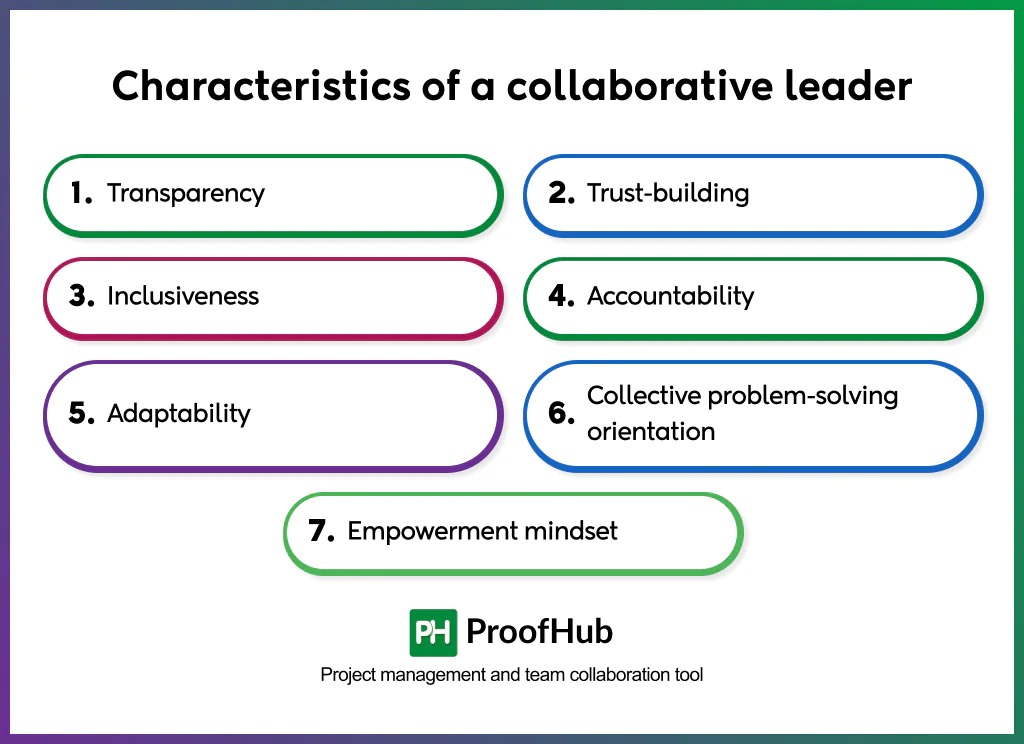
Collaborative leadership characteristics include transparency, trust-building, inclusiveness, accountability, adaptability, and a strong focus on collective problem-solving.
- Transparency: Shares information openly to reduce uncertainty and strengthen alignment.
- Trust-building: Establishes reliability, psychological safety, and confidence in shared decisions.
- Inclusiveness: Encourages participation from diverse voices and integrates broad expertise.
- Accountability: Holds self and teams responsible for outcomes while distributing ownership.
- Adaptability: Adjusts direction quickly based on group input, emerging data, and changing priorities.
- Collective problem-solving orientation: Prioritizes group-driven solutions instead of individual control.
- Empowerment mindset: Gives teams autonomy, authority, and resources to contribute effectively.
What are the core principles of collaborative leadership?
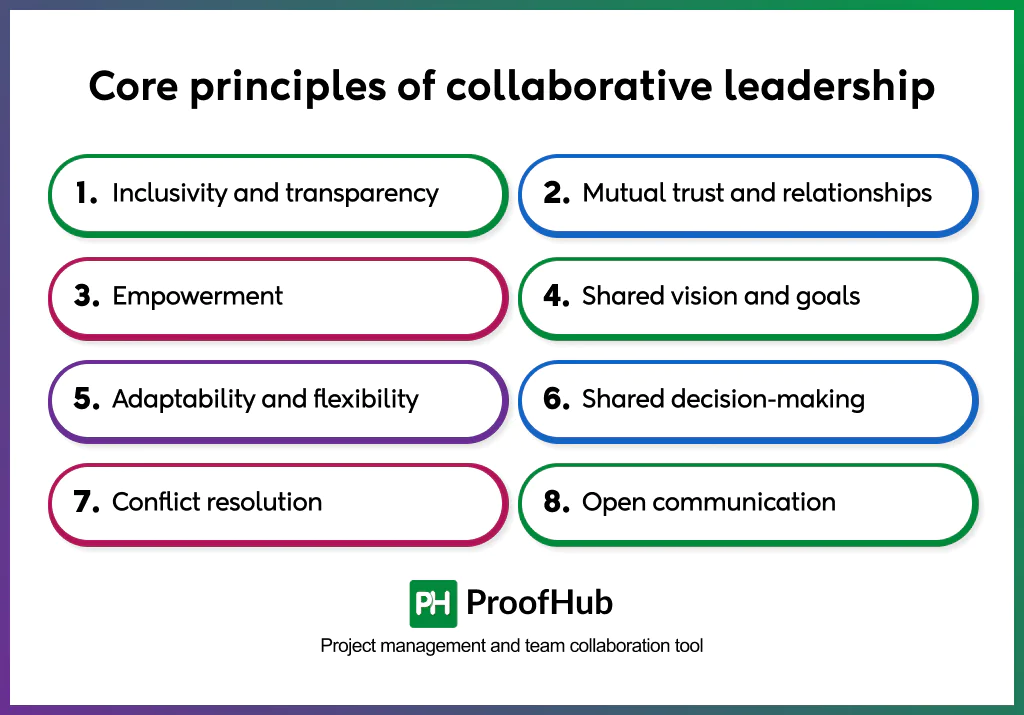
Core principles of the collaborative leadership model include inclusivity, transparency, mutual trust, empowerment, shared vision, adaptability, shared decision-making, conflict resolution, and open communication.
- Inclusivity and transparency
Inclusivity ensures each voice influences team direction, while transparency strengthens alignment by openly sharing goals, progress, challenges, and information. These principles establish psychological safety and reduce ambiguity, forming the baseline for effective collaboration.
- Mutual trust and relationships
Trust emerges from consistent communication, follow-through, and recognizing each member’s expertise. Strong relationships enable honest dialogue, faster coordination, and a willingness to engage in collective problem-solving.
- Empowerment
Empowerment shifts authority from a single leader to the team. By delegating meaningful responsibilities and granting autonomy, collaborative leaders expand ownership, increase accountability, and create pathways for emerging leadership within the group.
- Shared vision and goals
Shared goals unify individual efforts toward a common direction. A clearly defined shared vision provides purpose, while collective goals synchronize decisions, resource allocation, and execution across teams.
- Adaptability and flexibility
Leaders embrace new ideas, encourage experimentation, and adjust actions based on group input, evolving needs, or changing conditions. Flexibility ensures collaboration remains relevant and effective.
- Shared decision-making
Instead of a single authority directing outcomes, teams evaluate information together, contribute insights, and align on decisions that reflect broader expertise, turning problem-solving into a collective function.
- Conflict resolution
Collaborative leaders view disagreements as data for improvement. They promote constructive dialogue, address tensions early, and guide teams toward solutions that maintain relationships and progress.
- Open communication
Effective communication ensures consistent information flow, clarity of expectations, and aligned actions. It supports transparency, enhances situational awareness, and enables every team member to contribute meaningfully.
How to implement collaborative leadership?
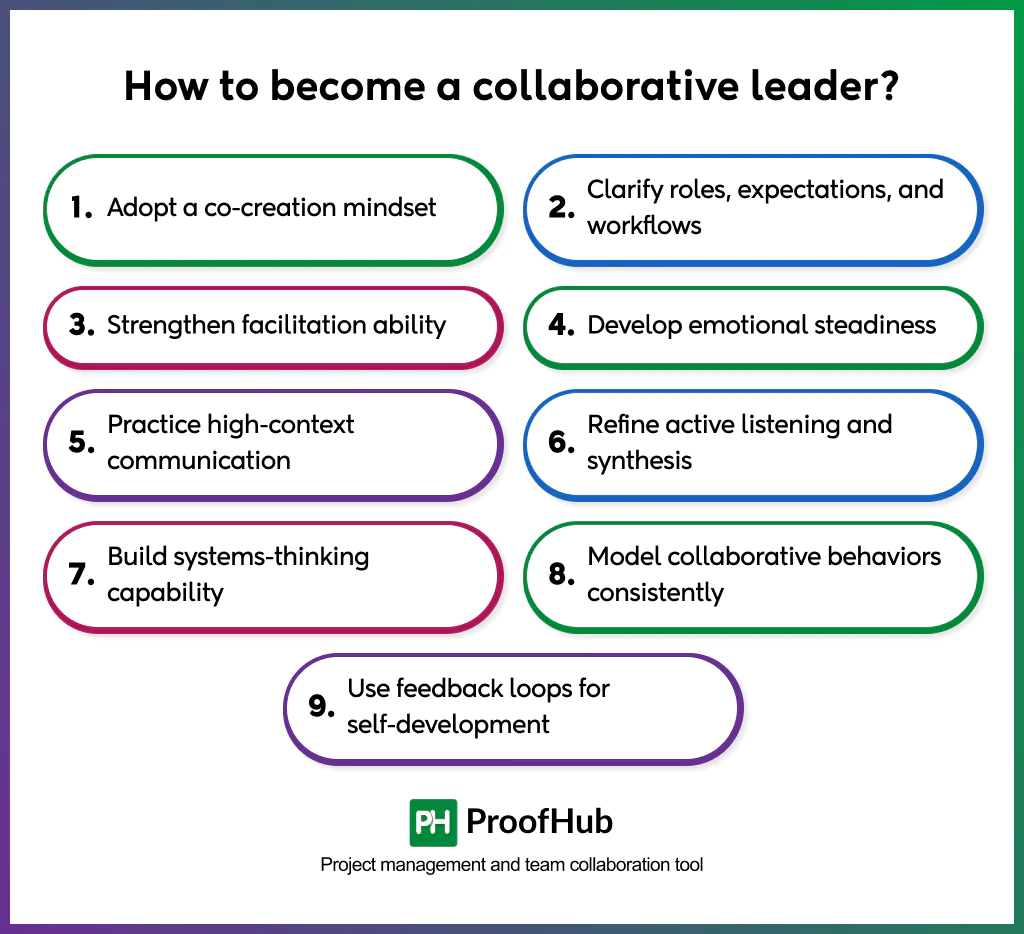
Becoming a collaborative leader requires developing behaviors, systems, and decision patterns that shift leadership from individual control to shared influence and collective execution.
1. Adopt a co-creation mindset: Replace directive habits with an approach that values shared input, collective reasoning, and joint ownership of outcomes.
Encourage teams to question assumptions, invite multiple viewpoints early in the process, and position yourself as a partner in problem-solving rather than the sole decision-maker.
2. Clarify roles, expectations, and workflows: Create structural clarity so teams understand how to participate, where authority sits, and how decisions progress through the group.
With explicit boundaries and responsibilities, collaboration becomes efficient, reduces delays, and prevents duplication of effort across individuals and functions.
3. Strengthen facilitation ability: Guide discussions, manage group dynamics, and ensure contributions are organized and purposeful without dominating the process.
For effective facilitation, balance voices, prevent monopolization of ideas, and steer conversations toward actionable outcomes that reflect collective input.
4. Develop emotional steadiness: Maintain composure during disagreements, negotiate conflicting viewpoints, and support teams through iterative decision cycles.
Emotional steadiness signals psychological safety, allowing people to express dissenting opinions, surface risks, and explore alternatives without fear of criticism.
5. Practice high-context communication: Frame problems clearly, articulate rationale, and translate complex information into a shared understanding that supports alignment.
High-context communication helps teams grasp the “why” behind decisions, reducing ambiguity and building a cohesive mental model of goals and constraints.
6. Refine active listening and synthesis: Listen to identify patterns, distill insights, and integrate diverse perspectives into decisions that represent collective intelligence.
Connect ideas across departments, recognize interdependencies, and convert feedback into structured, actionable direction for effective synthesis.
7. Build systems-thinking capability: Understand how roles, incentives, workflows, and interdependencies affect collaboration and adjust these systems to remove friction.
Create a collaborative adaptable workspace where small changes like shifting approval paths or reassigning decision rights can significantly improve coordination and speed.
8. Model collaborative behaviors consistently: Demonstrate reliability, openness, respect for differing perspectives, and commitment to shared success to reinforce collaborative norms.
Consistently model these behaviors to shape the culture and signal that collaboration is an expected standard of work.
9. Use feedback loops for self-development: Seek input on leadership behaviors and adjust practices to support evolving team and organizational needs.
Continuous feedback (both formal and informal) helps leaders identify blind spots, refine their collaborative approach, and stay aligned with team expectations.
How to demonstrate collaborative leadership?
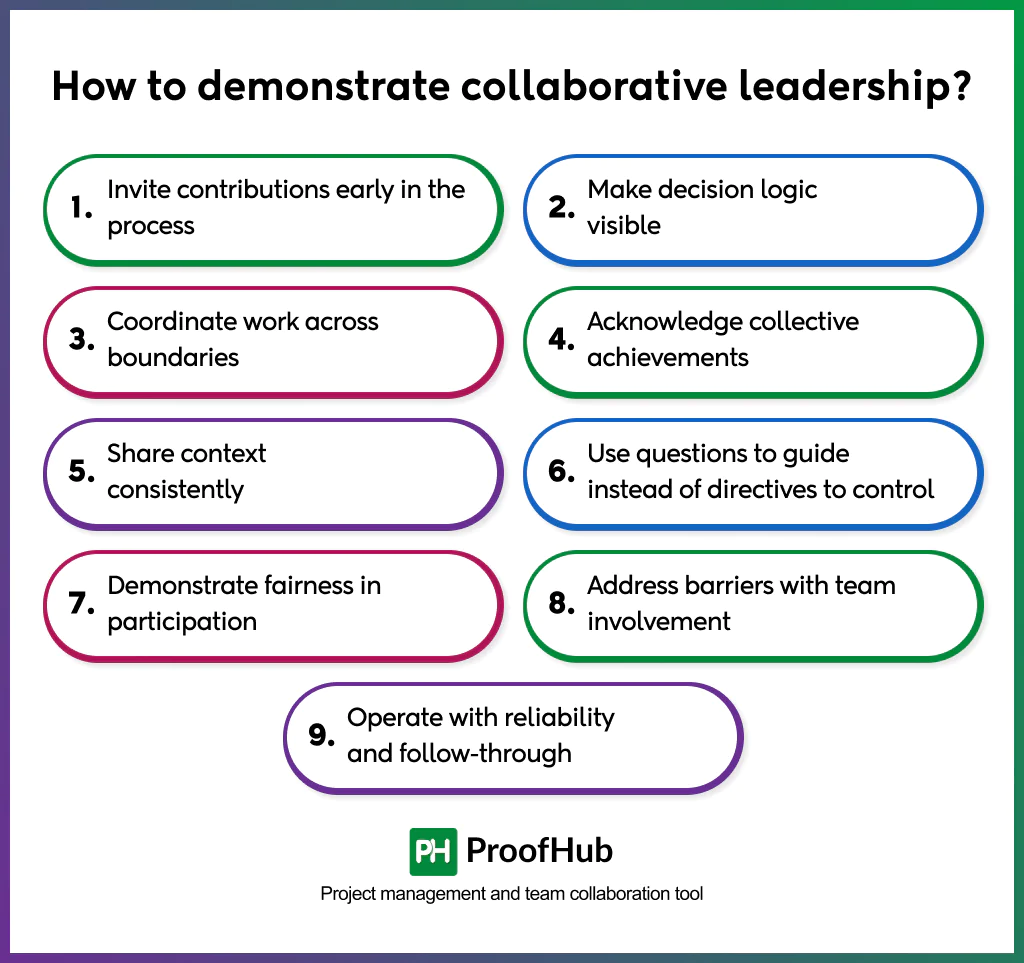
Collaborative leadership is demonstrated through daily behaviors that show shared ownership, collective reasoning, and commitment to team-driven outcomes.
- Invite contributions early in the process: Demonstrate collaboration by seeking input before taking any decisions, not after direction is already set.
Early involvement gives people influence, increases idea diversity, and prevents teams from feeling like they’re only validating predetermined choices.
- Make decision logic visible: Explain how conclusions were reached, what trade-offs were evaluated, and how team insights influenced the outcome.
Transparency in reasoning helps teams understand constraints, reduces misinterpretations, and builds confidence in the fairness of decisions.
- Coordinate work across boundaries: Actively connect departments, remove silos, and encourage cross-functional interactions that strengthen joint execution.
Align shared goals, and ensure teams have the visibility needed to coordinate effectively.
- Acknowledge collective achievements: Attribute success to team efforts, highlight interdependencies, and reinforce the value of combined expertise.
Publicly recognize contributions to strengthen cohesion, promote psychological safety, and encourage continued collaboration.
- Share context consistently: Provide updates on priorities, constraints, and changes so the team can make informed decisions without relying on constant oversight.
Clear context empowers autonomy and ensures teams act with a shared understanding of what matters most.
- Use questions to guide instead of directives to control: Shift conversations from “do this” to “what options do we have?” to reinforce joint responsibility for solutions.
Question-driven leadership promotes critical thinking, encourages ownership, and reduces dependency on top-down answers.
- Demonstrate fairness in participation: Ensure balanced airtime, rotate ownership roles, and prevent dominant voices from overshadowing quieter contributors.
Fair participation signals that every perspective is valued, improving the quality of the discussion and accelerating buy-in.
- Address barriers with team involvement: Bring challenges to the group, explore causes together, and find solutions collectively to maintain ownership and momentum.
Shared problem-solving prevents isolation, distributes cognitive load, and builds collective accountability for outcomes.
- Operate with reliability and follow-through: Keep commitments, close feedback loops, and maintain consistency to show that collaboration is dependable, not performative.
When leaders follow through, teams trust the process and engage more openly in collaborative work.
What are the challenges of collaborative leadership?
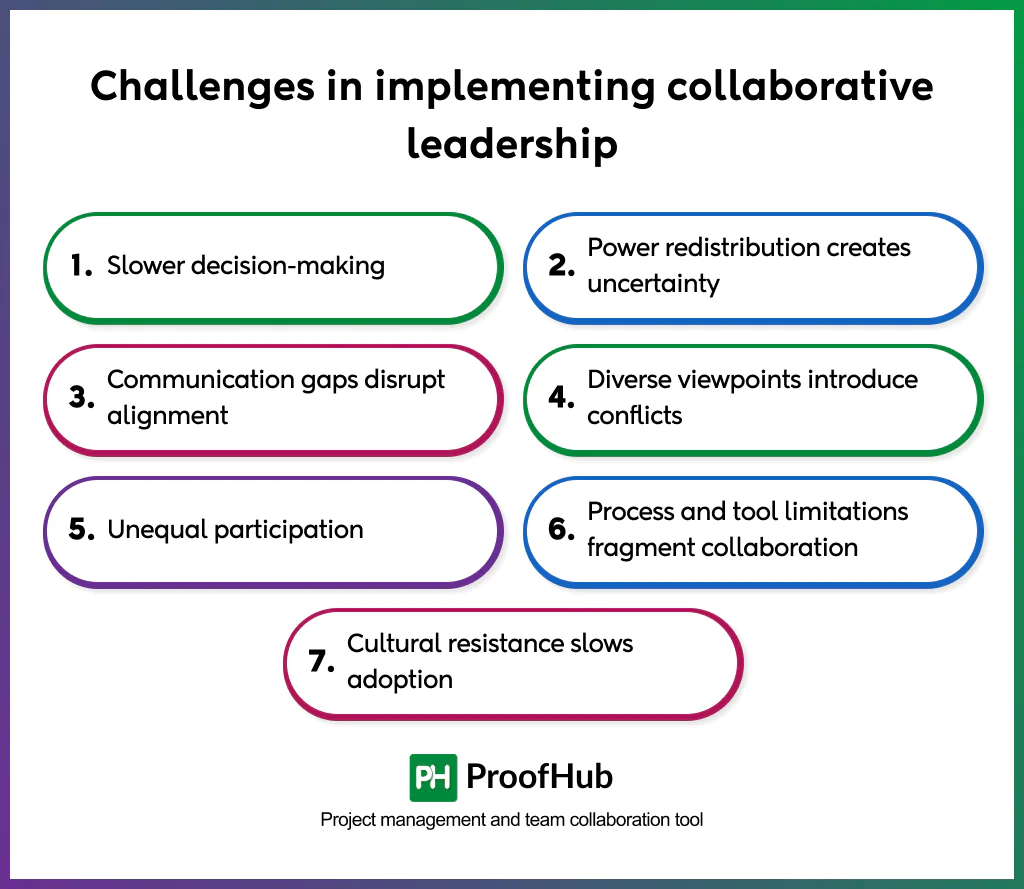
The challenges of collaborative leadership include slower decision-making, unclear power distribution, communication gaps, friction from diverse perspectives, unequal participation, hesitation toward shared ownership, system limitations, and cultural resistance.
1. Slower decision-making
When decisions are made jointly, gathering input from multiple people can delay the decision-making process. While inclusive, this process may slow momentum, stretch timelines, and create frustration when quick action is needed.
2. Power redistribution creates uncertainty
A major challenge emerges when leaders accustomed to top-down control struggle to share authority. This change creates confusion about decision ownership, slows progress, and fractures accountability when roles are not clearly defined.
3. Communication gaps disrupt alignment
Collaborative leadership depends on continuous context-sharing, but many teams operate in silos or rely on limited updates. When communication gaps form, teams lose alignment, duplicate work, and misinterpret priorities. The impact is reduced coordination and lower-quality decisions.
4. Diverse viewpoints introduce conflicts
Diverse perspectives, while valuable, introduce friction. Collaborative environments surface contrasting opinions that slow decisions or escalate into conflict if not handled constructively. Without strong facilitation, debates become personal, and teams avoid contributing, weakening psychological safety.
5. Unequal participation
Some team members contribute actively while others stay silent. This imbalance weakens collaboration and leads to decisions based on limited input. Leaders must draw out every voice and create a psychologically safe environment for participation.
6. Process and tool limitations fragment collaboration
Without the right tools for communication, documentation, and shared visibility, collaboration becomes fragmented. Information gets lost, decisions lack traceability, and teams struggle to coordinate work across functions.
7. Cultural resistance slows adoption
Organizations built on hierarchy often view collaboration as a disruption rather than an improvement. This resistance slows adoption, creates scepticism, and undermines trust in the new leadership approach.
What are examples of collaborative leadership?
Some examples of collaborative leadership include:
- Cross-functional problem solving: Leaders form a group of representatives from product, engineering, design, and marketing to define priorities together. Decisions are made collectively based on data, ensuring shared ownership of outcomes.
- Team-led project planning: Leaders allow teams to map workflows, set milestones, and identify risks themselves. The leader provides direction but not the entire plan, shifting control to the people executing the work.
- Open feedback and problem-solving forums: Leaders host structured sessions where teams openly discuss blockers, propose solutions, and align on actions. The leader facilitates but does not dictate the resolution, reinforcing trust and transparency.
Real-life example of collaborative leadership
Pixar Animation Studios illustrates collaborative leadership through its Braintrust, a system where directors, writers, and creative leads review films in progress together.
The process is non-hierarchical; participants challenge ideas freely, exchange feedback openly, and solve narrative problems as a group. The director acts as a facilitator, absorbing insights, reflecting with the team, and co-creating the story iteratively.
This collective approach has shaped some of Pixar’s most successful films and demonstrates how shared creativity, open communication, and mutual trust strengthen outcomes in a complex, creative environment.
How to practice collaborative leadership?
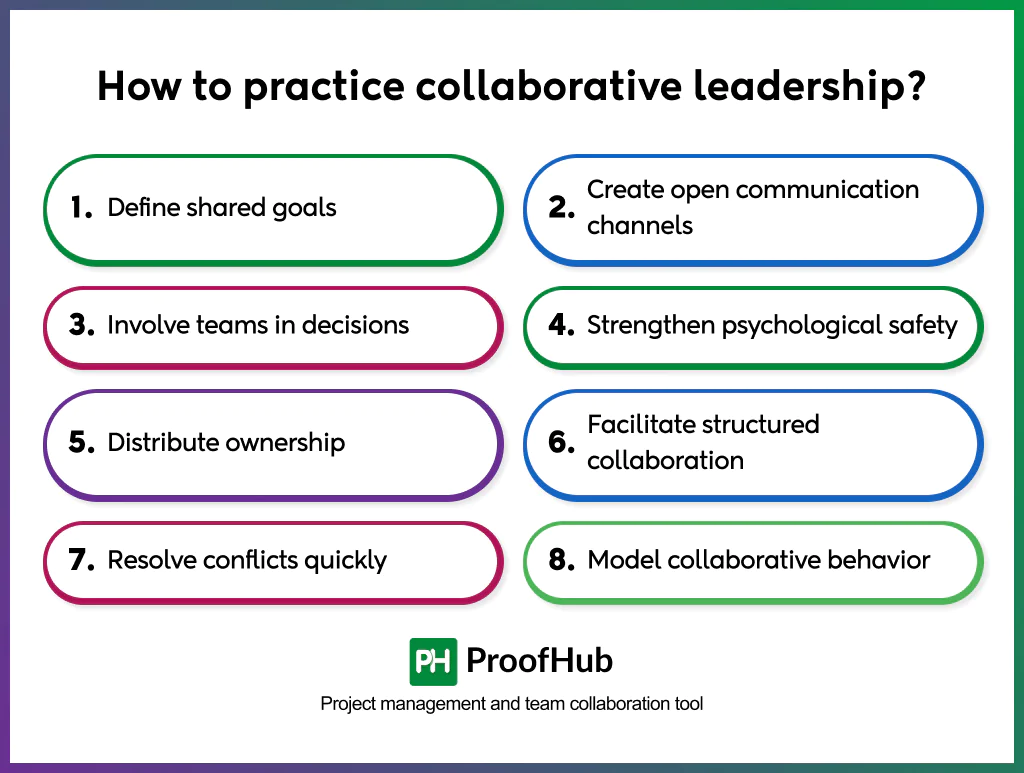
Collaborative leadership is practiced by creating shared goals, enabling participation, improving communication flow, and building structures that support joint decision-making.
- Define shared goals: Establish clear, mutually understood outcomes that guide collective effort.
- Create open communication channels: Use transparent updates, cross-functional meetings, and feedback loops to maintain alignment.
- Involve teams in decisions: Invite input early, evaluate options together, and document decisions openly.
- Strengthen psychological safety: Encourage questions, acknowledge contributions, and reduce fear of making mistakes.
- Distribute ownership: Assign responsibilities based on strengths and allow teams to lead parts of the process.
- Facilitate structured collaboration: Use agendas, frameworks, and collaborative tools to keep discussions productive.
- Resolve conflicts quickly: Address disagreements directly and use mediation techniques to maintain momentum.
- Model collaborative behavior: Demonstrate transparency, humility, and willingness to co-create solutions.
What skills are essential for collaborative leaders?
Essential skills for collaborative leaders include communication, conflict resolution, active listening, facilitation, emotional intelligence, and shared decision-making.
- Communication: Enables transparent information flow, alignment, and clarity across teams.
- Conflict resolution: Removes blockers, resolves disagreements quickly, and maintains forward momentum.
- Active listening: Strengthens trust and helps leaders accurately interpret concerns, expectations, and insights.
- Facilitation: Guides discussions, structures group participation, and keeps collaboration purposeful.
- Emotional intelligence: Enhances empathy, relationship-building, and psychological safety in team interactions.
- Shared decision-making: Integrates diverse inputs, strengthens ownership, and improves decision quality.
What is the difference between collaborative Leadership and traditional leadership?
The main difference between collaborative leadership and traditional leadership is that collaborative leadership distributes authority and decision-making across teams, while traditional leadership centralizes authority and directs decisions from the top.
Collaborative leadership relies on open communication, collective problem-solving, and shared accountability. It integrates diverse expertise and encourages participation to improve decision quality and alignment. Traditional leadership depends on hierarchical control, where leaders set direction, teams follow instructions, and decision-making remains concentrated at higher levels.
Collaborative leadership enhances adaptability, trust, and innovation by fostering free information flow and shared responsibility. Traditional leadership offers structural clarity but reduces idea diversity and slows cross-functional coordination. These contrasting approaches influence how teams work, communicate, and respond to organizational challenges.
What tools can support collaborative leadership?
Tools that support collaborative leadership include project management platforms, real-time communication apps, shared document workspaces, visual collaboration tools, and integrated hubs that centralize teamwork and enable collective decision-making.
- Project and workflow management platforms: These platforms provide teams with a shared space to assign responsibilities, set priorities, and track progress, fostering transparency, enabling distributed ownership, and aligning cross-functional work. Some examples include ProofHub, Asana, and Wrike.
- Real-time communication apps: Messaging platforms like Microsoft Teams and Slack keep conversations open, searchable, and accessible to everyone. They improve speed, reduce misalignment, and help leaders maintain an environment of continuous, transparent dialogue.
- Collaborative document and knowledge tools: Shared editing environments such as Google Workspace and Notion allow teams to co-create plans, reports, and knowledge bases. These tools strengthen co-creation, streamline feedback, and make information equally accessible.
- Visual collaboration and brainstorming tools: Digital whiteboards like Miro and FigJam support shared problem-solving, workflow mapping, and solution design as a group. They replicate co-creation sessions and help leaders involve diverse perspectives.
- Integrated collaboration hubs: All-in-one systems like ProofHub combine tasks, chat, documents, approvals, and reporting in one workspace. They reduce tool fatigue, centralize context, and support unified decision-making across teams.
How does leadership impact collaborative culture?
Leadership impacts collaborative culture by setting the norms, behaviors, and communication patterns that determine how openly teams share information, participate in decisions, and support collective accountability.
Leaders shape culture by reinforcing the expectations they set. Their actions influence the team’s willingness to contribute ideas, challenge assumptions, and rely on one another. Leaders foster psychological safety, enabling open dialogue and reducing the fear of mistakes.
They create structural conditions, such as cross-functional workflows, inclusive decision-making processes, and clear shared goals, that embed collaboration into daily operations. When leadership practices align with collaborative values, teams form stronger relationships, coordinate effectively, and sustain a culture centered on cooperation.
What is collaborative leadership theory?
Collaborative leadership theory explains how leaders achieve results by sharing authority, encouraging participation, and coordinating group decision-making to create unified, high-performing teams. It frames collaboration as a structured process where trust, psychological safety, and shared goals guide how teams generate solutions and maintain alignment.