
Collaboration challenges are the barriers that reduce the effectiveness of people working together towards shared goals. They affect productivity, decision-making, and employee morale across organizations.
Understanding these challenges helps you identify and apply the proper techniques, tools, and behaviors to overcome them.
This article explains common collaboration challenges, including misaligned goals, poor communication flow, conflicting priorities, organizational structure, information silos, technology gaps, and time zone conflicts. Each challenge is defined by how it disrupts teamwork, delays outcomes, and increases costs.
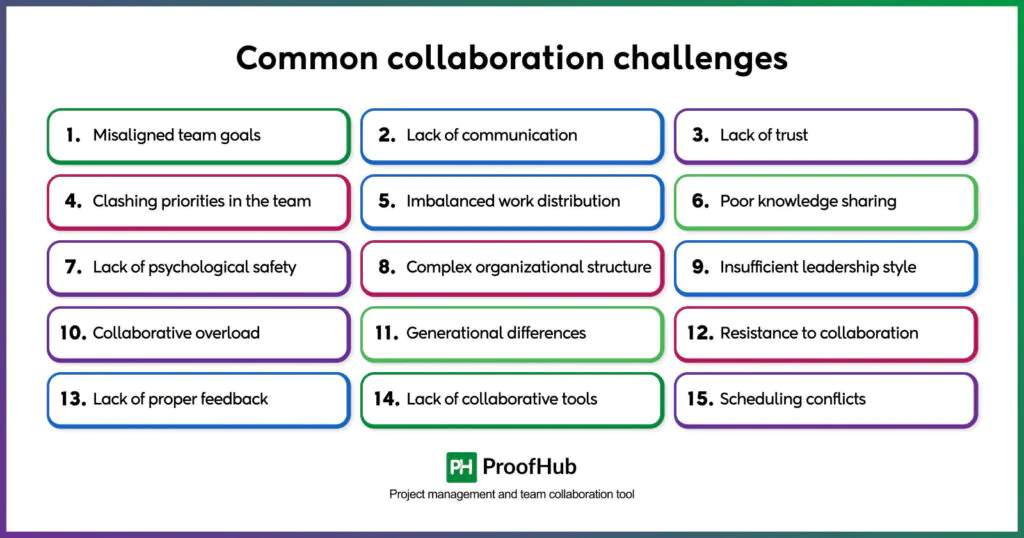
1. Misaligned team goals
When team members do not share a common understanding of the objectives, it leads to confusion, conflict, inefficient coordination, wasted resources, and project delays.
They occur when goals are not clearly defined, measurable, and effectively communicated.
How to solve it?
- Use the SMART framework to write team goals. SMART framework stands for specific, measurable, achievable, relevant, and time-bound. It makes team goals objective to help create a shared understanding.
- Communicate goals effectively by documenting them, explaining them clearly, and providing necessary clarifications, ensuring that everyone understands and aligns with the objectives.
2. Lack of communication
When team members fail to share important information timely and clearly, it causes misunderstandings, workflow inefficiencies, and conflicts that make collaboration difficult.
It occurs due to siloed information systems, unclear communication channels, undefined communication norms, different communication preferences, language and cultural barriers, and leadership bottlenecks.
Fierce, Inc. survey data show that 86 percent of employees cite a lack of collaboration as a reason for workplace failures.
It reduces employee morale, lowers engagement, decreases productivity, delays projects, and decreases innovation.
How to solve it?
- Use digital collaboration software to create a centralized and transparent team communication system and a shared workspace to store discussions, files, updates, and decisions in one place.
- Set clear communication protocols. Define when, where, and how updates should be shared and how each communication channel should be used.
- Run workshops to train teams on communication skills and build effective communication.
- Encourage an open communication culture. Promote active listening, ask clarifying questions, and normalize speaking up during meetings or feedback sessions.
3. Lack of trust
When team members hesitate to communicate openly, rely on each other, or share honest feedback, it affects interpersonal relationships, ideas are shared less freely, motivation decreases, and collaboration becomes more difficult.
A meta-analysis by Bart de Jong found that trust has a positive impact on team outcomes.
Lack of trust can weaken when communication is inconsistent, responsibilities are not fulfilled, and information is withheld from team members.
How to solve it?
- Promote open and transparent communication.
- Encourage team members to collaborate on projects.
- Implement a fair reward system.
4. Clashing priorities in the team
When team members focus on different tasks or goals that compete for the same time, attention, and resources, it leads to slow project progress, creates inefficiencies, and increases resentment within teams.
Clashing priorities occur when individual objectives do not align with collective shared goals, unclear job roles or responsibilities, poor communication, information silos, and varying key performance indicators (KPIs) for individuals.
How to solve it?
- Set clear goals. Align team and individual objectives with overall business goals using team-based OKRs.
- Clearly define and document roles and responsibilities using techniques like the RACI matrix to minimize overlaps and confusion.
- Create a culture of transparency by encouraging open communication and creating shared visibility using collaboration tools.
- Set fair and transparent KPIs to avoid disparity and conflicts.
5. Imbalanced work distribution
Unequal allocation of tasks, responsibilities, and workload overburdens some team members while others are underutilized. This imbalance creates a sense of unfairness within the team, negatively impacts team unity, and leads to resentment, burnout, and frustration.
This develops when roles are not defined clearly, workload planning is poor, team capacity and skills are not clearly visible, or tasks are not delegated properly.
How to solve it?
- Use centralized collaboration tools and dashboards to make assignments and workloads visible.
- Train managers to distribute tasks more equitably by leveraging everyone’s strengths and identifying and correcting distribution disparities.
- Review workload regularly to balance workload.
6. Poor knowledge sharing
Inconsistent information sharing among team members creates knowledge silos, misunderstandings, duplicated work, repeated mistakes, slower decision-making, and higher operational costs.
This is caused primarily by the lack of a centralized platform, knowledge hoarding by individuals, and the absence of documented processes and workflows.
How to solve it?
- Use centralized collaboration tools and knowledge management systems to break down information silos
- Establish clear protocols for what should be shared, where, and how
- Standardize knowledge documentation and sharing processes
7. Lack of psychological safety
When team members do not feel safe speaking up, expressing ideas, or asking questions, problem-solving, innovation, and decision-making within the team suffers.
Major contributors to the lack of psychological safety are authoritarian leadership style, punitive work culture, perceived bias of individuals, and lack of inclusive practices.
How to solve it?
- Adopt an inclusive and people-oriented leadership that models vulnerability, transparency, and empathy.
- Create a culture of open communication and inclusivity.
- Anonymous feedback to surface unspoken concerns.
- Provide support and training in giving and receiving feedback to managers and teams, emphasizing constructive and supportive methods.
8. Complex Organizational Structure
Multiple layers of hierarchy where some individuals hold disproportionate authority and decision-making power create power imbalances and rigid hierarchies.
It discourages open communication, resulting in siloed decision-making, poor collaboration, and slower decisions and innovation.
Additional management layers, reporting relationships, and approval processes can make the organizational structure more complex.
How to solve it?
- Encourage flattened hierarchies where possible to improve transparency and participation.
- Empower employees and seek input from all levels.
- Establish clear communication and collaboration protocols across departments.
9. Inadequate leadership style
A leader’s inability to provide clear direction, support, effective communication, and conflict resolution creates uncertainty around goals, roles, responsibilities, and expectations, making team alignment and collaboration more difficult.
This can arise from poor communication, weak decision-making, unclear priorities, conflict avoidance, micromanagement, excessive delegation, and a lack of support for collaboration.
How to solve it?
- Invest in leadership development with programs & courses focused on communication, collaboration, conflict management, and other soft skills required for managers and leaders.
- Clarify and communicate the strategic vision clearly.
- Set clear expectations and accountability.
- Encourage open and frequent communication to ensure team alignment and mediate to resolve conflicts.
- Trust team members and empower autonomy.
10. Collaborative overload
When employees spend excessive time on meetings, emails, chats, and other collaborative activities instead of focusing on their own work, it makes focused work more difficult, reduces productivity, and increases employee burnout.
The major causes of collaborative overload are unclear roles, responsibilities, decision rights, lack of standard communication norms, and an environment where visibility is rewarded over impact.
How to solve it?
- Clarify roles, responsibilities, and decision-making authority using project management techniques and tools like RAPID or RACI matrix.
- Set clear collaboration norms and guidelines. For example, define expectations for response times and after-hours communication.
- Reduce unnecessary meetings and leverage asynchronous tools. Use shared documents or Wikis, and record meetings.
11. Generational differences
Differences in work values, ethics, morals, communication styles, and working preferences among individuals from different age groups and backgrounds can increase misinterpretation of tone, intent, and participation levels, making collaboration more difficult.
These differences result from varying communication preferences, differing attitudes toward hierarchy, varying expectations from organizational culture, and varied technology fluency.
How to solve it?
- Conduct generational inclusivity workshops to break down barriers, bridge work-style gaps, and promote mutual understanding.
- Use of inclusive communication tools (e.g., asynchronous and synchronous options) and establish flexible collaboration norms to co-create workflows addressing different communication preferences.
- Policies to define behavioral expectations and shared values.
12. Resistance to collaboration
When individuals work in isolation and avoid sharing information, resources, or expertise with others, problem-solving and innovation decline, operational efficiency decreases, and employee morale and engagement suffer.
This mindset develops because of departmental structures, misaligned incentives, competitive workplace cultures, or inadequate systems and processes for cross-team collaboration.
How to solve it?
- Align incentives and KPIs with collaborative outcomes rather than siloed achievements.
- Use centralized collaboration platforms to increase transparency and visibility of work across teams.
- Facilitate regular interdepartmental meetings or communities of practice to build trust and familiarity.
13. Lack of proper feedback
When team members do not receive timely, specific, or constructive input about their work, behaviors, or collaboration efforts, it causes mistakes to be repeated and lowers employee engagement
Poor feedback culture is the result of the lack of structured feedback processes and performance metrics, managers avoiding difficult conversations, or a lack of skills needed to deliver effective feedback.
How to solve it?
- Create and implement a standard feedback or performance management system using structured feedback frameworks.
- Train managers and team leads in giving feedback that is specific, objective, and actionable.
- Create a positive and feedback-friendly culture where both leaders and peers share constructive insights openly.
14. Lack of collaborative tools
Lack of collaboration tools leads to information silos, miscommunication, lack of accountability, and inefficient manual processes.
Resource constraints, resistance to change, and outdated infrastructure are the major reasons behind the absence of collaborative tools.
How to solve it?
- Adopt an integrated collaboration platform such as ProofHub, Asana, and Jira to centralize communication and workflows. These platforms help you unify project management, instant messaging, video conferencing, file sharing, and more.
- Provide support to learn new software and technology.
- Choose a user-friendly solution that is easy to learn and adopt.
15. Time zones and scheduling conflicts
Scheduling conflicts in a team slows decision-making and delays dependent tasks. Meeting fatigue and burnout can also increase when employees regularly work outside their normal hours.
These conflicts occur because teams are distributed globally across vastly different time zones, with poor deadline planning that ignores local working times, over-reliance on synchronous communication, lack of asynchronous workflows, and inconsistent work-hour policies.
How to solve it?
- Adopt asynchronous collaboration practices using project management tools, shared documents, and recorded updates.
- Implement rotating meeting schedules so the inconvenience is shared fairly across time zones.
- Set clear response time expectations for asynchronous communication to maintain momentum.
- Plan project timelines with intentional buffer periods for cross-time-zone work.
- Leverage overlapping working hours strategically for critical real-time discussions.
What are collaboration challenges?
Collaboration challenges are the obstacles that prevent people from working together effectively to achieve shared goals. These challenges reduce efficiency, slow down decision-making, and lead to missed deadlines, duplicated work, and lower performance.
Research and reports from McKinsey & Company have found that high-performing teams, characterised by strong collaboration, can be up to 25% more productive than their less collaborative counterparts.
Identifying collaboration challenges early allows you to introduce more transparent processes, better technology, and more substantial team alignment, which improves productivity and outcomes.
What common collaboration challenges are faced by remote teams?
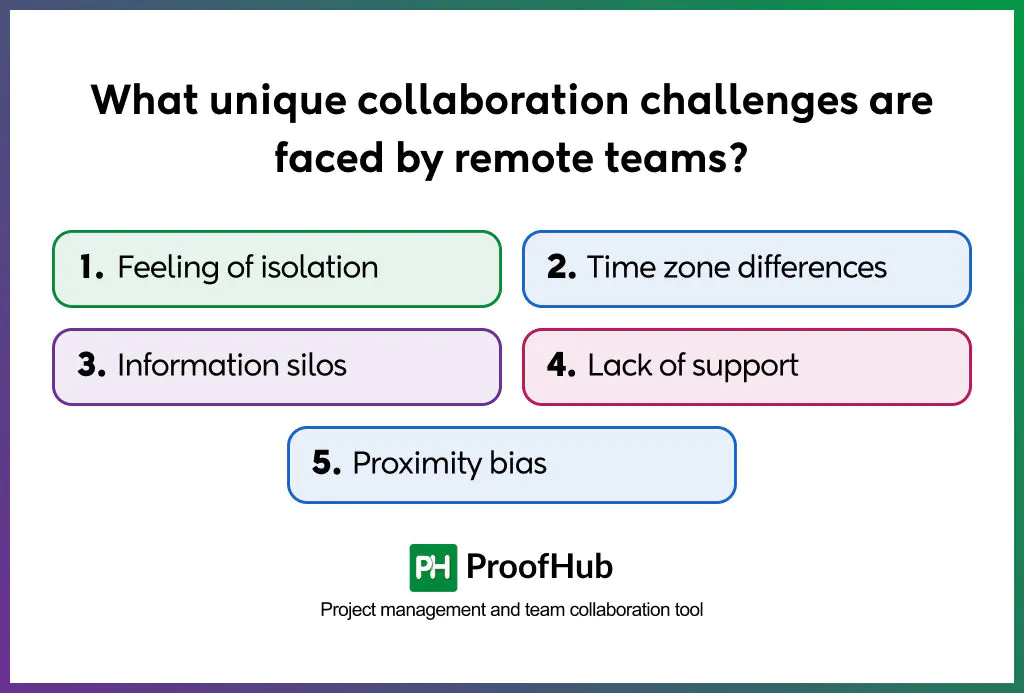
Remote teams face collaboration challenges related to geographic distance, including isolation, time zone differences, information silos, lack of support, and proximity bias.
- Feeling of isolation: Remote team members have fewer informal interactions with colleagues.This results in a lack of engagement, which increases the feeling of isolation.
- Time zone differences: Geographically dispersed team members working across different time zones make real-time collaboration difficult.
- Information silos: Remote employees being excluded from essential conversations creates information gaps. Text-based messages also increase the risk of misunderstandings.
- Lack of support: It becomes challenging for managers to monitor workloads, identify morale issues, and provide support due to a lack of visible cues. As a result, problems may go unnoticed until they become more serious.
- Proximity bias: Managers may unconsciously favor employees they see regularly. As a result, in-person employees receive more information, opportunities, or influence than remote colleagues.
What collaboration challenges are faced by hybrid teams?
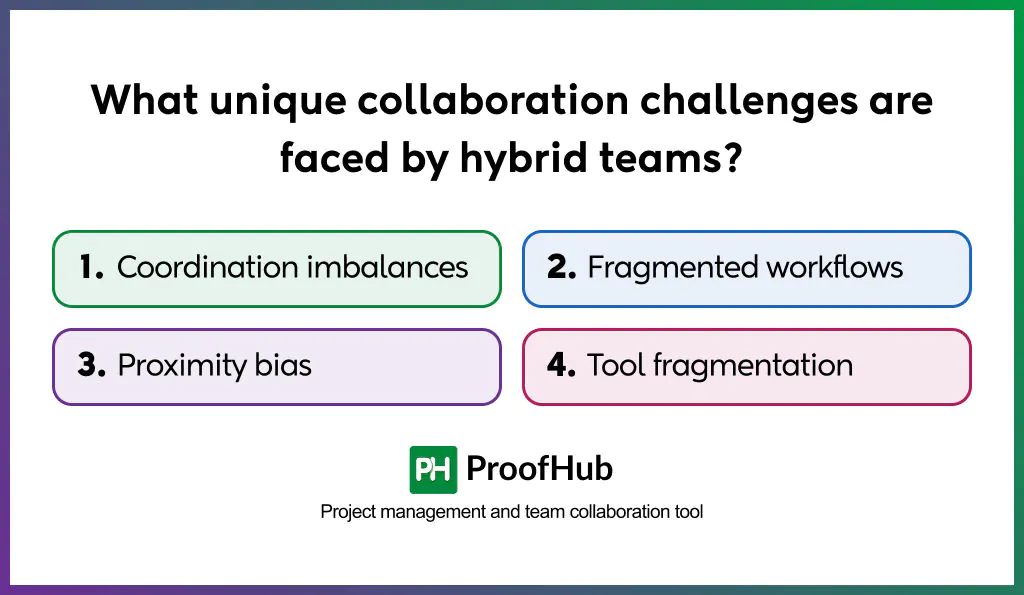
The challenges faced by hybrid teams include coordination imbalances between in-office and remote members, fragmented workflows, tool fragmentation, and proximity bias.
- Coordination imbalances: Informal discussions and quick decisions may exclude remote workers. Scheduling conflicts can arise when collaboration hours are not standardized.
- Fragmented workflows: Coordinating meetings and workflows between physical and digital workspaces across locations and flexible schedules complicates collaboration.
- Proximity bias: In-person employees may receive more information, opportunities, attention, or recognition simply due to physical presence, while remote colleagues feel sidelined or less valued.
- Tool fragmentation: Collaboration becomes more difficult when office and remote teams rely on different or incompatible tools and processes.
What strategies can help overcome the collaboration challenges?
Organizations can overcome collaboration challenges through structural, cultural, and technology-driven practices.
- Clarify goals and roles so that team members understand shared priorities.
- Use integrated collaboration platforms to centralize communication, projects, documents, and knowledge sharing.
- Establish communication norms that define communication frequency and when to use synchronous or asynchronous channels.
- Schedule regular alignment meetings to keep teams informed and coordinated.
- Rotate meeting times for team members working across different time zones.
- Encourage regular check-ins and feedback sessions to build trust and identify issues early.
- Maintain transparent decision-making processes so team members understand how decisions are made.
- Promote psychological safety so employees feel comfortable sharing ideas, concerns, and feedback.
- Provide training in collaboration skills such as active listening, conflict resolution, communication, and inclusive decision-making.
What is the role of leadership in overcoming collaboration challenges?
Leadership plays an important role in overcoming collaboration challenges.
- Effective leaders promote open communication, inclusivity, and respect for diverse viewpoints.
- They communicate vision, purpose, and priorities clearly so teams remain aligned.
- Leaders create an environment of psychological safety where team members feel comfortable sharing ideas, ask questions, and raise concerns without fear of negative consequences.
- They recognize and address obstacles to collaboration by resolving conflicts, balancing workloads, providing resources, and ensuring teams have the tools they need to work effectively
- Strong leaders also encourage feedback loops, listen to team input, and adapt processes when necessary to improve collaboration.
What is the biggest obstacle to workplace collaboration?
The biggest obstacle to workplace collaboration is a lack of trust. Without trust, team members are less likely to share information, admit mistakes, or provide honest feedback.
Lack of trust is caused by poor communication, inconsistent leadership direction, hidden agendas, and lack of psychological safety.
This results in a communication breakdown, which eventually leads to misalignment in goals, priorities, or expectations. Without a shared understanding of objectives, teams may duplicate work, miss deadlines, or make decisions based on incomplete data.