
Collaborative activities are group interactions where participants work together on shared tasks to achieve common goals, produce shared outputs, and build stronger working relationships. These activities improve team building and collaboration by strengthening how individuals communicate, coordinate, and contribute as a team.
According to a study titled “A Playful Way to Promote Team Flow: Evaluation of a Positive Psychological Board Game for Team Building”, conducted by Leonie Kloep, Anna-Lena Helten, and Corinna Peifer, collaborative activities for team-building can enhance team flow and cohesion. The study emphasizes that effective teamwork depends on strong communication, coordination, and shared engagement, and that intentional collaborative interventions can systematically strengthen these core elements of team building.
Collaborative team activities strengthen clarity of communication, trust, accountability, and alignment. By practising discussion, coordinated execution, constructive feedback, and collective problem-solving, teams develop stronger cohesion, mutual understanding, and effective collaboration over time.
What do collaborative activities mean?
Collaborative activities are group efforts in which teams, employees, or groups work together on common tasks to achieve shared goals, complete projects, and produce collective outcomes.
They require coordinated effort, shared responsibility, and active participation. Unlike individual assignments, outcomes depend on interaction, mutual contribution, and collective decision-making.
Collaborative team activities are organized in professional, academic, and organizational settings, where teams collaborate to complete projects, solve problems, or achieve defined learning outcomes.
When conducted effectively, collaborative activities strengthen team building and improve collaboration by increasing trust, alignment, and communication quality.
Examples of collaborative activities to improve team building and collaboration
Here are some examples of collaborative activities to improve team building and collaboration, organized into different types based on their purpose and focus:
Group discussion activities
Group discussion activities are conversations where participants exchange ideas, analyze topics, and reach shared understanding through guided dialogue. They focus on verbal interaction to build clarity, alignment, consensus, and collective thinking. Discussion reduces miscommunication and improves decision quality by ensuring balanced participation.
Group discussion activities differ based on structure and depth. Some emphasize individual reflection before sharing, while others focus on progressive consensus-building or equal voice distribution.
Examples of group discussion activities:
1. Think-Pair-Share
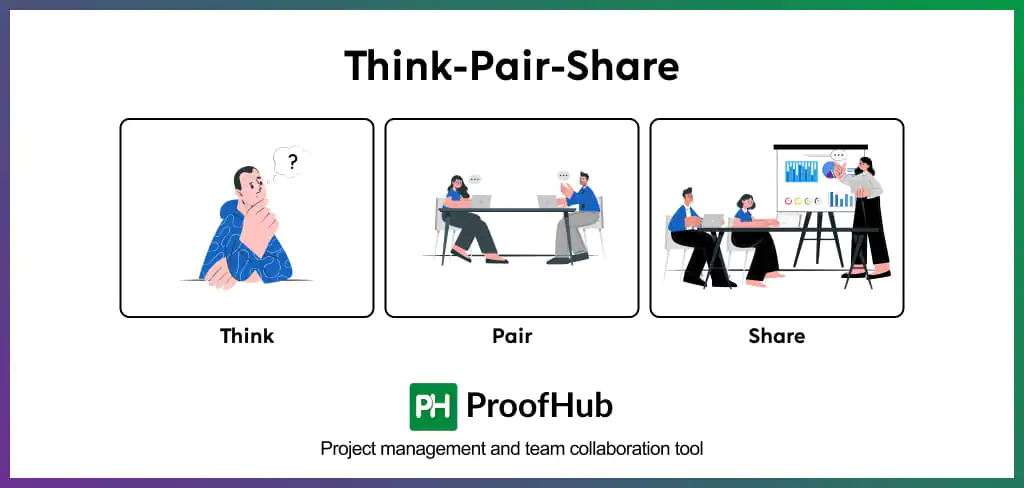
Think-Pair-Share is a discussion technique where individuals reflect independently, discuss ideas in pairs, and then share refined insights with the larger group.
The activity ensures every participant develops an initial viewpoint before entering group dialogue. This prevents passive participation and strengthens the quality of contributions from the start.
How to run the activity
- Present a clearly defined question, scenario, or problem aligned with the session goal.
- Allow 2-5 minutes of silent reflection. Participants note their key points individually.
- Pair participants and allocate time to compare responses, challenge assumptions, and refine ideas.
- Reconvene the full group and invite each pair to present consolidated insights.
- Record recurring themes, contrasting perspectives, and agreed conclusions.
The staged progression improves idea depth and clarity. Individual reflection increases cognitive preparation, paired discussion refines reasoning, and group sharing builds collective understanding.
This activity increases balanced participation, strengthens listening skills, improves confidence in contribution, and enhances alignment during decision-making discussions.
2. Fishbowl discussion
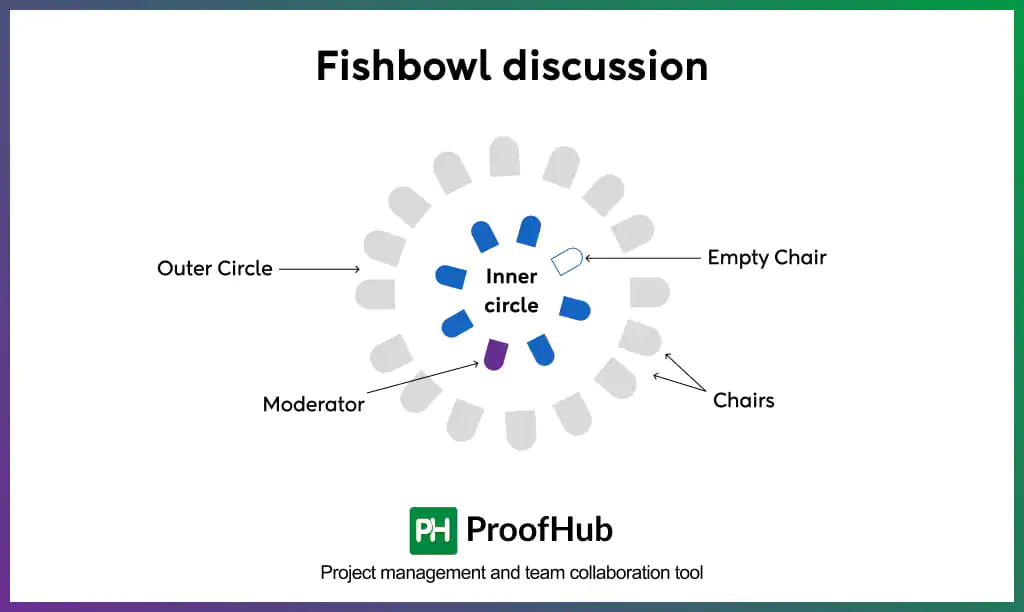
Fishbowl discussion is a group activity in which a small group discusses a topic in an inner circle while others observe; roles then rotate to ensure broad participation.
The activity separates active speakers from observers, creating focused dialogue without cross-talk. Observation strengthens listening discipline and analytical thinking before contribution.
How to run the activity
- Select a focused topic, problem, or decision question.
- Arrange chairs in two circles: a small inner circle (3-5 participants) and a larger outer circle for observers.
- The inner circle discusses the topic for a defined time while observers listen without interruption.
- After the time limit, rotate participants or open one empty chair in the inner circle for voluntary contribution.
- Conclude with a full-group synthesis to document insights, agreements, and unresolved points.
The activity improves discussion depth by limiting simultaneous speakers. Observers evaluate arguments, identify patterns, and prepare input before entering the conversation.
Fishbowl discussions strengthen critical listening, reduce dominance imbalance, improve reflection quality, and support consensus-building on complex or sensitive topics.
3. Round-table discussions
Round-table discussion is a dialogue activity where each participant contributes in a defined sequence to ensure equal voice and balanced participation.
The activity removes open-floor dominance by giving every participant dedicated time to speak. The contribution order is predetermined, which creates predictability and equity of participation.
How to run the activity
- Define a clear topic, question, or decision objective.
- Arrange participants in a circle or virtual equivalent to create equal visibility.
- Establish speaking order and time limits per participant.
- Each participant shares input without interruption.
- After one full round, open the floor for clarifications, synthesis, or follow-up discussion.
- Document key insights, agreements, and action points.
The sequence increases accountability and reduces conversational imbalance. Participants prepare focused contributions because speaking time is guaranteed but limited.
Round-table discussions improve clarity, encourage inclusive participation, strengthen listening discipline, and support transparent decision-making within teams.
Project-based collaboration activities
Project-based collaboration activities are joint tasks where participants work together over a defined period to produce a shared deliverable. They focus on execution and output rather than discussion alone. Participants divide responsibilities, coordinate efforts, and integrate contributions into a single result. Success depends on accountability, timeline management, and alignment with outcomes.
Project-based activities enhance ownership, interdependence, and measurable performance, as successful outcomes rely on coordinated contributions among team members.
Examples of project-based collaboration activities:
4. Group presentations
Group presentations are joint assignments where participants research, prepare, and deliver a topic collectively to produce a unified output.
The activity requires coordination, role allocation, and delivery. Each member contributes a defined component that integrates into a single presentation.
How to run the activity
- Define the topic, objective, audience, and evaluation criteria.
- Divide responsibilities such as research, content creation, data analysis, design, and delivery.
- Set internal milestones for draft review, consolidation, and rehearsal.
- Conduct rehearsal sessions to align transitions, timing, and message consistency.
- Deliver the final presentation and gather feedback.
Clear role assignment prevents duplication and ensures accountability. Rehearsals strengthen cohesion and alignment of the message before delivery.
Group presentations improve coordination, shared ownership, clarity of communication, and execution discipline. The requirement to deliver a unified output strengthens the integration of diverse inputs into a coherent result.
5. Collaborative writing and co-creation
Collaborative writing and co-creation are processes in which multiple participants cooperatively produce a single document, proposal, report, or content asset through shared contributions and editing.
The activity integrates diverse perspectives into one unified output. Contributors work within a defined structure to maintain coherence and consistency.
How to run the activity
- Define the objective, target audience, scope, and final deliverable format.
- Create an agreed outline that structures sections and key points.
- Assign ownership of sections while maintaining shared visibility of the full document.
- Establish contribution timelines and review checkpoints.
- Conduct joint editing sessions to align tone, remove duplication, and ensure logical flow.
- Finalize the document after collective review and approval.
A shared platform with version control maintains transparency and prevents content conflicts. Defined editorial standards ensure alignment in language.
Collaborative writing strengthens integration skills, improves clarity of thought, enhances accountability, and builds collective ownership over the final output.
6. Cross-functional team projects
Cross-functional team projects are initiatives where participants from different departments or expertise areas work together to achieve a shared objective.
The activity integrates diverse skills such as strategy, operations, design, marketing, and technical execution into one coordinated effort. Each department contributes specialized knowledge toward a unified outcome.
How to run the activity
- Define a clear project objective, scope, success criteria, and timeline.
- Select representatives from relevant departments based on the required expertise.
- Clarify roles, responsibilities, and decision authority across teams.
- Establish coordination checkpoints to review progress and resolve dependencies.
- Track milestones and document deliverables until project completion.
Defined governance prevents confusion caused by overlapping authority. Regular alignment discussions reduce silo-based decisions and maintain integration across departments.
Cross-functional projects improve knowledge exchange, strengthen organizational alignment, reduce duplication of effort, and produce more comprehensive solutions due to multi-disciplinary input.
Problem-solving activities
Problem-solving activities are exercises where participants analyze a defined issue, evaluate alternatives, and produce a collective solution. They focus on analytical thinking, reasoning, and decision accuracy. Participants identify root causes, assess constraints, compare options, and agree on the most viable outcome. The process emphasizes logic, evidence, and shared evaluation.
Problem-solving activities strengthen critical thinking, accountability, and solution ownership, as progress depends on joint analysis and collective consensus.
Examples of problem-solving activities:
7. Case study analysis
Case study analysis is a group exercise where participants examine a real or simulated scenario to identify problems, evaluate alternatives, and recommend evidence-based solutions.
The activity focuses on evaluation rather than opinion exchange. Participants assess facts, constraints, risks, and outcomes before forming conclusions.
How to run the activity
- Provide a detailed case describing context, stakeholders, data points, and the core issue.
- Define the analysis objective, such as identifying root causes, evaluating decisions, or proposing corrective actions.
- Divide participants into small groups to review the case and list key findings.
- Require each group to present problem statements, alternative options, and recommended solutions with justification.
- Conclude with a comparative discussion and synthesize final insights.
Structured analysis improves logical reasoning and evidence-based decision-making. The requirement to justify recommendations strengthens accountability and analytical depth.
Case study analysis enhances critical thinking, shared evaluation, and collective problem resolution while improving clarity in complex decision environments.
8. Role-play simulations
Role-play simulations are exercises where participants assume defined roles within a realistic scenario to practice decision-making, negotiation, or conflict resolution.
The activity recreates workplace situations such as client discussions, performance feedback, project conflicts, or strategic negotiations. Participants respond within assigned roles, which introduces perspective-based interaction.
How to run the activity
- Define a clear scenario aligned with a specific objective such as resolving a conflict or closing a deal.
- Assign roles with background context, goals, and constraints for each participant.
- Set time limits for preparation and live interaction.
- Conduct the simulation while observers note behaviors, communication patterns, and decisions.
- Facilitate a debrief to evaluate actions, outcomes, and areas for improvement.
The simulation activity identifies decision patterns and communication habits in a controlled environment. Immediate feedback strengthens awareness and skill refinement.
Role-play simulations improve empathy, negotiation capability, conflict management, and applied problem solving by requiring participants to act under realistic conditions.
9. Jigsaw method
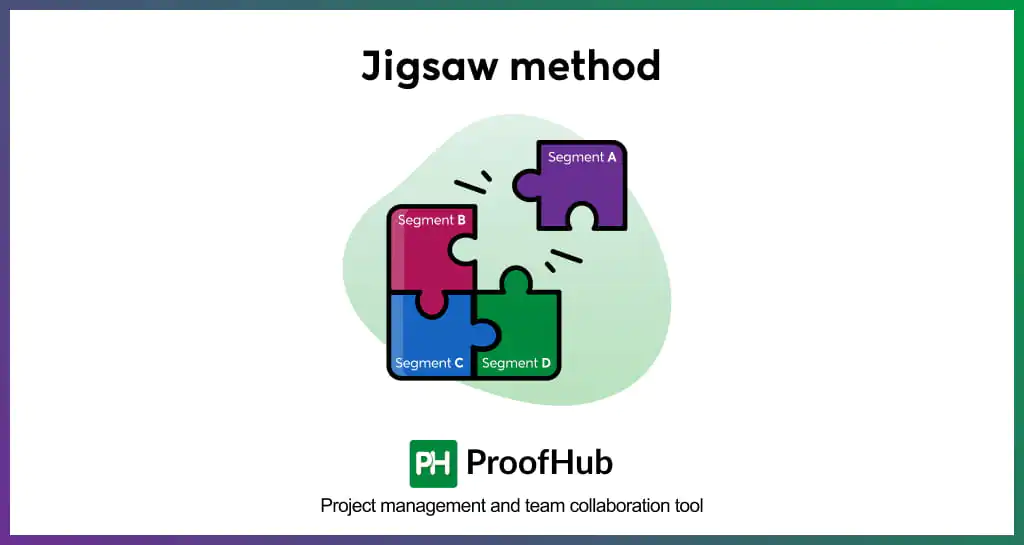
The Jigsaw method is a learning and problem-solving activity in which each participant is responsible for one segment of a task and later shares their expertise with the group to build collective understanding.
The method creates interdependence because no single participant holds all the information. Collective understanding emerges only when each member contributes their assigned segment.
How to run the activity
- Divide the main task or problem into distinct segments.
- Assign each participant one segment to work or analyze in depth.
- Form “expert groups” where participants with the same segment compare insights and refine understanding.
- Reorganize participants into mixed groups so each segment is represented.
- Each participant teaches their segment to the group, followed by integration and synthesis of the complete topic.
Interdependence increases accountability as each participant carries essential knowledge. Teaching others reinforces understanding and strengthens clarity.
The Jigsaw method improves knowledge retention, balanced participation, collaboration discipline, and shared ownership of outcomes through coordinated information exchange.
Peer learning activities
Peer learning activities are interactions in which participants learn from one another through knowledge exchange, feedback, and shared exploration of a topic. They focused on mutual teaching rather than top-down instruction. Participants contribute insights, review each other’s work, clarify concepts, and collectively refine understanding. Learning emerges from discussion, evaluation, and shared experience.
Peer-based activities strengthen knowledge transfer, shared accountability, and skill development, as progress depends on each participant’s active contributions.
Examples of peer learning activities:
10. Peer review and tutoring sessions
Peer review and tutoring sessions are interactions where participants evaluate each other’s work or guide one another to improve understanding and performance.
The activity redistributes learning and quality control from a single authority to shared responsibility. Participants provide feedback, clarify concepts, and suggest improvements in line with defined criteria.
How to run the activity
- Define clear evaluation standards or learning objectives.
- Pair participants or form small groups for exchange.
- Share work outputs, drafts, or problem sets for review.
- Provide written or verbal feedback based on agreed criteria.
- Allow time for clarification, revision, and follow-up discussion.
Defined criteria prevent subjective or vague feedback. Structured exchange strengthens focus and accountability during review.
Peer review and tutoring sessions improve quality standards, accelerate skill development, enhance analytical thinking, and strengthen mutual accountability through constructive evaluation and guided support.
11. Collaborative learning circles
Collaborative learning circles are small groups where participants explore a shared topic through recurring discussion, reflection, and knowledge exchange.
The activity emphasizes consistent interaction over a defined period. Participants collectively analyze material, share insights, question assumptions, and synthesize understanding.
How to run the activity
- Define a clear theme, objective, or subject area for exploration.
- Create small groups with 4-6 participants to maintain depth and interaction quality.
- Assign preparatory material such as articles, reports, or case references.
- Rotate facilitation roles to distribute responsibility.
- Conduct discussions focused on analysis, application, and synthesis.
- Document key insights and agreed action points after each session.
Rotating facilitation strengthens leadership skills and shared accountability. Documented summaries maintain continuity between sessions.
Collaborative learning circles improve knowledge retention, deepen understanding, strengthen communication discipline, and build long-term intellectual alignment within teams.
12. Social annotation
Social annotation is an activity where participants collectively comment on, highlight, and discuss a shared document in a transparent digital space.
The activity reframes reading as a participatory knowledge-building activity. Participants add observations, questions, critiques, and references directly within the text, making thinking visible to others.
How to run the activity
- Select a document aligned with a defined objective, such as analysis, learning, or decision support.
- Upload the document to a shared platform that allows commenting and highlighting.
- Set clear annotation guidelines such as minimum contributions, question prompts, or focus areas.
- Allocate a defined time window for participants to annotate.
- Review annotations collectively to identify patterns, agreements, and unresolved points.
Defined prompts increase analytical depth and prevent superficial comments. Transparent visibility encourages accountability and reasoning.
Social annotation improves critical thinking, strengthens knowledge exchange, enhances comprehension accuracy, and supports collaborative evaluation through documented dialogue within the source material.
Interactive games
Interactive games are goal-oriented group challenges that use competition, time limits, or scoring systems to boost engagement and coordinated participation. They focus on experiential interaction rather than formal discussion or project execution. Participants collaborate under defined rules, complete tasks collectively, and respond to dynamic prompts. Structure and constraints create focused cooperation.
Game-based activities strengthen communication speed, trust, and collective problem-solving, as progress depends on coordination and shared decision-making under pressure.
Examples of interactive game activities:
13. Team-based trivia
Team-based trivia is a competitive knowledge challenge where participants answer questions in groups to achieve a shared score.
The activity combines collaboration and time-bound decision-making. Participants discuss possible answers, evaluate options, and agree on a final response before submission.
How to run the activity
- Divide participants into balanced teams.
- Prepare categorized questions aligned with general knowledge, company knowledge, or a specific theme.
- Set time limits for discussion and response submission.
- Award points for correct answers and track scores transparently.
- Conclude with a results announcement and short reflection.
Clear rules and time constraints maintain focus and energy. Transparent scoring sustains motivation and engagement.
Team-based trivia improves quick decision-making, strengthens communication under time pressure, enhances coordination, and builds positive group dynamics through shared competition.
14. Scavenger hunts
Scavenger hunts are team challenges where participants complete a series of tasks or locate specific items within a defined time frame to achieve a shared objective.
The activity requires coordination, rapid planning, and task distribution. Teams analyze clues, assign responsibilities, and track progress collectively.
How to run the activity
- Define the objective, rules, time limit, and evaluation criteria.
- Prepare a list of tasks, clues, or problem prompts aligned with the theme.
- Divide participants into balanced teams.
- Allow teams to strategize briefly before execution.
- Monitor progress and verify task completion against defined criteria.
- Announce results based on accuracy, speed, or completion quality.
Clear constraints increase focus and collaboration. Defined scoring maintains fairness and competitive energy.
Scavenger hunts improve coordination, strategic planning, communication speed, and collective problem-solving while strengthening engagement and team cohesion.
15. Gamified innovation challenges
Gamified innovation challenges are competitive idea-generation exercises in which teams develop and present new solutions under defined constraints and scoring criteria.
The activity combines collaboration, creativity, and time-bound execution. Participants work collectively to transform a problem statement into a viable concept.
How to run the activity
- Define a clear innovation theme or problem statement aligned with strategic goals.
- Establish rules, time limits, evaluation criteria, and scoring metrics.
- Divide participants into teams and provide required resources or background information.
- Allocate focused development time for idea generation, refinement, and prototype outlining.
- Require teams to present their solutions within a fixed time limit.
- Evaluate submissions based on originality, feasibility, impact, and clarity.
Defined constraints stimulate focused creativity and prevent idea drift. Transparent scoring increases motivation and accountability.
Gamified innovation challenges strengthen rapid ideation, cross-functional thinking, collaboration, and solution-oriented execution while improving engagement and collective ownership of outcomes.
What are the organizational benefits of collaborative activities?
Collaborative activities enhance teamwork, strengthen problem-solving quality, encourage innovation, increase engagement and trust, improve learning outcomes, and boost overall productivity by integrating diverse skills and perspectives into cohesive outcomes.
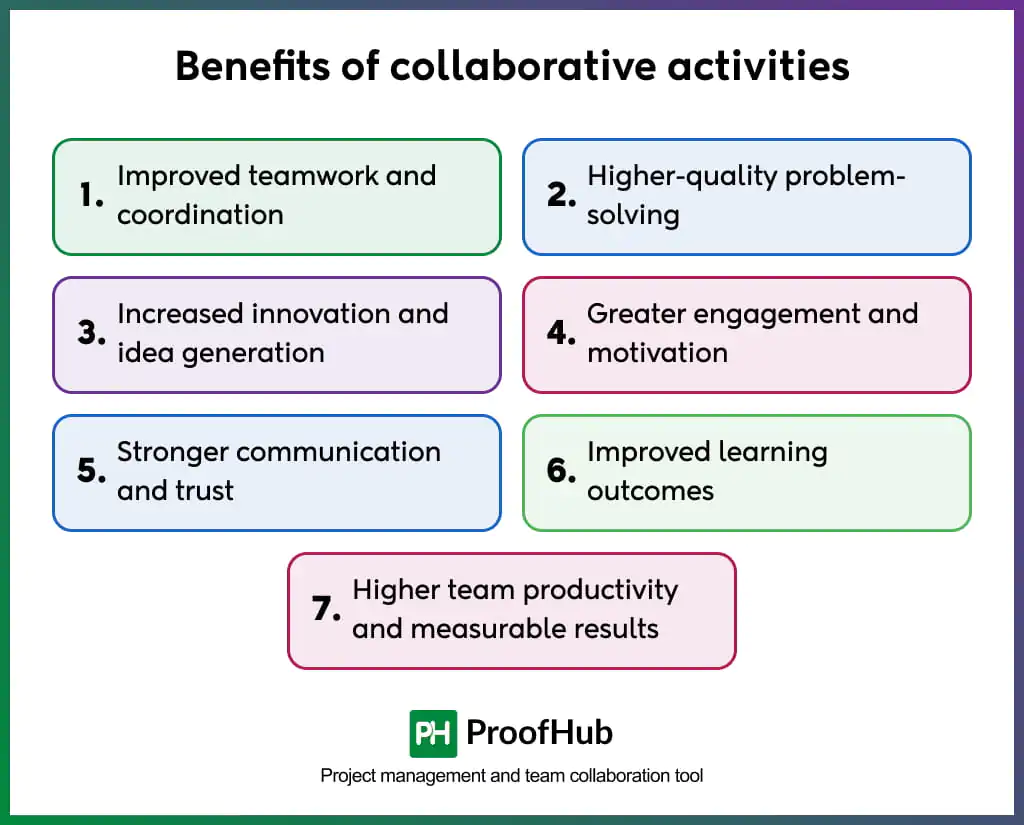
- Improved teamwork and coordination: Working together on shared tasks clarifies roles, responsibilities, and expectations. Participants understand interdependencies and coordinate efforts more effectively. Clear alignment reduces friction and improves execution speed.
- Higher-quality problem-solving: Group-based problem-solving combines multiple viewpoints, knowledge areas, and analytical approaches. This diversity reduces decision bias and strengthens analytical depth. Solutions become more accurate, practical, and sustainable.
- Increased innovation and idea generation: Idea exchange during discussions, brainstorming sessions, and workshops expands creative thinking. Exposure to different viewpoints stimulates new approaches and accelerates knowledge creation. Innovation becomes systematic rather than accidental.
- Greater engagement and motivation: Participation in collaborative activities increases involvement and ownership of outcomes. Individuals contribute actively when their input influences results. Higher engagement improves morale and strengthens commitment to completing the project.
- Stronger communication and trust: Frequent interaction fosters transparency, feedback, and open dialogue. Clear communication reduces misunderstandings and strengthens trust between members. Trust supports long-term cooperation and stable group performance.
- Improved learning outcomes: Peer interaction sessions enhance knowledge transfer and practical learning. Participants learn through discussion, observation, feedback, and shared experiences. This strengthens both individual capability and collective competence.
- Higher team productivity and measurable results: Alignment around shared goals and defined deliverables reduces duplication of effort, improves resource use, and accelerates execution. Coordinated execution accelerates project delivery and strengthens overall productivity.
What are the common challenges in organizing collaborative activities?
Common challenges in organizing collaborative activities include unequal participation, resistance or skepticism, poor facilitation, logistical constraints, and cultural differences.
1. Unequal participation: Some participants dominate discussions while others contribute minimally or disengage. Without structured planning, this imbalance reduces idea diversity and weakens collective ownership.
To mitigate this, design structured participation formats, assign roles for contributions, define speaking turns, and establish clear expectations for involvement before the activity begins.
2. Resistance or skepticism: Participants may question the purpose, value, or outcomes of the collaborative activity. Doubt or reluctance reduces engagement and limits meaningful contribution.
To address this, clearly communicate objectives, expected benefits, and intended outcomes in advance. Involve stakeholders early in planning and respond transparently to concerns.
3. Poor facilitation: Lack of guidance during the activity leads to unfocused discussions, time overruns, and unclear outcomes. Weak facilitation reduces productivity and participant engagement.
To handle this, assign a competent facilitator, prepare a clear agenda, define discussion protocols, and actively manage time and participation.
4. Logistical constraints: Scheduling conflicts, limited resources, inadequate tools, or unsuitable venues disrupt planning and execution. Operational inefficiencies reduce participation and effectiveness.
To address this, plan logistics early, confirm availability, allocate resources appropriately, test tools or platforms in advance, and prepare contingency arrangements.
5. Cultural differences: Variations in communication styles, expectations, and decision-making norms create misunderstandings or misalignment among participants from diverse backgrounds.
To mitigate this, establish shared behavioral norms, clarify communication expectations, encourage inclusive dialogue, and promote cultural awareness throughout the planning process.
How to measure the effectiveness of collaborative activities?
Measure effectiveness by evaluating goal achievement, quality of outcomes, participation levels, communication clarity, efficiency, impact on productivity, and learning outcomes.
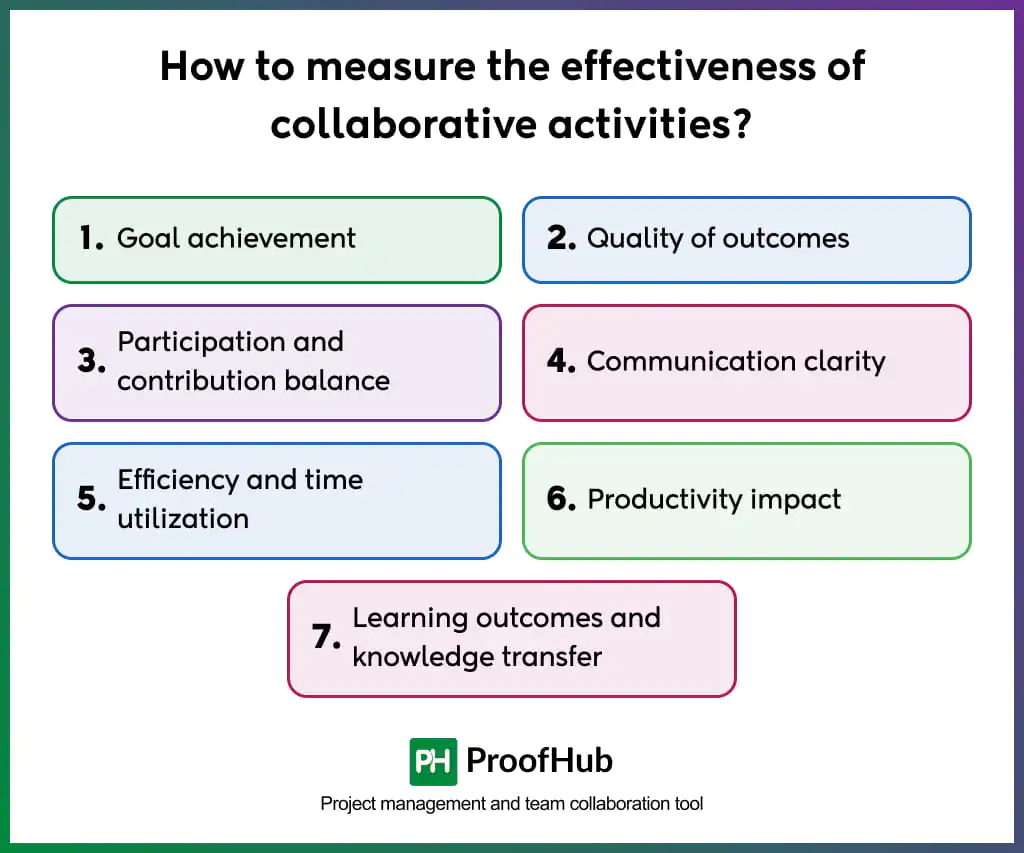
- Goal achievement: Effectiveness is reflected in whether shared goals and defined deliverables are completed on time and within scope. Compare planned outcomes with actual results to assess alignment and execution quality.
- Quality of outcomes: Evaluate the accuracy, practicality, and sustainability of produced solutions or completed projects. High-quality outputs indicate strong coordination and collective problem-solving.
- Participation and contribution balance: Measure the distribution of contributions across participants. Balanced engagement reflects shared ownership and effective interaction. Low participation concentration signals structural imbalance.
- Communication clarity: Assess frequency of misunderstandings, rework, or repeated clarifications. Reduced communication friction indicates effective information flow and shared understanding.
- Efficiency and time utilization: Compare the time invested with the results achieved. Efficient collaboration reduces duplication of effort and accelerates project completion.
- Productivity impact: Analyze performance indicators, such as project delivery rate, solution implementation speed, and output consistency, before and after implementing collaboration practices.
- Learning outcomes and knowledge transfer: Evaluate improvement in skills, shared knowledge, and cross-functional understanding. Strong knowledge exchange reflects long-term effectiveness beyond immediate deliverables.
Can collaborative activities work in remote teams?
Yes, collaborative activities can work effectively in remote teams when supported by processes, clear communication, and the right digital tools.
Group discussions, problem-solving exercises, workshops, and interactive games are productive for remote teams when agendas, roles, and expected outcomes are defined in advance. In virtual environments, structure replaces physical presence and ensures alignment.
When collaborative activities are carefully designed for virtual teams, remote teams achieve shared goals, complete projects, and sustain strong team-building outcomes.
How often should teams conduct collaborative activities?
Teams can conduct collaborative activities one to two times per quarter, supported by weekly alignment and monthly engagement sessions.
Frequency aligns with purpose. Operational coordination requires short, recurring interactions. Team building and strategic problem solving require longer, scheduled sessions.
- Weekly or daily: Short check-ins and focused discussions align immediate tasks, clarify priorities, and resolve bottlenecks.
- Monthly: Informal group interactions such as virtual trivia, social hours, or light collaborative exercises maintain morale and strengthen working relationships.
- Quarterly: Workshops, problem-solving sessions, and cross-functional planning meetings strengthen alignment, innovation, and shared accountability.
- Annually or biannually: Extended strategy sessions or off-site meetings focus on long-term planning, performance review, and cultural cohesion.