

A design review process is a systematic assessment of design work against defined requirements before it moves ahead for publishing or final relase. It helps teams identify gaps early, improve collaboration across stakeholders, and keep designs in accordance with the quality expectations.
The three types of design review process includes – peer, stakeholder, and customer reviews. Each review type has a distinct purpose and is conducted at different stages to ensure well-rounded validation and confirm final acceptance.
A design review process is created by defining the review scope and objectives, assigning the right reviewers, establishing evaluation criteria, conducting structured review sessions, documenting feedback and decisions, prioritizing changes, validating revisions, and obtaining sign-off.
An effective design review process is strengthened by centralizing feedback, conducting time-boxed sessions, assigning an objective facilitator, involving limited but relevant participants, and documenting clear next steps to ensure seamless execution.
What is a design review process?
A design review process is a structured evaluation of designs to achieve a specific standard of quality. It ensures the design aligns with your marketing strategy, brand identity, and user needs.
It helps identify potential issues, detect errors, and ensure that the quality checks are met.
In this process, stakeholders review the design, provide actionable feedback, and creators use that feedback to improve the final design.
What are the different types of design reviews?
Design reviews are classified into three types based on who reviews and when during the design lifecycle – peer, stakeholder, and customer reviews. Each review plays a primary role at a specific stage.
| Stage | Type | Focus |
| Early | Peer Design Review | Designers and writers evaluate direction, quality, and system alignment |
| Mid | Stakeholder Design Review | Product owners, managers, and business leads evaluate against requirements and goals |
| Final | Customer Design Review | End users or clients evaluate the design against real needs |
1. Peer review
Evaluates early-stage concepts and direction. It ensures the design approach aligns with the defined requirements.
Teams conduct a self-review to identify gaps, inconsistencies, and usability issues before sending it to stakeholders for review.
Peers with design domain knowledge evaluate the work, such as
- Fellow UI/UX designers
- Senior or lead designers
- Design system owners
- UX researchers
- Content designers / UX writers
2. Stakeholder review
Design is reviewed by internal stakeholders mid-stage, comparing with business goals and requirements. It ensures major deviations are identified and corrected early, before they become costly to fix.
Stakeholders with decision-making authority or business accountability participate, such as
- Product managers/product owners
- Engineering leads/tech leads
- Marketing and brand teams
- Legal and compliance teams
- C-suite or department heads (for high-stakes projects)
- Project managers
3. Customer review
Design is evaluated by the end user or client at the near-final or completion stage.
At the near-final stage, the goal is to ensure all specifications, components, and interactions are complete.
At the final stage, the goal is to ensure that prior feedback has been addressed and the design meets acceptance criteria.
Individuals who use or commission the design evaluate it against real needs.
- End users (via usability testing or beta access)
- Clients (in agency contexts, the paying party)
- Customer success representatives (proxy for end users in B2B)
- Beta testers/pilot group participants
Note: The table above reflects the primary ownership at each stage, not exclusive participation. In practice, the participation at different stages overlaps, with different groups contributing across multiple stages depending on team structure and project complexity.
What are the steps to create a design review process?
The design review process is broadly divided into two stages – preparation before the review and execution and final sign during and after review.
The first stage includes: defining design scope and objectives, identifying relevant stakeholders, and defining the review criteria for evaluation.
The second stage involves conducting the review session, recording feedback and decisions, prioritizing and implementing changes, validating revisions, and documenting approval and formal sign-off.
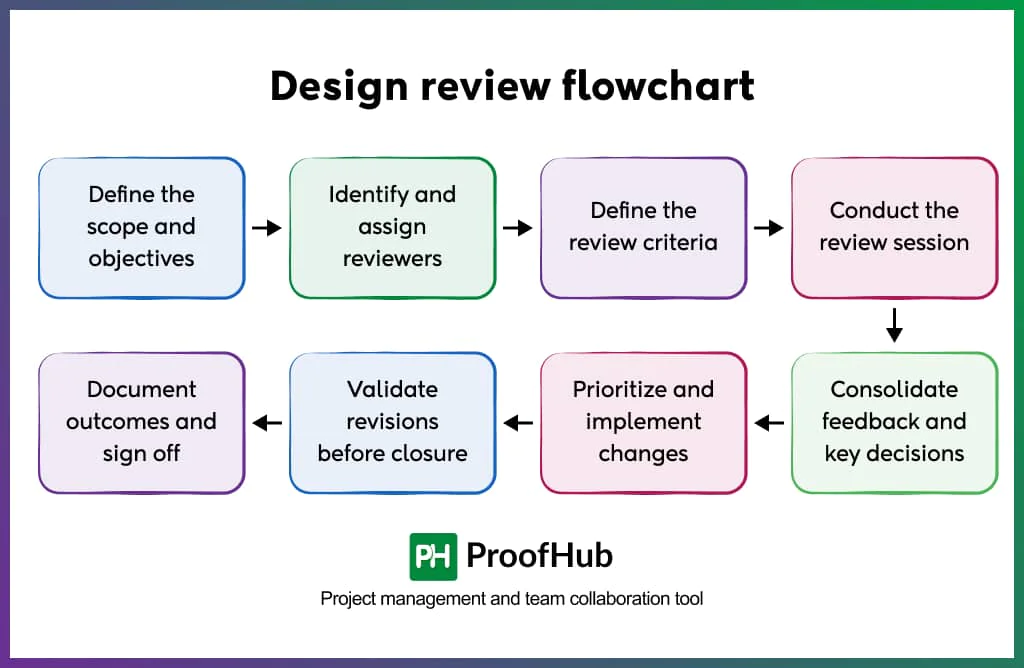
1. Define the scope and objectives
Outline clear design objectives and scope before the execution begins. Establishing guidelines around design quality, usability, consistency, and success criteria gives reviewers a clear framework to evaluate the work against.
Defined scope keeps feedback controlled and focused, helping reviewers make consistent and objective decisions within the boundaries of the project, avoiding unnecessary or out-of-scope feedback.
2. Identify and assign reviewers
Based on the review type, identify reviewers by expertise and project stake, and assign their roles before the session begins. Match reviewers to the stage they are best positioned to evaluate.
For example:
- Peer review requires design domain knowledge
- Stakeholder review requires business accountability
- Customer reviews require actual product users
When the right reviewers evaluate and validate the design at the right stages, the output is much more likely to be well-rounded and aligned with both user and business needs.
3. Define the review criteria
Create a checklist that defines the exact standards the design is evaluated against – quality benchmarks, project timelines, milestones, acceptance criteria, user flows, and responsive behavior.
Share it with reviewers before the session so they ensure their judgment is based on project requirements, not influenced by subjective opinions or personal preference.
Common criteria include:
- Usability and accessibility compliance
- Technical feasibility and scalability
- Consistency with design systems
- Alignment with business objectives
- Performance and edge-case handling
4. Conduct the review session
Evaluate the design thoroughly against established objectives and design criteria to identify gaps, risks, and areas of improvement. This ensures the final judgment remains aligned and objective.
Encourage open and constructive dialogue among participants (if more than one), so feedback is collaborative and consensus-driven, not fragmented or conflicting.
This is especially critical in stakeholder and customer reviews, where multiple perspectives are involved and alignment is crucial to avoid rework and conflicting directions later.
To maintain clarity, categorize feedback into:
- Blockers (must be resolved before moving forward)
- Major issues (impact usability, functionality, or goals)
- Minor issues (Nn-critical improvements)
Note: A strict time limit should be imposed on the session to keep the review focused and prevent it from stretching into unproductive debates.
5. Consolidate feedback and key decisions
Create a centralized, structured record of all feedback and decisions to minimize ambiguity about what was requested, what changes are required, and what has been approved or declined.
Record all feedback directly on the design and in one place to keep it clear, contextual, and easy to act on, while maintaining a single source of truth for the team to refer to during implementation.
Documentation includes:
- Categorized feedback (usability, technical, business)
- Approved elements and rejected components
- Open questions and dependencies
6. Prioritize and implement changes
Based on the severity and urgency of the feedback, immediately act on the critical issues that require immediate attention. Prioritize the remaining inputs so every raised issue is addressed systematically and with appropriate importance.
Prioritization factors:
- User impact
- Implementation complexity
- Business priority
7. Validate revisions before closure
Review the updated work to confirm the revisions fully address the feedback, resolve previously identified issues, and align with the defined criteria.
This step is critical to ensure there are no unresolved gaps or newly introduced issues, and that the design is ready to proceed for final approval with confidence.
8. Document outcomes and sign off
Record the final review outcomes and formally sign off to officially close the design review process.
This documentation marks the final approval of the design and creates an audit trail for stakeholder alignment, preventing scope creep from re-entering the process at later stages when changes become costly.
Includes:
- Final approved design version
- Summary of key decisions
- Sign-off from responsible stakeholders
What challenges occur in a design review process?
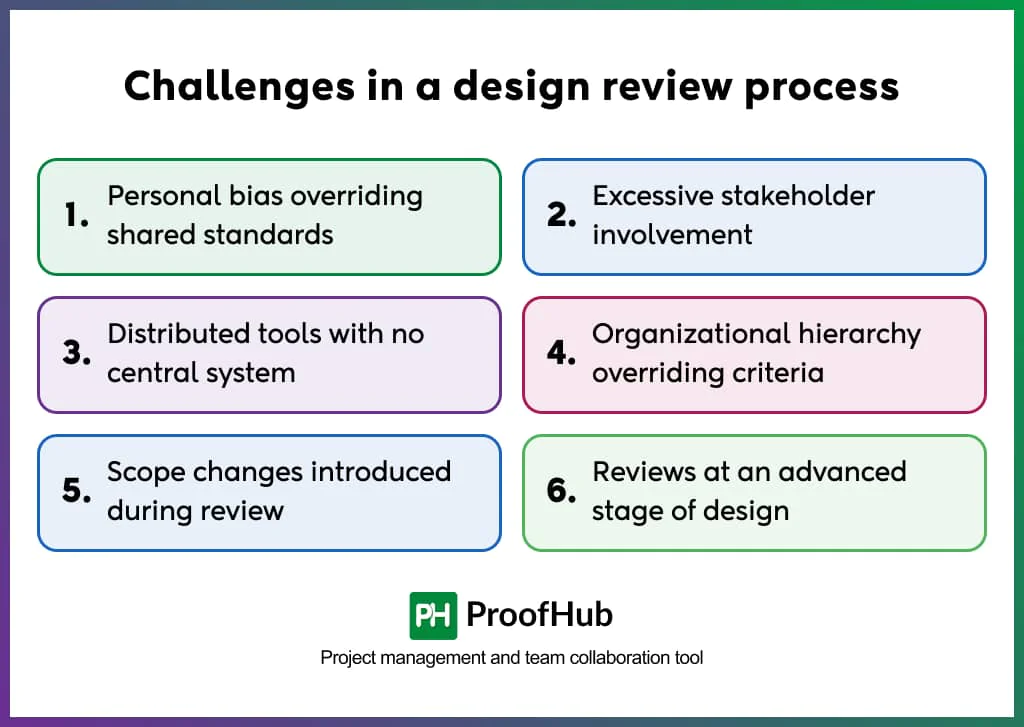
The most common challenges in a design review process include a misaligned evaluation mindset, involvement of too many stakeholders, scattered tool usage, decisions driven by hierarchy, unplanned scope changes, and reviews conducted too late in the process.
- Personal bias overriding shared standards: Despite having well-established criteria for a shared understanding, reviewers often interpret them differently based on their experience, role, and priorities. This introduces subjectivity into the evaluation, regardless of how clearly the standards are defined. Align everyone earlier by walking them through the structured guidelines to ensure they evaluate the design through the same lens.
- Excessive stakeholder involvement: Adding additional stakeholders beyond the essential group not only dilutes accountability but also extends resolution time, making sign-off harder to reach. When a stage genuinely requires collective expertise, ensure an optimal reviewer count (3-5) to avoid conflicting feedback and keep the session focused on achieving the intended outcome.
- Distributed tools with no central system: Feedback submitted across multiple disconnected tools, approvals tracked in spreadsheets, and versions and assets managed in silos create unnecessary confusion and efficiency drain for everyone. Centralize all feedback, versions, and assets in a single system like ProofHub to maintain a clear, contextual, and easily accessible source of truth.
- Organizational hierarchy overriding criteria: When a senior stakeholder or authority figure overrides or bypasses the established review criteria, the entire structure of the process breaks down into opinion-driven decisions instead of objective evaluation. Reinforce criteria as the primary decision framework to evaluate designs.
- Scope changes introduced during review: Introducing unplanned requirements that were not part of the original scope, especially when the design is at the final stage of the evaluation session, extend timelines, and push the design back to earlier stages. Freeze scope before review and route new requests into a separate iteration cycle.
- Reviews at an advanced stage of design: Conducting the first formal preview when the design is near completion leads to significant delays in rework and iteration, which could have been avoided earlier. It also increases the cost of correction and slows down execution. Introduce defined checkpoints across the design lifecycle and ensure structured reviews happen at each stage.
What are the best practices for conducting effective design reviews?
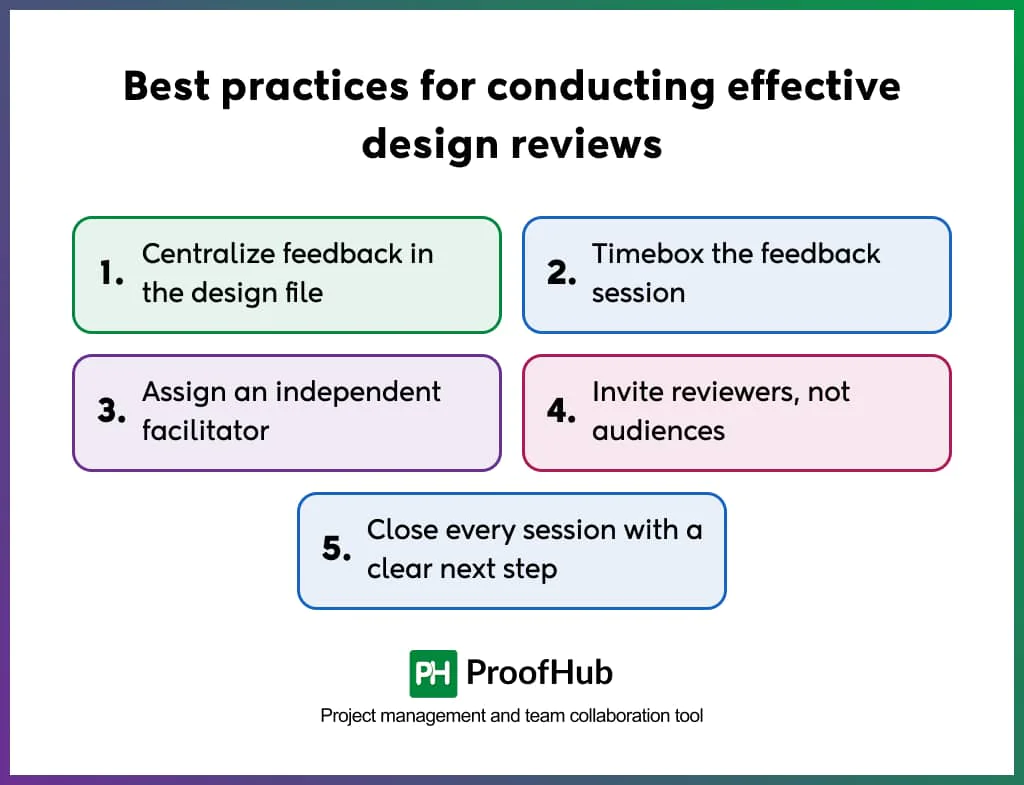
The best practices for conducting effective design reviews include capturing feedback throughout the design, keeping feedback sessions time-bound, using an unbiased lead, avoiding unnecessary attendees, and ensuring every session ends with direction.
- Centralize feedback in the design file: Capture all feedback directly on the design files to keep it contextual and anchored to exactly where changes are required. Use design review tools like ProofHub that offers online proofing feature to provide specific feedback right on the design. When feedback and design stay together, teams don’t waste time searching across tools or clarifying vague comments; instead make revisions quickly and accurately.
- Timebox the feedback session: Set a strict time limit for every review stage to prevent it from turning into an open-ended discussion. A structured agenda ensures all input arrives on time and there is enough time for reviewers to act on changes and implement corrections timely.
- Assign an independent facilitator: Assign an independent facilitator – a lead designer, project manager, or another team member who has no direct ownership of the design. Their role is crucial to ensure the outcome is not defended emotionally or influenced by bias, and that discussions are evaluated objectively.
- Invite reviewers, not audiences: Include only those reviewers who have relevant expertise or decision-making responsibility in the session. Observers who have nothing meaningful to contribute should be kept out to keep discussions focused, efficient, and outcome-driven.
- Close every session with a clear next step: Host a quick 5-minute wrap-up to summarize agreed changes, decisions, and action items. End every review stage with a defined next step, owners, and deadlines to ensure accountability and momentum. This information should be documented and followed through until closure.
How do you measure the effectiveness of a design review process?
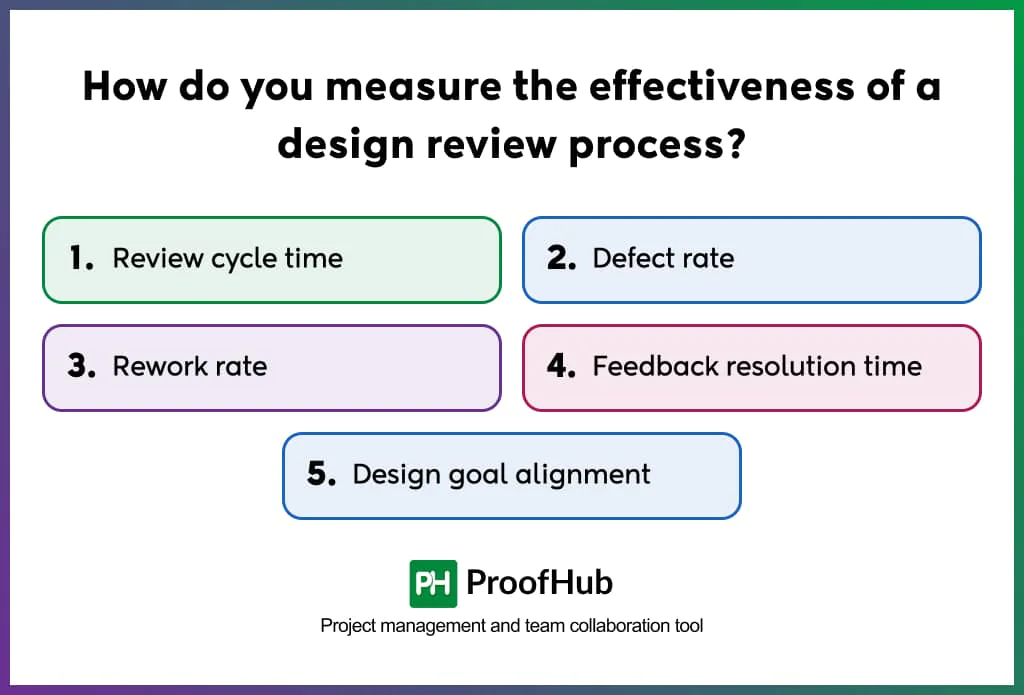
The effectiveness of a design review process is measured using five key metrics: review cycle time, defect rate, rework rate, feedback resolution time, and design goal alignment.
1. Review cycle time: The time between when a design is submitted for review and when it receives final sign-off. Longer cycle time indicates process inefficiencies, such as unclear criteria, unavailable or too many reviewers, or poorly structured sessions. While shorter review cycle times suggest faster decision-making and smoother collaboration, as long as quality is not compromised.
2. Defect rate: The percentage of issues identified during the design review or after it has moved to later stages. A higher defect rate post-review signals gaps in the review process, while a lower rate indicates that design is either error-free or issues are being caught early and effectively.
3. Rework rate: The percentage of design work requiring significant revisions after review. A high rework suggests either that feedback was unclear, incomplete, or surfaced too late, or that the review lacked structured evaluation criteria. Lower rework indicates a more thorough and effective review process and design decisions upfront.
4. Feedback resolution time: The time taken to address documented feedback and get it validated before final sign-off. Faster resolution times reflect that feedback was both clearly communicated and well-prioritized when shared. Delayed resolution times often suggest ambiguity, conflicting inputs, or dependency bottlenecks slowing progress.
5. Design goal alignment: The extent to which the final design aligns with the defined objectives or success criteria. Strong alignment indicates that the review process consistently evaluated the design against intended outcomes, while lower alignment suggests the review focused only on surface-level improvements rather than strategic goals.
What is the difference between a design review and a design critique?
The difference between a design review and a design critique process is in the outcome they achieve.
A design review process evaluates a design against established requirements and objectives to determine whether it is ready to move to the next stage. A design critique, on the other hand, is a collaborative and exploratory process focused on continuously improving a design’s usability, aesthetics, and effectiveness to achieve the best possible version.
| Design Review | Design Critique | |
| Purpose | Ensure design alignment with estalished requirements | Refine and improve design quality |
| Output | Go/no-go decision | Revision suggestions |
| Formality | Structured, documented | Open-ended, conversational |
| Participants | Cross-functional stakeholders | Primarily designers |
| Timing | At defined milestones | Ongoing |
What is the difference between synchronous and asynchronous design review?
The difference between synchronous and asynchronous design reviews lies in when and how feedback is delivered. Synchronous design reviews happen in real time, while asynchronous reviews allow reviewers to review and share feedback at their own schedule and availability.
Synchronous design reviews work best for teams that want quick resolution and alignment to make faster, well-informed decisions. These are typically used for complex, high-stakes projects where the stakes are high and immediate discussion or consensus is required to resolve blockers, trade-offs, or reach critical decisions.
Asynchronous design reviews are preferred by teams that value flexibility and thoughtful input across time zones or schedules. These are often suited for low to medium-stakes projects that don’t require immediate discussion or real-time alignment. This approach is commonly used during the early stages of a project, where feedback can be gathered gradually without impacting the timeline.
Can AI tools help in streamlining the design review process?
Yes, AI tools can streamline the design review process by automating consistency checks, summarizing feedback, and version comparison. But human judgment is always required to ensure intent and strategic quality of the process.