
The creative review process is a structured approach where stakeholders evaluate, refine, and approve creative assets to ensure quality and alignment with defined objectives.
A structured creative review process streamlines how work progresses from the first draft to final delivery. It ensures the relevant stakeholders participate at the right stage, feedback arrives on time, and no new changes are introduced after the final stage. This structure reduces unnecessary revision rounds and keeps execution predictable.
Building a streamlined creative process is a systematic approach to eliminating inefficiencies. By defining a creative brief, mapping review stages, assigning reviewers and decision-makers, consolidating feedback, and enforcing a final approver gate, it eliminates the gaps that cause unnecessary revision rounds and delays in the progress.
Best practices such as maintaining version control, evaluating complete assets, separating subjective and objective feedback, and locking scope after approval further strengthen the process by keeping it controlled and consistent.
What is the creative review process?
The creative review process is a structured workflow in which designated stakeholders assess, analyze, and approve creative assets (designs, copy, and videos) for quality and alignment before publication or delivery.
The review process follows a sequential order with defined stages and feedback loops.
It starts with a creative brief. Creators produce the asset and submit the first draft for review.
Reviewers evaluate it against the defined brief, document interpretations, provide positive and critical feedback, and record decisions, sometimes along with recommendations.
Based on the initial feedback and decisions, creators make revisions and send the draft for final approval, where it may or may not fully align with the defined requirements. The process either concludes with approved outcomes or extends for further iterations and refinement.
Why is a streamlined creative review process important?
- A streamlined creative review process reduces revision rounds, improves collaboration, ensures stakeholder alignment, increases productivity, and speeds up approvals.
- Revision rounds decrease through clear, aligned, and version-controlled feedback. Teams eliminate conflicting comments and reduce rework.
- Collaboration improves with defined roles and structured input stages, where each stakeholder contributes at the correct point.
- Stakeholder alignment strengthens through early decision ownership and consolidated feedback. Teams maintain a single direction across all revisions.
- Productivity increases as teams execute against clear objectives and timelines, which reduces time spent on clarification and rework.
- Approvals accelerate as teams reach accurate revisions faster, often within fewer iterations. Reviewers evaluate refined versions instead of repeated drafts.
- Defined stages, clear ownership, and designated decision-makers create controlled and predictable execution. Without structure, feedback loses context, revisions occur on incorrect or duplicate versions, and decisions remain unclear, which delays delivery and reduces output quality.
Steps to build a streamlined creative review process
Building a streamlined creative review process involves defining the creative brief, mapping review stages, assigning decision-makers at each stage, setting deadlines for each round, consolidating feedback, and establishing a final approval gate.
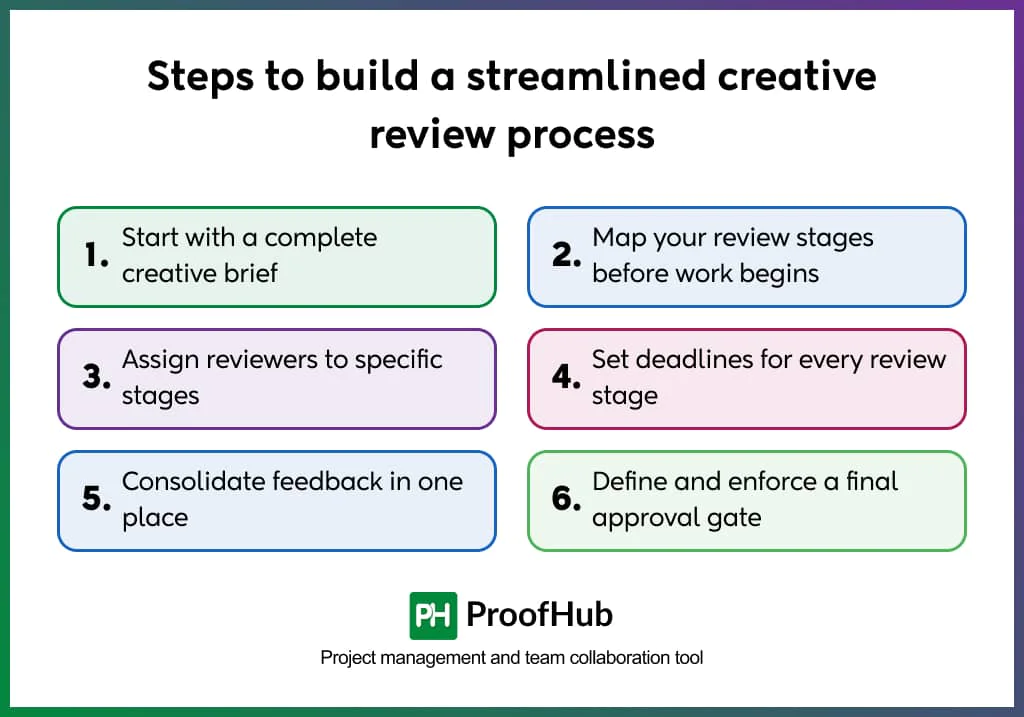
1. Start with a complete creative brief
Define the objectives, audience, format, quality standards, and deliverables. It serves as an objective reference point for aligning both creators and relevant stakeholders before the execution begins.
When the brief is clear and finalized at the input stage, everyone operates with a shared understanding of the established standards. Creators take into account the defined objectives, audience, and messaging constraints when developing assets, while reviewers ensure they evaluate work against the same criteria instead of personal preferences.
This clarity in direction eliminates the ambiguity caused by unstructured or undefined expectations. It ensures the entire review cycle is focused and consistent and does not shift direction mid-process.
Example: A structured creative brief includes:
- Objective: Increase app downloads by 20% through social ads
- Audience: First-time buyers aged 25–35
- Message: Highlight ease of use and quick onboarding
- Tone: Conversational and benefit-driven
- CTA: Drive app installs
- Design constraints: Use only primary brand colors
2. Map your review stages before work begins
Define the number of review stages and what each stage evaluates based on the asset complexity, and not the reviewer count.
Defining review stages in the beginning defines how work moves from concept to final approval. It establishes an entry-exit criterion for each stage, ensuring the work progresses to the next stage only when it meets the required standards.
It allows creators to structure their efforts to prepare output that aligns with stage-specific expectations instead of overbuilding or underdelivering. Reviewers follow the defined sequence, preventing premature or irrelevant feedback at incorrect stages.
A simple stage map looks like this:
- Stage 1: Internal creative review (creative lead and project manager only)
- Stage 2: Brand review (brand manager)
- Stage 3: Legal review (legal and compliance team)
- Stage 4: Stakeholder review (marketing director and account lead)
- Stage 5: Final approval (creative director or CMO)
3. Assign reviewers to specific stages
Assign a specific reviewer (or a small, role-based group when required) and outline their responsibilities at each stage to keep feedback precise and relevant.
Map reviewers to the stage where their expertise and decision authority are required. When all reviewers participate only at their designated stage, feedback aligns with stage objectives and lands at the right time.
Keep reviewers out of stages where their input is not required to maintain focus and prevent conflicting or premature feedback. This ensures each stage evaluates the creative asset against the right criteria, in the right context.
Unstructured process = Parallel, conflicting feedback
Structured process = sequential, stage-specific feedback
4. Set deadlines for every review stage
Create a fixed feedback window for each review stage, eliminating the rework creators have to do because of new inputs mid-work.
A defined feedback window formalizes the review cycle. It forces reviewers to provide focused, complete input within constraints, so creators can act quickly and move the work forward for timely completion.
When the window for a particular stage closes, the stage does not reopen, maintaining process discipline and forward momentum. If work moves back to a previous stage, the entire process resets for that stage.
Unstructured (what goes wrong):
- No fixed deadline for brand review
- Feedback comes in over multiple days
- Work gets paused, reworked, and delayed
Structured (what works):
- Stage: Brand review
- Deadline: 48-hour fixed window
- No new feedback accepted post-deadline
5. Consolidate feedback in one place
Create a single source of truth for everyone to review, align, and act on.
When all feedback is centralized, locating duplicate and contradictory input for removing subjective preferences becomes easy.
Reviewers align their inputs to reach consensus, so creators receive clear, actionable direction to work in.
- Use tools like ProofHub to streamline the creative review process by:
- Keeping feedback contextual on the asset
- Centralizing all comments and discussions
- Maintaining version control
- Holding stakeholders accountable with timelines
- Tracking approvals and decision history
When feedback lives directly on the asset, the creative review process becomes precise and traceable.
6. Define and enforce a final approval gate
Establish a final approver gate to limit review sessions and ensure an outcome-driven approach.
The final approval gate is a formal sign-off by the designated decision-maker based on predefined standards and success criteria. After this stage, no new requests or changes are introduced or accepted.
This gate is necessary to lock the scope and ensure closure. It confirms that the final output aligns with the agreed-upon brief and is ready for release.
Approvals with enforced finality look like:
Stage: Final approval
Approver: Creative director
All stage criteria are met
Post-approval → no changes allowed
Best practices for managing creative review cycles
Best practices for managing creative review cycles include finalizing the reviewer list, maintaining version control, evaluating complete assets, separating subjective and objective feedback, limiting revision rounds, and locking scope after approval.
- Close the reviewer list before work begins: Finalizing the stakeholders list early in the process ensures only relevant stakeholders participate in the feedback process.
Identifying stakeholders, their roles, and the stage where their expertise matters streamlines the review system and keeps work progressing.
Add new stakeholders later in the revision cycle only when escalated through the formal approval path.
- Version control every asset iteration: A structured version history maintains a clear record of the evolution of the creative asset.
It helps stakeholders compare two versions, track changes against your feedback, and ensure accountability for suggestions, revisions, and approvals.
It keeps the review cycles efficient by eliminating confusion about the latest version and preventing feedback on outdated or incorrect files.
- Evaluate the complete creative asset: Prioritizing full evaluations over fragmented comments prevents misaligned and impulsive inputs.
Unlike partial evaluation, which often lacks full context and creates contradictions even within a single person’s review, complete evaluation takes full context into account.
This approach is more consistent and reduces unnecessary revisions.
- Separate subjective from objective feedback: Objective feedback aligns with the brief and defined goals, while subjective feedback comes from personal expertise, preferences, or opinion.
Objective feedback overvalues subjective criteria, but can add value when supported by strategic reasoning or domain expertise.
While consolidating feedback, separating the two ensures creative teams prioritize what is essential and escalate what is optional.
- Set a maximum revision round limit: A redefined cap on revision rounds prevents the approval process from turning into endless rounds of revisions.
Based on the project complexity and agreed quality standards, defining the maximum number of rounds at the brief stage keeps the process meaningful and time-bound.
Defining the limit upfront encourages stakeholders to provide meaningful, consolidated feedback early, ensuring closure within the expected timeline.
- Lock scope after approval stages: A formal sign-off marks the completion of the creative review workflow and prevents further changes.
Scope locking enforces discipline and ensures previously approved elements are not revisited, maintaining progress and protecting timelines.
Without scope locking, reviewers continue to suggest changes, and the asset remains open to revisions indefinitely. The process never reaches closure, and creators remain stuck in a continuous iteration cycle.
What are the key roles and stakeholders involved in the creative review process?
Key roles in the creative review process include creators, reviewers from core departments, specialists, and final decision-makers.
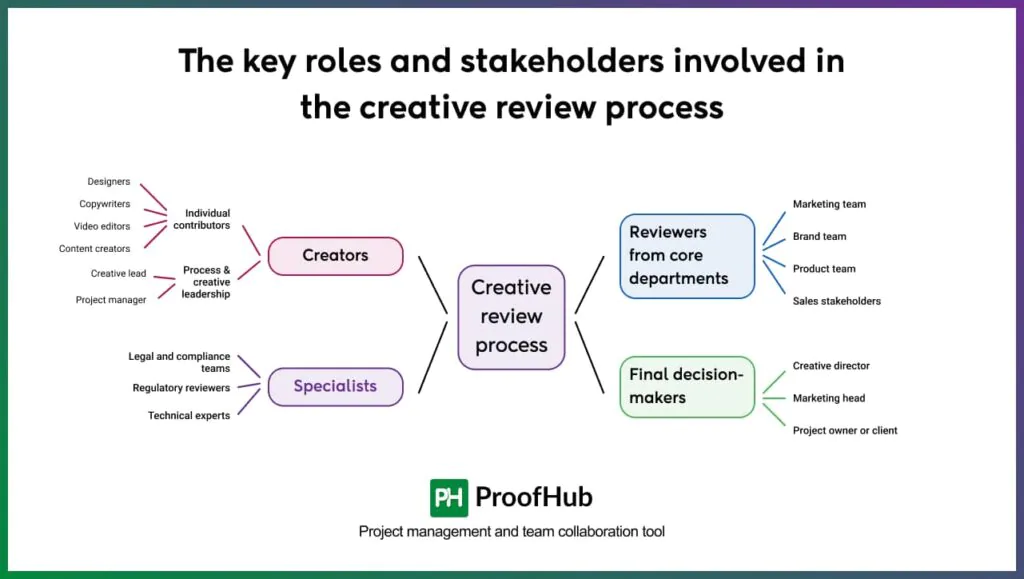
Creators (Execution ownership)
Creators produce creative assets based on defined objectives and requirements, and implement revisions across review cycles according to structured feedback.
Individual contributors
- Designers
- Copywriters
- Video editors
- Content creators
Process & creative leadership
- Creative lead
- Project manager
Reviewers from core departments (Alignment ownership)
Reviewers ensure the creative aligns with defined guidelines, campaign objectives, and client requirements.
- Marketing team
- Brand team
- Product team
- Sales stakeholders
Specialists (Compliance and accuracy ownership)
Specialists ensure adherence to technical, legal, or domain-specific standards before final approval.
- Legal and compliance teams
- Regulatory reviewers
- Technical experts
Final decision-makers (Approval ownership)
Decision-makers provide final approval and confirm if the asset is ready to be released or not.
- Creative director
- Marketing head
- Project owner or client
How does the creative review process improve creative quality?
A structured creative review process ensures feedback remains aligned with the defined creative brief and applied at the right stage.
Sequential, stage-appropriate review ensures quality checks happen progressively, with relevant reviewers providing precise and actionable feedback that directly improves the asset.
A consistent review process and centralized feedback enable creators to prioritize meaningful changes, execute with clarity, and remove ambiguity caused by scattered or conflicting inputs.
Can fixing the creative review process reduce the number of revision rounds?
Yes, fixing the creative review process reduces the number of revision rounds. It eliminates conflicting feedback, consolidating input, and structuring how and when feedback is applied.
When feedback aligns with the creative brief and is provided within the defined review stages and timelines, each revision moves the creative closer to the final output. Enforcing a final approval gate and limiting review cycles ensures only necessary changes are implemented, preventing endless iterations and revisions that keep progress inconsistent and delayed.